BM631 Research Methods: Age Discrimination in UK Retail Impact
VerifiedAdded on 2023/06/10
|9
|2569
|102
Report
AI Summary
This research proposal delves into the impact of age discrimination on business performance and market image within the UK retail industry, with a specific focus on ASDA. The proposal outlines the management problem, research aims, objectives, and questions, as well as the purpose and background of the research. It explores different types of discrimination and their impact on business performance and market image, and proposes strategies for overcoming age discrimination in the workplace. The proposal details the research methods, including the research philosophy, approach, strategy, choice, data collection methods, sampling, time horizon, and research instruments. It also provides an alternative plan B for the research, including references to relevant books and journals.
Research Methods

Paraphrase This Document
Need a fresh take? Get an instant paraphrase of this document with our AI Paraphraser
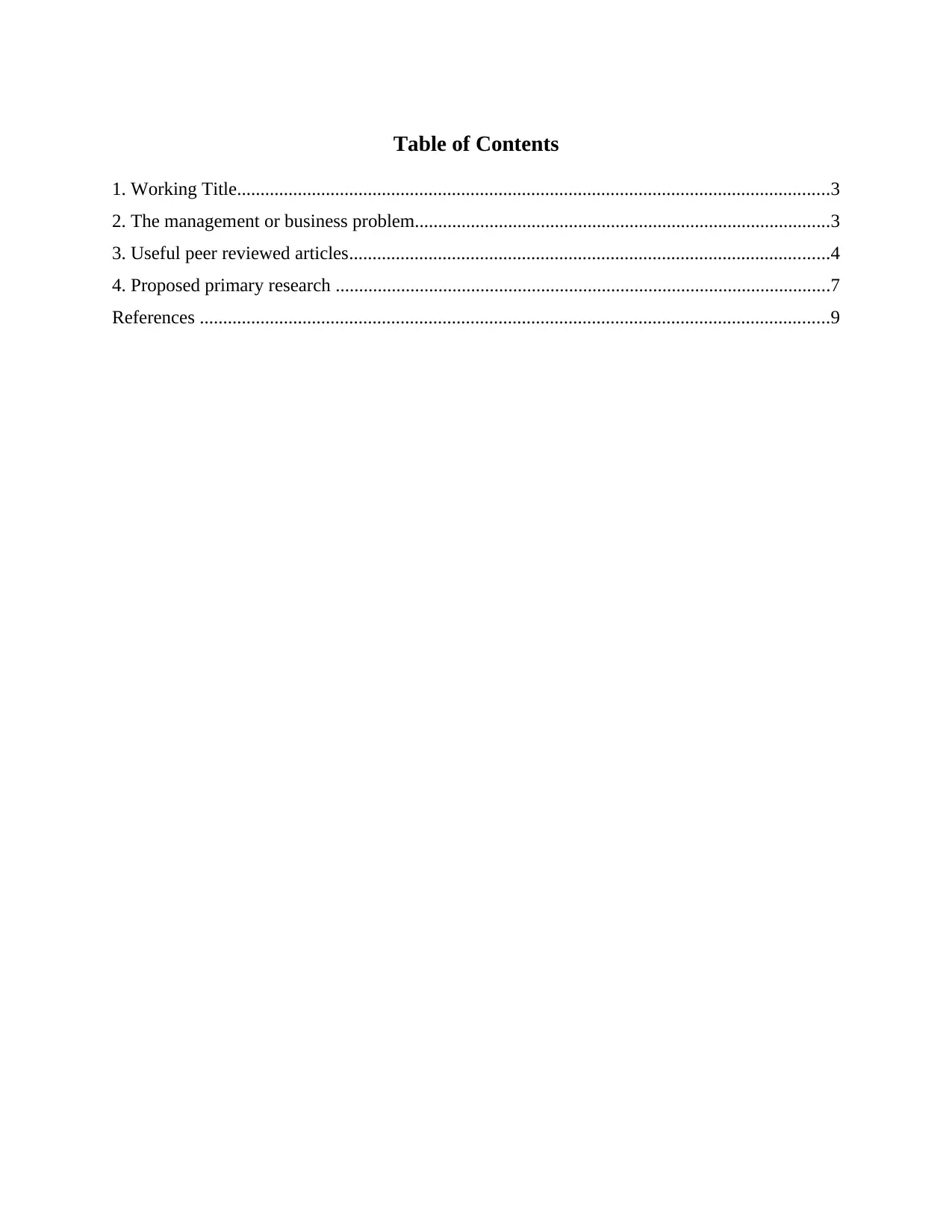
Table of Contents
1. Working Title...............................................................................................................................3
2. The management or business problem.........................................................................................3
3. Useful peer reviewed articles.......................................................................................................4
4. Proposed primary research ..........................................................................................................7
References .......................................................................................................................................9
1. Working Title...............................................................................................................................3
2. The management or business problem.........................................................................................3
3. Useful peer reviewed articles.......................................................................................................4
4. Proposed primary research ..........................................................................................................7
References .......................................................................................................................................9
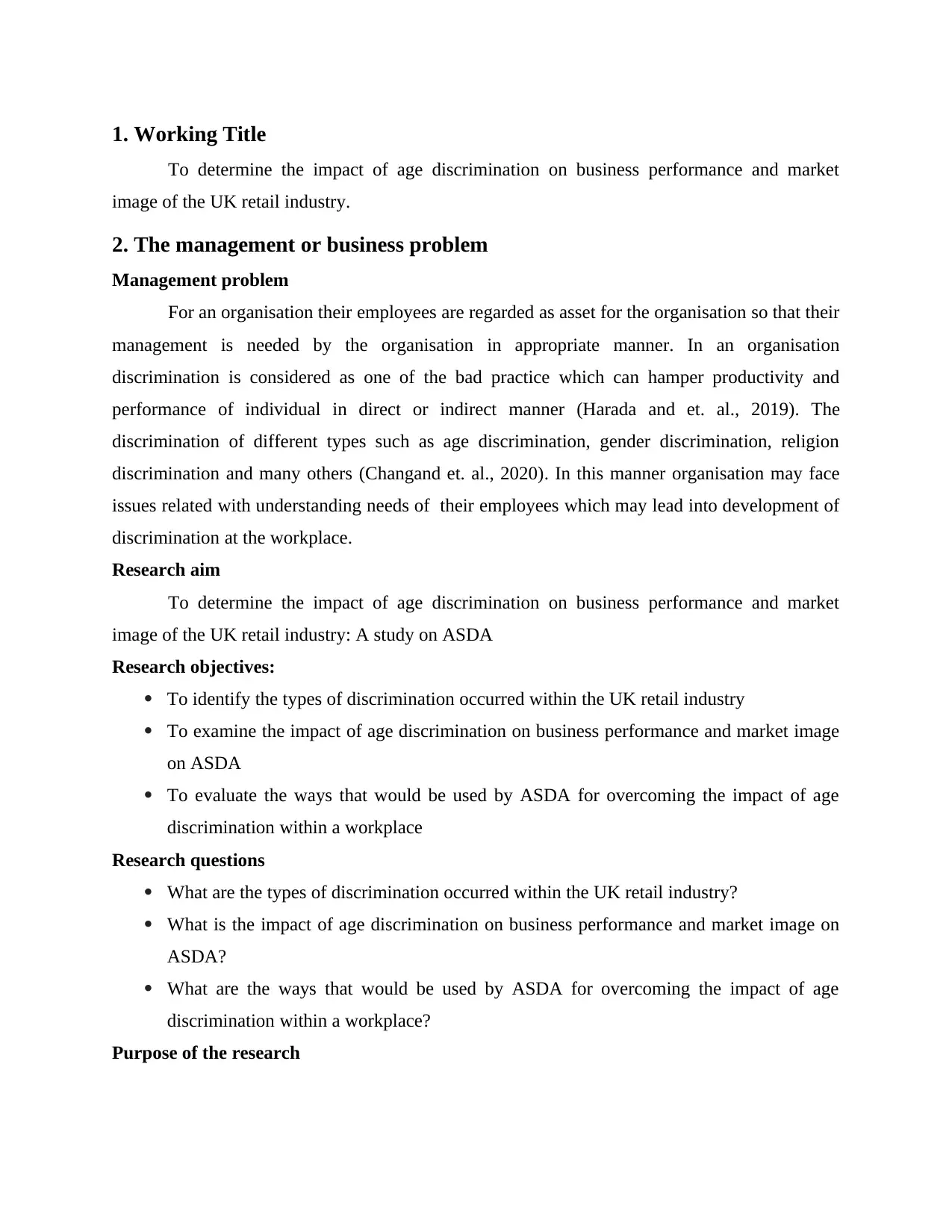
1. Working Title
To determine the impact of age discrimination on business performance and market
image of the UK retail industry.
2. The management or business problem
Management problem
For an organisation their employees are regarded as asset for the organisation so that their
management is needed by the organisation in appropriate manner. In an organisation
discrimination is considered as one of the bad practice which can hamper productivity and
performance of individual in direct or indirect manner (Harada and et. al., 2019). The
discrimination of different types such as age discrimination, gender discrimination, religion
discrimination and many others (Changand et. al., 2020). In this manner organisation may face
issues related with understanding needs of their employees which may lead into development of
discrimination at the workplace.
Research aim
To determine the impact of age discrimination on business performance and market
image of the UK retail industry: A study on ASDA
Research objectives:
To identify the types of discrimination occurred within the UK retail industry
To examine the impact of age discrimination on business performance and market image
on ASDA
To evaluate the ways that would be used by ASDA for overcoming the impact of age
discrimination within a workplace
Research questions
What are the types of discrimination occurred within the UK retail industry?
What is the impact of age discrimination on business performance and market image on
ASDA?
What are the ways that would be used by ASDA for overcoming the impact of age
discrimination within a workplace?
Purpose of the research
To determine the impact of age discrimination on business performance and market
image of the UK retail industry.
2. The management or business problem
Management problem
For an organisation their employees are regarded as asset for the organisation so that their
management is needed by the organisation in appropriate manner. In an organisation
discrimination is considered as one of the bad practice which can hamper productivity and
performance of individual in direct or indirect manner (Harada and et. al., 2019). The
discrimination of different types such as age discrimination, gender discrimination, religion
discrimination and many others (Changand et. al., 2020). In this manner organisation may face
issues related with understanding needs of their employees which may lead into development of
discrimination at the workplace.
Research aim
To determine the impact of age discrimination on business performance and market
image of the UK retail industry: A study on ASDA
Research objectives:
To identify the types of discrimination occurred within the UK retail industry
To examine the impact of age discrimination on business performance and market image
on ASDA
To evaluate the ways that would be used by ASDA for overcoming the impact of age
discrimination within a workplace
Research questions
What are the types of discrimination occurred within the UK retail industry?
What is the impact of age discrimination on business performance and market image on
ASDA?
What are the ways that would be used by ASDA for overcoming the impact of age
discrimination within a workplace?
Purpose of the research
⊘ This is a preview!⊘
Do you want full access?
Subscribe today to unlock all pages.

Trusted by 1+ million students worldwide
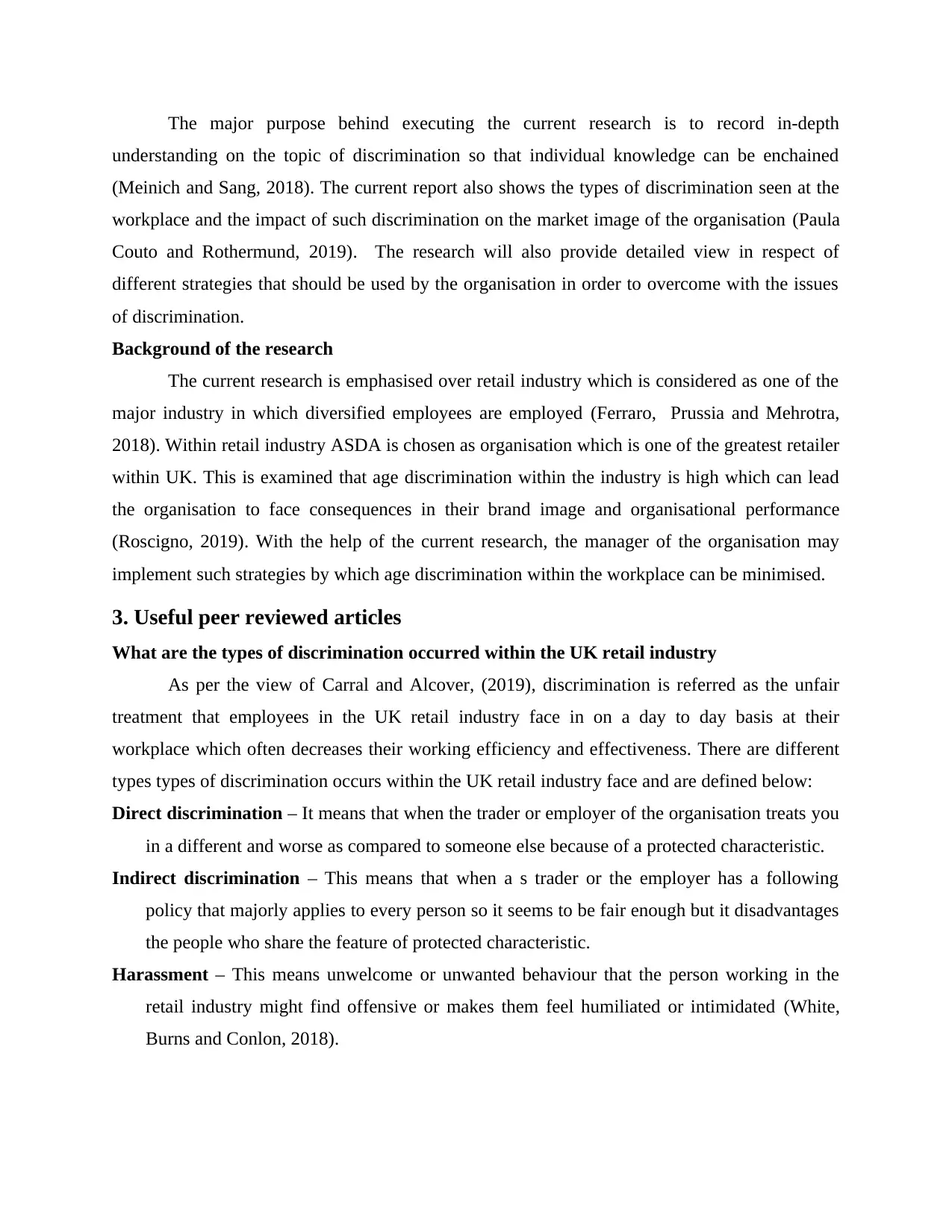
The major purpose behind executing the current research is to record in-depth
understanding on the topic of discrimination so that individual knowledge can be enchained
(Meinich and Sang, 2018). The current report also shows the types of discrimination seen at the
workplace and the impact of such discrimination on the market image of the organisation (Paula
Couto and Rothermund, 2019). The research will also provide detailed view in respect of
different strategies that should be used by the organisation in order to overcome with the issues
of discrimination.
Background of the research
The current research is emphasised over retail industry which is considered as one of the
major industry in which diversified employees are employed (Ferraro, Prussia and Mehrotra,
2018). Within retail industry ASDA is chosen as organisation which is one of the greatest retailer
within UK. This is examined that age discrimination within the industry is high which can lead
the organisation to face consequences in their brand image and organisational performance
(Roscigno, 2019). With the help of the current research, the manager of the organisation may
implement such strategies by which age discrimination within the workplace can be minimised.
3. Useful peer reviewed articles
What are the types of discrimination occurred within the UK retail industry
As per the view of Carral and Alcover, (2019), discrimination is referred as the unfair
treatment that employees in the UK retail industry face in on a day to day basis at their
workplace which often decreases their working efficiency and effectiveness. There are different
types types of discrimination occurs within the UK retail industry face and are defined below:
Direct discrimination – It means that when the trader or employer of the organisation treats you
in a different and worse as compared to someone else because of a protected characteristic.
Indirect discrimination – This means that when a s trader or the employer has a following
policy that majorly applies to every person so it seems to be fair enough but it disadvantages
the people who share the feature of protected characteristic.
Harassment – This means unwelcome or unwanted behaviour that the person working in the
retail industry might find offensive or makes them feel humiliated or intimidated (White,
Burns and Conlon, 2018).
understanding on the topic of discrimination so that individual knowledge can be enchained
(Meinich and Sang, 2018). The current report also shows the types of discrimination seen at the
workplace and the impact of such discrimination on the market image of the organisation (Paula
Couto and Rothermund, 2019). The research will also provide detailed view in respect of
different strategies that should be used by the organisation in order to overcome with the issues
of discrimination.
Background of the research
The current research is emphasised over retail industry which is considered as one of the
major industry in which diversified employees are employed (Ferraro, Prussia and Mehrotra,
2018). Within retail industry ASDA is chosen as organisation which is one of the greatest retailer
within UK. This is examined that age discrimination within the industry is high which can lead
the organisation to face consequences in their brand image and organisational performance
(Roscigno, 2019). With the help of the current research, the manager of the organisation may
implement such strategies by which age discrimination within the workplace can be minimised.
3. Useful peer reviewed articles
What are the types of discrimination occurred within the UK retail industry
As per the view of Carral and Alcover, (2019), discrimination is referred as the unfair
treatment that employees in the UK retail industry face in on a day to day basis at their
workplace which often decreases their working efficiency and effectiveness. There are different
types types of discrimination occurs within the UK retail industry face and are defined below:
Direct discrimination – It means that when the trader or employer of the organisation treats you
in a different and worse as compared to someone else because of a protected characteristic.
Indirect discrimination – This means that when a s trader or the employer has a following
policy that majorly applies to every person so it seems to be fair enough but it disadvantages
the people who share the feature of protected characteristic.
Harassment – This means unwelcome or unwanted behaviour that the person working in the
retail industry might find offensive or makes them feel humiliated or intimidated (White,
Burns and Conlon, 2018).
Paraphrase This Document
Need a fresh take? Get an instant paraphrase of this document with our AI Paraphraser
Victimisation – This means that when someone treats other person badly because he or she
companies about the discrimination or helped someone that is being the victim of
discrimination.
What is the impact of age discrimination on business performance and market image on
ASDA
As per the view of McLaughlin, (2018), age discrimination refers to treating unequal to
the employee because of their age. Age discrimination has negative impact on the business
performance and market image of the company. Age discrimination occurs when the adult age
people treat the young age employee in discriminate way. They either neglect their idea or
demotivate them for their work. Some of the impact of age discrimination on Asda are:
Poor physical and mental health: The foremost impact of age discrimination on employee is
poor mental health which effect their performance as well as productivity. if employee does not
feel mentally fit then they will be demotivated towards their work which impact the business
performance of Asda in greater manner (McCarthy, Heraty and Bamberg, 2019). they productive
lower down as well as the market reputation will also hinder.
Lack of new ideas and thoughts:The age discrimination in the organisation reduce the
creativity and innovative approach of the company. This will impact their business performance
as company will not get the new idea and thoughts (Sharma and et. al., 2021). Due to less
innovation and creativity they will not enhance their market image because in recent time
uniqueness and innovation in product matter a lot.
What are the ways that would be used by ASDA for overcoming the impact of age
discrimination within a workplace
As per the perspective of Stypińska and Nikander, (2018), there are different ways which
can be used by company in order to overcome the impact of age discrimination within
workplace. It is important for Asda to implement these ways so that the impact of age
discrimination can be reduced in effective and efficient manner. For reducing the discrimination
within workplace the few strategies are developing written policy that defines procedures and
rules, educating employees about discrimination, conducting team building activities, respect
different culture and develop positive working environment. These are the few ways which helps
in reducing the impact of age discrimination within workplace.
Educating all the employees about discrimination:
companies about the discrimination or helped someone that is being the victim of
discrimination.
What is the impact of age discrimination on business performance and market image on
ASDA
As per the view of McLaughlin, (2018), age discrimination refers to treating unequal to
the employee because of their age. Age discrimination has negative impact on the business
performance and market image of the company. Age discrimination occurs when the adult age
people treat the young age employee in discriminate way. They either neglect their idea or
demotivate them for their work. Some of the impact of age discrimination on Asda are:
Poor physical and mental health: The foremost impact of age discrimination on employee is
poor mental health which effect their performance as well as productivity. if employee does not
feel mentally fit then they will be demotivated towards their work which impact the business
performance of Asda in greater manner (McCarthy, Heraty and Bamberg, 2019). they productive
lower down as well as the market reputation will also hinder.
Lack of new ideas and thoughts:The age discrimination in the organisation reduce the
creativity and innovative approach of the company. This will impact their business performance
as company will not get the new idea and thoughts (Sharma and et. al., 2021). Due to less
innovation and creativity they will not enhance their market image because in recent time
uniqueness and innovation in product matter a lot.
What are the ways that would be used by ASDA for overcoming the impact of age
discrimination within a workplace
As per the perspective of Stypińska and Nikander, (2018), there are different ways which
can be used by company in order to overcome the impact of age discrimination within
workplace. It is important for Asda to implement these ways so that the impact of age
discrimination can be reduced in effective and efficient manner. For reducing the discrimination
within workplace the few strategies are developing written policy that defines procedures and
rules, educating employees about discrimination, conducting team building activities, respect
different culture and develop positive working environment. These are the few ways which helps
in reducing the impact of age discrimination within workplace.
Educating all the employees about discrimination:
It is one of the strategy which can be used by Asda in order to mitigate the impact of age
discrimination within workplace (Farmer, 2019). Manager must conduct anti-discriminatory
training programs in order to state some laws related to discrimination. It is necessary to ensure
that each and every employee must know about the discrimination issues and have enough
knowledge related to policies and procedures.
Conducting team building activities:
Conducting team building activities is also a way through which Asda can overcome the impact
of age discrimination (Ajunwa, 2019). It is important to organise team building activities so that
employees can indulge and participate in business activities and collectively work together due
to which age discrimination get reduced.
4. Proposed primary research
Research methods is the chapter that focuses on the collection and evaluation of apt information.
This assists in accumulating relevant and accurate piece of information. Thus, these methods are
provided with apt justification.
Research Philosophy: It is the research method that provides principles and belief for the
evaluation of appropriate and relevant information (Apuke, 2017). It is categorised into two
forms: positivism and interpretivism philosophy. Investigator will choose positivism philosophy
because it facilitates in evaluating numerical data. The main benefit is that it takes out relevancy
of numerable piece of information.
Research Approach: It is the research method that given knowledge theories for evaluating and
analysing data. This has two forms which are: inductive and deductive approach. Investigator
will be selecting deductive approach because it facilitates in identifying relevancy of numerical
data. Investigator will select deductive approach so that established theory could be considered to
evaluate numerable information.
Research Strategy: There are various research strategies such as: grounded theory, action
research, case study, interview, survey etc. Researcher will choose survey strategy as it helps in
collecting content which is in numerical form (Opoku, Ahmed and Akotia, 2016). This also helps
in creating measurable outcomes.
Research Choice: It is the method that helps in accumulating right kind of information. It is of
two forms which are: quantitative and qualitative choice. Investigator will choose quantitative
discrimination within workplace (Farmer, 2019). Manager must conduct anti-discriminatory
training programs in order to state some laws related to discrimination. It is necessary to ensure
that each and every employee must know about the discrimination issues and have enough
knowledge related to policies and procedures.
Conducting team building activities:
Conducting team building activities is also a way through which Asda can overcome the impact
of age discrimination (Ajunwa, 2019). It is important to organise team building activities so that
employees can indulge and participate in business activities and collectively work together due
to which age discrimination get reduced.
4. Proposed primary research
Research methods is the chapter that focuses on the collection and evaluation of apt information.
This assists in accumulating relevant and accurate piece of information. Thus, these methods are
provided with apt justification.
Research Philosophy: It is the research method that provides principles and belief for the
evaluation of appropriate and relevant information (Apuke, 2017). It is categorised into two
forms: positivism and interpretivism philosophy. Investigator will choose positivism philosophy
because it facilitates in evaluating numerical data. The main benefit is that it takes out relevancy
of numerable piece of information.
Research Approach: It is the research method that given knowledge theories for evaluating and
analysing data. This has two forms which are: inductive and deductive approach. Investigator
will be selecting deductive approach because it facilitates in identifying relevancy of numerical
data. Investigator will select deductive approach so that established theory could be considered to
evaluate numerable information.
Research Strategy: There are various research strategies such as: grounded theory, action
research, case study, interview, survey etc. Researcher will choose survey strategy as it helps in
collecting content which is in numerical form (Opoku, Ahmed and Akotia, 2016). This also helps
in creating measurable outcomes.
Research Choice: It is the method that helps in accumulating right kind of information. It is of
two forms which are: quantitative and qualitative choice. Investigator will choose quantitative
⊘ This is a preview!⊘
Do you want full access?
Subscribe today to unlock all pages.
Trusted by 1+ million students worldwide
choice so that numerable data can be recorded and analysed. Thus, objectives are attained
through numerable data.
Data Collection: Primary and secondary data collection methods are used. Primary is selected to
collect raw information and on the other hand, secondary method is chosen to assemble
published data (Babones, 2016). Questionnaire is used for collection of raw information and
books, journals, newspapers, publications and so on are used to gather used data.
Sampling: Probability sampling will be selected by researcher because it helps in selecting right
type of participants. 30 respondents will be selected from ASDA for gathering right kind of
information about impact of age discrimination.
Time-horizon: It has two forms which are: cross-sectional and longitudinal time horizon.
Researcher will choose cross-sectional time horizon because it helps in achieving objectives in
real-time.
Research Instruments: Investigator will select questionnaire as a primary research instrument
because it helps in the collection of raw information about the proposed research topic in a
systematic way. The main advantage of using questionnaire as an instrument is that it directly
records data from the source of information (Matović and Ovesni, 2021). This increases the
relevancy and accuracy of gathered piece of information. On the other hand, for the
accumulation of secondary information, researcher will show dependence over books, journals,
publications, magazines, conducted interviews and surveys.
Alternative Plan B for the research: For conducting investigation, researcher will plan to
conduct primary research. It shows that researcher will be approaching human participants for
collecting data but when it is quite risk situation for researcher because participants can deny at
any time from giving information (Patterson, 2019). So, researcher will focus over plan B in
which whole investigation will be conducting only on secondary piece of information. This will
also help in achieving objectives without consuming longer hours because secondary sources are
easily available.
through numerable data.
Data Collection: Primary and secondary data collection methods are used. Primary is selected to
collect raw information and on the other hand, secondary method is chosen to assemble
published data (Babones, 2016). Questionnaire is used for collection of raw information and
books, journals, newspapers, publications and so on are used to gather used data.
Sampling: Probability sampling will be selected by researcher because it helps in selecting right
type of participants. 30 respondents will be selected from ASDA for gathering right kind of
information about impact of age discrimination.
Time-horizon: It has two forms which are: cross-sectional and longitudinal time horizon.
Researcher will choose cross-sectional time horizon because it helps in achieving objectives in
real-time.
Research Instruments: Investigator will select questionnaire as a primary research instrument
because it helps in the collection of raw information about the proposed research topic in a
systematic way. The main advantage of using questionnaire as an instrument is that it directly
records data from the source of information (Matović and Ovesni, 2021). This increases the
relevancy and accuracy of gathered piece of information. On the other hand, for the
accumulation of secondary information, researcher will show dependence over books, journals,
publications, magazines, conducted interviews and surveys.
Alternative Plan B for the research: For conducting investigation, researcher will plan to
conduct primary research. It shows that researcher will be approaching human participants for
collecting data but when it is quite risk situation for researcher because participants can deny at
any time from giving information (Patterson, 2019). So, researcher will focus over plan B in
which whole investigation will be conducting only on secondary piece of information. This will
also help in achieving objectives without consuming longer hours because secondary sources are
easily available.
Paraphrase This Document
Need a fresh take? Get an instant paraphrase of this document with our AI Paraphraser
References
Books and journals
Ajunwa, I., 2019. Age Discrimination by Platforms. Berkeley J. Emp. & Lab. L., 40, p.1.
Apuke, O .D., 2017. Quantitative research methods: A synopsis approach. Kuwait Chapter of
Arabian Journal of Business and Management Review, 33(5471), pp.1-8.
Babones, S., 2016. Interpretive quantitative methods for the social sciences. Sociology, 50(3),
pp.453-469.
Carral, P. and Alcover, C.M., 2019. Measuring age discrimination at work: Spanish adaptation
and preliminary validation of the Nordic Age Discrimination Scale
(NADS). International journal of environmental research and public health, 16(8),
p.1431.
Chang and et. al., 2020. Global reach of ageism on older persons’ health: A systematic
review. PloS one, 15(1), p.e0220857.
Farmer, K., 2019. OUTSIDERS NEED NOT APPLY: MYOPIC APPELLATE
INTERPRETATIONS OF THE AGE DISCRIMINATION IN EMPLOYMENT ACT
INSULATE PROSPECTIVE EMPLOYERS FROM DISPARATE IMPACT
LIABILITY. Southern Law Journal, 29(2), pp.255-280.
Ferraro, H.S., Prussia, G. and Mehrotra, S., 2018. The impact of age norms on career transition
intentions. Career Development International.
Harada and et. al., 2019. Perceived age discrimination and job satisfaction among older
employed men in Japan. The International Journal of Aging and Human
Development, 89(3), pp.294-310.
Matović, N. and Ovesni, K., 2021. Interaction of quantitative and qualitative methodology in
mixed methods research: integration and/or combination. International Journal of Social
Research Methodology, pp.1-15.
McCarthy, J., Heraty, N. and Bamberg, A., 2019. Lifespan perspectives on age-related
stereotypes, prejudice, and discrimination at work (and beyond). In Work across the
lifespan (pp. 417-435). Academic Press.
McLaughlin, J.S., 2018. Limited Legal Recourse for Older Women's Intersectional
Discrimination Under the Age Discrimination in Employment Act. Elder LJ, 26, p.287.
Meinich, J. and Sang, K., 2018. “It does not help to look young and dumb…”: Ageism and
intergenerational contact in the Norwegian technical industry. Equality, Diversity and
Inclusion: An International Journal.
Opoku, A., Ahmed, V. and Akotia, J., 2016. Choosing an appropriate research methodology and
method. Research methodology in the built environment: A selection of case studies, 1,
pp.30-43.
Patterson, G., 2019. Queering and transing quantitative research. Re/Orienting Writing Studies:
Queer Methods, Queer Projects, pp.54-74.
Paula Couto, M.C.D. and Rothermund, K., 2019. Ageism and age discrimination at the
workplace—A psychological perspective. In Vorurteile im Arbeitsleben (pp. 57-80).
Springer Gabler, Berlin, Heidelberg.
Roscigno, V.J., 2019. Discrimination, sexual harassment, and the impact of workplace
power. Socius, 5, p.2378023119853894.Roscigno, V.J., 2019. Discrimination, sexual
harassment, and the impact of workplace power. Socius, 5, p.2378023119853894.
Books and journals
Ajunwa, I., 2019. Age Discrimination by Platforms. Berkeley J. Emp. & Lab. L., 40, p.1.
Apuke, O .D., 2017. Quantitative research methods: A synopsis approach. Kuwait Chapter of
Arabian Journal of Business and Management Review, 33(5471), pp.1-8.
Babones, S., 2016. Interpretive quantitative methods for the social sciences. Sociology, 50(3),
pp.453-469.
Carral, P. and Alcover, C.M., 2019. Measuring age discrimination at work: Spanish adaptation
and preliminary validation of the Nordic Age Discrimination Scale
(NADS). International journal of environmental research and public health, 16(8),
p.1431.
Chang and et. al., 2020. Global reach of ageism on older persons’ health: A systematic
review. PloS one, 15(1), p.e0220857.
Farmer, K., 2019. OUTSIDERS NEED NOT APPLY: MYOPIC APPELLATE
INTERPRETATIONS OF THE AGE DISCRIMINATION IN EMPLOYMENT ACT
INSULATE PROSPECTIVE EMPLOYERS FROM DISPARATE IMPACT
LIABILITY. Southern Law Journal, 29(2), pp.255-280.
Ferraro, H.S., Prussia, G. and Mehrotra, S., 2018. The impact of age norms on career transition
intentions. Career Development International.
Harada and et. al., 2019. Perceived age discrimination and job satisfaction among older
employed men in Japan. The International Journal of Aging and Human
Development, 89(3), pp.294-310.
Matović, N. and Ovesni, K., 2021. Interaction of quantitative and qualitative methodology in
mixed methods research: integration and/or combination. International Journal of Social
Research Methodology, pp.1-15.
McCarthy, J., Heraty, N. and Bamberg, A., 2019. Lifespan perspectives on age-related
stereotypes, prejudice, and discrimination at work (and beyond). In Work across the
lifespan (pp. 417-435). Academic Press.
McLaughlin, J.S., 2018. Limited Legal Recourse for Older Women's Intersectional
Discrimination Under the Age Discrimination in Employment Act. Elder LJ, 26, p.287.
Meinich, J. and Sang, K., 2018. “It does not help to look young and dumb…”: Ageism and
intergenerational contact in the Norwegian technical industry. Equality, Diversity and
Inclusion: An International Journal.
Opoku, A., Ahmed, V. and Akotia, J., 2016. Choosing an appropriate research methodology and
method. Research methodology in the built environment: A selection of case studies, 1,
pp.30-43.
Patterson, G., 2019. Queering and transing quantitative research. Re/Orienting Writing Studies:
Queer Methods, Queer Projects, pp.54-74.
Paula Couto, M.C.D. and Rothermund, K., 2019. Ageism and age discrimination at the
workplace—A psychological perspective. In Vorurteile im Arbeitsleben (pp. 57-80).
Springer Gabler, Berlin, Heidelberg.
Roscigno, V.J., 2019. Discrimination, sexual harassment, and the impact of workplace
power. Socius, 5, p.2378023119853894.Roscigno, V.J., 2019. Discrimination, sexual
harassment, and the impact of workplace power. Socius, 5, p.2378023119853894.

Sharma and et. al., 2021. Global prevalence and impact of hostility, discrimination, and
harassment in the cardiology workplace. Journal of the American College of
Cardiology, 77(19), pp.2398-2409.
Stypińska, J. and Nikander, P., 2018. Ageism and age discrimination in the labour market: A
macrostructural perspective. In Contemporary perspectives on ageism (pp. 91-108).
Springer, Cham.
White, M.S., Burns, C. and Conlon, H.A., 2018. The impact of an aging population in the
workplace. Workplace health & safety, 66(10), pp.493-498.
harassment in the cardiology workplace. Journal of the American College of
Cardiology, 77(19), pp.2398-2409.
Stypińska, J. and Nikander, P., 2018. Ageism and age discrimination in the labour market: A
macrostructural perspective. In Contemporary perspectives on ageism (pp. 91-108).
Springer, Cham.
White, M.S., Burns, C. and Conlon, H.A., 2018. The impact of an aging population in the
workplace. Workplace health & safety, 66(10), pp.493-498.
⊘ This is a preview!⊘
Do you want full access?
Subscribe today to unlock all pages.
Trusted by 1+ million students worldwide

1 out of 9


Related Documents


Your All-in-One AI-Powered Toolkit for Academic Success.
+13062052269
info@desklib.com
Available 24*7 on WhatsApp / Email
![[object Object]](/_next/static/media/star-bottom.7253800d.svg)
Unlock your academic potential
Copyright © 2020–2026 A2Z Services. All Rights Reserved. Developed and managed by ZUCOL.