Teaching Models Analysis: Understanding Anorexia's Impact on Women
VerifiedAdded on 2023/04/23
|8
|1886
|463
Essay
AI Summary
This essay discusses the impact of anorexia nervosa on women, covering its symptoms, causes, and health consequences. It explores different teaching models, comparing the competency-based model with the ADDIE model and highlighting the advantages and challenges of terminal performance objectives in the affective domain. The essay also applies Gagne's nine events of instruction in both face-to-face and online learning environments, analyzing their similarities and differences. It concludes by suggesting methods to evaluate the effectiveness of training programs, such as exam performance and the ability of professionals to replicate and pass on learned information. The document is available on Desklib, a platform offering a wide array of study tools and solved assignments for students.

Running head: TEACHING MODELS 1
Teaching models: Impact of anorexia in women
Student’s name
Institution affiliation
Teaching models: Impact of anorexia in women
Student’s name
Institution affiliation

Paraphrase This Document
Need a fresh take? Get an instant paraphrase of this document with our AI Paraphraser

Running head: TEACHING MODELS 2
Teaching models: Impact of anorexia in women
Introduction
This is a topic to eighth grade learners and is meant to inform the learners about the
anorexia illness, symptoms, impact on women and girls, causes of anorexia, diagnosis, people in
high risk of acquiring the illness Anorexia is referred to as anorexia nervosa and involves a type
of poor eating disorder. People suffering from the sickness eat very little and have unhealthy loss
in weight that makes them dangerously thin (Minuchin, Rosman, Baker, & Minuchin, 2009).
These people may have the perception that they are fat or overweight even when they are thin or
underweight. The health problem affects more women and girls than it affects the men and the
boys. It is a very serious problem in healthcare that increases the risks of early death. However,
people suffering from the sickness normally get better through treatment. When women suffer
from the sickness, their body lacks the energy that is obtained from food and makes the body to
stop functioning normally. With time the disease affects the body in various ways. People suffer
from heart problems such as low blood pressure, irregular heartbeat, reduced heart rate and
sudden loss of life from these problems (Steinhausen, 2002). They also suffer from osteopenia or
osteoporosis, which is a problem related to thinning of bones. This is a sickness that is quite
serious as it causes death to of the victims. Studies have confirmed that many girls and women
die from the disease than from any other disorder related to poor eating habit or serious health
mental problem like depression. The victims of anorexia have also been confirmed to suffer from
anxiety and depression. Other long term research by 20 years and above show that girls and
women who suffer from the illness can reach and maintain good health after undergoing
treatment (Minuchin, Rosman, Baker, & Minuchin, 2009).
Teaching models: Impact of anorexia in women
Introduction
This is a topic to eighth grade learners and is meant to inform the learners about the
anorexia illness, symptoms, impact on women and girls, causes of anorexia, diagnosis, people in
high risk of acquiring the illness Anorexia is referred to as anorexia nervosa and involves a type
of poor eating disorder. People suffering from the sickness eat very little and have unhealthy loss
in weight that makes them dangerously thin (Minuchin, Rosman, Baker, & Minuchin, 2009).
These people may have the perception that they are fat or overweight even when they are thin or
underweight. The health problem affects more women and girls than it affects the men and the
boys. It is a very serious problem in healthcare that increases the risks of early death. However,
people suffering from the sickness normally get better through treatment. When women suffer
from the sickness, their body lacks the energy that is obtained from food and makes the body to
stop functioning normally. With time the disease affects the body in various ways. People suffer
from heart problems such as low blood pressure, irregular heartbeat, reduced heart rate and
sudden loss of life from these problems (Steinhausen, 2002). They also suffer from osteopenia or
osteoporosis, which is a problem related to thinning of bones. This is a sickness that is quite
serious as it causes death to of the victims. Studies have confirmed that many girls and women
die from the disease than from any other disorder related to poor eating habit or serious health
mental problem like depression. The victims of anorexia have also been confirmed to suffer from
anxiety and depression. Other long term research by 20 years and above show that girls and
women who suffer from the illness can reach and maintain good health after undergoing
treatment (Minuchin, Rosman, Baker, & Minuchin, 2009).
Running head: TEACHING MODELS 3
The learning environment of the topic is in a class setting whereby learners are seated in
groups and discuss about the topic in a self-directed manner. They need reading materials such as
textbooks and printed sources as reference materials.
Objectives
The objectives for the course include the following;
The sociology student should be able to achieve the various aspects of self-directed
learning using secondary sources
The sociology student should be able to explore aspects of sociology including anorexia
using the learnt principles
The sociology student should be able to tackle issues related to the problems that are
experienced in the society using learnt principles
Differences in instructional design
The various ways through which the competency-based model is better than the ADDIE model
involve the following.
First it enables the students with family or work commitments that help them study at
their pace. This means that the instructors are not the people who dominate the design of
teaching and learning as in the old model (Syatriana, 2013). Unlike in the ADDIE model,
students are not left behind based on aspects of them being slow learners or having other
challenges during learning. The new model makes sure that all students learn towards achieving
the objectives set in the teaching guideline regardless of their learning challenges.
The other advantage involves students being able to receive individual help and support from
mentors. The new model identifies students as they are and ensures that focus is made towards
those with challenges in learning. Strategies meant to ensure that the learners achieve intended
The learning environment of the topic is in a class setting whereby learners are seated in
groups and discuss about the topic in a self-directed manner. They need reading materials such as
textbooks and printed sources as reference materials.
Objectives
The objectives for the course include the following;
The sociology student should be able to achieve the various aspects of self-directed
learning using secondary sources
The sociology student should be able to explore aspects of sociology including anorexia
using the learnt principles
The sociology student should be able to tackle issues related to the problems that are
experienced in the society using learnt principles
Differences in instructional design
The various ways through which the competency-based model is better than the ADDIE model
involve the following.
First it enables the students with family or work commitments that help them study at
their pace. This means that the instructors are not the people who dominate the design of
teaching and learning as in the old model (Syatriana, 2013). Unlike in the ADDIE model,
students are not left behind based on aspects of them being slow learners or having other
challenges during learning. The new model makes sure that all students learn towards achieving
the objectives set in the teaching guideline regardless of their learning challenges.
The other advantage involves students being able to receive individual help and support from
mentors. The new model identifies students as they are and ensures that focus is made towards
those with challenges in learning. Strategies meant to ensure that the learners achieve intended
⊘ This is a preview!⊘
Do you want full access?
Subscribe today to unlock all pages.

Trusted by 1+ million students worldwide
Running head: TEACHING MODELS 4
results in the end are incorporated in the model such as group discussions or self-directed
learning help achieve this aspect (Nguyen, & Hung, 2013). This has helped ensure that all
students in the classroom attain the desired objectives.
The other advantage of competency-based model is that it speeds up the timeline of
student qualification as it enables the recognition of prior learning. The model tries to evaluate
what the student knows about the new concepts based on previous learning so that the instruction
and design has all the necessary elements of learning and teaching so that no one is left behind.
Terminal performance objectives advantages and challenges
The various advantages of the terminal objectives of performance using the affective
domain include the following; the domain helps select teaching techniques that are targeted and
foster the development of values and beliefs that underlie advanced competencies and sub-
competencies (McConnell, & van Der Hoeven Kraft, 2011). This means that it is easy to meet
the set objectives or goals based on the focus towards each one of them. The objectives help
ensure a continued performance of student behaviors desired in learning. The reason is that the
domain is based on the attitudes, emotions and beliefs of learners and thus the best behaviors can
be identified and nurtured towards student performance. The other advantage is that objectives
are set based on various levels of the domain (Garritz, 2010). This means that the objectives are
realistic and easy to achieve since they are specific based on tasks and levels. This means that
objectives are not set generally but are set based on a thin line of focus.
The various challenges of the objectives based on affective domain are hard to set since
the feelings, emotions, attitudes and feelings of students are not easy to translate them into
observable and overt behaviors (Lawrence, 2008). The focus on student behavior in relation to
affective domain needs to take place out of free choice situations if one wishes to obtain a true
results in the end are incorporated in the model such as group discussions or self-directed
learning help achieve this aspect (Nguyen, & Hung, 2013). This has helped ensure that all
students in the classroom attain the desired objectives.
The other advantage of competency-based model is that it speeds up the timeline of
student qualification as it enables the recognition of prior learning. The model tries to evaluate
what the student knows about the new concepts based on previous learning so that the instruction
and design has all the necessary elements of learning and teaching so that no one is left behind.
Terminal performance objectives advantages and challenges
The various advantages of the terminal objectives of performance using the affective
domain include the following; the domain helps select teaching techniques that are targeted and
foster the development of values and beliefs that underlie advanced competencies and sub-
competencies (McConnell, & van Der Hoeven Kraft, 2011). This means that it is easy to meet
the set objectives or goals based on the focus towards each one of them. The objectives help
ensure a continued performance of student behaviors desired in learning. The reason is that the
domain is based on the attitudes, emotions and beliefs of learners and thus the best behaviors can
be identified and nurtured towards student performance. The other advantage is that objectives
are set based on various levels of the domain (Garritz, 2010). This means that the objectives are
realistic and easy to achieve since they are specific based on tasks and levels. This means that
objectives are not set generally but are set based on a thin line of focus.
The various challenges of the objectives based on affective domain are hard to set since
the feelings, emotions, attitudes and feelings of students are not easy to translate them into
observable and overt behaviors (Lawrence, 2008). The focus on student behavior in relation to
affective domain needs to take place out of free choice situations if one wishes to obtain a true
Paraphrase This Document
Need a fresh take? Get an instant paraphrase of this document with our AI Paraphraser
Running head: TEACHING MODELS 5
indication of the feelings, likes, dislikes and attitudes of learners. If this is not the case, learners
would exhibit desired behaviors based on rewards as they are after pleasing the instructors. The
last challenge is that objectives are based on different learning atmospheres. This is hard to
achieve based on the fact that learners and instructors bring into class personal issues and thus
affect the learning outcome among themselves and others.
Gagne’s 9 events
Before an adult audience in face-to-face interaction, the following strategies help apply the
events.
Maintaining eye contact and being audible helps achieve attention.
Presenting the audience with a copy of written objectives helps inform them of the
session targets (Kruse, 2009).
Brainstorming would help stimulate previous content
Using step by step instruction process to present the stimulus material
The provision of a learning guidance can be done using live examples and
demonstrations
Eliciting practice performance can be done by giving the audience a take-home query to
be analyzed in next meeting (Kruse, 2009).
Feedback is provided by involving the audience in a form of discussion where they raise
concerns, and queries and they get answers
Performance assessment is done using questions and brainstorming sessions
Group discussions help store and retain information among audience
Similarities of face-to-face and online model using Gagne’s events
Both models can achieve the desired goals and objectives
indication of the feelings, likes, dislikes and attitudes of learners. If this is not the case, learners
would exhibit desired behaviors based on rewards as they are after pleasing the instructors. The
last challenge is that objectives are based on different learning atmospheres. This is hard to
achieve based on the fact that learners and instructors bring into class personal issues and thus
affect the learning outcome among themselves and others.
Gagne’s 9 events
Before an adult audience in face-to-face interaction, the following strategies help apply the
events.
Maintaining eye contact and being audible helps achieve attention.
Presenting the audience with a copy of written objectives helps inform them of the
session targets (Kruse, 2009).
Brainstorming would help stimulate previous content
Using step by step instruction process to present the stimulus material
The provision of a learning guidance can be done using live examples and
demonstrations
Eliciting practice performance can be done by giving the audience a take-home query to
be analyzed in next meeting (Kruse, 2009).
Feedback is provided by involving the audience in a form of discussion where they raise
concerns, and queries and they get answers
Performance assessment is done using questions and brainstorming sessions
Group discussions help store and retain information among audience
Similarities of face-to-face and online model using Gagne’s events
Both models can achieve the desired goals and objectives
Running head: TEACHING MODELS 6
They are effective for a group focus but not an individual target
All the events are applicable in the models
Differences of face-to-face and online model using Gagne’s events
Face-to-face model is better in achieving intended objectives as the attention is better
than online (Ertmer, DrisCOll, & Wager, 2014).
Instructor can evaluate the events and see how they work in a face-to-face interaction
than online (Kruse, 2009).
The mode of instruction can be changed based on the situation in a face-to-face situation
unlike online
Feedback is instant in the first case than in online
Audience can be monitored in the first case than online
Data to learn effectiveness
Exam performance results can be a good data to evaluate the effectiveness of an eighth
grade class. This is because comparison can be made after the data analysis and evidence
presented. It is simple to analyze the data and make comparison (Krull, Oras, & Sisask, 2007).
Evaluation of effectiveness of a training program among professionals include their
understanding levels, their ability to replicate what has been learnt and their ability to pass on
what has been learnt. The reason is that these being professionals who may not sit for an exam.
They are effective for a group focus but not an individual target
All the events are applicable in the models
Differences of face-to-face and online model using Gagne’s events
Face-to-face model is better in achieving intended objectives as the attention is better
than online (Ertmer, DrisCOll, & Wager, 2014).
Instructor can evaluate the events and see how they work in a face-to-face interaction
than online (Kruse, 2009).
The mode of instruction can be changed based on the situation in a face-to-face situation
unlike online
Feedback is instant in the first case than in online
Audience can be monitored in the first case than online
Data to learn effectiveness
Exam performance results can be a good data to evaluate the effectiveness of an eighth
grade class. This is because comparison can be made after the data analysis and evidence
presented. It is simple to analyze the data and make comparison (Krull, Oras, & Sisask, 2007).
Evaluation of effectiveness of a training program among professionals include their
understanding levels, their ability to replicate what has been learnt and their ability to pass on
what has been learnt. The reason is that these being professionals who may not sit for an exam.
⊘ This is a preview!⊘
Do you want full access?
Subscribe today to unlock all pages.
Trusted by 1+ million students worldwide
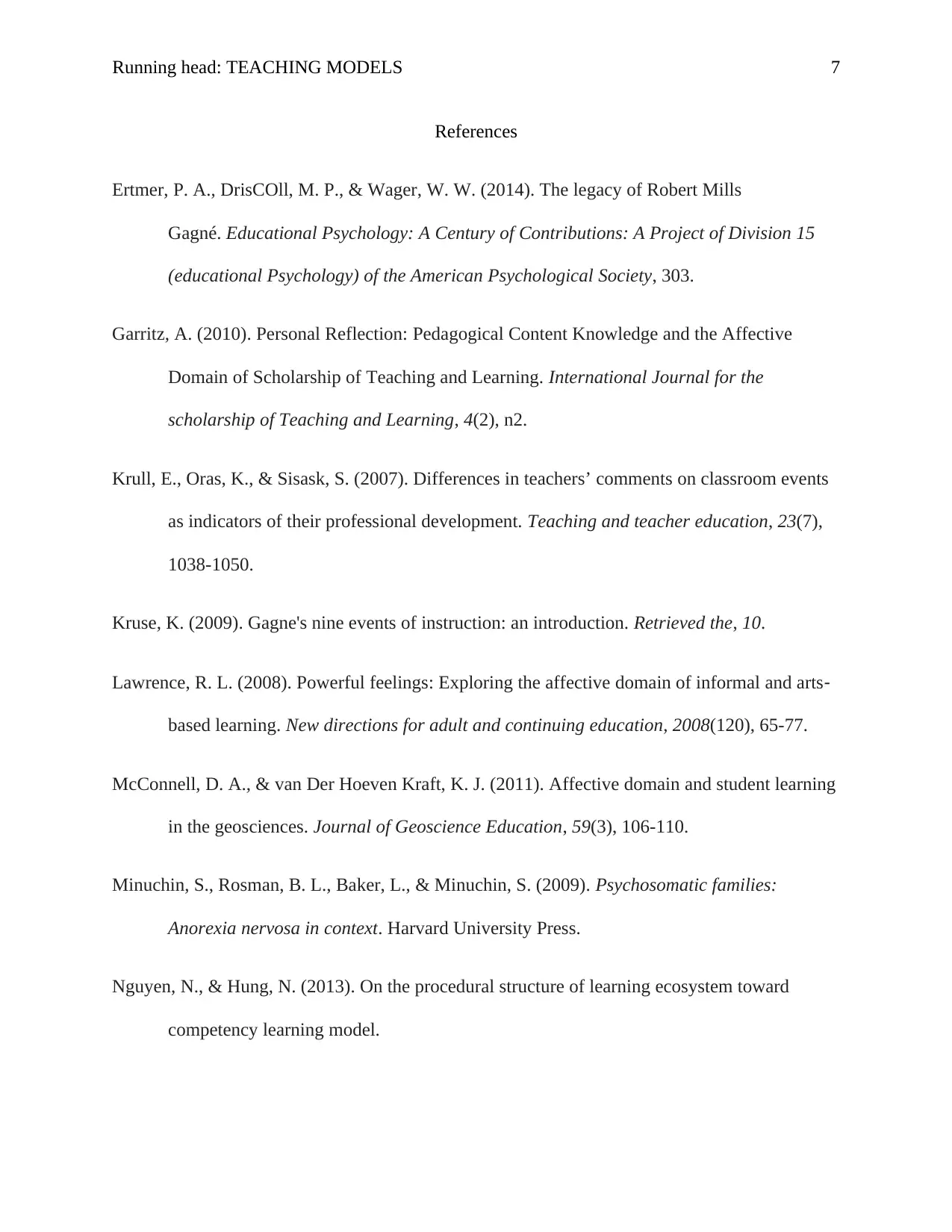
Running head: TEACHING MODELS 7
References
Ertmer, P. A., DrisCOll, M. P., & Wager, W. W. (2014). The legacy of Robert Mills
Gagné. Educational Psychology: A Century of Contributions: A Project of Division 15
(educational Psychology) of the American Psychological Society, 303.
Garritz, A. (2010). Personal Reflection: Pedagogical Content Knowledge and the Affective
Domain of Scholarship of Teaching and Learning. International Journal for the
scholarship of Teaching and Learning, 4(2), n2.
Krull, E., Oras, K., & Sisask, S. (2007). Differences in teachers’ comments on classroom events
as indicators of their professional development. Teaching and teacher education, 23(7),
1038-1050.
Kruse, K. (2009). Gagne's nine events of instruction: an introduction. Retrieved the, 10.
Lawrence, R. L. (2008). Powerful feelings: Exploring the affective domain of informal and arts‐
based learning. New directions for adult and continuing education, 2008(120), 65-77.
McConnell, D. A., & van Der Hoeven Kraft, K. J. (2011). Affective domain and student learning
in the geosciences. Journal of Geoscience Education, 59(3), 106-110.
Minuchin, S., Rosman, B. L., Baker, L., & Minuchin, S. (2009). Psychosomatic families:
Anorexia nervosa in context. Harvard University Press.
Nguyen, N., & Hung, N. (2013). On the procedural structure of learning ecosystem toward
competency learning model.
References
Ertmer, P. A., DrisCOll, M. P., & Wager, W. W. (2014). The legacy of Robert Mills
Gagné. Educational Psychology: A Century of Contributions: A Project of Division 15
(educational Psychology) of the American Psychological Society, 303.
Garritz, A. (2010). Personal Reflection: Pedagogical Content Knowledge and the Affective
Domain of Scholarship of Teaching and Learning. International Journal for the
scholarship of Teaching and Learning, 4(2), n2.
Krull, E., Oras, K., & Sisask, S. (2007). Differences in teachers’ comments on classroom events
as indicators of their professional development. Teaching and teacher education, 23(7),
1038-1050.
Kruse, K. (2009). Gagne's nine events of instruction: an introduction. Retrieved the, 10.
Lawrence, R. L. (2008). Powerful feelings: Exploring the affective domain of informal and arts‐
based learning. New directions for adult and continuing education, 2008(120), 65-77.
McConnell, D. A., & van Der Hoeven Kraft, K. J. (2011). Affective domain and student learning
in the geosciences. Journal of Geoscience Education, 59(3), 106-110.
Minuchin, S., Rosman, B. L., Baker, L., & Minuchin, S. (2009). Psychosomatic families:
Anorexia nervosa in context. Harvard University Press.
Nguyen, N., & Hung, N. (2013). On the procedural structure of learning ecosystem toward
competency learning model.
Paraphrase This Document
Need a fresh take? Get an instant paraphrase of this document with our AI Paraphraser

Running head: TEACHING MODELS 8
Steinhausen, H. C. (2002). The outcome of anorexia nervosa in the 20th century. American
journal of Psychiatry, 159(8), 1284-1293.
Syatriana, E. (2013). A Model of Creating Instructional Materials Based on the School
Curriculum for Indonesian Secondary Schools.
Steinhausen, H. C. (2002). The outcome of anorexia nervosa in the 20th century. American
journal of Psychiatry, 159(8), 1284-1293.
Syatriana, E. (2013). A Model of Creating Instructional Materials Based on the School
Curriculum for Indonesian Secondary Schools.

1 out of 8


Your All-in-One AI-Powered Toolkit for Academic Success.
+13062052269
info@desklib.com
Available 24*7 on WhatsApp / Email
![[object Object]](/_next/static/media/star-bottom.7253800d.svg)
Unlock your academic potential
Copyright © 2020–2026 A2Z Services. All Rights Reserved. Developed and managed by ZUCOL.