Strategic Management Accounting: Adapting to a Changing Environment
VerifiedAdded on 2023/06/15
|11
|2909
|285
Essay
AI Summary
This essay provides a comprehensive analysis of strategic management accounting within the context of a changing business environment. It begins by highlighting the shift from traditional accounting approaches to technology-driven management accounting in response to increased competition and evolving production processes. The essay evaluates the impact of both external and internal factors on management accounting, employing tools such as PESTLE and VRIO analysis. External factors discussed include political, economic, technological, social, environmental, and legal aspects, while internal factors focus on valuable, rare, inimitable, and organization-supported assets. The essay also explores the role of contingency theory, emphasizing the influence of environmental uncertainty and organizational change on management accounting practices. Furthermore, it touches upon the importance of Total Quality Management (TQM) and the limitations of traditional accounting systems in capturing non-financial knowledge. Finally, the essay briefly explains costing methods, highlighting the significance of understanding costs in relation to production and product types.
Strategic Management
Accounting
Accounting

Paraphrase This Document
Need a fresh take? Get an instant paraphrase of this document with our AI Paraphraser

Contents
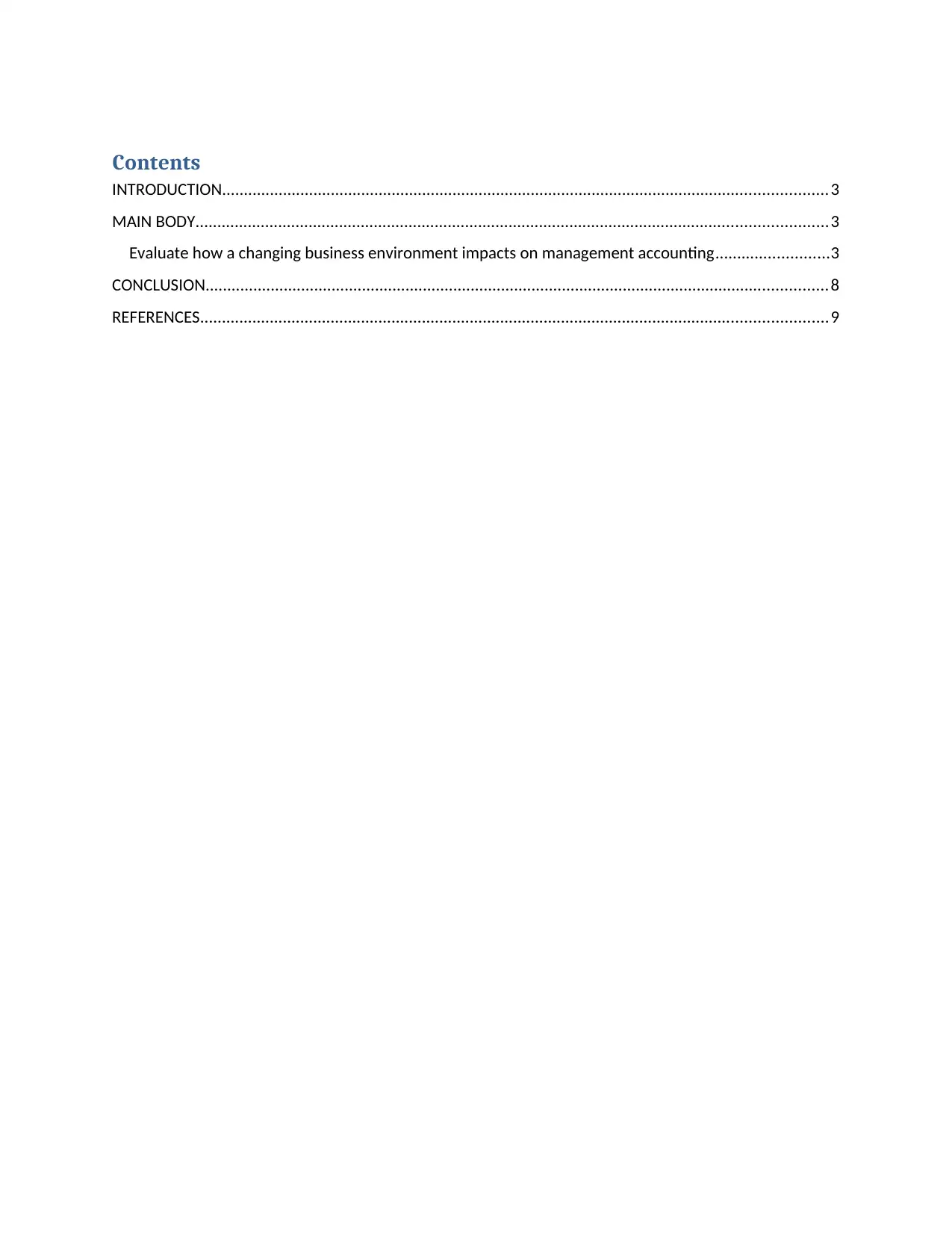
INTRODUCTION...........................................................................................................................................3
MAIN BODY.................................................................................................................................................3
Evaluate how a changing business environment impacts on management accounting..........................3
CONCLUSION...............................................................................................................................................8
REFERENCES................................................................................................................................................9
INTRODUCTION...........................................................................................................................................3
MAIN BODY.................................................................................................................................................3
Evaluate how a changing business environment impacts on management accounting..........................3
CONCLUSION...............................................................................................................................................8
REFERENCES................................................................................................................................................9
⊘ This is a preview!⊘
Do you want full access?
Subscribe today to unlock all pages.

Trusted by 1+ million students worldwide
INTRODUCTION
Managerial accounting processes play an important role in our culture, trading current
accounting systems that are clearly shown by a number of contingent factors, both inside and
publicly. In recent history, organizations had moved their business strategy away from traditional
accounting approaches towards the implementation of technology management accounting. In
order to properly manage and participate fully in today's highly competitive business climate,
several businesses face multiple problems (Bedford and Speklé, 2018). Traditional management
accounting, according to some specialists, is no longer adequate for modern production
environments since production processes have changed including the firm's efficiency and
negative production. Because traditional administrators are unable to provide this information,
these advances need correct and dependable paperwork to assist executives in tracking and
arranging tasks. Companies can change their strategies by keeping an eye on their competitors'
moves.
MAIN BODY
Evaluate how external and internal factors impacts on management accounting
Environment assessment, also referred to as external evaluation, is a company's purpose of
examining the new paradigm in which it works, being knowledgeable of early warning signs, and
seeing potential threats and opportunities. All businesses and organizations operate in a complex
atmosphere, and they are vulnerable to its variables, which are massive naturally produced
occurrences that require comprehension. The external economic environment of an organisation
has an influence on its operations. On top of that, the organization has set strategies to adjust for
these types of factors, allowing the firm to embrace opportunities and difficulties while paving
their way to triumph by matching key strengths.
The PESTLE analysis is a competitiveness analytical approach that is one of the most successful
scientific tools for analyzing the impacts of a company's global problems. It's an advanced
version of the PESTLE model (Hosseinzadeh and Davari, 2018).
• Political factors: These are the effects of the governance on business operations. Business
strategy, firm stability and unpredictability, business crime, taxation rules, underage worker
Managerial accounting processes play an important role in our culture, trading current
accounting systems that are clearly shown by a number of contingent factors, both inside and
publicly. In recent history, organizations had moved their business strategy away from traditional
accounting approaches towards the implementation of technology management accounting. In
order to properly manage and participate fully in today's highly competitive business climate,
several businesses face multiple problems (Bedford and Speklé, 2018). Traditional management
accounting, according to some specialists, is no longer adequate for modern production
environments since production processes have changed including the firm's efficiency and
negative production. Because traditional administrators are unable to provide this information,
these advances need correct and dependable paperwork to assist executives in tracking and
arranging tasks. Companies can change their strategies by keeping an eye on their competitors'
moves.
MAIN BODY
Evaluate how external and internal factors impacts on management accounting
Environment assessment, also referred to as external evaluation, is a company's purpose of
examining the new paradigm in which it works, being knowledgeable of early warning signs, and
seeing potential threats and opportunities. All businesses and organizations operate in a complex
atmosphere, and they are vulnerable to its variables, which are massive naturally produced
occurrences that require comprehension. The external economic environment of an organisation
has an influence on its operations. On top of that, the organization has set strategies to adjust for
these types of factors, allowing the firm to embrace opportunities and difficulties while paving
their way to triumph by matching key strengths.
The PESTLE analysis is a competitiveness analytical approach that is one of the most successful
scientific tools for analyzing the impacts of a company's global problems. It's an advanced
version of the PESTLE model (Hosseinzadeh and Davari, 2018).
• Political factors: These are the effects of the governance on business operations. Business
strategy, firm stability and unpredictability, business crime, taxation rules, underage worker
Paraphrase This Document
Need a fresh take? Get an instant paraphrase of this document with our AI Paraphraser
safeguards, environmental laws, and protectionist measures were among the topics discussed.
These factors can frequently have a detrimental influence on a business. In addition, the
management has a great influence on the country's higher education institutions. All elements
should be examined while deciding to choose whether or not connect a variety of clients.
• Economic Factors: Employment growth, treasury yields, commodities prices, and, most
crucially, unemployment figures have all been included in this pandemic situation. As a
consequence of all of this, the company may encounter difficulties in the immediate or long
term. This might spell the end for the company. Factors impact a user's discretionary money
from a company and may cause demand or supply in the economy to alter. It might lead to a
considerable change in the company's item prices. Furthermore, because the demand for and
variety of items is continually rising, it may have a positive impact on the company (Ciambotti
and et.al, 2020).
• Technological Factors: The most substantial improvements in the business field have been
characterized as technological factors. The most crucial impact of technological has been to
increase workers' awareness of modern technology, which has benefited a core business by
expanding supplier offers profits. This might have an influence on when a product is released.
• Social Elements: These factors have an impact on the company because they contain generation
characteristics including racial composition, financial distribution, lifestyle views, societal
factors, and protection emphasis, among others. Corporations might promote topics like sample
population, income distribution, and other problems that are more important to the future
generation more regularly.
• Environmental Component: This factor has risen to prominence in recent years. It becomes
more significant for enterprises as a result of a scarcity of natural resources and growing
pollutants, which are affecting item mechanical performance and govt carbon pollution
objectives. Climate change, carbon offsetting, and other environmental and environmental causes
are included. It is now more important than ever for companies to raise awareness about the
effects of environmental damage. This affects the long-term viability of fundamental materials.
• Legal Aspects: In numerous ways, this element has blended with the geopolitical factors. This
includes laws pertaining to racism, fiscal policy, employment, patent laws, industrial safety, and
These factors can frequently have a detrimental influence on a business. In addition, the
management has a great influence on the country's higher education institutions. All elements
should be examined while deciding to choose whether or not connect a variety of clients.
• Economic Factors: Employment growth, treasury yields, commodities prices, and, most
crucially, unemployment figures have all been included in this pandemic situation. As a
consequence of all of this, the company may encounter difficulties in the immediate or long
term. This might spell the end for the company. Factors impact a user's discretionary money
from a company and may cause demand or supply in the economy to alter. It might lead to a
considerable change in the company's item prices. Furthermore, because the demand for and
variety of items is continually rising, it may have a positive impact on the company (Ciambotti
and et.al, 2020).
• Technological Factors: The most substantial improvements in the business field have been
characterized as technological factors. The most crucial impact of technological has been to
increase workers' awareness of modern technology, which has benefited a core business by
expanding supplier offers profits. This might have an influence on when a product is released.
• Social Elements: These factors have an impact on the company because they contain generation
characteristics including racial composition, financial distribution, lifestyle views, societal
factors, and protection emphasis, among others. Corporations might promote topics like sample
population, income distribution, and other problems that are more important to the future
generation more regularly.
• Environmental Component: This factor has risen to prominence in recent years. It becomes
more significant for enterprises as a result of a scarcity of natural resources and growing
pollutants, which are affecting item mechanical performance and govt carbon pollution
objectives. Climate change, carbon offsetting, and other environmental and environmental causes
are included. It is now more important than ever for companies to raise awareness about the
effects of environmental damage. This affects the long-term viability of fundamental materials.
• Legal Aspects: In numerous ways, this element has blended with the geopolitical factors. This
includes laws pertaining to racism, fiscal policy, employment, patent laws, industrial safety, and
etc. Because each country has its own set of rules and constraints, international trade is vitally
important (Hertati, Nazarudin and Fery, 2020).
Internal examination assists a company in analyzing its internal environment in order to establish
its assets, competencies, and competitive advantage. Intrinsic evaluation might be used to
determine the firm's benefits and shortcomings. This application can assist administrators in
strategizing their options for restricting activities in the organisation and its operational
operations. Organizations might gain a full grasp of their skills and areas where they fall short
using this sort of research. There are mentioned different factors that impact on the management
accounting such as:
VRIO evaluation is an essential notion that helps in the investigation of a company's internal
environment, which contains ingredients such as organizational ideology and hierarchy,
employees, corporate standards and guidelines, and etc. The below are some of the most crucial
business tools for every company:
Assets that are useful to a firm include those that help it implement and create successful
strategies, including those that aid in the investigation of opportunities and the control of risks.
The following assets have a significant impact on the corporate team and are useful to it:
• Branding picture As a consequence of a company's internationalization, its brand awareness is
mirrored all over the world, making it a useful asset for the company (Napitupulu, 2018).
• Item Quality: The performance of a company's products is yet another essential and valuable
resource.
• Transmission Network: The Company has a global delivery system that contributes in
satisfying consumer demands and is recognized as a precious business resource.
• Financial Assets: As per a VRIO research, income and investments are evaluated differently
depending on the firm.
Considering the significance of management accounting to companies, several experts claim that
it has evolved far more gradually than is required to meet the need for knowledge in the current
business climate. Numerous researches have concentrated their emphasis on the practice of
important (Hertati, Nazarudin and Fery, 2020).
Internal examination assists a company in analyzing its internal environment in order to establish
its assets, competencies, and competitive advantage. Intrinsic evaluation might be used to
determine the firm's benefits and shortcomings. This application can assist administrators in
strategizing their options for restricting activities in the organisation and its operational
operations. Organizations might gain a full grasp of their skills and areas where they fall short
using this sort of research. There are mentioned different factors that impact on the management
accounting such as:
VRIO evaluation is an essential notion that helps in the investigation of a company's internal
environment, which contains ingredients such as organizational ideology and hierarchy,
employees, corporate standards and guidelines, and etc. The below are some of the most crucial
business tools for every company:
Assets that are useful to a firm include those that help it implement and create successful
strategies, including those that aid in the investigation of opportunities and the control of risks.
The following assets have a significant impact on the corporate team and are useful to it:
• Branding picture As a consequence of a company's internationalization, its brand awareness is
mirrored all over the world, making it a useful asset for the company (Napitupulu, 2018).
• Item Quality: The performance of a company's products is yet another essential and valuable
resource.
• Transmission Network: The Company has a global delivery system that contributes in
satisfying consumer demands and is recognized as a precious business resource.
• Financial Assets: As per a VRIO research, income and investments are evaluated differently
depending on the firm.
Considering the significance of management accounting to companies, several experts claim that
it has evolved far more gradually than is required to meet the need for knowledge in the current
business climate. Numerous researches have concentrated their emphasis on the practice of
⊘ This is a preview!⊘
Do you want full access?
Subscribe today to unlock all pages.
Trusted by 1+ million students worldwide
management accounting transformation in light of this viewpoint. Such comparatively recent
field of study is focused on a diverse variety of hypotheses and methodologies. Various
methodologies to analyzing management accounting transition exist, including studies whose
primary goal is to analyze corporate pressures, conflicts, and inflexibility, as well as studies
whose primary goal is to explore management accounting development as a process (Le and
et.al, 2020).
Restricted assets are resources that are both definitely beneficial to the company, and they play a
vital role in the company's profitability and in obtaining a competitive advantage. In context of
the following organization, the following elements are judged strange:
• Item Qualities In order to meet the needs of the intended audience, businesses provides the
most speed designs and appealing goods. As a consequence, the individual accomplishment of a
single corporation, as per this principle, is valuable and distinctive.
• According to the VRIO evaluation, the distribution network has a substantial impact on the
achievement of stated objectives and is one of the organization's scarce resources.
• Financial assets as a source of income because firms invest so much in research and
development, as well as expansion into other countries, financial assistance is both rare and
valuable.
Unparalleled assets are assets that are difficult for competitors to imitate or get, leading in the
establishment of a strong economic position in the market. A company uses effective marketing
strategies to get a competitive advantage over its competitors. Every firm's distinguishing assets
are as follows:
• Transmissions connectivity is tough for new entrants to compete because comparable
marketing costs a significant percentage of their budget on their providers. As a consequence, its
distribution system is included in this VRIO study subcategory (Juliana, Gani and Jermias,
2021).
• Monetary assets, as companies have a financial position, which is something that only a few
companies in the industry have. It demonstrates its unrivalled financial capability.
field of study is focused on a diverse variety of hypotheses and methodologies. Various
methodologies to analyzing management accounting transition exist, including studies whose
primary goal is to analyze corporate pressures, conflicts, and inflexibility, as well as studies
whose primary goal is to explore management accounting development as a process (Le and
et.al, 2020).
Restricted assets are resources that are both definitely beneficial to the company, and they play a
vital role in the company's profitability and in obtaining a competitive advantage. In context of
the following organization, the following elements are judged strange:
• Item Qualities In order to meet the needs of the intended audience, businesses provides the
most speed designs and appealing goods. As a consequence, the individual accomplishment of a
single corporation, as per this principle, is valuable and distinctive.
• According to the VRIO evaluation, the distribution network has a substantial impact on the
achievement of stated objectives and is one of the organization's scarce resources.
• Financial assets as a source of income because firms invest so much in research and
development, as well as expansion into other countries, financial assistance is both rare and
valuable.
Unparalleled assets are assets that are difficult for competitors to imitate or get, leading in the
establishment of a strong economic position in the market. A company uses effective marketing
strategies to get a competitive advantage over its competitors. Every firm's distinguishing assets
are as follows:
• Transmissions connectivity is tough for new entrants to compete because comparable
marketing costs a significant percentage of their budget on their providers. As a consequence, its
distribution system is included in this VRIO study subcategory (Juliana, Gani and Jermias,
2021).
• Monetary assets, as companies have a financial position, which is something that only a few
companies in the industry have. It demonstrates its unrivalled financial capability.
Paraphrase This Document
Need a fresh take? Get an instant paraphrase of this document with our AI Paraphraser
Assets used as valuable, unusual, and distinctive assets are responsible to give a company a
competitive advantage over its competitors; so, asset management is critical:
• It is an ability to rise since it is the well-organized, important, unusual, and distinctive asset of
the company.
The MAPs' administrative modifications, on the other extreme, are influenced by both internal
and external obstacles. The parameters that influenced financial instruments to manage expand in
tandem with the size of an organisation. Various approaches have been introduced in reaction to
advancements and technology in the corporate sector, and all of those changes in the
organizational accounting procedures must struggle with the obstacles of today's business
requirements. Each business has its own budgetary control approach, which is impacted by
internationally and domestically technology and significant reforms (Qian, Hörisch and
Schaltegger, 2018). When a food company wants to modernize its technology for transportation,
packaging, and manufacturing meals, it should use a computer-based platform that follows
managerial accounting guidelines. As a consequence, the contingency hypothesis argues that
there is no universally valid organizational approach for representing the heterogeneity of
structured growth, and that organizational architecture is reliant on contextual contingent
components. Contingencies such as business strategy, the external people, company structure,
and variety influence the design of corporate governance processes. The possibilities
methodology assumes that the approach and procedures of the managerial controlling
programme are impacted by the situation in which they are performed.
Climate uncertainty is one of the first dependent components to be investigated, in addition
to its impact on the development of management accounting operations. Executives can make
very good market estimates whenever there is a tiny bit of emotional ambiguity. Companies with
a higher level of environmental security use more complex management accounting systems than
those with a lower level of environmental security. The level of environmental uncertainty
influences the amount of improvement in managerial accounting procedures. The relationship
between rivalry intensity and functionality in the marketing management. The surveillance
system performance depends on accounting corporation operations and business divisional
information.
competitive advantage over its competitors; so, asset management is critical:
• It is an ability to rise since it is the well-organized, important, unusual, and distinctive asset of
the company.
The MAPs' administrative modifications, on the other extreme, are influenced by both internal
and external obstacles. The parameters that influenced financial instruments to manage expand in
tandem with the size of an organisation. Various approaches have been introduced in reaction to
advancements and technology in the corporate sector, and all of those changes in the
organizational accounting procedures must struggle with the obstacles of today's business
requirements. Each business has its own budgetary control approach, which is impacted by
internationally and domestically technology and significant reforms (Qian, Hörisch and
Schaltegger, 2018). When a food company wants to modernize its technology for transportation,
packaging, and manufacturing meals, it should use a computer-based platform that follows
managerial accounting guidelines. As a consequence, the contingency hypothesis argues that
there is no universally valid organizational approach for representing the heterogeneity of
structured growth, and that organizational architecture is reliant on contextual contingent
components. Contingencies such as business strategy, the external people, company structure,
and variety influence the design of corporate governance processes. The possibilities
methodology assumes that the approach and procedures of the managerial controlling
programme are impacted by the situation in which they are performed.
Climate uncertainty is one of the first dependent components to be investigated, in addition
to its impact on the development of management accounting operations. Executives can make
very good market estimates whenever there is a tiny bit of emotional ambiguity. Companies with
a higher level of environmental security use more complex management accounting systems than
those with a lower level of environmental security. The level of environmental uncertainty
influences the amount of improvement in managerial accounting procedures. The relationship
between rivalry intensity and functionality in the marketing management. The surveillance
system performance depends on accounting corporation operations and business divisional
information.
Organizations should modify their strategies in response to changes in the external
environment. The fundamental definition of organizational change, on the other extreme, argues
that the company's methodology of teaching and ability to adapt to changing ecosystems are
influenced by the company's cultures. By implementing a change in approach in gradual or rapid
modification, a successful movement in the fundamental organizational structures can be
realized. To promote organizational correctness and consistency, all aspects of the company must
be changed at the same time, including architecture, strategy, equipment, staff, mentality, and etc
(Nielsen and Pontoppidan, 2019).
Altogether perfection government can offer management and leadership a boost by addressing
customers' requirements, which is the main purpose of entire excellence planning. It aids an
organization's ability to succeed and innovate. Firms that follow TQM get better rewards in
terms of delighted customers, high-quality items, and the establishment of innovative brands.
Additionally, significant attempts are being taken to examine the cost of current administration
systems in terms of absolute quality administration. The additional connecting trust in non-
financial knowledge has grown as findings of this experiment, which looks at the relationship
between total production control and accounting processes. In the case of qualitative
management, traditional accounting systems that rely on financial discrepancies are inefficient
since they do not indicate where capabilities originate from (Höglund and et.al, 2018).
Needs to explain costing methods and their results of the topic
Costs are essentially the funds or resources connected with a transaction, commercial
transactions, or other operation. Depending on the severity of the manufacturing and the kind of
product, various industries use multiple methods to calculate the risks of their goods.
Fixed costs are those that do not alter with increase in manufacturing and would accumulate
when no production was created. Rent, interest charges, real estate taxes, and wage costs are
examples. Fixed expenses, on the other hand, are limited to a given time range since fixed
expenses might fluctuate over time. For instance, a factory may opt to raise production in
addition to the growth for its product, necessitating a larger level of investment in tools and
machinery.
environment. The fundamental definition of organizational change, on the other extreme, argues
that the company's methodology of teaching and ability to adapt to changing ecosystems are
influenced by the company's cultures. By implementing a change in approach in gradual or rapid
modification, a successful movement in the fundamental organizational structures can be
realized. To promote organizational correctness and consistency, all aspects of the company must
be changed at the same time, including architecture, strategy, equipment, staff, mentality, and etc
(Nielsen and Pontoppidan, 2019).
Altogether perfection government can offer management and leadership a boost by addressing
customers' requirements, which is the main purpose of entire excellence planning. It aids an
organization's ability to succeed and innovate. Firms that follow TQM get better rewards in
terms of delighted customers, high-quality items, and the establishment of innovative brands.
Additionally, significant attempts are being taken to examine the cost of current administration
systems in terms of absolute quality administration. The additional connecting trust in non-
financial knowledge has grown as findings of this experiment, which looks at the relationship
between total production control and accounting processes. In the case of qualitative
management, traditional accounting systems that rely on financial discrepancies are inefficient
since they do not indicate where capabilities originate from (Höglund and et.al, 2018).
Needs to explain costing methods and their results of the topic
Costs are essentially the funds or resources connected with a transaction, commercial
transactions, or other operation. Depending on the severity of the manufacturing and the kind of
product, various industries use multiple methods to calculate the risks of their goods.
Fixed costs are those that do not alter with increase in manufacturing and would accumulate
when no production was created. Rent, interest charges, real estate taxes, and wage costs are
examples. Fixed expenses, on the other hand, are limited to a given time range since fixed
expenses might fluctuate over time. For instance, a factory may opt to raise production in
addition to the growth for its product, necessitating a larger level of investment in tools and
machinery.
⊘ This is a preview!⊘
Do you want full access?
Subscribe today to unlock all pages.
Trusted by 1+ million students worldwide
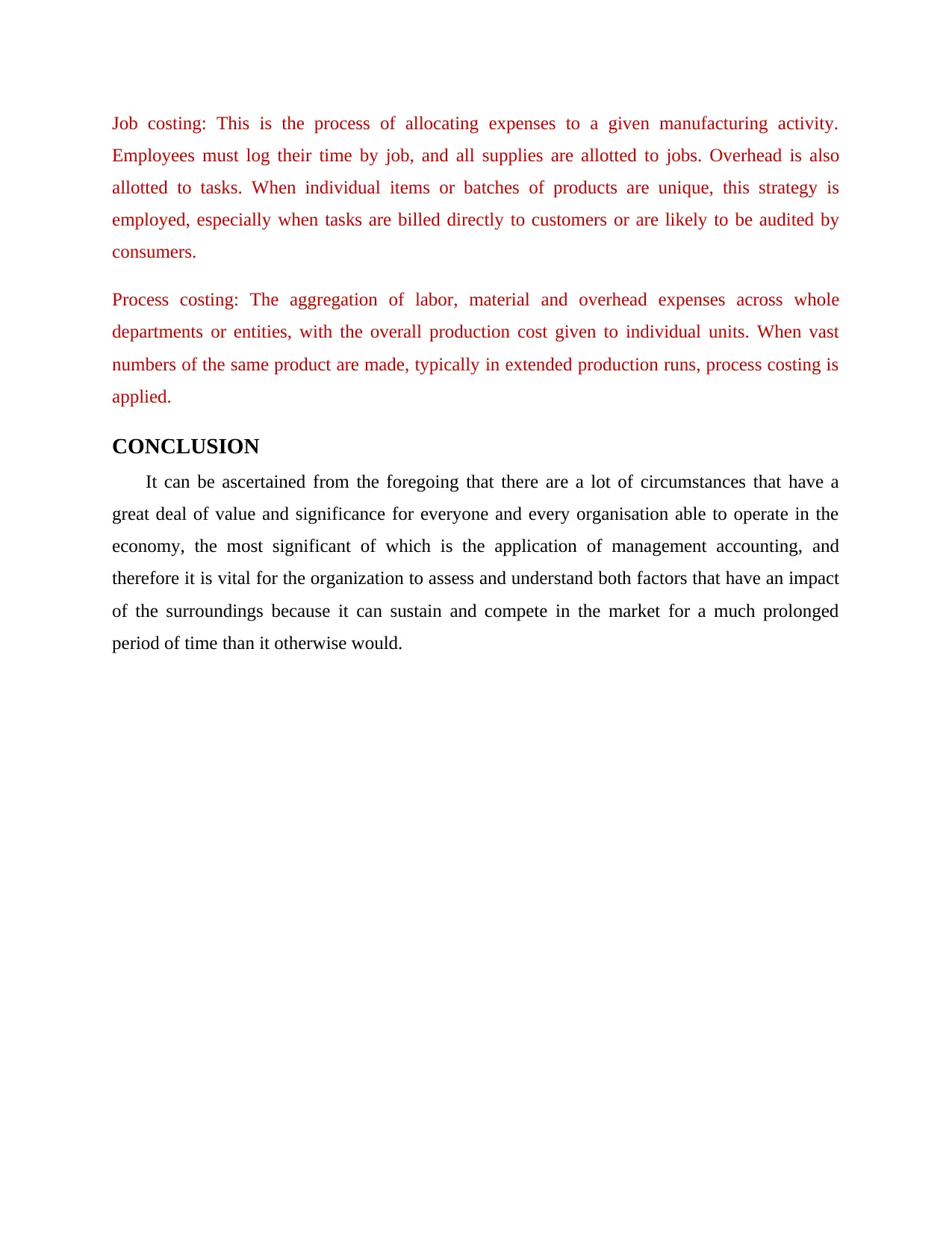
Job costing: This is the process of allocating expenses to a given manufacturing activity.
Employees must log their time by job, and all supplies are allotted to jobs. Overhead is also
allotted to tasks. When individual items or batches of products are unique, this strategy is
employed, especially when tasks are billed directly to customers or are likely to be audited by
consumers.
Process costing: The aggregation of labor, material and overhead expenses across whole
departments or entities, with the overall production cost given to individual units. When vast
numbers of the same product are made, typically in extended production runs, process costing is
applied.
CONCLUSION
It can be ascertained from the foregoing that there are a lot of circumstances that have a
great deal of value and significance for everyone and every organisation able to operate in the
economy, the most significant of which is the application of management accounting, and
therefore it is vital for the organization to assess and understand both factors that have an impact
of the surroundings because it can sustain and compete in the market for a much prolonged
period of time than it otherwise would.
Employees must log their time by job, and all supplies are allotted to jobs. Overhead is also
allotted to tasks. When individual items or batches of products are unique, this strategy is
employed, especially when tasks are billed directly to customers or are likely to be audited by
consumers.
Process costing: The aggregation of labor, material and overhead expenses across whole
departments or entities, with the overall production cost given to individual units. When vast
numbers of the same product are made, typically in extended production runs, process costing is
applied.
CONCLUSION
It can be ascertained from the foregoing that there are a lot of circumstances that have a
great deal of value and significance for everyone and every organisation able to operate in the
economy, the most significant of which is the application of management accounting, and
therefore it is vital for the organization to assess and understand both factors that have an impact
of the surroundings because it can sustain and compete in the market for a much prolonged
period of time than it otherwise would.
Paraphrase This Document
Need a fresh take? Get an instant paraphrase of this document with our AI Paraphraser
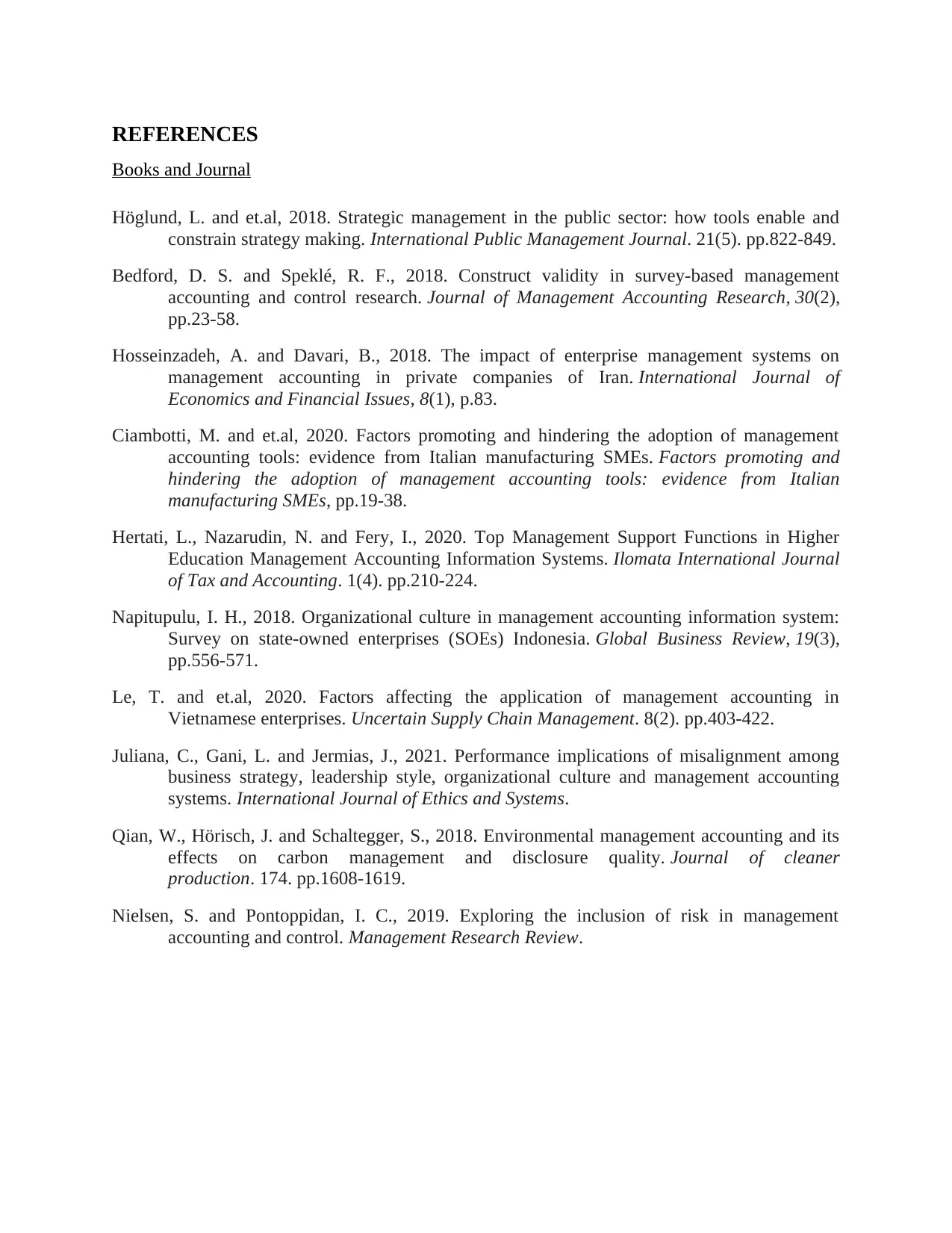
REFERENCES
Books and Journal
Höglund, L. and et.al, 2018. Strategic management in the public sector: how tools enable and
constrain strategy making. International Public Management Journal. 21(5). pp.822-849.
Bedford, D. S. and Speklé, R. F., 2018. Construct validity in survey-based management
accounting and control research. Journal of Management Accounting Research, 30(2),
pp.23-58.
Hosseinzadeh, A. and Davari, B., 2018. The impact of enterprise management systems on
management accounting in private companies of Iran. International Journal of
Economics and Financial Issues, 8(1), p.83.
Ciambotti, M. and et.al, 2020. Factors promoting and hindering the adoption of management
accounting tools: evidence from Italian manufacturing SMEs. Factors promoting and
hindering the adoption of management accounting tools: evidence from Italian
manufacturing SMEs, pp.19-38.
Hertati, L., Nazarudin, N. and Fery, I., 2020. Top Management Support Functions in Higher
Education Management Accounting Information Systems. Ilomata International Journal
of Tax and Accounting. 1(4). pp.210-224.
Napitupulu, I. H., 2018. Organizational culture in management accounting information system:
Survey on state-owned enterprises (SOEs) Indonesia. Global Business Review, 19(3),
pp.556-571.
Le, T. and et.al, 2020. Factors affecting the application of management accounting in
Vietnamese enterprises. Uncertain Supply Chain Management. 8(2). pp.403-422.
Juliana, C., Gani, L. and Jermias, J., 2021. Performance implications of misalignment among
business strategy, leadership style, organizational culture and management accounting
systems. International Journal of Ethics and Systems.
Qian, W., Hörisch, J. and Schaltegger, S., 2018. Environmental management accounting and its
effects on carbon management and disclosure quality. Journal of cleaner
production. 174. pp.1608-1619.
Nielsen, S. and Pontoppidan, I. C., 2019. Exploring the inclusion of risk in management
accounting and control. Management Research Review.
Books and Journal
Höglund, L. and et.al, 2018. Strategic management in the public sector: how tools enable and
constrain strategy making. International Public Management Journal. 21(5). pp.822-849.
Bedford, D. S. and Speklé, R. F., 2018. Construct validity in survey-based management
accounting and control research. Journal of Management Accounting Research, 30(2),
pp.23-58.
Hosseinzadeh, A. and Davari, B., 2018. The impact of enterprise management systems on
management accounting in private companies of Iran. International Journal of
Economics and Financial Issues, 8(1), p.83.
Ciambotti, M. and et.al, 2020. Factors promoting and hindering the adoption of management
accounting tools: evidence from Italian manufacturing SMEs. Factors promoting and
hindering the adoption of management accounting tools: evidence from Italian
manufacturing SMEs, pp.19-38.
Hertati, L., Nazarudin, N. and Fery, I., 2020. Top Management Support Functions in Higher
Education Management Accounting Information Systems. Ilomata International Journal
of Tax and Accounting. 1(4). pp.210-224.
Napitupulu, I. H., 2018. Organizational culture in management accounting information system:
Survey on state-owned enterprises (SOEs) Indonesia. Global Business Review, 19(3),
pp.556-571.
Le, T. and et.al, 2020. Factors affecting the application of management accounting in
Vietnamese enterprises. Uncertain Supply Chain Management. 8(2). pp.403-422.
Juliana, C., Gani, L. and Jermias, J., 2021. Performance implications of misalignment among
business strategy, leadership style, organizational culture and management accounting
systems. International Journal of Ethics and Systems.
Qian, W., Hörisch, J. and Schaltegger, S., 2018. Environmental management accounting and its
effects on carbon management and disclosure quality. Journal of cleaner
production. 174. pp.1608-1619.
Nielsen, S. and Pontoppidan, I. C., 2019. Exploring the inclusion of risk in management
accounting and control. Management Research Review.

1 out of 11


Related Documents


Your All-in-One AI-Powered Toolkit for Academic Success.
+13062052269
info@desklib.com
Available 24*7 on WhatsApp / Email
![[object Object]](/_next/static/media/star-bottom.7253800d.svg)
Unlock your academic potential
Copyright © 2020–2026 A2Z Services. All Rights Reserved. Developed and managed by ZUCOL.