Analyzing Organizational Culture's Impact on Waitrose Employees
VerifiedAdded on 2019/12/03
|19
|4634
|34
Report
AI Summary
This research project investigates the impact of organizational culture on employee performance at Waitrose. The study begins with an introduction to organizational culture and its influence on employee behavior, followed by a clear articulation of the research title, aims, and objectives. The rationale for the research is presented, highlighting the significance of employee performance in the competitive retail landscape. A comprehensive literature review explores existing research on organizational culture and its effects. The research methodology, including a descriptive research design and a mixed-methods approach utilizing both qualitative (observation) and quantitative (questionnaire) data collection, is detailed. The report outlines the sampling technique, data analysis methods, and a time-action plan with a budget. The analysis section presents findings from both qualitative and quantitative data, followed by recommendations for Waitrose. The report concludes with an appropriate format for presenting the findings, along with a list of references and an appendix.

RESEARCH PROJECT

Paraphrase This Document
Need a fresh take? Get an instant paraphrase of this document with our AI Paraphraser
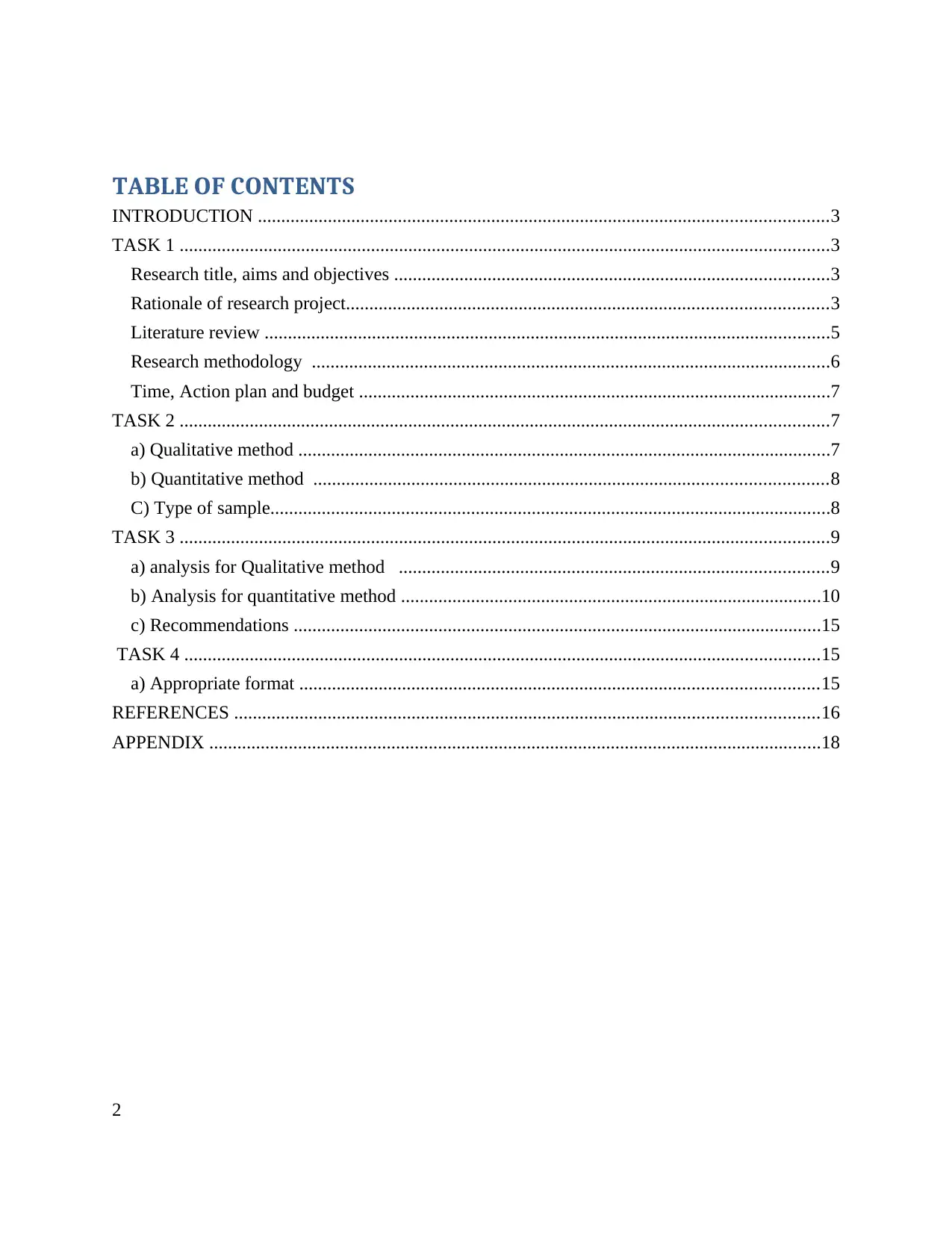
TABLE OF CONTENTS
INTRODUCTION ..........................................................................................................................3
TASK 1 ...........................................................................................................................................3
Research title, aims and objectives .............................................................................................3
Rationale of research project.......................................................................................................3
Literature review .........................................................................................................................5
Research methodology ...............................................................................................................6
Time, Action plan and budget .....................................................................................................7
TASK 2 ...........................................................................................................................................7
a) Qualitative method ..................................................................................................................7
b) Quantitative method ..............................................................................................................8
C) Type of sample........................................................................................................................8
TASK 3 ...........................................................................................................................................9
a) analysis for Qualitative method ............................................................................................9
b) Analysis for quantitative method ..........................................................................................10
c) Recommendations .................................................................................................................15
TASK 4 ........................................................................................................................................15
a) Appropriate format ...............................................................................................................15
REFERENCES .............................................................................................................................16
APPENDIX ...................................................................................................................................18
2
INTRODUCTION ..........................................................................................................................3
TASK 1 ...........................................................................................................................................3
Research title, aims and objectives .............................................................................................3
Rationale of research project.......................................................................................................3
Literature review .........................................................................................................................5
Research methodology ...............................................................................................................6
Time, Action plan and budget .....................................................................................................7
TASK 2 ...........................................................................................................................................7
a) Qualitative method ..................................................................................................................7
b) Quantitative method ..............................................................................................................8
C) Type of sample........................................................................................................................8
TASK 3 ...........................................................................................................................................9
a) analysis for Qualitative method ............................................................................................9
b) Analysis for quantitative method ..........................................................................................10
c) Recommendations .................................................................................................................15
TASK 4 ........................................................................................................................................15
a) Appropriate format ...............................................................................................................15
REFERENCES .............................................................................................................................16
APPENDIX ...................................................................................................................................18
2
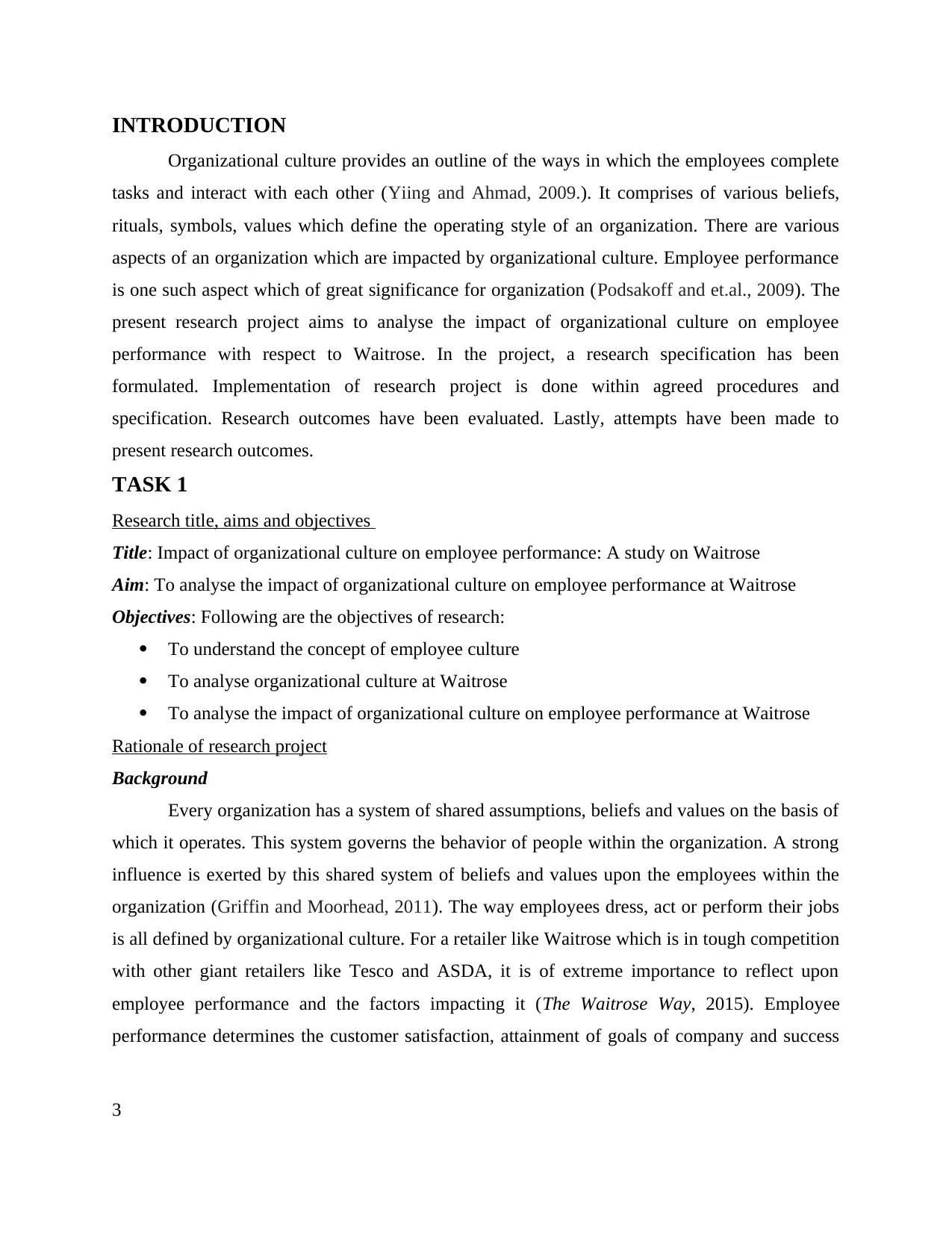
INTRODUCTION
Organizational culture provides an outline of the ways in which the employees complete
tasks and interact with each other (Yiing and Ahmad, 2009.). It comprises of various beliefs,
rituals, symbols, values which define the operating style of an organization. There are various
aspects of an organization which are impacted by organizational culture. Employee performance
is one such aspect which of great significance for organization (Podsakoff and et.al., 2009). The
present research project aims to analyse the impact of organizational culture on employee
performance with respect to Waitrose. In the project, a research specification has been
formulated. Implementation of research project is done within agreed procedures and
specification. Research outcomes have been evaluated. Lastly, attempts have been made to
present research outcomes.
TASK 1
Research title, aims and objectives
Title: Impact of organizational culture on employee performance: A study on Waitrose
Aim: To analyse the impact of organizational culture on employee performance at Waitrose
Objectives: Following are the objectives of research:
To understand the concept of employee culture
To analyse organizational culture at Waitrose
To analyse the impact of organizational culture on employee performance at Waitrose
Rationale of research project
Background
Every organization has a system of shared assumptions, beliefs and values on the basis of
which it operates. This system governs the behavior of people within the organization. A strong
influence is exerted by this shared system of beliefs and values upon the employees within the
organization (Griffin and Moorhead, 2011). The way employees dress, act or perform their jobs
is all defined by organizational culture. For a retailer like Waitrose which is in tough competition
with other giant retailers like Tesco and ASDA, it is of extreme importance to reflect upon
employee performance and the factors impacting it (The Waitrose Way, 2015). Employee
performance determines the customer satisfaction, attainment of goals of company and success
3
Organizational culture provides an outline of the ways in which the employees complete
tasks and interact with each other (Yiing and Ahmad, 2009.). It comprises of various beliefs,
rituals, symbols, values which define the operating style of an organization. There are various
aspects of an organization which are impacted by organizational culture. Employee performance
is one such aspect which of great significance for organization (Podsakoff and et.al., 2009). The
present research project aims to analyse the impact of organizational culture on employee
performance with respect to Waitrose. In the project, a research specification has been
formulated. Implementation of research project is done within agreed procedures and
specification. Research outcomes have been evaluated. Lastly, attempts have been made to
present research outcomes.
TASK 1
Research title, aims and objectives
Title: Impact of organizational culture on employee performance: A study on Waitrose
Aim: To analyse the impact of organizational culture on employee performance at Waitrose
Objectives: Following are the objectives of research:
To understand the concept of employee culture
To analyse organizational culture at Waitrose
To analyse the impact of organizational culture on employee performance at Waitrose
Rationale of research project
Background
Every organization has a system of shared assumptions, beliefs and values on the basis of
which it operates. This system governs the behavior of people within the organization. A strong
influence is exerted by this shared system of beliefs and values upon the employees within the
organization (Griffin and Moorhead, 2011). The way employees dress, act or perform their jobs
is all defined by organizational culture. For a retailer like Waitrose which is in tough competition
with other giant retailers like Tesco and ASDA, it is of extreme importance to reflect upon
employee performance and the factors impacting it (The Waitrose Way, 2015). Employee
performance determines the customer satisfaction, attainment of goals of company and success
3
⊘ This is a preview!⊘
Do you want full access?
Subscribe today to unlock all pages.

Trusted by 1+ million students worldwide
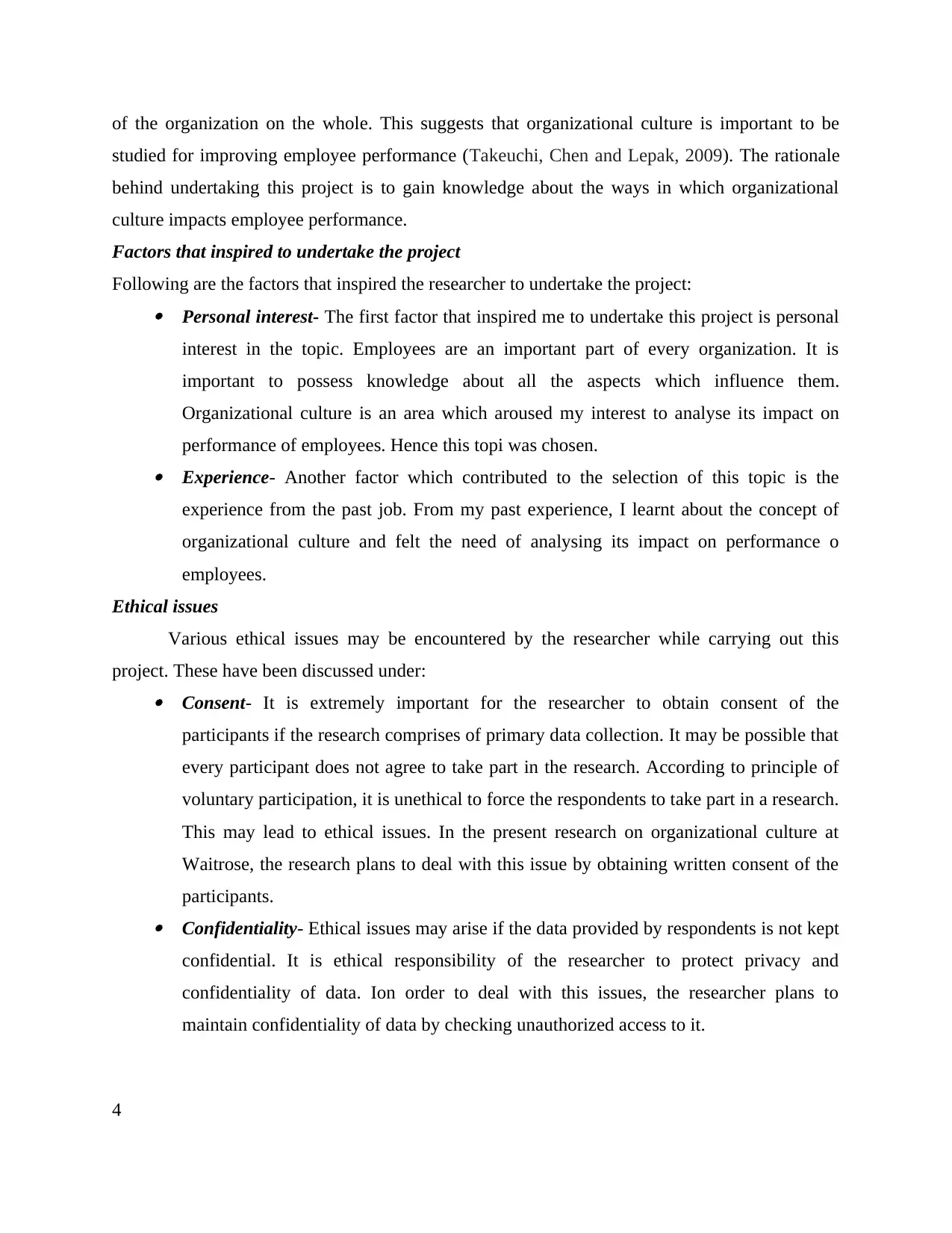
of the organization on the whole. This suggests that organizational culture is important to be
studied for improving employee performance (Takeuchi, Chen and Lepak, 2009). The rationale
behind undertaking this project is to gain knowledge about the ways in which organizational
culture impacts employee performance.
Factors that inspired to undertake the project
Following are the factors that inspired the researcher to undertake the project: Personal interest- The first factor that inspired me to undertake this project is personal
interest in the topic. Employees are an important part of every organization. It is
important to possess knowledge about all the aspects which influence them.
Organizational culture is an area which aroused my interest to analyse its impact on
performance of employees. Hence this topi was chosen. Experience- Another factor which contributed to the selection of this topic is the
experience from the past job. From my past experience, I learnt about the concept of
organizational culture and felt the need of analysing its impact on performance o
employees.
Ethical issues
Various ethical issues may be encountered by the researcher while carrying out this
project. These have been discussed under: Consent- It is extremely important for the researcher to obtain consent of the
participants if the research comprises of primary data collection. It may be possible that
every participant does not agree to take part in the research. According to principle of
voluntary participation, it is unethical to force the respondents to take part in a research.
This may lead to ethical issues. In the present research on organizational culture at
Waitrose, the research plans to deal with this issue by obtaining written consent of the
participants. Confidentiality- Ethical issues may arise if the data provided by respondents is not kept
confidential. It is ethical responsibility of the researcher to protect privacy and
confidentiality of data. Ion order to deal with this issues, the researcher plans to
maintain confidentiality of data by checking unauthorized access to it.
4
studied for improving employee performance (Takeuchi, Chen and Lepak, 2009). The rationale
behind undertaking this project is to gain knowledge about the ways in which organizational
culture impacts employee performance.
Factors that inspired to undertake the project
Following are the factors that inspired the researcher to undertake the project: Personal interest- The first factor that inspired me to undertake this project is personal
interest in the topic. Employees are an important part of every organization. It is
important to possess knowledge about all the aspects which influence them.
Organizational culture is an area which aroused my interest to analyse its impact on
performance of employees. Hence this topi was chosen. Experience- Another factor which contributed to the selection of this topic is the
experience from the past job. From my past experience, I learnt about the concept of
organizational culture and felt the need of analysing its impact on performance o
employees.
Ethical issues
Various ethical issues may be encountered by the researcher while carrying out this
project. These have been discussed under: Consent- It is extremely important for the researcher to obtain consent of the
participants if the research comprises of primary data collection. It may be possible that
every participant does not agree to take part in the research. According to principle of
voluntary participation, it is unethical to force the respondents to take part in a research.
This may lead to ethical issues. In the present research on organizational culture at
Waitrose, the research plans to deal with this issue by obtaining written consent of the
participants. Confidentiality- Ethical issues may arise if the data provided by respondents is not kept
confidential. It is ethical responsibility of the researcher to protect privacy and
confidentiality of data. Ion order to deal with this issues, the researcher plans to
maintain confidentiality of data by checking unauthorized access to it.
4
Paraphrase This Document
Need a fresh take? Get an instant paraphrase of this document with our AI Paraphraser
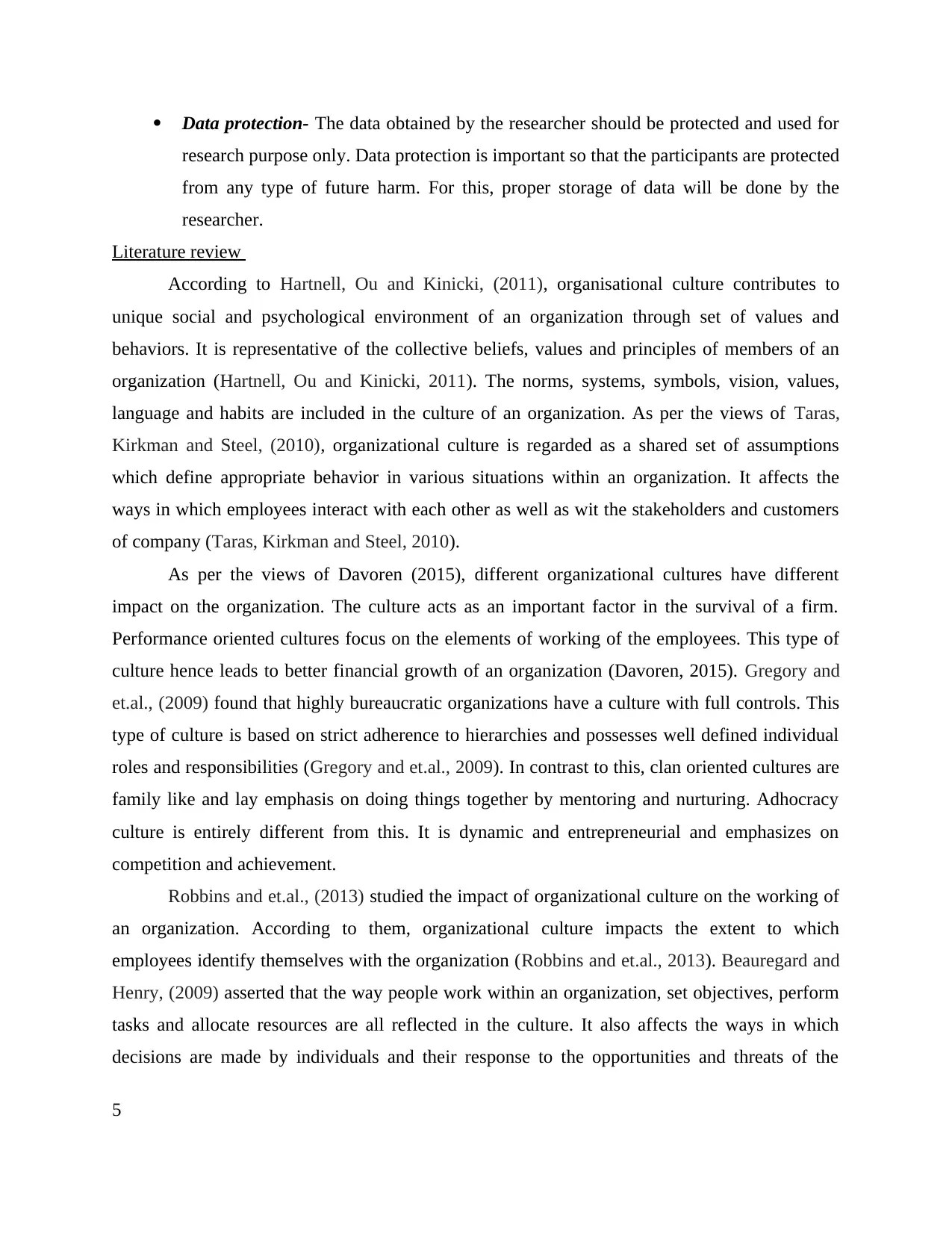
Data protection- The data obtained by the researcher should be protected and used for
research purpose only. Data protection is important so that the participants are protected
from any type of future harm. For this, proper storage of data will be done by the
researcher.
Literature review
According to Hartnell, Ou and Kinicki, (2011), organisational culture contributes to
unique social and psychological environment of an organization through set of values and
behaviors. It is representative of the collective beliefs, values and principles of members of an
organization (Hartnell, Ou and Kinicki, 2011). The norms, systems, symbols, vision, values,
language and habits are included in the culture of an organization. As per the views of Taras,
Kirkman and Steel, (2010), organizational culture is regarded as a shared set of assumptions
which define appropriate behavior in various situations within an organization. It affects the
ways in which employees interact with each other as well as wit the stakeholders and customers
of company (Taras, Kirkman and Steel, 2010).
As per the views of Davoren (2015), different organizational cultures have different
impact on the organization. The culture acts as an important factor in the survival of a firm.
Performance oriented cultures focus on the elements of working of the employees. This type of
culture hence leads to better financial growth of an organization (Davoren, 2015). Gregory and
et.al., (2009) found that highly bureaucratic organizations have a culture with full controls. This
type of culture is based on strict adherence to hierarchies and possesses well defined individual
roles and responsibilities (Gregory and et.al., 2009). In contrast to this, clan oriented cultures are
family like and lay emphasis on doing things together by mentoring and nurturing. Adhocracy
culture is entirely different from this. It is dynamic and entrepreneurial and emphasizes on
competition and achievement.
Robbins and et.al., (2013) studied the impact of organizational culture on the working of
an organization. According to them, organizational culture impacts the extent to which
employees identify themselves with the organization (Robbins and et.al., 2013). Beauregard and
Henry, (2009) asserted that the way people work within an organization, set objectives, perform
tasks and allocate resources are all reflected in the culture. It also affects the ways in which
decisions are made by individuals and their response to the opportunities and threats of the
5
research purpose only. Data protection is important so that the participants are protected
from any type of future harm. For this, proper storage of data will be done by the
researcher.
Literature review
According to Hartnell, Ou and Kinicki, (2011), organisational culture contributes to
unique social and psychological environment of an organization through set of values and
behaviors. It is representative of the collective beliefs, values and principles of members of an
organization (Hartnell, Ou and Kinicki, 2011). The norms, systems, symbols, vision, values,
language and habits are included in the culture of an organization. As per the views of Taras,
Kirkman and Steel, (2010), organizational culture is regarded as a shared set of assumptions
which define appropriate behavior in various situations within an organization. It affects the
ways in which employees interact with each other as well as wit the stakeholders and customers
of company (Taras, Kirkman and Steel, 2010).
As per the views of Davoren (2015), different organizational cultures have different
impact on the organization. The culture acts as an important factor in the survival of a firm.
Performance oriented cultures focus on the elements of working of the employees. This type of
culture hence leads to better financial growth of an organization (Davoren, 2015). Gregory and
et.al., (2009) found that highly bureaucratic organizations have a culture with full controls. This
type of culture is based on strict adherence to hierarchies and possesses well defined individual
roles and responsibilities (Gregory and et.al., 2009). In contrast to this, clan oriented cultures are
family like and lay emphasis on doing things together by mentoring and nurturing. Adhocracy
culture is entirely different from this. It is dynamic and entrepreneurial and emphasizes on
competition and achievement.
Robbins and et.al., (2013) studied the impact of organizational culture on the working of
an organization. According to them, organizational culture impacts the extent to which
employees identify themselves with the organization (Robbins and et.al., 2013). Beauregard and
Henry, (2009) asserted that the way people work within an organization, set objectives, perform
tasks and allocate resources are all reflected in the culture. It also affects the ways in which
decisions are made by individuals and their response to the opportunities and threats of the
5
organization (Beauregard and Henry, 2009). However, it can be critically analysed that their
behavior may also be influenced by personal factors. Linnenluecke and Griffiths (2010) stress
that organizational culture brings behavioral control and encourages the employees to
demonstrate a certain type of behavior which is beneficial for the business. Organizational
culture impacts employees by affecting their level of creativity (Linnenluecke and
Griffiths,2010). It also defines the strength of motivation which is possessed by the employees.
Research methodology
Research design
There are various types of research designs such as exploratory, descriptive, explanatory
etc. (Bhattacharyya, 2009). For The present research, descriptive research design will be used.
This is because descriptive design will help the researcher in depicting the participants in an
accurate manner.
Type of research
The present research on organizational culture at Waitrose will be of qualitative type.
This is because it will help to understand the underlying reasons, motivations and opinions
regarding impact of organizational culture on employee performance (Wyse, 2013). It will also
provide insights into the problem or issue related to employee performance.
Data collection
There are two types of data, namely primary and secondary. Primary data is the first hand
information which is collected by the researcher particularly for specific research. Secondary
datais the information which has already been published in previous studies (Daniel and Sam,
2011). In the present research on organizational culture, both primary and secondary data will be
collected. Primary data will be collected from employees of Waitrose through interviews.
Secondary data will be collected from various sources such as journals, books, online articles,
blogs etc.
Sampling
Sampling is the method of selecting few units from a population. This is required as it is
practically not feasible for the researcher to obtain primary information from each and every
member of population. Therefore, a few members are selected to form a sample which is
representative of the whole population (Crowther and Lancaster, 2012). There are two sampling
6
behavior may also be influenced by personal factors. Linnenluecke and Griffiths (2010) stress
that organizational culture brings behavioral control and encourages the employees to
demonstrate a certain type of behavior which is beneficial for the business. Organizational
culture impacts employees by affecting their level of creativity (Linnenluecke and
Griffiths,2010). It also defines the strength of motivation which is possessed by the employees.
Research methodology
Research design
There are various types of research designs such as exploratory, descriptive, explanatory
etc. (Bhattacharyya, 2009). For The present research, descriptive research design will be used.
This is because descriptive design will help the researcher in depicting the participants in an
accurate manner.
Type of research
The present research on organizational culture at Waitrose will be of qualitative type.
This is because it will help to understand the underlying reasons, motivations and opinions
regarding impact of organizational culture on employee performance (Wyse, 2013). It will also
provide insights into the problem or issue related to employee performance.
Data collection
There are two types of data, namely primary and secondary. Primary data is the first hand
information which is collected by the researcher particularly for specific research. Secondary
datais the information which has already been published in previous studies (Daniel and Sam,
2011). In the present research on organizational culture, both primary and secondary data will be
collected. Primary data will be collected from employees of Waitrose through interviews.
Secondary data will be collected from various sources such as journals, books, online articles,
blogs etc.
Sampling
Sampling is the method of selecting few units from a population. This is required as it is
practically not feasible for the researcher to obtain primary information from each and every
member of population. Therefore, a few members are selected to form a sample which is
representative of the whole population (Crowther and Lancaster, 2012). There are two sampling
6
⊘ This is a preview!⊘
Do you want full access?
Subscribe today to unlock all pages.
Trusted by 1+ million students worldwide
methods, probabilistic and non probabilistic. In this research on organizational culture,
probability sampling method has been used. Sample of 20 employees will be selected by simple
random sampling technique.
Data analysis
The researcher will analyse the data by using both qualitative and quantitative methods.
For qualitative analysis, thematic technique will be used. In contrast to this, for carrying out
quantitative analysis, tables and charts will be used for interpreting the data.
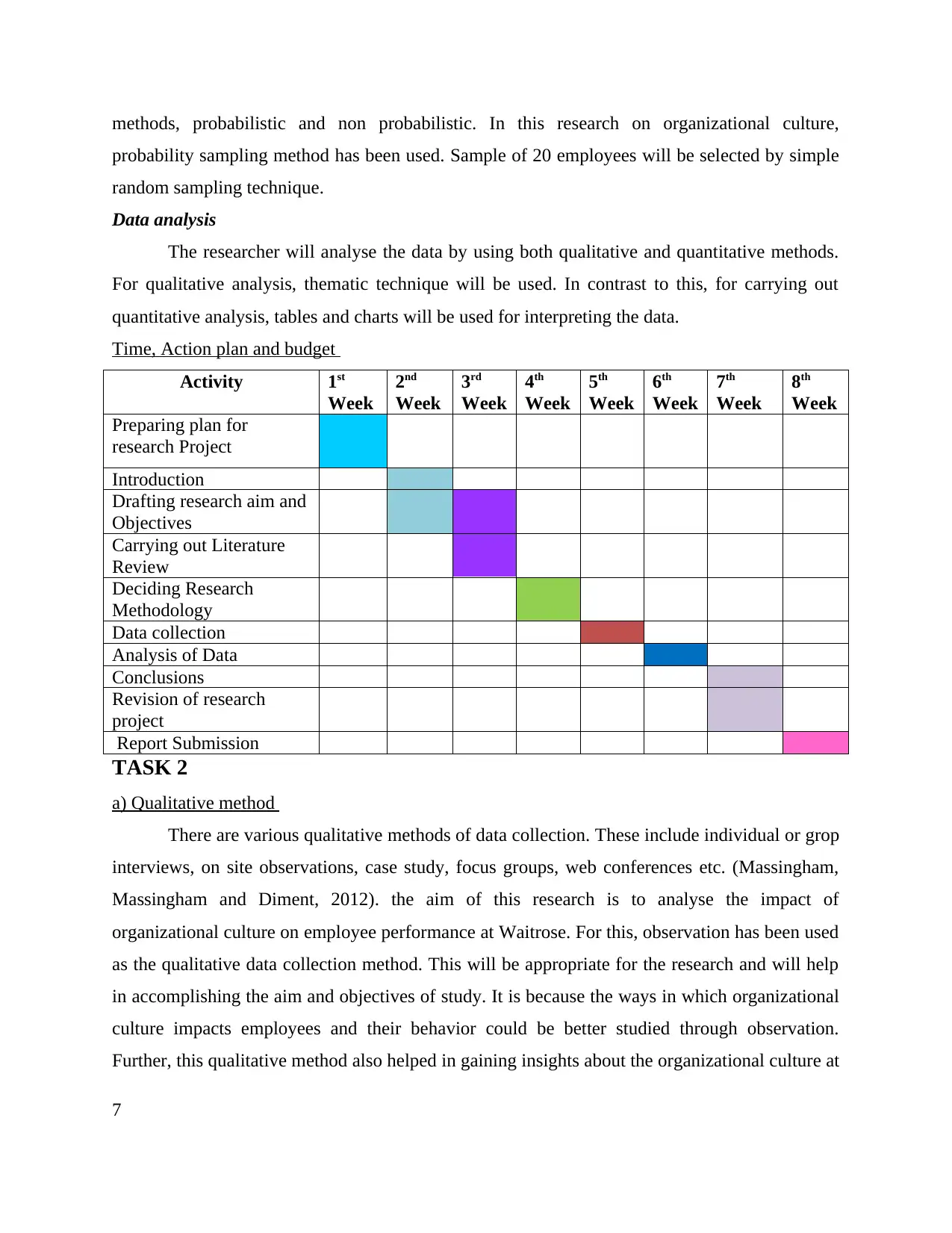
Time, Action plan and budget
Activity 1st
Week
2nd
Week
3rd
Week
4th
Week
5th
Week
6th
Week
7th
Week
8th
Week
Preparing plan for
research Project
Introduction
Drafting research aim and
Objectives
Carrying out Literature
Review
Deciding Research
Methodology
Data collection
Analysis of Data
Conclusions
Revision of research
project
Report Submission
TASK 2
a) Qualitative method
There are various qualitative methods of data collection. These include individual or grop
interviews, on site observations, case study, focus groups, web conferences etc. (Massingham,
Massingham and Diment, 2012). the aim of this research is to analyse the impact of
organizational culture on employee performance at Waitrose. For this, observation has been used
as the qualitative data collection method. This will be appropriate for the research and will help
in accomplishing the aim and objectives of study. It is because the ways in which organizational
culture impacts employees and their behavior could be better studied through observation.
Further, this qualitative method also helped in gaining insights about the organizational culture at
7
probability sampling method has been used. Sample of 20 employees will be selected by simple
random sampling technique.
Data analysis
The researcher will analyse the data by using both qualitative and quantitative methods.
For qualitative analysis, thematic technique will be used. In contrast to this, for carrying out
quantitative analysis, tables and charts will be used for interpreting the data.
Time, Action plan and budget
Activity 1st
Week
2nd
Week
3rd
Week
4th
Week
5th
Week
6th
Week
7th
Week
8th
Week
Preparing plan for
research Project
Introduction
Drafting research aim and
Objectives
Carrying out Literature
Review
Deciding Research
Methodology
Data collection
Analysis of Data
Conclusions
Revision of research
project
Report Submission
TASK 2
a) Qualitative method
There are various qualitative methods of data collection. These include individual or grop
interviews, on site observations, case study, focus groups, web conferences etc. (Massingham,
Massingham and Diment, 2012). the aim of this research is to analyse the impact of
organizational culture on employee performance at Waitrose. For this, observation has been used
as the qualitative data collection method. This will be appropriate for the research and will help
in accomplishing the aim and objectives of study. It is because the ways in which organizational
culture impacts employees and their behavior could be better studied through observation.
Further, this qualitative method also helped in gaining insights about the organizational culture at
7
Paraphrase This Document
Need a fresh take? Get an instant paraphrase of this document with our AI Paraphraser
Waitrose and its various aspects. Observation was made through cameras which provided
detailed information about the employee interactions at Waitrose, their behavior and responses to
organizational policies and work practices. Observation method assisted in collecting sufficient
qualitative data regarding the research study.
b) Quantitative method
There are various quantitative methods with the help of which data can be collected.
These are survey, experiments, questionnaire,, correlation etc. (McGrath and O'Toole, 2012). For
this research on organizational culture at Waitrose, questionnaire has been used for collecting
data. This method was used because large amount of information can be collected with it. Also,
the researcher could collect information from any number of people with limited affect on its
reliability and validity. Moreover, questionnaire provided another benefit that the results could
be quickly and easily quantified (Advantages and Disadvantages of using Questionnaires, 2012).
Another reason for using questionnaire method was that after quantifying the data obtained from
it, the researcher could compare and contrast and measure change. However, there is a
disadvantage of using this method as well. The respondents may ignore certain questions or they
may also be completed incorrectly. However, the data obtained from questionnaire is relatively
easy to analyse.
C) Type of sample
Sampling
Simple random sampling technique was used for selecting a sample of 20 employees.
This sample was used because it could provide relevant information about the ways in which
culture of Waitrose impacts their performance.
Project validity and reliability
Validity of the project was maintained by using appropriate tools for collecting data. The
tools used such as observation and questionnaire, served the purpose for which the were
uti8lized. Useful information was provided by these tool. Similarly, reliability of the study is the
degree to which similar results are obtained if a study is conducted again in future (Fiegen,
2010). The researcher accounted for project reliability by using authenticated sources for
obtained data.
Limitations of methodology
8
detailed information about the employee interactions at Waitrose, their behavior and responses to
organizational policies and work practices. Observation method assisted in collecting sufficient
qualitative data regarding the research study.
b) Quantitative method
There are various quantitative methods with the help of which data can be collected.
These are survey, experiments, questionnaire,, correlation etc. (McGrath and O'Toole, 2012). For
this research on organizational culture at Waitrose, questionnaire has been used for collecting
data. This method was used because large amount of information can be collected with it. Also,
the researcher could collect information from any number of people with limited affect on its
reliability and validity. Moreover, questionnaire provided another benefit that the results could
be quickly and easily quantified (Advantages and Disadvantages of using Questionnaires, 2012).
Another reason for using questionnaire method was that after quantifying the data obtained from
it, the researcher could compare and contrast and measure change. However, there is a
disadvantage of using this method as well. The respondents may ignore certain questions or they
may also be completed incorrectly. However, the data obtained from questionnaire is relatively
easy to analyse.
C) Type of sample
Sampling
Simple random sampling technique was used for selecting a sample of 20 employees.
This sample was used because it could provide relevant information about the ways in which
culture of Waitrose impacts their performance.
Project validity and reliability
Validity of the project was maintained by using appropriate tools for collecting data. The
tools used such as observation and questionnaire, served the purpose for which the were
uti8lized. Useful information was provided by these tool. Similarly, reliability of the study is the
degree to which similar results are obtained if a study is conducted again in future (Fiegen,
2010). The researcher accounted for project reliability by using authenticated sources for
obtained data.
Limitations of methodology
8
The following are three limitations of methodology:
Qualitative method such as interview was not used in the research. This would have
limited the information as interviews provide detailed information about the respondents.
The researcher obtained primary data from only the employees. Views of management
were not considered. This could be a limitation as managers of Waitrose would have
provided useful information about the impact of organizational culture on employee
performance. Waitrose is a large organization and hence a sample of 20 respondents would act as a
limitation of the methodology.
Practical issues
The following practical issues were encountered by the researcher:
The respondents were hesitant to provide information on the impact of organizational
culture on employee performance. They were informed about the purpose of research
and were assured that the information will be kept confidential and anonymity will be
maintained.
Another practical issue faced was restricted access to some online sites which contained
relevant information. These sites were accessed by obtaining permission.
TASK 3
a) analysis for Qualitative method
The qualitative method used for collecting data was onsite observation with the help of
camera. For evaluating this data, thematic technique was used. The data obtained has been
evaluated in the form of the following themes:
Theme 1: Waitrose has a strong culture which is integral part of the company
From the observation, it was found that the organizational culture is Waitrose is strong
and is depicted in various forms. Most of the staff a the organization wears the same uniform
except the senior management. It can be critically analysed that this difference creates a culture
of hierarchy and brings distinction between the senior management and other employees.
However, same uniform for all indicates that Waitrose follows and believes in the culture of
unity. Everyone on the organization is treated equal. The staff is treated as a partner of the
business which makes them feel significant.
9
Qualitative method such as interview was not used in the research. This would have
limited the information as interviews provide detailed information about the respondents.
The researcher obtained primary data from only the employees. Views of management
were not considered. This could be a limitation as managers of Waitrose would have
provided useful information about the impact of organizational culture on employee
performance. Waitrose is a large organization and hence a sample of 20 respondents would act as a
limitation of the methodology.
Practical issues
The following practical issues were encountered by the researcher:
The respondents were hesitant to provide information on the impact of organizational
culture on employee performance. They were informed about the purpose of research
and were assured that the information will be kept confidential and anonymity will be
maintained.
Another practical issue faced was restricted access to some online sites which contained
relevant information. These sites were accessed by obtaining permission.
TASK 3
a) analysis for Qualitative method
The qualitative method used for collecting data was onsite observation with the help of
camera. For evaluating this data, thematic technique was used. The data obtained has been
evaluated in the form of the following themes:
Theme 1: Waitrose has a strong culture which is integral part of the company
From the observation, it was found that the organizational culture is Waitrose is strong
and is depicted in various forms. Most of the staff a the organization wears the same uniform
except the senior management. It can be critically analysed that this difference creates a culture
of hierarchy and brings distinction between the senior management and other employees.
However, same uniform for all indicates that Waitrose follows and believes in the culture of
unity. Everyone on the organization is treated equal. The staff is treated as a partner of the
business which makes them feel significant.
9
⊘ This is a preview!⊘
Do you want full access?
Subscribe today to unlock all pages.
Trusted by 1+ million students worldwide
Theme 2: There is nurturing culture at Waitrose
From the observation, it was found that the culture followed at Waitrose emphasizes on
nurturing and caring for the staff. It can be analysed that Waitrose believes in paying attention to
the staff and their concerns. The senior management has perception that if they care for the staff,
the employees feel valued and work more productively. They also provide customers with good
service. Another visible aspect of Waitrose culture is that same level of benefits, rewards and
bonus is obtained by all the partners. However, it can be critically evaluated that culture of
equality may be demotivating factor for some employees who work harder than others and
contribute more time to the company. But, it was observed that the company makes the staff
happy by ensuring that the benefits from profits and other rewards are provided to them.
Everyone works as a part of a single team which motivates the employees to work harder and
better.
Theme 3: Role culture at Waitrose improves the efficiency of employees
From on site observation, it was found that each member at Waitrose has a specific job
role. The person who is a level higher in the hierarchy assigns this role to the subordinate. Hence,
the manager delegates the work downwards. From this it can be analysed that there is role
culture at Waitrose. The partners or staff are also allowed to provide their opinions regarding
significant decisions.
b) Analysis for quantitative method
Questionnaire was used as a quantitative method. For analysing and interpreting the data
obtained from this quantitative method, charts and tables have been used.
Role culture helps in improving efficiency
Responses No. of employees Percentage
Yes 12 60
No 5 25
Can't say 3 15
10
From the observation, it was found that the culture followed at Waitrose emphasizes on
nurturing and caring for the staff. It can be analysed that Waitrose believes in paying attention to
the staff and their concerns. The senior management has perception that if they care for the staff,
the employees feel valued and work more productively. They also provide customers with good
service. Another visible aspect of Waitrose culture is that same level of benefits, rewards and
bonus is obtained by all the partners. However, it can be critically evaluated that culture of
equality may be demotivating factor for some employees who work harder than others and
contribute more time to the company. But, it was observed that the company makes the staff
happy by ensuring that the benefits from profits and other rewards are provided to them.
Everyone works as a part of a single team which motivates the employees to work harder and
better.
Theme 3: Role culture at Waitrose improves the efficiency of employees
From on site observation, it was found that each member at Waitrose has a specific job
role. The person who is a level higher in the hierarchy assigns this role to the subordinate. Hence,
the manager delegates the work downwards. From this it can be analysed that there is role
culture at Waitrose. The partners or staff are also allowed to provide their opinions regarding
significant decisions.
b) Analysis for quantitative method
Questionnaire was used as a quantitative method. For analysing and interpreting the data
obtained from this quantitative method, charts and tables have been used.
Role culture helps in improving efficiency
Responses No. of employees Percentage
Yes 12 60
No 5 25
Can't say 3 15
10
Paraphrase This Document
Need a fresh take? Get an instant paraphrase of this document with our AI Paraphraser
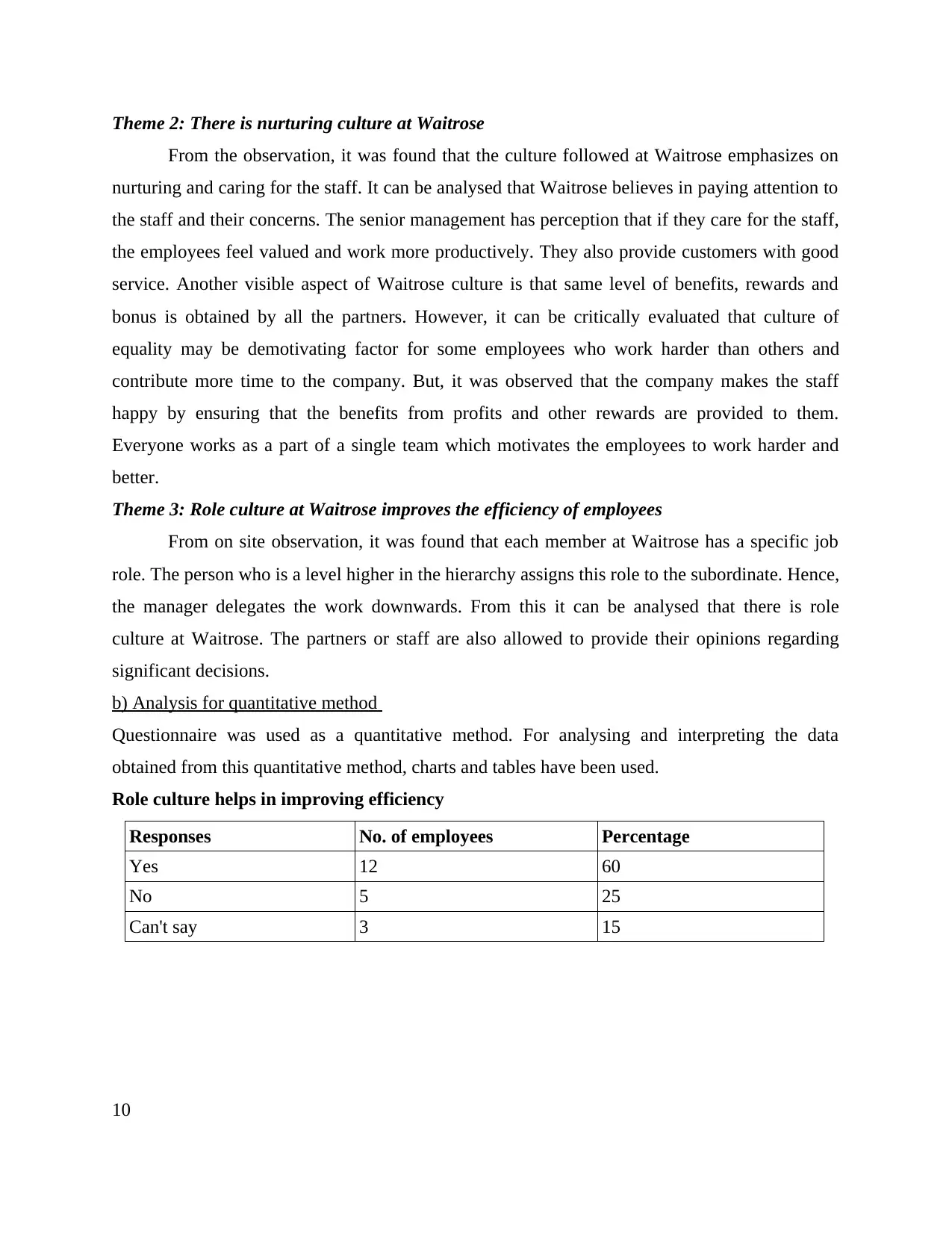
Interpretation and analysis: From the table it can be interpreted that 60 per cent of respondents
feel that role culture at Waitrose helps in improving their efficiency. Only 15 per cent
participants did not have any specific opinion about role culture and its impact on efficiency. It
can be analysed that as each member plays a specific role, the employees at Waitrose work as a
single team. If any member of the team as as a slack member or does not work efficiently, he
knows that the other members would have to work even harder because of him. This encourages
every staff member to work effectively thus improving their efficiency.
Culture at Waitrose helps increase creativity
Responses No. of employees Percentage
Yes 11 55
No 4 20
Can't say 5 25
11
Yes No Can't say
0
2
4
6
8
10
12
12
5
3
feel that role culture at Waitrose helps in improving their efficiency. Only 15 per cent
participants did not have any specific opinion about role culture and its impact on efficiency. It
can be analysed that as each member plays a specific role, the employees at Waitrose work as a
single team. If any member of the team as as a slack member or does not work efficiently, he
knows that the other members would have to work even harder because of him. This encourages
every staff member to work effectively thus improving their efficiency.
Culture at Waitrose helps increase creativity
Responses No. of employees Percentage
Yes 11 55
No 4 20
Can't say 5 25
11
Yes No Can't say
0
2
4
6
8
10
12
12
5
3
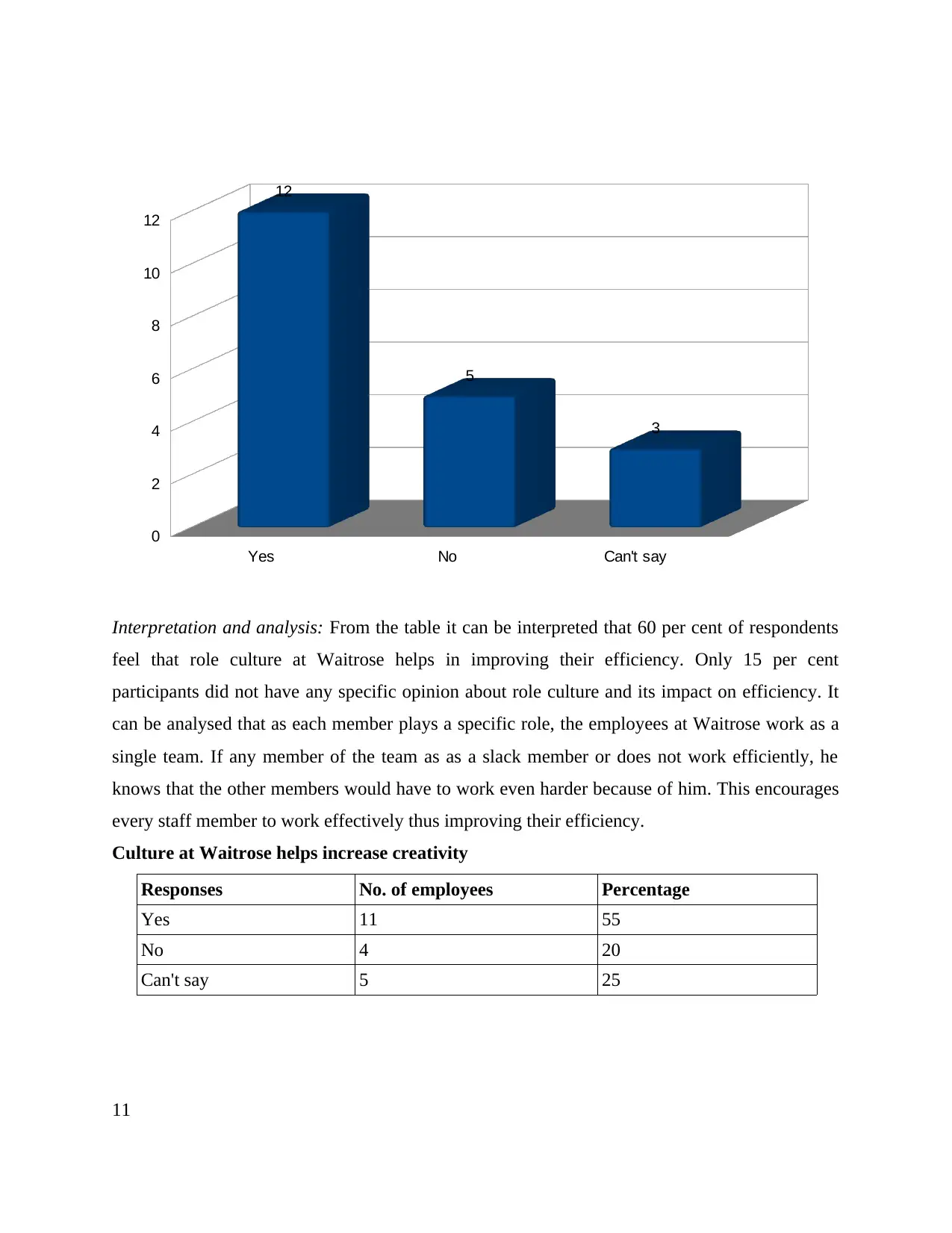
Interpretation and analysis: from the table it can be interpreted that 55 per cent of respondent
have perception that the culture at Waitrose helps in increasing their creativity. Only 20 per cent
think that the culture does not promotes creativity. From the responses, it can be analysed that
majority of the respondents feel that Waitrose culture promotes creativity. As the employees
have a say in the significant decisions of the company, they are encouraged to place their views
and opinions before the management. This gives them confidence and makes them feel valued.
Creativity is also enhanced on the basis of this.
Culture at Waitrose efficient at guiding employees about the appropriate behavior and
ethical values
Responses No. of employees Percentage
Yes 9 45
No 6 30
Can't say 5 25
12
Yes No Can't say
0
2
4
6
8
10
12 11
4
5 Column B
have perception that the culture at Waitrose helps in increasing their creativity. Only 20 per cent
think that the culture does not promotes creativity. From the responses, it can be analysed that
majority of the respondents feel that Waitrose culture promotes creativity. As the employees
have a say in the significant decisions of the company, they are encouraged to place their views
and opinions before the management. This gives them confidence and makes them feel valued.
Creativity is also enhanced on the basis of this.
Culture at Waitrose efficient at guiding employees about the appropriate behavior and
ethical values
Responses No. of employees Percentage
Yes 9 45
No 6 30
Can't say 5 25
12
Yes No Can't say
0
2
4
6
8
10
12 11
4
5 Column B
⊘ This is a preview!⊘
Do you want full access?
Subscribe today to unlock all pages.
Trusted by 1+ million students worldwide

1 out of 19


Related Documents


Your All-in-One AI-Powered Toolkit for Academic Success.
+13062052269
info@desklib.com
Available 24*7 on WhatsApp / Email
![[object Object]](/_next/static/media/star-bottom.7253800d.svg)
Unlock your academic potential
Copyright © 2020–2026 A2Z Services. All Rights Reserved. Developed and managed by ZUCOL.