Impact of E-Business Strategies on Organizational Processes - Report

Verified

Added on  2020/02/19

|4
|722
|171
Report
AI Summary
This report delves into the impact of e-business strategies on organizational processes, emphasizing the role of Information and Communication Technologies (ICTs) in supporting business operations. It highlights the significance of electronic commerce and its influence on supply chain management, organizational collaboration, and overall business performance. The study examines the effects of e-business technologies, revenue models, and both intra- and inter-organizational collaboration on key performance indicators. Findings reveal the complex relationship between these elements and the importance of promoting internal collaboration and investing in enabling technologies. The report also discusses the significance of a well-defined revenue model for a business's success, covering aspects like identifying revenue sources and pricing strategies. The document includes references to support its arguments and findings, making it a valuable resource for understanding e-business strategies and their implications for organizational success.

Document Page
Running head: E PROTFOLIO
E-Portfolio
Name of the Student
Name of the University
Authors Note
tabler-icon-diamond-filled.svg

Paraphrase This Document

Need a fresh take? Get an instant paraphrase of this document with our AI Paraphraser
Document Page
1
E-PORTFOLIO
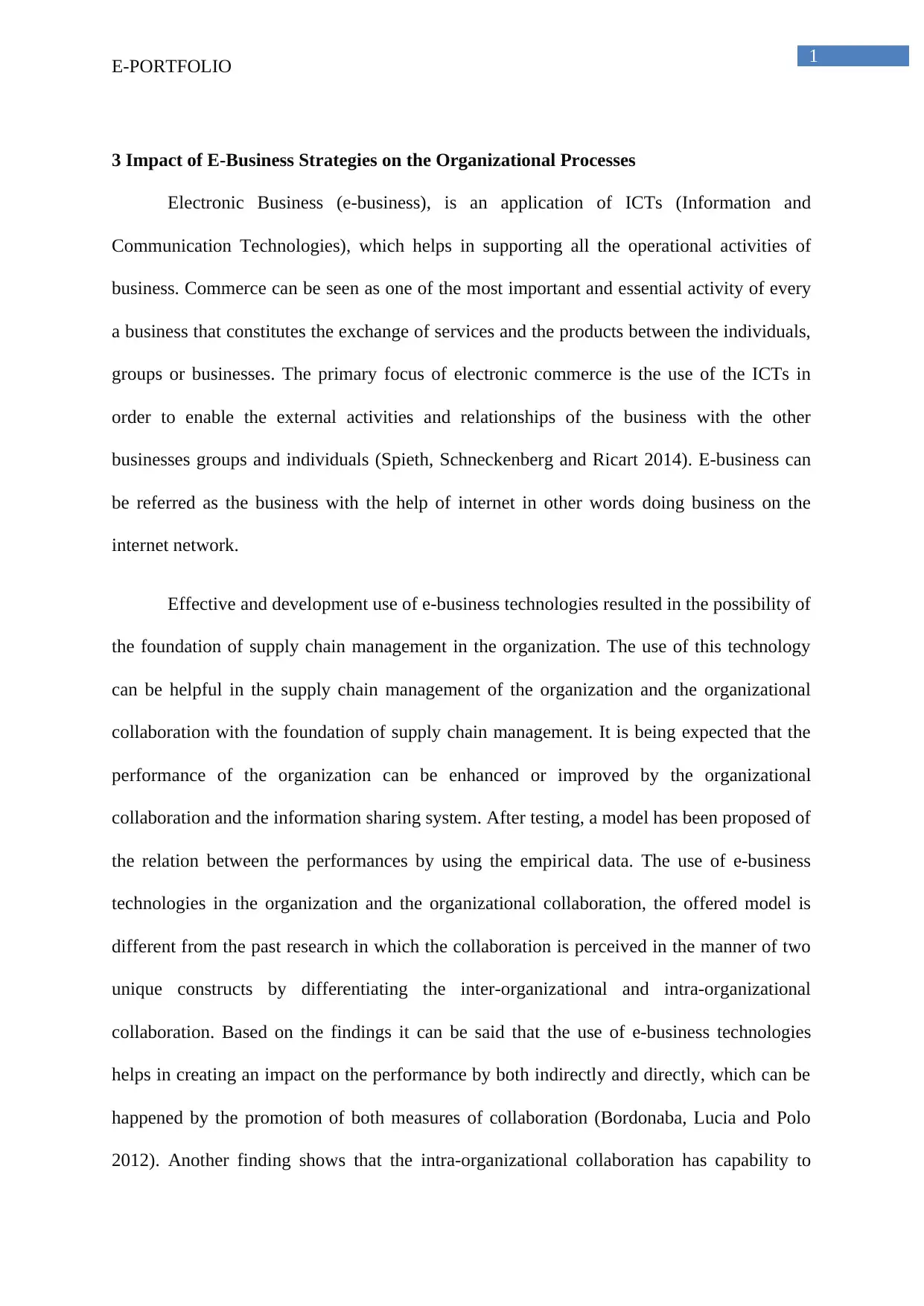
3 Impact of E-Business Strategies on the Organizational Processes
Electronic Business (e-business), is an application of ICTs (Information and
Communication Technologies), which helps in supporting all the operational activities of
business. Commerce can be seen as one of the most important and essential activity of every
a business that constitutes the exchange of services and the products between the individuals,
groups or businesses. The primary focus of electronic commerce is the use of the ICTs in
order to enable the external activities and relationships of the business with the other
businesses groups and individuals (Spieth, Schneckenberg and Ricart 2014). E-business can
be referred as the business with the help of internet in other words doing business on the
internet network.
Effective and development use of e-business technologies resulted in the possibility of
the foundation of supply chain management in the organization. The use of this technology
can be helpful in the supply chain management of the organization and the organizational
collaboration with the foundation of supply chain management. It is being expected that the
performance of the organization can be enhanced or improved by the organizational
collaboration and the information sharing system. After testing, a model has been proposed of
the relation between the performances by using the empirical data. The use of e-business
technologies in the organization and the organizational collaboration, the offered model is
different from the past research in which the collaboration is perceived in the manner of two
unique constructs by differentiating the inter-organizational and intra-organizational
collaboration. Based on the findings it can be said that the use of e-business technologies
helps in creating an impact on the performance by both indirectly and directly, which can be
happened by the promotion of both measures of collaboration (Bordonaba, Lucia and Polo
2012). Another finding shows that the intra-organizational collaboration has capability to
Document Page
2
E-PORTFOLIO
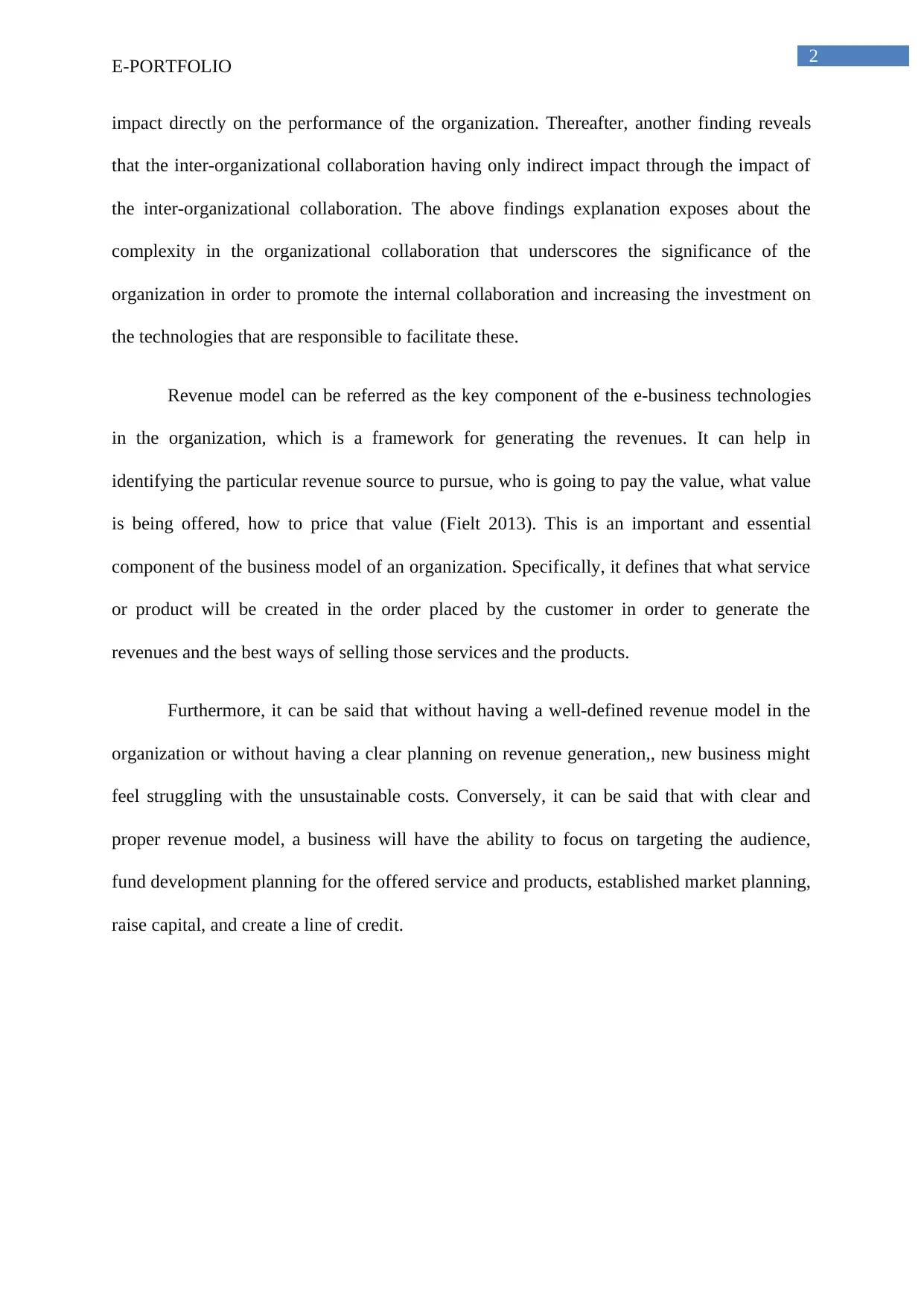
impact directly on the performance of the organization. Thereafter, another finding reveals
that the inter-organizational collaboration having only indirect impact through the impact of
the inter-organizational collaboration. The above findings explanation exposes about the
complexity in the organizational collaboration that underscores the significance of the
organization in order to promote the internal collaboration and increasing the investment on
the technologies that are responsible to facilitate these.
Revenue model can be referred as the key component of the e-business technologies
in the organization, which is a framework for generating the revenues. It can help in
identifying the particular revenue source to pursue, who is going to pay the value, what value
is being offered, how to price that value (Fielt 2013). This is an important and essential
component of the business model of an organization. Specifically, it defines that what service
or product will be created in the order placed by the customer in order to generate the
revenues and the best ways of selling those services and the products.
Furthermore, it can be said that without having a well-defined revenue model in the
organization or without having a clear planning on revenue generation,, new business might
feel struggling with the unsustainable costs. Conversely, it can be said that with clear and
proper revenue model, a business will have the ability to focus on targeting the audience,
fund development planning for the offered service and products, established market planning,
raise capital, and create a line of credit.
Document Page
3
E-PORTFOLIO
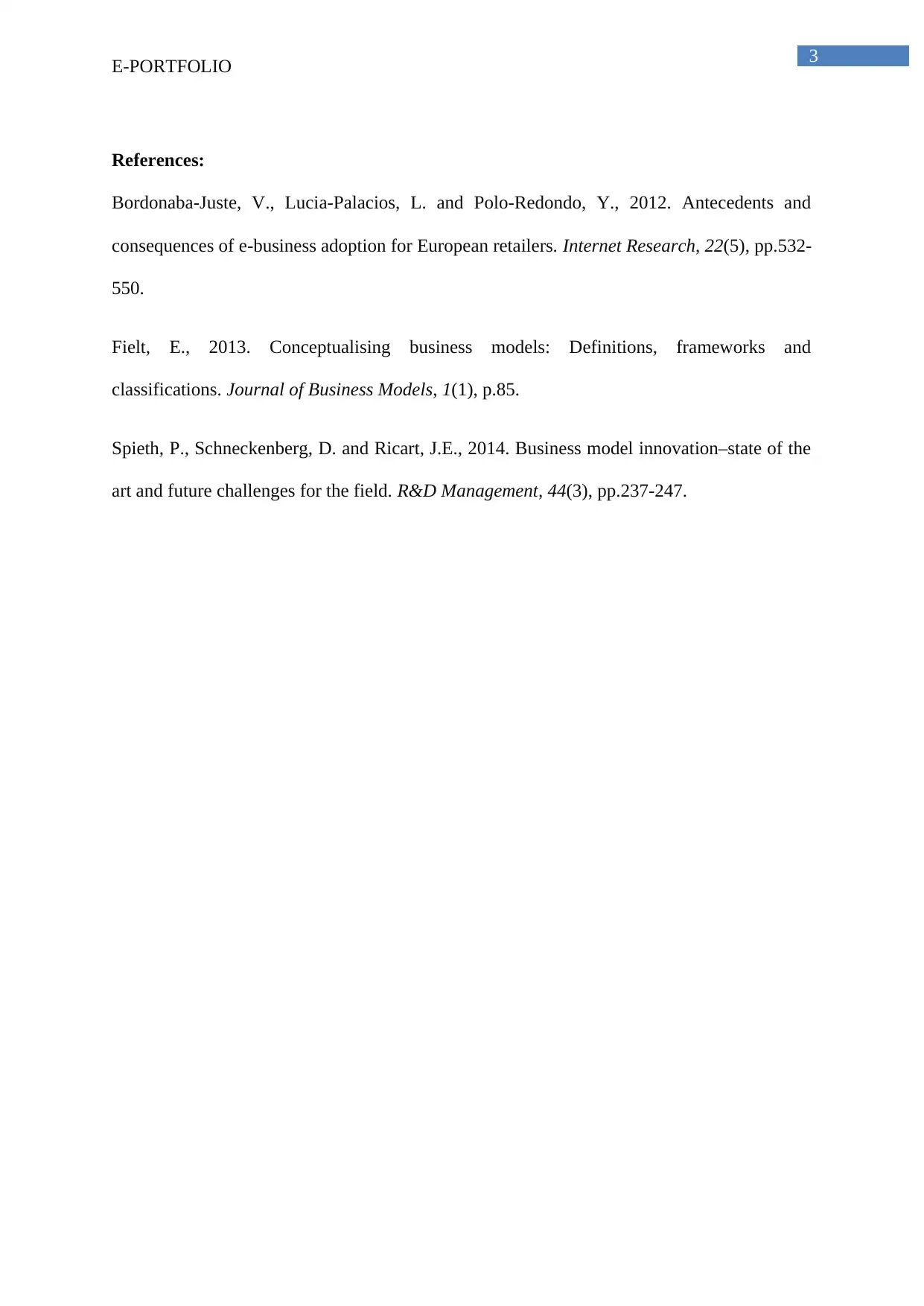
References:
Bordonaba-Juste, V., Lucia-Palacios, L. and Polo-Redondo, Y., 2012. Antecedents and
consequences of e-business adoption for European retailers. Internet Research, 22(5), pp.532-
550.
Fielt, E., 2013. Conceptualising business models: Definitions, frameworks and
classifications. Journal of Business Models, 1(1), p.85.
Spieth, P., Schneckenberg, D. and Ricart, J.E., 2014. Business model innovation–state of the
art and future challenges for the field. R&D Management, 44(3), pp.237-247.
chevron_up_icon
1 out of 4
circle_padding
hide_on_mobile
zoom_out_icon
[object Object]