Impact of Gender Discrimination: A Comprehensive Research Project
VerifiedAdded on 2020/07/23
|19
|5934
|24
Report
AI Summary
This research project examines gender-based discrimination, a prevalent issue globally. It explores the concept, its impact on society, and the rise of inequality. The project investigates the rationale behind the research, identifying the impact of discrimination on individuals and society, and analyzes the methodology, including research design, philosophy, and strategy. The study also reviews existing literature on gender discrimination, focusing on workplace inequality, social conflicts, and the challenges faced by women. Furthermore, it delves into ethical considerations and limitations, including the critical nature of data collection and the potential impact on respondents' emotions. The project's findings and analysis reveal insights into the factors contributing to gender discrimination and its consequences, concluding with recommendations aimed at protecting human interests and boosting the morale of women worldwide.

RESEARCH
PROJECT
PROJECT

Paraphrase This Document
Need a fresh take? Get an instant paraphrase of this document with our AI Paraphraser

Table of Contents
CHAPTER 1: INTRODUCTION............................................................................................................4
CHAPTER 2: LITERATURE REVIEW.................................................................................................6
CHAPTER 3: METHODOLOGY ..........................................................................................................7
CHAPTER 4: FINDINGS AND ANALYSIS.........................................................................................9
CHAPTER 5: CONCLUSION AND RECOMMENDATION............................................................15
REFERENCES.......................................................................................................................................16
CHAPTER 1: INTRODUCTION............................................................................................................4
CHAPTER 2: LITERATURE REVIEW.................................................................................................6
CHAPTER 3: METHODOLOGY ..........................................................................................................7
CHAPTER 4: FINDINGS AND ANALYSIS.........................................................................................9
CHAPTER 5: CONCLUSION AND RECOMMENDATION............................................................15
REFERENCES.......................................................................................................................................16
CHAPTER 1: INTRODUCTION
Research project is collection of information on one given topic, in this research the
scholar will prepare research on gender based discrimination a concept which is followed in
almost all countries across the globe. In accordance to sexism women’s are given less grade
of work in comparison to men’s and these are the factors which are giving arise to the
concept of inequality and discrimination. Further, it will outline the proposal of research
which will focus on Research aims and rationale behind conducting research that is to
identify the impact of gender based discrimination on society and people. Moreover, it will
evaluate the methods involved in research methodology that is Research, strategy, approach,
philosophy, design, data collection methods and data analysis.
Apart from this, it analysed the ethical consideration considered by scholar when
planning a research project that is consideration of on ethical practices and values which
focus on human emotions and feelings. In addition, the report will outline the findings and
analysis identified by researcher on Discrimination on the basis of gender. Thus, it will
determine the recommendation on the basis of collected and analysed information on gender
based discrimination which will assit the society in protecting the interest of all humans and
will be benifical in boosting the morale of womes across the globe.
1.1 Study Background
Gender based discrimination is the concept which is carried and followed by many
countries and communities across the globe. There are various studies which denote that
community identifies people and groups on the basis of their sex and will judge them
inequitable. The people who are discriminated on the basis of gender are specially females
are considered as victims as they have no right to work and make decisions. According to
male dominating society of world women’s are meant to work for house and children’s and
are not allowed to move out and work for their interest.
1.2 Rationale and Research Question
The rationale behind conducting this research is to identify the impact of gender based
discrimination on society and people. It will assist in evaluating various factors of
discrimination which are giving rise to concept and will help in determining the people and
their mentality who are supporting sexism in society. Further, it is important for the scholar to
Research project is collection of information on one given topic, in this research the
scholar will prepare research on gender based discrimination a concept which is followed in
almost all countries across the globe. In accordance to sexism women’s are given less grade
of work in comparison to men’s and these are the factors which are giving arise to the
concept of inequality and discrimination. Further, it will outline the proposal of research
which will focus on Research aims and rationale behind conducting research that is to
identify the impact of gender based discrimination on society and people. Moreover, it will
evaluate the methods involved in research methodology that is Research, strategy, approach,
philosophy, design, data collection methods and data analysis.
Apart from this, it analysed the ethical consideration considered by scholar when
planning a research project that is consideration of on ethical practices and values which
focus on human emotions and feelings. In addition, the report will outline the findings and
analysis identified by researcher on Discrimination on the basis of gender. Thus, it will
determine the recommendation on the basis of collected and analysed information on gender
based discrimination which will assit the society in protecting the interest of all humans and
will be benifical in boosting the morale of womes across the globe.
1.1 Study Background
Gender based discrimination is the concept which is carried and followed by many
countries and communities across the globe. There are various studies which denote that
community identifies people and groups on the basis of their sex and will judge them
inequitable. The people who are discriminated on the basis of gender are specially females
are considered as victims as they have no right to work and make decisions. According to
male dominating society of world women’s are meant to work for house and children’s and
are not allowed to move out and work for their interest.
1.2 Rationale and Research Question
The rationale behind conducting this research is to identify the impact of gender based
discrimination on society and people. It will assist in evaluating various factors of
discrimination which are giving rise to concept and will help in determining the people and
their mentality who are supporting sexism in society. Further, it is important for the scholar to
⊘ This is a preview!⊘
Do you want full access?
Subscribe today to unlock all pages.

Trusted by 1+ million students worldwide
determine the factors which are arising to due to gender based discrimination such as, social
conflicts, inequality, etc.
Research Question
1. What is discrimination on the base of gender?
2. What is the in connection between gender discrimination and inequality?
3. What are the major challenges which arise due to gender based discrimination?
4. Which practices in organisation leads to discrimination?
5. What are the major risks which are arising due to gender based discrimination?
1.3 Aims and Objectives
Aim: To identity the impact of discrimination on the basis of gender.
Research Objectives
1. To analyse the meaning and concept of discrimination on the base of gender.
2. To determine the connection between gender discrimination and inequality.
3. To evaluate the major challenges which arise due to gender based discrimination.
4. To demonstrate the practices in organisations leads to discrimination.
5. To identify major risks which are arising due to gender based discrimination.
1.4 Study Approach
Ethical Issues: When conducting research, the scholar will focus on keeping in mind
the ethical practices and values which focus on human emotions and feelings. It will be the
duty of scholar to conduct interview win such as manner that the questions and answers do no
impact the emotions of respondents (Geerts, 2011). Discrimination is the critical topic which
has been faced by almost all individuals and there for when forming and asking questions it is
the duty of author to keep in mind ethical consideration which assist in protecting wrong
formation of questionnaire. Thus, when talking about discrimination on the basis of gender,
ethical issues are normal as t s the most concept which is been followed by the society across
the globe.
Limitation: The limitation of the research will be its cost and time majorly because
the researcher has less time to prepare interview and analyse the data collected with the help
conflicts, inequality, etc.
Research Question
1. What is discrimination on the base of gender?
2. What is the in connection between gender discrimination and inequality?
3. What are the major challenges which arise due to gender based discrimination?
4. Which practices in organisation leads to discrimination?
5. What are the major risks which are arising due to gender based discrimination?
1.3 Aims and Objectives
Aim: To identity the impact of discrimination on the basis of gender.
Research Objectives
1. To analyse the meaning and concept of discrimination on the base of gender.
2. To determine the connection between gender discrimination and inequality.
3. To evaluate the major challenges which arise due to gender based discrimination.
4. To demonstrate the practices in organisations leads to discrimination.
5. To identify major risks which are arising due to gender based discrimination.
1.4 Study Approach
Ethical Issues: When conducting research, the scholar will focus on keeping in mind
the ethical practices and values which focus on human emotions and feelings. It will be the
duty of scholar to conduct interview win such as manner that the questions and answers do no
impact the emotions of respondents (Geerts, 2011). Discrimination is the critical topic which
has been faced by almost all individuals and there for when forming and asking questions it is
the duty of author to keep in mind ethical consideration which assist in protecting wrong
formation of questionnaire. Thus, when talking about discrimination on the basis of gender,
ethical issues are normal as t s the most concept which is been followed by the society across
the globe.
Limitation: The limitation of the research will be its cost and time majorly because
the researcher has less time to prepare interview and analyse the data collected with the help
Paraphrase This Document
Need a fresh take? Get an instant paraphrase of this document with our AI Paraphraser
of respondents. Further, the limitation is the topic is when the scholar is researching about
Gender based discrimination the individual will have to focused on the data collection as the
author cannot make hypothetical assumption in the topic (Meskendahl, 2010). The topic it elf
is very critical when comes to seeking information. Apart from this it is the duty of scholar to
collect and evaluate information and data in specified period of time with efficiency and
effectiveness in work.
Reliable and viable: This will ensure that the data and information collected by the
scholar will be reliable and viable in order to make the research project effective and
efficiency.
1.5 Case Study
The case study over Gender based discrimination denotes that it is differentiation between
male and female worldwide. The individuals are judged according to their gender and not on
their interest, working efficiency and ability to stand out in competition. Moreover, it is
generally seen at workplace, there are various places and organisation in which women’s are
not even allowed to work. Women’s have no say in management and decision making
process (Miller, Birch and Jessop. eds., 2012). In accordance to male dominating society
women’s are mean for doing household work and to look after kids.
CHAPTER 2: LITERATURE REVIEW
Discrimination is the basis of Gender is the phenomenon which is carried and
followed by many people across the globe. In this the differentiation and inequality is
established among on the basis of their sex. According to Vujaklija, Hren and Marušić, 2010,
the major discrimination on the basis of Gender is seen at workplace, there are various places
and organisation in which women’s are not even allowed to work and if some of them allow
than the community do not give female employee equal preferences as per the male workers.
In accordance to the concept has raised so much there has been so many equality campaigns
which are focused on supporting and seeking the right for women. In contrast, Belot, Bhaskar
and Van De Ven, 2012, has stated that women’s are given less grade of work in comparison
to men’s and these are the factors which are giving arise to the concept of inequality and
discrimination. In addition to this the most discrimination these days is noticed in the travel
and tourism where the trips are organised on the basis of Gender. Further, this phenomenon is
the reason behind increasing unethical practices in several countries such as harassment,
Gender based discrimination the individual will have to focused on the data collection as the
author cannot make hypothetical assumption in the topic (Meskendahl, 2010). The topic it elf
is very critical when comes to seeking information. Apart from this it is the duty of scholar to
collect and evaluate information and data in specified period of time with efficiency and
effectiveness in work.
Reliable and viable: This will ensure that the data and information collected by the
scholar will be reliable and viable in order to make the research project effective and
efficiency.
1.5 Case Study
The case study over Gender based discrimination denotes that it is differentiation between
male and female worldwide. The individuals are judged according to their gender and not on
their interest, working efficiency and ability to stand out in competition. Moreover, it is
generally seen at workplace, there are various places and organisation in which women’s are
not even allowed to work. Women’s have no say in management and decision making
process (Miller, Birch and Jessop. eds., 2012). In accordance to male dominating society
women’s are mean for doing household work and to look after kids.
CHAPTER 2: LITERATURE REVIEW
Discrimination is the basis of Gender is the phenomenon which is carried and
followed by many people across the globe. In this the differentiation and inequality is
established among on the basis of their sex. According to Vujaklija, Hren and Marušić, 2010,
the major discrimination on the basis of Gender is seen at workplace, there are various places
and organisation in which women’s are not even allowed to work and if some of them allow
than the community do not give female employee equal preferences as per the male workers.
In accordance to the concept has raised so much there has been so many equality campaigns
which are focused on supporting and seeking the right for women. In contrast, Belot, Bhaskar
and Van De Ven, 2012, has stated that women’s are given less grade of work in comparison
to men’s and these are the factors which are giving arise to the concept of inequality and
discrimination. In addition to this the most discrimination these days is noticed in the travel
and tourism where the trips are organised on the basis of Gender. Further, this phenomenon is
the reason behind increasing unethical practices in several countries such as harassment,
human trafficking etc. Moreover, productive roles of females have been ignored in the
society and the individuals are treated as object that holds no right and say in anything.
Therefore, it can be said that gender based discrimination is majorly impacting females of
society which is the major reason behind rising inequality in context to employment, rights,
decision making etc. According to Tamerius, 2010 this inequality on the basis of gender a
very complex phenomenon which contains both the types of dimensions either it is subjective
or objective. According to the study by him it examines about the subjective perceptions of
inequality on the basis of gender at workplace to the people in United Kingdom. Firstly it was
found that there are certain significant differences on the basis of gender in what constitute
the perceived prevalence on the basis of gender as well as the gender inequality. In addition
to this gender based inequality, the age of the respondent, their education as well as their
marital status is found to be affecting the sensitivity to the inequality based on the gender.
However, the author has stated that social conflicts arising due to gender discrimination are
creating comlexity between males therefore the right of both the genders in society should be
equally disctributed so that every inidvidual can work according to their interest of work. In
addition, the author has stated that Discrimination starts form family therefore it is importnat
for the families to provide equall values and living conditions to male and female in the
house. It is important for the society to not discriminate between household work.
Bobbitt-Zeher, 2011 has stated that the gender discrimination on the basis of gender
and by their age, education, experience of employment, parental and their marital status,
social-economical status and others reflects the life course experiences of individual and their
social position. Accordingly, to this context women are more sensitive to this discrimination
on the basis of gender as compared to men. Moreover, this personal experience with this
discrimination also affects the perception of one in these respects. Furthermore, as according
to the social theory of identity, when community identifies that the member of these identity
groups experiences the outcome which is unjust then they will judge them inequitable even
though they are the observers of this rather than victims. In accordance to Booth and Leigh,
2010, Sexism is that discrimination based on the sex of the person which can also affects to
very adverse effects to the change in the thinking of peoples and their psychological
advancement, it can also result to the promotion in the rape, harassment and other forms of
sexual violence activities. Apparently, Bobbitt-Zeher, 2011 has stated that womens should be
given equal right to work and particpate in all types of activities in order to protect the
interest of all humans and will be benifical in boosting the morale of womes across the globe.
society and the individuals are treated as object that holds no right and say in anything.
Therefore, it can be said that gender based discrimination is majorly impacting females of
society which is the major reason behind rising inequality in context to employment, rights,
decision making etc. According to Tamerius, 2010 this inequality on the basis of gender a
very complex phenomenon which contains both the types of dimensions either it is subjective
or objective. According to the study by him it examines about the subjective perceptions of
inequality on the basis of gender at workplace to the people in United Kingdom. Firstly it was
found that there are certain significant differences on the basis of gender in what constitute
the perceived prevalence on the basis of gender as well as the gender inequality. In addition
to this gender based inequality, the age of the respondent, their education as well as their
marital status is found to be affecting the sensitivity to the inequality based on the gender.
However, the author has stated that social conflicts arising due to gender discrimination are
creating comlexity between males therefore the right of both the genders in society should be
equally disctributed so that every inidvidual can work according to their interest of work. In
addition, the author has stated that Discrimination starts form family therefore it is importnat
for the families to provide equall values and living conditions to male and female in the
house. It is important for the society to not discriminate between household work.
Bobbitt-Zeher, 2011 has stated that the gender discrimination on the basis of gender
and by their age, education, experience of employment, parental and their marital status,
social-economical status and others reflects the life course experiences of individual and their
social position. Accordingly, to this context women are more sensitive to this discrimination
on the basis of gender as compared to men. Moreover, this personal experience with this
discrimination also affects the perception of one in these respects. Furthermore, as according
to the social theory of identity, when community identifies that the member of these identity
groups experiences the outcome which is unjust then they will judge them inequitable even
though they are the observers of this rather than victims. In accordance to Booth and Leigh,
2010, Sexism is that discrimination based on the sex of the person which can also affects to
very adverse effects to the change in the thinking of peoples and their psychological
advancement, it can also result to the promotion in the rape, harassment and other forms of
sexual violence activities. Apparently, Bobbitt-Zeher, 2011 has stated that womens should be
given equal right to work and particpate in all types of activities in order to protect the
interest of all humans and will be benifical in boosting the morale of womes across the globe.
⊘ This is a preview!⊘
Do you want full access?
Subscribe today to unlock all pages.
Trusted by 1+ million students worldwide
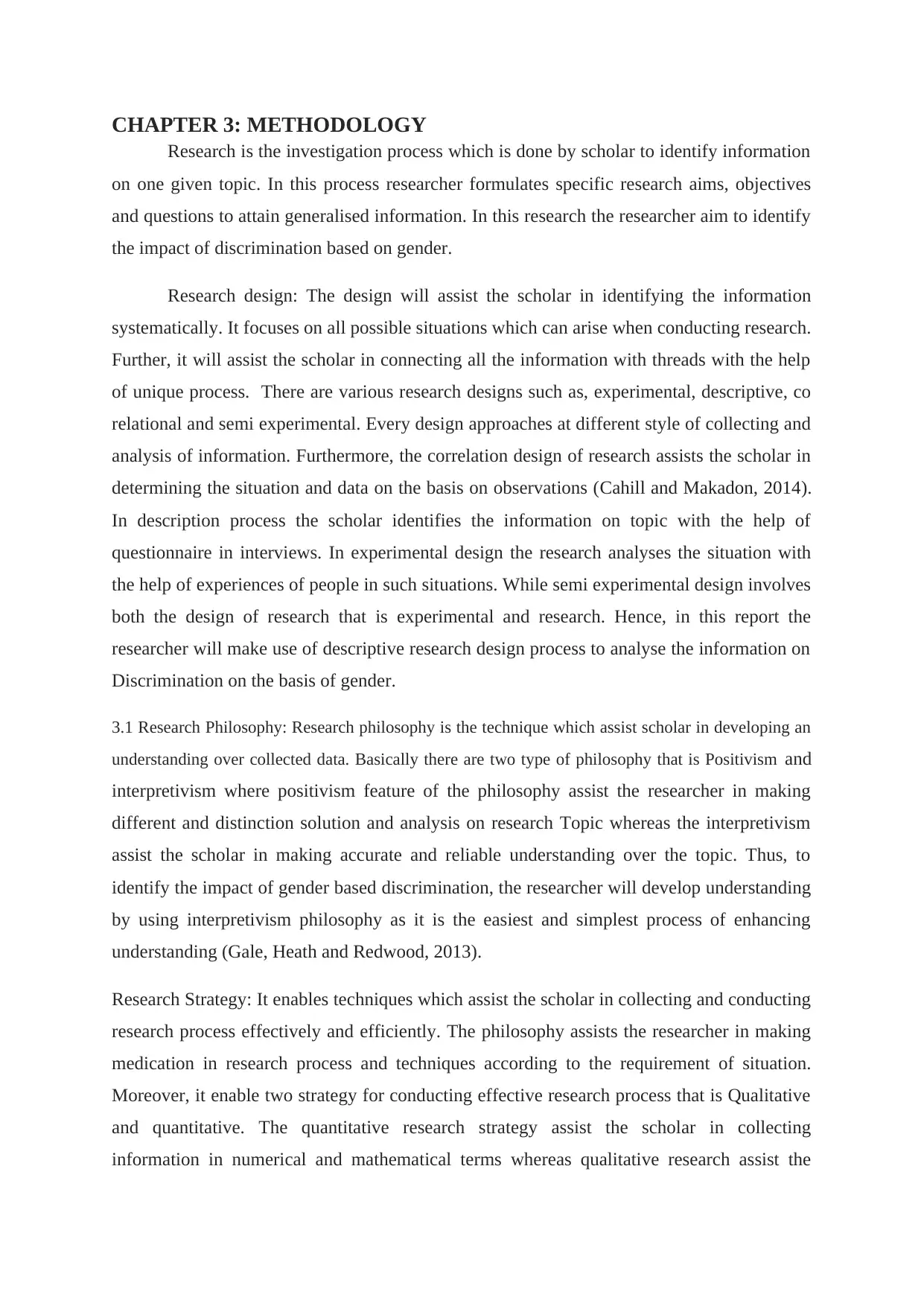
CHAPTER 3: METHODOLOGY
Research is the investigation process which is done by scholar to identify information
on one given topic. In this process researcher formulates specific research aims, objectives
and questions to attain generalised information. In this research the researcher aim to identify
the impact of discrimination based on gender.
Research design: The design will assist the scholar in identifying the information
systematically. It focuses on all possible situations which can arise when conducting research.
Further, it will assist the scholar in connecting all the information with threads with the help
of unique process. There are various research designs such as, experimental, descriptive, co
relational and semi experimental. Every design approaches at different style of collecting and
analysis of information. Furthermore, the correlation design of research assists the scholar in
determining the situation and data on the basis on observations (Cahill and Makadon, 2014).
In description process the scholar identifies the information on topic with the help of
questionnaire in interviews. In experimental design the research analyses the situation with
the help of experiences of people in such situations. While semi experimental design involves
both the design of research that is experimental and research. Hence, in this report the
researcher will make use of descriptive research design process to analyse the information on
Discrimination on the basis of gender.
3.1 Research Philosophy: Research philosophy is the technique which assist scholar in developing an
understanding over collected data. Basically there are two type of philosophy that is Positivism and
interpretivism where positivism feature of the philosophy assist the researcher in making
different and distinction solution and analysis on research Topic whereas the interpretivism
assist the scholar in making accurate and reliable understanding over the topic. Thus, to
identify the impact of gender based discrimination, the researcher will develop understanding
by using interpretivism philosophy as it is the easiest and simplest process of enhancing
understanding (Gale, Heath and Redwood, 2013).
Research Strategy: It enables techniques which assist the scholar in collecting and conducting
research process effectively and efficiently. The philosophy assists the researcher in making
medication in research process and techniques according to the requirement of situation.
Moreover, it enable two strategy for conducting effective research process that is Qualitative
and quantitative. The quantitative research strategy assist the scholar in collecting
information in numerical and mathematical terms whereas qualitative research assist the
Research is the investigation process which is done by scholar to identify information
on one given topic. In this process researcher formulates specific research aims, objectives
and questions to attain generalised information. In this research the researcher aim to identify
the impact of discrimination based on gender.
Research design: The design will assist the scholar in identifying the information
systematically. It focuses on all possible situations which can arise when conducting research.
Further, it will assist the scholar in connecting all the information with threads with the help
of unique process. There are various research designs such as, experimental, descriptive, co
relational and semi experimental. Every design approaches at different style of collecting and
analysis of information. Furthermore, the correlation design of research assists the scholar in
determining the situation and data on the basis on observations (Cahill and Makadon, 2014).
In description process the scholar identifies the information on topic with the help of
questionnaire in interviews. In experimental design the research analyses the situation with
the help of experiences of people in such situations. While semi experimental design involves
both the design of research that is experimental and research. Hence, in this report the
researcher will make use of descriptive research design process to analyse the information on
Discrimination on the basis of gender.
3.1 Research Philosophy: Research philosophy is the technique which assist scholar in developing an
understanding over collected data. Basically there are two type of philosophy that is Positivism and
interpretivism where positivism feature of the philosophy assist the researcher in making
different and distinction solution and analysis on research Topic whereas the interpretivism
assist the scholar in making accurate and reliable understanding over the topic. Thus, to
identify the impact of gender based discrimination, the researcher will develop understanding
by using interpretivism philosophy as it is the easiest and simplest process of enhancing
understanding (Gale, Heath and Redwood, 2013).
Research Strategy: It enables techniques which assist the scholar in collecting and conducting
research process effectively and efficiently. The philosophy assists the researcher in making
medication in research process and techniques according to the requirement of situation.
Moreover, it enable two strategy for conducting effective research process that is Qualitative
and quantitative. The quantitative research strategy assist the scholar in collecting
information in numerical and mathematical terms whereas qualitative research assist the
Paraphrase This Document
Need a fresh take? Get an instant paraphrase of this document with our AI Paraphraser
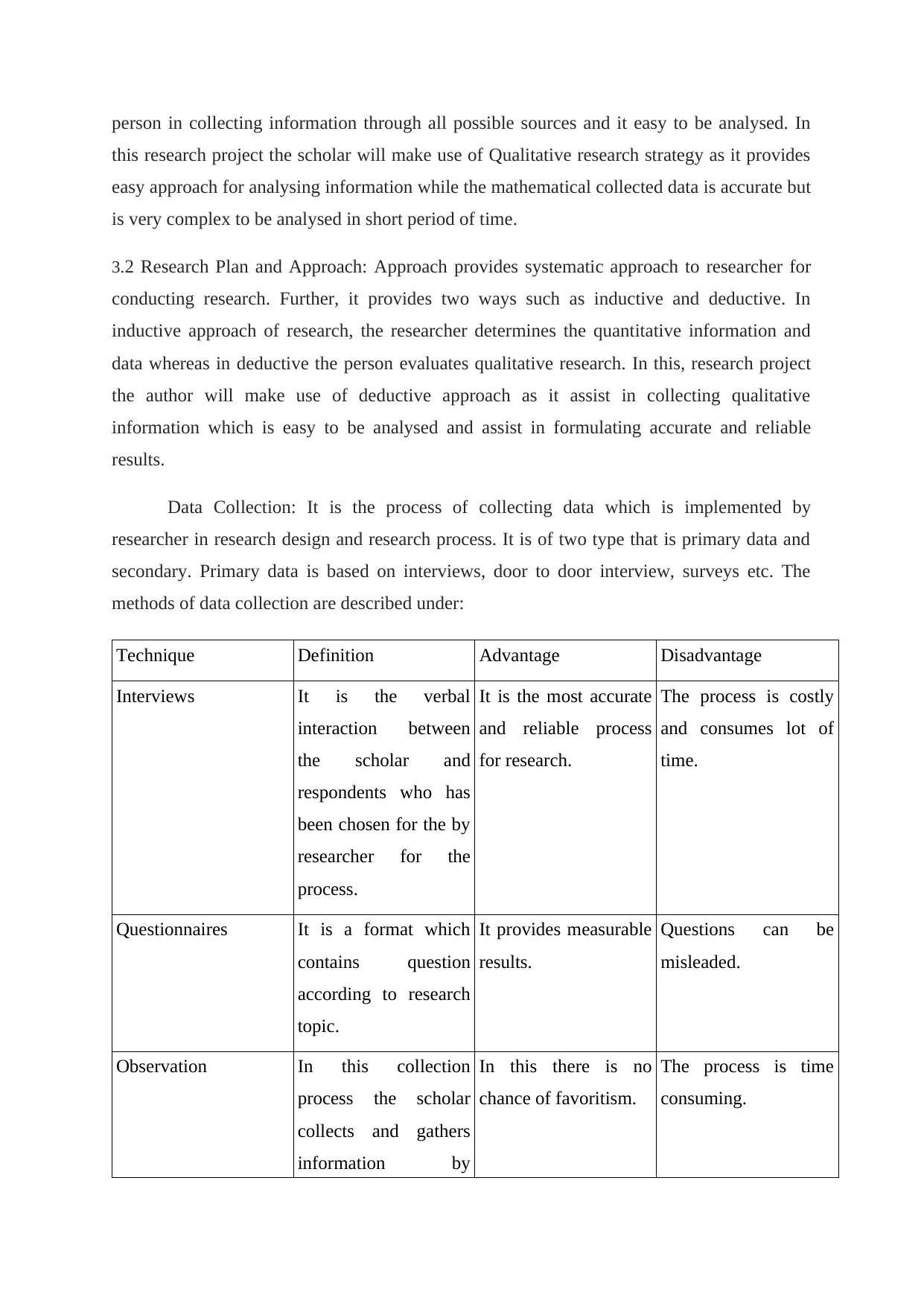
person in collecting information through all possible sources and it easy to be analysed. In
this research project the scholar will make use of Qualitative research strategy as it provides
easy approach for analysing information while the mathematical collected data is accurate but
is very complex to be analysed in short period of time.
3.2 Research Plan and Approach: Approach provides systematic approach to researcher for
conducting research. Further, it provides two ways such as inductive and deductive. In
inductive approach of research, the researcher determines the quantitative information and
data whereas in deductive the person evaluates qualitative research. In this, research project
the author will make use of deductive approach as it assist in collecting qualitative
information which is easy to be analysed and assist in formulating accurate and reliable
results.
Data Collection: It is the process of collecting data which is implemented by
researcher in research design and research process. It is of two type that is primary data and
secondary. Primary data is based on interviews, door to door interview, surveys etc. The
methods of data collection are described under:
Technique Definition Advantage Disadvantage
Interviews It is the verbal
interaction between
the scholar and
respondents who has
been chosen for the by
researcher for the
process.
It is the most accurate
and reliable process
for research.
The process is costly
and consumes lot of
time.
Questionnaires It is a format which
contains question
according to research
topic.
It provides measurable
results.
Questions can be
misleaded.
Observation In this collection
process the scholar
collects and gathers
information by
In this there is no
chance of favoritism.
The process is time
consuming.
this research project the scholar will make use of Qualitative research strategy as it provides
easy approach for analysing information while the mathematical collected data is accurate but
is very complex to be analysed in short period of time.
3.2 Research Plan and Approach: Approach provides systematic approach to researcher for
conducting research. Further, it provides two ways such as inductive and deductive. In
inductive approach of research, the researcher determines the quantitative information and
data whereas in deductive the person evaluates qualitative research. In this, research project
the author will make use of deductive approach as it assist in collecting qualitative
information which is easy to be analysed and assist in formulating accurate and reliable
results.
Data Collection: It is the process of collecting data which is implemented by
researcher in research design and research process. It is of two type that is primary data and
secondary. Primary data is based on interviews, door to door interview, surveys etc. The
methods of data collection are described under:
Technique Definition Advantage Disadvantage
Interviews It is the verbal
interaction between
the scholar and
respondents who has
been chosen for the by
researcher for the
process.
It is the most accurate
and reliable process
for research.
The process is costly
and consumes lot of
time.
Questionnaires It is a format which
contains question
according to research
topic.
It provides measurable
results.
Questions can be
misleaded.
Observation In this collection
process the scholar
collects and gathers
information by
In this there is no
chance of favoritism.
The process is time
consuming.
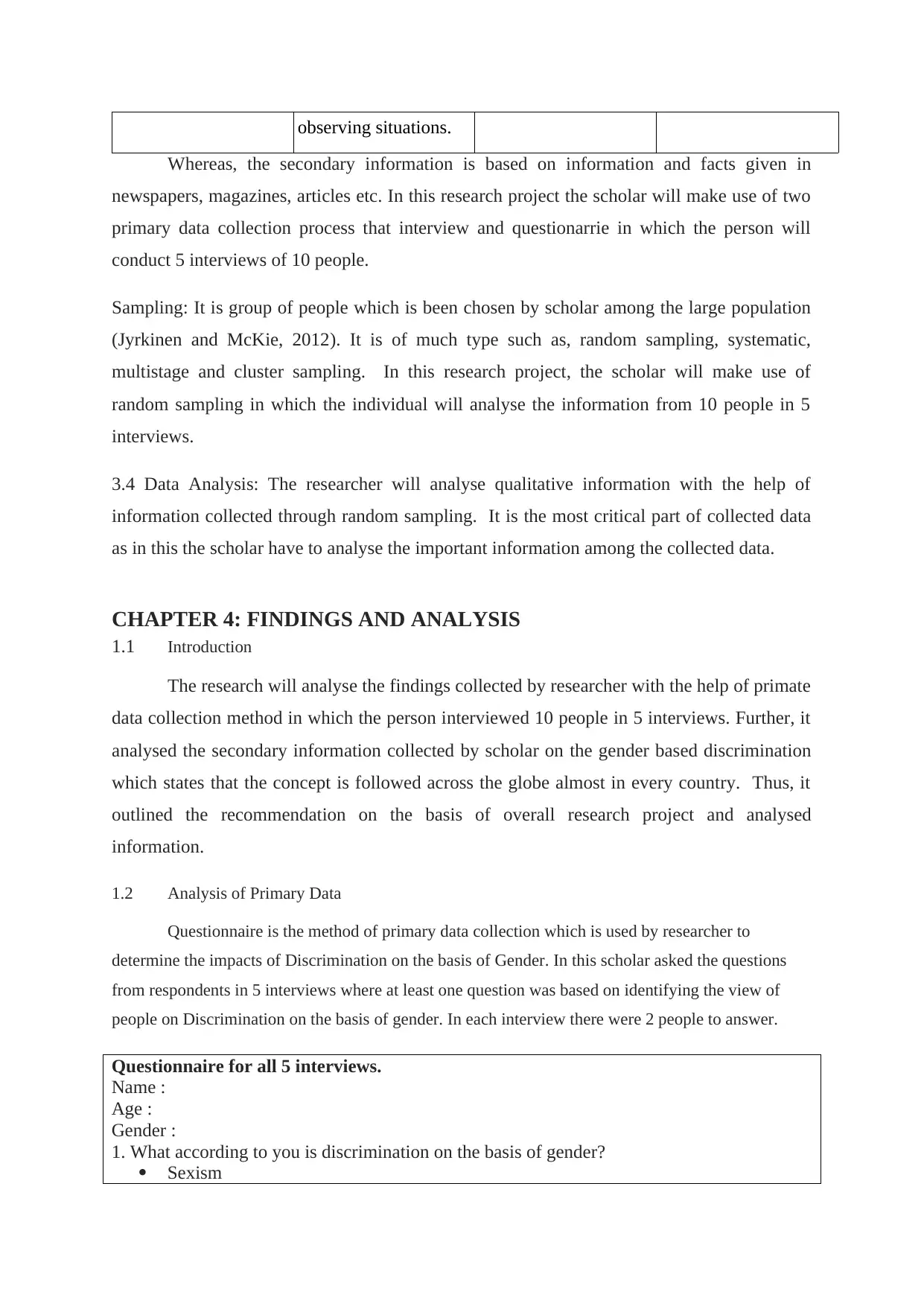
observing situations.
Whereas, the secondary information is based on information and facts given in
newspapers, magazines, articles etc. In this research project the scholar will make use of two
primary data collection process that interview and questionarrie in which the person will
conduct 5 interviews of 10 people.
Sampling: It is group of people which is been chosen by scholar among the large population
(Jyrkinen and McKie, 2012). It is of much type such as, random sampling, systematic,
multistage and cluster sampling. In this research project, the scholar will make use of
random sampling in which the individual will analyse the information from 10 people in 5
interviews.
3.4 Data Analysis: The researcher will analyse qualitative information with the help of
information collected through random sampling. It is the most critical part of collected data
as in this the scholar have to analyse the important information among the collected data.
CHAPTER 4: FINDINGS AND ANALYSIS
1.1 Introduction
The research will analyse the findings collected by researcher with the help of primate
data collection method in which the person interviewed 10 people in 5 interviews. Further, it
analysed the secondary information collected by scholar on the gender based discrimination
which states that the concept is followed across the globe almost in every country. Thus, it
outlined the recommendation on the basis of overall research project and analysed
information.
1.2 Analysis of Primary Data
Questionnaire is the method of primary data collection which is used by researcher to
determine the impacts of Discrimination on the basis of Gender. In this scholar asked the questions
from respondents in 5 interviews where at least one question was based on identifying the view of
people on Discrimination on the basis of gender. In each interview there were 2 people to answer.
Questionnaire for all 5 interviews.
Name :
Age :
Gender :
1. What according to you is discrimination on the basis of gender?
Sexism
Whereas, the secondary information is based on information and facts given in
newspapers, magazines, articles etc. In this research project the scholar will make use of two
primary data collection process that interview and questionarrie in which the person will
conduct 5 interviews of 10 people.
Sampling: It is group of people which is been chosen by scholar among the large population
(Jyrkinen and McKie, 2012). It is of much type such as, random sampling, systematic,
multistage and cluster sampling. In this research project, the scholar will make use of
random sampling in which the individual will analyse the information from 10 people in 5
interviews.
3.4 Data Analysis: The researcher will analyse qualitative information with the help of
information collected through random sampling. It is the most critical part of collected data
as in this the scholar have to analyse the important information among the collected data.
CHAPTER 4: FINDINGS AND ANALYSIS
1.1 Introduction
The research will analyse the findings collected by researcher with the help of primate
data collection method in which the person interviewed 10 people in 5 interviews. Further, it
analysed the secondary information collected by scholar on the gender based discrimination
which states that the concept is followed across the globe almost in every country. Thus, it
outlined the recommendation on the basis of overall research project and analysed
information.
1.2 Analysis of Primary Data
Questionnaire is the method of primary data collection which is used by researcher to
determine the impacts of Discrimination on the basis of Gender. In this scholar asked the questions
from respondents in 5 interviews where at least one question was based on identifying the view of
people on Discrimination on the basis of gender. In each interview there were 2 people to answer.
Questionnaire for all 5 interviews.
Name :
Age :
Gender :
1. What according to you is discrimination on the basis of gender?
Sexism
⊘ This is a preview!⊘
Do you want full access?
Subscribe today to unlock all pages.
Trusted by 1+ million students worldwide
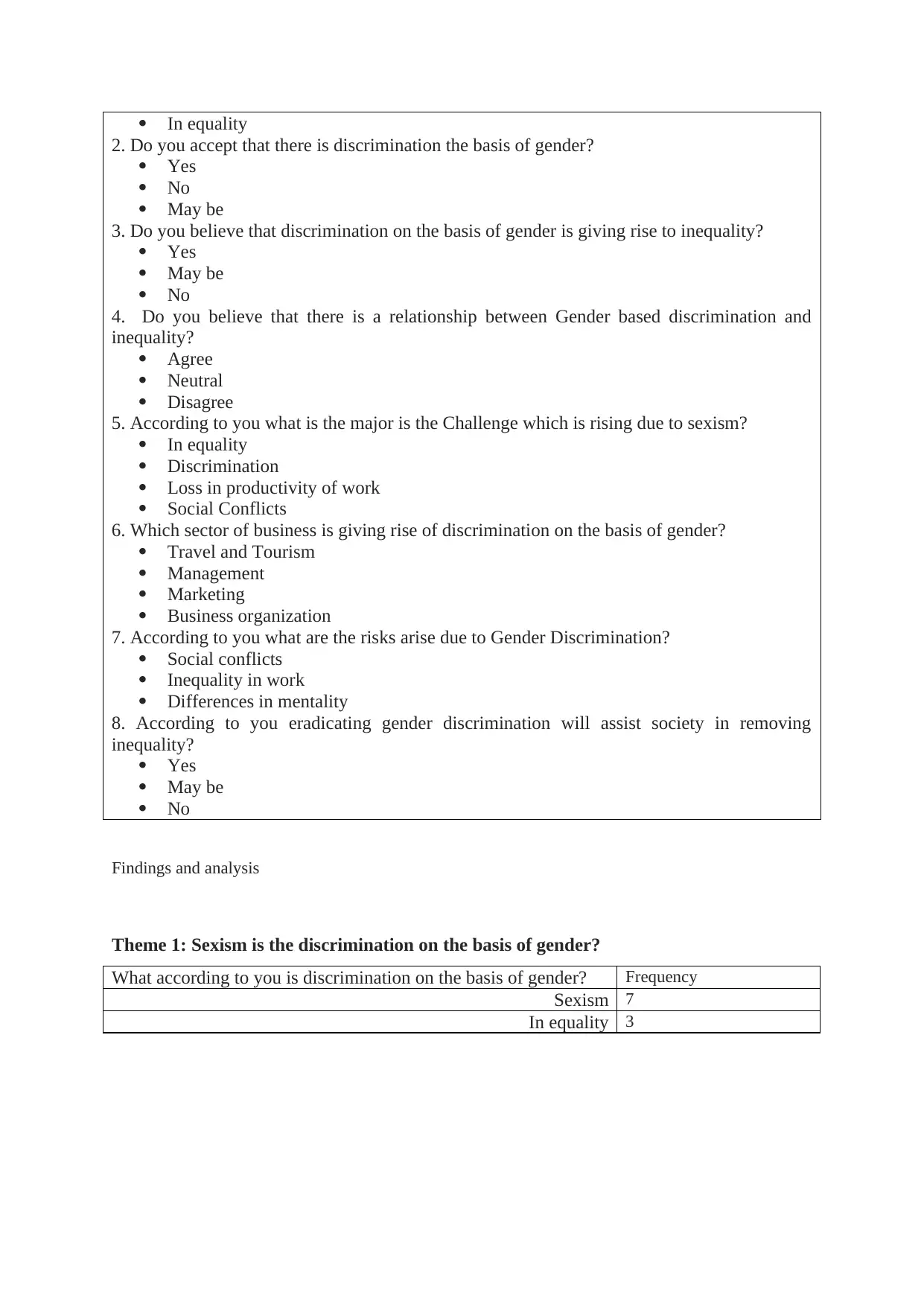
In equality
2. Do you accept that there is discrimination the basis of gender?
Yes
No
May be
3. Do you believe that discrimination on the basis of gender is giving rise to inequality?
Yes
May be
No
4. Do you believe that there is a relationship between Gender based discrimination and
inequality?
Agree
Neutral
Disagree
5. According to you what is the major is the Challenge which is rising due to sexism?
In equality
Discrimination
Loss in productivity of work
Social Conflicts
6. Which sector of business is giving rise of discrimination on the basis of gender?
Travel and Tourism
Management
Marketing
Business organization
7. According to you what are the risks arise due to Gender Discrimination?
Social conflicts
Inequality in work
Differences in mentality
8. According to you eradicating gender discrimination will assist society in removing
inequality?
Yes
May be
No
Findings and analysis
Theme 1: Sexism is the discrimination on the basis of gender?
What according to you is discrimination on the basis of gender? Frequency
Sexism 7
In equality 3
2. Do you accept that there is discrimination the basis of gender?
Yes
No
May be
3. Do you believe that discrimination on the basis of gender is giving rise to inequality?
Yes
May be
No
4. Do you believe that there is a relationship between Gender based discrimination and
inequality?
Agree
Neutral
Disagree
5. According to you what is the major is the Challenge which is rising due to sexism?
In equality
Discrimination
Loss in productivity of work
Social Conflicts
6. Which sector of business is giving rise of discrimination on the basis of gender?
Travel and Tourism
Management
Marketing
Business organization
7. According to you what are the risks arise due to Gender Discrimination?
Social conflicts
Inequality in work
Differences in mentality
8. According to you eradicating gender discrimination will assist society in removing
inequality?
Yes
May be
No
Findings and analysis
Theme 1: Sexism is the discrimination on the basis of gender?
What according to you is discrimination on the basis of gender? Frequency
Sexism 7
In equality 3
Paraphrase This Document
Need a fresh take? Get an instant paraphrase of this document with our AI Paraphraser
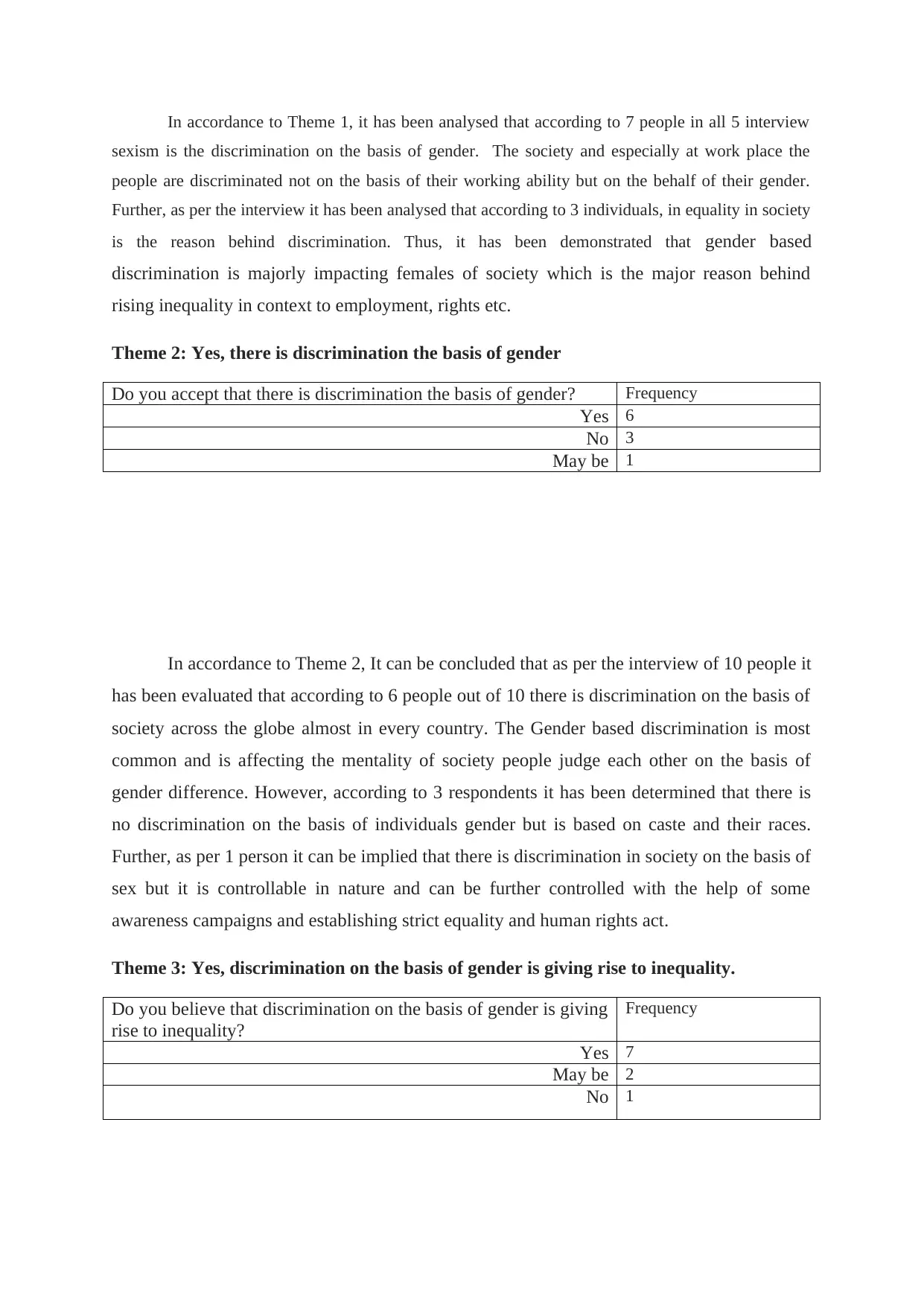
In accordance to Theme 1, it has been analysed that according to 7 people in all 5 interview
sexism is the discrimination on the basis of gender. The society and especially at work place the
people are discriminated not on the basis of their working ability but on the behalf of their gender.
Further, as per the interview it has been analysed that according to 3 individuals, in equality in society
is the reason behind discrimination. Thus, it has been demonstrated that gender based
discrimination is majorly impacting females of society which is the major reason behind
rising inequality in context to employment, rights etc.
Theme 2: Yes, there is discrimination the basis of gender
Do you accept that there is discrimination the basis of gender? Frequency
Yes 6
No 3
May be 1
In accordance to Theme 2, It can be concluded that as per the interview of 10 people it
has been evaluated that according to 6 people out of 10 there is discrimination on the basis of
society across the globe almost in every country. The Gender based discrimination is most
common and is affecting the mentality of society people judge each other on the basis of
gender difference. However, according to 3 respondents it has been determined that there is
no discrimination on the basis of individuals gender but is based on caste and their races.
Further, as per 1 person it can be implied that there is discrimination in society on the basis of
sex but it is controllable in nature and can be further controlled with the help of some
awareness campaigns and establishing strict equality and human rights act.
Theme 3: Yes, discrimination on the basis of gender is giving rise to inequality.
Do you believe that discrimination on the basis of gender is giving
rise to inequality?
Frequency
Yes 7
May be 2
No 1
sexism is the discrimination on the basis of gender. The society and especially at work place the
people are discriminated not on the basis of their working ability but on the behalf of their gender.
Further, as per the interview it has been analysed that according to 3 individuals, in equality in society
is the reason behind discrimination. Thus, it has been demonstrated that gender based
discrimination is majorly impacting females of society which is the major reason behind
rising inequality in context to employment, rights etc.
Theme 2: Yes, there is discrimination the basis of gender
Do you accept that there is discrimination the basis of gender? Frequency
Yes 6
No 3
May be 1
In accordance to Theme 2, It can be concluded that as per the interview of 10 people it
has been evaluated that according to 6 people out of 10 there is discrimination on the basis of
society across the globe almost in every country. The Gender based discrimination is most
common and is affecting the mentality of society people judge each other on the basis of
gender difference. However, according to 3 respondents it has been determined that there is
no discrimination on the basis of individuals gender but is based on caste and their races.
Further, as per 1 person it can be implied that there is discrimination in society on the basis of
sex but it is controllable in nature and can be further controlled with the help of some
awareness campaigns and establishing strict equality and human rights act.
Theme 3: Yes, discrimination on the basis of gender is giving rise to inequality.
Do you believe that discrimination on the basis of gender is giving
rise to inequality?
Frequency
Yes 7
May be 2
No 1
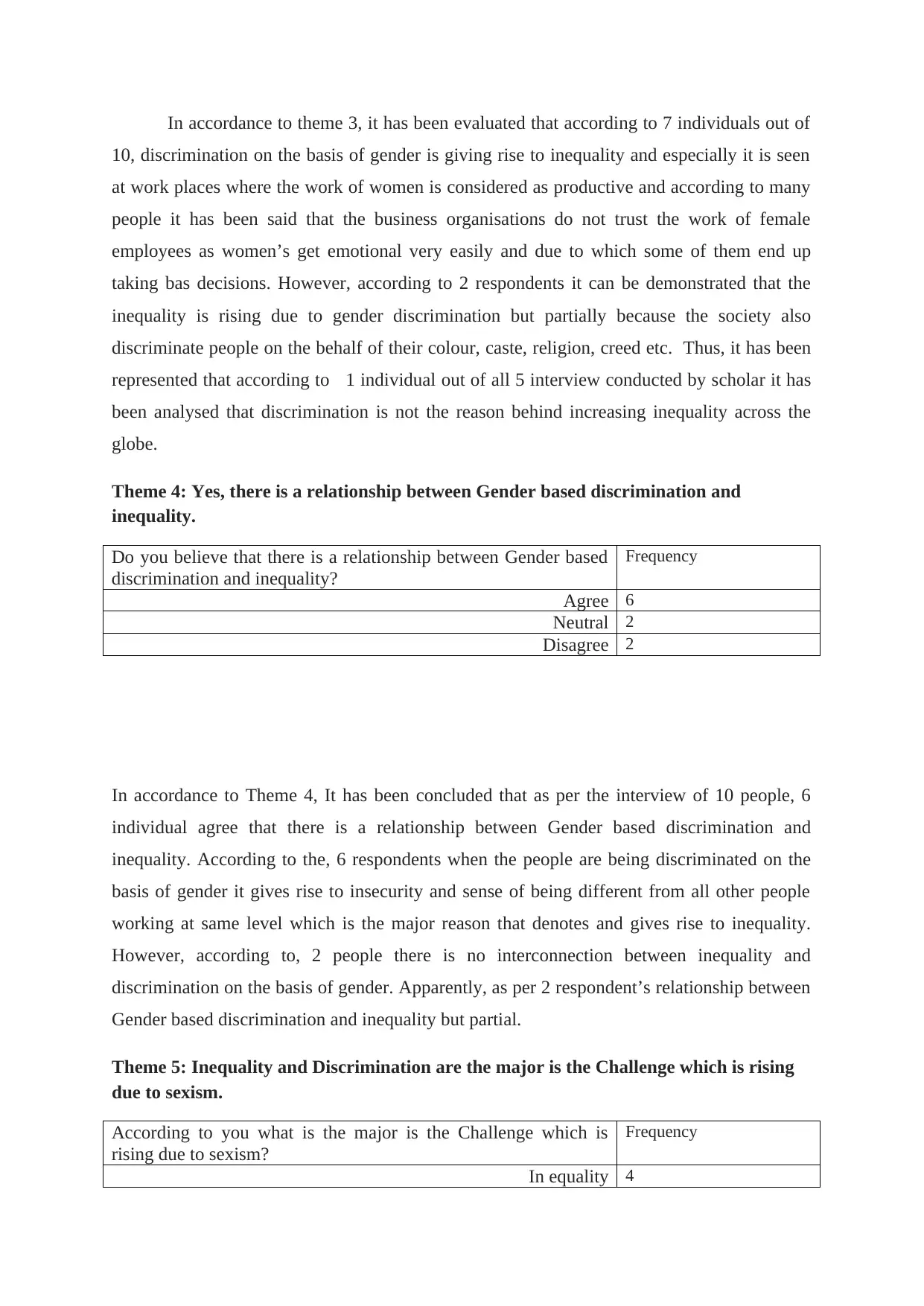
In accordance to theme 3, it has been evaluated that according to 7 individuals out of
10, discrimination on the basis of gender is giving rise to inequality and especially it is seen
at work places where the work of women is considered as productive and according to many
people it has been said that the business organisations do not trust the work of female
employees as women’s get emotional very easily and due to which some of them end up
taking bas decisions. However, according to 2 respondents it can be demonstrated that the
inequality is rising due to gender discrimination but partially because the society also
discriminate people on the behalf of their colour, caste, religion, creed etc. Thus, it has been
represented that according to 1 individual out of all 5 interview conducted by scholar it has
been analysed that discrimination is not the reason behind increasing inequality across the
globe.
Theme 4: Yes, there is a relationship between Gender based discrimination and
inequality.
Do you believe that there is a relationship between Gender based
discrimination and inequality?
Frequency
Agree 6
Neutral 2
Disagree 2
In accordance to Theme 4, It has been concluded that as per the interview of 10 people, 6
individual agree that there is a relationship between Gender based discrimination and
inequality. According to the, 6 respondents when the people are being discriminated on the
basis of gender it gives rise to insecurity and sense of being different from all other people
working at same level which is the major reason that denotes and gives rise to inequality.
However, according to, 2 people there is no interconnection between inequality and
discrimination on the basis of gender. Apparently, as per 2 respondent’s relationship between
Gender based discrimination and inequality but partial.
Theme 5: Inequality and Discrimination are the major is the Challenge which is rising
due to sexism.
According to you what is the major is the Challenge which is
rising due to sexism?
Frequency
In equality 4
10, discrimination on the basis of gender is giving rise to inequality and especially it is seen
at work places where the work of women is considered as productive and according to many
people it has been said that the business organisations do not trust the work of female
employees as women’s get emotional very easily and due to which some of them end up
taking bas decisions. However, according to 2 respondents it can be demonstrated that the
inequality is rising due to gender discrimination but partially because the society also
discriminate people on the behalf of their colour, caste, religion, creed etc. Thus, it has been
represented that according to 1 individual out of all 5 interview conducted by scholar it has
been analysed that discrimination is not the reason behind increasing inequality across the
globe.
Theme 4: Yes, there is a relationship between Gender based discrimination and
inequality.
Do you believe that there is a relationship between Gender based
discrimination and inequality?
Frequency
Agree 6
Neutral 2
Disagree 2
In accordance to Theme 4, It has been concluded that as per the interview of 10 people, 6
individual agree that there is a relationship between Gender based discrimination and
inequality. According to the, 6 respondents when the people are being discriminated on the
basis of gender it gives rise to insecurity and sense of being different from all other people
working at same level which is the major reason that denotes and gives rise to inequality.
However, according to, 2 people there is no interconnection between inequality and
discrimination on the basis of gender. Apparently, as per 2 respondent’s relationship between
Gender based discrimination and inequality but partial.
Theme 5: Inequality and Discrimination are the major is the Challenge which is rising
due to sexism.
According to you what is the major is the Challenge which is
rising due to sexism?
Frequency
In equality 4
⊘ This is a preview!⊘
Do you want full access?
Subscribe today to unlock all pages.
Trusted by 1+ million students worldwide

1 out of 19


Related Documents


Your All-in-One AI-Powered Toolkit for Academic Success.
+13062052269
info@desklib.com
Available 24*7 on WhatsApp / Email
![[object Object]](/_next/static/media/star-bottom.7253800d.svg)
Unlock your academic potential
Copyright © 2020–2026 A2Z Services. All Rights Reserved. Developed and managed by ZUCOL.