Analysis of Chanel Brand within the Global Business Context

Verified

Added on  2020/11/23

|5
|1101
|493
Essay
AI Summary
This essay provides an in-depth analysis of the Chanel brand within the context of the global business environment. It begins with an introduction that sets the stage for exploring how global factors influence Chanel's operations. The main body of the essay delves into a detailed PESTLE analysis, examining the political, economic, social, technological, environmental, and legal factors that impact Chanel's business. Each factor is thoroughly discussed, providing examples of how they affect the brand's strategies, market presence, and profitability. The essay concludes by summarizing the key findings and emphasizing the importance of understanding the global business environment for the success of luxury brands like Chanel. The references section provides a comprehensive list of sources used in the research.
Document Page
GLOBAL BUSINESS
tabler-icon-diamond-filled.svg

Paraphrase This Document

Need a fresh take? Get an instant paraphrase of this document with our AI Paraphraser
Document Page
Table of Contents
INTRODUCTION...........................................................................................................................3
MAIN BODY...................................................................................................................................3
CONCLUSION................................................................................................................................4
REFERENCES................................................................................................................................5
Document Page
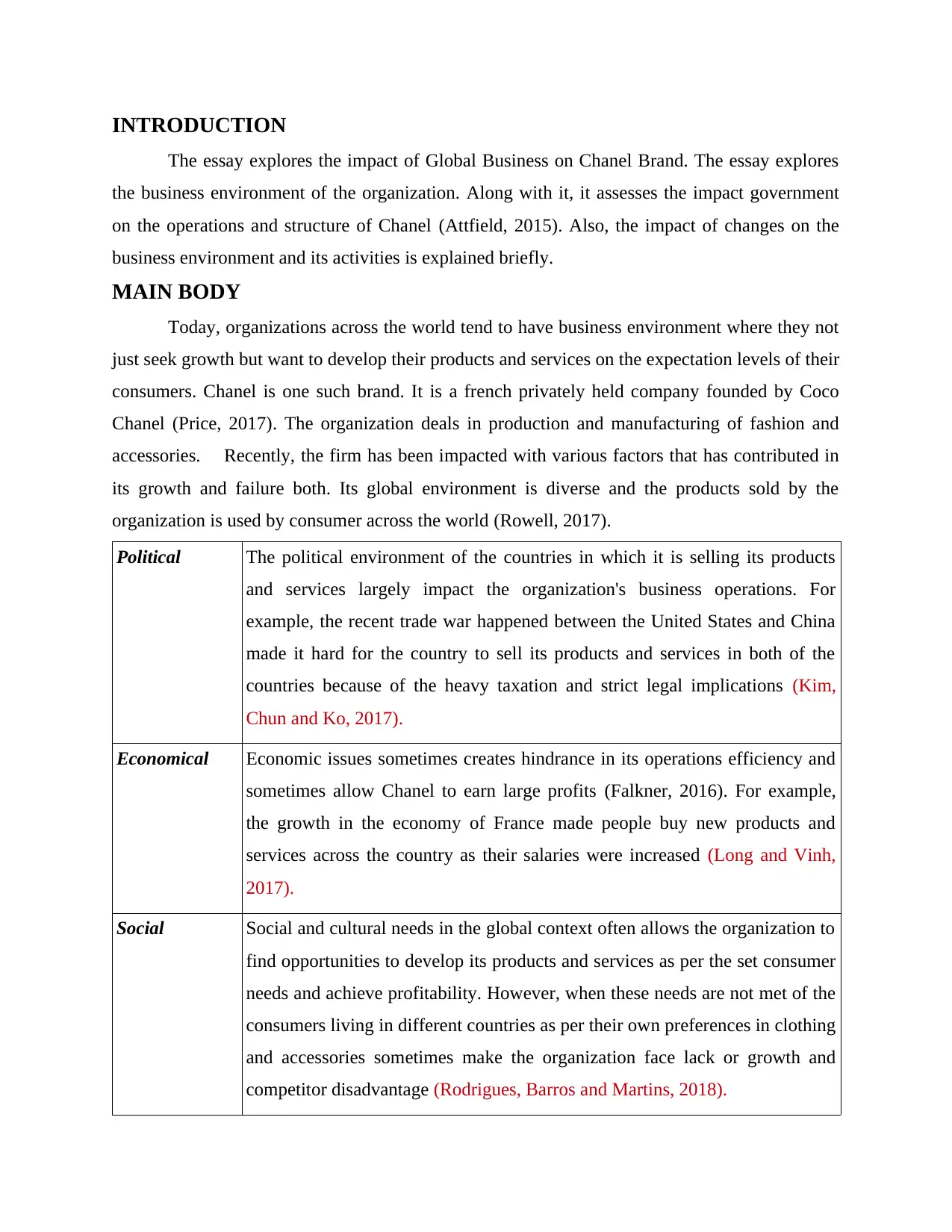
INTRODUCTION
The essay explores the impact of Global Business on Chanel Brand. The essay explores
the business environment of the organization. Along with it, it assesses the impact government
on the operations and structure of Chanel (Attfield, 2015). Also, the impact of changes on the
business environment and its activities is explained briefly.
MAIN BODY
Today, organizations across the world tend to have business environment where they not
just seek growth but want to develop their products and services on the expectation levels of their
consumers. Chanel is one such brand. It is a french privately held company founded by Coco
Chanel (Price, 2017). The organization deals in production and manufacturing of fashion and
accessories. Recently, the firm has been impacted with various factors that has contributed in
its growth and failure both. Its global environment is diverse and the products sold by the
organization is used by consumer across the world (Rowell, 2017).
Political The political environment of the countries in which it is selling its products
and services largely impact the organization's business operations. For
example, the recent trade war happened between the United States and China
made it hard for the country to sell its products and services in both of the
countries because of the heavy taxation and strict legal implications (Kim,
Chun and Ko, 2017).
Economical Economic issues sometimes creates hindrance in its operations efficiency and
sometimes allow Chanel to earn large profits (Falkner, 2016). For example,
the growth in the economy of France made people buy new products and
services across the country as their salaries were increased (Long and Vinh,
2017).
Social Social and cultural needs in the global context often allows the organization to
find opportunities to develop its products and services as per the set consumer
needs and achieve profitability. However, when these needs are not met of the
consumers living in different countries as per their own preferences in clothing
and accessories sometimes make the organization face lack or growth and
competitor disadvantage (Rodrigues, Barros and Martins, 2018).
Document Page
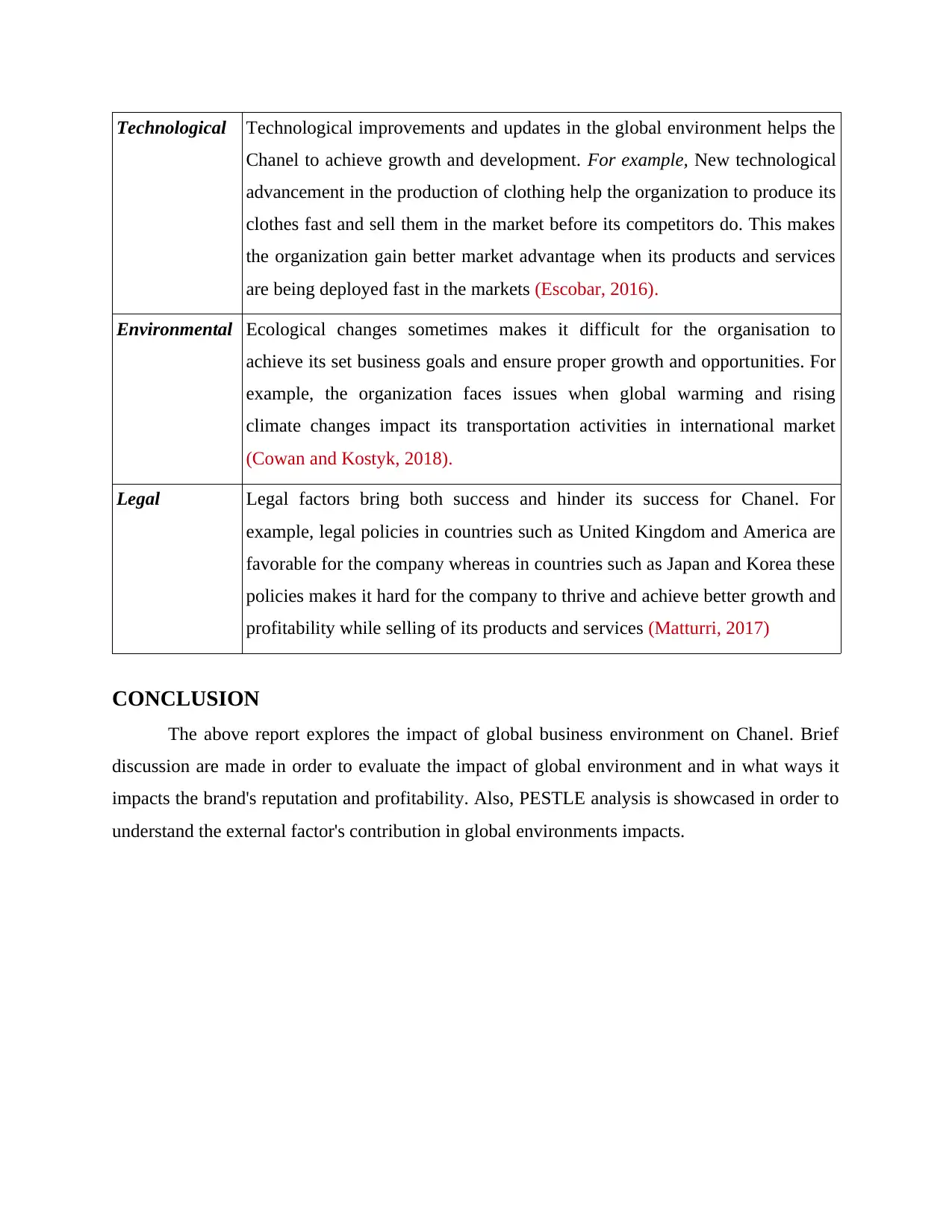
Technological Technological improvements and updates in the global environment helps the
Chanel to achieve growth and development. For example, New technological
advancement in the production of clothing help the organization to produce its
clothes fast and sell them in the market before its competitors do. This makes
the organization gain better market advantage when its products and services
are being deployed fast in the markets (Escobar, 2016).
Environmental Ecological changes sometimes makes it difficult for the organisation to
achieve its set business goals and ensure proper growth and opportunities. For
example, the organization faces issues when global warming and rising
climate changes impact its transportation activities in international market
(Cowan and Kostyk, 2018).
Legal Legal factors bring both success and hinder its success for Chanel. For
example, legal policies in countries such as United Kingdom and America are
favorable for the company whereas in countries such as Japan and Korea these
policies makes it hard for the company to thrive and achieve better growth and
profitability while selling of its products and services (Matturri, 2017)
CONCLUSION
The above report explores the impact of global business environment on Chanel. Brief
discussion are made in order to evaluate the impact of global environment and in what ways it
impacts the brand's reputation and profitability. Also, PESTLE analysis is showcased in order to
understand the external factor's contribution in global environments impacts.
tabler-icon-diamond-filled.svg

Paraphrase This Document

Need a fresh take? Get an instant paraphrase of this document with our AI Paraphraser
Document Page
REFERENCES
Books and Journals
Attfield, R., 2015. Ethics of the global environment. Edinburgh University Press.
Cowan, K. L. and Kostyk, A., 2018, July. MODERN VERSUS TRADITIONAL LUXURY
BRAND DIGITAL STRATEGY. In 2018 Global Marketing Conference at Tokyo (pp.
257-262).
Escobar, A., 2016. The impact of the digital revolution in the development of market and
communication strategies for the luxury sector (fashion luxury). Central European
Business Review. 5(2). p.17.
Falkner, R. ed., 2016. The handbook of global climate and environment policy. John Wiley &
Sons.
Kim, N., Chun, E. and Ko, E., 2017. Country of origin effects on brand image, brand evaluation,
and purchase intention: A closer look at Seoul, New York, and Paris fashion
collection. International Marketing Review. 34(2). pp.254-271.
Kirton, J. J. and Trebilcock, M. J., 2017. Hard choices, soft law: Voluntary standards in global
trade, environment and social governance. Routledge.
Long, H. C. and Vinh, N. N., 2017. FACTORS INFLUENCING CONSUMERS'ATTITUDES
TOWARDS COUNTERFEIT LUXURY FASHION BRANDS: EVIDENCE FROM
VIETNAM. Global Journal of Management and Marketing. 1(2). pp.63-77.
Matturri, L., 2017. The Devil Wears Nada: How the Current Statutory Damages System for
Counterfeit Trademarks as Demonstrated in Chanel, Inc. v. Matos Is out of Style. Vill. L.
Rev. 62. p.327.
Price, M. N. ed., 2017. Nina Chanel Abney-Royal Flush. Duke University Press.
Rodrigues, P. L., Barros, T. and Martins, C., 2018. The Value of Luxury: Social, individual and
functional dimensions. International Journal of Marketing, Communication and New
Media. (4).
Rowell, A., 2017. Green backlash: Global subversion of the environment movement. Routledge.
Smith, T. C. and Ligon, P., 2015. Junior Recital: Taylor Chanel Smith, mezzo-soprano.
chevron_up_icon
1 out of 5
circle_padding
hide_on_mobile
zoom_out_icon
[object Object]