The Impact of Globalisation on Business and Government Dynamics

Verified

Added on  2022/11/13

|8
|2624
|243
Essay
AI Summary
This essay analyzes the multifaceted impact of globalisation on business and government, focusing on its uneven distribution of benefits and the need for a fairer model. The essay discusses how technology, skill management, and investments have reshaped the global landscape, creating both opportunities and challenges. It examines the economic gaps, cultural impacts, and social inequalities arising from globalisation, including issues like brain drain, cultural homogenization, and the widening income gap. The essay further explores the role of competition, technology, and access to resources in shaping outcomes, highlighting the challenges faced by those without resources and skills. It argues for a new, fairer model of globalisation that prioritizes technology access, fair wages, and cultural sensitivity, while promoting global standards in education and equal opportunities for all, advocating for a more equitable and inclusive global economy. The essay suggests that governments and companies should partner to eliminate poverty and control privatization and liberalization of the economies. It also suggests that companies should adopt the culture of the country in which they are expanding and world media needs to promote all the cultures equally, so people from each and every part of the world will get equal opportunities irrespective of their differences.
Document Page
BUSINESS AND GOVERNMENT
tabler-icon-diamond-filled.svg

Paraphrase This Document

Need a fresh take? Get an instant paraphrase of this document with our AI Paraphraser
Document Page
1
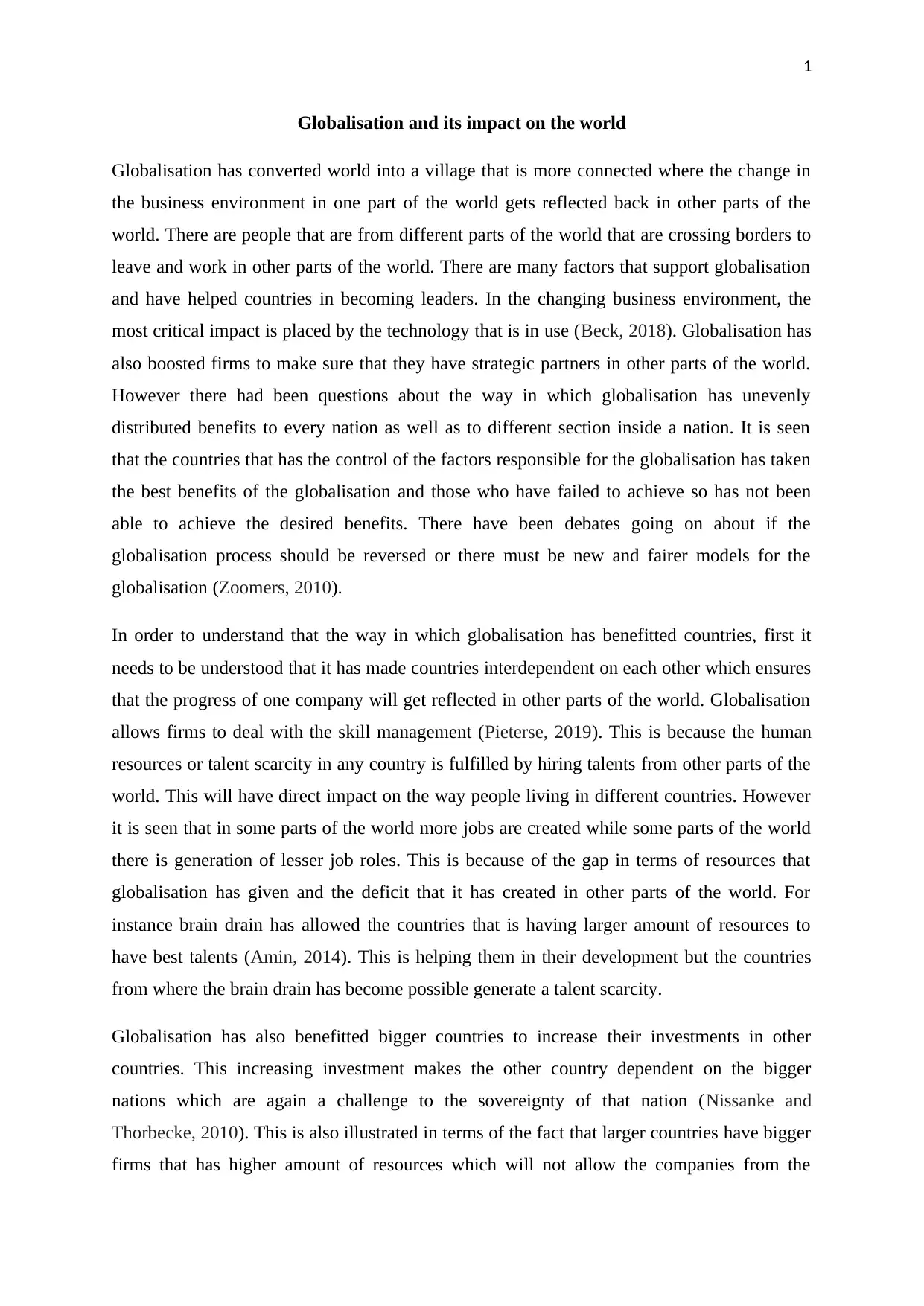
Globalisation and its impact on the world
Globalisation has converted world into a village that is more connected where the change in
the business environment in one part of the world gets reflected back in other parts of the
world. There are people that are from different parts of the world that are crossing borders to
leave and work in other parts of the world. There are many factors that support globalisation
and have helped countries in becoming leaders. In the changing business environment, the
most critical impact is placed by the technology that is in use (Beck, 2018). Globalisation has
also boosted firms to make sure that they have strategic partners in other parts of the world.
However there had been questions about the way in which globalisation has unevenly
distributed benefits to every nation as well as to different section inside a nation. It is seen
that the countries that has the control of the factors responsible for the globalisation has taken
the best benefits of the globalisation and those who have failed to achieve so has not been
able to achieve the desired benefits. There have been debates going on about if the
globalisation process should be reversed or there must be new and fairer models for the
globalisation (Zoomers, 2010).
In order to understand that the way in which globalisation has benefitted countries, first it
needs to be understood that it has made countries interdependent on each other which ensures
that the progress of one company will get reflected in other parts of the world. Globalisation
allows firms to deal with the skill management (Pieterse, 2019). This is because the human
resources or talent scarcity in any country is fulfilled by hiring talents from other parts of the
world. This will have direct impact on the way people living in different countries. However
it is seen that in some parts of the world more jobs are created while some parts of the world
there is generation of lesser job roles. This is because of the gap in terms of resources that
globalisation has given and the deficit that it has created in other parts of the world. For
instance brain drain has allowed the countries that is having larger amount of resources to
have best talents (Amin, 2014). This is helping them in their development but the countries
from where the brain drain has become possible generate a talent scarcity.
Globalisation has also benefitted bigger countries to increase their investments in other
countries. This increasing investment makes the other country dependent on the bigger
nations which are again a challenge to the sovereignty of that nation (Nissanke and
Thorbecke, 2010). This is also illustrated in terms of the fact that larger countries have bigger
firms that has higher amount of resources which will not allow the companies from the
Document Page
2
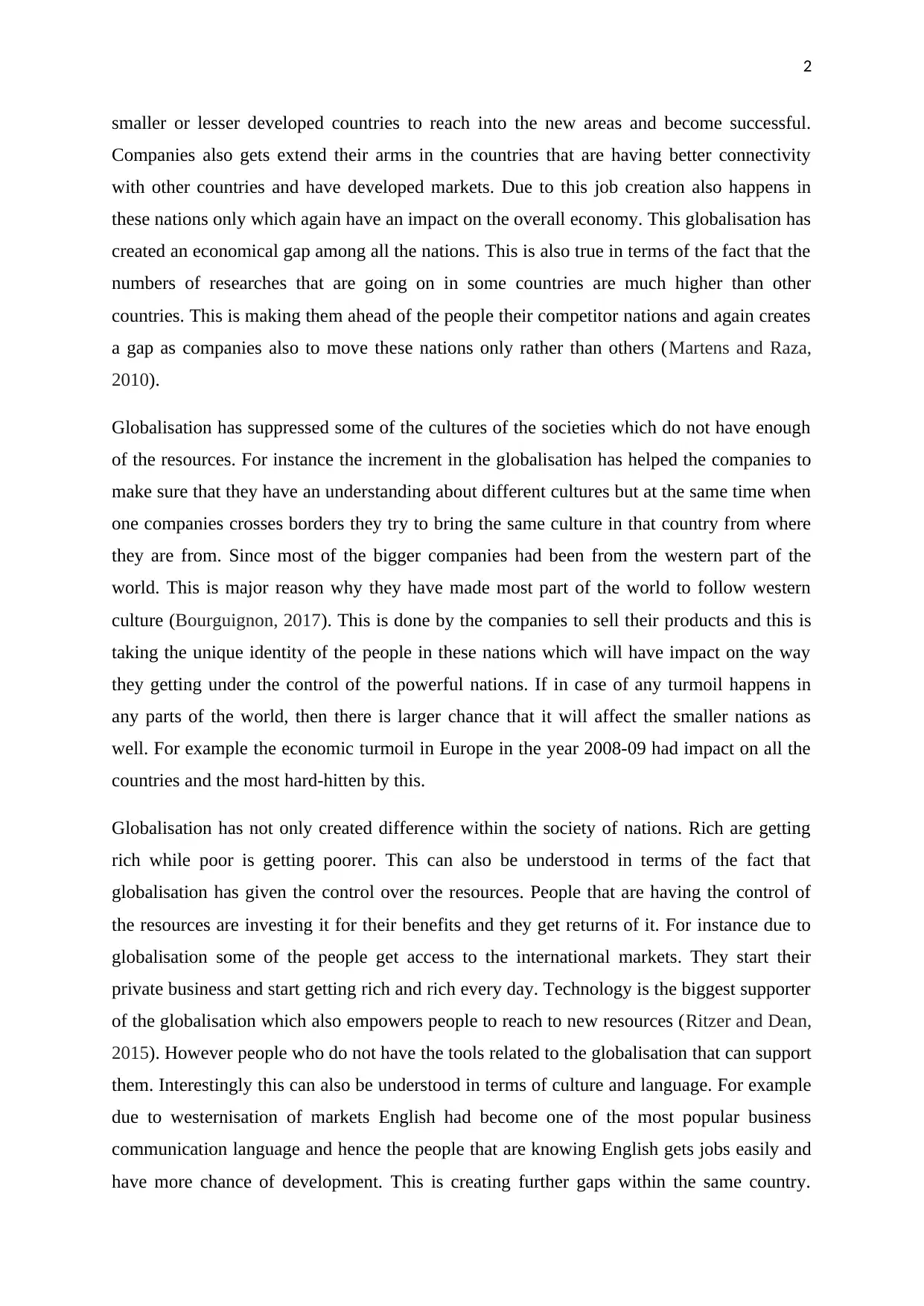
smaller or lesser developed countries to reach into the new areas and become successful.
Companies also gets extend their arms in the countries that are having better connectivity
with other countries and have developed markets. Due to this job creation also happens in
these nations only which again have an impact on the overall economy. This globalisation has
created an economical gap among all the nations. This is also true in terms of the fact that the
numbers of researches that are going on in some countries are much higher than other
countries. This is making them ahead of the people their competitor nations and again creates
a gap as companies also to move these nations only rather than others (Martens and Raza,
2010).
Globalisation has suppressed some of the cultures of the societies which do not have enough
of the resources. For instance the increment in the globalisation has helped the companies to
make sure that they have an understanding about different cultures but at the same time when
one companies crosses borders they try to bring the same culture in that country from where
they are from. Since most of the bigger companies had been from the western part of the
world. This is major reason why they have made most part of the world to follow western
culture (Bourguignon, 2017). This is done by the companies to sell their products and this is
taking the unique identity of the people in these nations which will have impact on the way
they getting under the control of the powerful nations. If in case of any turmoil happens in
any parts of the world, then there is larger chance that it will affect the smaller nations as
well. For example the economic turmoil in Europe in the year 2008-09 had impact on all the
countries and the most hard-hitten by this.
Globalisation has not only created difference within the society of nations. Rich are getting
rich while poor is getting poorer. This can also be understood in terms of the fact that
globalisation has given the control over the resources. People that are having the control of
the resources are investing it for their benefits and they get returns of it. For instance due to
globalisation some of the people get access to the international markets. They start their
private business and start getting rich and rich every day. Technology is the biggest supporter
of the globalisation which also empowers people to reach to new resources (Ritzer and Dean,
2015). However people who do not have the tools related to the globalisation that can support
them. Interestingly this can also be understood in terms of culture and language. For example
due to westernisation of markets English had become one of the most popular business
communication language and hence the people that are knowing English gets jobs easily and
have more chance of development. This is creating further gaps within the same country.
Document Page
3
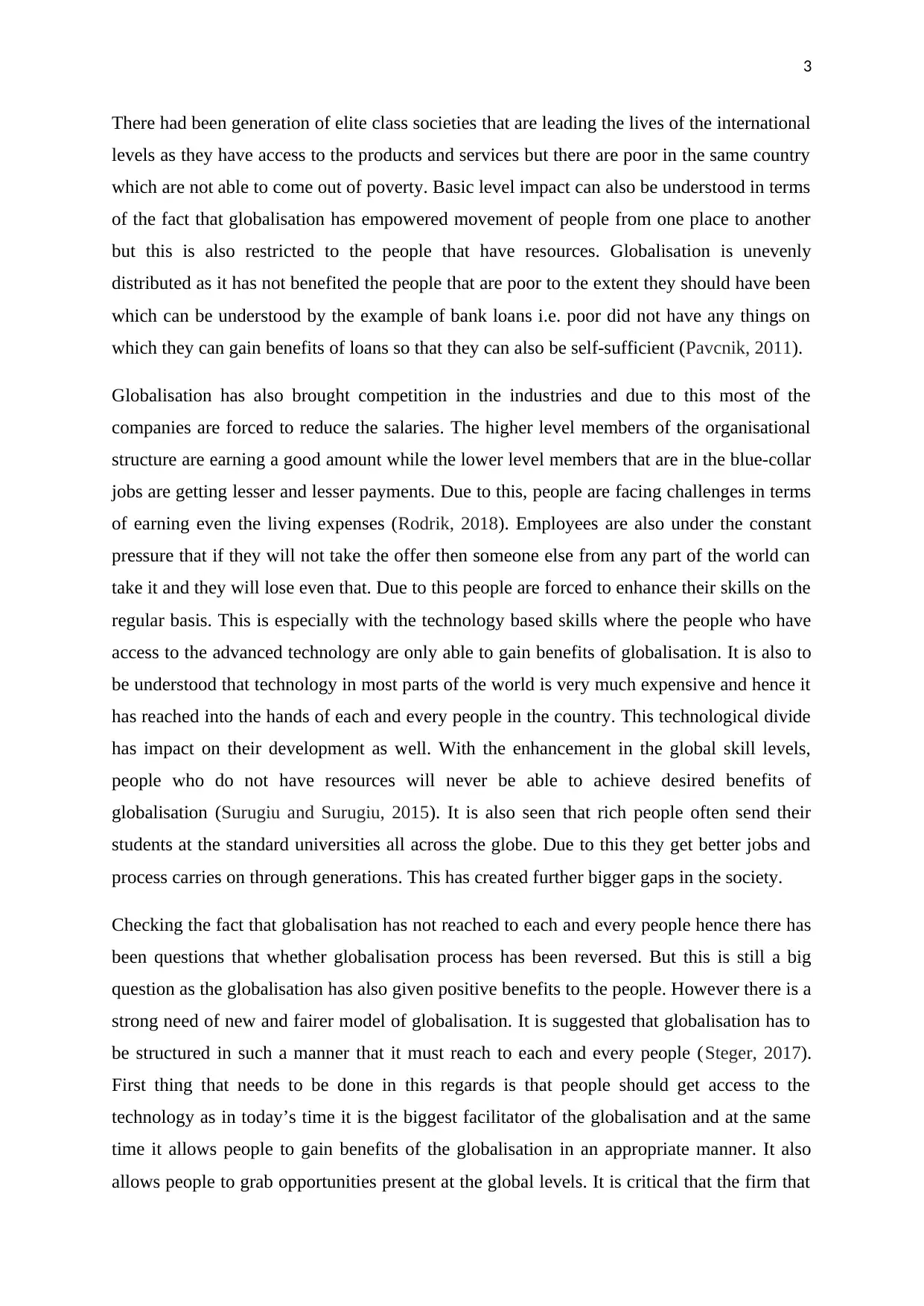
There had been generation of elite class societies that are leading the lives of the international
levels as they have access to the products and services but there are poor in the same country
which are not able to come out of poverty. Basic level impact can also be understood in terms
of the fact that globalisation has empowered movement of people from one place to another
but this is also restricted to the people that have resources. Globalisation is unevenly
distributed as it has not benefited the people that are poor to the extent they should have been
which can be understood by the example of bank loans i.e. poor did not have any things on
which they can gain benefits of loans so that they can also be self-sufficient (Pavcnik, 2011).
Globalisation has also brought competition in the industries and due to this most of the
companies are forced to reduce the salaries. The higher level members of the organisational
structure are earning a good amount while the lower level members that are in the blue-collar
jobs are getting lesser and lesser payments. Due to this, people are facing challenges in terms
of earning even the living expenses (Rodrik, 2018). Employees are also under the constant
pressure that if they will not take the offer then someone else from any part of the world can
take it and they will lose even that. Due to this people are forced to enhance their skills on the
regular basis. This is especially with the technology based skills where the people who have
access to the advanced technology are only able to gain benefits of globalisation. It is also to
be understood that technology in most parts of the world is very much expensive and hence it
has reached into the hands of each and every people in the country. This technological divide
has impact on their development as well. With the enhancement in the global skill levels,
people who do not have resources will never be able to achieve desired benefits of
globalisation (Surugiu and Surugiu, 2015). It is also seen that rich people often send their
students at the standard universities all across the globe. Due to this they get better jobs and
process carries on through generations. This has created further bigger gaps in the society.
Checking the fact that globalisation has not reached to each and every people hence there has
been questions that whether globalisation process has been reversed. But this is still a big
question as the globalisation has also given positive benefits to the people. However there is a
strong need of new and fairer model of globalisation. It is suggested that globalisation has to
be structured in such a manner that it must reach to each and every people (Steger, 2017).
First thing that needs to be done in this regards is that people should get access to the
technology as in today’s time it is the biggest facilitator of the globalisation and at the same
time it allows people to gain benefits of the globalisation in an appropriate manner. It also
allows people to grab opportunities present at the global levels. It is critical that the firm that
tabler-icon-diamond-filled.svg

Paraphrase This Document

Need a fresh take? Get an instant paraphrase of this document with our AI Paraphraser
Document Page
4
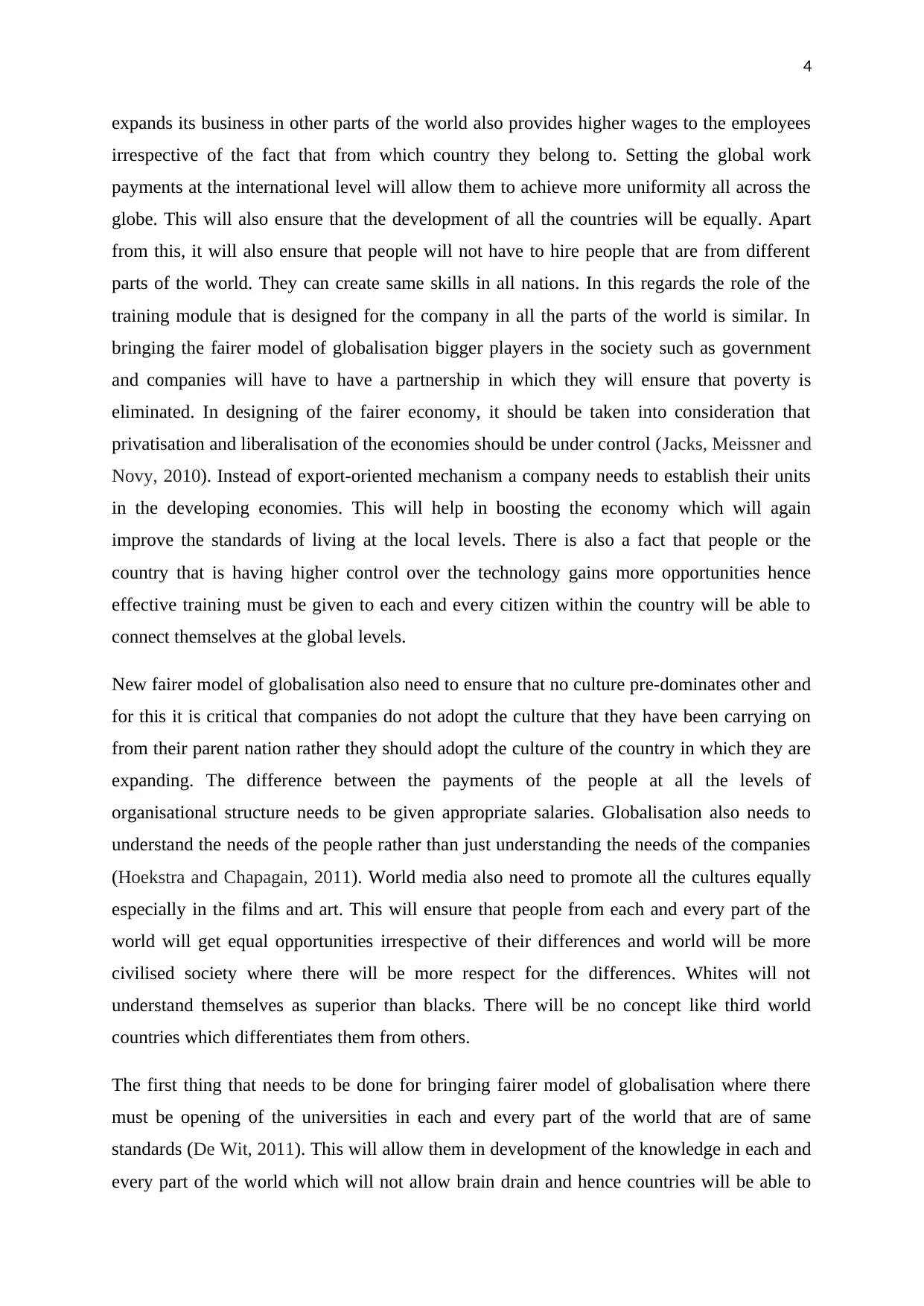
expands its business in other parts of the world also provides higher wages to the employees
irrespective of the fact that from which country they belong to. Setting the global work
payments at the international level will allow them to achieve more uniformity all across the
globe. This will also ensure that the development of all the countries will be equally. Apart
from this, it will also ensure that people will not have to hire people that are from different
parts of the world. They can create same skills in all nations. In this regards the role of the
training module that is designed for the company in all the parts of the world is similar. In
bringing the fairer model of globalisation bigger players in the society such as government
and companies will have to have a partnership in which they will ensure that poverty is
eliminated. In designing of the fairer economy, it should be taken into consideration that
privatisation and liberalisation of the economies should be under control (Jacks, Meissner and
Novy, 2010). Instead of export-oriented mechanism a company needs to establish their units
in the developing economies. This will help in boosting the economy which will again
improve the standards of living at the local levels. There is also a fact that people or the
country that is having higher control over the technology gains more opportunities hence
effective training must be given to each and every citizen within the country will be able to
connect themselves at the global levels.
New fairer model of globalisation also need to ensure that no culture pre-dominates other and
for this it is critical that companies do not adopt the culture that they have been carrying on
from their parent nation rather they should adopt the culture of the country in which they are
expanding. The difference between the payments of the people at all the levels of
organisational structure needs to be given appropriate salaries. Globalisation also needs to
understand the needs of the people rather than just understanding the needs of the companies
(Hoekstra and Chapagain, 2011). World media also need to promote all the cultures equally
especially in the films and art. This will ensure that people from each and every part of the
world will get equal opportunities irrespective of their differences and world will be more
civilised society where there will be more respect for the differences. Whites will not
understand themselves as superior than blacks. There will be no concept like third world
countries which differentiates them from others.
The first thing that needs to be done for bringing fairer model of globalisation where there
must be opening of the universities in each and every part of the world that are of same
standards (De Wit, 2011). This will allow them in development of the knowledge in each and
every part of the world which will not allow brain drain and hence countries will be able to
Document Page
5
achieve the desired benefits (Zhou, et al 2011). Fairer model of globalisation will also have a
better support to the people at the lower levels in the society. This is necessary for the holistic
development of the overall world as putting larger section of the people below poverty line
will never be able to achieve the desired benefits.
Document Page
6
References
Amin, S., 2014. Capitalism in the age of globalization: The management of contemporary
society. Zed Books Ltd..
Beck, U., 2018. What is globalization?. John Wiley & Sons.
Bourguignon, F., 2017. The globalization of inequality. Princeton University Press.
De Wit, H., 2011. Globalisation and internationalisation of higher
education. Internationalisation of universities in the network society, 8(2).
Hoekstra, A.Y. and Chapagain, A.K., 2011. Globalization of water: Sharing the planet's
freshwater resources. John Wiley & Sons.
Jacks, D.S., Meissner, C.M. and Novy, D., 2010. Trade costs in the first wave of
globalization. Explorations in Economic History, 47(2), pp.127-141.
Martens, P. and Raza, M., 2010. Is globalisation sustainable?. Sustainability, 2(1), pp.280-
293.
Nissanke, M. and Thorbecke, E., 2010. Globalization, poverty, and inequality in Latin
America: Findings from case studies. World Development, 38(6), pp.797-802.
Pavcnik, N., 2011. Globalization and within-country income inequality. Making globalization
socially sustainable, pp.233-259.
Pieterse, J.N., 2019. Globalization and culture: Global mélange. Rowman & Littlefield
Publishers.
Ritzer, G. and Dean, P., 2015. Globalization: A basic text. John Wiley & Sons.
Rodrik, D., 2018. Populism and the Economics of Globalization. Journal of International
Business Policy, 1(1-2), pp.12-33.
Steger, M.B., 2017. Globalization: A very short introduction (Vol. 86). Oxford University
Press.
tabler-icon-diamond-filled.svg

Paraphrase This Document

Need a fresh take? Get an instant paraphrase of this document with our AI Paraphraser
Document Page
7
Surugiu, M.R. and Surugiu, C., 2015. International trade, globalization and economic
interdependence between European countries: implications for businesses and marketing
framework. Procedia Economics and Finance, 32, pp.131-138.
Zhou, L., Biswas, B., Bowles, T. and Saunders, P.J., 2011. Impact of globalization on income
distribution inequality in 60 countries. Global Economy Journal, 11(1), p.1850216.
Zoomers, A., 2010. Globalisation and the foreignisation of space: seven processes driving the
current global land grab. The Journal of Peasant Studies, 37(2), pp.429-447.
chevron_up_icon
1 out of 8
circle_padding
hide_on_mobile
zoom_out_icon
[object Object]