Article Critique: NURS2101 - Impact of Hypoglycemic Events on Patients
VerifiedAdded on 2022/09/25
|9
|2218
|16
Report
AI Summary
This report provides a comprehensive critique of a qualitative research article titled "Non-severe nocturnal hypoglycemic events: experience and impacts on patient functioning and well-being." The study, which utilized focus groups in four countries, aimed to understand the consequences of nocturnal hypoglycemic events (NSNHEs) in diabetic patients. The methodology involved semi-structured focus groups with participants from Germany, the UK, the USA, and France, with data analyzed thematically. The critique evaluates the study's methodology, ethical considerations, results, discussion, and limitations. The results revealed that both type 1 and type 2 diabetic patients experienced NSNHEs, which impacted their sleep, social life, and work. The report also reflects on the importance of proper diabetes care plans and the need for healthcare providers to address the impact of NSNHEs on patient well-being. The critique highlights the study's value in closing gaps in the existing literature and emphasizes the need for further research, particularly regarding patient experiences with healthcare providers and the impact of NSNHEs from various perspectives.
Running Head: ARTICLE CRITIQUE
ARTICLE CRITIQUE
Name of the Student
Name of the University
Author’s Note
ARTICLE CRITIQUE
Name of the Student
Name of the University
Author’s Note
Paraphrase This Document
Need a fresh take? Get an instant paraphrase of this document with our AI Paraphraser

1ARTICLE CRITIQUE
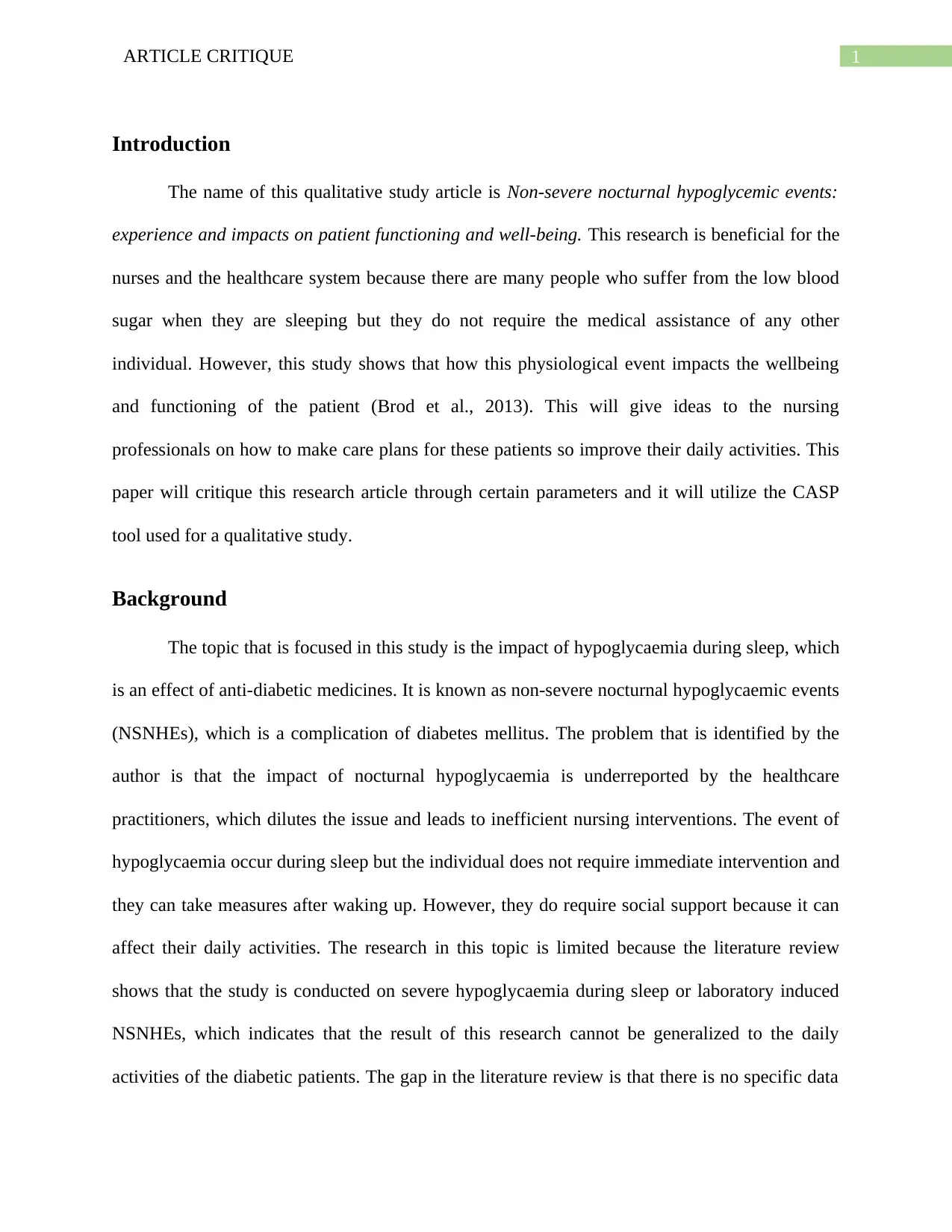
Introduction
The name of this qualitative study article is Non-severe nocturnal hypoglycemic events:
experience and impacts on patient functioning and well-being. This research is beneficial for the
nurses and the healthcare system because there are many people who suffer from the low blood
sugar when they are sleeping but they do not require the medical assistance of any other
individual. However, this study shows that how this physiological event impacts the wellbeing
and functioning of the patient (Brod et al., 2013). This will give ideas to the nursing
professionals on how to make care plans for these patients so improve their daily activities. This
paper will critique this research article through certain parameters and it will utilize the CASP
tool used for a qualitative study.
Background
The topic that is focused in this study is the impact of hypoglycaemia during sleep, which
is an effect of anti-diabetic medicines. It is known as non-severe nocturnal hypoglycaemic events
(NSNHEs), which is a complication of diabetes mellitus. The problem that is identified by the
author is that the impact of nocturnal hypoglycaemia is underreported by the healthcare
practitioners, which dilutes the issue and leads to inefficient nursing interventions. The event of
hypoglycaemia occur during sleep but the individual does not require immediate intervention and
they can take measures after waking up. However, they do require social support because it can
affect their daily activities. The research in this topic is limited because the literature review
shows that the study is conducted on severe hypoglycaemia during sleep or laboratory induced
NSNHEs, which indicates that the result of this research cannot be generalized to the daily
activities of the diabetic patients. The gap in the literature review is that there is no specific data
Introduction
The name of this qualitative study article is Non-severe nocturnal hypoglycemic events:
experience and impacts on patient functioning and well-being. This research is beneficial for the
nurses and the healthcare system because there are many people who suffer from the low blood
sugar when they are sleeping but they do not require the medical assistance of any other
individual. However, this study shows that how this physiological event impacts the wellbeing
and functioning of the patient (Brod et al., 2013). This will give ideas to the nursing
professionals on how to make care plans for these patients so improve their daily activities. This
paper will critique this research article through certain parameters and it will utilize the CASP
tool used for a qualitative study.
Background
The topic that is focused in this study is the impact of hypoglycaemia during sleep, which
is an effect of anti-diabetic medicines. It is known as non-severe nocturnal hypoglycaemic events
(NSNHEs), which is a complication of diabetes mellitus. The problem that is identified by the
author is that the impact of nocturnal hypoglycaemia is underreported by the healthcare
practitioners, which dilutes the issue and leads to inefficient nursing interventions. The event of
hypoglycaemia occur during sleep but the individual does not require immediate intervention and
they can take measures after waking up. However, they do require social support because it can
affect their daily activities. The research in this topic is limited because the literature review
shows that the study is conducted on severe hypoglycaemia during sleep or laboratory induced
NSNHEs, which indicates that the result of this research cannot be generalized to the daily
activities of the diabetic patients. The gap in the literature review is that there is no specific data

2ARTICLE CRITIQUE
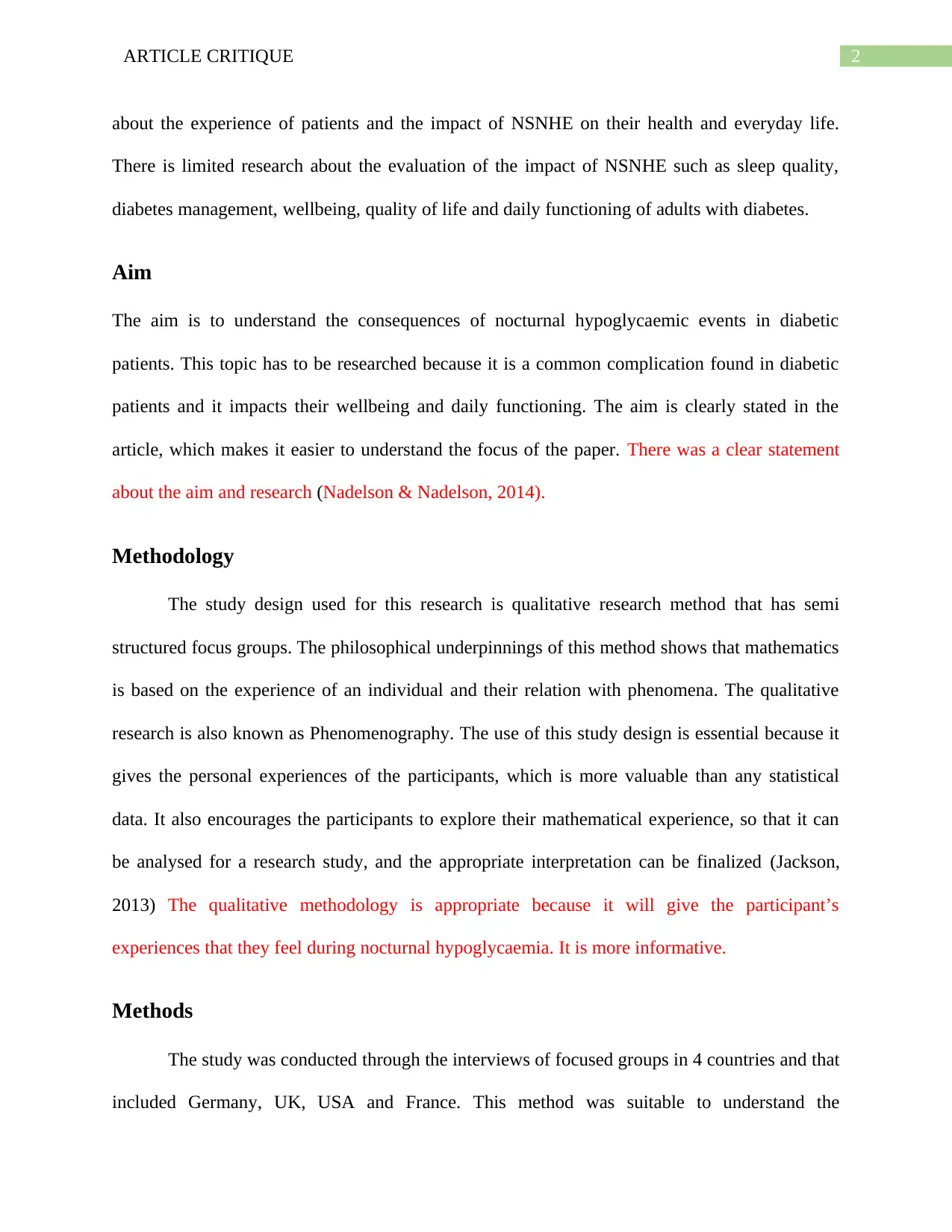
about the experience of patients and the impact of NSNHE on their health and everyday life.
There is limited research about the evaluation of the impact of NSNHE such as sleep quality,
diabetes management, wellbeing, quality of life and daily functioning of adults with diabetes.
Aim
The aim is to understand the consequences of nocturnal hypoglycaemic events in diabetic
patients. This topic has to be researched because it is a common complication found in diabetic
patients and it impacts their wellbeing and daily functioning. The aim is clearly stated in the
article, which makes it easier to understand the focus of the paper. There was a clear statement
about the aim and research (Nadelson & Nadelson, 2014).
Methodology
The study design used for this research is qualitative research method that has semi
structured focus groups. The philosophical underpinnings of this method shows that mathematics
is based on the experience of an individual and their relation with phenomena. The qualitative
research is also known as Phenomenography. The use of this study design is essential because it
gives the personal experiences of the participants, which is more valuable than any statistical
data. It also encourages the participants to explore their mathematical experience, so that it can
be analysed for a research study, and the appropriate interpretation can be finalized (Jackson,
2013) The qualitative methodology is appropriate because it will give the participant’s
experiences that they feel during nocturnal hypoglycaemia. It is more informative.
Methods
The study was conducted through the interviews of focused groups in 4 countries and that
included Germany, UK, USA and France. This method was suitable to understand the
about the experience of patients and the impact of NSNHE on their health and everyday life.
There is limited research about the evaluation of the impact of NSNHE such as sleep quality,
diabetes management, wellbeing, quality of life and daily functioning of adults with diabetes.
Aim
The aim is to understand the consequences of nocturnal hypoglycaemic events in diabetic
patients. This topic has to be researched because it is a common complication found in diabetic
patients and it impacts their wellbeing and daily functioning. The aim is clearly stated in the
article, which makes it easier to understand the focus of the paper. There was a clear statement
about the aim and research (Nadelson & Nadelson, 2014).
Methodology
The study design used for this research is qualitative research method that has semi
structured focus groups. The philosophical underpinnings of this method shows that mathematics
is based on the experience of an individual and their relation with phenomena. The qualitative
research is also known as Phenomenography. The use of this study design is essential because it
gives the personal experiences of the participants, which is more valuable than any statistical
data. It also encourages the participants to explore their mathematical experience, so that it can
be analysed for a research study, and the appropriate interpretation can be finalized (Jackson,
2013) The qualitative methodology is appropriate because it will give the participant’s
experiences that they feel during nocturnal hypoglycaemia. It is more informative.
Methods
The study was conducted through the interviews of focused groups in 4 countries and that
included Germany, UK, USA and France. This method was suitable to understand the
⊘ This is a preview!⊘
Do you want full access?
Subscribe today to unlock all pages.

Trusted by 1+ million students worldwide

3ARTICLE CRITIQUE
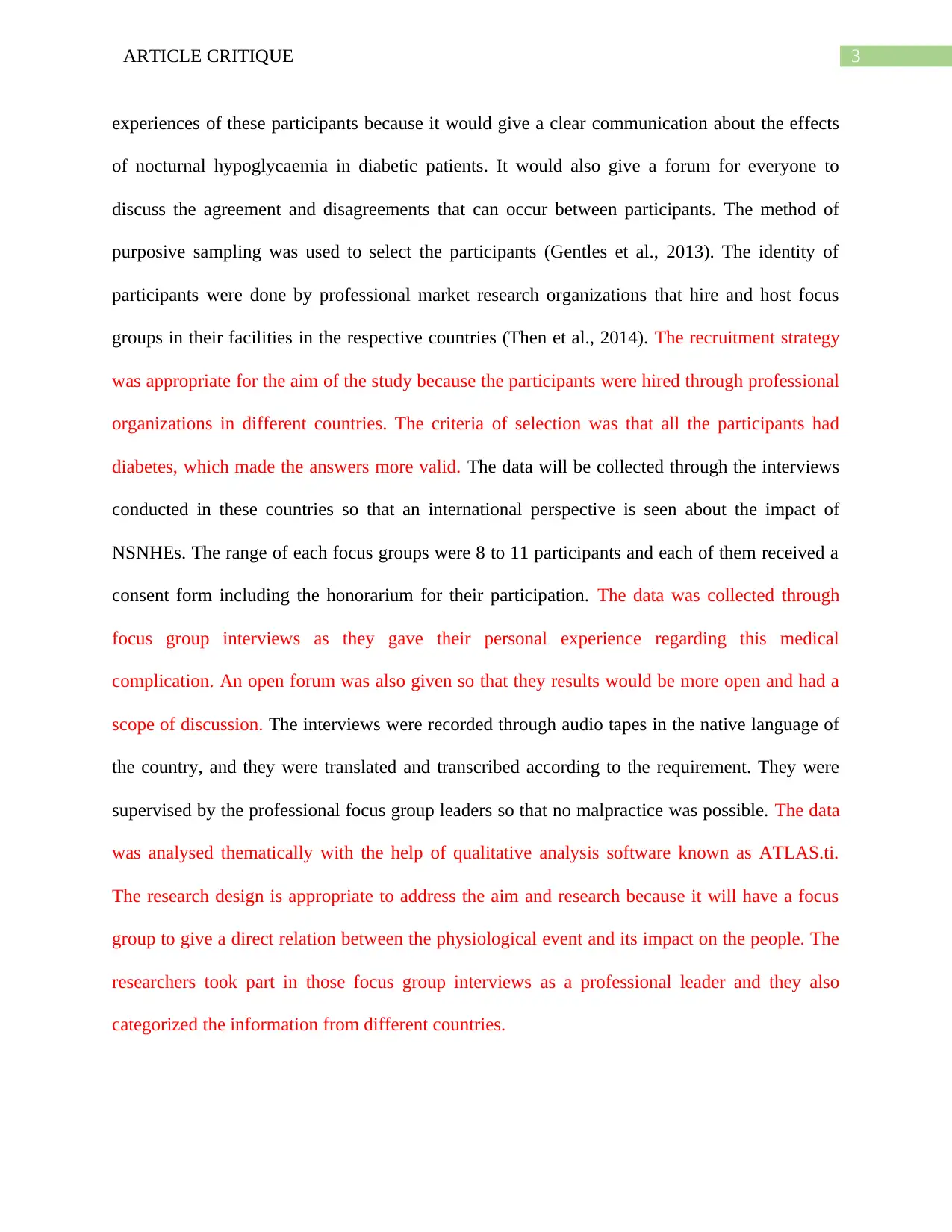
experiences of these participants because it would give a clear communication about the effects
of nocturnal hypoglycaemia in diabetic patients. It would also give a forum for everyone to
discuss the agreement and disagreements that can occur between participants. The method of
purposive sampling was used to select the participants (Gentles et al., 2013). The identity of
participants were done by professional market research organizations that hire and host focus
groups in their facilities in the respective countries (Then et al., 2014). The recruitment strategy
was appropriate for the aim of the study because the participants were hired through professional
organizations in different countries. The criteria of selection was that all the participants had
diabetes, which made the answers more valid. The data will be collected through the interviews
conducted in these countries so that an international perspective is seen about the impact of
NSNHEs. The range of each focus groups were 8 to 11 participants and each of them received a
consent form including the honorarium for their participation. The data was collected through
focus group interviews as they gave their personal experience regarding this medical
complication. An open forum was also given so that they results would be more open and had a
scope of discussion. The interviews were recorded through audio tapes in the native language of
the country, and they were translated and transcribed according to the requirement. They were
supervised by the professional focus group leaders so that no malpractice was possible. The data
was analysed thematically with the help of qualitative analysis software known as ATLAS.ti.
The research design is appropriate to address the aim and research because it will have a focus
group to give a direct relation between the physiological event and its impact on the people. The
researchers took part in those focus group interviews as a professional leader and they also
categorized the information from different countries.
experiences of these participants because it would give a clear communication about the effects
of nocturnal hypoglycaemia in diabetic patients. It would also give a forum for everyone to
discuss the agreement and disagreements that can occur between participants. The method of
purposive sampling was used to select the participants (Gentles et al., 2013). The identity of
participants were done by professional market research organizations that hire and host focus
groups in their facilities in the respective countries (Then et al., 2014). The recruitment strategy
was appropriate for the aim of the study because the participants were hired through professional
organizations in different countries. The criteria of selection was that all the participants had
diabetes, which made the answers more valid. The data will be collected through the interviews
conducted in these countries so that an international perspective is seen about the impact of
NSNHEs. The range of each focus groups were 8 to 11 participants and each of them received a
consent form including the honorarium for their participation. The data was collected through
focus group interviews as they gave their personal experience regarding this medical
complication. An open forum was also given so that they results would be more open and had a
scope of discussion. The interviews were recorded through audio tapes in the native language of
the country, and they were translated and transcribed according to the requirement. They were
supervised by the professional focus group leaders so that no malpractice was possible. The data
was analysed thematically with the help of qualitative analysis software known as ATLAS.ti.
The research design is appropriate to address the aim and research because it will have a focus
group to give a direct relation between the physiological event and its impact on the people. The
researchers took part in those focus group interviews as a professional leader and they also
categorized the information from different countries.
Paraphrase This Document
Need a fresh take? Get an instant paraphrase of this document with our AI Paraphraser

4ARTICLE CRITIQUE
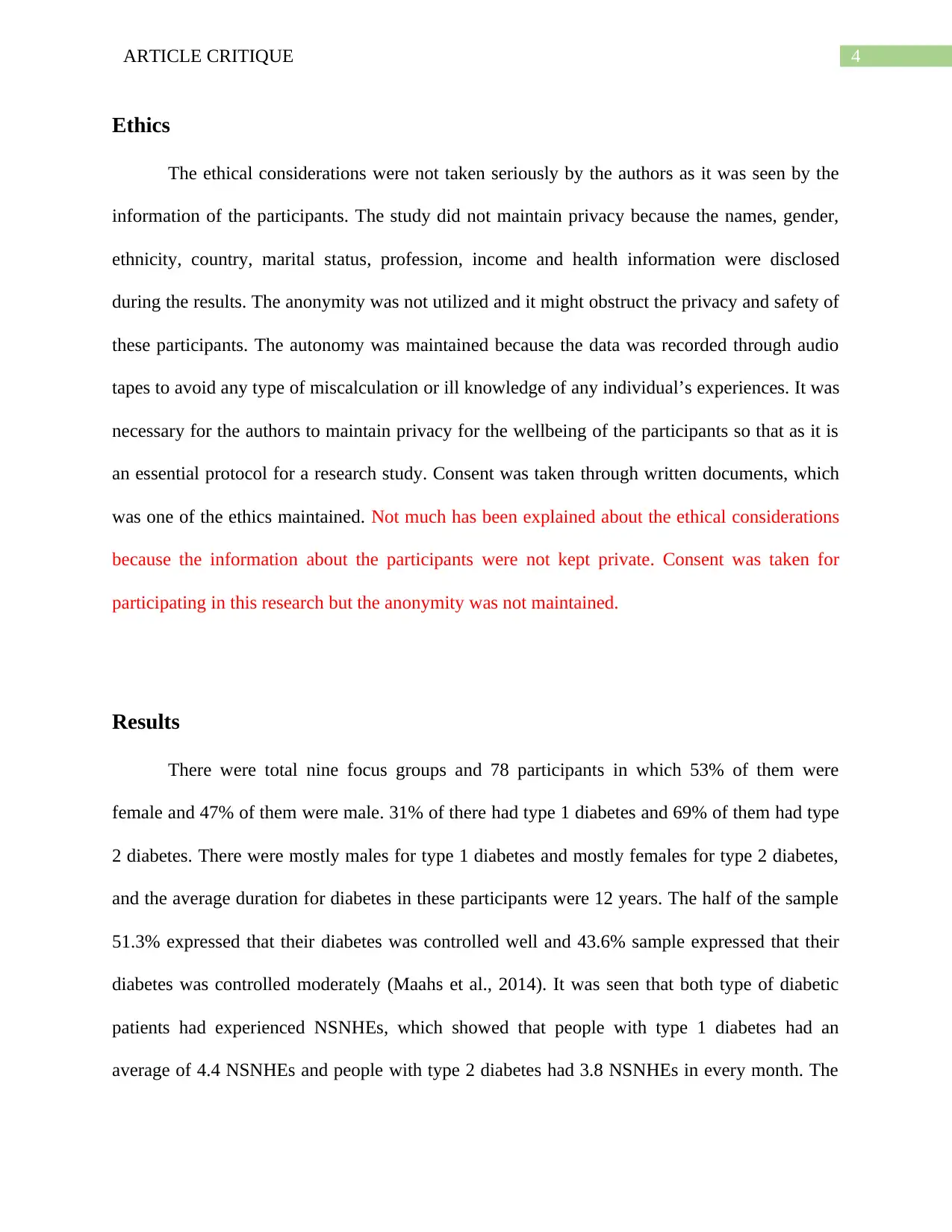
Ethics
The ethical considerations were not taken seriously by the authors as it was seen by the
information of the participants. The study did not maintain privacy because the names, gender,
ethnicity, country, marital status, profession, income and health information were disclosed
during the results. The anonymity was not utilized and it might obstruct the privacy and safety of
these participants. The autonomy was maintained because the data was recorded through audio
tapes to avoid any type of miscalculation or ill knowledge of any individual’s experiences. It was
necessary for the authors to maintain privacy for the wellbeing of the participants so that as it is
an essential protocol for a research study. Consent was taken through written documents, which
was one of the ethics maintained. Not much has been explained about the ethical considerations
because the information about the participants were not kept private. Consent was taken for
participating in this research but the anonymity was not maintained.
Results
There were total nine focus groups and 78 participants in which 53% of them were
female and 47% of them were male. 31% of there had type 1 diabetes and 69% of them had type
2 diabetes. There were mostly males for type 1 diabetes and mostly females for type 2 diabetes,
and the average duration for diabetes in these participants were 12 years. The half of the sample
51.3% expressed that their diabetes was controlled well and 43.6% sample expressed that their
diabetes was controlled moderately (Maahs et al., 2014). It was seen that both type of diabetic
patients had experienced NSNHEs, which showed that people with type 1 diabetes had an
average of 4.4 NSNHEs and people with type 2 diabetes had 3.8 NSNHEs in every month. The
Ethics
The ethical considerations were not taken seriously by the authors as it was seen by the
information of the participants. The study did not maintain privacy because the names, gender,
ethnicity, country, marital status, profession, income and health information were disclosed
during the results. The anonymity was not utilized and it might obstruct the privacy and safety of
these participants. The autonomy was maintained because the data was recorded through audio
tapes to avoid any type of miscalculation or ill knowledge of any individual’s experiences. It was
necessary for the authors to maintain privacy for the wellbeing of the participants so that as it is
an essential protocol for a research study. Consent was taken through written documents, which
was one of the ethics maintained. Not much has been explained about the ethical considerations
because the information about the participants were not kept private. Consent was taken for
participating in this research but the anonymity was not maintained.
Results
There were total nine focus groups and 78 participants in which 53% of them were
female and 47% of them were male. 31% of there had type 1 diabetes and 69% of them had type
2 diabetes. There were mostly males for type 1 diabetes and mostly females for type 2 diabetes,
and the average duration for diabetes in these participants were 12 years. The half of the sample
51.3% expressed that their diabetes was controlled well and 43.6% sample expressed that their
diabetes was controlled moderately (Maahs et al., 2014). It was seen that both type of diabetic
patients had experienced NSNHEs, which showed that people with type 1 diabetes had an
average of 4.4 NSNHEs and people with type 2 diabetes had 3.8 NSNHEs in every month. The

5ARTICLE CRITIQUE
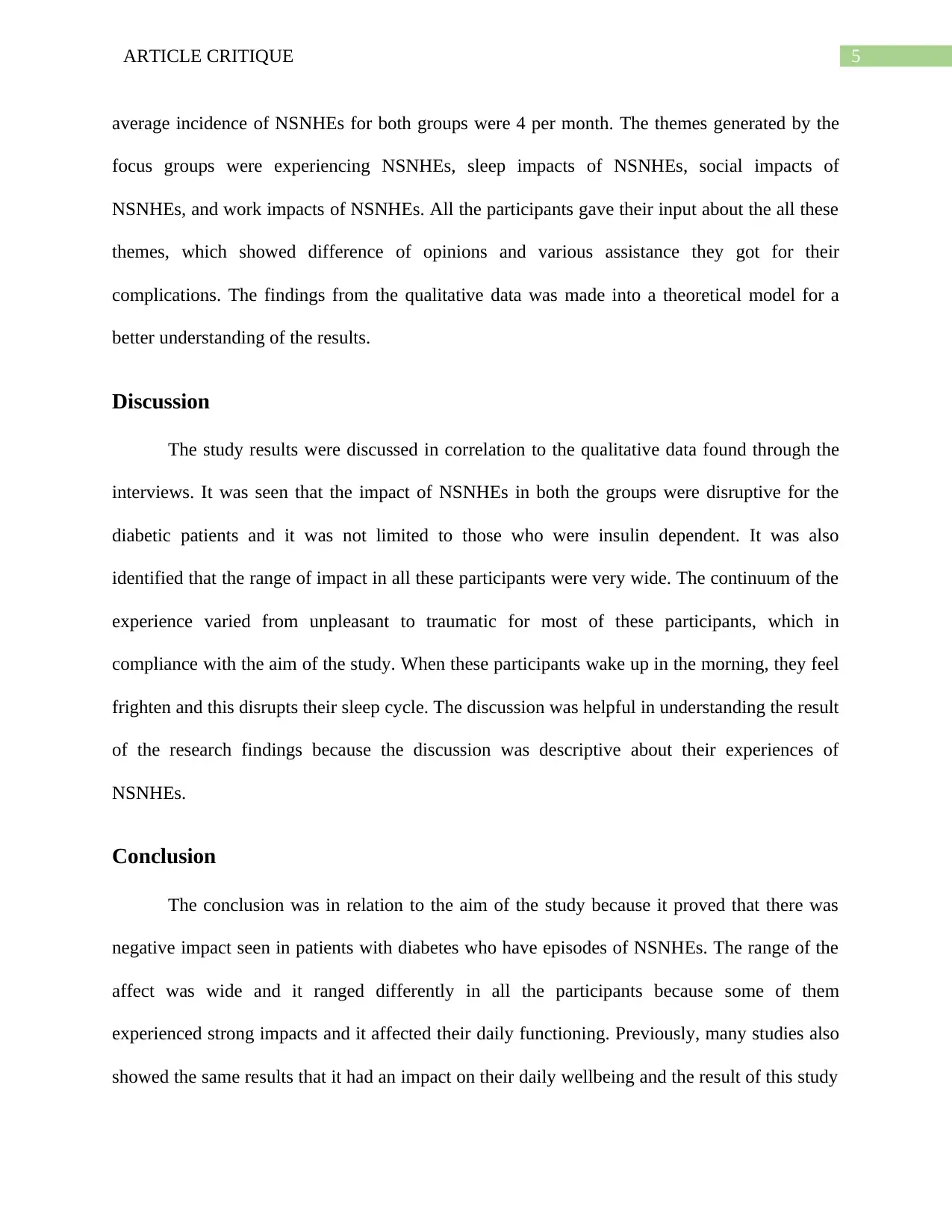
average incidence of NSNHEs for both groups were 4 per month. The themes generated by the
focus groups were experiencing NSNHEs, sleep impacts of NSNHEs, social impacts of
NSNHEs, and work impacts of NSNHEs. All the participants gave their input about the all these
themes, which showed difference of opinions and various assistance they got for their
complications. The findings from the qualitative data was made into a theoretical model for a
better understanding of the results.
Discussion
The study results were discussed in correlation to the qualitative data found through the
interviews. It was seen that the impact of NSNHEs in both the groups were disruptive for the
diabetic patients and it was not limited to those who were insulin dependent. It was also
identified that the range of impact in all these participants were very wide. The continuum of the
experience varied from unpleasant to traumatic for most of these participants, which in
compliance with the aim of the study. When these participants wake up in the morning, they feel
frighten and this disrupts their sleep cycle. The discussion was helpful in understanding the result
of the research findings because the discussion was descriptive about their experiences of
NSNHEs.
Conclusion
The conclusion was in relation to the aim of the study because it proved that there was
negative impact seen in patients with diabetes who have episodes of NSNHEs. The range of the
affect was wide and it ranged differently in all the participants because some of them
experienced strong impacts and it affected their daily functioning. Previously, many studies also
showed the same results that it had an impact on their daily wellbeing and the result of this study
average incidence of NSNHEs for both groups were 4 per month. The themes generated by the
focus groups were experiencing NSNHEs, sleep impacts of NSNHEs, social impacts of
NSNHEs, and work impacts of NSNHEs. All the participants gave their input about the all these
themes, which showed difference of opinions and various assistance they got for their
complications. The findings from the qualitative data was made into a theoretical model for a
better understanding of the results.
Discussion
The study results were discussed in correlation to the qualitative data found through the
interviews. It was seen that the impact of NSNHEs in both the groups were disruptive for the
diabetic patients and it was not limited to those who were insulin dependent. It was also
identified that the range of impact in all these participants were very wide. The continuum of the
experience varied from unpleasant to traumatic for most of these participants, which in
compliance with the aim of the study. When these participants wake up in the morning, they feel
frighten and this disrupts their sleep cycle. The discussion was helpful in understanding the result
of the research findings because the discussion was descriptive about their experiences of
NSNHEs.
Conclusion
The conclusion was in relation to the aim of the study because it proved that there was
negative impact seen in patients with diabetes who have episodes of NSNHEs. The range of the
affect was wide and it ranged differently in all the participants because some of them
experienced strong impacts and it affected their daily functioning. Previously, many studies also
showed the same results that it had an impact on their daily wellbeing and the result of this study
⊘ This is a preview!⊘
Do you want full access?
Subscribe today to unlock all pages.

Trusted by 1+ million students worldwide

6ARTICLE CRITIQUE
had a similar conclusion. They identify recommendations for future study that will focus on the
experiences of these patients with their healthcare providers regarding NSNHEs and the impact
of NSNHEs from the social, emotional and physiological perspective. These data does not
indicate if the same impact is seen if hypoglycaemia occurs during day.
Limitation
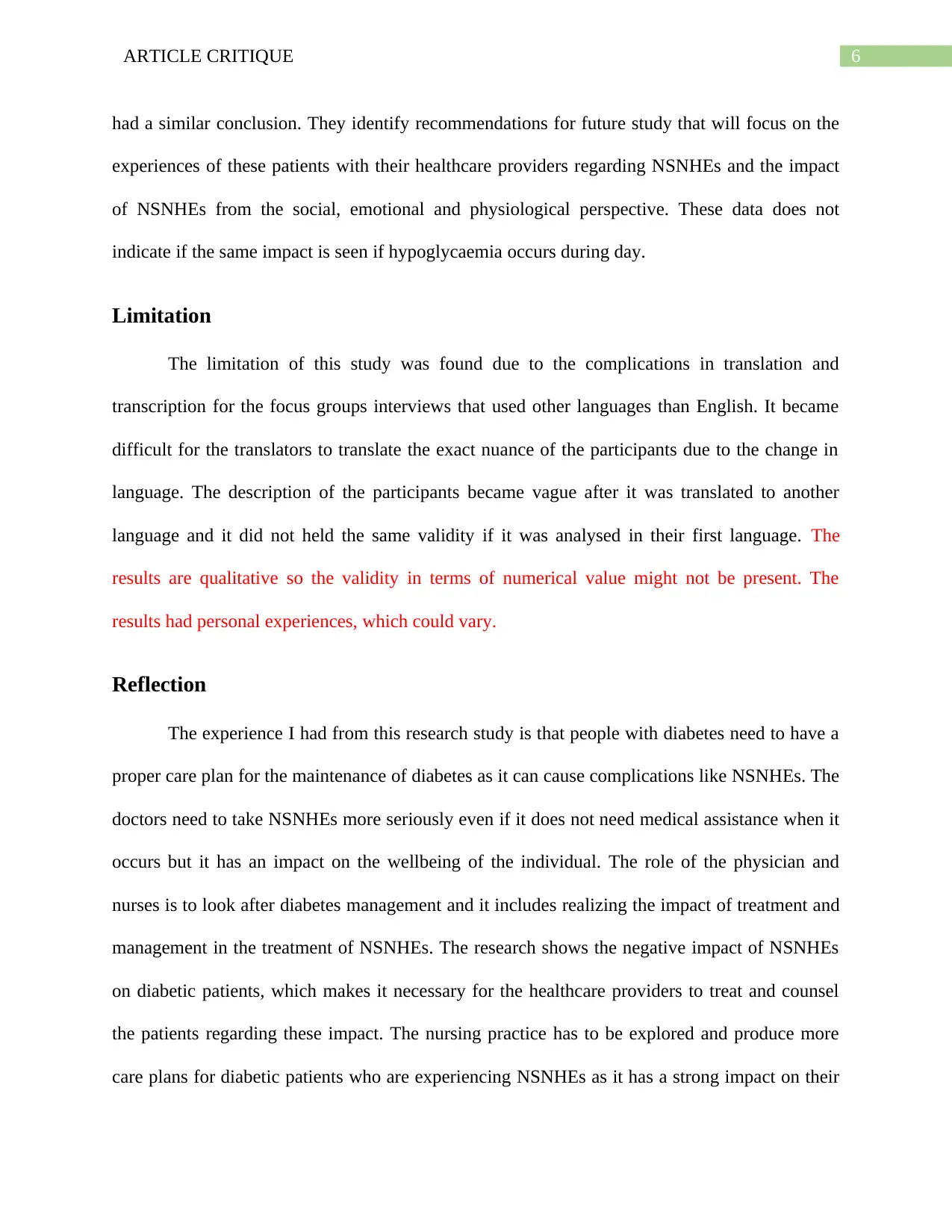
The limitation of this study was found due to the complications in translation and
transcription for the focus groups interviews that used other languages than English. It became
difficult for the translators to translate the exact nuance of the participants due to the change in
language. The description of the participants became vague after it was translated to another
language and it did not held the same validity if it was analysed in their first language. The
results are qualitative so the validity in terms of numerical value might not be present. The
results had personal experiences, which could vary.
Reflection
The experience I had from this research study is that people with diabetes need to have a
proper care plan for the maintenance of diabetes as it can cause complications like NSNHEs. The
doctors need to take NSNHEs more seriously even if it does not need medical assistance when it
occurs but it has an impact on the wellbeing of the individual. The role of the physician and
nurses is to look after diabetes management and it includes realizing the impact of treatment and
management in the treatment of NSNHEs. The research shows the negative impact of NSNHEs
on diabetic patients, which makes it necessary for the healthcare providers to treat and counsel
the patients regarding these impact. The nursing practice has to be explored and produce more
care plans for diabetic patients who are experiencing NSNHEs as it has a strong impact on their
had a similar conclusion. They identify recommendations for future study that will focus on the
experiences of these patients with their healthcare providers regarding NSNHEs and the impact
of NSNHEs from the social, emotional and physiological perspective. These data does not
indicate if the same impact is seen if hypoglycaemia occurs during day.
Limitation
The limitation of this study was found due to the complications in translation and
transcription for the focus groups interviews that used other languages than English. It became
difficult for the translators to translate the exact nuance of the participants due to the change in
language. The description of the participants became vague after it was translated to another
language and it did not held the same validity if it was analysed in their first language. The
results are qualitative so the validity in terms of numerical value might not be present. The
results had personal experiences, which could vary.
Reflection
The experience I had from this research study is that people with diabetes need to have a
proper care plan for the maintenance of diabetes as it can cause complications like NSNHEs. The
doctors need to take NSNHEs more seriously even if it does not need medical assistance when it
occurs but it has an impact on the wellbeing of the individual. The role of the physician and
nurses is to look after diabetes management and it includes realizing the impact of treatment and
management in the treatment of NSNHEs. The research shows the negative impact of NSNHEs
on diabetic patients, which makes it necessary for the healthcare providers to treat and counsel
the patients regarding these impact. The nursing practice has to be explored and produce more
care plans for diabetic patients who are experiencing NSNHEs as it has a strong impact on their
Paraphrase This Document
Need a fresh take? Get an instant paraphrase of this document with our AI Paraphraser

7ARTICLE CRITIQUE
wellbeing. The research is valuable because it close the gap in the literature review regarding this
topic because there were many gaps in previous research about the impact of NSNHE.
wellbeing. The research is valuable because it close the gap in the literature review regarding this
topic because there were many gaps in previous research about the impact of NSNHE.

8ARTICLE CRITIQUE
References
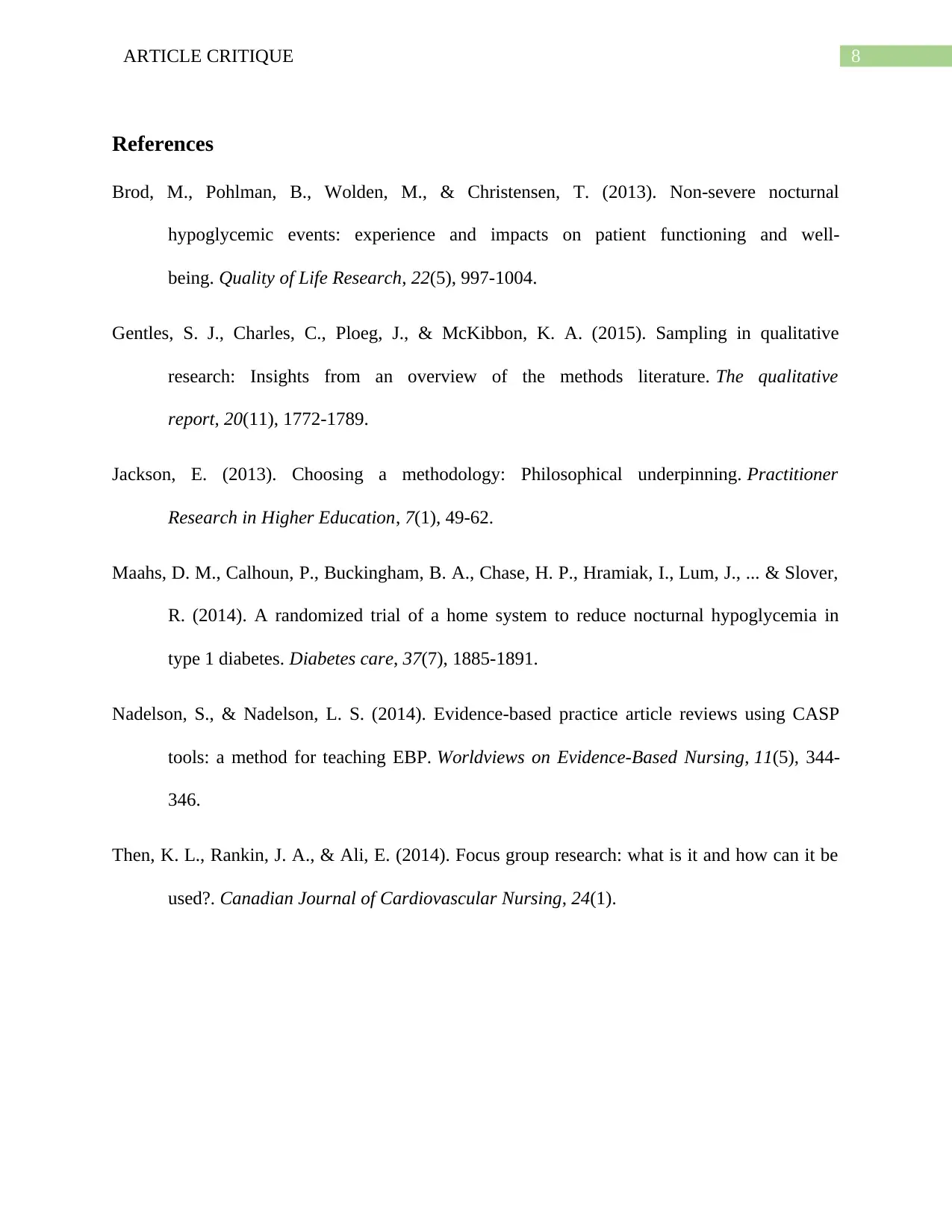
Brod, M., Pohlman, B., Wolden, M., & Christensen, T. (2013). Non-severe nocturnal
hypoglycemic events: experience and impacts on patient functioning and well-
being. Quality of Life Research, 22(5), 997-1004.
Gentles, S. J., Charles, C., Ploeg, J., & McKibbon, K. A. (2015). Sampling in qualitative
research: Insights from an overview of the methods literature. The qualitative
report, 20(11), 1772-1789.
Jackson, E. (2013). Choosing a methodology: Philosophical underpinning. Practitioner
Research in Higher Education, 7(1), 49-62.
Maahs, D. M., Calhoun, P., Buckingham, B. A., Chase, H. P., Hramiak, I., Lum, J., ... & Slover,
R. (2014). A randomized trial of a home system to reduce nocturnal hypoglycemia in
type 1 diabetes. Diabetes care, 37(7), 1885-1891.
Nadelson, S., & Nadelson, L. S. (2014). Evidence‐based practice article reviews using CASP
tools: a method for teaching EBP. Worldviews on Evidence‐Based Nursing, 11(5), 344-
346.
Then, K. L., Rankin, J. A., & Ali, E. (2014). Focus group research: what is it and how can it be
used?. Canadian Journal of Cardiovascular Nursing, 24(1).
References
Brod, M., Pohlman, B., Wolden, M., & Christensen, T. (2013). Non-severe nocturnal
hypoglycemic events: experience and impacts on patient functioning and well-
being. Quality of Life Research, 22(5), 997-1004.
Gentles, S. J., Charles, C., Ploeg, J., & McKibbon, K. A. (2015). Sampling in qualitative
research: Insights from an overview of the methods literature. The qualitative
report, 20(11), 1772-1789.
Jackson, E. (2013). Choosing a methodology: Philosophical underpinning. Practitioner
Research in Higher Education, 7(1), 49-62.
Maahs, D. M., Calhoun, P., Buckingham, B. A., Chase, H. P., Hramiak, I., Lum, J., ... & Slover,
R. (2014). A randomized trial of a home system to reduce nocturnal hypoglycemia in
type 1 diabetes. Diabetes care, 37(7), 1885-1891.
Nadelson, S., & Nadelson, L. S. (2014). Evidence‐based practice article reviews using CASP
tools: a method for teaching EBP. Worldviews on Evidence‐Based Nursing, 11(5), 344-
346.
Then, K. L., Rankin, J. A., & Ali, E. (2014). Focus group research: what is it and how can it be
used?. Canadian Journal of Cardiovascular Nursing, 24(1).
⊘ This is a preview!⊘
Do you want full access?
Subscribe today to unlock all pages.

Trusted by 1+ million students worldwide
1 out of 9
Related Documents
Your All-in-One AI-Powered Toolkit for Academic Success.
+13062052269
info@desklib.com
Available 24*7 on WhatsApp / Email
Unlock your academic potential
Copyright © 2020–2025 A2Z Services. All Rights Reserved. Developed and managed by ZUCOL.