Impact of Inflation on the Growth of the Australian Retail Industry
VerifiedAdded on 2023/04/19
|11
|2458
|415
Project
AI Summary
This professional project investigates the impact of inflation on the growth of the Australian retail industry over the past decade. The research explores the adverse effects of rising inflation on both consumers and retailers, examining how changes in inflation rates influence consumer income and the cost base of retail companies. The project includes an introduction, feasibility assessment, aims and objectives, research questions, a literature review, and a detailed research methodology, including data collection and analysis methods. A Gantt chart outlines the project timeline. The study employs a descriptive research design, positivism philosophy, and a deductive approach. Primary data is collected through surveys of retail employees, analyzed using the Likert scale and SPSS. The project concludes with a discussion of findings and the implications of inflation on the retail sector, including strategies for adapting to changing economic conditions and the long-term structural and operational changes expected in the future.
Running head: PROFESSIONAL PROJECT
Professional Project
Name of the Student
Name of the University
Author’s Note
Professional Project
Name of the Student
Name of the University
Author’s Note

Paraphrase This Document
Need a fresh take? Get an instant paraphrase of this document with our AI Paraphraser
1PROFESSIONAL PROJECT
Table of Contents
Introduction......................................................................................................................................2
Feasibility of project within time- frame.........................................................................................2
Aims and objectives of research......................................................................................................3
Research Questions..........................................................................................................................4
Literature Review............................................................................................................................4
Research Methodology....................................................................................................................6
Data collection process....................................................................................................................6
Data analysis method.......................................................................................................................6
Gantt Chart.......................................................................................................................................7
Written communication...................................................................................................................7
References........................................................................................................................................9
Table of Contents
Introduction......................................................................................................................................2
Feasibility of project within time- frame.........................................................................................2
Aims and objectives of research......................................................................................................3
Research Questions..........................................................................................................................4
Literature Review............................................................................................................................4
Research Methodology....................................................................................................................6
Data collection process....................................................................................................................6
Data analysis method.......................................................................................................................6
Gantt Chart.......................................................................................................................................7
Written communication...................................................................................................................7
References........................................................................................................................................9
2PROFESSIONAL PROJECT
Introduction
The paper aims to analyze the effect of rate of inflation on the growth of the Australian
retail industry in the past decade. With the rise of inflation, both the consumers as well as the
retailers gets adversely affected. When there is an increase in the price of the levels of services
and goods in the economy over a period of time, it is known as inflation (Brown, 2017). The
retail sales in Australia have known to rise at 3.5 per cent in the current year whereas the rate of
inflation in Australia is 1.9 percent presently. The retail industry of Australia is basically a
service industry which has many roles from introducing new products to the consumers to
assisting them for assessing the products and compares their prices. The retail industry also
helps the consumers to buy products at a very convenient time and in quantities they find
appropriate for the needs. There is a presence of almost 140,000 retail businesses in Australia
where around 1.2 million people are employed in the industry (Bernanke et al., 2018). The retail
industry of Australia has also known to make a significant contribution to the economic output
and is also known to be quite diverse in nature (Magnan, 2015). Inflation generally takes place
when there is an increase in the demand for the products or services than the supply. In such
cases, the retailer will be increasing the price of products. Although in the past decade it has been
found out that inflation have been quite beneficial for the retail sector (Noorulhadi, Khan &
Khan, 2018). Inflation can also be represented as a wake-up call for the retailers which states
how they need to manage for the long-term growth when there will be a structural change
(Clarke, 2018).
Feasibility of project within time- frame
This specific research project is feasible and can be completed within the given time
frame. The research can be conducted within the retail industry in Australia in order to obtain
Introduction
The paper aims to analyze the effect of rate of inflation on the growth of the Australian
retail industry in the past decade. With the rise of inflation, both the consumers as well as the
retailers gets adversely affected. When there is an increase in the price of the levels of services
and goods in the economy over a period of time, it is known as inflation (Brown, 2017). The
retail sales in Australia have known to rise at 3.5 per cent in the current year whereas the rate of
inflation in Australia is 1.9 percent presently. The retail industry of Australia is basically a
service industry which has many roles from introducing new products to the consumers to
assisting them for assessing the products and compares their prices. The retail industry also
helps the consumers to buy products at a very convenient time and in quantities they find
appropriate for the needs. There is a presence of almost 140,000 retail businesses in Australia
where around 1.2 million people are employed in the industry (Bernanke et al., 2018). The retail
industry of Australia has also known to make a significant contribution to the economic output
and is also known to be quite diverse in nature (Magnan, 2015). Inflation generally takes place
when there is an increase in the demand for the products or services than the supply. In such
cases, the retailer will be increasing the price of products. Although in the past decade it has been
found out that inflation have been quite beneficial for the retail sector (Noorulhadi, Khan &
Khan, 2018). Inflation can also be represented as a wake-up call for the retailers which states
how they need to manage for the long-term growth when there will be a structural change
(Clarke, 2018).
Feasibility of project within time- frame
This specific research project is feasible and can be completed within the given time
frame. The research can be conducted within the retail industry in Australia in order to obtain
⊘ This is a preview!⊘
Do you want full access?
Subscribe today to unlock all pages.

Trusted by 1+ million students worldwide
3PROFESSIONAL PROJECT
accurate outcome of research. Even though few difficulties might arise in conducting this
research, there is a possibility that sufficient data will be obtained for drawing conclusions of this
research study.
Aims and objectives of research
The aim of the research is to examine the impact of inflation on the growth of the retail
industry of Australia. Inflation have known to be a serious threat for the firms in the retail
industry as it will be harmful for the consumers. Inflation is also known to affect the cost base of
the retail companies which will lead to a rise in the price of the commodities (Bailey et al, 2015).
As a result of inflation, both the retailers as well as the consumers will be facing a harmful result
in the economy. The retail industry is also known to be quite diverse in nature in terms of sector,
origin and by the size of the business. The workforce of the retail sector also known to have
retrieval low skill levels. Much of the retailing in Australia have changed as a result of increased
competition which takes place from the increase in the rate of online shopping.
The main objective of the paper is to find:
The impact of the rate of inflation on the growth of the retail industry in Australia.
The impact on consumers as well as retailers due to inflation.
accurate outcome of research. Even though few difficulties might arise in conducting this
research, there is a possibility that sufficient data will be obtained for drawing conclusions of this
research study.
Aims and objectives of research
The aim of the research is to examine the impact of inflation on the growth of the retail
industry of Australia. Inflation have known to be a serious threat for the firms in the retail
industry as it will be harmful for the consumers. Inflation is also known to affect the cost base of
the retail companies which will lead to a rise in the price of the commodities (Bailey et al, 2015).
As a result of inflation, both the retailers as well as the consumers will be facing a harmful result
in the economy. The retail industry is also known to be quite diverse in nature in terms of sector,
origin and by the size of the business. The workforce of the retail sector also known to have
retrieval low skill levels. Much of the retailing in Australia have changed as a result of increased
competition which takes place from the increase in the rate of online shopping.
The main objective of the paper is to find:
The impact of the rate of inflation on the growth of the retail industry in Australia.
The impact on consumers as well as retailers due to inflation.
Paraphrase This Document
Need a fresh take? Get an instant paraphrase of this document with our AI Paraphraser
4PROFESSIONAL PROJECT
Research Questions
The primary question for this research study is given below–
What is the effect of inflation rate on the growth of retail sector?
The secondary questions for tis research study are-
How does inflation rate influences competition in the retail industry?
Do inflation rate brought about changes in the development of retail sector?
Literature Review
Jaravel (2016) opines that inflation in the past has occurred at the time when heath of
retail sector has been improving. According to Bhutta & Hasan (2013), the period before
financial crisis reflects high inflation in form of increasing housing prices that led to several
customers feel better off and permitted to extractequity from homes and some flowed into
retailers tills. Even inflation in mid 1980s was helpful driven by surge in customer demand it
permitted the retailers to increase prices and improve margins without damming its sales. At
present, the consumers as well as retailers are adversely affected since present inflation is based
on supply rather than demand driven. Price inflation occurs at the same time adjust its consumer
spending to highlight their financial realities (Keynes, 2018). As a result, both margins as well as
sales comes under pressure. From the perspective of retailers, price boom in global community,
increasing cost of labor and weakness of currency in the developed nations have observed rise in
input prices in recent times (Hara, Hiraki & Ichise, 2015). This in turn has huge effect on the
consumers demand since changes in inflation rate influences their income (Burch & Lawrence,
2013).While RIT acknowledge that the retailers have done better job of keeping prices lower and
stay competitive during financial crisis. Several manufacturers as well as retailers have been
Research Questions
The primary question for this research study is given below–
What is the effect of inflation rate on the growth of retail sector?
The secondary questions for tis research study are-
How does inflation rate influences competition in the retail industry?
Do inflation rate brought about changes in the development of retail sector?
Literature Review
Jaravel (2016) opines that inflation in the past has occurred at the time when heath of
retail sector has been improving. According to Bhutta & Hasan (2013), the period before
financial crisis reflects high inflation in form of increasing housing prices that led to several
customers feel better off and permitted to extractequity from homes and some flowed into
retailers tills. Even inflation in mid 1980s was helpful driven by surge in customer demand it
permitted the retailers to increase prices and improve margins without damming its sales. At
present, the consumers as well as retailers are adversely affected since present inflation is based
on supply rather than demand driven. Price inflation occurs at the same time adjust its consumer
spending to highlight their financial realities (Keynes, 2018). As a result, both margins as well as
sales comes under pressure. From the perspective of retailers, price boom in global community,
increasing cost of labor and weakness of currency in the developed nations have observed rise in
input prices in recent times (Hara, Hiraki & Ichise, 2015). This in turn has huge effect on the
consumers demand since changes in inflation rate influences their income (Burch & Lawrence,
2013).While RIT acknowledge that the retailers have done better job of keeping prices lower and
stay competitive during financial crisis. Several manufacturers as well as retailers have been
5PROFESSIONAL PROJECT
attaining cost increases by offsetting it through cost savings, product redesign, supplier support
and by reducing profit margins. As the price inflation impacts the customers demand as well as
cost structure of the retailers, the rate of price inflation vary in terms of channel and retailers
format operation (Governor, 2014). For instance, the food retailers as well as value non- food
retailers are influenced to larger extent owing to raw materials comprising larger proportion of
selling price and volume is vital.
Tiwariet al.(2016) opines that, inflation rate in present years have enhanced competition
in the retail industry. The retail items price have been declining or steady over the present years.
The variation in the import prices tended to have passed on to retail prices that the consumer
faces. However, this led to shift in pricing dynamics for the retail products. For instance, in
Australia, online sales has made up around 50% over the past few years (Jacenko & Gunasekera,
2015). The competitive pressurehas not has been confined to only online market share with large
number of foreign retailers. The organizations in this sector have responded to growing
competition by decreasing its costs as well as improving their total productivity.
Most of the retailers have never encountered inflation against the backdrop as it highly
familiar with growth framework based on deflationary pressures as well as rise in volume (Bawa,
Gupta& Sharma, 2013). On the contrary, few retailersfaced difficulties in doing their business
with changing inflation rate. However, the retailers have been adopting various strategies for
managing inflation rate in the country. Few retail companies have been strengthening its price
position as well as protecting its consumer base for building its market position and increasing its
total market share in long run. Moreover, all the retailers must consider different means for
adapting to the change in the environment (Riff, Lacy & Fico, 2014).
attaining cost increases by offsetting it through cost savings, product redesign, supplier support
and by reducing profit margins. As the price inflation impacts the customers demand as well as
cost structure of the retailers, the rate of price inflation vary in terms of channel and retailers
format operation (Governor, 2014). For instance, the food retailers as well as value non- food
retailers are influenced to larger extent owing to raw materials comprising larger proportion of
selling price and volume is vital.
Tiwariet al.(2016) opines that, inflation rate in present years have enhanced competition
in the retail industry. The retail items price have been declining or steady over the present years.
The variation in the import prices tended to have passed on to retail prices that the consumer
faces. However, this led to shift in pricing dynamics for the retail products. For instance, in
Australia, online sales has made up around 50% over the past few years (Jacenko & Gunasekera,
2015). The competitive pressurehas not has been confined to only online market share with large
number of foreign retailers. The organizations in this sector have responded to growing
competition by decreasing its costs as well as improving their total productivity.
Most of the retailers have never encountered inflation against the backdrop as it highly
familiar with growth framework based on deflationary pressures as well as rise in volume (Bawa,
Gupta& Sharma, 2013). On the contrary, few retailersfaced difficulties in doing their business
with changing inflation rate. However, the retailers have been adopting various strategies for
managing inflation rate in the country. Few retail companies have been strengthening its price
position as well as protecting its consumer base for building its market position and increasing its
total market share in long run. Moreover, all the retailers must consider different means for
adapting to the change in the environment (Riff, Lacy & Fico, 2014).
⊘ This is a preview!⊘
Do you want full access?
Subscribe today to unlock all pages.
Trusted by 1+ million students worldwide
6PROFESSIONAL PROJECT
Research Methodology
Different methods will be adopted for conducting this present research study. The
descriptive research design will be used in this study as it deals with describing different theories
relating to this study. Furthermore, positivism philosophy is used in this study as it considers
scientific way of data collection aligning to this research topic. In addition to this, deductive
approach will be adopted in this thesis since it is mainly concerned with formulating and testing
hypothesis. This approach will also help to utilize various theories for analyzing this present
thesis.
Data collection process
Treiman (2014) states that data can be collected by using two methods- primary and
secondary. The primary data are gatheredthrough survey method, observations and interviews
while the secondary data are collected from different sources such as- peer- reviewed journals,
books, newspapers and so on. For this research study, primary data collection method will
beadopted as it is more reliable than secondary data collection method. The primary data will be
collected through survey method. A structured questionnaire will be framed and provided o the
employees of the retail organizations in Australia. A sample size of around 50 employees will be
selected for the survey method through simple random sampling design.
Data analysis method
In this study, quantitative data method will be used in order to obtain accurate data. The
responses obtained from the survey processwill be analyzed using the Likert scale method. In
this Likert scale method, 1 signifies strongly disagree and 5 signifies strongly agree.The data
collected through survey method will be further analyzed with the help of SPSS method. The
SPSS analysis will further help to provide accurate outcome of the research study.
Research Methodology
Different methods will be adopted for conducting this present research study. The
descriptive research design will be used in this study as it deals with describing different theories
relating to this study. Furthermore, positivism philosophy is used in this study as it considers
scientific way of data collection aligning to this research topic. In addition to this, deductive
approach will be adopted in this thesis since it is mainly concerned with formulating and testing
hypothesis. This approach will also help to utilize various theories for analyzing this present
thesis.
Data collection process
Treiman (2014) states that data can be collected by using two methods- primary and
secondary. The primary data are gatheredthrough survey method, observations and interviews
while the secondary data are collected from different sources such as- peer- reviewed journals,
books, newspapers and so on. For this research study, primary data collection method will
beadopted as it is more reliable than secondary data collection method. The primary data will be
collected through survey method. A structured questionnaire will be framed and provided o the
employees of the retail organizations in Australia. A sample size of around 50 employees will be
selected for the survey method through simple random sampling design.
Data analysis method
In this study, quantitative data method will be used in order to obtain accurate data. The
responses obtained from the survey processwill be analyzed using the Likert scale method. In
this Likert scale method, 1 signifies strongly disagree and 5 signifies strongly agree.The data
collected through survey method will be further analyzed with the help of SPSS method. The
SPSS analysis will further help to provide accurate outcome of the research study.
Paraphrase This Document
Need a fresh take? Get an instant paraphrase of this document with our AI Paraphraser
7PROFESSIONAL PROJECT
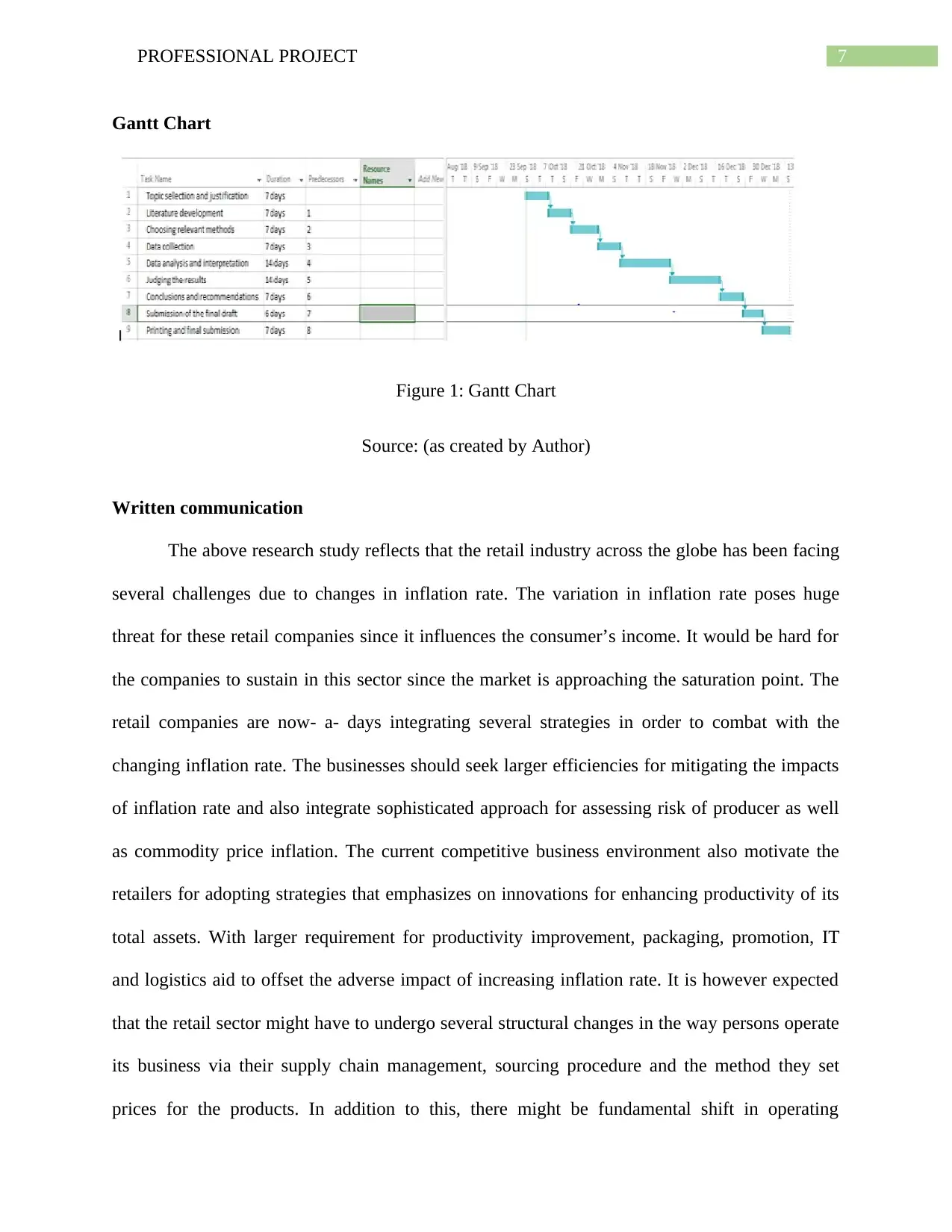
Gantt Chart
Figure 1: Gantt Chart
Source: (as created by Author)
Written communication
The above research study reflects that the retail industry across the globe has been facing
several challenges due to changes in inflation rate. The variation in inflation rate poses huge
threat for these retail companies since it influences the consumer’s income. It would be hard for
the companies to sustain in this sector since the market is approaching the saturation point. The
retail companies are now- a- days integrating several strategies in order to combat with the
changing inflation rate. The businesses should seek larger efficiencies for mitigating the impacts
of inflation rate and also integrate sophisticated approach for assessing risk of producer as well
as commodity price inflation. The current competitive business environment also motivate the
retailers for adopting strategies that emphasizes on innovations for enhancing productivity of its
total assets. With larger requirement for productivity improvement, packaging, promotion, IT
and logistics aid to offset the adverse impact of increasing inflation rate. It is however expected
that the retail sector might have to undergo several structural changes in the way persons operate
its business via their supply chain management, sourcing procedure and the method they set
prices for the products. In addition to this, there might be fundamental shift in operating
Gantt Chart
Figure 1: Gantt Chart
Source: (as created by Author)
Written communication
The above research study reflects that the retail industry across the globe has been facing
several challenges due to changes in inflation rate. The variation in inflation rate poses huge
threat for these retail companies since it influences the consumer’s income. It would be hard for
the companies to sustain in this sector since the market is approaching the saturation point. The
retail companies are now- a- days integrating several strategies in order to combat with the
changing inflation rate. The businesses should seek larger efficiencies for mitigating the impacts
of inflation rate and also integrate sophisticated approach for assessing risk of producer as well
as commodity price inflation. The current competitive business environment also motivate the
retailers for adopting strategies that emphasizes on innovations for enhancing productivity of its
total assets. With larger requirement for productivity improvement, packaging, promotion, IT
and logistics aid to offset the adverse impact of increasing inflation rate. It is however expected
that the retail sector might have to undergo several structural changes in the way persons operate
its business via their supply chain management, sourcing procedure and the method they set
prices for the products. In addition to this, there might be fundamental shift in operating
8PROFESSIONAL PROJECT
framework of the retailers since they seek in countering enhancing costs caused by enhancing
scarcity of resources supply. Hence, it is predicted that the retail sector will innovate different
methods and consider long – term structural as well as operational changes in future with
changes in inflation rate.
framework of the retailers since they seek in countering enhancing costs caused by enhancing
scarcity of resources supply. Hence, it is predicted that the retail sector will innovate different
methods and consider long – term structural as well as operational changes in future with
changes in inflation rate.
⊘ This is a preview!⊘
Do you want full access?
Subscribe today to unlock all pages.
Trusted by 1+ million students worldwide
9PROFESSIONAL PROJECT
References
Bawa, P., Gupta, B. L., & Sharma, B. (2013). Retail Service Quality's Impact on Value Delivery
& Customer Satisfaction in a Retail Store Environment. Journal of Marketing &
Communication, 8(4).
Bhutta, N. T., & Hasan, A. (2013). Impact of firm specific factors on profitability of firms in
food sector. Open journal of accounting, 2(02), 19.
Brown, B., 2017. A MODERN CONCEPT OF ASSET PRICE INFLATION IN BOOM AND
DEPRESSION. Quarterly Journal of Austrian Economics, 20(1).
Burch, D., & Lawrence, G. (2013). Financialization in agri-food supply chains: private equity
and the transformation of the retail sector. Agriculture and human values, 30(2), 247-258.
Governor, G. (2018). Low Inflation | Speeches | RBA. Retrieved from
https://www.rba.gov.au/speeches/2018/sp-dg-2018-08-22.html
Hara, N., Hiraki, K., &Ichise, Y. (2015). Changing exchange rate pass-through in Japan: does it
indicate changing pricing behavior? (No. 15-E-4). Bank of Japan.
Jacenko, A., &Gunasekera, D. (2015, May). Australia’s retail food sector’. In Pacific Food
System Outlook Conference, Kunming, China (pp. 11-13).
Jaravel, X. (2016). The unequal gains from product innovations: Evidence from the us retail
sector.
Keynes, J.M., 2018. The general theory of employment, interest, and money. Springer.
References
Bawa, P., Gupta, B. L., & Sharma, B. (2013). Retail Service Quality's Impact on Value Delivery
& Customer Satisfaction in a Retail Store Environment. Journal of Marketing &
Communication, 8(4).
Bhutta, N. T., & Hasan, A. (2013). Impact of firm specific factors on profitability of firms in
food sector. Open journal of accounting, 2(02), 19.
Brown, B., 2017. A MODERN CONCEPT OF ASSET PRICE INFLATION IN BOOM AND
DEPRESSION. Quarterly Journal of Austrian Economics, 20(1).
Burch, D., & Lawrence, G. (2013). Financialization in agri-food supply chains: private equity
and the transformation of the retail sector. Agriculture and human values, 30(2), 247-258.
Governor, G. (2018). Low Inflation | Speeches | RBA. Retrieved from
https://www.rba.gov.au/speeches/2018/sp-dg-2018-08-22.html
Hara, N., Hiraki, K., &Ichise, Y. (2015). Changing exchange rate pass-through in Japan: does it
indicate changing pricing behavior? (No. 15-E-4). Bank of Japan.
Jacenko, A., &Gunasekera, D. (2015, May). Australia’s retail food sector’. In Pacific Food
System Outlook Conference, Kunming, China (pp. 11-13).
Jaravel, X. (2016). The unequal gains from product innovations: Evidence from the us retail
sector.
Keynes, J.M., 2018. The general theory of employment, interest, and money. Springer.
Paraphrase This Document
Need a fresh take? Get an instant paraphrase of this document with our AI Paraphraser
10PROFESSIONAL PROJECT
Magnan, A., 2015. The financialization of agri-food in Canada and Australia: Corporate
farmland and farm ownership in the grains and oilseed sector. Journal of Rural
Studies, 41, pp.1-12.
Noorulhadi, I. A., Khan, B., & Khan, M. (2018). The Effect of Inflation and Trade Deficit on
Pakistan Economy. International Journal of Business Studies Review, 4(1), 24-38.
Riff, D., Lacy, S., & Fico, F. (2014). Analyzing media messages: Using quantitative content
analysis in research. Routledge.
Tiwari, S., Cárdenas-Barrón, L. E., Khanna, A., &Jaggi, C. K. (2016). Impact of trade credit and
inflation on retailer's ordering policies for non-instantaneous deteriorating items in a two-
warehouse environment. International Journal of Production Economics, 176, 154-169.
Treiman, D. J. (2014). Quantitative data analysis: Doing social research to test ideas. John
Wiley & Sons.
Magnan, A., 2015. The financialization of agri-food in Canada and Australia: Corporate
farmland and farm ownership in the grains and oilseed sector. Journal of Rural
Studies, 41, pp.1-12.
Noorulhadi, I. A., Khan, B., & Khan, M. (2018). The Effect of Inflation and Trade Deficit on
Pakistan Economy. International Journal of Business Studies Review, 4(1), 24-38.
Riff, D., Lacy, S., & Fico, F. (2014). Analyzing media messages: Using quantitative content
analysis in research. Routledge.
Tiwari, S., Cárdenas-Barrón, L. E., Khanna, A., &Jaggi, C. K. (2016). Impact of trade credit and
inflation on retailer's ordering policies for non-instantaneous deteriorating items in a two-
warehouse environment. International Journal of Production Economics, 176, 154-169.
Treiman, D. J. (2014). Quantitative data analysis: Doing social research to test ideas. John
Wiley & Sons.

1 out of 11


Related Documents


Your All-in-One AI-Powered Toolkit for Academic Success.
+13062052269
info@desklib.com
Available 24*7 on WhatsApp / Email
![[object Object]](/_next/static/media/star-bottom.7253800d.svg)
Unlock your academic potential
Copyright © 2020–2026 A2Z Services. All Rights Reserved. Developed and managed by ZUCOL.