Analysis of Managerial Techniques for Motivating Workers: Report
VerifiedAdded on 2020/04/01
|10
|2447
|36
Report
AI Summary
This report examines the critical role of motivation in determining employee performance, focusing on the impact of managerial techniques. It begins with an introduction to motivation and its significance in the workplace, followed by an analysis of managers' perceptions of their employees and the strategies they employ to achieve optimal performance. The report delves into the strengths and weaknesses of the provided article, offering a personal viewpoint on the subject. It also explores the factors that influence worker motivation, such as employee involvement in decision-making and effective communication channels, while also identifying factors that demotivate employees and lead to underperformance, including the working environment, manager-employee relationships, and compensation issues. The conclusion emphasizes the importance of implementing effective motivation strategies to enhance employee performance and organizational success. This document is a valuable resource for students on Desklib, offering insights into leadership management and human resource practices.
MOTIVATING THE WORKERS 1
MOTIVATING THE WORKERS
By [Student’s name]
Professor’s name
Course Code
University
Date of submission
MOTIVATING THE WORKERS
By [Student’s name]
Professor’s name
Course Code
University
Date of submission

Paraphrase This Document
Need a fresh take? Get an instant paraphrase of this document with our AI Paraphraser
MOTIVATING THE WORKERS 2
Executive Summary
Motivation is one of the roles of the human resource that significantly determine the
performance of the employees. This paper discusses the impact of managerial
techniques on the efficiency of the workers. It starts with introducing the concept of
motivation and efficacy about an organization's working environment. The research
examines managers' perception of their employees and techniques to achieve optimal
performance. Further, researcher discusses the strengths and weaknesses of the article
and gives own point of view. Later the paper explores the reasons for the presence of
deficiencies and techniques employed by managers to motivate their staff. Therefore,
this report is critical in helping the company understand why and how they should
motivate the employees
Executive Summary
Motivation is one of the roles of the human resource that significantly determine the
performance of the employees. This paper discusses the impact of managerial
techniques on the efficiency of the workers. It starts with introducing the concept of
motivation and efficacy about an organization's working environment. The research
examines managers' perception of their employees and techniques to achieve optimal
performance. Further, researcher discusses the strengths and weaknesses of the article
and gives own point of view. Later the paper explores the reasons for the presence of
deficiencies and techniques employed by managers to motivate their staff. Therefore,
this report is critical in helping the company understand why and how they should
motivate the employees
MOTIVATING THE WORKERS 3
Table of Contents
Introduction....................................................................................................................4
Manager’s perception towards employees..................................................................4
Managerial techniques to realize optimum efficiency................................................4
The strength of the article..............................................................................................5
Weaknesses of the Article..............................................................................................5
My Position about the article.........................................................................................6
Aspects that influence worker motivation......................................................................6
Considering the employees in decision-making process............................................6
Effective communication channels.............................................................................7
Factors that Demotivate the Employees to underperform..............................................7
Working Environment................................................................................................7
Manager-Employee Relationship...............................................................................7
Payment and Rewards.................................................................................................8
Conclusion......................................................................................................................8
References......................................................................................................................9
Table of Contents
Introduction....................................................................................................................4
Manager’s perception towards employees..................................................................4
Managerial techniques to realize optimum efficiency................................................4
The strength of the article..............................................................................................5
Weaknesses of the Article..............................................................................................5
My Position about the article.........................................................................................6
Aspects that influence worker motivation......................................................................6
Considering the employees in decision-making process............................................6
Effective communication channels.............................................................................7
Factors that Demotivate the Employees to underperform..............................................7
Working Environment................................................................................................7
Manager-Employee Relationship...............................................................................7
Payment and Rewards.................................................................................................8
Conclusion......................................................................................................................8
References......................................................................................................................9
⊘ This is a preview!⊘
Do you want full access?
Subscribe today to unlock all pages.

Trusted by 1+ million students worldwide

MOTIVATING THE WORKERS 4
Introduction
One of the major factors that determine the effectiveness of the human factors is
motivation. Every human being naturally needs to be motivated for their better
outcome. Therefore, it is clear that the performance of the human factors is
substantially determined by the extent to which motivation is induced to them.
Motivation is a significant contributor to the worker efficiency which entails the
employee doing the right thing in the most accurate way possible. Therefore, this
helps the organization to benefit more from the increased employee performance.
Manager’s perception towards employees
The article discusses the opinion of top leaders in the organization towards
motivation of the employees. It establishes the consequent efficiency that comes when
motivation is induced to the workers. The article brings out the position and role of
the employees in the organization. The position of the employees of the company
makes them be a lifeblood of the business. This is because they are the main factors
that ensure that the organization smoothly runs the operations thus delivering the
expected results. Therefore, the position of the employees in organization necessitates
a clear plan to engage the workers in a strategic and bloody-minded way. This aspect
is critical in adding the value to the company. Therefore, motivation is essential in
ensuring the company reaps maximum performance from the employees.
Managerial techniques to realize optimum efficiency
There are many methods that the organization's management can employ to
achieve optimum efficiency in their business. These efficiency techniques are broadly
categorized into two main categories as the internal or external factors. The internal
factors are those that lie within the company's core business and its cultures such as
the organizational structure and its management systems. On the other hand, the
external factors those that are acquired outside the company to help in complementing
the company's already existing processes. They include the equipment, technology
and also the management approach among many others. These aspects work hand in
hand to deliver the best motivation of the workers to work for the organization.
Consequently, it helps to derive a high level of performance of the employees in the
company.
Introduction
One of the major factors that determine the effectiveness of the human factors is
motivation. Every human being naturally needs to be motivated for their better
outcome. Therefore, it is clear that the performance of the human factors is
substantially determined by the extent to which motivation is induced to them.
Motivation is a significant contributor to the worker efficiency which entails the
employee doing the right thing in the most accurate way possible. Therefore, this
helps the organization to benefit more from the increased employee performance.
Manager’s perception towards employees
The article discusses the opinion of top leaders in the organization towards
motivation of the employees. It establishes the consequent efficiency that comes when
motivation is induced to the workers. The article brings out the position and role of
the employees in the organization. The position of the employees of the company
makes them be a lifeblood of the business. This is because they are the main factors
that ensure that the organization smoothly runs the operations thus delivering the
expected results. Therefore, the position of the employees in organization necessitates
a clear plan to engage the workers in a strategic and bloody-minded way. This aspect
is critical in adding the value to the company. Therefore, motivation is essential in
ensuring the company reaps maximum performance from the employees.
Managerial techniques to realize optimum efficiency
There are many methods that the organization's management can employ to
achieve optimum efficiency in their business. These efficiency techniques are broadly
categorized into two main categories as the internal or external factors. The internal
factors are those that lie within the company's core business and its cultures such as
the organizational structure and its management systems. On the other hand, the
external factors those that are acquired outside the company to help in complementing
the company's already existing processes. They include the equipment, technology
and also the management approach among many others. These aspects work hand in
hand to deliver the best motivation of the workers to work for the organization.
Consequently, it helps to derive a high level of performance of the employees in the
company.
Paraphrase This Document
Need a fresh take? Get an instant paraphrase of this document with our AI Paraphraser
MOTIVATING THE WORKERS 5
Currently, performance management systems are critical in delivering value to
the organization. They help the management to know track the level of performance
and also a provision for the employees to monitor their degree of performance. This is
achieved by its ability to manage feedbacks in the organization. The performance
management system can be automated to help give deeper reports and also provide
room for references in future (Soo, 2010, pp. 135–143). This is critical since it helps
the organization's management to be better positions to determine the rewards,
salaries, and wages that can be given to the employees.
It is clear from the article that the workers usually have a hidden form of ability
that can only be unlocked with sufficient appropriate form of motivation. The
company’s management can trigger the potential of its employees to help them realize
their goals with the incorporation of the motivation plans. The workers who are
motivated are passionate about the job that they do and thus, deliver more efforts
regarding efficiency and effectiveness. Therefore, motivation benefits both the society
and the business enterprise.
The strength of the article
The article is clear with its thesis statement that seeks to support the statement
that the techniques employed by the managers to motivate the employees have an
impact on their quality and the level of effectiveness. The article is critical in opening
the eyes of the organization’s management to motivate their employees. It unveils the
importance of motivating the employees and the ways that can be employed to
achieve this course. It also discusses alternative ways that have been neglected yet
they effective in motivating the workers such improving their skills and talents, which
int turn benefits the company. Besides, it makes it clear that the managers can
disservice the employees and reduce their productivity if they fail to plan for their
motivation. The employee will not give their best at work if they are not motivated.
Weaknesses of the Article
In as much as the article vigorously discusses the significance of adopting the
motivation techniques on increasing their efficiency, it does not strongly discuss the
effects that will be brought about when the staff is not motivated. An understanding of
the implications of the unmotivated staff is critical for the management to evaluate the
low-level productivity that they are likely to get from the unmotivated staff. This
Currently, performance management systems are critical in delivering value to
the organization. They help the management to know track the level of performance
and also a provision for the employees to monitor their degree of performance. This is
achieved by its ability to manage feedbacks in the organization. The performance
management system can be automated to help give deeper reports and also provide
room for references in future (Soo, 2010, pp. 135–143). This is critical since it helps
the organization's management to be better positions to determine the rewards,
salaries, and wages that can be given to the employees.
It is clear from the article that the workers usually have a hidden form of ability
that can only be unlocked with sufficient appropriate form of motivation. The
company’s management can trigger the potential of its employees to help them realize
their goals with the incorporation of the motivation plans. The workers who are
motivated are passionate about the job that they do and thus, deliver more efforts
regarding efficiency and effectiveness. Therefore, motivation benefits both the society
and the business enterprise.
The strength of the article
The article is clear with its thesis statement that seeks to support the statement
that the techniques employed by the managers to motivate the employees have an
impact on their quality and the level of effectiveness. The article is critical in opening
the eyes of the organization’s management to motivate their employees. It unveils the
importance of motivating the employees and the ways that can be employed to
achieve this course. It also discusses alternative ways that have been neglected yet
they effective in motivating the workers such improving their skills and talents, which
int turn benefits the company. Besides, it makes it clear that the managers can
disservice the employees and reduce their productivity if they fail to plan for their
motivation. The employee will not give their best at work if they are not motivated.
Weaknesses of the Article
In as much as the article vigorously discusses the significance of adopting the
motivation techniques on increasing their efficiency, it does not strongly discuss the
effects that will be brought about when the staff is not motivated. An understanding of
the implications of the unmotivated staff is critical for the management to evaluate the
low-level productivity that they are likely to get from the unmotivated staff. This
MOTIVATING THE WORKERS 6
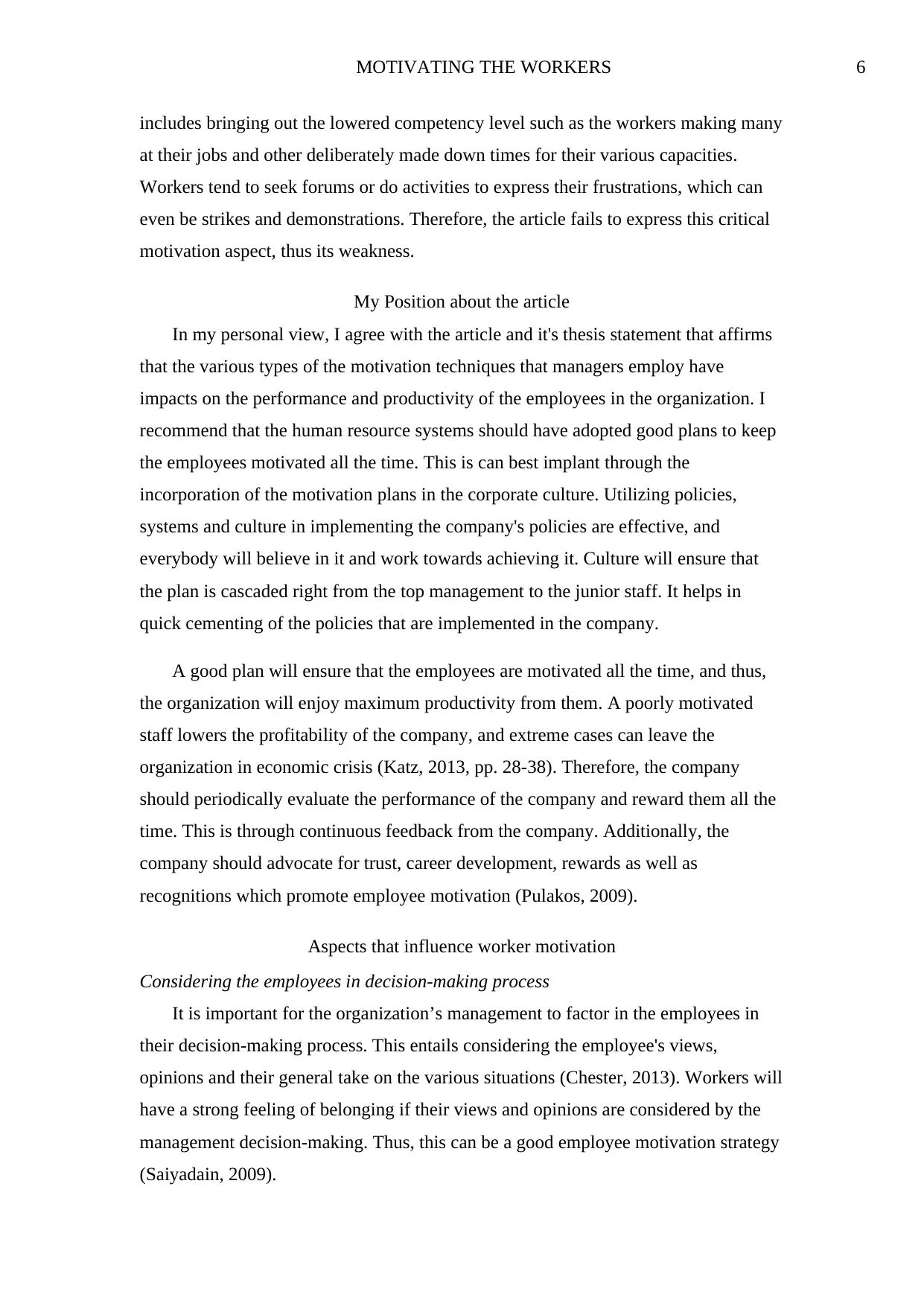
includes bringing out the lowered competency level such as the workers making many
at their jobs and other deliberately made down times for their various capacities.
Workers tend to seek forums or do activities to express their frustrations, which can
even be strikes and demonstrations. Therefore, the article fails to express this critical
motivation aspect, thus its weakness.
My Position about the article
In my personal view, I agree with the article and it's thesis statement that affirms
that the various types of the motivation techniques that managers employ have
impacts on the performance and productivity of the employees in the organization. I
recommend that the human resource systems should have adopted good plans to keep
the employees motivated all the time. This is can best implant through the
incorporation of the motivation plans in the corporate culture. Utilizing policies,
systems and culture in implementing the company's policies are effective, and
everybody will believe in it and work towards achieving it. Culture will ensure that
the plan is cascaded right from the top management to the junior staff. It helps in
quick cementing of the policies that are implemented in the company.
A good plan will ensure that the employees are motivated all the time, and thus,
the organization will enjoy maximum productivity from them. A poorly motivated
staff lowers the profitability of the company, and extreme cases can leave the
organization in economic crisis (Katz, 2013, pp. 28-38). Therefore, the company
should periodically evaluate the performance of the company and reward them all the
time. This is through continuous feedback from the company. Additionally, the
company should advocate for trust, career development, rewards as well as
recognitions which promote employee motivation (Pulakos, 2009).
Aspects that influence worker motivation
Considering the employees in decision-making process
It is important for the organization’s management to factor in the employees in
their decision-making process. This entails considering the employee's views,
opinions and their general take on the various situations (Chester, 2013). Workers will
have a strong feeling of belonging if their views and opinions are considered by the
management decision-making. Thus, this can be a good employee motivation strategy
(Saiyadain, 2009).
includes bringing out the lowered competency level such as the workers making many
at their jobs and other deliberately made down times for their various capacities.
Workers tend to seek forums or do activities to express their frustrations, which can
even be strikes and demonstrations. Therefore, the article fails to express this critical
motivation aspect, thus its weakness.
My Position about the article
In my personal view, I agree with the article and it's thesis statement that affirms
that the various types of the motivation techniques that managers employ have
impacts on the performance and productivity of the employees in the organization. I
recommend that the human resource systems should have adopted good plans to keep
the employees motivated all the time. This is can best implant through the
incorporation of the motivation plans in the corporate culture. Utilizing policies,
systems and culture in implementing the company's policies are effective, and
everybody will believe in it and work towards achieving it. Culture will ensure that
the plan is cascaded right from the top management to the junior staff. It helps in
quick cementing of the policies that are implemented in the company.
A good plan will ensure that the employees are motivated all the time, and thus,
the organization will enjoy maximum productivity from them. A poorly motivated
staff lowers the profitability of the company, and extreme cases can leave the
organization in economic crisis (Katz, 2013, pp. 28-38). Therefore, the company
should periodically evaluate the performance of the company and reward them all the
time. This is through continuous feedback from the company. Additionally, the
company should advocate for trust, career development, rewards as well as
recognitions which promote employee motivation (Pulakos, 2009).
Aspects that influence worker motivation
Considering the employees in decision-making process
It is important for the organization’s management to factor in the employees in
their decision-making process. This entails considering the employee's views,
opinions and their general take on the various situations (Chester, 2013). Workers will
have a strong feeling of belonging if their views and opinions are considered by the
management decision-making. Thus, this can be a good employee motivation strategy
(Saiyadain, 2009).
⊘ This is a preview!⊘
Do you want full access?
Subscribe today to unlock all pages.
Trusted by 1+ million students worldwide

MOTIVATING THE WORKERS 7
Effective communication channels
Communication is one of the critical aspects of better leadership in the organization. It
is a medium that the senior employees can express themselves to have the job done by
the junior staff. It helps effectively dedicate the duties thus increasing the productivity
in the organization. Besides, communication is essential in clearing disagreements
that may be caused by a poor, inaccurate communication system (Jones and George,
2008). Effective communication is also critical in to deliver the instructions to
employees which will help them perform better. Additionally, good leadership should
advocate for employee development of their talents and abilities through
communication. This greatly helps in improving the employee motivation (Mihalko,
2010).
Factors that Demotivate the Employees to underperform
Various reasons contribute to the employee underperformance in the organization
due to demotivation. When workers are not self-driven due to demotivation, it
becomes detrimental to the organization’s performance (Keller, 2010). This because
the company will experience many negative effects from the employees, such as
careless handling of tasks among many others (D'Souza and Gurin, 2016). These
demotivating factors include:
Working Environment
A health-hazard working condition greatly demotivates the employees. The
organization needs to prioritize the health and safety of the workers to ensure that they
are comfortable in their respective working capacities (Johann, 2008). This will
motivate them, and they are likely to develop a positive attitude towards the
management, thus increasing their productivity (Buetow, 2007, pp. 183-185).
Manager-Employee Relationship
One of the greatest factors that influence the motivation of the employees is their
relationship with the bosses. When the senior staff relates well with the juniors, the
company realizes high productivity. It is important for the managers to adopt
leadership skills that ensure that their relationship with the workers is kept well. Thus,
this will motivate the employees and increase their productivity (Lyso, Mjoen and
Levin, 2011, pp. 210-224).
Effective communication channels
Communication is one of the critical aspects of better leadership in the organization. It
is a medium that the senior employees can express themselves to have the job done by
the junior staff. It helps effectively dedicate the duties thus increasing the productivity
in the organization. Besides, communication is essential in clearing disagreements
that may be caused by a poor, inaccurate communication system (Jones and George,
2008). Effective communication is also critical in to deliver the instructions to
employees which will help them perform better. Additionally, good leadership should
advocate for employee development of their talents and abilities through
communication. This greatly helps in improving the employee motivation (Mihalko,
2010).
Factors that Demotivate the Employees to underperform
Various reasons contribute to the employee underperformance in the organization
due to demotivation. When workers are not self-driven due to demotivation, it
becomes detrimental to the organization’s performance (Keller, 2010). This because
the company will experience many negative effects from the employees, such as
careless handling of tasks among many others (D'Souza and Gurin, 2016). These
demotivating factors include:
Working Environment
A health-hazard working condition greatly demotivates the employees. The
organization needs to prioritize the health and safety of the workers to ensure that they
are comfortable in their respective working capacities (Johann, 2008). This will
motivate them, and they are likely to develop a positive attitude towards the
management, thus increasing their productivity (Buetow, 2007, pp. 183-185).
Manager-Employee Relationship
One of the greatest factors that influence the motivation of the employees is their
relationship with the bosses. When the senior staff relates well with the juniors, the
company realizes high productivity. It is important for the managers to adopt
leadership skills that ensure that their relationship with the workers is kept well. Thus,
this will motivate the employees and increase their productivity (Lyso, Mjoen and
Levin, 2011, pp. 210-224).
Paraphrase This Document
Need a fresh take? Get an instant paraphrase of this document with our AI Paraphraser
MOTIVATING THE WORKERS 8
Payment and Rewards
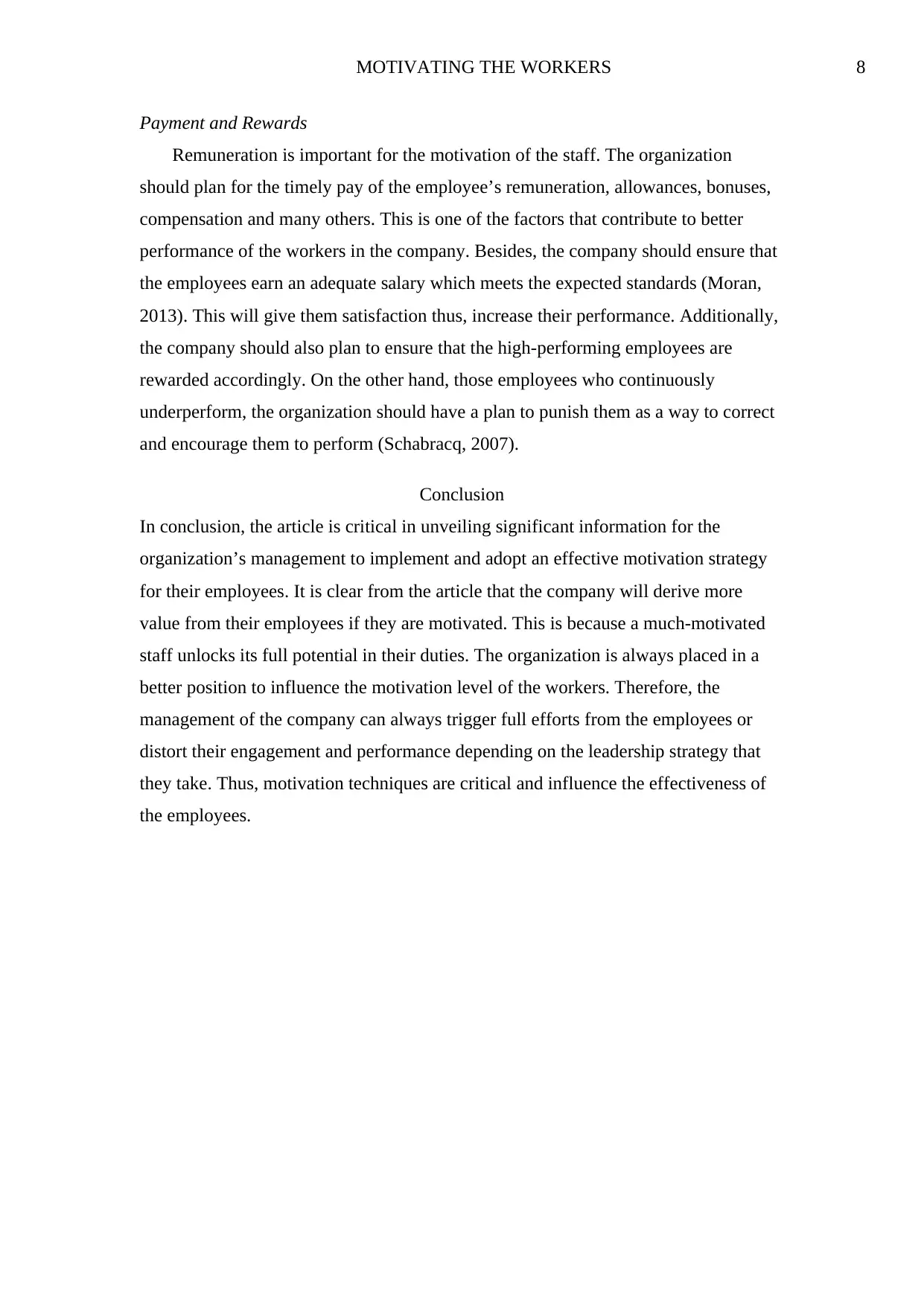
Remuneration is important for the motivation of the staff. The organization
should plan for the timely pay of the employee’s remuneration, allowances, bonuses,
compensation and many others. This is one of the factors that contribute to better
performance of the workers in the company. Besides, the company should ensure that
the employees earn an adequate salary which meets the expected standards (Moran,
2013). This will give them satisfaction thus, increase their performance. Additionally,
the company should also plan to ensure that the high-performing employees are
rewarded accordingly. On the other hand, those employees who continuously
underperform, the organization should have a plan to punish them as a way to correct
and encourage them to perform (Schabracq, 2007).
Conclusion
In conclusion, the article is critical in unveiling significant information for the
organization’s management to implement and adopt an effective motivation strategy
for their employees. It is clear from the article that the company will derive more
value from their employees if they are motivated. This is because a much-motivated
staff unlocks its full potential in their duties. The organization is always placed in a
better position to influence the motivation level of the workers. Therefore, the
management of the company can always trigger full efforts from the employees or
distort their engagement and performance depending on the leadership strategy that
they take. Thus, motivation techniques are critical and influence the effectiveness of
the employees.
Payment and Rewards
Remuneration is important for the motivation of the staff. The organization
should plan for the timely pay of the employee’s remuneration, allowances, bonuses,
compensation and many others. This is one of the factors that contribute to better
performance of the workers in the company. Besides, the company should ensure that
the employees earn an adequate salary which meets the expected standards (Moran,
2013). This will give them satisfaction thus, increase their performance. Additionally,
the company should also plan to ensure that the high-performing employees are
rewarded accordingly. On the other hand, those employees who continuously
underperform, the organization should have a plan to punish them as a way to correct
and encourage them to perform (Schabracq, 2007).
Conclusion
In conclusion, the article is critical in unveiling significant information for the
organization’s management to implement and adopt an effective motivation strategy
for their employees. It is clear from the article that the company will derive more
value from their employees if they are motivated. This is because a much-motivated
staff unlocks its full potential in their duties. The organization is always placed in a
better position to influence the motivation level of the workers. Therefore, the
management of the company can always trigger full efforts from the employees or
distort their engagement and performance depending on the leadership strategy that
they take. Thus, motivation techniques are critical and influence the effectiveness of
the employees.
MOTIVATING THE WORKERS 9
References
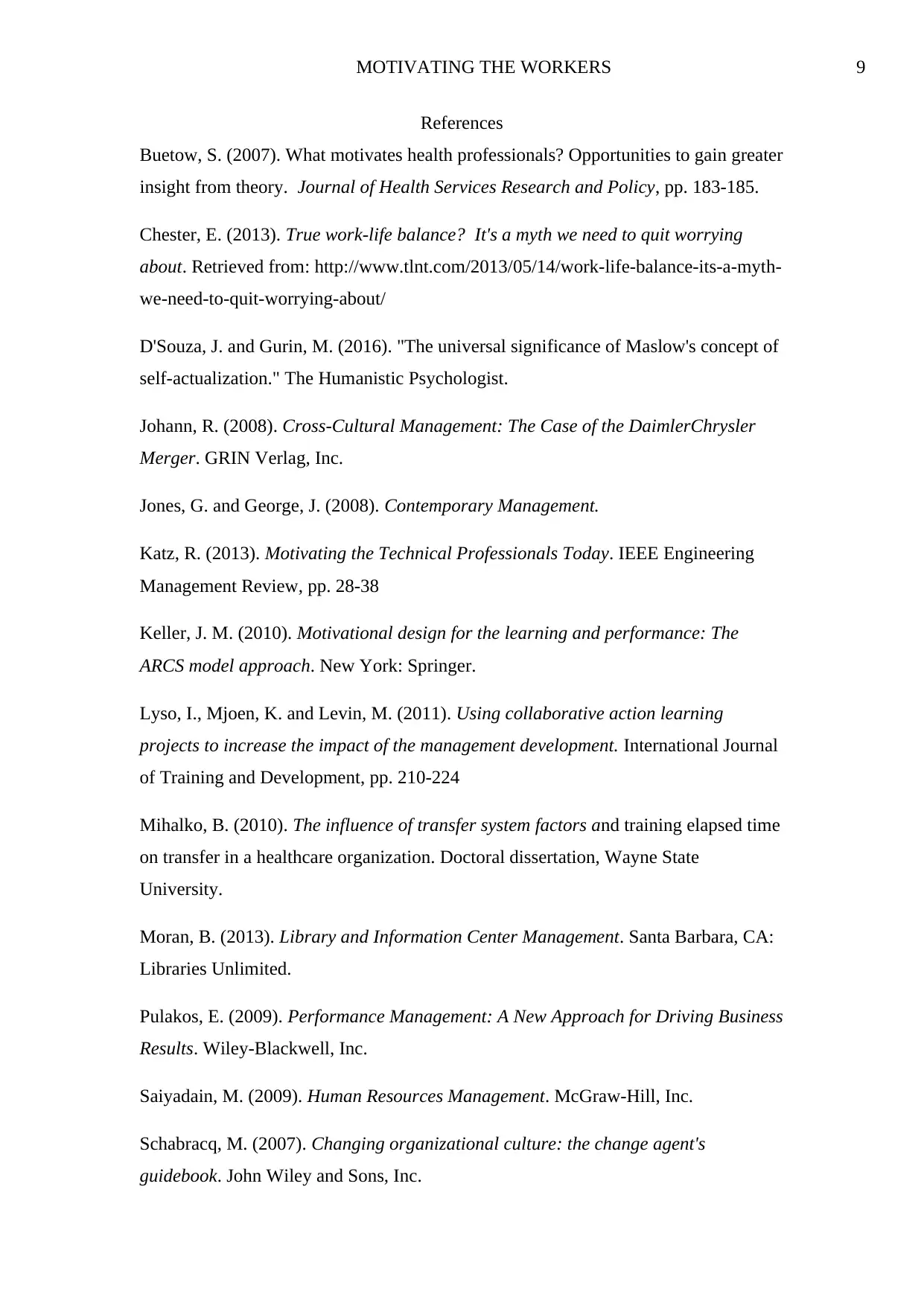
Buetow, S. (2007). What motivates health professionals? Opportunities to gain greater
insight from theory. Journal of Health Services Research and Policy, pp. 183-185.
Chester, E. (2013). True work-life balance? It's a myth we need to quit worrying
about. Retrieved from: http://www.tlnt.com/2013/05/14/work-life-balance-its-a-myth-
we-need-to-quit-worrying-about/
D'Souza, J. and Gurin, M. (2016). "The universal significance of Maslow's concept of
self-actualization." The Humanistic Psychologist.
Johann, R. (2008). Cross-Cultural Management: The Case of the DaimlerChrysler
Merger. GRIN Verlag, Inc.
Jones, G. and George, J. (2008). Contemporary Management.
Katz, R. (2013). Motivating the Technical Professionals Today. IEEE Engineering
Management Review, pp. 28-38
Keller, J. M. (2010). Motivational design for the learning and performance: The
ARCS model approach. New York: Springer.
Lyso, I., Mjoen, K. and Levin, M. (2011). Using collaborative action learning
projects to increase the impact of the management development. International Journal
of Training and Development, pp. 210-224
Mihalko, B. (2010). The influence of transfer system factors and training elapsed time
on transfer in a healthcare organization. Doctoral dissertation, Wayne State
University.
Moran, B. (2013). Library and Information Center Management. Santa Barbara, CA:
Libraries Unlimited.
Pulakos, E. (2009). Performance Management: A New Approach for Driving Business
Results. Wiley-Blackwell, Inc.
Saiyadain, M. (2009). Human Resources Management. McGraw-Hill, Inc.
Schabracq, M. (2007). Changing organizational culture: the change agent's
guidebook. John Wiley and Sons, Inc.
References
Buetow, S. (2007). What motivates health professionals? Opportunities to gain greater
insight from theory. Journal of Health Services Research and Policy, pp. 183-185.
Chester, E. (2013). True work-life balance? It's a myth we need to quit worrying
about. Retrieved from: http://www.tlnt.com/2013/05/14/work-life-balance-its-a-myth-
we-need-to-quit-worrying-about/
D'Souza, J. and Gurin, M. (2016). "The universal significance of Maslow's concept of
self-actualization." The Humanistic Psychologist.
Johann, R. (2008). Cross-Cultural Management: The Case of the DaimlerChrysler
Merger. GRIN Verlag, Inc.
Jones, G. and George, J. (2008). Contemporary Management.
Katz, R. (2013). Motivating the Technical Professionals Today. IEEE Engineering
Management Review, pp. 28-38
Keller, J. M. (2010). Motivational design for the learning and performance: The
ARCS model approach. New York: Springer.
Lyso, I., Mjoen, K. and Levin, M. (2011). Using collaborative action learning
projects to increase the impact of the management development. International Journal
of Training and Development, pp. 210-224
Mihalko, B. (2010). The influence of transfer system factors and training elapsed time
on transfer in a healthcare organization. Doctoral dissertation, Wayne State
University.
Moran, B. (2013). Library and Information Center Management. Santa Barbara, CA:
Libraries Unlimited.
Pulakos, E. (2009). Performance Management: A New Approach for Driving Business
Results. Wiley-Blackwell, Inc.
Saiyadain, M. (2009). Human Resources Management. McGraw-Hill, Inc.
Schabracq, M. (2007). Changing organizational culture: the change agent's
guidebook. John Wiley and Sons, Inc.
⊘ This is a preview!⊘
Do you want full access?
Subscribe today to unlock all pages.
Trusted by 1+ million students worldwide

MOTIVATING THE WORKERS 10
Soo, J. (2010). "The interaction effects of the scheduling control and work-life
balance programs on job satisfaction and mental health". International Journal of
Social Welfare. pp. 135–143.
Soo, J. (2010). "The interaction effects of the scheduling control and work-life
balance programs on job satisfaction and mental health". International Journal of
Social Welfare. pp. 135–143.

1 out of 10


Related Documents


Your All-in-One AI-Powered Toolkit for Academic Success.
+13062052269
info@desklib.com
Available 24*7 on WhatsApp / Email
![[object Object]](/_next/static/media/star-bottom.7253800d.svg)
Unlock your academic potential
Copyright © 2020–2026 A2Z Services. All Rights Reserved. Developed and managed by ZUCOL.