Impact of Financial Cutbacks on UK National Health Service (NHS)
VerifiedAdded on 2020/04/15
|23
|4039
|326
Report
AI Summary
This social research report investigates the effects of cost-cutting measures on the National Health Service (NHS) in the United Kingdom. The study examines the background of the NHS, its principles, and the impact of reduced funding on healthcare quality and accessibility. The research aims to determine how financial cutbacks affect patient care, considering factors such as age, gender, ethnicity, and religion. The methodology includes a deductive research approach, employing both primary and secondary data collection methods, such as interviews and questionnaires. The report presents findings from a survey of 16 respondents, analyzing demographics and their experiences with the NHS. The results highlight concerns about declining service quality due to funding limitations and suggest that specific demographic groups may be disproportionately affected. The conclusion emphasizes the need for government intervention to address these issues and ensure equitable healthcare services for all UK residents. The report also acknowledges limitations such as the small sample size and restricted access to secondary sources.

Running head: SOCIAL RESEARCH
Social Research
Name of the Student
Name of the University
Author note
Social Research
Name of the Student
Name of the University
Author note

Paraphrase This Document
Need a fresh take? Get an instant paraphrase of this document with our AI Paraphraser
1SOCIAL RESEARCH
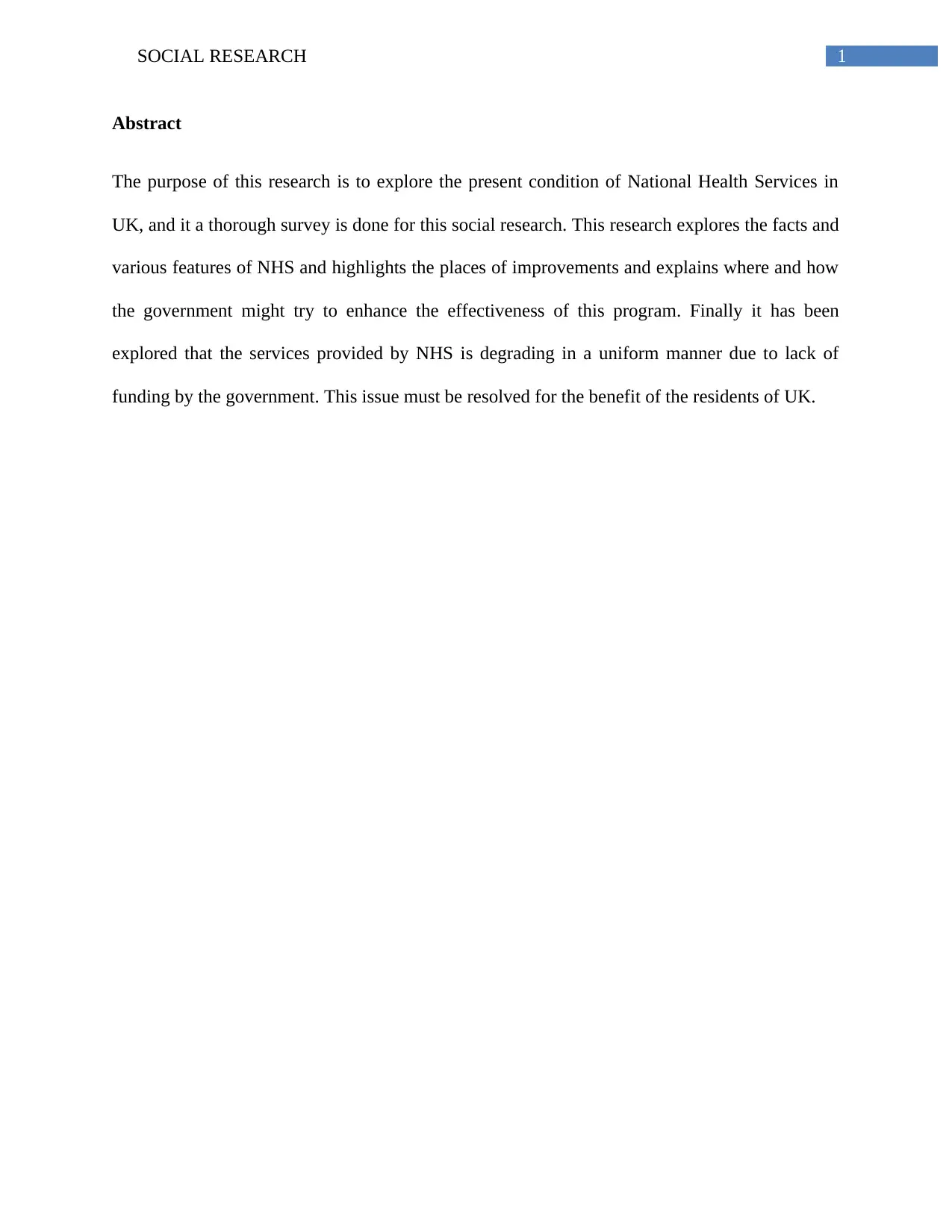
Abstract
The purpose of this research is to explore the present condition of National Health Services in
UK, and it a thorough survey is done for this social research. This research explores the facts and
various features of NHS and highlights the places of improvements and explains where and how
the government might try to enhance the effectiveness of this program. Finally it has been
explored that the services provided by NHS is degrading in a uniform manner due to lack of
funding by the government. This issue must be resolved for the benefit of the residents of UK.
Abstract
The purpose of this research is to explore the present condition of National Health Services in
UK, and it a thorough survey is done for this social research. This research explores the facts and
various features of NHS and highlights the places of improvements and explains where and how
the government might try to enhance the effectiveness of this program. Finally it has been
explored that the services provided by NHS is degrading in a uniform manner due to lack of
funding by the government. This issue must be resolved for the benefit of the residents of UK.
2SOCIAL RESEARCH
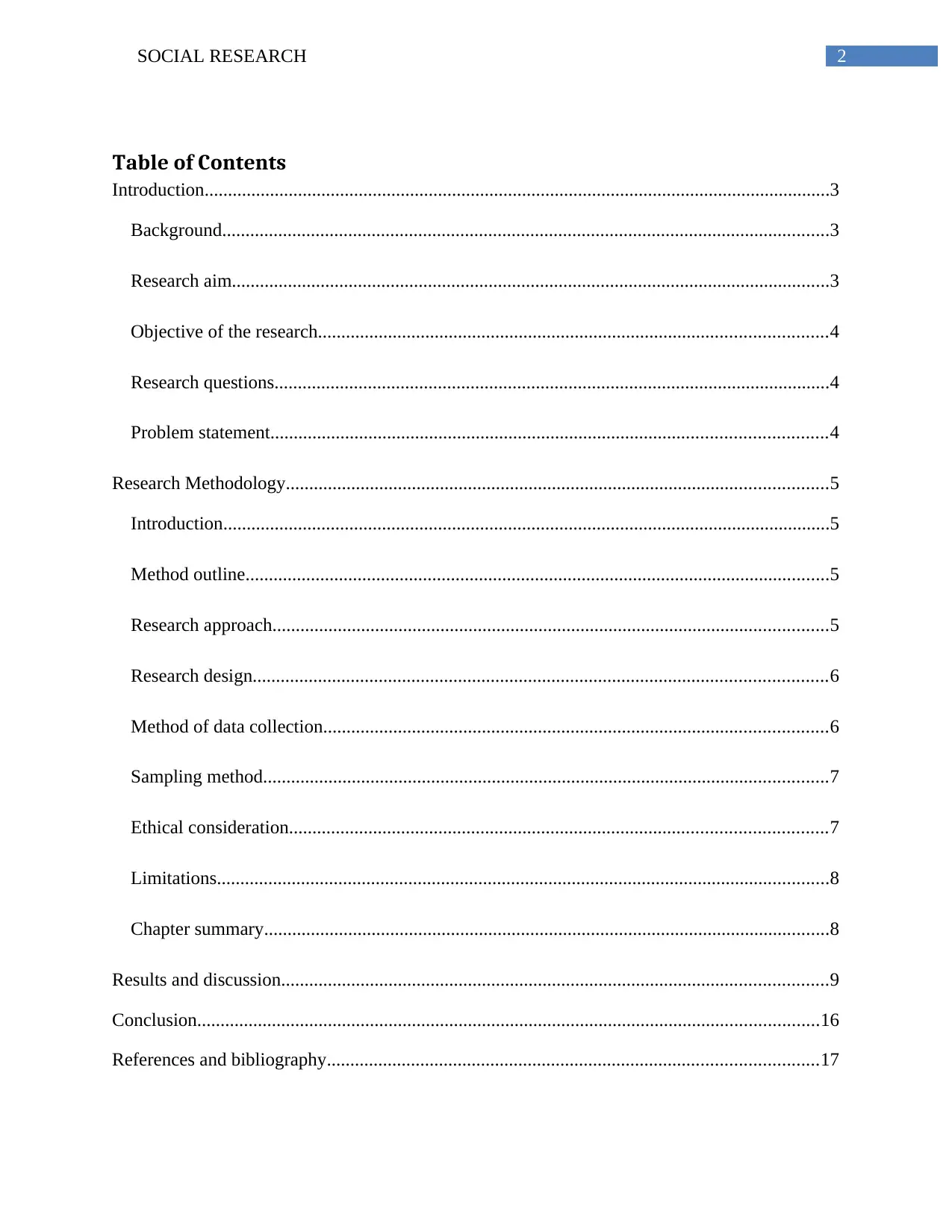
Table of Contents
Introduction......................................................................................................................................3
Background..................................................................................................................................3
Research aim................................................................................................................................3
Objective of the research.............................................................................................................4
Research questions.......................................................................................................................4
Problem statement.......................................................................................................................4
Research Methodology....................................................................................................................5
Introduction..................................................................................................................................5
Method outline.............................................................................................................................5
Research approach.......................................................................................................................5
Research design...........................................................................................................................6
Method of data collection............................................................................................................6
Sampling method.........................................................................................................................7
Ethical consideration...................................................................................................................7
Limitations...................................................................................................................................8
Chapter summary.........................................................................................................................8
Results and discussion.....................................................................................................................9
Conclusion.....................................................................................................................................16
References and bibliography.........................................................................................................17
Table of Contents
Introduction......................................................................................................................................3
Background..................................................................................................................................3
Research aim................................................................................................................................3
Objective of the research.............................................................................................................4
Research questions.......................................................................................................................4
Problem statement.......................................................................................................................4
Research Methodology....................................................................................................................5
Introduction..................................................................................................................................5
Method outline.............................................................................................................................5
Research approach.......................................................................................................................5
Research design...........................................................................................................................6
Method of data collection............................................................................................................6
Sampling method.........................................................................................................................7
Ethical consideration...................................................................................................................7
Limitations...................................................................................................................................8
Chapter summary.........................................................................................................................8
Results and discussion.....................................................................................................................9
Conclusion.....................................................................................................................................16
References and bibliography.........................................................................................................17
⊘ This is a preview!⊘
Do you want full access?
Subscribe today to unlock all pages.

Trusted by 1+ million students worldwide
3SOCIAL RESEARCH
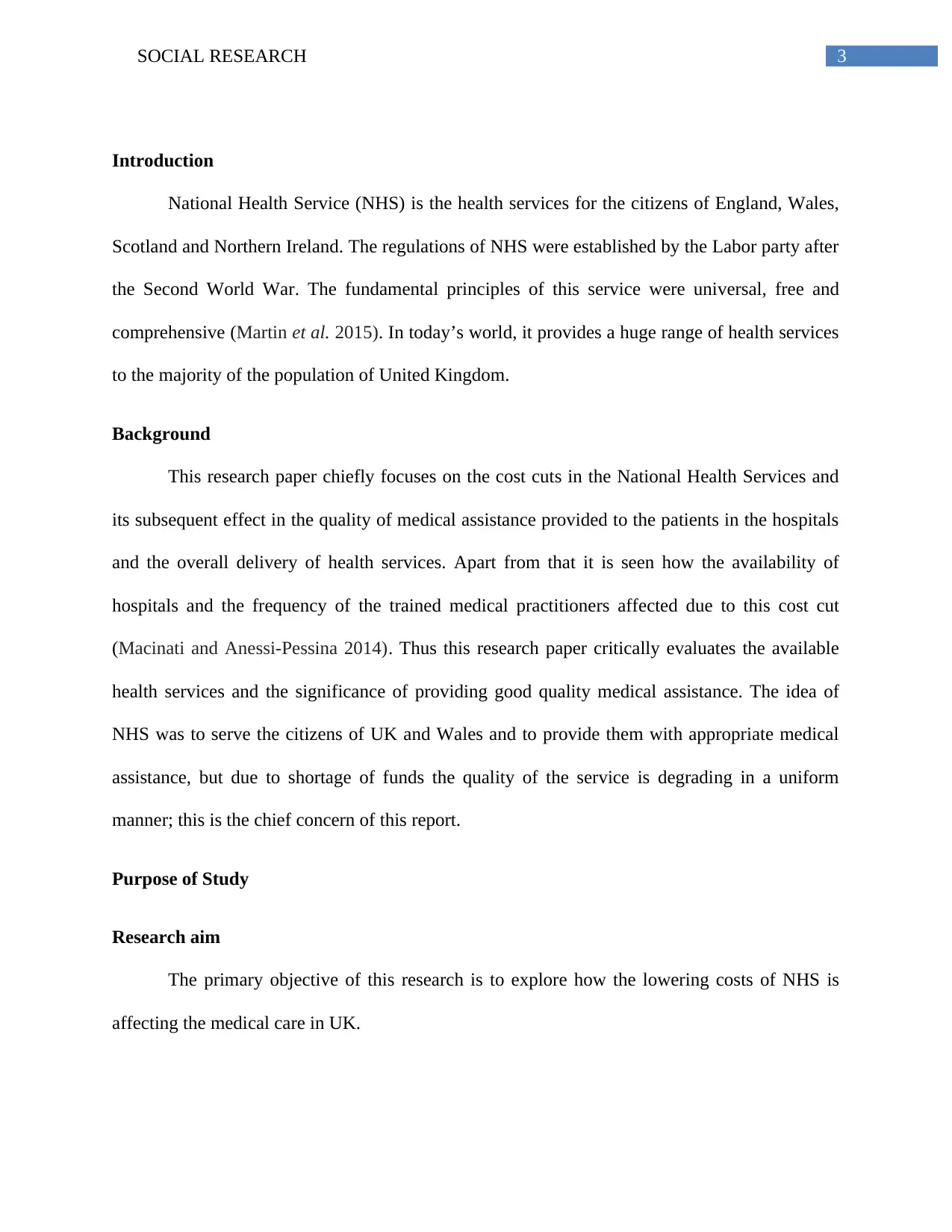
Introduction
National Health Service (NHS) is the health services for the citizens of England, Wales,
Scotland and Northern Ireland. The regulations of NHS were established by the Labor party after
the Second World War. The fundamental principles of this service were universal, free and
comprehensive (Martin et al. 2015). In today’s world, it provides a huge range of health services
to the majority of the population of United Kingdom.
Background
This research paper chiefly focuses on the cost cuts in the National Health Services and
its subsequent effect in the quality of medical assistance provided to the patients in the hospitals
and the overall delivery of health services. Apart from that it is seen how the availability of
hospitals and the frequency of the trained medical practitioners affected due to this cost cut
(Macinati and Anessi-Pessina 2014). Thus this research paper critically evaluates the available
health services and the significance of providing good quality medical assistance. The idea of
NHS was to serve the citizens of UK and Wales and to provide them with appropriate medical
assistance, but due to shortage of funds the quality of the service is degrading in a uniform
manner; this is the chief concern of this report.
Purpose of Study
Research aim
The primary objective of this research is to explore how the lowering costs of NHS is
affecting the medical care in UK.
Introduction
National Health Service (NHS) is the health services for the citizens of England, Wales,
Scotland and Northern Ireland. The regulations of NHS were established by the Labor party after
the Second World War. The fundamental principles of this service were universal, free and
comprehensive (Martin et al. 2015). In today’s world, it provides a huge range of health services
to the majority of the population of United Kingdom.
Background
This research paper chiefly focuses on the cost cuts in the National Health Services and
its subsequent effect in the quality of medical assistance provided to the patients in the hospitals
and the overall delivery of health services. Apart from that it is seen how the availability of
hospitals and the frequency of the trained medical practitioners affected due to this cost cut
(Macinati and Anessi-Pessina 2014). Thus this research paper critically evaluates the available
health services and the significance of providing good quality medical assistance. The idea of
NHS was to serve the citizens of UK and Wales and to provide them with appropriate medical
assistance, but due to shortage of funds the quality of the service is degrading in a uniform
manner; this is the chief concern of this report.
Purpose of Study
Research aim
The primary objective of this research is to explore how the lowering costs of NHS is
affecting the medical care in UK.
Paraphrase This Document
Need a fresh take? Get an instant paraphrase of this document with our AI Paraphraser
4SOCIAL RESEARCH
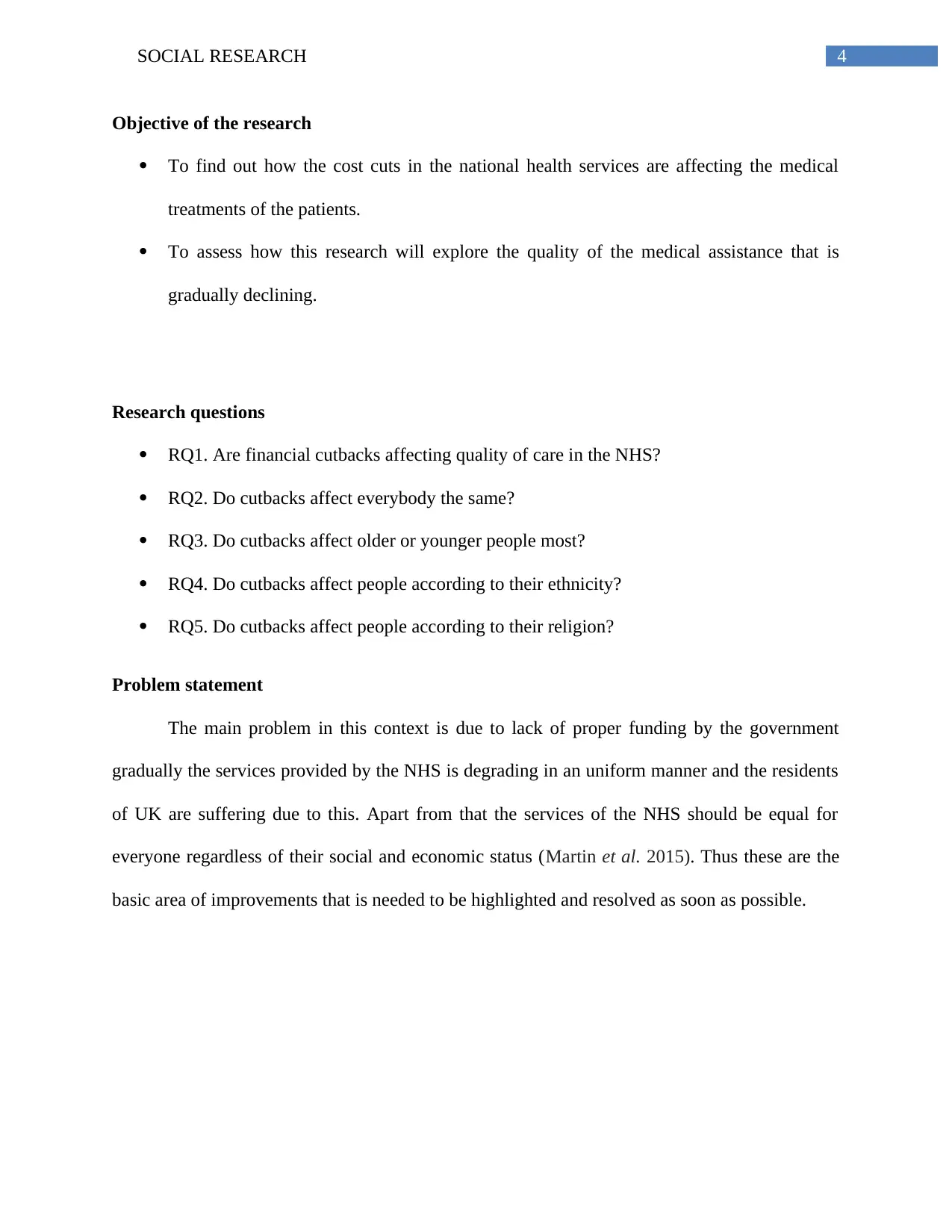
Objective of the research
To find out how the cost cuts in the national health services are affecting the medical
treatments of the patients.
To assess how this research will explore the quality of the medical assistance that is
gradually declining.
Research questions
RQ1. Are financial cutbacks affecting quality of care in the NHS?
RQ2. Do cutbacks affect everybody the same?
RQ3. Do cutbacks affect older or younger people most?
RQ4. Do cutbacks affect people according to their ethnicity?
RQ5. Do cutbacks affect people according to their religion?
Problem statement
The main problem in this context is due to lack of proper funding by the government
gradually the services provided by the NHS is degrading in an uniform manner and the residents
of UK are suffering due to this. Apart from that the services of the NHS should be equal for
everyone regardless of their social and economic status (Martin et al. 2015). Thus these are the
basic area of improvements that is needed to be highlighted and resolved as soon as possible.
Objective of the research
To find out how the cost cuts in the national health services are affecting the medical
treatments of the patients.
To assess how this research will explore the quality of the medical assistance that is
gradually declining.
Research questions
RQ1. Are financial cutbacks affecting quality of care in the NHS?
RQ2. Do cutbacks affect everybody the same?
RQ3. Do cutbacks affect older or younger people most?
RQ4. Do cutbacks affect people according to their ethnicity?
RQ5. Do cutbacks affect people according to their religion?
Problem statement
The main problem in this context is due to lack of proper funding by the government
gradually the services provided by the NHS is degrading in an uniform manner and the residents
of UK are suffering due to this. Apart from that the services of the NHS should be equal for
everyone regardless of their social and economic status (Martin et al. 2015). Thus these are the
basic area of improvements that is needed to be highlighted and resolved as soon as possible.
5SOCIAL RESEARCH
Research Methodology
Introduction
The success of the research is highly dependent on the choice and implementation of the
right tools while conducting the process. For this research study, the research scholar should
evaluate various methodologies, like research philosophy, techniques of the research, data
collection methods and many more (Harrison 2013). In this study an ethical consideration will
also be incorporated along with the limitations of this particular research.
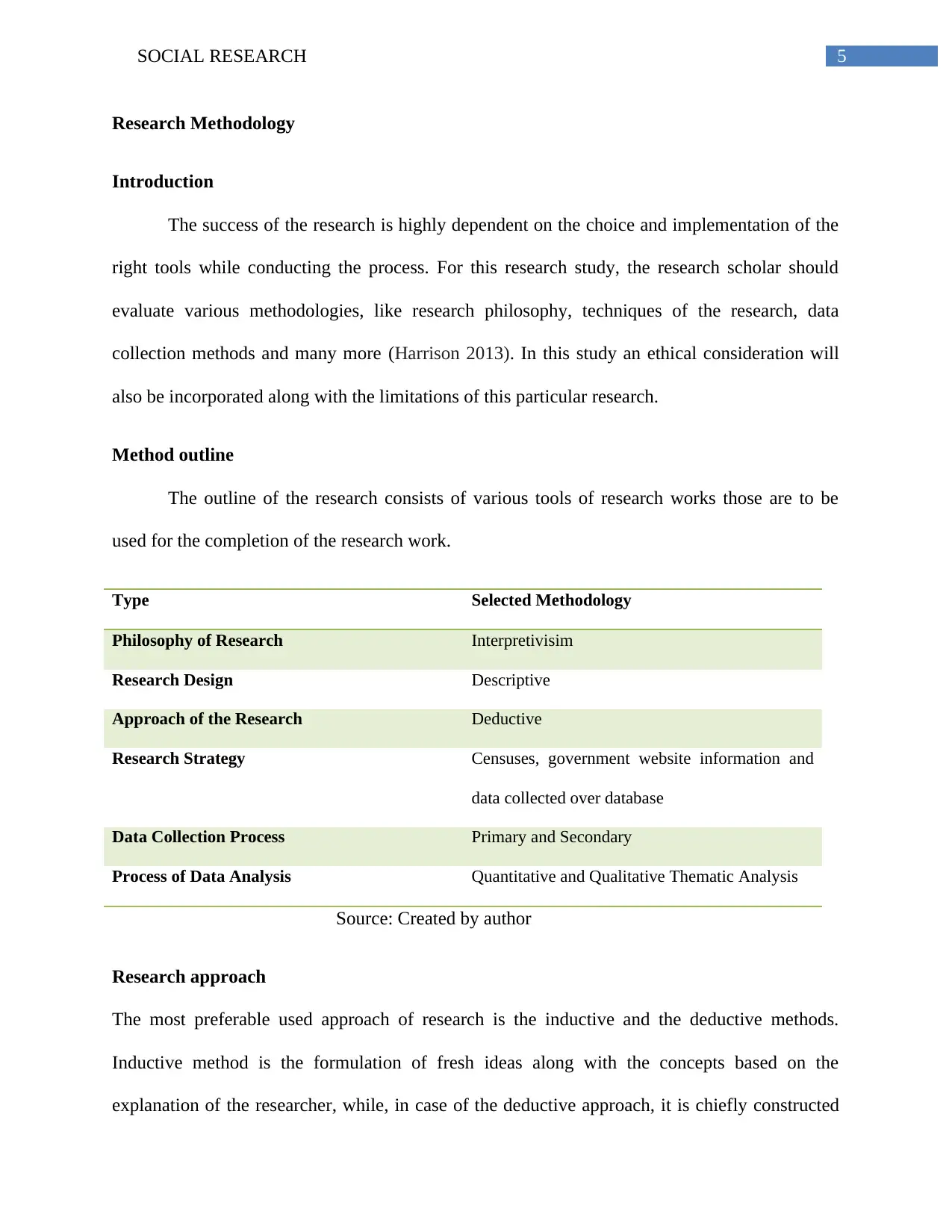
Method outline
The outline of the research consists of various tools of research works those are to be
used for the completion of the research work.
Type Selected Methodology
Philosophy of Research Interpretivisim
Research Design Descriptive
Approach of the Research Deductive
Research Strategy Censuses, government website information and
data collected over database
Data Collection Process Primary and Secondary
Process of Data Analysis Quantitative and Qualitative Thematic Analysis
Source: Created by author
Research approach
The most preferable used approach of research is the inductive and the deductive methods.
Inductive method is the formulation of fresh ideas along with the concepts based on the
explanation of the researcher, while, in case of the deductive approach, it is chiefly constructed
Research Methodology
Introduction
The success of the research is highly dependent on the choice and implementation of the
right tools while conducting the process. For this research study, the research scholar should
evaluate various methodologies, like research philosophy, techniques of the research, data
collection methods and many more (Harrison 2013). In this study an ethical consideration will
also be incorporated along with the limitations of this particular research.
Method outline
The outline of the research consists of various tools of research works those are to be
used for the completion of the research work.
Type Selected Methodology
Philosophy of Research Interpretivisim
Research Design Descriptive
Approach of the Research Deductive
Research Strategy Censuses, government website information and
data collected over database
Data Collection Process Primary and Secondary
Process of Data Analysis Quantitative and Qualitative Thematic Analysis
Source: Created by author
Research approach
The most preferable used approach of research is the inductive and the deductive methods.
Inductive method is the formulation of fresh ideas along with the concepts based on the
explanation of the researcher, while, in case of the deductive approach, it is chiefly constructed
⊘ This is a preview!⊘
Do you want full access?
Subscribe today to unlock all pages.
Trusted by 1+ million students worldwide
6SOCIAL RESEARCH
on the active concepts and theories (Greenfield et al. 2015). For the inductive approach the
research scholar is required to emphasize upon the development of the original patterns within
the theories that subsists already, resulting in the recreation of the focus of the researcher from
the objectives and aims of the surveillance along with the analysis. On the other hand, the
deductive approach would provide a vision for the research scholar to examine the present
impression and relating the same with the topic of the research. In this study of research, the
researcher has nominated the deductive method as this would be assisting the researcher in
transforming the common data into detailed information (Harrison 2013). Moreover, this has
facilitated the researcher in scrutinizing the recent theories and the perceptions instead of
refining a fresh notion or a new theory.
Research design
For this social research descriptive research design is followed as the requirement of the
research study required this type of approach.
Method of data collection
For this particular research work, the social researcher tried for both the primary and the
secondary type of data collection method. This modus operandi have definite allowed the
researcher to collect relevant information from a variety of sources like the government website,
numerous articles that were published initially in the most important newspapers along with
some books (Croft, Currie, and Lockett 2015). Furthermore, the collection process of the
secondary type of data has enabled the researcher to compare the data that is being collected and
on the active concepts and theories (Greenfield et al. 2015). For the inductive approach the
research scholar is required to emphasize upon the development of the original patterns within
the theories that subsists already, resulting in the recreation of the focus of the researcher from
the objectives and aims of the surveillance along with the analysis. On the other hand, the
deductive approach would provide a vision for the research scholar to examine the present
impression and relating the same with the topic of the research. In this study of research, the
researcher has nominated the deductive method as this would be assisting the researcher in
transforming the common data into detailed information (Harrison 2013). Moreover, this has
facilitated the researcher in scrutinizing the recent theories and the perceptions instead of
refining a fresh notion or a new theory.
Research design
For this social research descriptive research design is followed as the requirement of the
research study required this type of approach.
Method of data collection
For this particular research work, the social researcher tried for both the primary and the
secondary type of data collection method. This modus operandi have definite allowed the
researcher to collect relevant information from a variety of sources like the government website,
numerous articles that were published initially in the most important newspapers along with
some books (Croft, Currie, and Lockett 2015). Furthermore, the collection process of the
secondary type of data has enabled the researcher to compare the data that is being collected and
Paraphrase This Document
Need a fresh take? Get an instant paraphrase of this document with our AI Paraphraser
7SOCIAL RESEARCH
finishing the inference of the effect that declining level of medical assistance in UK due to cost
cut in NHS. For the process of primary data collection, interviews and questionnaires shall be the
chief tools to understand the course of action along with effects of massive cost cuts in the NHS,
for the patients admitted in the hospitals of UK and those who receive medical assistance in any
other forms (Croft, Currie, and Lockett 2015). Relevant people like the officials from the
medical field along with local and few other residents of UK and medical practitioners would be
the ones who would be targeted by the researcher for the purpose of his research study and going
along with the data collection method (Chang et al. 2016). Consequently, whatever the way is for
the collection of information, it ought to be fulfilling the requisites. The ultimate objective would
to be to productively finish the research study satisfying the aims and objectives of the research
work by an appropriate research study.
Sampling method
Sample Size
The sample size is 16 a survey is conducted for this social research in order to come to an
conclusion.
Ethical consideration
It is vital for the research scholar to judge all the ethical considerations necessary for him
to follow. The information and the data that is being attained by the research scholar should be of
authentic nature and must not contain any type of manoeuvring (Chang et al. 2016). The social
research scholar would not indulge in any kind of biasness while going for interviewing as a
process or a process of collecting data. The key emphasis of the researcher would be on the fact
that the respondents must not engage themselves in channelizing the research scholar towards
finishing the inference of the effect that declining level of medical assistance in UK due to cost
cut in NHS. For the process of primary data collection, interviews and questionnaires shall be the
chief tools to understand the course of action along with effects of massive cost cuts in the NHS,
for the patients admitted in the hospitals of UK and those who receive medical assistance in any
other forms (Croft, Currie, and Lockett 2015). Relevant people like the officials from the
medical field along with local and few other residents of UK and medical practitioners would be
the ones who would be targeted by the researcher for the purpose of his research study and going
along with the data collection method (Chang et al. 2016). Consequently, whatever the way is for
the collection of information, it ought to be fulfilling the requisites. The ultimate objective would
to be to productively finish the research study satisfying the aims and objectives of the research
work by an appropriate research study.
Sampling method
Sample Size
The sample size is 16 a survey is conducted for this social research in order to come to an
conclusion.
Ethical consideration
It is vital for the research scholar to judge all the ethical considerations necessary for him
to follow. The information and the data that is being attained by the research scholar should be of
authentic nature and must not contain any type of manoeuvring (Chang et al. 2016). The social
research scholar would not indulge in any kind of biasness while going for interviewing as a
process or a process of collecting data. The key emphasis of the researcher would be on the fact
that the respondents must not engage themselves in channelizing the research scholar towards
8SOCIAL RESEARCH
wrong information. This would extremely hinder the in general pace of the research scholar
process. Furthermore the social researcher would also be needing to recognize the fact that there
must not be any dripping of important information by any means (Abel-Smith and Titmuss
2016). The social researcher is limited to amend the data and the collected information by the
researcher in any sort of situation. The information and facts that is being collected over time is
mandatory to be presented in its real form by the social researcher. Any kind of manoeuvring in
that would surely border the rate of success of the research. Besides, the researcher is being
much-admired for using the information and the data for the academic principle and is
constrained in using the same for any type of commercial function. For this particular research
study, the researcher has followed the ethical considerations mentioned above while starting
along with the research work.
Limitations
Due to the limitation of time responses from only 16 respondents were collected. On the
other hand, due to budget issues the research scholar could not access to some of the authentic
secondary sources. These are the basic limitations faced by the researcher.
Chapter summary
This particular chapter has engaged in the choice of the methodologies of the research
work that provides the definite explanation of picking the suitable methodology for the research
work. This chapter also takes into account the numerous techniques of accumulating the primary
and the secondary data for the completion of the research work. On the other hand, in primary
way it would be interviews and questionnaire, for the secondary type of analysis it would be
beforehand published articles in magazines and the newspapers alongside with some appropriate
books on the topic of the research. The research scholar has also demarcated the worth of
wrong information. This would extremely hinder the in general pace of the research scholar
process. Furthermore the social researcher would also be needing to recognize the fact that there
must not be any dripping of important information by any means (Abel-Smith and Titmuss
2016). The social researcher is limited to amend the data and the collected information by the
researcher in any sort of situation. The information and facts that is being collected over time is
mandatory to be presented in its real form by the social researcher. Any kind of manoeuvring in
that would surely border the rate of success of the research. Besides, the researcher is being
much-admired for using the information and the data for the academic principle and is
constrained in using the same for any type of commercial function. For this particular research
study, the researcher has followed the ethical considerations mentioned above while starting
along with the research work.
Limitations
Due to the limitation of time responses from only 16 respondents were collected. On the
other hand, due to budget issues the research scholar could not access to some of the authentic
secondary sources. These are the basic limitations faced by the researcher.
Chapter summary
This particular chapter has engaged in the choice of the methodologies of the research
work that provides the definite explanation of picking the suitable methodology for the research
work. This chapter also takes into account the numerous techniques of accumulating the primary
and the secondary data for the completion of the research work. On the other hand, in primary
way it would be interviews and questionnaire, for the secondary type of analysis it would be
beforehand published articles in magazines and the newspapers alongside with some appropriate
books on the topic of the research. The research scholar has also demarcated the worth of
⊘ This is a preview!⊘
Do you want full access?
Subscribe today to unlock all pages.
Trusted by 1+ million students worldwide
9SOCIAL RESEARCH
ensuring the ethical consideration while piloting the research work along with the limits that is
being majorly faced by the research scholar when performing the study of research (Abel-Smith
and Titmuss 2016). The researcher have to keep important information clandestine as the
research scholar would be making god use of the government website’s data and definite other
things that cannot be used wrongly.
Results and discussion
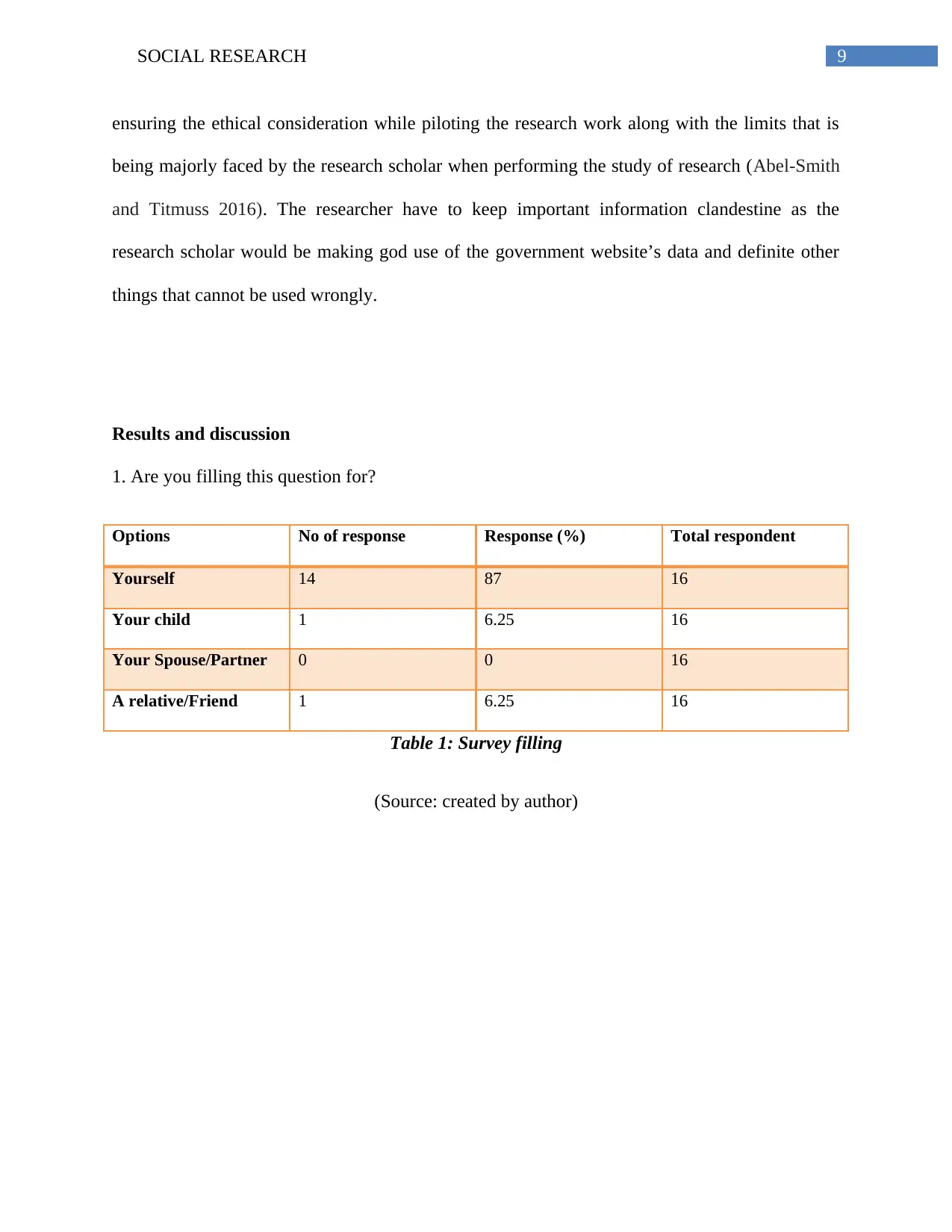
1. Are you filling this question for?
Options No of response Response (%) Total respondent
Yourself 14 87 16
Your child 1 6.25 16
Your Spouse/Partner 0 0 16
A relative/Friend 1 6.25 16
Table 1: Survey filling
(Source: created by author)
ensuring the ethical consideration while piloting the research work along with the limits that is
being majorly faced by the research scholar when performing the study of research (Abel-Smith
and Titmuss 2016). The researcher have to keep important information clandestine as the
research scholar would be making god use of the government website’s data and definite other
things that cannot be used wrongly.
Results and discussion
1. Are you filling this question for?
Options No of response Response (%) Total respondent
Yourself 14 87 16
Your child 1 6.25 16
Your Spouse/Partner 0 0 16
A relative/Friend 1 6.25 16
Table 1: Survey filling
(Source: created by author)
Paraphrase This Document
Need a fresh take? Get an instant paraphrase of this document with our AI Paraphraser
10SOCIAL RESEARCH
Yourself Your child Your
Spouse/
Partner
A
relative/
Friend
0
20
40
60
80
100
120
140
87
6.25 0 6.25
Total respondent
Response (%)
No of response
Source: created by author
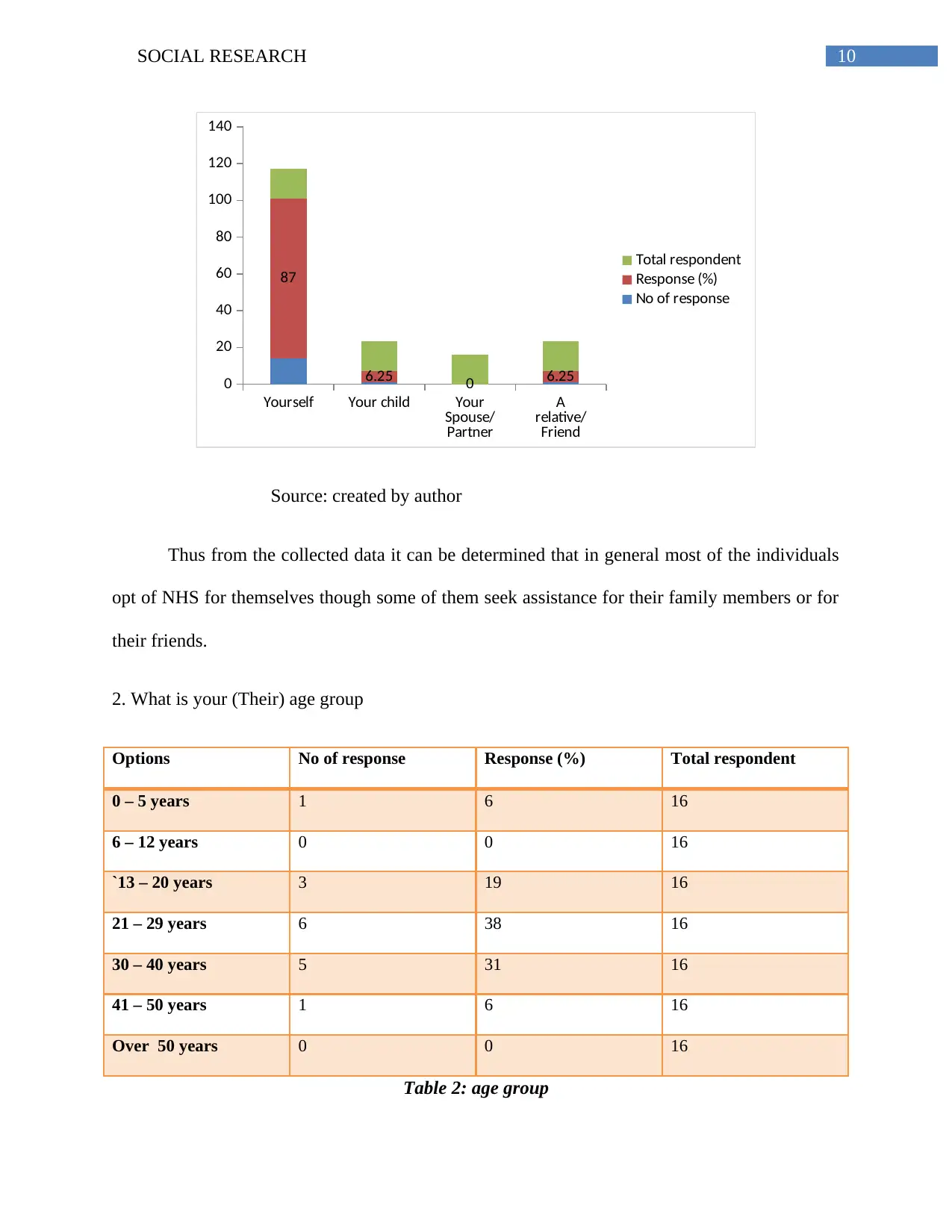
Thus from the collected data it can be determined that in general most of the individuals
opt of NHS for themselves though some of them seek assistance for their family members or for
their friends.
2. What is your (Their) age group
Options No of response Response (%) Total respondent
0 – 5 years 1 6 16
6 – 12 years 0 0 16
`13 – 20 years 3 19 16
21 – 29 years 6 38 16
30 – 40 years 5 31 16
41 – 50 years 1 6 16
Over 50 years 0 0 16
Table 2: age group
Yourself Your child Your
Spouse/
Partner
A
relative/
Friend
0
20
40
60
80
100
120
140
87
6.25 0 6.25
Total respondent
Response (%)
No of response
Source: created by author
Thus from the collected data it can be determined that in general most of the individuals
opt of NHS for themselves though some of them seek assistance for their family members or for
their friends.
2. What is your (Their) age group
Options No of response Response (%) Total respondent
0 – 5 years 1 6 16
6 – 12 years 0 0 16
`13 – 20 years 3 19 16
21 – 29 years 6 38 16
30 – 40 years 5 31 16
41 – 50 years 1 6 16
Over 50 years 0 0 16
Table 2: age group
11SOCIAL RESEARCH
(Source: created by author)
0 – 5
years 6 – 12
years `13 –
20
years
21 – 29
years 30 – 40
years 41 – 50
years Over
50
years
0
10
20
30
40
50
60
70
16
16
16
16
16
16
16
Total respondent
Response (%)
No of response
Source: created by author
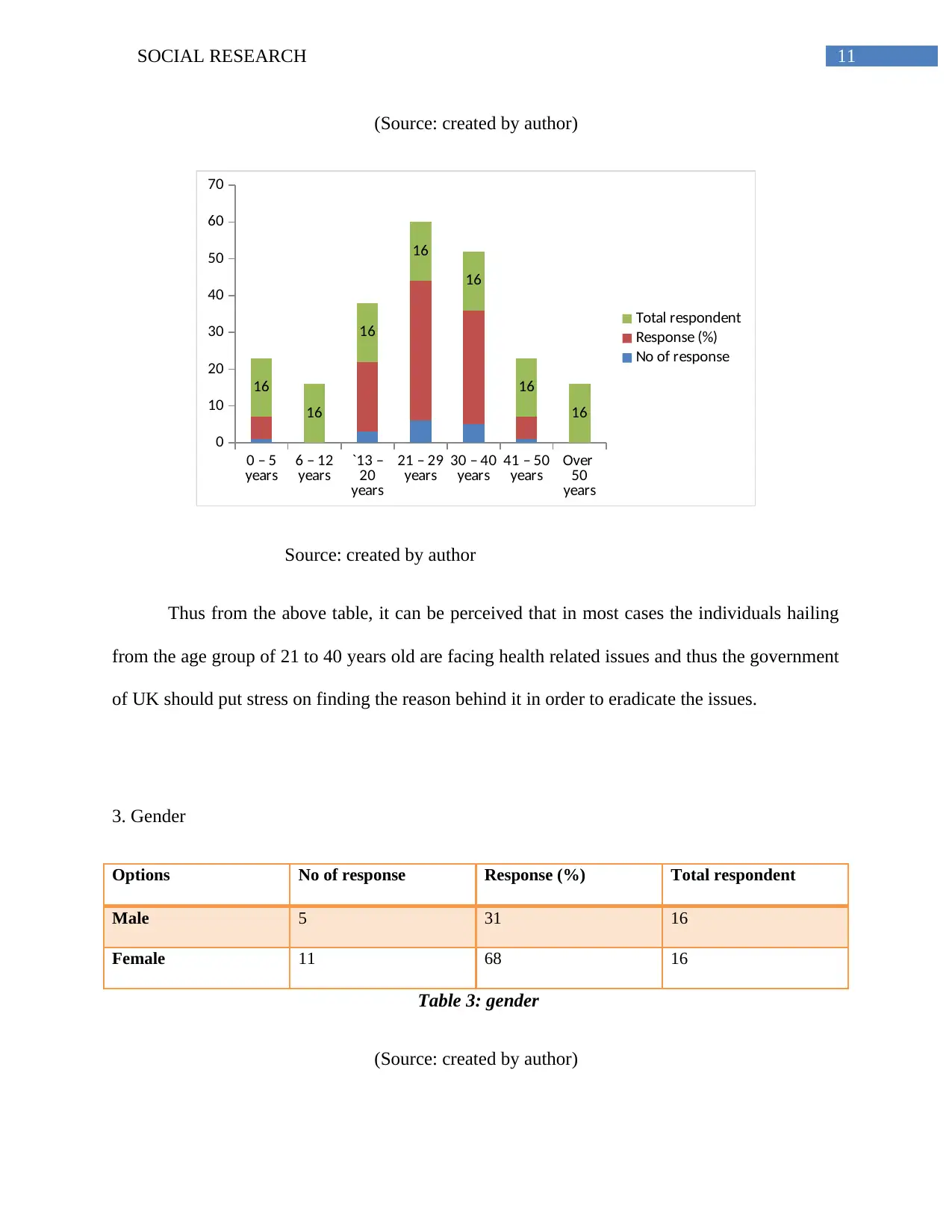
Thus from the above table, it can be perceived that in most cases the individuals hailing
from the age group of 21 to 40 years old are facing health related issues and thus the government
of UK should put stress on finding the reason behind it in order to eradicate the issues.
3. Gender
Options No of response Response (%) Total respondent
Male 5 31 16
Female 11 68 16
Table 3: gender
(Source: created by author)
(Source: created by author)
0 – 5
years 6 – 12
years `13 –
20
years
21 – 29
years 30 – 40
years 41 – 50
years Over
50
years
0
10
20
30
40
50
60
70
16
16
16
16
16
16
16
Total respondent
Response (%)
No of response
Source: created by author
Thus from the above table, it can be perceived that in most cases the individuals hailing
from the age group of 21 to 40 years old are facing health related issues and thus the government
of UK should put stress on finding the reason behind it in order to eradicate the issues.
3. Gender
Options No of response Response (%) Total respondent
Male 5 31 16
Female 11 68 16
Table 3: gender
(Source: created by author)
⊘ This is a preview!⊘
Do you want full access?
Subscribe today to unlock all pages.
Trusted by 1+ million students worldwide

1 out of 23


Related Documents


Your All-in-One AI-Powered Toolkit for Academic Success.
+13062052269
info@desklib.com
Available 24*7 on WhatsApp / Email
![[object Object]](/_next/static/media/star-bottom.7253800d.svg)
Unlock your academic potential
Copyright © 2020–2026 A2Z Services. All Rights Reserved. Developed and managed by ZUCOL.