Comprehensive Report: Assessing Big Data's Impacts on Organizations
VerifiedAdded on 2020/05/11
|21
|4969
|78
Report
AI Summary
This report investigates the impacts of big data on organizations, focusing on its potential to revolutionize business operations. The study employs an empirical approach, examining the influence of big data on organizational processes and performance. The research involved data collection from three organizations, highlighting the benefits of big data, such as enhanced data availability, process integration, and data-driven insights. The report also acknowledges the challenges associated with implementing big data technologies. An interpretive framework is presented to analyze definitional perspectives and applications of big data. The findings offer a comprehensive understanding of big data's role in capturing organizational value, providing insights into achieving value through big data strategy and its implementation. The report fills a gap in the existing research by providing an empirical study, whereas most of the existing research on this topic is theoretical.

Running head: BIG DATA 1
The impacts of Big Data on organizations
Name:
Institution Affiliation:
The impacts of Big Data on organizations
Name:
Institution Affiliation:

Paraphrase This Document
Need a fresh take? Get an instant paraphrase of this document with our AI Paraphraser
BIG DATA 2
Executive Summary
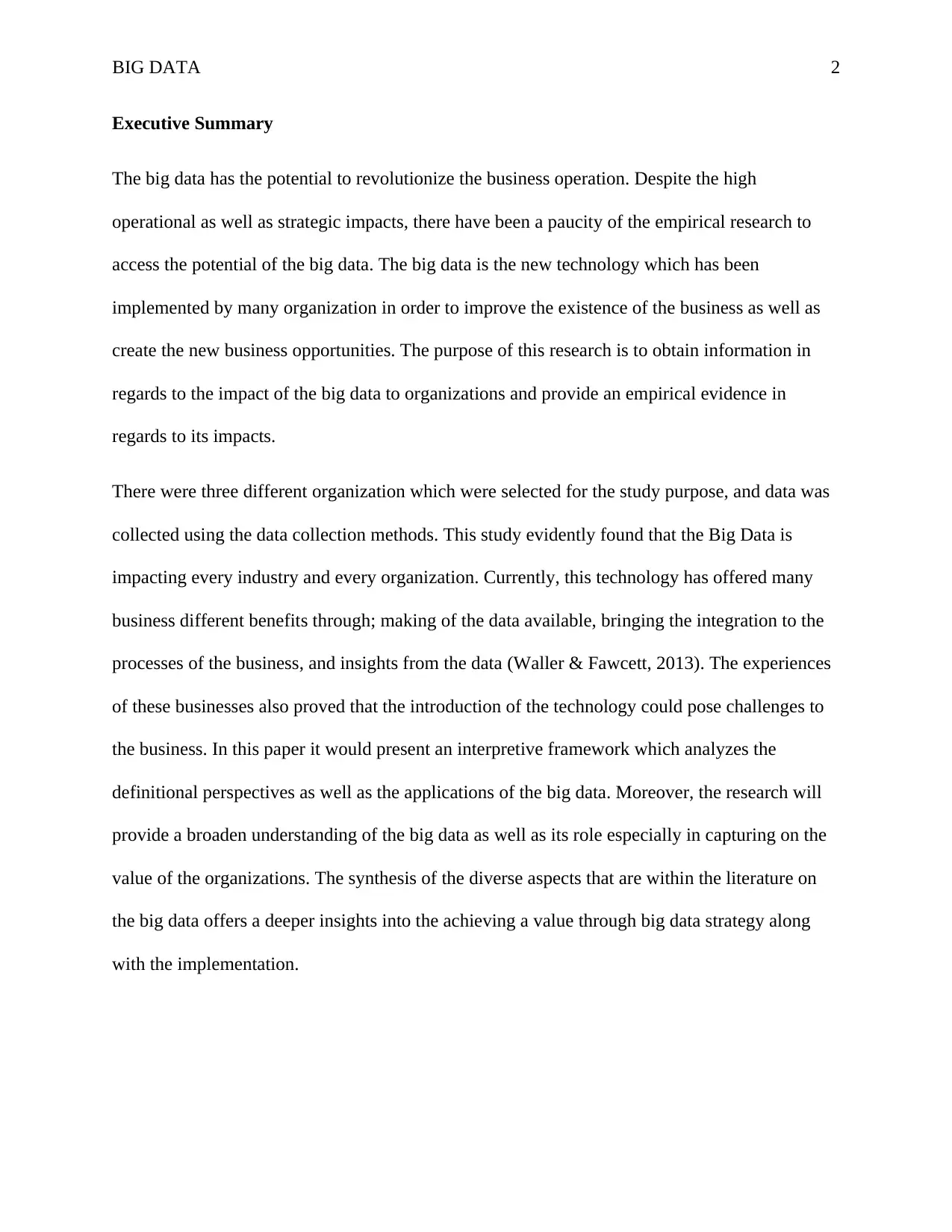
The big data has the potential to revolutionize the business operation. Despite the high
operational as well as strategic impacts, there have been a paucity of the empirical research to
access the potential of the big data. The big data is the new technology which has been
implemented by many organization in order to improve the existence of the business as well as
create the new business opportunities. The purpose of this research is to obtain information in
regards to the impact of the big data to organizations and provide an empirical evidence in
regards to its impacts.
There were three different organization which were selected for the study purpose, and data was
collected using the data collection methods. This study evidently found that the Big Data is
impacting every industry and every organization. Currently, this technology has offered many
business different benefits through; making of the data available, bringing the integration to the
processes of the business, and insights from the data (Waller & Fawcett, 2013). The experiences
of these businesses also proved that the introduction of the technology could pose challenges to
the business. In this paper it would present an interpretive framework which analyzes the
definitional perspectives as well as the applications of the big data. Moreover, the research will
provide a broaden understanding of the big data as well as its role especially in capturing on the
value of the organizations. The synthesis of the diverse aspects that are within the literature on
the big data offers a deeper insights into the achieving a value through big data strategy along
with the implementation.
Executive Summary
The big data has the potential to revolutionize the business operation. Despite the high
operational as well as strategic impacts, there have been a paucity of the empirical research to
access the potential of the big data. The big data is the new technology which has been
implemented by many organization in order to improve the existence of the business as well as
create the new business opportunities. The purpose of this research is to obtain information in
regards to the impact of the big data to organizations and provide an empirical evidence in
regards to its impacts.
There were three different organization which were selected for the study purpose, and data was
collected using the data collection methods. This study evidently found that the Big Data is
impacting every industry and every organization. Currently, this technology has offered many
business different benefits through; making of the data available, bringing the integration to the
processes of the business, and insights from the data (Waller & Fawcett, 2013). The experiences
of these businesses also proved that the introduction of the technology could pose challenges to
the business. In this paper it would present an interpretive framework which analyzes the
definitional perspectives as well as the applications of the big data. Moreover, the research will
provide a broaden understanding of the big data as well as its role especially in capturing on the
value of the organizations. The synthesis of the diverse aspects that are within the literature on
the big data offers a deeper insights into the achieving a value through big data strategy along
with the implementation.
BIG DATA 3
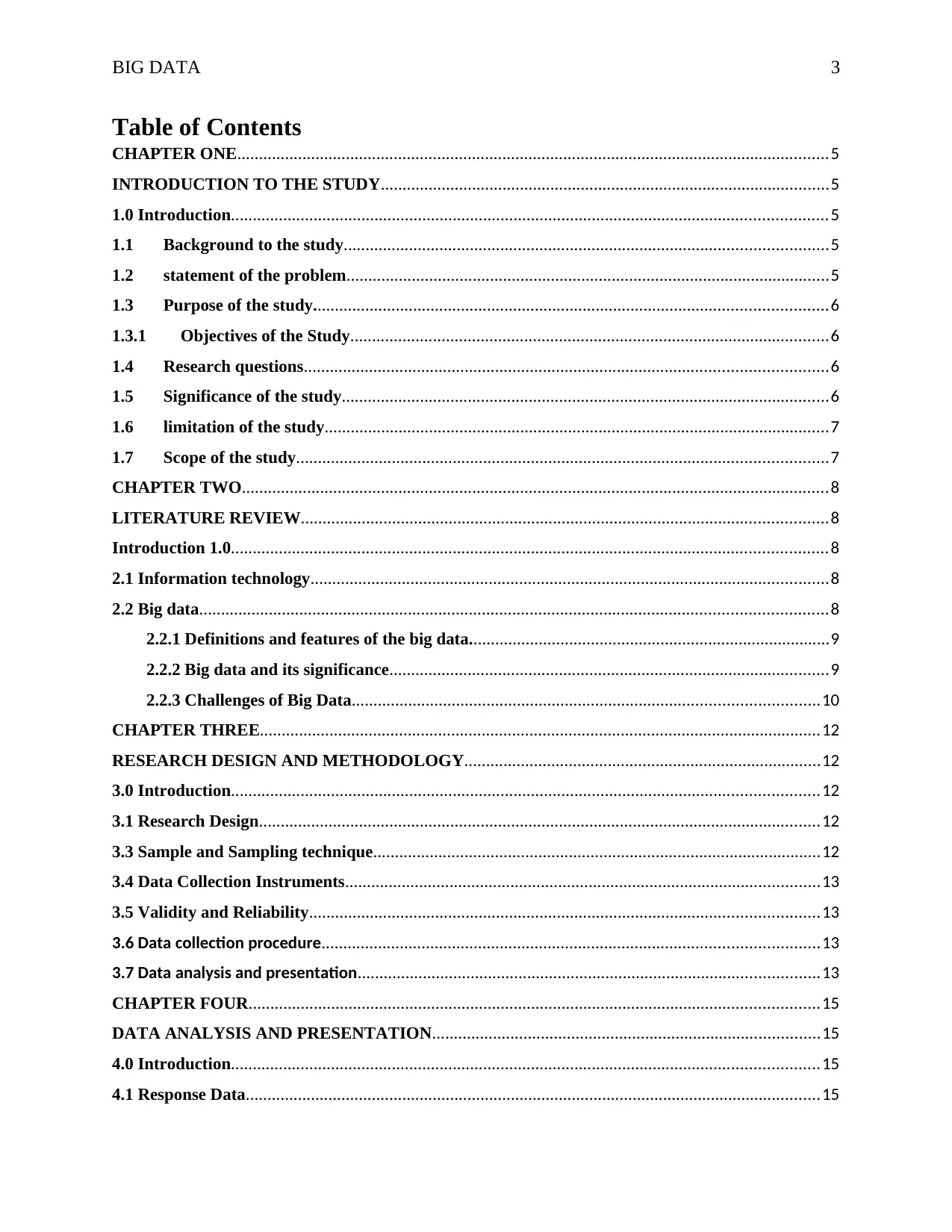
Table of Contents
CHAPTER ONE........................................................................................................................................5
INTRODUCTION TO THE STUDY.......................................................................................................5
1.0 Introduction.........................................................................................................................................5
1.1 Background to the study...............................................................................................................5
1.2 statement of the problem...............................................................................................................5
1.3 Purpose of the study......................................................................................................................6
1.3.1 Objectives of the Study..............................................................................................................6
1.4 Research questions........................................................................................................................6
1.5 Significance of the study................................................................................................................6
1.6 limitation of the study....................................................................................................................7
1.7 Scope of the study..........................................................................................................................7
CHAPTER TWO.......................................................................................................................................8
LITERATURE REVIEW.........................................................................................................................8
Introduction 1.0.........................................................................................................................................8
2.1 Information technology.......................................................................................................................8
2.2 Big data................................................................................................................................................8
2.2.1 Definitions and features of the big data...................................................................................9
2.2.2 Big data and its significance.....................................................................................................9
2.2.3 Challenges of Big Data...........................................................................................................10
CHAPTER THREE.................................................................................................................................12
RESEARCH DESIGN AND METHODOLOGY..................................................................................12
3.0 Introduction.......................................................................................................................................12
3.1 Research Design.................................................................................................................................12
3.3 Sample and Sampling technique.......................................................................................................12
3.4 Data Collection Instruments.............................................................................................................13
3.5 Validity and Reliability.....................................................................................................................13
3.6 Data collection procedure..................................................................................................................13
3.7 Data analysis and presentation..........................................................................................................13
CHAPTER FOUR...................................................................................................................................15
DATA ANALYSIS AND PRESENTATION.........................................................................................15
4.0 Introduction.......................................................................................................................................15
4.1 Response Data....................................................................................................................................15
Table of Contents
CHAPTER ONE........................................................................................................................................5
INTRODUCTION TO THE STUDY.......................................................................................................5
1.0 Introduction.........................................................................................................................................5
1.1 Background to the study...............................................................................................................5
1.2 statement of the problem...............................................................................................................5
1.3 Purpose of the study......................................................................................................................6
1.3.1 Objectives of the Study..............................................................................................................6
1.4 Research questions........................................................................................................................6
1.5 Significance of the study................................................................................................................6
1.6 limitation of the study....................................................................................................................7
1.7 Scope of the study..........................................................................................................................7
CHAPTER TWO.......................................................................................................................................8
LITERATURE REVIEW.........................................................................................................................8
Introduction 1.0.........................................................................................................................................8
2.1 Information technology.......................................................................................................................8
2.2 Big data................................................................................................................................................8
2.2.1 Definitions and features of the big data...................................................................................9
2.2.2 Big data and its significance.....................................................................................................9
2.2.3 Challenges of Big Data...........................................................................................................10
CHAPTER THREE.................................................................................................................................12
RESEARCH DESIGN AND METHODOLOGY..................................................................................12
3.0 Introduction.......................................................................................................................................12
3.1 Research Design.................................................................................................................................12
3.3 Sample and Sampling technique.......................................................................................................12
3.4 Data Collection Instruments.............................................................................................................13
3.5 Validity and Reliability.....................................................................................................................13
3.6 Data collection procedure..................................................................................................................13
3.7 Data analysis and presentation..........................................................................................................13
CHAPTER FOUR...................................................................................................................................15
DATA ANALYSIS AND PRESENTATION.........................................................................................15
4.0 Introduction.......................................................................................................................................15
4.1 Response Data....................................................................................................................................15
⊘ This is a preview!⊘
Do you want full access?
Subscribe today to unlock all pages.

Trusted by 1+ million students worldwide
BIG DATA 4
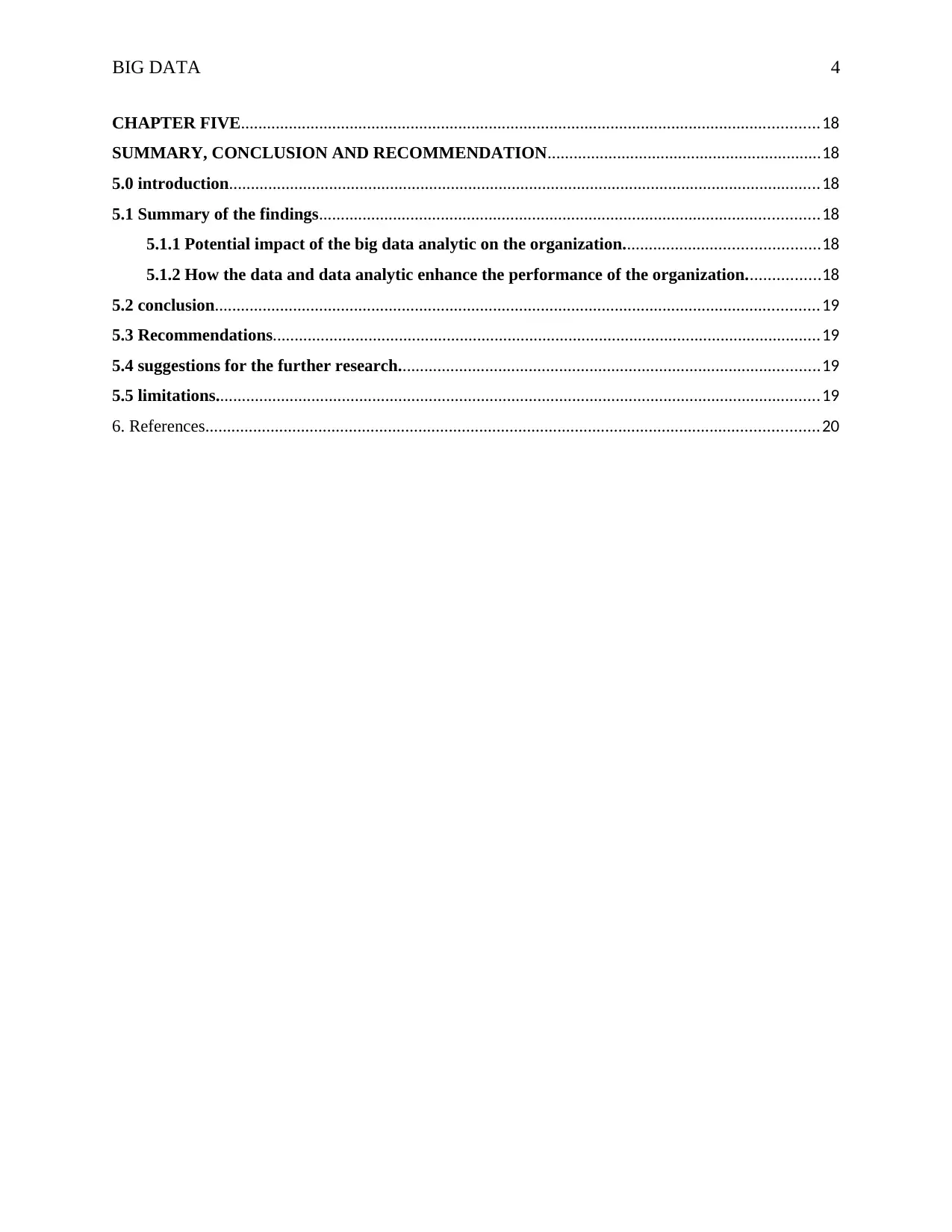
CHAPTER FIVE.....................................................................................................................................18
SUMMARY, CONCLUSION AND RECOMMENDATION...............................................................18
5.0 introduction........................................................................................................................................18
5.1 Summary of the findings...................................................................................................................18
5.1.1 Potential impact of the big data analytic on the organization.............................................18
5.1.2 How the data and data analytic enhance the performance of the organization.................18
5.2 conclusion...........................................................................................................................................19
5.3 Recommendations..............................................................................................................................19
5.4 suggestions for the further research.................................................................................................19
5.5 limitations...........................................................................................................................................19
6. References.............................................................................................................................................20
CHAPTER FIVE.....................................................................................................................................18
SUMMARY, CONCLUSION AND RECOMMENDATION...............................................................18
5.0 introduction........................................................................................................................................18
5.1 Summary of the findings...................................................................................................................18
5.1.1 Potential impact of the big data analytic on the organization.............................................18
5.1.2 How the data and data analytic enhance the performance of the organization.................18
5.2 conclusion...........................................................................................................................................19
5.3 Recommendations..............................................................................................................................19
5.4 suggestions for the further research.................................................................................................19
5.5 limitations...........................................................................................................................................19
6. References.............................................................................................................................................20
Paraphrase This Document
Need a fresh take? Get an instant paraphrase of this document with our AI Paraphraser
BIG DATA 5
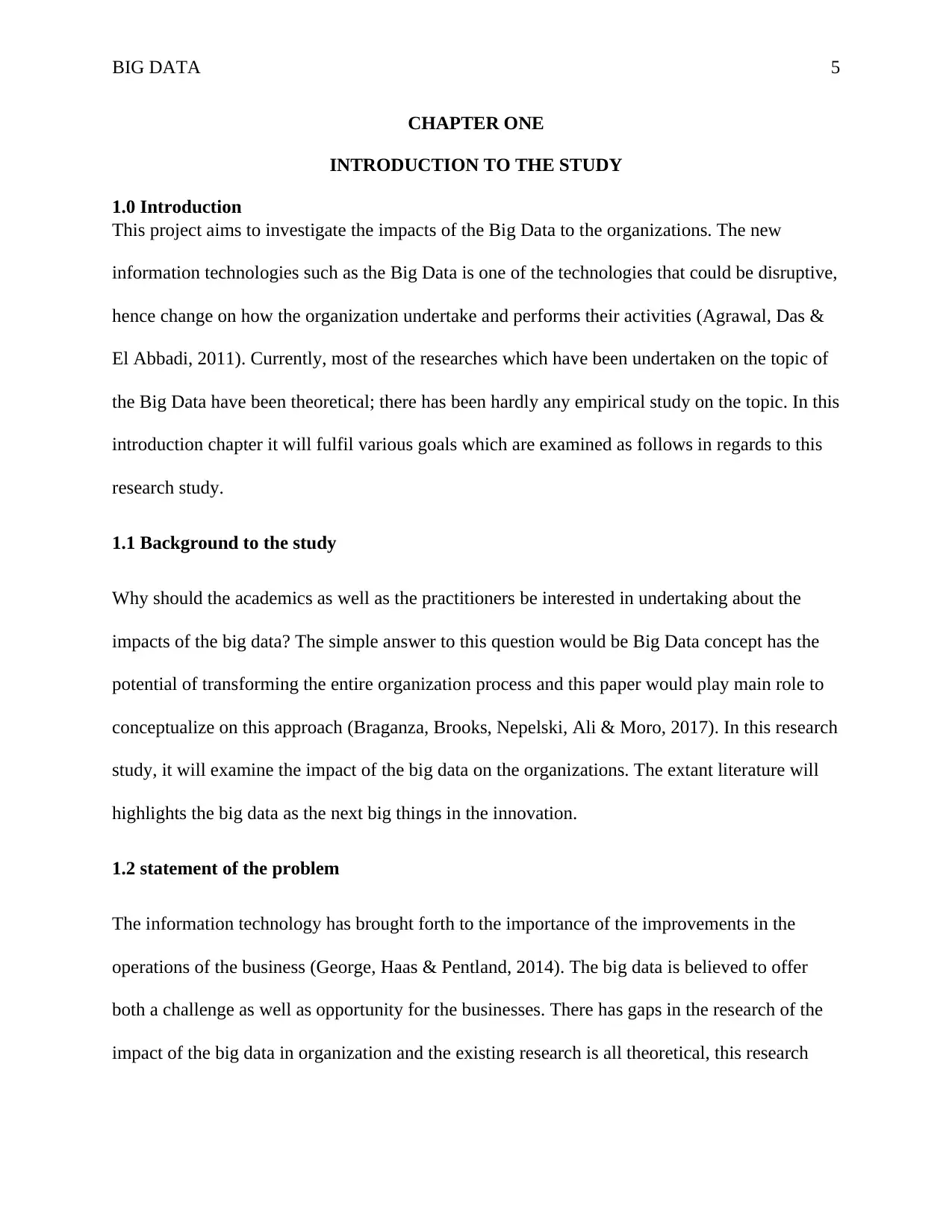
CHAPTER ONE
INTRODUCTION TO THE STUDY
1.0 Introduction
This project aims to investigate the impacts of the Big Data to the organizations. The new
information technologies such as the Big Data is one of the technologies that could be disruptive,
hence change on how the organization undertake and performs their activities (Agrawal, Das &
El Abbadi, 2011). Currently, most of the researches which have been undertaken on the topic of
the Big Data have been theoretical; there has been hardly any empirical study on the topic. In this
introduction chapter it will fulfil various goals which are examined as follows in regards to this
research study.
1.1 Background to the study
Why should the academics as well as the practitioners be interested in undertaking about the
impacts of the big data? The simple answer to this question would be Big Data concept has the
potential of transforming the entire organization process and this paper would play main role to
conceptualize on this approach (Braganza, Brooks, Nepelski, Ali & Moro, 2017). In this research
study, it will examine the impact of the big data on the organizations. The extant literature will
highlights the big data as the next big things in the innovation.
1.2 statement of the problem
The information technology has brought forth to the importance of the improvements in the
operations of the business (George, Haas & Pentland, 2014). The big data is believed to offer
both a challenge as well as opportunity for the businesses. There has gaps in the research of the
impact of the big data in organization and the existing research is all theoretical, this research
CHAPTER ONE
INTRODUCTION TO THE STUDY
1.0 Introduction
This project aims to investigate the impacts of the Big Data to the organizations. The new
information technologies such as the Big Data is one of the technologies that could be disruptive,
hence change on how the organization undertake and performs their activities (Agrawal, Das &
El Abbadi, 2011). Currently, most of the researches which have been undertaken on the topic of
the Big Data have been theoretical; there has been hardly any empirical study on the topic. In this
introduction chapter it will fulfil various goals which are examined as follows in regards to this
research study.
1.1 Background to the study
Why should the academics as well as the practitioners be interested in undertaking about the
impacts of the big data? The simple answer to this question would be Big Data concept has the
potential of transforming the entire organization process and this paper would play main role to
conceptualize on this approach (Braganza, Brooks, Nepelski, Ali & Moro, 2017). In this research
study, it will examine the impact of the big data on the organizations. The extant literature will
highlights the big data as the next big things in the innovation.
1.2 statement of the problem
The information technology has brought forth to the importance of the improvements in the
operations of the business (George, Haas & Pentland, 2014). The big data is believed to offer
both a challenge as well as opportunity for the businesses. There has gaps in the research of the
impact of the big data in organization and the existing research is all theoretical, this research
BIG DATA 6
will address this and provide an empirical study. It will highlight how the big data has impacted
on the businesses.
1.3 Purpose of the study.
The main objective of this study is to investigate the impacts of the big data on the organizations.
1.3.1 Objectives of the Study
To investigate the impact of the big data to the organization process?
To find out how big data analytics could impact the performance of an organization?
1.4 Research questions
It is important to possess a definite objective as to the reasons this study would be carried out
based on the study issue description provided above, it really is clear the aim of the study would
be to offer empirical attestation regarding the influences of big data to the businesses (Hussain &
Roy, 2016).
What are the potential impact of the big data analytic on the organization?
How does the fit between data, data analytic tools, and the task influence the performance
antecedents of an organization?
1.5 Significance of the study
This research is aimed to be of the scientific in addition to practical significance. Even though
the data has become the modern form for the capital in addition to the source for the competitive
advantage, the principle off the big data is a whole new emerging concept for many individuals
to gain. This research will fill the gap, by providing the empirical study which not many research
has been done
will address this and provide an empirical study. It will highlight how the big data has impacted
on the businesses.
1.3 Purpose of the study.
The main objective of this study is to investigate the impacts of the big data on the organizations.
1.3.1 Objectives of the Study
To investigate the impact of the big data to the organization process?
To find out how big data analytics could impact the performance of an organization?
1.4 Research questions
It is important to possess a definite objective as to the reasons this study would be carried out
based on the study issue description provided above, it really is clear the aim of the study would
be to offer empirical attestation regarding the influences of big data to the businesses (Hussain &
Roy, 2016).
What are the potential impact of the big data analytic on the organization?
How does the fit between data, data analytic tools, and the task influence the performance
antecedents of an organization?
1.5 Significance of the study
This research is aimed to be of the scientific in addition to practical significance. Even though
the data has become the modern form for the capital in addition to the source for the competitive
advantage, the principle off the big data is a whole new emerging concept for many individuals
to gain. This research will fill the gap, by providing the empirical study which not many research
has been done
⊘ This is a preview!⊘
Do you want full access?
Subscribe today to unlock all pages.
Trusted by 1+ million students worldwide
BIG DATA 7
1.6 limitation of the study
The researcher may encounter constraints from the respondents where some of them could hold
the information due to the confidentiality aspects in the workplace, but as a researcher I will be
able to convenience them that the information will be confidential and it will be utilized only for
the purpose of academic.
1.7 Scope of the study
The scope of the study will be within the setup of the banking institution with a target population
of approximately seventy eight employees and a sample size of thirty nine in the organization.
The research is aimed at addressing the impacts of the big data on organizations.
1.6 limitation of the study
The researcher may encounter constraints from the respondents where some of them could hold
the information due to the confidentiality aspects in the workplace, but as a researcher I will be
able to convenience them that the information will be confidential and it will be utilized only for
the purpose of academic.
1.7 Scope of the study
The scope of the study will be within the setup of the banking institution with a target population
of approximately seventy eight employees and a sample size of thirty nine in the organization.
The research is aimed at addressing the impacts of the big data on organizations.
Paraphrase This Document
Need a fresh take? Get an instant paraphrase of this document with our AI Paraphraser
BIG DATA 8
CHAPTER TWO
LITERATURE REVIEW
Introduction 1.0
This chapter focuses on the literature review from the various sources which includes the books,
magazines, journals, periodical as well as the websites. It entails the review of the analytical
literature, summary of the gaps to be filled.
In this chapter it will describe various concepts particularly to the existing literature and
providing the insights into the relevant existing studies especially in the fields of IT, big data and
the management control systems (Wang, Kung & Byrd, 2016). In this chapter it discusses the
theoretical basis for the study.
2.1 Information technology
The information technology has become omnipresent and it is changing each aspect of
individual’s lives. Additionally, IT has become an integral part especially in the modern
organizations and it has changed on the way many of the organizations processes and operations
(Chen, Chiang & Storey, 2012). Therefore, this is a consensus that the information technology
has a great impact towards the productivity of the organizations.
In the recent decades, the information technology has advanced at a fast pace, and what was hard
to imagine has now become part of every individual live (Chen, Chiang & Storey, 2012). Among
others, is the online shopping, digital marketing, cloud computing, digital communication along
with social networking such as Facebook (Raghupathi & Raghupathi, 2014). To make usage of
the available data many organization have acquired various kinds of IT systems and programs.
2.2 Big data
The data has been a brick to which any organization could blossom. The big data and the
analytics offers various benefits. It has helped in the creation of the various kind of the values,
CHAPTER TWO
LITERATURE REVIEW
Introduction 1.0
This chapter focuses on the literature review from the various sources which includes the books,
magazines, journals, periodical as well as the websites. It entails the review of the analytical
literature, summary of the gaps to be filled.
In this chapter it will describe various concepts particularly to the existing literature and
providing the insights into the relevant existing studies especially in the fields of IT, big data and
the management control systems (Wang, Kung & Byrd, 2016). In this chapter it discusses the
theoretical basis for the study.
2.1 Information technology
The information technology has become omnipresent and it is changing each aspect of
individual’s lives. Additionally, IT has become an integral part especially in the modern
organizations and it has changed on the way many of the organizations processes and operations
(Chen, Chiang & Storey, 2012). Therefore, this is a consensus that the information technology
has a great impact towards the productivity of the organizations.
In the recent decades, the information technology has advanced at a fast pace, and what was hard
to imagine has now become part of every individual live (Chen, Chiang & Storey, 2012). Among
others, is the online shopping, digital marketing, cloud computing, digital communication along
with social networking such as Facebook (Raghupathi & Raghupathi, 2014). To make usage of
the available data many organization have acquired various kinds of IT systems and programs.
2.2 Big data
The data has been a brick to which any organization could blossom. The big data and the
analytics offers various benefits. It has helped in the creation of the various kind of the values,
BIG DATA 9
transparency, expose of the variation as well as the improvement of performance (Russom,
2011). Moreover, it has been found to support the human decision making with the use of the
automated algorithms and innovating new business models, services and the products. It is
evident that with the rapid development of the information technologies for example the cloud
computing, the mobile internet as well as the internet of things there has been all kind of data
which has been generated and accumulated (Ross, Ressia & Sander, 2017). Therefore, this could
present opportunities and unprecedented challenges which could be associated to the available
data.
2.2.1 Definitions and features of the big data.
The big data has been a concept which has been leading the world and it has been taken as storm.
Some of the research regards as a huge set of the data which is possible to analyze by hand or
even through the traditional methods, for example the spreadsheet. A portion of the scholar
thinks that it is a set of the data asset to the organization, which has many values and there is a
lot of benefits which could be generated from using it. It has been changing on the way the
business are performing (Ross, Ressia & Sander, 2017). Many organization are investing in it to
derive the value from their data which have an advantage over the rival firms. There would be a
performance gap which will still grow as more relevant data has been generated, emergence of
new technologies as well as the digital channels which provider a better acquisition and a
delivery mechanism. The big data has a datasets which has sizes which go beyond the abilities of
the traditional as well as the common tools in the business to capture, manage as well as store the
data processes.
2.2.2 Big data and its significance
As more volume of data keeps to grow exponentially, organization have turned to the huge
amounts of the data as well as analytics to form a strategy and decision making (Gunasekaran,
transparency, expose of the variation as well as the improvement of performance (Russom,
2011). Moreover, it has been found to support the human decision making with the use of the
automated algorithms and innovating new business models, services and the products. It is
evident that with the rapid development of the information technologies for example the cloud
computing, the mobile internet as well as the internet of things there has been all kind of data
which has been generated and accumulated (Ross, Ressia & Sander, 2017). Therefore, this could
present opportunities and unprecedented challenges which could be associated to the available
data.
2.2.1 Definitions and features of the big data.
The big data has been a concept which has been leading the world and it has been taken as storm.
Some of the research regards as a huge set of the data which is possible to analyze by hand or
even through the traditional methods, for example the spreadsheet. A portion of the scholar
thinks that it is a set of the data asset to the organization, which has many values and there is a
lot of benefits which could be generated from using it. It has been changing on the way the
business are performing (Ross, Ressia & Sander, 2017). Many organization are investing in it to
derive the value from their data which have an advantage over the rival firms. There would be a
performance gap which will still grow as more relevant data has been generated, emergence of
new technologies as well as the digital channels which provider a better acquisition and a
delivery mechanism. The big data has a datasets which has sizes which go beyond the abilities of
the traditional as well as the common tools in the business to capture, manage as well as store the
data processes.
2.2.2 Big data and its significance
As more volume of data keeps to grow exponentially, organization have turned to the huge
amounts of the data as well as analytics to form a strategy and decision making (Gunasekaran,
⊘ This is a preview!⊘
Do you want full access?
Subscribe today to unlock all pages.
Trusted by 1+ million students worldwide
BIG DATA 10
Papadopoulos, Dubey, Wamba, Childe, Hazen and Akter, 2017). The Big Data technologies are
impacting the businesses positively as they are providing the possibility of storing and analyzing
the huge amount of data to unseen patterns, sentiments as well as the customer intelligence
(Gandomi & Haider, 2015). In today world which has been fast changing, it is vital for the
businesses to stay ahead of their peer and at the same time react faster to the changes in the
market, act on the present and future shortcomings. Big data is becoming a significant assets to
many organization in making of decision (Wang, White & Chen, 2015). The Big Data
technologies analyze huge amount data from various sources to offer opportunity to deliver
benefits to organizations. According to Wang, White & Chen, (2015) one of the significant
benefit of the Big Data is the ability of making a wider availability, transparency as well as
visibility to the information to the decision makers in the business. Big data and analytics offers
manager ability to measure and be able to know more about their organization, customers and
market, and be in a position of translating the knowledge (Tesfaye, 2017).
2.2.3 Challenges of Big Data
While there are many benefits which Big Data provides there are also some challenges which
exists and should be addressed to realize the potential of Big Data (Ross, Ressia & Sander,
2017). Some of the challenges are function of the features of Big Data, some are associated to
the existing analysis methods, models and others are through limitation to current data
processing system. For the organization to reap benefits of Big Data and analytics and become
fully, Big Data empowered organization, they need to overcome some of these problems and
challenges. According to Chen, Chiang and Storey, (2012) one of the major problem of Big Data
is the high cost of the infrastructure. Moreover, based on Diesner, (2015), argued that based on
lifecycle of the data the challenges could be grouped as data processes and the management.
Additionally according to Diesner, (2015) also categorized the challenges of the Big Data as the
Papadopoulos, Dubey, Wamba, Childe, Hazen and Akter, 2017). The Big Data technologies are
impacting the businesses positively as they are providing the possibility of storing and analyzing
the huge amount of data to unseen patterns, sentiments as well as the customer intelligence
(Gandomi & Haider, 2015). In today world which has been fast changing, it is vital for the
businesses to stay ahead of their peer and at the same time react faster to the changes in the
market, act on the present and future shortcomings. Big data is becoming a significant assets to
many organization in making of decision (Wang, White & Chen, 2015). The Big Data
technologies analyze huge amount data from various sources to offer opportunity to deliver
benefits to organizations. According to Wang, White & Chen, (2015) one of the significant
benefit of the Big Data is the ability of making a wider availability, transparency as well as
visibility to the information to the decision makers in the business. Big data and analytics offers
manager ability to measure and be able to know more about their organization, customers and
market, and be in a position of translating the knowledge (Tesfaye, 2017).
2.2.3 Challenges of Big Data
While there are many benefits which Big Data provides there are also some challenges which
exists and should be addressed to realize the potential of Big Data (Ross, Ressia & Sander,
2017). Some of the challenges are function of the features of Big Data, some are associated to
the existing analysis methods, models and others are through limitation to current data
processing system. For the organization to reap benefits of Big Data and analytics and become
fully, Big Data empowered organization, they need to overcome some of these problems and
challenges. According to Chen, Chiang and Storey, (2012) one of the major problem of Big Data
is the high cost of the infrastructure. Moreover, based on Diesner, (2015), argued that based on
lifecycle of the data the challenges could be grouped as data processes and the management.
Additionally according to Diesner, (2015) also categorized the challenges of the Big Data as the
Paraphrase This Document
Need a fresh take? Get an instant paraphrase of this document with our AI Paraphraser

BIG DATA 11
managerial as well as technological challenges. Moreover, the process challenges which have
been identified by Gandomi & Haider, 2015), have been classified as the technological
challenge. This thus, shows that most of the scholars agree to the fact that these challenges of the
Big Data are major managerial as well as technological.
managerial as well as technological challenges. Moreover, the process challenges which have
been identified by Gandomi & Haider, 2015), have been classified as the technological
challenge. This thus, shows that most of the scholars agree to the fact that these challenges of the
Big Data are major managerial as well as technological.
BIG DATA 12
CHAPTER THREE
RESEARCH DESIGN AND METHODOLOGY
3.0 Introduction
The research was done quantitative. This is because some numerical data was collected in order
to explain phenomena and frequencies sought to enable explanation of meanings, it entails the
research design that was utilize in the research and data analysis.
3.1 Research Design
Descriptive investigations are created to obtain pertinent and precise data concerning the present
level of phenomena. Descriptive design is furthermore aimed to acquire information which is
often analyzed, patterns extracted and compression created (Havakhor, 2016). The researcher
utilize questionnaire which consisted of organized and unstructured questions.
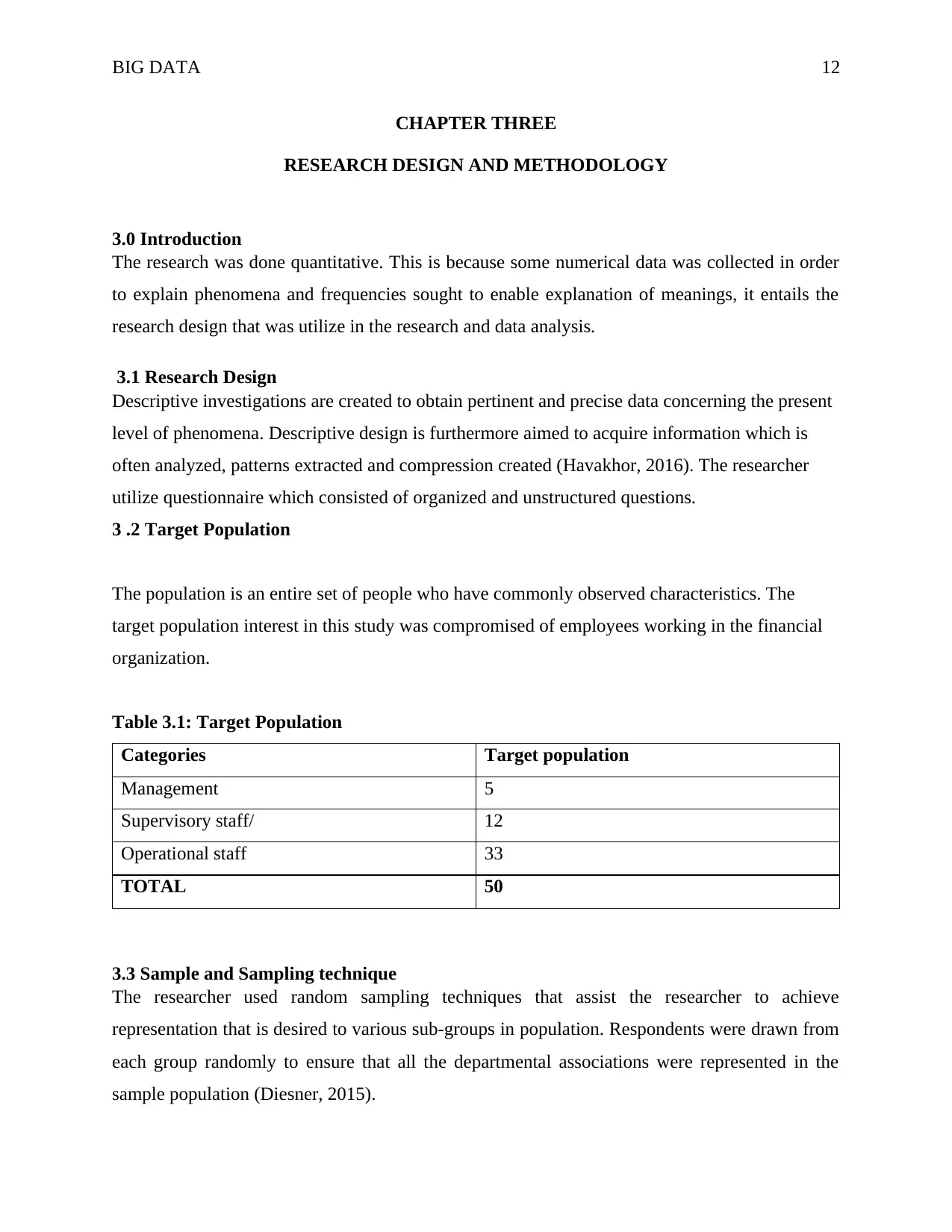
3 .2 Target Population
The population is an entire set of people who have commonly observed characteristics. The
target population interest in this study was compromised of employees working in the financial
organization.
Table 3.1: Target Population
Categories Target population
Management 5
Supervisory staff/ 12
Operational staff 33
TOTAL 50
3.3 Sample and Sampling technique
The researcher used random sampling techniques that assist the researcher to achieve
representation that is desired to various sub-groups in population. Respondents were drawn from
each group randomly to ensure that all the departmental associations were represented in the
sample population (Diesner, 2015).
CHAPTER THREE
RESEARCH DESIGN AND METHODOLOGY
3.0 Introduction
The research was done quantitative. This is because some numerical data was collected in order
to explain phenomena and frequencies sought to enable explanation of meanings, it entails the
research design that was utilize in the research and data analysis.
3.1 Research Design
Descriptive investigations are created to obtain pertinent and precise data concerning the present
level of phenomena. Descriptive design is furthermore aimed to acquire information which is
often analyzed, patterns extracted and compression created (Havakhor, 2016). The researcher
utilize questionnaire which consisted of organized and unstructured questions.
3 .2 Target Population
The population is an entire set of people who have commonly observed characteristics. The
target population interest in this study was compromised of employees working in the financial
organization.
Table 3.1: Target Population
Categories Target population
Management 5
Supervisory staff/ 12
Operational staff 33
TOTAL 50
3.3 Sample and Sampling technique
The researcher used random sampling techniques that assist the researcher to achieve
representation that is desired to various sub-groups in population. Respondents were drawn from
each group randomly to ensure that all the departmental associations were represented in the
sample population (Diesner, 2015).
⊘ This is a preview!⊘
Do you want full access?
Subscribe today to unlock all pages.
Trusted by 1+ million students worldwide

1 out of 21


Related Documents


Your All-in-One AI-Powered Toolkit for Academic Success.
+13062052269
info@desklib.com
Available 24*7 on WhatsApp / Email
![[object Object]](/_next/static/media/star-bottom.7253800d.svg)
Unlock your academic potential
Copyright © 2020–2026 A2Z Services. All Rights Reserved. Developed and managed by ZUCOL.