A Study on the Impact of Poor Recruitment Decisions on Performance
VerifiedAdded on 2020/03/16
|17
|4046
|205
Report
AI Summary
This research report investigates the significant impact of poor recruitment decisions on organizational performance. The study begins with an introduction highlighting the importance of human resources in business development and the critical role of recruitment decisions. It defines the problem, which is the potential for poor recruitment to negatively affect company growth, productivity, and goodwill. The research aims to identify the true impact of poor recruitment decisions and investigate the performance levels of employees hired through this process. The report addresses key research questions, such as whether poor recruitment leads to lower productivity and poor performance, and explores the relationship between poor recruitment and employee performance. Justification for the research is provided, emphasizing the benefits for current and new companies in understanding the consequences of poor recruitment. The research outlines potential outcomes, including a deeper understanding of the issue and strategies for decision-makers. It relies on human capital theory, equity theory, and resource-based view theory. The methodology employs a mixed research design, including both qualitative and quantitative approaches, using exploratory research techniques and secondary information sources like articles, websites, and journals. Primary data collection methods will include questionnaires, interviews, and observations. The report concludes with a project budget, schedule, and Gantt chart to outline the study's timeline and resource allocation.

Running head: RESEARCH IN BUSINESS
IMPACT OF POOR RECRUITMENT DECISION ON ORGANIZATIONAL
PERFORMANCE
IMPACT OF POOR RECRUITMENT DECISION ON ORGANIZATIONAL
PERFORMANCE

Paraphrase This Document
Need a fresh take? Get an instant paraphrase of this document with our AI Paraphraser
RESEARCH IN BUSINESS 2
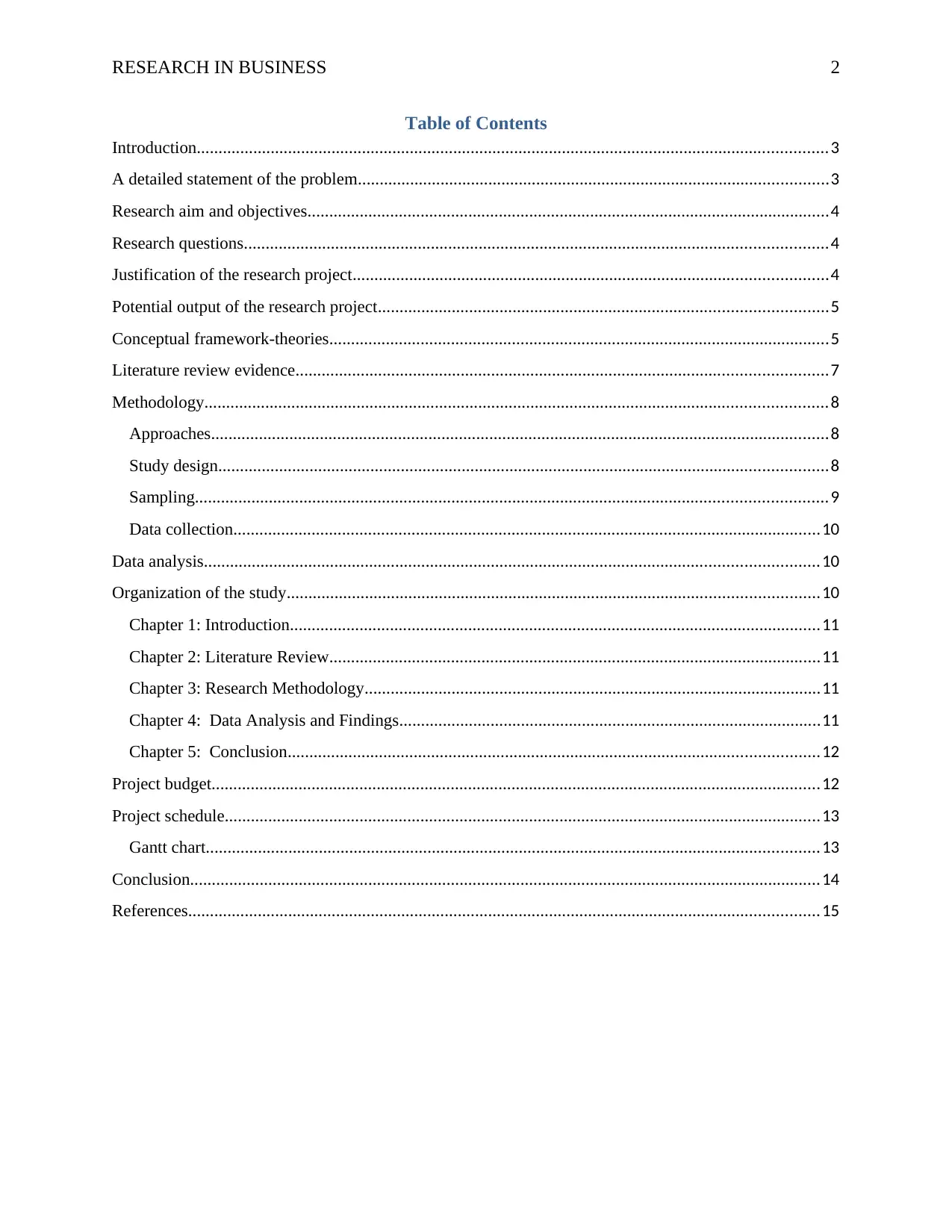
Table of Contents
Introduction.................................................................................................................................................3
A detailed statement of the problem............................................................................................................3
Research aim and objectives........................................................................................................................4
Research questions......................................................................................................................................4
Justification of the research project.............................................................................................................4
Potential output of the research project.......................................................................................................5
Conceptual framework-theories...................................................................................................................5
Literature review evidence..........................................................................................................................7
Methodology...............................................................................................................................................8
Approaches..............................................................................................................................................8
Study design............................................................................................................................................8
Sampling.................................................................................................................................................9
Data collection.......................................................................................................................................10
Data analysis.............................................................................................................................................10
Organization of the study..........................................................................................................................10
Chapter 1: Introduction..........................................................................................................................11
Chapter 2: Literature Review.................................................................................................................11
Chapter 3: Research Methodology.........................................................................................................11
Chapter 4: Data Analysis and Findings.................................................................................................11
Chapter 5: Conclusion..........................................................................................................................12
Project budget............................................................................................................................................12
Project schedule.........................................................................................................................................13
Gantt chart.............................................................................................................................................13
Conclusion.................................................................................................................................................14
References.................................................................................................................................................15
Table of Contents
Introduction.................................................................................................................................................3
A detailed statement of the problem............................................................................................................3
Research aim and objectives........................................................................................................................4
Research questions......................................................................................................................................4
Justification of the research project.............................................................................................................4
Potential output of the research project.......................................................................................................5
Conceptual framework-theories...................................................................................................................5
Literature review evidence..........................................................................................................................7
Methodology...............................................................................................................................................8
Approaches..............................................................................................................................................8
Study design............................................................................................................................................8
Sampling.................................................................................................................................................9
Data collection.......................................................................................................................................10
Data analysis.............................................................................................................................................10
Organization of the study..........................................................................................................................10
Chapter 1: Introduction..........................................................................................................................11
Chapter 2: Literature Review.................................................................................................................11
Chapter 3: Research Methodology.........................................................................................................11
Chapter 4: Data Analysis and Findings.................................................................................................11
Chapter 5: Conclusion..........................................................................................................................12
Project budget............................................................................................................................................12
Project schedule.........................................................................................................................................13
Gantt chart.............................................................................................................................................13
Conclusion.................................................................................................................................................14
References.................................................................................................................................................15
RESEARCH IN BUSINESS 3
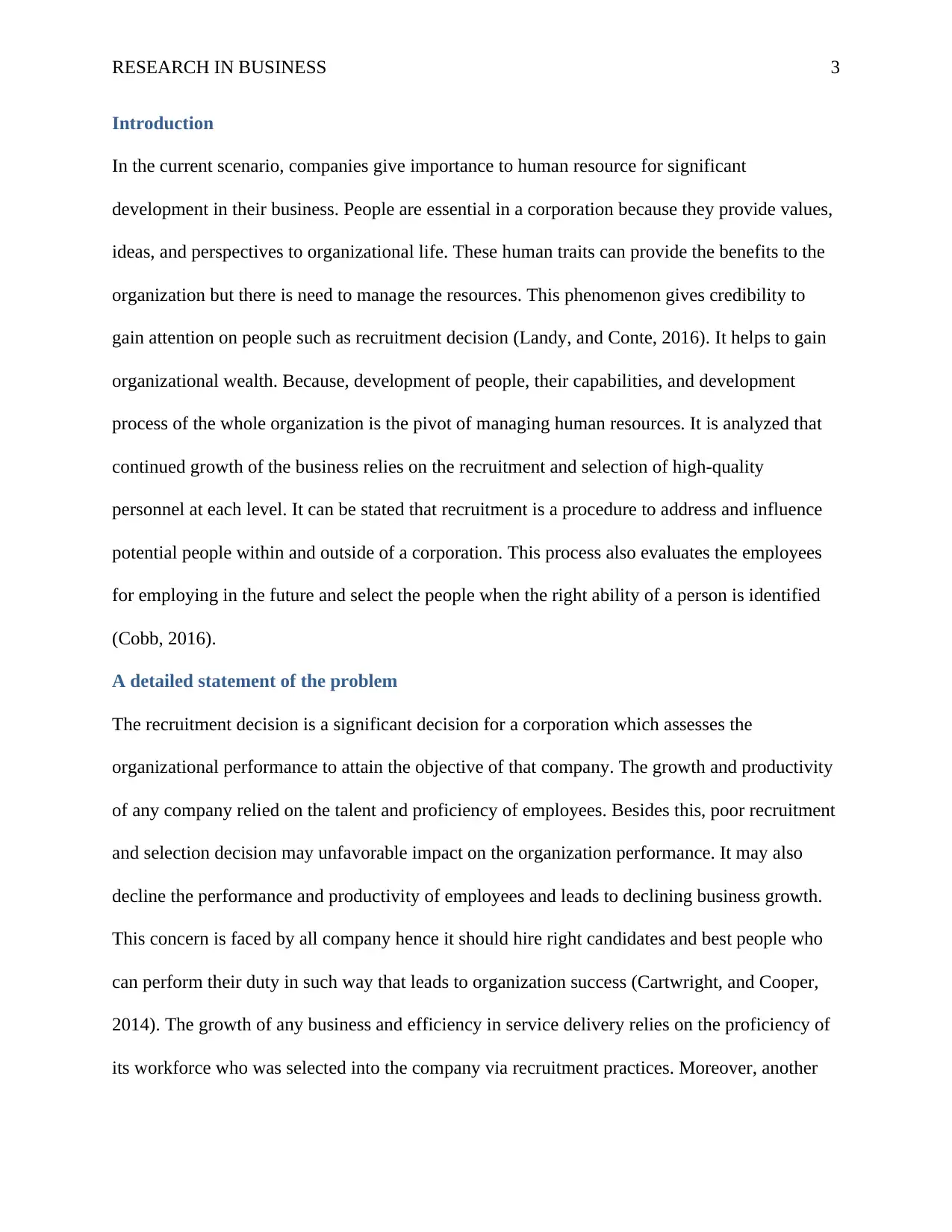
Introduction
In the current scenario, companies give importance to human resource for significant
development in their business. People are essential in a corporation because they provide values,
ideas, and perspectives to organizational life. These human traits can provide the benefits to the
organization but there is need to manage the resources. This phenomenon gives credibility to
gain attention on people such as recruitment decision (Landy, and Conte, 2016). It helps to gain
organizational wealth. Because, development of people, their capabilities, and development
process of the whole organization is the pivot of managing human resources. It is analyzed that
continued growth of the business relies on the recruitment and selection of high-quality
personnel at each level. It can be stated that recruitment is a procedure to address and influence
potential people within and outside of a corporation. This process also evaluates the employees
for employing in the future and select the people when the right ability of a person is identified
(Cobb, 2016).
A detailed statement of the problem
The recruitment decision is a significant decision for a corporation which assesses the
organizational performance to attain the objective of that company. The growth and productivity
of any company relied on the talent and proficiency of employees. Besides this, poor recruitment
and selection decision may unfavorable impact on the organization performance. It may also
decline the performance and productivity of employees and leads to declining business growth.
This concern is faced by all company hence it should hire right candidates and best people who
can perform their duty in such way that leads to organization success (Cartwright, and Cooper,
2014). The growth of any business and efficiency in service delivery relies on the proficiency of
its workforce who was selected into the company via recruitment practices. Moreover, another
Introduction
In the current scenario, companies give importance to human resource for significant
development in their business. People are essential in a corporation because they provide values,
ideas, and perspectives to organizational life. These human traits can provide the benefits to the
organization but there is need to manage the resources. This phenomenon gives credibility to
gain attention on people such as recruitment decision (Landy, and Conte, 2016). It helps to gain
organizational wealth. Because, development of people, their capabilities, and development
process of the whole organization is the pivot of managing human resources. It is analyzed that
continued growth of the business relies on the recruitment and selection of high-quality
personnel at each level. It can be stated that recruitment is a procedure to address and influence
potential people within and outside of a corporation. This process also evaluates the employees
for employing in the future and select the people when the right ability of a person is identified
(Cobb, 2016).
A detailed statement of the problem
The recruitment decision is a significant decision for a corporation which assesses the
organizational performance to attain the objective of that company. The growth and productivity
of any company relied on the talent and proficiency of employees. Besides this, poor recruitment
and selection decision may unfavorable impact on the organization performance. It may also
decline the performance and productivity of employees and leads to declining business growth.
This concern is faced by all company hence it should hire right candidates and best people who
can perform their duty in such way that leads to organization success (Cartwright, and Cooper,
2014). The growth of any business and efficiency in service delivery relies on the proficiency of
its workforce who was selected into the company via recruitment practices. Moreover, another
⊘ This is a preview!⊘
Do you want full access?
Subscribe today to unlock all pages.

Trusted by 1+ million students worldwide
RESEARCH IN BUSINESS 4
thing that each organization should concentrate is goodwill. Since, recruiting poor employees not
only provides low-quality performances but also damage the organization’s goodwill. It is
analyzed that any workforce if he engages in a role even in short time period then it would be
liable for each practice of the organization (Treadway, et. al., 2014). Hence, any bad practices of
employees can reflect the employer of an organization.
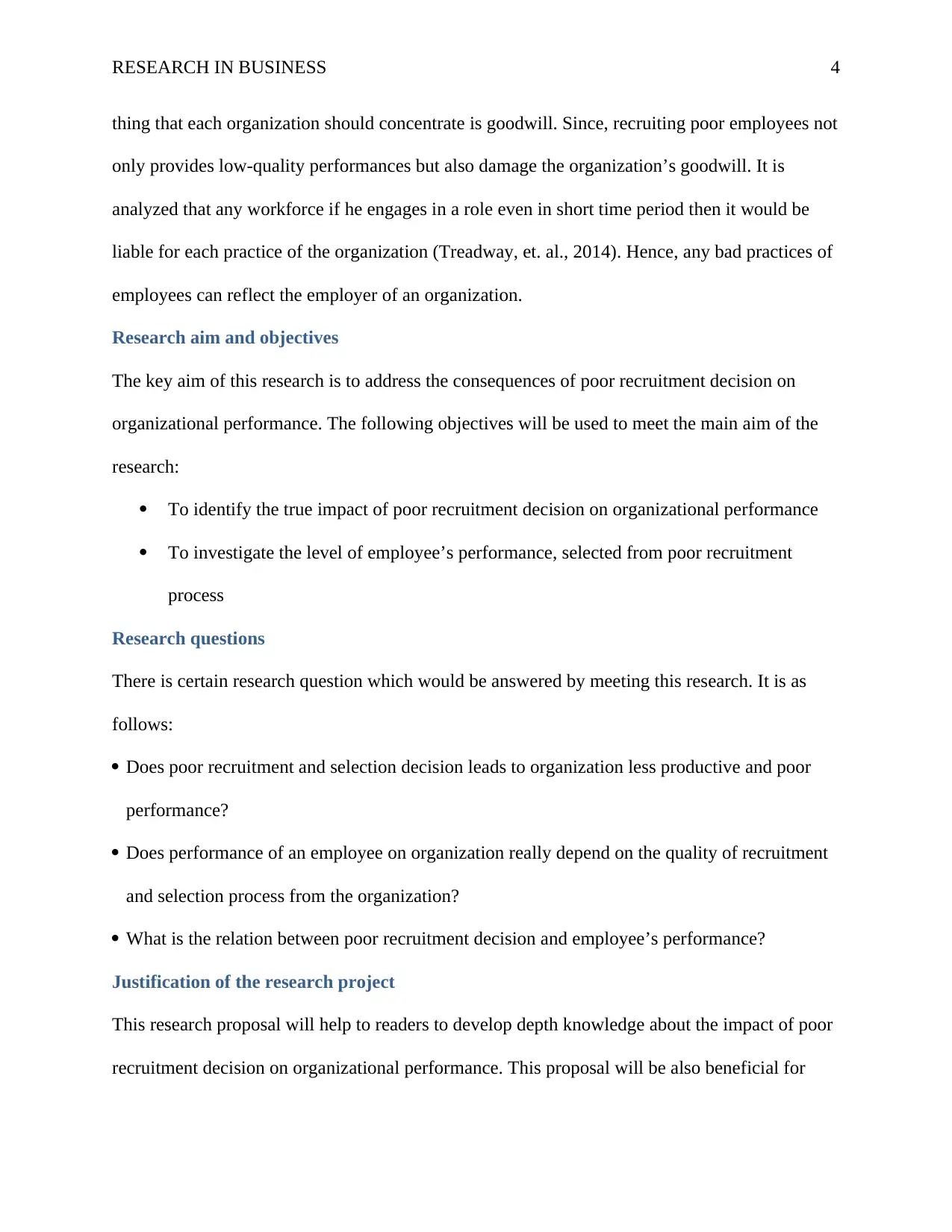
Research aim and objectives
The key aim of this research is to address the consequences of poor recruitment decision on
organizational performance. The following objectives will be used to meet the main aim of the
research:
To identify the true impact of poor recruitment decision on organizational performance
To investigate the level of employee’s performance, selected from poor recruitment
process
Research questions
There is certain research question which would be answered by meeting this research. It is as
follows:
Does poor recruitment and selection decision leads to organization less productive and poor
performance?
Does performance of an employee on organization really depend on the quality of recruitment
and selection process from the organization?
What is the relation between poor recruitment decision and employee’s performance?
Justification of the research project
This research proposal will help to readers to develop depth knowledge about the impact of poor
recruitment decision on organizational performance. This proposal will be also beneficial for
thing that each organization should concentrate is goodwill. Since, recruiting poor employees not
only provides low-quality performances but also damage the organization’s goodwill. It is
analyzed that any workforce if he engages in a role even in short time period then it would be
liable for each practice of the organization (Treadway, et. al., 2014). Hence, any bad practices of
employees can reflect the employer of an organization.
Research aim and objectives
The key aim of this research is to address the consequences of poor recruitment decision on
organizational performance. The following objectives will be used to meet the main aim of the
research:
To identify the true impact of poor recruitment decision on organizational performance
To investigate the level of employee’s performance, selected from poor recruitment
process
Research questions
There is certain research question which would be answered by meeting this research. It is as
follows:
Does poor recruitment and selection decision leads to organization less productive and poor
performance?
Does performance of an employee on organization really depend on the quality of recruitment
and selection process from the organization?
What is the relation between poor recruitment decision and employee’s performance?
Justification of the research project
This research proposal will help to readers to develop depth knowledge about the impact of poor
recruitment decision on organizational performance. This proposal will be also beneficial for
Paraphrase This Document
Need a fresh take? Get an instant paraphrase of this document with our AI Paraphraser
RESEARCH IN BUSINESS 5
current companies and new companies to generate the awareness about the causes, impacts, and
consequences of poor recruitment within an organization. As a result, it would enable the
organization to better prepare and sensible in case recruiting the employees in the future
(Mostafa, and Gould-Williams, 2014). This research will enable policymaker and researcher to
address the appropriate focus areas during the recruitment process.
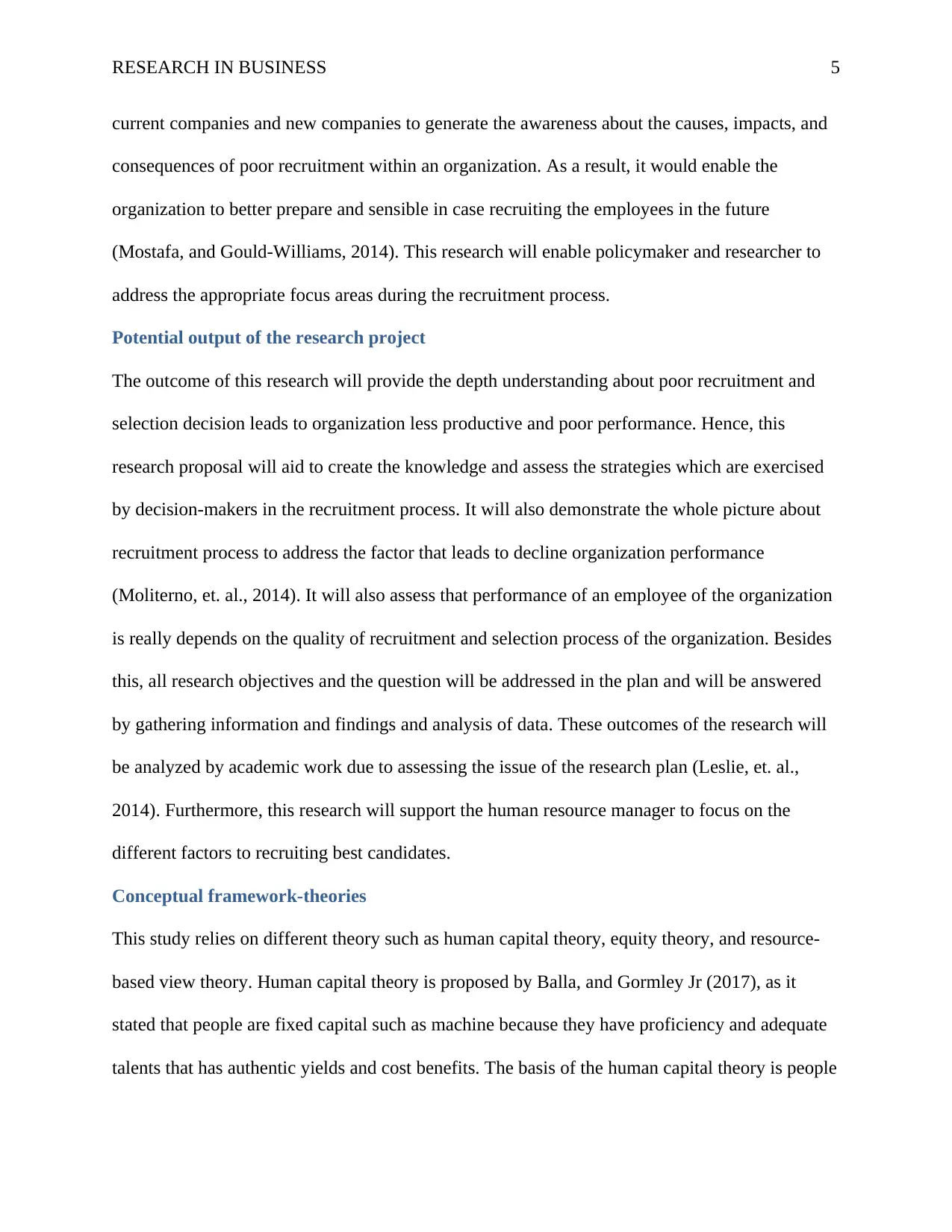
Potential output of the research project
The outcome of this research will provide the depth understanding about poor recruitment and
selection decision leads to organization less productive and poor performance. Hence, this
research proposal will aid to create the knowledge and assess the strategies which are exercised
by decision-makers in the recruitment process. It will also demonstrate the whole picture about
recruitment process to address the factor that leads to decline organization performance
(Moliterno, et. al., 2014). It will also assess that performance of an employee of the organization
is really depends on the quality of recruitment and selection process of the organization. Besides
this, all research objectives and the question will be addressed in the plan and will be answered
by gathering information and findings and analysis of data. These outcomes of the research will
be analyzed by academic work due to assessing the issue of the research plan (Leslie, et. al.,
2014). Furthermore, this research will support the human resource manager to focus on the
different factors to recruiting best candidates.
Conceptual framework-theories
This study relies on different theory such as human capital theory, equity theory, and resource-
based view theory. Human capital theory is proposed by Balla, and Gormley Jr (2017), as it
stated that people are fixed capital such as machine because they have proficiency and adequate
talents that has authentic yields and cost benefits. The basis of the human capital theory is people
current companies and new companies to generate the awareness about the causes, impacts, and
consequences of poor recruitment within an organization. As a result, it would enable the
organization to better prepare and sensible in case recruiting the employees in the future
(Mostafa, and Gould-Williams, 2014). This research will enable policymaker and researcher to
address the appropriate focus areas during the recruitment process.
Potential output of the research project
The outcome of this research will provide the depth understanding about poor recruitment and
selection decision leads to organization less productive and poor performance. Hence, this
research proposal will aid to create the knowledge and assess the strategies which are exercised
by decision-makers in the recruitment process. It will also demonstrate the whole picture about
recruitment process to address the factor that leads to decline organization performance
(Moliterno, et. al., 2014). It will also assess that performance of an employee of the organization
is really depends on the quality of recruitment and selection process of the organization. Besides
this, all research objectives and the question will be addressed in the plan and will be answered
by gathering information and findings and analysis of data. These outcomes of the research will
be analyzed by academic work due to assessing the issue of the research plan (Leslie, et. al.,
2014). Furthermore, this research will support the human resource manager to focus on the
different factors to recruiting best candidates.
Conceptual framework-theories
This study relies on different theory such as human capital theory, equity theory, and resource-
based view theory. Human capital theory is proposed by Balla, and Gormley Jr (2017), as it
stated that people are fixed capital such as machine because they have proficiency and adequate
talents that has authentic yields and cost benefits. The basis of the human capital theory is people
RESEARCH IN BUSINESS 6
which stated that experience, skills, couple, and talents of people are used to organize the
resources within an organization. It is now contributed to the organizational success and also
effective to gain competitive advantages.
According to Gupta and Shaw (2014), resource-based theory evaluates that company can get
sustainable competitive advantages by gathering the effective and efficient human resources.
Since, it cannot be imitated and substituted by key market participants. The company should
constantly assess their workforce to make sure that they have the right people who have right
proficiency and also situated in the right place to make sure sustained competitive advantages. If
a company has not employed right people then it should overcome the shortfalls by occupying
right criteria of recruitment and selection. This theory emphasized that the prime activities and
strength or weakness is originated from occupying the people’s ability and developing quality in
their working practices. Laschinger and Fida (2014) revealed that company which retains and
recruits exceptional individuals may have competencies to obtain the advantage of human
capital. Further, capital and technology can be obtained by a large number of companies at any
time. However, it is complex to obtain a highly proficient and encouraged workforce. Therefore,
the company should careful at the time of recruiting and selecting the employees within an
organization as it must be differentiated to another key market player.
Equity theory is revealed by Sabharwal (2014) as it stated that fundamental principle of equality.
As per this theory, it is analyzed that the best recruitment and selection criteria in an essential for
an organization because it demonstrates the equal opportunity of the employer to find the
competent employees within an organization. This theory also focuses on the challenges that can
be faced an organization on recruiting and selecting the best candidates with the appropriate
skills. Therefore, this theory is effective to attain the goals and objectives of the company.
which stated that experience, skills, couple, and talents of people are used to organize the
resources within an organization. It is now contributed to the organizational success and also
effective to gain competitive advantages.
According to Gupta and Shaw (2014), resource-based theory evaluates that company can get
sustainable competitive advantages by gathering the effective and efficient human resources.
Since, it cannot be imitated and substituted by key market participants. The company should
constantly assess their workforce to make sure that they have the right people who have right
proficiency and also situated in the right place to make sure sustained competitive advantages. If
a company has not employed right people then it should overcome the shortfalls by occupying
right criteria of recruitment and selection. This theory emphasized that the prime activities and
strength or weakness is originated from occupying the people’s ability and developing quality in
their working practices. Laschinger and Fida (2014) revealed that company which retains and
recruits exceptional individuals may have competencies to obtain the advantage of human
capital. Further, capital and technology can be obtained by a large number of companies at any
time. However, it is complex to obtain a highly proficient and encouraged workforce. Therefore,
the company should careful at the time of recruiting and selecting the employees within an
organization as it must be differentiated to another key market player.
Equity theory is revealed by Sabharwal (2014) as it stated that fundamental principle of equality.
As per this theory, it is analyzed that the best recruitment and selection criteria in an essential for
an organization because it demonstrates the equal opportunity of the employer to find the
competent employees within an organization. This theory also focuses on the challenges that can
be faced an organization on recruiting and selecting the best candidates with the appropriate
skills. Therefore, this theory is effective to attain the goals and objectives of the company.
⊘ This is a preview!⊘
Do you want full access?
Subscribe today to unlock all pages.
Trusted by 1+ million students worldwide
RESEARCH IN BUSINESS 7
Shin and Konrad (2017) argued that poor recruitment problem stem due to lack of an organized
method of recruiting and selecting workforces. It also stated that a methodical recruitment
procedure entails job analysis, identifying vacancies, person specification, vacancies, and
advertisement. In opposed to this, the informal procedure of recruiting, and selecting employees
does not entail the effective procedure of recruitment. In the systematic process, organization
gathers the information with respect to qualified applicants and also evaluates the qualification of
each workforce and takes a decision regarding employment.
Literature review evidence
As per view of Katzenbach and Smith (2015), recruitment and selection is an essential function
of human resource management for each type of business. These processes are used to
persuading and selecting the right person for employment. The company heavily relies on both
effectiveness and quality of human resources. Further, recruiting and selecting the wrong people
who are not capable for that position can create huge cost which organization cannot afford.
Therefore, the main aim of selecting and recruiting within an organization is to create the quality
and high amount of workforce. It is also required to accomplish the objectives of an organization
with a minimal cost.
In support to this, Epstein and Buhovac (2014) stated that recruitment is the procedure of
persuading and finding the suitably qualified people to apply for job vacancies within an
organization. It is a set of activities in which an organization makes effort to influence job
candidates who have desired attitudes and abilities. Recruitment is a major component of
recruiting strategies within an organization. This process is used to identify and protect people
who required for a company to exist and achieve the objectives in short to medium term. The key
purpose of recruiting the employees is to pool the appropriate proficient employees hence it
Shin and Konrad (2017) argued that poor recruitment problem stem due to lack of an organized
method of recruiting and selecting workforces. It also stated that a methodical recruitment
procedure entails job analysis, identifying vacancies, person specification, vacancies, and
advertisement. In opposed to this, the informal procedure of recruiting, and selecting employees
does not entail the effective procedure of recruitment. In the systematic process, organization
gathers the information with respect to qualified applicants and also evaluates the qualification of
each workforce and takes a decision regarding employment.
Literature review evidence
As per view of Katzenbach and Smith (2015), recruitment and selection is an essential function
of human resource management for each type of business. These processes are used to
persuading and selecting the right person for employment. The company heavily relies on both
effectiveness and quality of human resources. Further, recruiting and selecting the wrong people
who are not capable for that position can create huge cost which organization cannot afford.
Therefore, the main aim of selecting and recruiting within an organization is to create the quality
and high amount of workforce. It is also required to accomplish the objectives of an organization
with a minimal cost.
In support to this, Epstein and Buhovac (2014) stated that recruitment is the procedure of
persuading and finding the suitably qualified people to apply for job vacancies within an
organization. It is a set of activities in which an organization makes effort to influence job
candidates who have desired attitudes and abilities. Recruitment is a major component of
recruiting strategies within an organization. This process is used to identify and protect people
who required for a company to exist and achieve the objectives in short to medium term. The key
purpose of recruiting the employees is to pool the appropriate proficient employees hence it
Paraphrase This Document
Need a fresh take? Get an instant paraphrase of this document with our AI Paraphraser
RESEARCH IN BUSINESS 8
enables the organization to select the best applicants. This process is also used to persuade a
large number of the workforce to apply within an organization (Certo, 2015). In contrast to this,
the key intention of using selection procedure is to select the best candidates to fill the different
places within a company.
The available evidence demonstrated that there is favorable and essential relationship amid
recruitment and performance of the company. Eesley et al. (2014) discovered a favorable link
between recruitment and business performance. Other studies of Marr (2015) have equally
demonstrated that implementing an effective recruitment is favorably associated with
organizational performance.
Methodology
Approaches
For this research, a researcher will use the inductive approach as compared to deductive
approach because it will allow the researcher to enhance the subjective understanding regarding
research matter. Through this approach, research would be able to improve the validity and
reliability of research outcomes. By using this approach, the researcher will able to gather the
data and build the particular conclusion to describe the impact of poor recruitment on
organizational performance (Parmenter, 2015). In contrast to this, the deductive approach will
not be suitable because researcher will not create any hypothesis to respond the research
questions.
Study design
This research will be attained by using mix research design which contains the characteristics of
both research designs such as qualitative and quantitative. For this researcher issue, exploratory
enables the organization to select the best applicants. This process is also used to persuade a
large number of the workforce to apply within an organization (Certo, 2015). In contrast to this,
the key intention of using selection procedure is to select the best candidates to fill the different
places within a company.
The available evidence demonstrated that there is favorable and essential relationship amid
recruitment and performance of the company. Eesley et al. (2014) discovered a favorable link
between recruitment and business performance. Other studies of Marr (2015) have equally
demonstrated that implementing an effective recruitment is favorably associated with
organizational performance.
Methodology
Approaches
For this research, a researcher will use the inductive approach as compared to deductive
approach because it will allow the researcher to enhance the subjective understanding regarding
research matter. Through this approach, research would be able to improve the validity and
reliability of research outcomes. By using this approach, the researcher will able to gather the
data and build the particular conclusion to describe the impact of poor recruitment on
organizational performance (Parmenter, 2015). In contrast to this, the deductive approach will
not be suitable because researcher will not create any hypothesis to respond the research
questions.
Study design
This research will be attained by using mix research design which contains the characteristics of
both research designs such as qualitative and quantitative. For this researcher issue, exploratory
RESEARCH IN BUSINESS 9
research technique will be used because this research is based on new concepts and ideas
(Swider, et. al., 2015). Following research design will be used by the researcher for this research:
Qualitative research design
Non-numeric data represents the qualitative technique. In this way, a primarily qualitative
method is an exploratory method. It will be beneficial to assess the entire factors which are
intangible. This will be used to increase the knowledge regarding emotions, opinions,
unexpressed reasons, and feeling of people (Newman, et. al., 2015).
Quantitative research design
The quantitative method of research shows the all numeric information which can convert into
usable statistics and facts. Information will be collected from a different organization which
consulting with the HR department, manager, and employees who are placed in human resource
management of the organization (Swider, et. al., 2015).
For this research, researchers will also use the secondary information to meet the research
objectives. In this way, researchers will use different sources like articles, websites, books,
academic publications, journal, and online and offline resources. Along with this, for primary
data collection, researchers will use different methods like questionnaire, interview, sampling
and observation (Parmenter, 2015).
Sampling
For this research, probability sampling technique will be used by the researcher. In this way,
random sampling method will be used by researchers to select the participants as per the random
basis. This random sampling method will be used because it facilitates the equal opportunity to
each respondent. Therefore, it reduces the chances of partiality from survey through a
questionnaire. For conducting the survey through a questionnaire, 50 employees are selected who
research technique will be used because this research is based on new concepts and ideas
(Swider, et. al., 2015). Following research design will be used by the researcher for this research:
Qualitative research design
Non-numeric data represents the qualitative technique. In this way, a primarily qualitative
method is an exploratory method. It will be beneficial to assess the entire factors which are
intangible. This will be used to increase the knowledge regarding emotions, opinions,
unexpressed reasons, and feeling of people (Newman, et. al., 2015).
Quantitative research design
The quantitative method of research shows the all numeric information which can convert into
usable statistics and facts. Information will be collected from a different organization which
consulting with the HR department, manager, and employees who are placed in human resource
management of the organization (Swider, et. al., 2015).
For this research, researchers will also use the secondary information to meet the research
objectives. In this way, researchers will use different sources like articles, websites, books,
academic publications, journal, and online and offline resources. Along with this, for primary
data collection, researchers will use different methods like questionnaire, interview, sampling
and observation (Parmenter, 2015).
Sampling
For this research, probability sampling technique will be used by the researcher. In this way,
random sampling method will be used by researchers to select the participants as per the random
basis. This random sampling method will be used because it facilitates the equal opportunity to
each respondent. Therefore, it reduces the chances of partiality from survey through a
questionnaire. For conducting the survey through a questionnaire, 50 employees are selected who
⊘ This is a preview!⊘
Do you want full access?
Subscribe today to unlock all pages.
Trusted by 1+ million students worldwide
RESEARCH IN BUSINESS 10
are in human resource management of different Australian companies like Woolworths,
Wesfarmers and Tesco (Eesley, et. al., 2014).
Data collection
For conducting this research, researchers will use data collection method as it will allow them to
meet the research gap between actual information and standard information. Along with this,
primary data will be collected by a researcher via survey through a questionnaire with the
specified participants. This method would be beneficial to attain the reliable and valid data about
the research issue. Besides this, the researcher will use secondary information from different
sources like a journal articles, annual reports, online sources, authentic websites and academic
publication. This method will be beneficial to gather authentic information with less time and
cost (Certo, 2015).
Data analysis
Data analysis is a significant part of research methodology because it provides the consistent and
appropriate result. It is a procedure of pertaining logical method to discuss and assess
information. For conducting this research, statistical data analysis will be used by researchers to
determine the gathered data and interpret them in a comprehensive way. Moreover, the
researcher will exercise the MS-excel software to present the data via using different bar
diagram, pie chart and column graph (Epstein, and Buhovac, 2014). As a result, it will be
beneficial for readers to create an inclusive knowledge regarding research issue.
Organization of the study
The following framework will be used to complete the research in a specified time period:
are in human resource management of different Australian companies like Woolworths,
Wesfarmers and Tesco (Eesley, et. al., 2014).
Data collection
For conducting this research, researchers will use data collection method as it will allow them to
meet the research gap between actual information and standard information. Along with this,
primary data will be collected by a researcher via survey through a questionnaire with the
specified participants. This method would be beneficial to attain the reliable and valid data about
the research issue. Besides this, the researcher will use secondary information from different
sources like a journal articles, annual reports, online sources, authentic websites and academic
publication. This method will be beneficial to gather authentic information with less time and
cost (Certo, 2015).
Data analysis
Data analysis is a significant part of research methodology because it provides the consistent and
appropriate result. It is a procedure of pertaining logical method to discuss and assess
information. For conducting this research, statistical data analysis will be used by researchers to
determine the gathered data and interpret them in a comprehensive way. Moreover, the
researcher will exercise the MS-excel software to present the data via using different bar
diagram, pie chart and column graph (Epstein, and Buhovac, 2014). As a result, it will be
beneficial for readers to create an inclusive knowledge regarding research issue.
Organization of the study
The following framework will be used to complete the research in a specified time period:
Paraphrase This Document
Need a fresh take? Get an instant paraphrase of this document with our AI Paraphraser
RESEARCH IN BUSINESS 11
Chapter 1: Introduction
This is the first chapter which will be essential for attaining the research objectives because it
explains distinct components which will be required for this research. These components are
research background, justification of the study, research aim and objectives and research
question (Shin, and Konrad, 2017).
Chapter 2: Literature Review
This is a second chapter which is significant to understand that poor recruitment and selection
decision does lead to organization less productive and poor performance. It is also essential to
gain depth understanding about the performance of an employee on an organization does really
depend on the quality of recruitment and selection process from the organization. It is a vital tool
which defines the relation between poor recruitment decision and employee’s performance
(Katzenbach, and Smith, 2015).
Chapter 3: Research Methodology
This part will aid the researcher to assess the tools that will be required to gather the reliable data
and analyze the facts and figures. Besides this, it can be evaluated that analyzed information will
be beneficial to attain the valid result within specified budget and time schedule (Laschinger, and
Fida, 2014).
Chapter 4: Data Analysis and Findings
The fourth chapter will use by the researcher to demonstrate, evaluate and describe the collected
secondary information. It facilitates the effective results with respect the research objectives
Chapter 1: Introduction
This is the first chapter which will be essential for attaining the research objectives because it
explains distinct components which will be required for this research. These components are
research background, justification of the study, research aim and objectives and research
question (Shin, and Konrad, 2017).
Chapter 2: Literature Review
This is a second chapter which is significant to understand that poor recruitment and selection
decision does lead to organization less productive and poor performance. It is also essential to
gain depth understanding about the performance of an employee on an organization does really
depend on the quality of recruitment and selection process from the organization. It is a vital tool
which defines the relation between poor recruitment decision and employee’s performance
(Katzenbach, and Smith, 2015).
Chapter 3: Research Methodology
This part will aid the researcher to assess the tools that will be required to gather the reliable data
and analyze the facts and figures. Besides this, it can be evaluated that analyzed information will
be beneficial to attain the valid result within specified budget and time schedule (Laschinger, and
Fida, 2014).
Chapter 4: Data Analysis and Findings
The fourth chapter will use by the researcher to demonstrate, evaluate and describe the collected
secondary information. It facilitates the effective results with respect the research objectives
RESEARCH IN BUSINESS 12
Chapter 5: Conclusion
The fifth chapter is the last section which depicts the summary of entire information which will
rely on research objective. After that, it provides the recommendation associated with upcoming
issues (Sabharwal, 2014).
Project budget
The budget for this research will be about AUS$ 1600 to attain the research objectives within
given time period that is specified in the project schedule.
The project budget will be included following research components:
For completing the literature review, different secondary sources will be used such as
academic journals, course book, online resources, and editorial which cannot be assessed
without paying the charge. Hence, the researcher should approximately AUS$ 600 to pay
for purchasing these resources (Gupta, and Shaw, 2014).
Data gathering is the significant source to collect the data about research issue. Hence,
there will be approximately AUS$500 to purchase case study from different authors and
organizations. Since, it is a significant approach for gathering data from different
companies about the impact of poor recruitment on organizational performance (Leslie,
et. al., 2014).
To create graphs, tables, and administration data for research issue, the cost of the
financial plan to be paid approximately AUS$500.
In outline,
Activities
Expected Amount to be Spent in
AUS$
Literature Review 600
Chapter 5: Conclusion
The fifth chapter is the last section which depicts the summary of entire information which will
rely on research objective. After that, it provides the recommendation associated with upcoming
issues (Sabharwal, 2014).
Project budget
The budget for this research will be about AUS$ 1600 to attain the research objectives within
given time period that is specified in the project schedule.
The project budget will be included following research components:
For completing the literature review, different secondary sources will be used such as
academic journals, course book, online resources, and editorial which cannot be assessed
without paying the charge. Hence, the researcher should approximately AUS$ 600 to pay
for purchasing these resources (Gupta, and Shaw, 2014).
Data gathering is the significant source to collect the data about research issue. Hence,
there will be approximately AUS$500 to purchase case study from different authors and
organizations. Since, it is a significant approach for gathering data from different
companies about the impact of poor recruitment on organizational performance (Leslie,
et. al., 2014).
To create graphs, tables, and administration data for research issue, the cost of the
financial plan to be paid approximately AUS$500.
In outline,
Activities
Expected Amount to be Spent in
AUS$
Literature Review 600
⊘ This is a preview!⊘
Do you want full access?
Subscribe today to unlock all pages.
Trusted by 1+ million students worldwide

1 out of 17


Related Documents


Your All-in-One AI-Powered Toolkit for Academic Success.
+13062052269
info@desklib.com
Available 24*7 on WhatsApp / Email
![[object Object]](/_next/static/media/star-bottom.7253800d.svg)
Unlock your academic potential
Copyright © 2020–2026 A2Z Services. All Rights Reserved. Developed and managed by ZUCOL.