Zara Case Study: Product and Market Development on Performance
VerifiedAdded on 2020/11/12
|35
|5102
|291
Report
AI Summary
This report provides a comprehensive analysis of the impact of product and market development on the business performance of Zara, a global fashion retailer. The study begins with an introduction outlining the research aim, objectives, and questions, followed by a review of relevant literature on product development, market strategies, and their effects on business outcomes. The research employs both primary and secondary data collection methods, including a survey of Zara managers to gather insights into their perspectives on product development strategies, market development influence, and the challenges faced. The data analysis section presents the findings from the primary research, highlighting key themes such as the impact of product development on customer satisfaction, the influence of market development on business performance, and the elements required for an effective product development strategy. The report concludes with recommendations for Zara, focusing on areas for improvement in product and market development, and a summary of the key findings and implications for the company's future strategies.
To Examine the impact of product
and development on business
performance- A case study on
ZARA
and development on business
performance- A case study on
ZARA

Paraphrase This Document
Need a fresh take? Get an instant paraphrase of this document with our AI Paraphraser
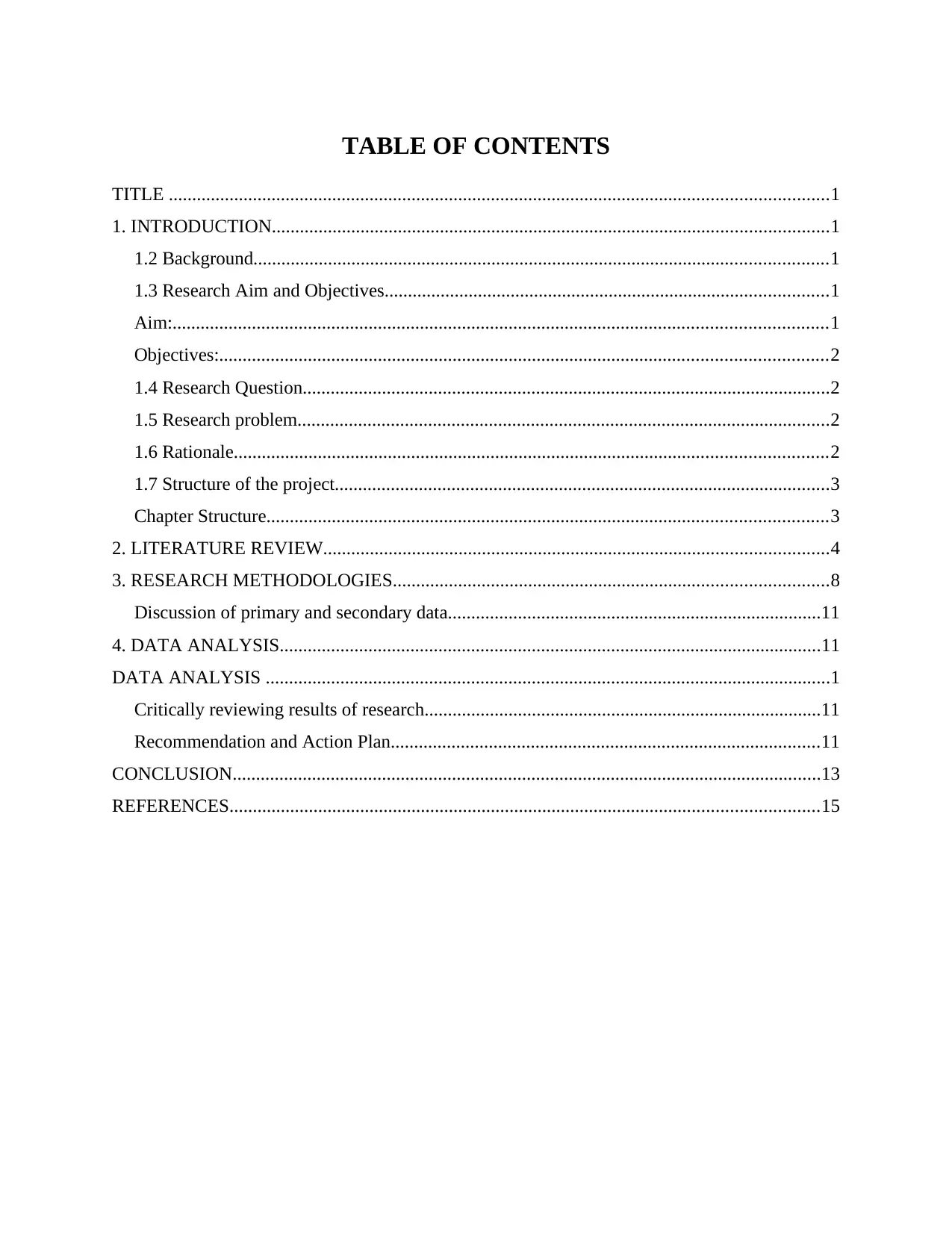
TABLE OF CONTENTS
TITLE .............................................................................................................................................1
1. INTRODUCTION.......................................................................................................................1
1.2 Background...........................................................................................................................1
1.3 Research Aim and Objectives...............................................................................................1
Aim:............................................................................................................................................1
Objectives:..................................................................................................................................2
1.4 Research Question.................................................................................................................2
1.5 Research problem..................................................................................................................2
1.6 Rationale...............................................................................................................................2
1.7 Structure of the project..........................................................................................................3
Chapter Structure........................................................................................................................3
2. LITERATURE REVIEW............................................................................................................4
3. RESEARCH METHODOLOGIES.............................................................................................8
Discussion of primary and secondary data................................................................................11
4. DATA ANALYSIS....................................................................................................................11
DATA ANALYSIS .........................................................................................................................1
Critically reviewing results of research.....................................................................................11
Recommendation and Action Plan............................................................................................11
CONCLUSION..............................................................................................................................13
REFERENCES..............................................................................................................................15
TITLE .............................................................................................................................................1
1. INTRODUCTION.......................................................................................................................1
1.2 Background...........................................................................................................................1
1.3 Research Aim and Objectives...............................................................................................1
Aim:............................................................................................................................................1
Objectives:..................................................................................................................................2
1.4 Research Question.................................................................................................................2
1.5 Research problem..................................................................................................................2
1.6 Rationale...............................................................................................................................2
1.7 Structure of the project..........................................................................................................3
Chapter Structure........................................................................................................................3
2. LITERATURE REVIEW............................................................................................................4
3. RESEARCH METHODOLOGIES.............................................................................................8
Discussion of primary and secondary data................................................................................11
4. DATA ANALYSIS....................................................................................................................11
DATA ANALYSIS .........................................................................................................................1
Critically reviewing results of research.....................................................................................11
Recommendation and Action Plan............................................................................................11
CONCLUSION..............................................................................................................................13
REFERENCES..............................................................................................................................15
TITLE
“To Examine the impact of product and development on business performance- A case study on
ZARA”
1. INTRODUCTION
Product and market development strategies are to be implemented so that business may
be able to attain enhanced business performance. It is quite important for business in attainment
of desired objectives of business. For the present research report, ZARA is been chosen as
organisation of context. It is a Spain based fashion enterprise, operating worldwide, including
UK. Report will examine impact of product and market development on business performance in
effective manner. Suitable business proposal is been presented along with the reviews of
literature and assessment of primary and secondary data collection. Other than this, proper
research is carried out with presentation of suitable outcomes and appropriate recommendation
and action plan is presented to improve understanding about the product and market
development in ZARA.
1.2 Background
Research study is quite important for meeting the ideas of research for which it is
intended in a better manner. The product development strategy is used for creating fresh goods in
the market so that customers may be attracted quite easily. It is needed that product development
and its impact may be evaluated beforehand so that no issues arise in the future (Tsai and Yang,
2013). On the other hand, market development is another strategy adopted by organization for
developing new segments of market for current products sold by company. Present study deals
with examining impact of these two strategies on performance of ZARA in effective manner.
Besides this, appropriate market analysis and identification of consumer preference with current
market trends are been analyzed for framing a proper strategy so that organization may be able to
attain desired performance.
1.3 Research Aim and Objectives
Aim:
“To Examine the impact of product and development on business performance- A case
study on ZARA”
M
A
N
A
G
E
R
S
“To Examine the impact of product and development on business performance- A case study on
ZARA”
1. INTRODUCTION
Product and market development strategies are to be implemented so that business may
be able to attain enhanced business performance. It is quite important for business in attainment
of desired objectives of business. For the present research report, ZARA is been chosen as
organisation of context. It is a Spain based fashion enterprise, operating worldwide, including
UK. Report will examine impact of product and market development on business performance in
effective manner. Suitable business proposal is been presented along with the reviews of
literature and assessment of primary and secondary data collection. Other than this, proper
research is carried out with presentation of suitable outcomes and appropriate recommendation
and action plan is presented to improve understanding about the product and market
development in ZARA.
1.2 Background
Research study is quite important for meeting the ideas of research for which it is
intended in a better manner. The product development strategy is used for creating fresh goods in
the market so that customers may be attracted quite easily. It is needed that product development
and its impact may be evaluated beforehand so that no issues arise in the future (Tsai and Yang,
2013). On the other hand, market development is another strategy adopted by organization for
developing new segments of market for current products sold by company. Present study deals
with examining impact of these two strategies on performance of ZARA in effective manner.
Besides this, appropriate market analysis and identification of consumer preference with current
market trends are been analyzed for framing a proper strategy so that organization may be able to
attain desired performance.
1.3 Research Aim and Objectives
Aim:
“To Examine the impact of product and development on business performance- A case
study on ZARA”
M
A
N
A
G
E
R
S
⊘ This is a preview!⊘
Do you want full access?
Subscribe today to unlock all pages.

Trusted by 1+ million students worldwide
Objectives:
To assess the ongoing trend prevailing in retail sector
To analyze effect of product and market development on ZARA
To examine impact of product and market development on performance of ZARA
To propose improvements to product and market development to ZARA
1.4 Research Question
Q1. What are the requirement of product and market development in business activities and
responsibilities of professionals?
Q2. What are the factors of product and market development that impacts ZARA?
Q3. How to develop an internal adaptive management for initiating smooth development of
market and product for ZARA?
1.5 Research problem
The research issues can be highlighted which is being faced by ZARA in implementing
appropriate strategies for product and market development. It is required that products being sold
in the current market are becoming less popular and needs to maintain better strategies. The
customer expectations are also not met according to current product line. Moreover, implication
of several techniques have been made for enhancing overall business performance.
1.6 Rationale
What
The competition in the marketplace is increasing day-by-day. For outreaching rivalries,
ZARA is required for developing product and market development strategy so that business may
be able to increase its customer base. This will automatically enhance business performance in a
better manner. Proper formulation of strategies are to made so that high quality fashion apparels
may be sold to them in effective manner.
Why
The research study will be used to get appropriate idea about strategies to be taken by
company in terms of market and product development in a better manner. Assessment of issues
being faced by ZARA in terms of market and product development needs to be taken into
account. The research will help company to enhance its performance by formulating strategy and
attain adequate profits.
2
To assess the ongoing trend prevailing in retail sector
To analyze effect of product and market development on ZARA
To examine impact of product and market development on performance of ZARA
To propose improvements to product and market development to ZARA
1.4 Research Question
Q1. What are the requirement of product and market development in business activities and
responsibilities of professionals?
Q2. What are the factors of product and market development that impacts ZARA?
Q3. How to develop an internal adaptive management for initiating smooth development of
market and product for ZARA?
1.5 Research problem
The research issues can be highlighted which is being faced by ZARA in implementing
appropriate strategies for product and market development. It is required that products being sold
in the current market are becoming less popular and needs to maintain better strategies. The
customer expectations are also not met according to current product line. Moreover, implication
of several techniques have been made for enhancing overall business performance.
1.6 Rationale
What
The competition in the marketplace is increasing day-by-day. For outreaching rivalries,
ZARA is required for developing product and market development strategy so that business may
be able to increase its customer base. This will automatically enhance business performance in a
better manner. Proper formulation of strategies are to made so that high quality fashion apparels
may be sold to them in effective manner.
Why
The research study will be used to get appropriate idea about strategies to be taken by
company in terms of market and product development in a better manner. Assessment of issues
being faced by ZARA in terms of market and product development needs to be taken into
account. The research will help company to enhance its performance by formulating strategy and
attain adequate profits.
2
Paraphrase This Document
Need a fresh take? Get an instant paraphrase of this document with our AI Paraphraser
How
Extensive research will be carried out that will assist ZARA in meeting profits in a better
manner. Furthermore, it will have immense benefits to company as product line will be
revamped. It will also help company in meeting its objectives in effective manner. Thus, by
applying appropriate research methodologies and analytical tools, research will be conducted.
1.7 Structure of the project
Chapter Structure
Chapter 1. Introduction:
This chapter is based on outlining the overview of the study as well as topic. In this
chapter researcher focus on developing a brief understanding of topic of the research. Aims,
objectives and research questions are also formed in this chapter. Further, reason for choosing
the impacts of Research and development in formulating business strategy is the topic also
specified in this chapter.
Chapter 2. Literature Review:
This is the second chapter of the dissertation where the discussion of secondary facts as
well as findings which are gathered by several researchers or scholars. The entire discussion is
based on the different books, journals, articles, blogs and other valid and authentic sources.
Chapter 3. Research Methodology:
This is the third chapter that is based on the implication of research tools. These research
tools assist scholar in collecting, analysing and interpreting data. The reason for selecting the
methods of research methodologies is also explained in this chapter. With the help of research
methods, it becomes easy for researcher to achieve the aims and objectives of the study.
Chapter 4:
Data Analysis and Interpretation: This chapter is based on the data collected by the
researcher where the researcher will collect information from various primary sources by
preparing questionnaire.
Chapter 5: Conclusion and Recommendation:
This chapter is the summary of whole study that assist in valuing information which are
collected by researcher. Scholar will also provide recommendations and advise to the company
3
Extensive research will be carried out that will assist ZARA in meeting profits in a better
manner. Furthermore, it will have immense benefits to company as product line will be
revamped. It will also help company in meeting its objectives in effective manner. Thus, by
applying appropriate research methodologies and analytical tools, research will be conducted.
1.7 Structure of the project
Chapter Structure
Chapter 1. Introduction:
This chapter is based on outlining the overview of the study as well as topic. In this
chapter researcher focus on developing a brief understanding of topic of the research. Aims,
objectives and research questions are also formed in this chapter. Further, reason for choosing
the impacts of Research and development in formulating business strategy is the topic also
specified in this chapter.
Chapter 2. Literature Review:
This is the second chapter of the dissertation where the discussion of secondary facts as
well as findings which are gathered by several researchers or scholars. The entire discussion is
based on the different books, journals, articles, blogs and other valid and authentic sources.
Chapter 3. Research Methodology:
This is the third chapter that is based on the implication of research tools. These research
tools assist scholar in collecting, analysing and interpreting data. The reason for selecting the
methods of research methodologies is also explained in this chapter. With the help of research
methods, it becomes easy for researcher to achieve the aims and objectives of the study.
Chapter 4:
Data Analysis and Interpretation: This chapter is based on the data collected by the
researcher where the researcher will collect information from various primary sources by
preparing questionnaire.
Chapter 5: Conclusion and Recommendation:
This chapter is the summary of whole study that assist in valuing information which are
collected by researcher. Scholar will also provide recommendations and advise to the company
3
behalf of the topic. The conclusion will be descriptive on the basis of all chapters which will
make clear assumption of over every information collected and analyses.
Timeline
Activities Week
1
Week
2
Week
3
Week
4
Week
5
Week
6
Week
7
Week
8
Week
9
Week 10
Research proposal
Aims and
objectives
Literature review
Research
methodologies
Data collection
Data analysis
Data interpretation
Finding and
conclusion
Recommendations
Execute the plan
Submission
2. LITERATURE REVIEW
2.1 Introduction
The review of literature is required to be done so that existing knowledge or theory can
be utilised for making pathway of ideas in a better manner. The product and market development
both are crucial for business performance and have large impact on it. In relation to this, existing
4
make clear assumption of over every information collected and analyses.
Timeline
Activities Week
1
Week
2
Week
3
Week
4
Week
5
Week
6
Week
7
Week
8
Week
9
Week 10
Research proposal
Aims and
objectives
Literature review
Research
methodologies
Data collection
Data analysis
Data interpretation
Finding and
conclusion
Recommendations
Execute the plan
Submission
2. LITERATURE REVIEW
2.1 Introduction
The review of literature is required to be done so that existing knowledge or theory can
be utilised for making pathway of ideas in a better manner. The product and market development
both are crucial for business performance and have large impact on it. In relation to this, existing
4
⊘ This is a preview!⊘
Do you want full access?
Subscribe today to unlock all pages.
Trusted by 1+ million students worldwide
theory in practice can be identified and review can be done in effective way. The literature is
summarised below with reference to listed objectives-
2.2 Product and Market Development
As per the views of Boons and et.al. (2013), product life cycle is a stage where
product goes from the introductory stage to the growth, then maturity stage is accomplished
and lastly product declines. The introduction stage is where heavy expenses are incurred for
getting products in the market and limited distributions levels prevail. In the growth stage,
consumer knowledge towards organization increases and this leads to increase in sales.
Maturity stage arrives where sales and profits reach at their peak point and customers are
lured towards product by modifying commodities as per their needs. Next stage arises of
decline where sales constantly falls for the company and for maintaining sales, profit margin
has to be cut down.
In contrast to this, Durmuşoğlu and Barczak (2011) firm is required to make product
and market development strategy by implementing the Ansoff Matrix which helps to decide
business upon their product and market growth strategy in a better manner. The market
penetration, market development, product development and diversification are four grids of
the matrix that helps business to focus on product and market in the best manner possible
that increases its performance (B2B Product/Market Growth. 2018). Market penetration
means to penetrate existing products in the current market by enlarging share of current
products. This enhances company's profits up to a major extent leading to incorporate better
pricing strategies for attracting customers. Market development is termed as a strategy for
getting into new market to sell existing products in order to develop more market share of
the product. This means that by selling current successful products to new markets,
organization becomes able to grab new share.
Morgan (2012) argues that product development is selling new products to existing
markets in order to replace existing ones. The products are then sold to existing customers.
It is a strategy where corporate adopts a strategy to replace existing products which have
reached decline stage. Innovatory commodities enhances customer satisfaction and they are
attracted to buy the same. Diversification is a growth strategy where organization sells
5
summarised below with reference to listed objectives-
2.2 Product and Market Development
As per the views of Boons and et.al. (2013), product life cycle is a stage where
product goes from the introductory stage to the growth, then maturity stage is accomplished
and lastly product declines. The introduction stage is where heavy expenses are incurred for
getting products in the market and limited distributions levels prevail. In the growth stage,
consumer knowledge towards organization increases and this leads to increase in sales.
Maturity stage arrives where sales and profits reach at their peak point and customers are
lured towards product by modifying commodities as per their needs. Next stage arises of
decline where sales constantly falls for the company and for maintaining sales, profit margin
has to be cut down.
In contrast to this, Durmuşoğlu and Barczak (2011) firm is required to make product
and market development strategy by implementing the Ansoff Matrix which helps to decide
business upon their product and market growth strategy in a better manner. The market
penetration, market development, product development and diversification are four grids of
the matrix that helps business to focus on product and market in the best manner possible
that increases its performance (B2B Product/Market Growth. 2018). Market penetration
means to penetrate existing products in the current market by enlarging share of current
products. This enhances company's profits up to a major extent leading to incorporate better
pricing strategies for attracting customers. Market development is termed as a strategy for
getting into new market to sell existing products in order to develop more market share of
the product. This means that by selling current successful products to new markets,
organization becomes able to grab new share.
Morgan (2012) argues that product development is selling new products to existing
markets in order to replace existing ones. The products are then sold to existing customers.
It is a strategy where corporate adopts a strategy to replace existing products which have
reached decline stage. Innovatory commodities enhances customer satisfaction and they are
attracted to buy the same. Diversification is a growth strategy where organization sells
5
Paraphrase This Document
Need a fresh take? Get an instant paraphrase of this document with our AI Paraphraser
completely new products to new customers. Through diversification strategy, new market
share can be developed but requires thorough market research for making it successful.
Jasra and et.al. (2011) says that Boston Consulting Group (BCG) matrix is useful for
organization for identifying their product line in a better manner. It is divided into four
elements such as stars, cash cows, dogs and question marks. The star products have rapid
growth and good potential in the market for the company. Lot of income is also generated
by stars in company quite effectually due to greater market share. Cash cows have less
competitive pressures with low market share and maintaining some dominant position in the
market. Dogs are classified as weakest share in the market and low growth market as well.
Products are making a loss and has an adverse impact on management time resources. The
question marks arises when commodities are in a high growth market but does not seem to
have good market share. Products like this needs more investment for making them attain
better approach from customers.
2.3 Business Performance
According to Rodríguez-Pinto, Carbonell and Rodríguez-Escudero (2011), business
performance can be encouraged by making better approach to the customers so that it may
become successful in the market. The performance should be measured in a better manner
which helps organization to take into account inefficiencies if any so that it can be removed
and performance could be improved. The performance of the business can be enhanced by
incorporating theory of performance management. The balanced scorecard is one of the
crucial performance measurement tool used for managing implementation of corporate
strategies. Balanced scorecard lies on four perspectives such as financial, customers,
internal business processes and learning and growth.
As per the Chen and Chang (2013), financial perspective measures use of financial
resources made by company and also whether financial performance of company is adequate
or not. The customer perspective views organizational performance with reference to point
of view of stakeholders or customers of the firm. Internal process refers to analyze quality
and efficiency of products or key business processes which provides output to company.
Learning and growth refers to human capital, infrastructure, culture and technology to
enhance overall performance of business in the best manner possible. This means that with
6
share can be developed but requires thorough market research for making it successful.
Jasra and et.al. (2011) says that Boston Consulting Group (BCG) matrix is useful for
organization for identifying their product line in a better manner. It is divided into four
elements such as stars, cash cows, dogs and question marks. The star products have rapid
growth and good potential in the market for the company. Lot of income is also generated
by stars in company quite effectually due to greater market share. Cash cows have less
competitive pressures with low market share and maintaining some dominant position in the
market. Dogs are classified as weakest share in the market and low growth market as well.
Products are making a loss and has an adverse impact on management time resources. The
question marks arises when commodities are in a high growth market but does not seem to
have good market share. Products like this needs more investment for making them attain
better approach from customers.
2.3 Business Performance
According to Rodríguez-Pinto, Carbonell and Rodríguez-Escudero (2011), business
performance can be encouraged by making better approach to the customers so that it may
become successful in the market. The performance should be measured in a better manner
which helps organization to take into account inefficiencies if any so that it can be removed
and performance could be improved. The performance of the business can be enhanced by
incorporating theory of performance management. The balanced scorecard is one of the
crucial performance measurement tool used for managing implementation of corporate
strategies. Balanced scorecard lies on four perspectives such as financial, customers,
internal business processes and learning and growth.
As per the Chen and Chang (2013), financial perspective measures use of financial
resources made by company and also whether financial performance of company is adequate
or not. The customer perspective views organizational performance with reference to point
of view of stakeholders or customers of the firm. Internal process refers to analyze quality
and efficiency of products or key business processes which provides output to company.
Learning and growth refers to human capital, infrastructure, culture and technology to
enhance overall performance of business in the best manner possible. This means that with
6
the help of balanced scorecard, internal process of business gets enhanced and better output
is delivered to consumers by managing business performance.
Lisboa, Skarmeas and Lages (2011) argues that business performance is required to be
improved by incorporating constant innovations which helps in increasing market share. The
customer base also increases helping to attain higher profits in the best manner possible.
This helps organization to accomplish desired market share. Theory of market share refers
to not to cut prices of commodities for gaining volume share as it often decreases revenues
for the market. Moreover, it can be said that business may be able to attain higher profits as
growing even dollar share in market which is declining, often leads to decreased revenue.
Firm is profitable and is big as well that means it is producing good product which
ultimately increases its market share as product is fairly accepted in the marketplace. This
means that by enhancing overall production line and making better products, market share
can be increased leading to accomplish enhanced business performance in a better manner.
Lau, Yam and Tang (2011) says that profitability is directly in relation to market
share of the company. It means that when a product finds place in the market or customer
purchases it, profitability gets maximized automatically as growth of product is achieved.
This means that company is able to attain higher profits and relative market share increases
up to a major extent. It means that increase in profitability of organization leads to increase
in market share which ultimately elevates business performance as products are being
accepted by large number of people. This means that by improving upon products and
markets, company can eventually achieve higher sales in comparison to market. This
highlights that higher profits are attained and as a result, higher market share is grab by
company.
2.4 Effect of Product and market development on market performance
As per the views of Cheng and Krumwiede (2012), product and market developing both
have impact on company's performance and also on customers up to a high extent. Business
exists for satisfying customers so that desired profits can be achieved by fulfilling requirements
or demands of customers. It means that new product planning and development is utmost
significant for maintaining market share in a better way. Product development is a strategy where
set of activities are begun having market opportunity and ends with production, sale and final
7
is delivered to consumers by managing business performance.
Lisboa, Skarmeas and Lages (2011) argues that business performance is required to be
improved by incorporating constant innovations which helps in increasing market share. The
customer base also increases helping to attain higher profits in the best manner possible.
This helps organization to accomplish desired market share. Theory of market share refers
to not to cut prices of commodities for gaining volume share as it often decreases revenues
for the market. Moreover, it can be said that business may be able to attain higher profits as
growing even dollar share in market which is declining, often leads to decreased revenue.
Firm is profitable and is big as well that means it is producing good product which
ultimately increases its market share as product is fairly accepted in the marketplace. This
means that by enhancing overall production line and making better products, market share
can be increased leading to accomplish enhanced business performance in a better manner.
Lau, Yam and Tang (2011) says that profitability is directly in relation to market
share of the company. It means that when a product finds place in the market or customer
purchases it, profitability gets maximized automatically as growth of product is achieved.
This means that company is able to attain higher profits and relative market share increases
up to a major extent. It means that increase in profitability of organization leads to increase
in market share which ultimately elevates business performance as products are being
accepted by large number of people. This means that by improving upon products and
markets, company can eventually achieve higher sales in comparison to market. This
highlights that higher profits are attained and as a result, higher market share is grab by
company.
2.4 Effect of Product and market development on market performance
As per the views of Cheng and Krumwiede (2012), product and market developing both
have impact on company's performance and also on customers up to a high extent. Business
exists for satisfying customers so that desired profits can be achieved by fulfilling requirements
or demands of customers. It means that new product planning and development is utmost
significant for maintaining market share in a better way. Product development is a strategy where
set of activities are begun having market opportunity and ends with production, sale and final
7
⊘ This is a preview!⊘
Do you want full access?
Subscribe today to unlock all pages.
Trusted by 1+ million students worldwide
delivery to customers. This has direct effect on the consumers as commodities are being
produced for them only. It is required that consumers purchases the product, if it is liked by them
or disengage with the same when it is not made according to their set parameters. Customers
have to provided with desired items which satisfy them and help company to gain share in the
market.
Cassia, De Massis and Pizzurno (2012) argues that firm can attain higher profits by
satisfying customers by attracting them to purchase product on frequent basis. By offering
products, consumers are in charge of providing best of their products which increases customer's
satisfaction and they are able to attain higher market share quite comfortably. It can be
accomplished by understanding the demands and needs of customers by properly conducting
market research in the best way possible. This means that company must conduct thorough
market research that helps in identifying needs quite comfortably. Moreover, it can be
ascertained that by providing better products through implementation of product development
strategy, company is able to attain increased sales as new products are introduced in existing
market where penetration can be successful.
According to Knudsen and Mortensen (2011), market development is initiated when firm
tries to enter into new markets to sell its current products which are successful in another market.
The effect on the consumers can be analysed as they are not attracted instantly to purchase the
product. Certain market research is done by them and then only, if their parameters are attained,
purchase is made by them. This ensures that company is able to attain good profits as customers
are lured to make purchase. It leads to enhance customer base and product is successfully placed
in new market as customers accept the same. It provides clarity that effect on customers on
market development is adequate as firm tries to incorporate desired products in new market to
create share by satisfying customers.
Bhuiyan (2011) says that product and market development has impact on the market
where customers make purchases and it is required that according to their needs, product should
be designed for making higher profits in shorter time period. This leads to grab good grip in the
market which increases share and sales volume increases up to a certain extent. The higher the
market share, better the performance of business can be enhanced with ease. Customers are to be
offered with products which are desired by them so that they may become loyal to the firm and
8
produced for them only. It is required that consumers purchases the product, if it is liked by them
or disengage with the same when it is not made according to their set parameters. Customers
have to provided with desired items which satisfy them and help company to gain share in the
market.
Cassia, De Massis and Pizzurno (2012) argues that firm can attain higher profits by
satisfying customers by attracting them to purchase product on frequent basis. By offering
products, consumers are in charge of providing best of their products which increases customer's
satisfaction and they are able to attain higher market share quite comfortably. It can be
accomplished by understanding the demands and needs of customers by properly conducting
market research in the best way possible. This means that company must conduct thorough
market research that helps in identifying needs quite comfortably. Moreover, it can be
ascertained that by providing better products through implementation of product development
strategy, company is able to attain increased sales as new products are introduced in existing
market where penetration can be successful.
According to Knudsen and Mortensen (2011), market development is initiated when firm
tries to enter into new markets to sell its current products which are successful in another market.
The effect on the consumers can be analysed as they are not attracted instantly to purchase the
product. Certain market research is done by them and then only, if their parameters are attained,
purchase is made by them. This ensures that company is able to attain good profits as customers
are lured to make purchase. It leads to enhance customer base and product is successfully placed
in new market as customers accept the same. It provides clarity that effect on customers on
market development is adequate as firm tries to incorporate desired products in new market to
create share by satisfying customers.
Bhuiyan (2011) says that product and market development has impact on the market
where customers make purchases and it is required that according to their needs, product should
be designed for making higher profits in shorter time period. This leads to grab good grip in the
market which increases share and sales volume increases up to a certain extent. The higher the
market share, better the performance of business can be enhanced with ease. Customers are to be
offered with products which are desired by them so that they may become loyal to the firm and
8
Paraphrase This Document
Need a fresh take? Get an instant paraphrase of this document with our AI Paraphraser
overall business performance can be improvised quite comfortably. Moreover, with better
internal processes, firm can enhance its performance and accomplish share.
3. RESEARCH METHODOLOGIES
Research Type:
Selection of proper research type is a very important aspect of the organization as it
helps the firm to set the methodologies and operations by a scholar (Brewster, 2017). There
are basically two types of researches: qualitative and quantitative. The qualitative research
method is used to assess the non numeric data while the quantitative research method is
used to evaluate numeric details. For the present research report, Qualitative research type
has been chosen as it will involve the quality assessment of different sort of non numeric
based data collected for the research purpose.
Research Approach:
After the research type is been selected, the research approach is been followed by
the scholar within the selected firm. Selecting proper research approach will help in suitable
assessment of research operations that are been taken by the firm (Davcik and Sharma,
2016). There are majorly two types of data evaluation approaches that are undertaken by a
scholar: Inductive and Deductive. As the name suggests, inductive involves setting up of
patterns of various observation to develop specific theories from series of hypothesis on the
other hand, deductive approach is the method to derive hypothesis on the basis of existing
theory. For the present research process at ZARA, scholar has chosen inductive research
approach as qualitative research type has been selected.
Research Philosophy:
Followed by the selection of research approach, the scholar will look after the proper
adoption of research philosophy which will contribute in carrying out suitable data
assessment process within the firm (Fabbe-Costes and Colin, 2017). There are two types of
research philosophies which are undertaken by the scholar: Interpretivism and Positivism.
Interpretivism philosophy is used for the naturalistic approach of data assessment for the
solution of a problem, while, Positivism philosophy involves the perception of people
towards a problem. As Qualitative research type is been selected for the research purpose,
Interpretivism research philosophy has been chosen by scholar.
9
internal processes, firm can enhance its performance and accomplish share.
3. RESEARCH METHODOLOGIES
Research Type:
Selection of proper research type is a very important aspect of the organization as it
helps the firm to set the methodologies and operations by a scholar (Brewster, 2017). There
are basically two types of researches: qualitative and quantitative. The qualitative research
method is used to assess the non numeric data while the quantitative research method is
used to evaluate numeric details. For the present research report, Qualitative research type
has been chosen as it will involve the quality assessment of different sort of non numeric
based data collected for the research purpose.
Research Approach:
After the research type is been selected, the research approach is been followed by
the scholar within the selected firm. Selecting proper research approach will help in suitable
assessment of research operations that are been taken by the firm (Davcik and Sharma,
2016). There are majorly two types of data evaluation approaches that are undertaken by a
scholar: Inductive and Deductive. As the name suggests, inductive involves setting up of
patterns of various observation to develop specific theories from series of hypothesis on the
other hand, deductive approach is the method to derive hypothesis on the basis of existing
theory. For the present research process at ZARA, scholar has chosen inductive research
approach as qualitative research type has been selected.
Research Philosophy:
Followed by the selection of research approach, the scholar will look after the proper
adoption of research philosophy which will contribute in carrying out suitable data
assessment process within the firm (Fabbe-Costes and Colin, 2017). There are two types of
research philosophies which are undertaken by the scholar: Interpretivism and Positivism.
Interpretivism philosophy is used for the naturalistic approach of data assessment for the
solution of a problem, while, Positivism philosophy involves the perception of people
towards a problem. As Qualitative research type is been selected for the research purpose,
Interpretivism research philosophy has been chosen by scholar.
9
Sampling:
After the selection of the data collection method, suitable sampling approach is
required to be taken to carry out the research process effectively. Sampling process is been
carried out for the proper selection of the participants or respondents for a research activity
from a population. There are basically two data sampling measures: probabilistic and non
probabilistic. In probabilistic sampling, scholar freely chooses the number and type of
respondents while in non probabilistic measure, the respondents are fixed priory. For the
present research process, scholar has chosen simple random sampling approach of
Probabilistic sampling involving 30 managers of ZARA are chosen as Qualitative research
type has been selected.
Data Collection:
After the suitable selection of research philosophy the data collection measures are
been selected by the scholar that will improve the overall effectiveness of research process
that is been carried out within the organization. There are basically two types of data
collection measures: primary and secondary data collection. The primary data collection
measure involves the gathering of appropriate data using Interview, focus groups or surveys.
On the other hand, secondary data collection measure involves evaluation of books, journals
and scholarly articles for the research purpose (Dayan, Heisig and Matos, 2017). For the
present report, primary data collection method has been selected as scholar has chosen
Qualitative research type.
Data Analysis:
The data analysis measure will help in proper identification of research activities and
operations within the firm (Schaltegger, Burritt and Petersen, 2017). It has two sub
categories or types: Thematic and SPSS. The thematic approach helps in analysis of data by
arranging it in form of themes and is used majorly with qualitative research type while in
SPSS, certain codes are been implemented over the data to get suitable outputs and used in
quantitative research type. The current research approach includes the thematic data analysis
as Qualitative research type has been selected.
Ethical Considerations:
10
After the selection of the data collection method, suitable sampling approach is
required to be taken to carry out the research process effectively. Sampling process is been
carried out for the proper selection of the participants or respondents for a research activity
from a population. There are basically two data sampling measures: probabilistic and non
probabilistic. In probabilistic sampling, scholar freely chooses the number and type of
respondents while in non probabilistic measure, the respondents are fixed priory. For the
present research process, scholar has chosen simple random sampling approach of
Probabilistic sampling involving 30 managers of ZARA are chosen as Qualitative research
type has been selected.
Data Collection:
After the suitable selection of research philosophy the data collection measures are
been selected by the scholar that will improve the overall effectiveness of research process
that is been carried out within the organization. There are basically two types of data
collection measures: primary and secondary data collection. The primary data collection
measure involves the gathering of appropriate data using Interview, focus groups or surveys.
On the other hand, secondary data collection measure involves evaluation of books, journals
and scholarly articles for the research purpose (Dayan, Heisig and Matos, 2017). For the
present report, primary data collection method has been selected as scholar has chosen
Qualitative research type.
Data Analysis:
The data analysis measure will help in proper identification of research activities and
operations within the firm (Schaltegger, Burritt and Petersen, 2017). It has two sub
categories or types: Thematic and SPSS. The thematic approach helps in analysis of data by
arranging it in form of themes and is used majorly with qualitative research type while in
SPSS, certain codes are been implemented over the data to get suitable outputs and used in
quantitative research type. The current research approach includes the thematic data analysis
as Qualitative research type has been selected.
Ethical Considerations:
10
⊘ This is a preview!⊘
Do you want full access?
Subscribe today to unlock all pages.
Trusted by 1+ million students worldwide

1 out of 35


Related Documents


Your All-in-One AI-Powered Toolkit for Academic Success.
+13062052269
info@desklib.com
Available 24*7 on WhatsApp / Email
![[object Object]](/_next/static/media/star-bottom.7253800d.svg)
Unlock your academic potential
Copyright © 2020–2026 A2Z Services. All Rights Reserved. Developed and managed by ZUCOL.