Impact of Working in Psychiatric Facility on RN Relationships
VerifiedAdded on 2022/08/24
|13
|3152
|22
Report
AI Summary
This report investigates the impact of working in psychiatric facilities on the personal relationships of registered nurses (RNs). The research employs a qualitative ethnographic study design, focusing on RNs in metropolitan psychiatric facilities. The study population includes RNs with over a year of experience, aged 30-50, with exclusion criteria for enrolled nurses and those with less experience. Data collection methods involve open-question questionnaires and semi-structured interviews to gather in-depth insights into nurses' experiences, feelings about their jobs, and the impact on their relationships with family and friends. The report addresses rigour, trustworthiness, limitations, and ethical considerations, including voluntary participation and anonymity. The findings aim to provide a detailed understanding of the challenges and support needs of RNs in psychiatric settings and their work-life balance.
Running head:NURSING
Impact of working in Psychiatric Facility on the Personal Relationships of Registered Nurses
Name of the Student
Name of the University
Author Note
Impact of working in Psychiatric Facility on the Personal Relationships of Registered Nurses
Name of the Student
Name of the University
Author Note

Paraphrase This Document
Need a fresh take? Get an instant paraphrase of this document with our AI Paraphraser
1NURSING
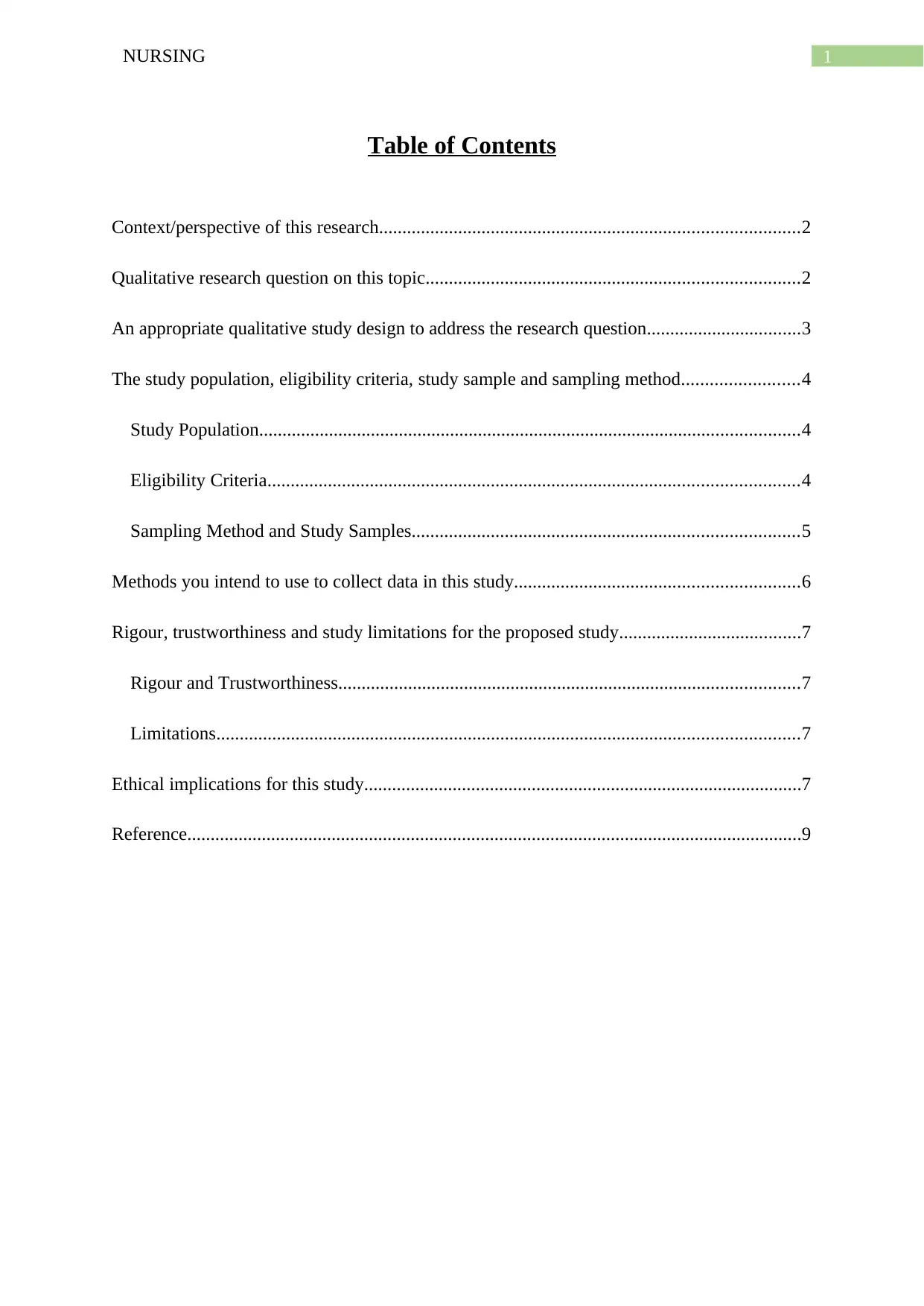
Table of Contents
Context/perspective of this research..........................................................................................2
Qualitative research question on this topic................................................................................2
An appropriate qualitative study design to address the research question.................................3
The study population, eligibility criteria, study sample and sampling method.........................4
Study Population....................................................................................................................4
Eligibility Criteria..................................................................................................................4
Sampling Method and Study Samples...................................................................................5
Methods you intend to use to collect data in this study.............................................................6
Rigour, trustworthiness and study limitations for the proposed study.......................................7
Rigour and Trustworthiness...................................................................................................7
Limitations.............................................................................................................................7
Ethical implications for this study..............................................................................................7
Reference....................................................................................................................................9
Table of Contents
Context/perspective of this research..........................................................................................2
Qualitative research question on this topic................................................................................2
An appropriate qualitative study design to address the research question.................................3
The study population, eligibility criteria, study sample and sampling method.........................4
Study Population....................................................................................................................4
Eligibility Criteria..................................................................................................................4
Sampling Method and Study Samples...................................................................................5
Methods you intend to use to collect data in this study.............................................................6
Rigour, trustworthiness and study limitations for the proposed study.......................................7
Rigour and Trustworthiness...................................................................................................7
Limitations.............................................................................................................................7
Ethical implications for this study..............................................................................................7
Reference....................................................................................................................................9
2NURSING
Context/perspective of this research
Taking care of patients is a critical job, and it is sometimes incredibly taxing on an
individual, both mentally, and physically (Tong et al., 2018). Many nurses, especially nurses
working in psychiatric facilities, tend to get stressed out, be it due to experiences with the
patients, or the incredible workload of their job. In Australia, it has been reported that a single
psychiatric nurse is responsible for taking care of four patients in the busier shifts, such as
morning and afternoon shifts (Australian Institute of Health and Welfare, 2020). Taking care
of psychiatric patients is not easy, and it often takes a huge toll on healthcare professionals.
Working in a psychiatric facility often exposes the nurses to negative experiences, such as
aggression, violence, and trauma. The offenders are usually patients (Niu et al., 2019). These
experiences may lead to depressive symptoms in the nurses (Hsieh, Wang, Shen & Li, 2018).
It has been observed that registered nurses, due to the huge burden of their jobs, experience
serious burnout and stress, ultimately leading to emotional exhaustion or unintended cynicism
(Dixon, 2018). It has been seen that depression and stress are a common theme in psychiatric
nurses (Hasan, Elsayed & Tumah, 2018). It has been seen that work-family conflict has been
an issue in many nursing professionals (Wang & Tsai, 2014). Hence, the huge responsibility
of the nurses in their workplaces, the stress, and the burnout may have a significant impact on
the relationships of the psychiatric nurses with their family or friends.
Qualitative research question on this topic
A good quality research question is important in qualitative research as it is very
likely that a poorly constructed research question will yield poor results as well. The research
question must be reflective of what the researcher aims to know about the sample population
Context/perspective of this research
Taking care of patients is a critical job, and it is sometimes incredibly taxing on an
individual, both mentally, and physically (Tong et al., 2018). Many nurses, especially nurses
working in psychiatric facilities, tend to get stressed out, be it due to experiences with the
patients, or the incredible workload of their job. In Australia, it has been reported that a single
psychiatric nurse is responsible for taking care of four patients in the busier shifts, such as
morning and afternoon shifts (Australian Institute of Health and Welfare, 2020). Taking care
of psychiatric patients is not easy, and it often takes a huge toll on healthcare professionals.
Working in a psychiatric facility often exposes the nurses to negative experiences, such as
aggression, violence, and trauma. The offenders are usually patients (Niu et al., 2019). These
experiences may lead to depressive symptoms in the nurses (Hsieh, Wang, Shen & Li, 2018).
It has been observed that registered nurses, due to the huge burden of their jobs, experience
serious burnout and stress, ultimately leading to emotional exhaustion or unintended cynicism
(Dixon, 2018). It has been seen that depression and stress are a common theme in psychiatric
nurses (Hasan, Elsayed & Tumah, 2018). It has been seen that work-family conflict has been
an issue in many nursing professionals (Wang & Tsai, 2014). Hence, the huge responsibility
of the nurses in their workplaces, the stress, and the burnout may have a significant impact on
the relationships of the psychiatric nurses with their family or friends.
Qualitative research question on this topic
A good quality research question is important in qualitative research as it is very
likely that a poorly constructed research question will yield poor results as well. The research
question must be reflective of what the researcher aims to know about the sample population
⊘ This is a preview!⊘
Do you want full access?
Subscribe today to unlock all pages.

Trusted by 1+ million students worldwide
3NURSING
and what perspectives are they looking for in terms of the experience of the participants
(Agee, 2009).
This study aims to understand the impact of working at psychiatric facilities on the personal
relationships of the Registered Nurses, that is, the relationships they have with their family
and friends outside their professional environment. Since this is a qualitative study, the
research question must focus on the experiences of the nurses and their impact.
RQ: How does working in a psychiatric facility impact on the relationship registered nurses
have with their family and friends?
An appropriate qualitative study design to address the research question
The study design will be qualitative. There are four types of qualitative study designs,
namely – phenomenology, ethnography, grounded theory, and case study (Astalin, 2013).
Based on the aim of the study, an Ethnographic study design will be followed. Ethnography
originated as a part of Anthropology, which describes the study of a specific population in a
social setting (Astalin, 2013). The focused ethnographic methodology will be utilised in the
current scenario. A focused ethnographic approach is a qualitative approach to collect
relevant data from a small group of people using versatile data collection tools in a specific
setting. In this case, it is a healthcare setting. The focused ethnographic design allows the
understanding of the unique roles the nurse play in society, as well as the struggles they face
(Cruz & Higginbottom, 2013). This study design has been successfully utilised in similar
studies before to collect data from a set of people in a healthcare environment (Kallakorpi,
Haatainen & Kankkunen, 2019). The advantage of this method is that it allows in-depth and
detailed qualitative data collection about experiences and insights from a group of people,
which is the purpose of this study (Cruz & Higginbottom, 2013).
and what perspectives are they looking for in terms of the experience of the participants
(Agee, 2009).
This study aims to understand the impact of working at psychiatric facilities on the personal
relationships of the Registered Nurses, that is, the relationships they have with their family
and friends outside their professional environment. Since this is a qualitative study, the
research question must focus on the experiences of the nurses and their impact.
RQ: How does working in a psychiatric facility impact on the relationship registered nurses
have with their family and friends?
An appropriate qualitative study design to address the research question
The study design will be qualitative. There are four types of qualitative study designs,
namely – phenomenology, ethnography, grounded theory, and case study (Astalin, 2013).
Based on the aim of the study, an Ethnographic study design will be followed. Ethnography
originated as a part of Anthropology, which describes the study of a specific population in a
social setting (Astalin, 2013). The focused ethnographic methodology will be utilised in the
current scenario. A focused ethnographic approach is a qualitative approach to collect
relevant data from a small group of people using versatile data collection tools in a specific
setting. In this case, it is a healthcare setting. The focused ethnographic design allows the
understanding of the unique roles the nurse play in society, as well as the struggles they face
(Cruz & Higginbottom, 2013). This study design has been successfully utilised in similar
studies before to collect data from a set of people in a healthcare environment (Kallakorpi,
Haatainen & Kankkunen, 2019). The advantage of this method is that it allows in-depth and
detailed qualitative data collection about experiences and insights from a group of people,
which is the purpose of this study (Cruz & Higginbottom, 2013).
Paraphrase This Document
Need a fresh take? Get an instant paraphrase of this document with our AI Paraphraser
4NURSING
The study population, eligibility criteria, study sample and sampling
method
Study Population
The study population will include nurses working at an inpatient psychiatric facility in
a busy area. More specifically, this study will focus on Registered Nurses in acute inpatient
psychiatric facilities located in a metropolitan city. The registered nurses have been selected
because they have the highest responsibility among the nurses and apart from taking care of
patients, they are also responsible for supervising the enrolled nurses and delegating tasks and
maintaining high professional standards (Nursingmidwiferyboard.gov.au, 2020). So the
Registered Nurses have been selected as the study population.
Eligibility Criteria
The participants of the study will be chosen by following certain inclusion and
exclusion criteria. Specifying the inclusion and exclusion criteria of a study is extremely
important as it has a direct effect on the validity and reliability of the study (Patino &
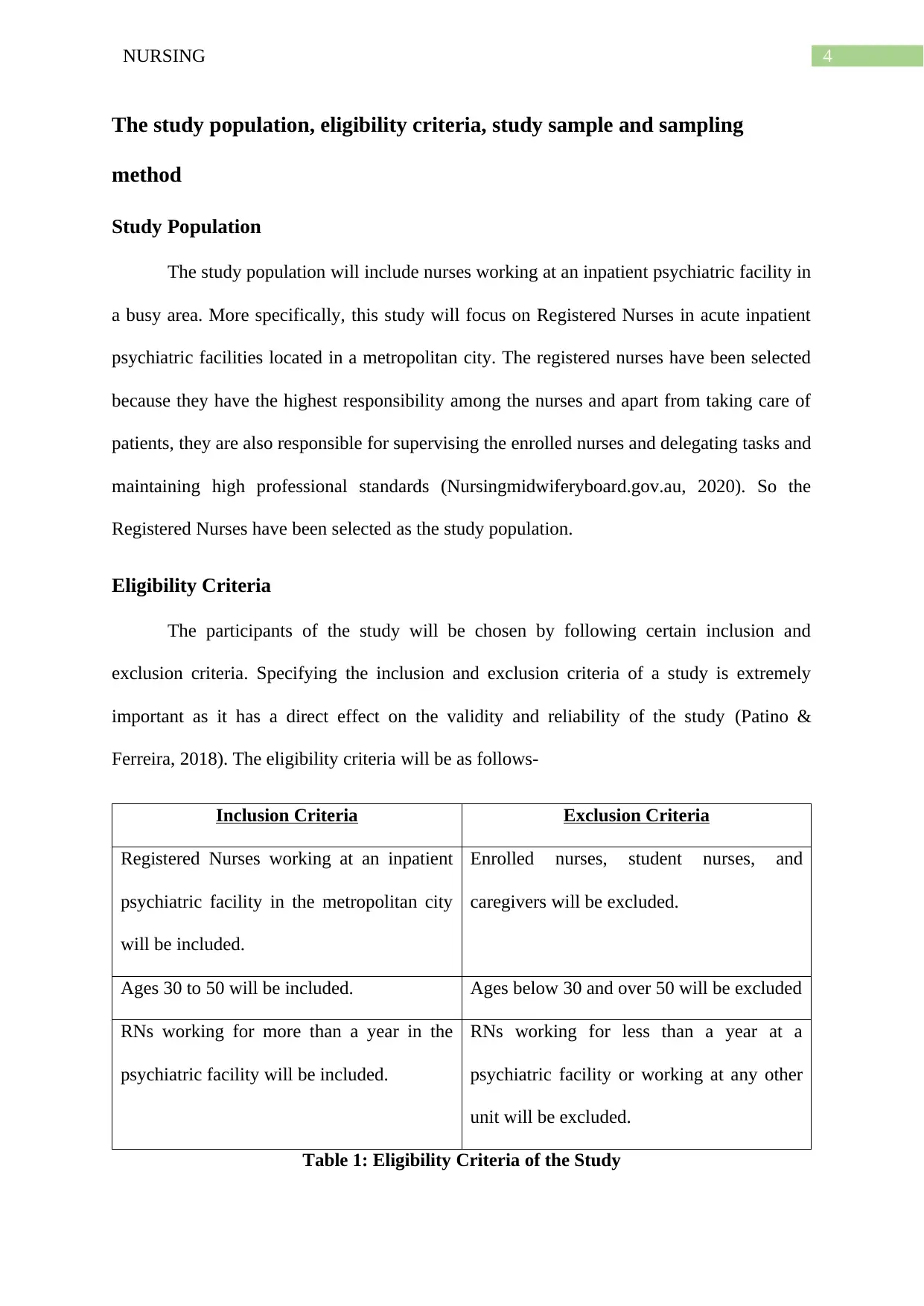
Ferreira, 2018). The eligibility criteria will be as follows-
Inclusion Criteria Exclusion Criteria
Registered Nurses working at an inpatient
psychiatric facility in the metropolitan city
will be included.
Enrolled nurses, student nurses, and
caregivers will be excluded.
Ages 30 to 50 will be included. Ages below 30 and over 50 will be excluded
RNs working for more than a year in the
psychiatric facility will be included.
RNs working for less than a year at a
psychiatric facility or working at any other
unit will be excluded.
Table 1: Eligibility Criteria of the Study
The study population, eligibility criteria, study sample and sampling
method
Study Population
The study population will include nurses working at an inpatient psychiatric facility in
a busy area. More specifically, this study will focus on Registered Nurses in acute inpatient
psychiatric facilities located in a metropolitan city. The registered nurses have been selected
because they have the highest responsibility among the nurses and apart from taking care of
patients, they are also responsible for supervising the enrolled nurses and delegating tasks and
maintaining high professional standards (Nursingmidwiferyboard.gov.au, 2020). So the
Registered Nurses have been selected as the study population.
Eligibility Criteria
The participants of the study will be chosen by following certain inclusion and
exclusion criteria. Specifying the inclusion and exclusion criteria of a study is extremely
important as it has a direct effect on the validity and reliability of the study (Patino &
Ferreira, 2018). The eligibility criteria will be as follows-
Inclusion Criteria Exclusion Criteria
Registered Nurses working at an inpatient
psychiatric facility in the metropolitan city
will be included.
Enrolled nurses, student nurses, and
caregivers will be excluded.
Ages 30 to 50 will be included. Ages below 30 and over 50 will be excluded
RNs working for more than a year in the
psychiatric facility will be included.
RNs working for less than a year at a
psychiatric facility or working at any other
unit will be excluded.
Table 1: Eligibility Criteria of the Study
5NURSING
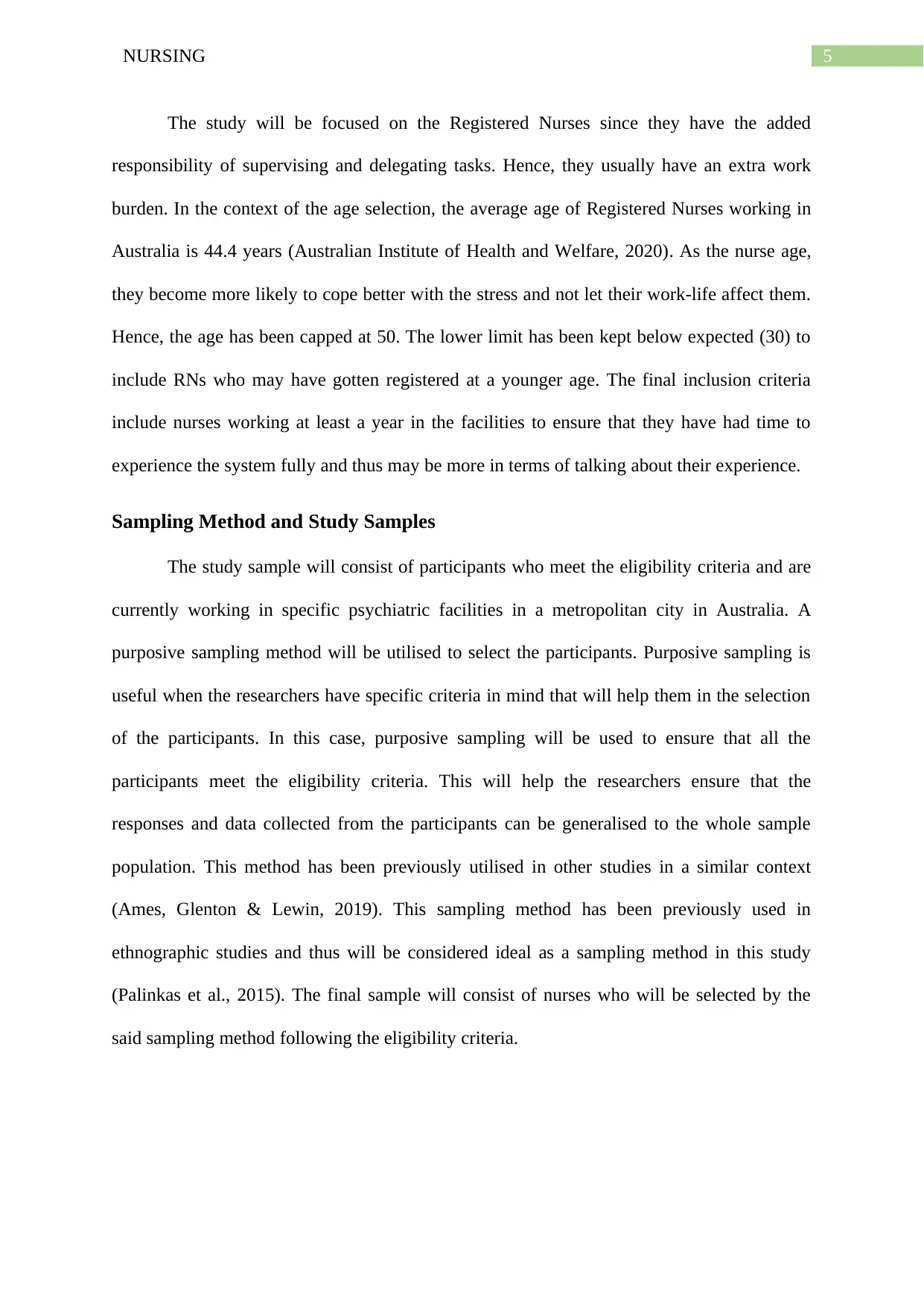
The study will be focused on the Registered Nurses since they have the added
responsibility of supervising and delegating tasks. Hence, they usually have an extra work
burden. In the context of the age selection, the average age of Registered Nurses working in
Australia is 44.4 years (Australian Institute of Health and Welfare, 2020). As the nurse age,
they become more likely to cope better with the stress and not let their work-life affect them.
Hence, the age has been capped at 50. The lower limit has been kept below expected (30) to
include RNs who may have gotten registered at a younger age. The final inclusion criteria
include nurses working at least a year in the facilities to ensure that they have had time to
experience the system fully and thus may be more in terms of talking about their experience.
Sampling Method and Study Samples
The study sample will consist of participants who meet the eligibility criteria and are
currently working in specific psychiatric facilities in a metropolitan city in Australia. A
purposive sampling method will be utilised to select the participants. Purposive sampling is
useful when the researchers have specific criteria in mind that will help them in the selection
of the participants. In this case, purposive sampling will be used to ensure that all the
participants meet the eligibility criteria. This will help the researchers ensure that the
responses and data collected from the participants can be generalised to the whole sample
population. This method has been previously utilised in other studies in a similar context
(Ames, Glenton & Lewin, 2019). This sampling method has been previously used in
ethnographic studies and thus will be considered ideal as a sampling method in this study
(Palinkas et al., 2015). The final sample will consist of nurses who will be selected by the
said sampling method following the eligibility criteria.
The study will be focused on the Registered Nurses since they have the added
responsibility of supervising and delegating tasks. Hence, they usually have an extra work
burden. In the context of the age selection, the average age of Registered Nurses working in
Australia is 44.4 years (Australian Institute of Health and Welfare, 2020). As the nurse age,
they become more likely to cope better with the stress and not let their work-life affect them.
Hence, the age has been capped at 50. The lower limit has been kept below expected (30) to
include RNs who may have gotten registered at a younger age. The final inclusion criteria
include nurses working at least a year in the facilities to ensure that they have had time to
experience the system fully and thus may be more in terms of talking about their experience.
Sampling Method and Study Samples
The study sample will consist of participants who meet the eligibility criteria and are
currently working in specific psychiatric facilities in a metropolitan city in Australia. A
purposive sampling method will be utilised to select the participants. Purposive sampling is
useful when the researchers have specific criteria in mind that will help them in the selection
of the participants. In this case, purposive sampling will be used to ensure that all the
participants meet the eligibility criteria. This will help the researchers ensure that the
responses and data collected from the participants can be generalised to the whole sample
population. This method has been previously utilised in other studies in a similar context
(Ames, Glenton & Lewin, 2019). This sampling method has been previously used in
ethnographic studies and thus will be considered ideal as a sampling method in this study
(Palinkas et al., 2015). The final sample will consist of nurses who will be selected by the
said sampling method following the eligibility criteria.
⊘ This is a preview!⊘
Do you want full access?
Subscribe today to unlock all pages.
Trusted by 1+ million students worldwide
6NURSING
Methods you intend to use to collect data in this study
Since a focused ethnographical approach means that the researchers are going to be in
the field for a short time, multiple data collection techniques should be employed together to
maximise the amount of data collected (Rashid, Hodgson & Luig, 2019). The data collection
methods to be used here will include questionnaires and semi-structured interviews. The
questionnaire used will be an open-question questionnaire to allow the participants to answer
the questions in a less restrictive manner (Krosnick, 2018). The questionnaires will consist of
in-depth questions related to the experiences of the nurses, their families, their relationships,
their feelings about their job, positive or negative, and their thoughts about work-family
balance.
Apart from the questionnaires, semi-structured interviews will be conducted for the
nurses. For this, data will be collected on the working conditions, statistics, patient outcomes,
and the nurse-to-patient ratio and other information about the work culture of that facility.
This way of collecting data will ensure that the questions are focused and will provide proper
answers (Kallio, Pietilä, Johnson & Kangasniemi, 2016). This method will also ensure that
the informative or quantitative questions such as ‘how many of you work here’ and others
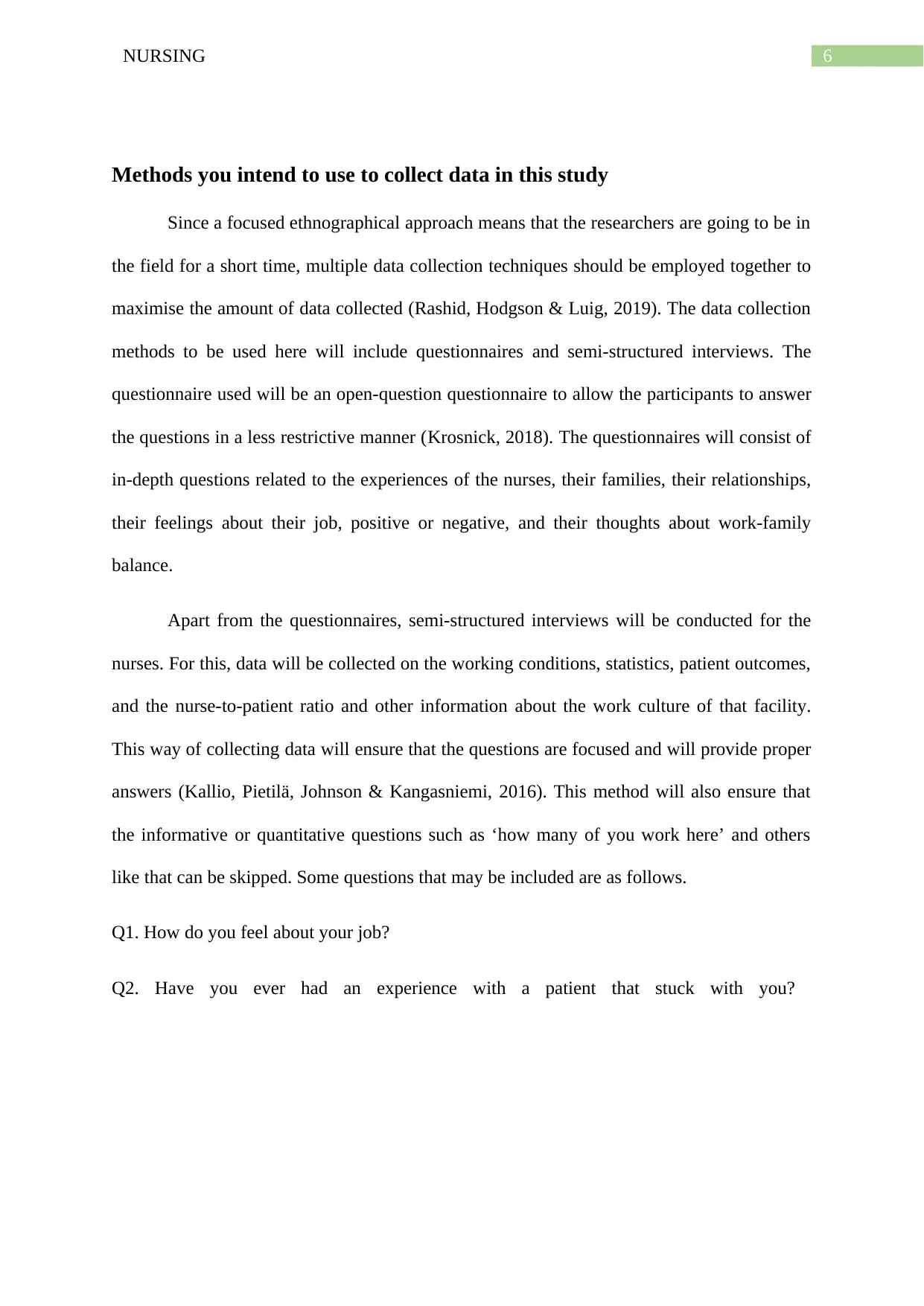
like that can be skipped. Some questions that may be included are as follows.
Q1. How do you feel about your job?
Q2. Have you ever had an experience with a patient that stuck with you?
Methods you intend to use to collect data in this study
Since a focused ethnographical approach means that the researchers are going to be in
the field for a short time, multiple data collection techniques should be employed together to
maximise the amount of data collected (Rashid, Hodgson & Luig, 2019). The data collection
methods to be used here will include questionnaires and semi-structured interviews. The
questionnaire used will be an open-question questionnaire to allow the participants to answer
the questions in a less restrictive manner (Krosnick, 2018). The questionnaires will consist of
in-depth questions related to the experiences of the nurses, their families, their relationships,
their feelings about their job, positive or negative, and their thoughts about work-family
balance.
Apart from the questionnaires, semi-structured interviews will be conducted for the
nurses. For this, data will be collected on the working conditions, statistics, patient outcomes,
and the nurse-to-patient ratio and other information about the work culture of that facility.
This way of collecting data will ensure that the questions are focused and will provide proper
answers (Kallio, Pietilä, Johnson & Kangasniemi, 2016). This method will also ensure that
the informative or quantitative questions such as ‘how many of you work here’ and others
like that can be skipped. Some questions that may be included are as follows.
Q1. How do you feel about your job?
Q2. Have you ever had an experience with a patient that stuck with you?
Paraphrase This Document
Need a fresh take? Get an instant paraphrase of this document with our AI Paraphraser
7NURSING
Rigour, trustworthiness and study limitations for the proposed study
Rigour and Trustworthiness
Since qualitative research is very open-ended and not every exact, the rigour of such a
study is still under question. Trustworthiness is based on the authenticity of the study and the
truthfulness of the findings (Cypress, 2017). The study design has been generalised as much
as possible, and it can be considered transferable to other metropolitan psychiatric facilities
over Australia. The eligibility criteria have been set up to ensure high generalizability. Hence,
the study is trustworthy to give an idea of the experiences of the nurses working in
psychiatric facilities, at least in Australian metropolitan cities.
Limitations
This research study has some limitations to consider. Firstly, the study will be one
inpatient psychiatric facility only, which raises the concern of bias as the nurses may have
shared experiences and opinions. They may also not feel comfortable sharing their
experiences. The study will be conducted in a metropolitan environment, and it may not be
the representative of the Registered Nurses across all Australia. Secondly, Qualitative
ethnographic study is time-consuming, but the study needs to be conducted over a short
period due to restrictions. Also, ethnographic studies do not provide concrete results, and
success cannot be measured (Queirós, Faria & Almeida, 2017).
Ethical implications for this study
Necessary approval for the study will be taken from the Ethics Board as required. The
participation of the nurses will be completely voluntary and consensual. Before the
commencement of the study, the nurses will be provided with a consent form containing the
details of the study, and they will only be included in the study after signing the form. They
Rigour, trustworthiness and study limitations for the proposed study
Rigour and Trustworthiness
Since qualitative research is very open-ended and not every exact, the rigour of such a
study is still under question. Trustworthiness is based on the authenticity of the study and the
truthfulness of the findings (Cypress, 2017). The study design has been generalised as much
as possible, and it can be considered transferable to other metropolitan psychiatric facilities
over Australia. The eligibility criteria have been set up to ensure high generalizability. Hence,
the study is trustworthy to give an idea of the experiences of the nurses working in
psychiatric facilities, at least in Australian metropolitan cities.
Limitations
This research study has some limitations to consider. Firstly, the study will be one
inpatient psychiatric facility only, which raises the concern of bias as the nurses may have
shared experiences and opinions. They may also not feel comfortable sharing their
experiences. The study will be conducted in a metropolitan environment, and it may not be
the representative of the Registered Nurses across all Australia. Secondly, Qualitative
ethnographic study is time-consuming, but the study needs to be conducted over a short
period due to restrictions. Also, ethnographic studies do not provide concrete results, and
success cannot be measured (Queirós, Faria & Almeida, 2017).
Ethical implications for this study
Necessary approval for the study will be taken from the Ethics Board as required. The
participation of the nurses will be completely voluntary and consensual. Before the
commencement of the study, the nurses will be provided with a consent form containing the
details of the study, and they will only be included in the study after signing the form. They

8NURSING
will also be enlightened about the study verbally in detail and informed that they are free to
withdraw at any point in time before or after the commencement of the study. They will also
be ensured that their participation will be kept anonymous in the paper. It will be determined
that they understand the question fully before answering them (Minogue, Cooke, Donskoy &
Vicary, 2019). They will be free to reject any questions they are not comfortable with or even
withdraw their participation any time before the publication.
will also be enlightened about the study verbally in detail and informed that they are free to
withdraw at any point in time before or after the commencement of the study. They will also
be ensured that their participation will be kept anonymous in the paper. It will be determined
that they understand the question fully before answering them (Minogue, Cooke, Donskoy &
Vicary, 2019). They will be free to reject any questions they are not comfortable with or even
withdraw their participation any time before the publication.
⊘ This is a preview!⊘
Do you want full access?
Subscribe today to unlock all pages.
Trusted by 1+ million students worldwide
9NURSING
Reference
Agee, J. (2009). Developing qualitative research questions: a reflective process. International
journal of qualitative studies in education, 22(4), 431-447. DOI:
https://doi.org/10.1080/09518390902736512
Ames, H., Glenton, C., & Lewin, S. (2019). Purposive sampling in a qualitative evidence
synthesis: a worked example from a synthesis on parental perceptions of vaccination
communication. BMC medical research methodology, 19(1), 26. DOI:
https://doi.org/10.1186/s12874-019-0665-4
Astalin, P. K. (2013). Qualitative research designs: A conceptual framework. International
Journal of Social Science and Interdisciplinary Research, 2(1), 118-124. Retrieved
from
https://pdfs.semanticscholar.org/baa7/c8f5577b0b1798b5e9f559f5cbae32bf1a36.pdf
Australian Institute of Health and Welfare. (2020). Mental health services in Australia,
Staffing of state and territory specialised mental health care facilities - Australian
Institute of Health and Welfare. Retrieved 5 April 2020, from
https://www.aihw.gov.au/reports/mental-health-services/mental-health-services-in-
australia/report-contents/specialised-mental-health-care-facilities/staffing-of-mental-
health-care-facilities
Australian Institute of Health and Welfare. (2020). Nursing and midwifery workforce 2015,
Who are nurses and midwives? - Australian Institute of Health and Welfare. Retrieved
6 April 2020, from https://www.aihw.gov.au/reports/workforce/nursing-and-
midwifery-workforce-2015/contents/who-are-nurses-and-midwives
Reference
Agee, J. (2009). Developing qualitative research questions: a reflective process. International
journal of qualitative studies in education, 22(4), 431-447. DOI:
https://doi.org/10.1080/09518390902736512
Ames, H., Glenton, C., & Lewin, S. (2019). Purposive sampling in a qualitative evidence
synthesis: a worked example from a synthesis on parental perceptions of vaccination
communication. BMC medical research methodology, 19(1), 26. DOI:
https://doi.org/10.1186/s12874-019-0665-4
Astalin, P. K. (2013). Qualitative research designs: A conceptual framework. International
Journal of Social Science and Interdisciplinary Research, 2(1), 118-124. Retrieved
from
https://pdfs.semanticscholar.org/baa7/c8f5577b0b1798b5e9f559f5cbae32bf1a36.pdf
Australian Institute of Health and Welfare. (2020). Mental health services in Australia,
Staffing of state and territory specialised mental health care facilities - Australian
Institute of Health and Welfare. Retrieved 5 April 2020, from
https://www.aihw.gov.au/reports/mental-health-services/mental-health-services-in-
australia/report-contents/specialised-mental-health-care-facilities/staffing-of-mental-
health-care-facilities
Australian Institute of Health and Welfare. (2020). Nursing and midwifery workforce 2015,
Who are nurses and midwives? - Australian Institute of Health and Welfare. Retrieved
6 April 2020, from https://www.aihw.gov.au/reports/workforce/nursing-and-
midwifery-workforce-2015/contents/who-are-nurses-and-midwives
Paraphrase This Document
Need a fresh take? Get an instant paraphrase of this document with our AI Paraphraser
10NURSING
Cruz, E. V., & Higginbottom, G. (2013). The use of focused ethnography in nursing
research. Nurse researcher, 20(4). DOI: 10.7748/nr2013.03.20.4.36.e305
Cypress, B. S. (2017). Rigor or reliability and validity in qualitative research: Perspectives,
strategies, reconceptualisation, and recommendations. Dimensions of Critical Care
Nursing, 36(4), 253-263. 10.1097/DCC.0000000000000253
Dixon, C. M. (2018). The Impact of a Team Nursing Model on Stress and Burnout among
Registered Nurses and Licensed Practical Nurses (Doctoral dissertation, William
Carey University). Retrieved from
https://search.proquest.com/openview/2c6611a5f3a1c8d0fbcea77ba54e654c/1?pq-
origsite=gscholar&cbl=18750&diss=y
Hasan, A. A., Elsayed, S., & Tumah, H. (2018). Occupational stress, coping strategies, and
psychological‐related outcomes of nurses working in psychiatric
hospitals. Perspectives in psychiatric care, 54(4), 514-522. DOI:
https://doi.org/10.1111/ppc.12262
Hsieh, H. F., Wang, H. H., Shen, S. H., & Li, Y. C. (2018). Predictors of depressive
symptoms among psychiatric nurses who suffered from workplace violence. Journal
of advanced nursing, 74(2), 425-432. DOI: 10.1111/jan.13451
Kallakorpi, S., Haatainen, K., & Kankkunen, P. (2019). Psychiatric nursing care experiences
of immigrant patients: A Focused ethnographic study. International journal of mental
health nursing, 28(1), 117-127. DOI: 10.1111/inm.12500
Kallio, H., Pietilä, A. M., Johnson, M., & Kangasniemi, M. (2016). Systematic
methodological review: Developing a framework for a qualitative semi‐structured
interview guide. Journal of advanced nursing, 72(12), 2954-2965. DOI:
http://dx.doi.org/10.1111/jan.13031
Cruz, E. V., & Higginbottom, G. (2013). The use of focused ethnography in nursing
research. Nurse researcher, 20(4). DOI: 10.7748/nr2013.03.20.4.36.e305
Cypress, B. S. (2017). Rigor or reliability and validity in qualitative research: Perspectives,
strategies, reconceptualisation, and recommendations. Dimensions of Critical Care
Nursing, 36(4), 253-263. 10.1097/DCC.0000000000000253
Dixon, C. M. (2018). The Impact of a Team Nursing Model on Stress and Burnout among
Registered Nurses and Licensed Practical Nurses (Doctoral dissertation, William
Carey University). Retrieved from
https://search.proquest.com/openview/2c6611a5f3a1c8d0fbcea77ba54e654c/1?pq-
origsite=gscholar&cbl=18750&diss=y
Hasan, A. A., Elsayed, S., & Tumah, H. (2018). Occupational stress, coping strategies, and
psychological‐related outcomes of nurses working in psychiatric
hospitals. Perspectives in psychiatric care, 54(4), 514-522. DOI:
https://doi.org/10.1111/ppc.12262
Hsieh, H. F., Wang, H. H., Shen, S. H., & Li, Y. C. (2018). Predictors of depressive
symptoms among psychiatric nurses who suffered from workplace violence. Journal
of advanced nursing, 74(2), 425-432. DOI: 10.1111/jan.13451
Kallakorpi, S., Haatainen, K., & Kankkunen, P. (2019). Psychiatric nursing care experiences
of immigrant patients: A Focused ethnographic study. International journal of mental
health nursing, 28(1), 117-127. DOI: 10.1111/inm.12500
Kallio, H., Pietilä, A. M., Johnson, M., & Kangasniemi, M. (2016). Systematic
methodological review: Developing a framework for a qualitative semi‐structured
interview guide. Journal of advanced nursing, 72(12), 2954-2965. DOI:
http://dx.doi.org/10.1111/jan.13031
11NURSING
Krosnick, J. A. (2018). Questionnaire design. In The Palgrave handbook of survey
research (pp. 439-455). Palgrave Macmillan, Cham.
Minogue, V., Cooke, M., Donskoy, A. L., & Vicary, P. (2019). The legal, governance and
ethical implications of involving service users and carers in research. International
journal of health care quality assurance. DOI: https://doi.org/10.1108/IJHCQA-07-
2017-0131
Niu, S. F., Kuo, S. F., Tsai, H. T., Kao, C. C., Traynor, V., & Chou, K. R. (2019). Prevalence
of workplace violent episodes experienced by nurses in acute psychiatric
settings. PloS one, 14(1), e0211183. DOI:
https://doi.org/10.1371/journal.pone.0211183
Nursingmidwiferyboard.gov.au. (2020). Nursing and Midwifery Board of Australia -
Registered nurse standards for practice. Retrieved 6 April 2020, from
https://www.nursingmidwiferyboard.gov.au/Codes-Guidelines-Statements/
Professional-standards/registered-nurse-standards-for-practice.aspx
Palinkas, L. A., Horwitz, S. M., Green, C. A., Wisdom, J. P., Duan, N., & Hoagwood, K.
(2015). Purposeful Sampling for Qualitative Data Collection and Analysis in Mixed
Method Implementation Research. Administration and policy in mental health, 42(5),
533–544. DOI: https://doi.org/10.1007/s10488-013-0528-y
Patino, C. M., & Ferreira, J. C. (2018). Inclusion and exclusion criteria in research studies:
definitions and why they matter. Jornal brasileiro de pneumologia : publicacao
oficial da Sociedade Brasileira de Pneumologia e Tisilogia, 44(2), 84. DOI:
https://doi.org/10.1590/s1806-37562018000000088
Krosnick, J. A. (2018). Questionnaire design. In The Palgrave handbook of survey
research (pp. 439-455). Palgrave Macmillan, Cham.
Minogue, V., Cooke, M., Donskoy, A. L., & Vicary, P. (2019). The legal, governance and
ethical implications of involving service users and carers in research. International
journal of health care quality assurance. DOI: https://doi.org/10.1108/IJHCQA-07-
2017-0131
Niu, S. F., Kuo, S. F., Tsai, H. T., Kao, C. C., Traynor, V., & Chou, K. R. (2019). Prevalence
of workplace violent episodes experienced by nurses in acute psychiatric
settings. PloS one, 14(1), e0211183. DOI:
https://doi.org/10.1371/journal.pone.0211183
Nursingmidwiferyboard.gov.au. (2020). Nursing and Midwifery Board of Australia -
Registered nurse standards for practice. Retrieved 6 April 2020, from
https://www.nursingmidwiferyboard.gov.au/Codes-Guidelines-Statements/
Professional-standards/registered-nurse-standards-for-practice.aspx
Palinkas, L. A., Horwitz, S. M., Green, C. A., Wisdom, J. P., Duan, N., & Hoagwood, K.
(2015). Purposeful Sampling for Qualitative Data Collection and Analysis in Mixed
Method Implementation Research. Administration and policy in mental health, 42(5),
533–544. DOI: https://doi.org/10.1007/s10488-013-0528-y
Patino, C. M., & Ferreira, J. C. (2018). Inclusion and exclusion criteria in research studies:
definitions and why they matter. Jornal brasileiro de pneumologia : publicacao
oficial da Sociedade Brasileira de Pneumologia e Tisilogia, 44(2), 84. DOI:
https://doi.org/10.1590/s1806-37562018000000088
⊘ This is a preview!⊘
Do you want full access?
Subscribe today to unlock all pages.
Trusted by 1+ million students worldwide

1 out of 13


Related Documents


Your All-in-One AI-Powered Toolkit for Academic Success.
+13062052269
info@desklib.com
Available 24*7 on WhatsApp / Email
![[object Object]](/_next/static/media/star-bottom.7253800d.svg)
Unlock your academic potential
Copyright © 2020–2026 A2Z Services. All Rights Reserved. Developed and managed by ZUCOL.