Impact of Social Media Marketing on Tesco's Marketing Activities
VerifiedAdded on 2020/07/23
|11
|2982
|104
Report
AI Summary
This research project examines the impact of social media marketing on Tesco's promotional and marketing activities. The introduction highlights the growth of social media and its significance for businesses, especially in customer interaction and feedback. The literature review explores various social media marketing strategies, platforms, and their impact on organizations, emphasizing cost-effectiveness and broad reach. It also covers the challenges, such as reliability and measuring ROI. The research methodology outlines an interpretivism research philosophy, an inductive research approach, and an exploratory research design, utilizing a quantitative research method. Data will be collected using questionnaires. The report aims to understand Tesco's social media marketing approaches, analyze its influence on promotional activities, identify challenges, and recommend improvements. The study includes research questions focusing on the platforms used, marketing influence, and challenges faced by Tesco. The project's timeline and activities are also planned to ensure the research objectives are met.

Research Project

Paraphrase This Document
Need a fresh take? Get an instant paraphrase of this document with our AI Paraphraser
Table of Contents
INTRODUCTION......................................................................................................................1
LITERATURE REVIEW...........................................................................................................3
RESEARCH METHODOLOGY...............................................................................................5
ACTIVITIES AND TIMELINE................................................................................................6
REFERENCES...........................................................................................................................9
INTRODUCTION......................................................................................................................1
LITERATURE REVIEW...........................................................................................................3
RESEARCH METHODOLOGY...............................................................................................5
ACTIVITIES AND TIMELINE................................................................................................6
REFERENCES...........................................................................................................................9
INTRODUCTION
Topic of Research project
Impact of social media marketing in enhancing marketing and promotional activities of
organisation; a study on Tesco.
Introduction
Since the evolution of internet, various developments in field of information and
technologies have been seen. Social media has become a ubiquitous part of daily life, but this
growth and evolution has been in the works since the late 70s. From primitive days of
newsgroups, LISTSERVS and the introduction of early chat rooms, social media has changed
the way we communicate, gather and share information, and given rise to a connected global
society (Ashley and Tuten, 2015). Social media websites such as Facebook, Twitter,
Snapchat, and Instagram have gained popularity after 2010. Not only individuals but
organisations has also greatly benefited from social media. As social media helps in
interacting and communicating with each other organisations able to interact with consumers
to gain their feedbacks and suggestions. There are approximately 2 billion people on one or
many social media contributing one third of earth’s population (Stelzner, 2014). This gives an
enormous opportunity to business organisations in promotion of goods and services. In this
context, the present research study focuses on the impact of social media marketing in
increasing the marketing and promotional activities of organisation.
Researcher selects Tesco for this research as it is one of the largest supermarket and
retail organisation incorporating in United Kingdom. It has enormous customer base and
utilised digital and advance technologies more appropriately and precisely. Researcher will
create an argument in this proposal by conducting mini literature review. The motive of
conducting literature review is to gather brief knowledge and understanding about social
media marketing. Appropriate books, journals and articles will be selected and robust
argument will create which helps in enhancing the knowledge level of end users and
researcher. Researcher will also explain research methods which will be appropriate for
present research study. Eventually, with the help of Gantt Chart, timeline and activities of
research will be demonstrated by researcher.
Background of study
1
Topic of Research project
Impact of social media marketing in enhancing marketing and promotional activities of
organisation; a study on Tesco.
Introduction
Since the evolution of internet, various developments in field of information and
technologies have been seen. Social media has become a ubiquitous part of daily life, but this
growth and evolution has been in the works since the late 70s. From primitive days of
newsgroups, LISTSERVS and the introduction of early chat rooms, social media has changed
the way we communicate, gather and share information, and given rise to a connected global
society (Ashley and Tuten, 2015). Social media websites such as Facebook, Twitter,
Snapchat, and Instagram have gained popularity after 2010. Not only individuals but
organisations has also greatly benefited from social media. As social media helps in
interacting and communicating with each other organisations able to interact with consumers
to gain their feedbacks and suggestions. There are approximately 2 billion people on one or
many social media contributing one third of earth’s population (Stelzner, 2014). This gives an
enormous opportunity to business organisations in promotion of goods and services. In this
context, the present research study focuses on the impact of social media marketing in
increasing the marketing and promotional activities of organisation.
Researcher selects Tesco for this research as it is one of the largest supermarket and
retail organisation incorporating in United Kingdom. It has enormous customer base and
utilised digital and advance technologies more appropriately and precisely. Researcher will
create an argument in this proposal by conducting mini literature review. The motive of
conducting literature review is to gather brief knowledge and understanding about social
media marketing. Appropriate books, journals and articles will be selected and robust
argument will create which helps in enhancing the knowledge level of end users and
researcher. Researcher will also explain research methods which will be appropriate for
present research study. Eventually, with the help of Gantt Chart, timeline and activities of
research will be demonstrated by researcher.
Background of study
1
⊘ This is a preview!⊘
Do you want full access?
Subscribe today to unlock all pages.

Trusted by 1+ million students worldwide
Social media has become essential part of individual life. Daily millions of people connect
with each other using social media. By taking advantage of it marketers of today’s
organisation have transformed it into a platform for promotion and marketing (Kim and Ko,
2012). It is cost effective, time saving and helps in delivering information to large number of
populations. Researchers have examined the benefits of social media marketing enjoyed by
the organisation. Researchers in their previous studies also investigated methods and
applications which were used by organisations to promote goods and services. In present
research, researcher will examine the influence of social media marketing in enriching
marketing strategies of organisation by investigating on Tesco Plc.
Rationale of study
This research study will help in enriching the knowledge level of researcher by providing in
depth knowledge about social media and social media marketing. Digital technologies greatly
influenced the productivity and profitability of the organisation. Through this research
researcher will be able to know more about Tesco which is one of the leading supermarket
and retail organisation of United Kingdom. Researcher has to investigate the social media
marketing approaches used by Tesco and conduct survey in the organisation. Thus this
research provides opportunity to researcher as he or she will able to gain more knowledge of
the organisation.
Aim and Objectives
The aim of this research is to analyse the impact of social media marketing done by marketers
of Tesco in enhancing their marketing and promotional activities.
Objectives
The summarised objectives of the research are given below:
To understand the social media marketing platforms and approaches used by
organisation.
To analyse the influence of social media marketing in enhancing promotion and
marketing activities.
To identify issues faced by organisation while using social media marketing.
To recommend measures to Tesco so that they can make improvements in social
media marketing.
2
with each other using social media. By taking advantage of it marketers of today’s
organisation have transformed it into a platform for promotion and marketing (Kim and Ko,
2012). It is cost effective, time saving and helps in delivering information to large number of
populations. Researchers have examined the benefits of social media marketing enjoyed by
the organisation. Researchers in their previous studies also investigated methods and
applications which were used by organisations to promote goods and services. In present
research, researcher will examine the influence of social media marketing in enriching
marketing strategies of organisation by investigating on Tesco Plc.
Rationale of study
This research study will help in enriching the knowledge level of researcher by providing in
depth knowledge about social media and social media marketing. Digital technologies greatly
influenced the productivity and profitability of the organisation. Through this research
researcher will be able to know more about Tesco which is one of the leading supermarket
and retail organisation of United Kingdom. Researcher has to investigate the social media
marketing approaches used by Tesco and conduct survey in the organisation. Thus this
research provides opportunity to researcher as he or she will able to gain more knowledge of
the organisation.
Aim and Objectives
The aim of this research is to analyse the impact of social media marketing done by marketers
of Tesco in enhancing their marketing and promotional activities.
Objectives
The summarised objectives of the research are given below:
To understand the social media marketing platforms and approaches used by
organisation.
To analyse the influence of social media marketing in enhancing promotion and
marketing activities.
To identify issues faced by organisation while using social media marketing.
To recommend measures to Tesco so that they can make improvements in social
media marketing.
2
Paraphrase This Document
Need a fresh take? Get an instant paraphrase of this document with our AI Paraphraser
Research questions
The focus of this research is to analyse the impact of social media marketing in increasing
marketing and promotional activities of Tesco. Therefore, it is essential to raise certain
questions which are directly related to subject matter. In this context, the following questions
will be answered in this research:
1. What are the social media marketing platforms and approaches used by organisation?
2. How social media marketing influences organisations in enhancing promotion and
marketing activities?
3. What are the issues faced by organisation while using social media marketing?
LITERATURE REVIEW
The motive of conducting literature review is to gather brief knowledge and understanding
about social media marketing. Appropriate books, journals and articles will be selected and
robust argument will create which helps in enhancing the knowledge level of end users and
researcher in this section.
Social media marketing strategies, platforms and approaches used by organisations
According to Chaffey, (2016) social media marketing refers to the marketing strategies used
by business organisations to promote their goods and services on social media platforms by
using various analytical tools. In the era of enhanced digital technologies and internet
revolution, social media becomes prominent platform for marketers as they can promote
organisational products and services on them by using various tools and applications.
Hollensen and Raman, (2014) elucidated that social media marketing becomes latest trends
for marketers as it helps in delivering organisational or product information to target
customers rapidly, cheaply and efficiently. There are various social media platforms and
websites such as Facebook, YouTube, Instagram, etc. that allows organisation to create their
own account and published their advertisement so that their target customers can view it
efficiently. Shaikh et al., (2016) argued that researchers have broadly defined the term social
media marketing. To narrow it down social media marketing is the marketing on specific
social media site in order to gain attraction and retention of customers. Social media
marketing indeed transforms the perception of both customers and marketers as through
social media, an individual can direct access to the specific offer provided by marketers.
There are various approaches used by marketers in order to create advertisements on social
3
The focus of this research is to analyse the impact of social media marketing in increasing
marketing and promotional activities of Tesco. Therefore, it is essential to raise certain
questions which are directly related to subject matter. In this context, the following questions
will be answered in this research:
1. What are the social media marketing platforms and approaches used by organisation?
2. How social media marketing influences organisations in enhancing promotion and
marketing activities?
3. What are the issues faced by organisation while using social media marketing?
LITERATURE REVIEW
The motive of conducting literature review is to gather brief knowledge and understanding
about social media marketing. Appropriate books, journals and articles will be selected and
robust argument will create which helps in enhancing the knowledge level of end users and
researcher in this section.
Social media marketing strategies, platforms and approaches used by organisations
According to Chaffey, (2016) social media marketing refers to the marketing strategies used
by business organisations to promote their goods and services on social media platforms by
using various analytical tools. In the era of enhanced digital technologies and internet
revolution, social media becomes prominent platform for marketers as they can promote
organisational products and services on them by using various tools and applications.
Hollensen and Raman, (2014) elucidated that social media marketing becomes latest trends
for marketers as it helps in delivering organisational or product information to target
customers rapidly, cheaply and efficiently. There are various social media platforms and
websites such as Facebook, YouTube, Instagram, etc. that allows organisation to create their
own account and published their advertisement so that their target customers can view it
efficiently. Shaikh et al., (2016) argued that researchers have broadly defined the term social
media marketing. To narrow it down social media marketing is the marketing on specific
social media site in order to gain attraction and retention of customers. Social media
marketing indeed transforms the perception of both customers and marketers as through
social media, an individual can direct access to the specific offer provided by marketers.
There are various approaches used by marketers in order to create advertisements on social
3
media marketing. According to Saravanakumar and SuganthaLakshmi, (2012) some
marketers believed that quality content approach is optimum while some marketer’s believed
that creating interactive and creative visualisation is effective to gain customer attraction. De
Vries et al., (2012) argued that in order to sustain in competitive environment it is
rudimentary for the business organisations to implement and invest greatly in digital
technologies and promote more using social media as it is cheap and time saving. Social
media marketing strategies enhanced the marketing practices of organisations as they can
promote products and services to large number of population effectively and efficiently.
Impact of social media marketing on organisation
According to Kaur, (2016) social media marketing impact positively in enhancing
productivity and profitability of the organisation. With the help of social media marketing
organisation can promote their products and services to large number of population. In this
way social media marketing promotes growth and development of organisation. Shaikh et
al., (2016) argued that advertisements promoted on social media can be viewed by anyone
who account on it. They can post negative feedbacks about advertisement or organisations
which can be viewed by other users also. This can impact on psychology of other users and
may hamper organisational reputation. Erdoğmuş and Cicek, (2012) said that social media
marketing helps marketers saving their cost time and efforts. Through social media marketing
management of business organisation able to enhance their productivity and profitability by
increasing the number of customers. Digital marketing and technologies indeed transformed
the perception of customers and organisation and thus foster organisational growth and
development. According to Lipsman et al., (2012) since the evolution of internet, various
developments in field of information and technologies have been seen. Social media websites
such as Facebook, Twitter, Snapchat, and Instagram have gained popularity after 2010. Not
only individuals but organisations has also greatly benefited from social media. As social
media helps in interacting and communicating with each other organisations able to interact
with consumers to gain their feedbacks and suggestions. Shaikh et al., (2016) argued that
management needs to focus on content and quality of advertisement in order to gather
customer attraction on social media. Consumers majorly prefer authentic and creative
content. If the content posted on social media is not attractive, customers will avoid it and
move forward. Thus, it is essential as well as important for the business organisation to
promote effectively on social media so that more and more customers can be attracted
towards organisational products and services.
4
marketers believed that quality content approach is optimum while some marketer’s believed
that creating interactive and creative visualisation is effective to gain customer attraction. De
Vries et al., (2012) argued that in order to sustain in competitive environment it is
rudimentary for the business organisations to implement and invest greatly in digital
technologies and promote more using social media as it is cheap and time saving. Social
media marketing strategies enhanced the marketing practices of organisations as they can
promote products and services to large number of population effectively and efficiently.
Impact of social media marketing on organisation
According to Kaur, (2016) social media marketing impact positively in enhancing
productivity and profitability of the organisation. With the help of social media marketing
organisation can promote their products and services to large number of population. In this
way social media marketing promotes growth and development of organisation. Shaikh et
al., (2016) argued that advertisements promoted on social media can be viewed by anyone
who account on it. They can post negative feedbacks about advertisement or organisations
which can be viewed by other users also. This can impact on psychology of other users and
may hamper organisational reputation. Erdoğmuş and Cicek, (2012) said that social media
marketing helps marketers saving their cost time and efforts. Through social media marketing
management of business organisation able to enhance their productivity and profitability by
increasing the number of customers. Digital marketing and technologies indeed transformed
the perception of customers and organisation and thus foster organisational growth and
development. According to Lipsman et al., (2012) since the evolution of internet, various
developments in field of information and technologies have been seen. Social media websites
such as Facebook, Twitter, Snapchat, and Instagram have gained popularity after 2010. Not
only individuals but organisations has also greatly benefited from social media. As social
media helps in interacting and communicating with each other organisations able to interact
with consumers to gain their feedbacks and suggestions. Shaikh et al., (2016) argued that
management needs to focus on content and quality of advertisement in order to gather
customer attraction on social media. Consumers majorly prefer authentic and creative
content. If the content posted on social media is not attractive, customers will avoid it and
move forward. Thus, it is essential as well as important for the business organisation to
promote effectively on social media so that more and more customers can be attracted
towards organisational products and services.
4
⊘ This is a preview!⊘
Do you want full access?
Subscribe today to unlock all pages.
Trusted by 1+ million students worldwide
Issues and challenges faced by organisation using social media marketing
According to Heymann-Reder, (2012) there are ample of issues and challenges associated
with social media marketing. Marketers published advertisements on different social media in
order to attract more and more customers towards organisational products and services. They
faced limitations and obstructions that hamper the quality of social media marketing. One
such issue is reliability. It is not always convenient for the organisations to promote their
organisational products and services on those social media websites which are not reliable. In
order to enhance the quality of social media marketing it is essential for marketers to promote
goods and services on reliable social media websites. Kumar and Mirchandani, (2012) said
that another issue that disturbs marketers is measuring return on investment. It is difficult to
analyse how many views hit by the advertisement that has been promoted on particular social
media. Without adequate analytical tools and methods it is difficult for marketers to evaluate
the advertisement published on particular social media websites. Vinerean et al., (2013)
proposed that another challenge faced by the organisations is negative feedbacks that have
been given by different viewers or previous customers. This is an inevitable issue which
cannot be cured permanently. All management needs to do is providing effective quality of
products and services to the consumers and post quality advertisements on social media to
reduce the amount of negative feedbacks.
RESEARCH METHODOLOGY
Research methodology is the research framework of study. In this chapter researcher will
explain about different methods of research he or she will going to select in order to
accomplish the aim and objective of study. In this context, research methodology is described
below:
Research Philosophy: Research philosophy deals with source, nature and development of
knowledge. As per Saunders research onion research philosophy is first area to be covered by
researcher (Taylor et al., 2015). There are four types of research philosophy which are used
by researchers in order to accomplish the aim and objective of their studies. In present
research, researcher will use interpretivism research philosophy to enhance the effectiveness
of research.
Research Approach: Discussion of research approach is vital in research study. In order to
accomplish the aim and objective of research study, it is essential for researcher to elaborate
approach of research. There are two types of research approach and in this study, researcher
5
According to Heymann-Reder, (2012) there are ample of issues and challenges associated
with social media marketing. Marketers published advertisements on different social media in
order to attract more and more customers towards organisational products and services. They
faced limitations and obstructions that hamper the quality of social media marketing. One
such issue is reliability. It is not always convenient for the organisations to promote their
organisational products and services on those social media websites which are not reliable. In
order to enhance the quality of social media marketing it is essential for marketers to promote
goods and services on reliable social media websites. Kumar and Mirchandani, (2012) said
that another issue that disturbs marketers is measuring return on investment. It is difficult to
analyse how many views hit by the advertisement that has been promoted on particular social
media. Without adequate analytical tools and methods it is difficult for marketers to evaluate
the advertisement published on particular social media websites. Vinerean et al., (2013)
proposed that another challenge faced by the organisations is negative feedbacks that have
been given by different viewers or previous customers. This is an inevitable issue which
cannot be cured permanently. All management needs to do is providing effective quality of
products and services to the consumers and post quality advertisements on social media to
reduce the amount of negative feedbacks.
RESEARCH METHODOLOGY
Research methodology is the research framework of study. In this chapter researcher will
explain about different methods of research he or she will going to select in order to
accomplish the aim and objective of study. In this context, research methodology is described
below:
Research Philosophy: Research philosophy deals with source, nature and development of
knowledge. As per Saunders research onion research philosophy is first area to be covered by
researcher (Taylor et al., 2015). There are four types of research philosophy which are used
by researchers in order to accomplish the aim and objective of their studies. In present
research, researcher will use interpretivism research philosophy to enhance the effectiveness
of research.
Research Approach: Discussion of research approach is vital in research study. In order to
accomplish the aim and objective of research study, it is essential for researcher to elaborate
approach of research. There are two types of research approach and in this study, researcher
5
Paraphrase This Document
Need a fresh take? Get an instant paraphrase of this document with our AI Paraphraser
will use inductive research approach. Inductive research approach is used by researcher in
order to attain research questions, aim and objectives effectively and efficiently.
Research design: Research design refers to the plan which is formulated by researcher to
attain research questions effectively and efficiently (Lewis, 2015). In the present research
study, researcher will use exploratory research design. As through exploratory research
design researcher will be able to explore research questions more precisely.
Research strategy: Research strategy refers to the plan which is devised by researcher in
order to attain goals and objective of research study (Silverman, 2016). There are many types
of research study such as meta-analysis, systematic review, qualitative, quantitative, case
study, etc. has been used by researchers. In present study, researcher will use quantitative
research method to analyse numerical data associated with research study.
Data Collection: Data collection is very crucial and important process in research study.
There are two sources from where researcher collects data. These are primary and secondary
source. In this primary research researcher will collect data by using questionnaire research
instrument. The questionnaire will be provided to the marketers of Tesco by hand and close
ended questions will be asked from them.
Sampling: Sampling is the statistical process of lowering the amount of population of survey.
It is crucial as surveying large populations is pragmatically not possible and feasible for
researcher (Mackey and Gass, 2015). In this context, researcher will select a sample of 50
marketers randomly working at Tesco and provide them questionnaire.
Data analysis: Data analysis is considered as critical and crucial process. In this section
researcher will interprets the collected data in effective and efficient manner. Researcher will
use thematic analysis in order to analyse and interprets gathered data and information. Tables
and charts will be used to explain data more effectively and interactively.
Ethical consideration: Researcher will ensure that purpose of research has been explicitly
explained to the participants before providing them questionnaire. Researcher will ensure to
protect anonymity of participants of the research and will also ensure to respect the dignity of
organisation.
ACTIVITIES AND TIMELINE
Task Name Duration
6
order to attain research questions, aim and objectives effectively and efficiently.
Research design: Research design refers to the plan which is formulated by researcher to
attain research questions effectively and efficiently (Lewis, 2015). In the present research
study, researcher will use exploratory research design. As through exploratory research
design researcher will be able to explore research questions more precisely.
Research strategy: Research strategy refers to the plan which is devised by researcher in
order to attain goals and objective of research study (Silverman, 2016). There are many types
of research study such as meta-analysis, systematic review, qualitative, quantitative, case
study, etc. has been used by researchers. In present study, researcher will use quantitative
research method to analyse numerical data associated with research study.
Data Collection: Data collection is very crucial and important process in research study.
There are two sources from where researcher collects data. These are primary and secondary
source. In this primary research researcher will collect data by using questionnaire research
instrument. The questionnaire will be provided to the marketers of Tesco by hand and close
ended questions will be asked from them.
Sampling: Sampling is the statistical process of lowering the amount of population of survey.
It is crucial as surveying large populations is pragmatically not possible and feasible for
researcher (Mackey and Gass, 2015). In this context, researcher will select a sample of 50
marketers randomly working at Tesco and provide them questionnaire.
Data analysis: Data analysis is considered as critical and crucial process. In this section
researcher will interprets the collected data in effective and efficient manner. Researcher will
use thematic analysis in order to analyse and interprets gathered data and information. Tables
and charts will be used to explain data more effectively and interactively.
Ethical consideration: Researcher will ensure that purpose of research has been explicitly
explained to the participants before providing them questionnaire. Researcher will ensure to
protect anonymity of participants of the research and will also ensure to respect the dignity of
organisation.
ACTIVITIES AND TIMELINE
Task Name Duration
6
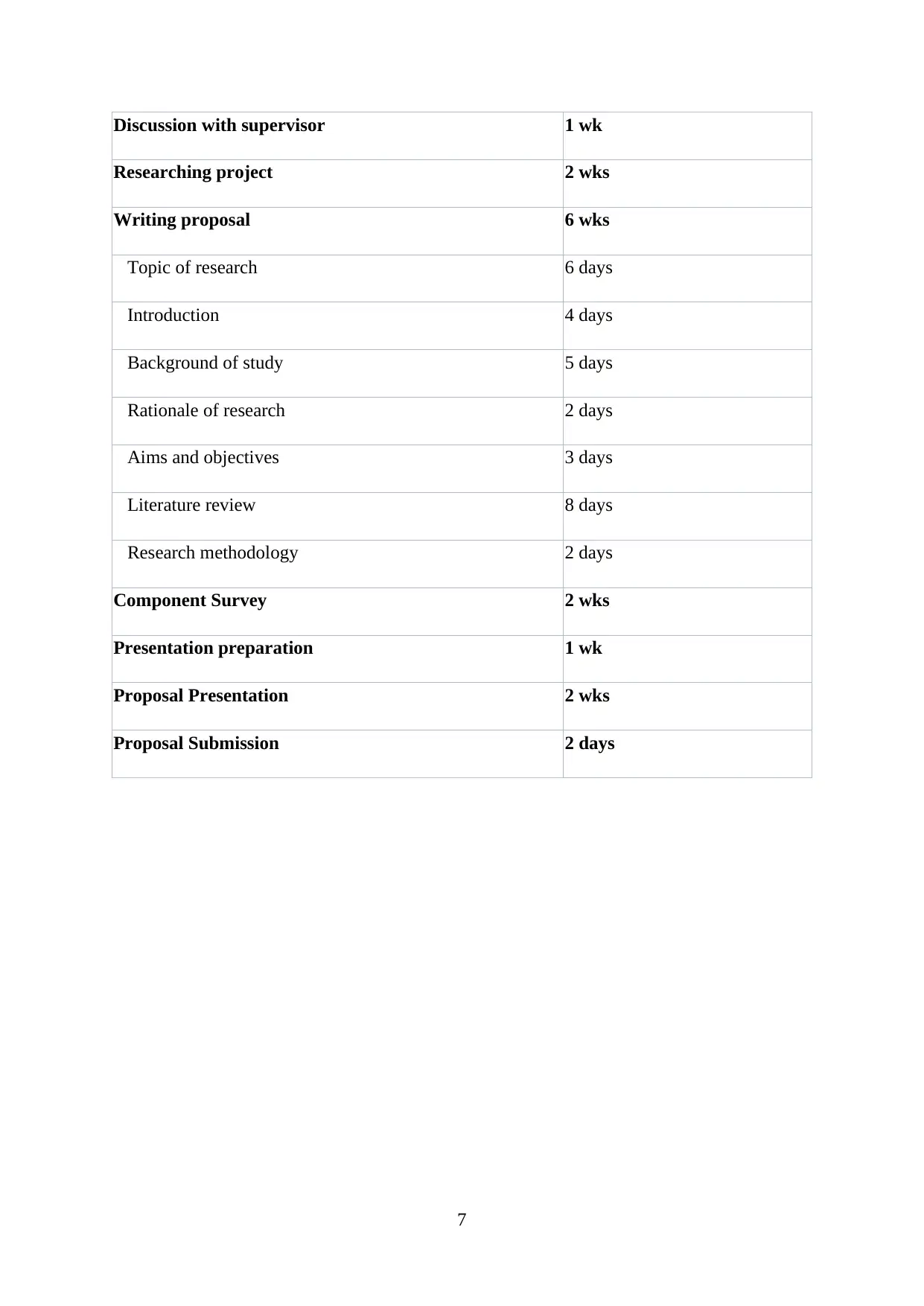
Discussion with supervisor 1 wk
Researching project 2 wks
Writing proposal 6 wks
Topic of research 6 days
Introduction 4 days
Background of study 5 days
Rationale of research 2 days
Aims and objectives 3 days
Literature review 8 days
Research methodology 2 days
Component Survey 2 wks
Presentation preparation 1 wk
Proposal Presentation 2 wks
Proposal Submission 2 days
7
Researching project 2 wks
Writing proposal 6 wks
Topic of research 6 days
Introduction 4 days
Background of study 5 days
Rationale of research 2 days
Aims and objectives 3 days
Literature review 8 days
Research methodology 2 days
Component Survey 2 wks
Presentation preparation 1 wk
Proposal Presentation 2 wks
Proposal Submission 2 days
7
⊘ This is a preview!⊘
Do you want full access?
Subscribe today to unlock all pages.
Trusted by 1+ million students worldwide

8
Paraphrase This Document
Need a fresh take? Get an instant paraphrase of this document with our AI Paraphraser
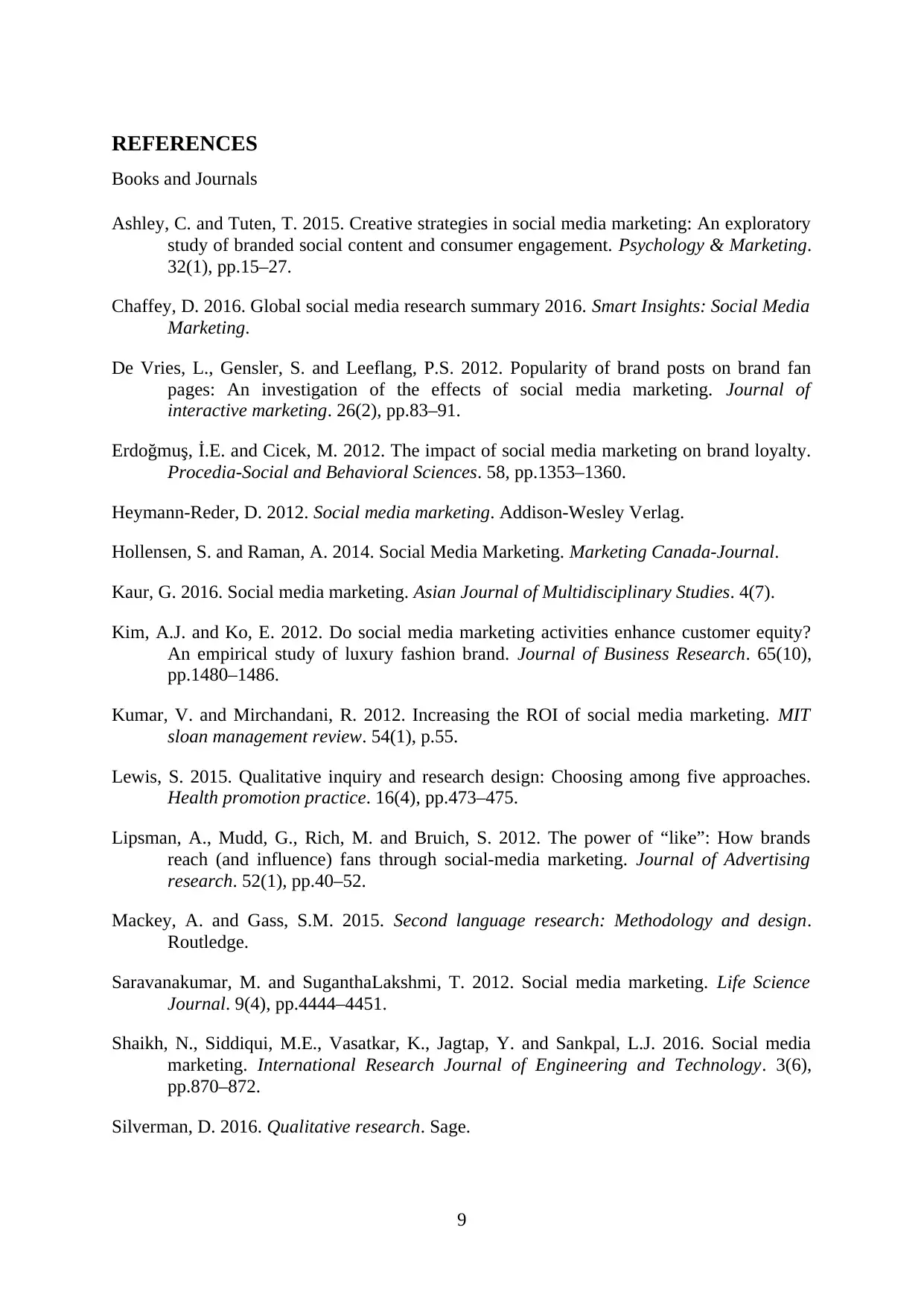
REFERENCES
Books and Journals
Ashley, C. and Tuten, T. 2015. Creative strategies in social media marketing: An exploratory
study of branded social content and consumer engagement. Psychology & Marketing.
32(1), pp.15–27.
Chaffey, D. 2016. Global social media research summary 2016. Smart Insights: Social Media
Marketing.
De Vries, L., Gensler, S. and Leeflang, P.S. 2012. Popularity of brand posts on brand fan
pages: An investigation of the effects of social media marketing. Journal of
interactive marketing. 26(2), pp.83–91.
Erdoğmuş, İ.E. and Cicek, M. 2012. The impact of social media marketing on brand loyalty.
Procedia-Social and Behavioral Sciences. 58, pp.1353–1360.
Heymann-Reder, D. 2012. Social media marketing. Addison-Wesley Verlag.
Hollensen, S. and Raman, A. 2014. Social Media Marketing. Marketing Canada-Journal.
Kaur, G. 2016. Social media marketing. Asian Journal of Multidisciplinary Studies. 4(7).
Kim, A.J. and Ko, E. 2012. Do social media marketing activities enhance customer equity?
An empirical study of luxury fashion brand. Journal of Business Research. 65(10),
pp.1480–1486.
Kumar, V. and Mirchandani, R. 2012. Increasing the ROI of social media marketing. MIT
sloan management review. 54(1), p.55.
Lewis, S. 2015. Qualitative inquiry and research design: Choosing among five approaches.
Health promotion practice. 16(4), pp.473–475.
Lipsman, A., Mudd, G., Rich, M. and Bruich, S. 2012. The power of “like”: How brands
reach (and influence) fans through social-media marketing. Journal of Advertising
research. 52(1), pp.40–52.
Mackey, A. and Gass, S.M. 2015. Second language research: Methodology and design.
Routledge.
Saravanakumar, M. and SuganthaLakshmi, T. 2012. Social media marketing. Life Science
Journal. 9(4), pp.4444–4451.
Shaikh, N., Siddiqui, M.E., Vasatkar, K., Jagtap, Y. and Sankpal, L.J. 2016. Social media
marketing. International Research Journal of Engineering and Technology. 3(6),
pp.870–872.
Silverman, D. 2016. Qualitative research. Sage.
9
Books and Journals
Ashley, C. and Tuten, T. 2015. Creative strategies in social media marketing: An exploratory
study of branded social content and consumer engagement. Psychology & Marketing.
32(1), pp.15–27.
Chaffey, D. 2016. Global social media research summary 2016. Smart Insights: Social Media
Marketing.
De Vries, L., Gensler, S. and Leeflang, P.S. 2012. Popularity of brand posts on brand fan
pages: An investigation of the effects of social media marketing. Journal of
interactive marketing. 26(2), pp.83–91.
Erdoğmuş, İ.E. and Cicek, M. 2012. The impact of social media marketing on brand loyalty.
Procedia-Social and Behavioral Sciences. 58, pp.1353–1360.
Heymann-Reder, D. 2012. Social media marketing. Addison-Wesley Verlag.
Hollensen, S. and Raman, A. 2014. Social Media Marketing. Marketing Canada-Journal.
Kaur, G. 2016. Social media marketing. Asian Journal of Multidisciplinary Studies. 4(7).
Kim, A.J. and Ko, E. 2012. Do social media marketing activities enhance customer equity?
An empirical study of luxury fashion brand. Journal of Business Research. 65(10),
pp.1480–1486.
Kumar, V. and Mirchandani, R. 2012. Increasing the ROI of social media marketing. MIT
sloan management review. 54(1), p.55.
Lewis, S. 2015. Qualitative inquiry and research design: Choosing among five approaches.
Health promotion practice. 16(4), pp.473–475.
Lipsman, A., Mudd, G., Rich, M. and Bruich, S. 2012. The power of “like”: How brands
reach (and influence) fans through social-media marketing. Journal of Advertising
research. 52(1), pp.40–52.
Mackey, A. and Gass, S.M. 2015. Second language research: Methodology and design.
Routledge.
Saravanakumar, M. and SuganthaLakshmi, T. 2012. Social media marketing. Life Science
Journal. 9(4), pp.4444–4451.
Shaikh, N., Siddiqui, M.E., Vasatkar, K., Jagtap, Y. and Sankpal, L.J. 2016. Social media
marketing. International Research Journal of Engineering and Technology. 3(6),
pp.870–872.
Silverman, D. 2016. Qualitative research. Sage.
9

1 out of 11


Related Documents


Your All-in-One AI-Powered Toolkit for Academic Success.
+13062052269
info@desklib.com
Available 24*7 on WhatsApp / Email
![[object Object]](/_next/static/media/star-bottom.7253800d.svg)
Unlock your academic potential
Copyright © 2020–2026 A2Z Services. All Rights Reserved. Developed and managed by ZUCOL.