The Impact of Social Media on the Young Generation: A Dissertation
VerifiedAdded on 2022/10/14
|40
|11450
|388
Thesis and Dissertation
AI Summary
This dissertation examines the impact of social media on the young generation, focusing on its effects on mental health, emotional well-being, and lifestyle. Chapter 1 introduces the background, problem statement, research rationale, aims, questions, and objectives. Chapter 2 provides a literature review, detailing the search strategy, inclusion and exclusion criteria, and key findings from existing research. Chapter 3 outlines the methodology, including the research design, methods, philosophy, data collection, and ethical considerations. Chapter 4 presents the results and findings, analyzing the demographics of the chosen subjects, their responses, and the development of key themes. Chapter 5 delves into data analysis and discussion, while Chapter 6 offers conclusions. The research aims to understand the positive and negative impacts of social media usage on the younger generation, including levels of stress, anxiety, and depression, and its influence on their thought processes and emotional well-being. The study utilizes a comprehensive approach, incorporating a literature review, detailed methodology, and thorough analysis to address the research questions effectively.
Running head: DISSERTATION
DISSERTATION: IMPACT OF SOCIAL MEDIA UPON THE YOUNG GENERATION
Name of the student
Name of the university
Author note
DISSERTATION: IMPACT OF SOCIAL MEDIA UPON THE YOUNG GENERATION
Name of the student
Name of the university
Author note

Paraphrase This Document
Need a fresh take? Get an instant paraphrase of this document with our AI Paraphraser
1DISSERTATION
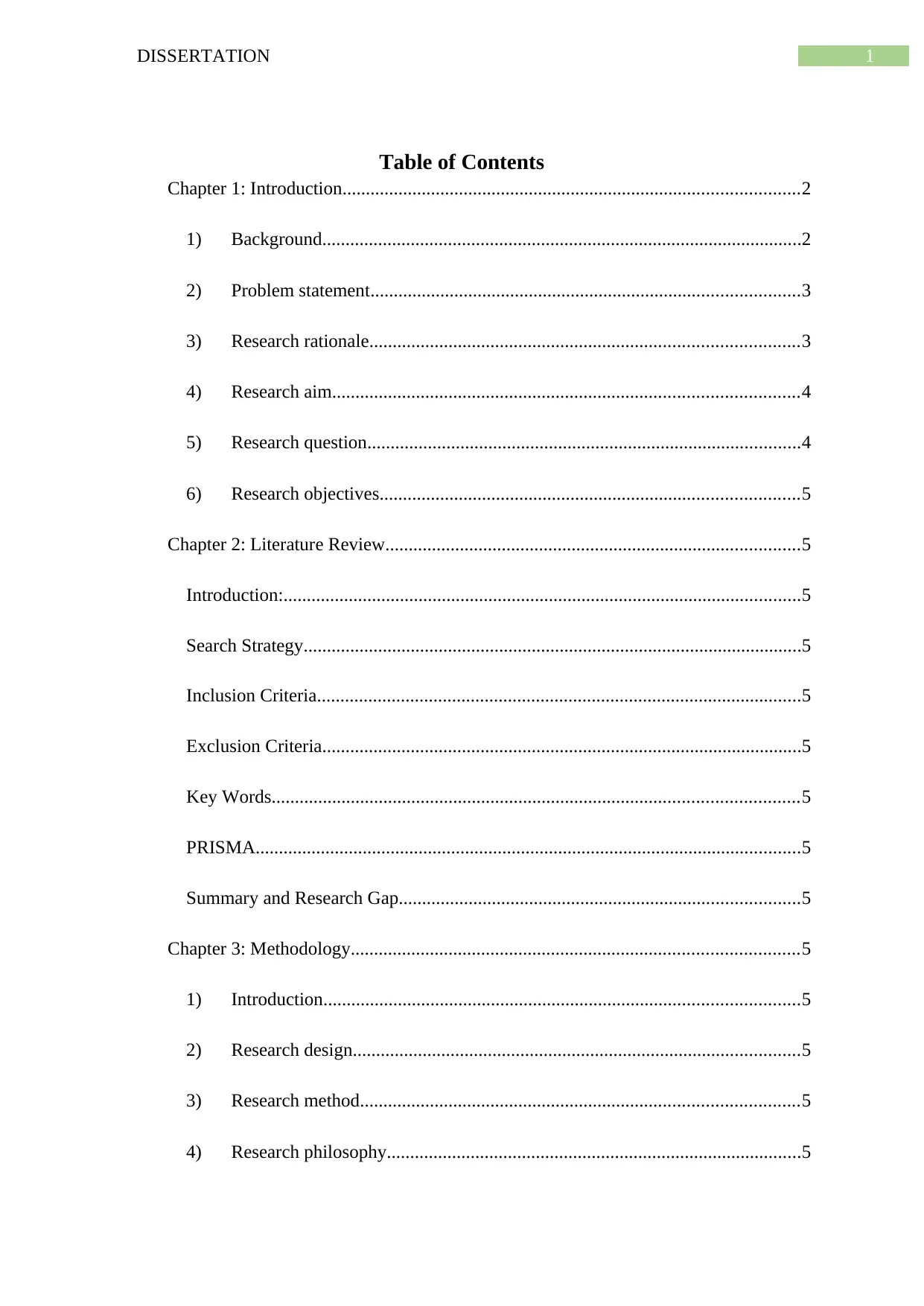
Table of Contents
Chapter 1: Introduction..................................................................................................2
1) Background.......................................................................................................2
2) Problem statement............................................................................................3
3) Research rationale............................................................................................3
4) Research aim....................................................................................................4
5) Research question.............................................................................................4
6) Research objectives..........................................................................................5
Chapter 2: Literature Review.........................................................................................5
Introduction:...............................................................................................................5
Search Strategy...........................................................................................................5
Inclusion Criteria........................................................................................................5
Exclusion Criteria.......................................................................................................5
Key Words.................................................................................................................5
PRISMA.....................................................................................................................5
Summary and Research Gap......................................................................................5
Chapter 3: Methodology................................................................................................5
1) Introduction......................................................................................................5
2) Research design................................................................................................5
3) Research method..............................................................................................5
4) Research philosophy.........................................................................................5
Table of Contents
Chapter 1: Introduction..................................................................................................2
1) Background.......................................................................................................2
2) Problem statement............................................................................................3
3) Research rationale............................................................................................3
4) Research aim....................................................................................................4
5) Research question.............................................................................................4
6) Research objectives..........................................................................................5
Chapter 2: Literature Review.........................................................................................5
Introduction:...............................................................................................................5
Search Strategy...........................................................................................................5
Inclusion Criteria........................................................................................................5
Exclusion Criteria.......................................................................................................5
Key Words.................................................................................................................5
PRISMA.....................................................................................................................5
Summary and Research Gap......................................................................................5
Chapter 3: Methodology................................................................................................5
1) Introduction......................................................................................................5
2) Research design................................................................................................5
3) Research method..............................................................................................5
4) Research philosophy.........................................................................................5
2DISSERTATION
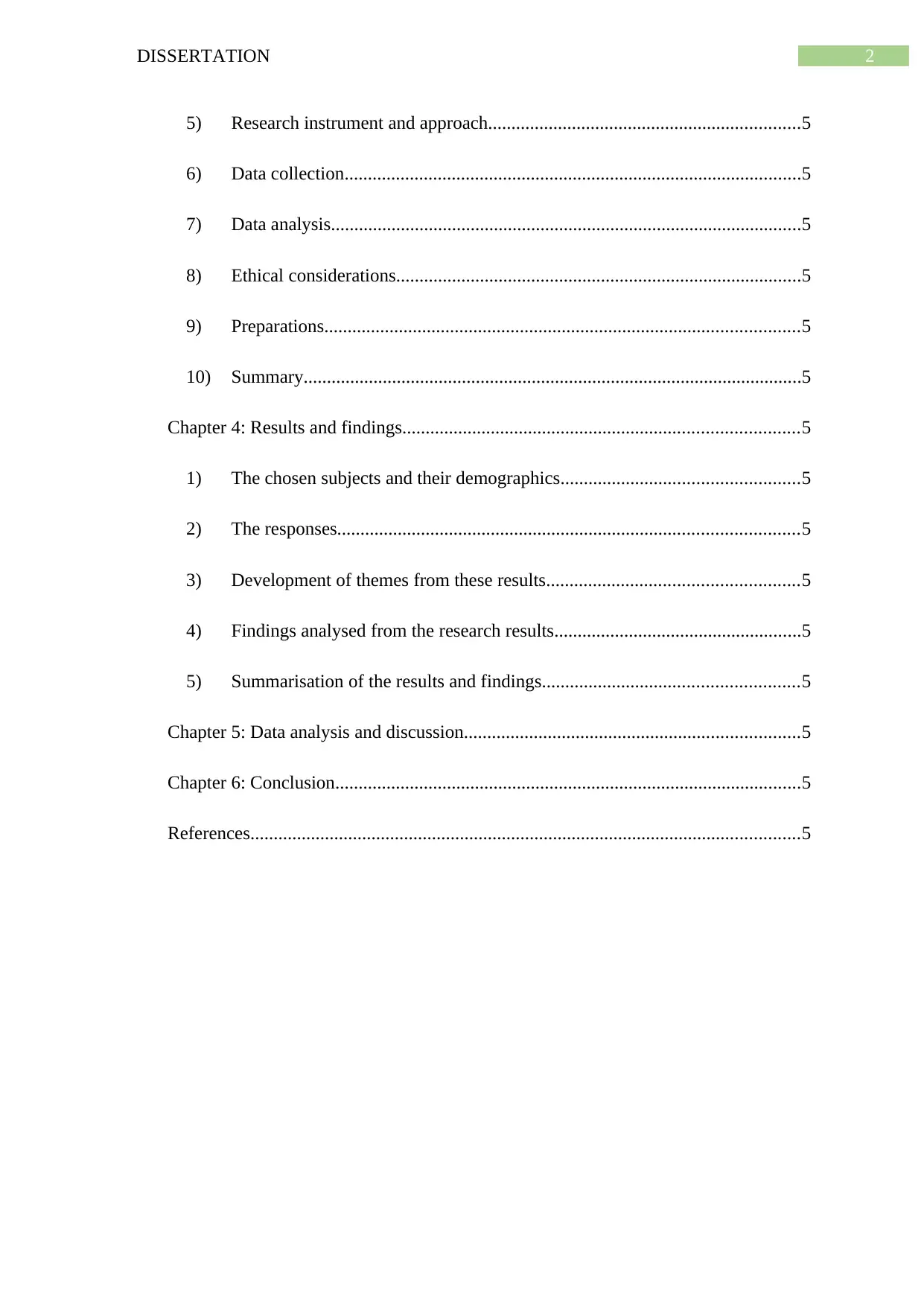
5) Research instrument and approach...................................................................5
6) Data collection..................................................................................................5
7) Data analysis.....................................................................................................5
8) Ethical considerations.......................................................................................5
9) Preparations......................................................................................................5
10) Summary...........................................................................................................5
Chapter 4: Results and findings.....................................................................................5
1) The chosen subjects and their demographics...................................................5
2) The responses...................................................................................................5
3) Development of themes from these results......................................................5
4) Findings analysed from the research results.....................................................5
5) Summarisation of the results and findings.......................................................5
Chapter 5: Data analysis and discussion........................................................................5
Chapter 6: Conclusion....................................................................................................5
References......................................................................................................................5
5) Research instrument and approach...................................................................5
6) Data collection..................................................................................................5
7) Data analysis.....................................................................................................5
8) Ethical considerations.......................................................................................5
9) Preparations......................................................................................................5
10) Summary...........................................................................................................5
Chapter 4: Results and findings.....................................................................................5
1) The chosen subjects and their demographics...................................................5
2) The responses...................................................................................................5
3) Development of themes from these results......................................................5
4) Findings analysed from the research results.....................................................5
5) Summarisation of the results and findings.......................................................5
Chapter 5: Data analysis and discussion........................................................................5
Chapter 6: Conclusion....................................................................................................5
References......................................................................................................................5
⊘ This is a preview!⊘
Do you want full access?
Subscribe today to unlock all pages.

Trusted by 1+ million students worldwide
3DISSERTATION
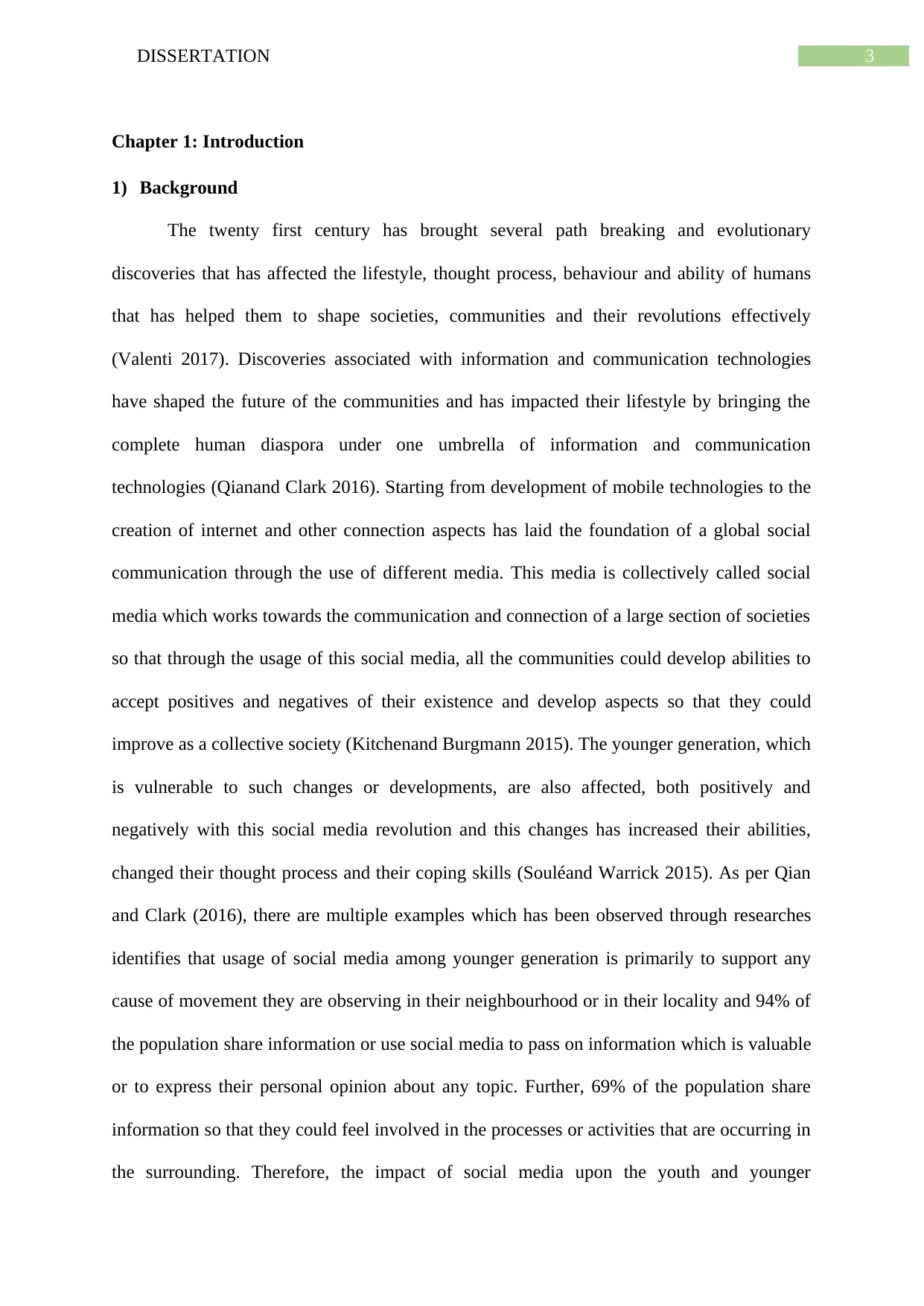
Chapter 1: Introduction
1) Background
The twenty first century has brought several path breaking and evolutionary
discoveries that has affected the lifestyle, thought process, behaviour and ability of humans
that has helped them to shape societies, communities and their revolutions effectively
(Valenti 2017). Discoveries associated with information and communication technologies
have shaped the future of the communities and has impacted their lifestyle by bringing the
complete human diaspora under one umbrella of information and communication
technologies (Qianand Clark 2016). Starting from development of mobile technologies to the
creation of internet and other connection aspects has laid the foundation of a global social
communication through the use of different media. This media is collectively called social
media which works towards the communication and connection of a large section of societies
so that through the usage of this social media, all the communities could develop abilities to
accept positives and negatives of their existence and develop aspects so that they could
improve as a collective society (Kitchenand Burgmann 2015). The younger generation, which
is vulnerable to such changes or developments, are also affected, both positively and
negatively with this social media revolution and this changes has increased their abilities,
changed their thought process and their coping skills (Souléand Warrick 2015). As per Qian
and Clark (2016), there are multiple examples which has been observed through researches
identifies that usage of social media among younger generation is primarily to support any
cause of movement they are observing in their neighbourhood or in their locality and 94% of
the population share information or use social media to pass on information which is valuable
or to express their personal opinion about any topic. Further, 69% of the population share
information so that they could feel involved in the processes or activities that are occurring in
the surrounding. Therefore, the impact of social media upon the youth and younger
Chapter 1: Introduction
1) Background
The twenty first century has brought several path breaking and evolutionary
discoveries that has affected the lifestyle, thought process, behaviour and ability of humans
that has helped them to shape societies, communities and their revolutions effectively
(Valenti 2017). Discoveries associated with information and communication technologies
have shaped the future of the communities and has impacted their lifestyle by bringing the
complete human diaspora under one umbrella of information and communication
technologies (Qianand Clark 2016). Starting from development of mobile technologies to the
creation of internet and other connection aspects has laid the foundation of a global social
communication through the use of different media. This media is collectively called social
media which works towards the communication and connection of a large section of societies
so that through the usage of this social media, all the communities could develop abilities to
accept positives and negatives of their existence and develop aspects so that they could
improve as a collective society (Kitchenand Burgmann 2015). The younger generation, which
is vulnerable to such changes or developments, are also affected, both positively and
negatively with this social media revolution and this changes has increased their abilities,
changed their thought process and their coping skills (Souléand Warrick 2015). As per Qian
and Clark (2016), there are multiple examples which has been observed through researches
identifies that usage of social media among younger generation is primarily to support any
cause of movement they are observing in their neighbourhood or in their locality and 94% of
the population share information or use social media to pass on information which is valuable
or to express their personal opinion about any topic. Further, 69% of the population share
information so that they could feel involved in the processes or activities that are occurring in
the surrounding. Therefore, the impact of social media upon the youth and younger
Paraphrase This Document
Need a fresh take? Get an instant paraphrase of this document with our AI Paraphraser
4DISSERTATION
generation could not be neglected as it is deeply embedded in their personality, thought
process and behaviour.
2) Problem statement
Despite the fact that the invention or discover of social media was conducted to
increase the connectivity and communication aspects among the population, there are
multiple examples in which the younger generations are seen to be negatively influenced by
the information provided upon the social media processes (Schivinskiand Dabrowski 2016).
This influence is observed to affect their personality, their determination power and their
thought process and has been observed to increase destructive or self-harm related tendency
(Caron and Light 2016). There are multiple cases in which it has been observed that social
media usage has affected the mental health and stability of multiple individuals and hence,
impacted their anxiety level, stress, depression, metal stability and others. Therefore, from
this condition, the research problem that arises is associated with the effects of social media
usage among the younger generation which would be addressed through this research article
(Moser 2016). Further, through the usage of this research problem, effective research
question would be developed.
3) Research rationale
The primary rationale of this research study is to identify the level of positivity and
negativity that is being spread through the usage of social media and the level of these
information or content in affecting the mental health of the younger generation (Soulé and
Warrick 2015). It is important to analyse or assess the level of social media usage among the
younger generation as it could also be one of the primary factor that is affecting their mental
health and social wellbeing (Caronand Light 2016). Therefore, from these understanding the
process would be completely focused upon understanding the positive and negative impact of
the social media usage among the younger generation that spend their majority of the time
generation could not be neglected as it is deeply embedded in their personality, thought
process and behaviour.
2) Problem statement
Despite the fact that the invention or discover of social media was conducted to
increase the connectivity and communication aspects among the population, there are
multiple examples in which the younger generations are seen to be negatively influenced by
the information provided upon the social media processes (Schivinskiand Dabrowski 2016).
This influence is observed to affect their personality, their determination power and their
thought process and has been observed to increase destructive or self-harm related tendency
(Caron and Light 2016). There are multiple cases in which it has been observed that social
media usage has affected the mental health and stability of multiple individuals and hence,
impacted their anxiety level, stress, depression, metal stability and others. Therefore, from
this condition, the research problem that arises is associated with the effects of social media
usage among the younger generation which would be addressed through this research article
(Moser 2016). Further, through the usage of this research problem, effective research
question would be developed.
3) Research rationale
The primary rationale of this research study is to identify the level of positivity and
negativity that is being spread through the usage of social media and the level of these
information or content in affecting the mental health of the younger generation (Soulé and
Warrick 2015). It is important to analyse or assess the level of social media usage among the
younger generation as it could also be one of the primary factor that is affecting their mental
health and social wellbeing (Caronand Light 2016). Therefore, from these understanding the
process would be completely focused upon understanding the positive and negative impact of
the social media usage among the younger generation that spend their majority of the time
5DISSERTATION
upon such websites. As well as it will also try to develop understanding of their emotional
wellbeing, their mental thought process, their sleep pattern and other aspects that determine
healthy and effective lifestyle (Moser 2016).
4) Research aim
Therefore, from this above- mentioned discussion, it should be mentioned that there
are multiple complex situations that would be analysed as the primary aim of this paper is to
find the answers to the research question. This research aims to understand the impact of
social media sites and its usage upon the younger population and the impact of these aspects
upon their mental health. Further, it would also aim to analyse the level of anxiety, stress,
depression and other mental health complications that are arising in the younger generation
so that the positive and negative impact of this condition among the younger generation could
be identified. Besides this, the primary aim of this research process would be to understand
the Impact of social media upon the thought process, lifestyle and emotional wellbeing of the
population so that their impact could be effectively analysed.
5) Research question
The research questions that has been developed and formulated for the successful
completion of this research and research aim is as follows:
RQ1: what are the impacts (both positives and negatives) of the extensive use of
social media upon the younger generation?
RQ2: what are the impacts of social media usage upon the mental health condition of
the younger generation such as their level of stress, anxiety, and depression?
RQ3: what is the impact of social media upon the emotional wellbeing and growth of
the younger generation?
upon such websites. As well as it will also try to develop understanding of their emotional
wellbeing, their mental thought process, their sleep pattern and other aspects that determine
healthy and effective lifestyle (Moser 2016).
4) Research aim
Therefore, from this above- mentioned discussion, it should be mentioned that there
are multiple complex situations that would be analysed as the primary aim of this paper is to
find the answers to the research question. This research aims to understand the impact of
social media sites and its usage upon the younger population and the impact of these aspects
upon their mental health. Further, it would also aim to analyse the level of anxiety, stress,
depression and other mental health complications that are arising in the younger generation
so that the positive and negative impact of this condition among the younger generation could
be identified. Besides this, the primary aim of this research process would be to understand
the Impact of social media upon the thought process, lifestyle and emotional wellbeing of the
population so that their impact could be effectively analysed.
5) Research question
The research questions that has been developed and formulated for the successful
completion of this research and research aim is as follows:
RQ1: what are the impacts (both positives and negatives) of the extensive use of
social media upon the younger generation?
RQ2: what are the impacts of social media usage upon the mental health condition of
the younger generation such as their level of stress, anxiety, and depression?
RQ3: what is the impact of social media upon the emotional wellbeing and growth of
the younger generation?
⊘ This is a preview!⊘
Do you want full access?
Subscribe today to unlock all pages.
Trusted by 1+ million students worldwide
6DISSERTATION
6) Research objectives
Through this research process, the primary objective is to identify the aspects of social
media which is associated with the mental health complications of the younger generation
and understanding the level of stress, anxiety, and depression they suffer from due to the
complex condition of mental illness. Further, this research would be identifying the process
and the ways which is related to the influence upon the mental health and other complex
conditions affecting the mental health, emotional wellbeing, their thought process and
thinking pattern over any complex situation. Further, through the help of this research the
primary aim of the researchers would be to understand the complex conditions, such as
bullying, discrimination and other which is faced by the younger generation and which
affects the mental health of these individuals drastically.
Chapter 2: Literature Review
Introduction:
The review of literature forms an important chapter of any thesis or a dissertation as it
enables the researcher to develop an overview about the existing research studies that have
been conducted on the area of research interest (Patten and Newhart 2017). The significance
of conducting a literature review is to equip the researcher with a methodological guideline
such that the primary research can be conducted accordingly. This chapter would enumerate
the detailed methodology undertaken to address the literature review and then discuss the
retrieved literatures that were selected for the research study and were aligned to research
question.
Search Strategy
To identify the research articles or research journals that identifies or answers the
accurate answer to the articulated research question developed for this research method, an
6) Research objectives
Through this research process, the primary objective is to identify the aspects of social
media which is associated with the mental health complications of the younger generation
and understanding the level of stress, anxiety, and depression they suffer from due to the
complex condition of mental illness. Further, this research would be identifying the process
and the ways which is related to the influence upon the mental health and other complex
conditions affecting the mental health, emotional wellbeing, their thought process and
thinking pattern over any complex situation. Further, through the help of this research the
primary aim of the researchers would be to understand the complex conditions, such as
bullying, discrimination and other which is faced by the younger generation and which
affects the mental health of these individuals drastically.
Chapter 2: Literature Review
Introduction:
The review of literature forms an important chapter of any thesis or a dissertation as it
enables the researcher to develop an overview about the existing research studies that have
been conducted on the area of research interest (Patten and Newhart 2017). The significance
of conducting a literature review is to equip the researcher with a methodological guideline
such that the primary research can be conducted accordingly. This chapter would enumerate
the detailed methodology undertaken to address the literature review and then discuss the
retrieved literatures that were selected for the research study and were aligned to research
question.
Search Strategy
To identify the research articles or research journals that identifies or answers the
accurate answer to the articulated research question developed for this research method, an
Paraphrase This Document
Need a fresh take? Get an instant paraphrase of this document with our AI Paraphraser
7DISSERTATION
inclusive and effectiveresearch process would be conducted so that all the research articles
connected to the research method could be identified and then these studies could be found
on electronic databases such as Google Scholar, CINHAL and PubMed. As stated by Gelling
(2015), electronic databases constitute gamut of knowledge in terms of research papers and
journals on diverse area of research interest. Conducting an elaborate search on the electronic
databases using appropriate key words help to retrieve research papers that are aligned to the
primary concept of the research question and the research objectives.
Inclusion Criteria
Inclusion criteria broadly refers to the characteristics or the properties that are used to
include research papers within a literature review (Morse 2016). In this case, the inclusion
criteria that were included for selecting relevant research papers included the following:
Research articles that had been available between the time span of 2015 to 2019 were
considered
Research papers that were exclusively published in the English language were
considered
Research articles that were available for full text were considered for the review
Exclusion Criteria
Exclusion criteria refers to the characteristics or the properties that are used to
eliminate irrelevant research papers within a literature review (Morse 2016). In this case, the
exclusion criteria that were considered for excluding research papers comprised of the
following:
Research papers that had been published prior to 2015 were excluded and were
considered as obsolete references
inclusive and effectiveresearch process would be conducted so that all the research articles
connected to the research method could be identified and then these studies could be found
on electronic databases such as Google Scholar, CINHAL and PubMed. As stated by Gelling
(2015), electronic databases constitute gamut of knowledge in terms of research papers and
journals on diverse area of research interest. Conducting an elaborate search on the electronic
databases using appropriate key words help to retrieve research papers that are aligned to the
primary concept of the research question and the research objectives.
Inclusion Criteria
Inclusion criteria broadly refers to the characteristics or the properties that are used to
include research papers within a literature review (Morse 2016). In this case, the inclusion
criteria that were included for selecting relevant research papers included the following:
Research articles that had been available between the time span of 2015 to 2019 were
considered
Research papers that were exclusively published in the English language were
considered
Research articles that were available for full text were considered for the review
Exclusion Criteria
Exclusion criteria refers to the characteristics or the properties that are used to
eliminate irrelevant research papers within a literature review (Morse 2016). In this case, the
exclusion criteria that were considered for excluding research papers comprised of the
following:
Research papers that had been published prior to 2015 were excluded and were
considered as obsolete references
8DISSERTATION
Research papers that were published in foreign languages other than English were
excluded on account of poor understanding of the text
Research papers that were not accessible for full text and papers whose abstracts
could only be accessed were excluded from the literature review
Key Words
According to Gentles et al. (2016), key words are short phrases or condensed search
terms that are used for conducting a search on the electronic databases. The electronic
databases cannot interpret long sentences and complex sentences. Therefore, in order to
obtain refined results, appropriate key terms are used such that relevant research papers that
are aligned to the research question can be obtained. In this case, the following key terms
were used to conduct search across the electronic databases.
Search terms: Mental health, anxiety, depression, youngsters, youth, young, use of
social media, impact of social media, psychological health and emotional wellbeing
The listed search terms were used in combination with the BOOLEAN operators that
included, OR/AND in order to obtain the most relevant and appropriate research journals that
adequately addressed the research question (Flick 2018). The key terms were entered on the
electronic database in combination with the BOOLEAN operators as: Impact of social media
AND Mental health OR Anxiety
Emotional wellbeing OR Psychological health OR Depression AND use of social
media
Youth OR Young OR Youngsters AND Impact of social media AND Mental health
PRISMA
Research papers that were published in foreign languages other than English were
excluded on account of poor understanding of the text
Research papers that were not accessible for full text and papers whose abstracts
could only be accessed were excluded from the literature review
Key Words
According to Gentles et al. (2016), key words are short phrases or condensed search
terms that are used for conducting a search on the electronic databases. The electronic
databases cannot interpret long sentences and complex sentences. Therefore, in order to
obtain refined results, appropriate key terms are used such that relevant research papers that
are aligned to the research question can be obtained. In this case, the following key terms
were used to conduct search across the electronic databases.
Search terms: Mental health, anxiety, depression, youngsters, youth, young, use of
social media, impact of social media, psychological health and emotional wellbeing
The listed search terms were used in combination with the BOOLEAN operators that
included, OR/AND in order to obtain the most relevant and appropriate research journals that
adequately addressed the research question (Flick 2018). The key terms were entered on the
electronic database in combination with the BOOLEAN operators as: Impact of social media
AND Mental health OR Anxiety
Emotional wellbeing OR Psychological health OR Depression AND use of social
media
Youth OR Young OR Youngsters AND Impact of social media AND Mental health
PRISMA
⊘ This is a preview!⊘
Do you want full access?
Subscribe today to unlock all pages.
Trusted by 1+ million students worldwide
9DISSERTATION
Paraphrase This Document
Need a fresh take? Get an instant paraphrase of this document with our AI Paraphraser
10DISSERTATION
Discussion
Research scholars are of the opinion that social media negatively impacts the mental
health of the adolescents and younger generation (Hamm et al. 2015). A number of research
studies mention that excessive use of social media can cause mental health disorders such as
depression, anxiety as well as eating disorders. In addition to this, sleeping disorders such as
sleep apnoea and insomnia have also been reported in young individuals who are excessively
active on social media. According to a report published on Psycom.net - Mental Health
Treatment Resource Since 1986 (2019), it has been mentioned that a strong correlation exists
between the time spent scrolling through the social media applications and negative
physiological health status. The report mentions about a study that was conducted in
Pittsburgh which reveals that young individuals who spent excessive time on the internet,
browsing through social media application were place at 2.2 times the risk of acquiring eating
and other physiological health disorders (Psycom.net - Mental Health Treatment Resource
Since 1986 2019). The research results also suggested that young students who spent more
than 4 hours on social media applications were most susceptible to develop mental health
disorders such as anxiety and depression (Psycom.net - Mental Health Treatment Resource
Since 1986 2019). Research studies further reveal that adolescents and youngsters are often
susceptible to cyberbullying, unrealistic comparisons, trolls and harassment that hamper the
mental wellness of the people (Garinger et al. 2016). Further, the usage of social media elicits
the desire to fetch more ‘likes’ on photographs and social posts shared online in order to be
socially acceptable. In the pursuit of acquiring more ‘likes’, youngsters often end up losing
their original identity as a result of which they experience tremendous insecurity which gives
rise to mental health disorders such as stress, anxiety and chronic depression (Garinger et al.
2016). In addition to this, issues such as cyberbullying have been reported to increasingly
hamper the mental health wellness of young individuals, which includes both boys and girls.
Discussion
Research scholars are of the opinion that social media negatively impacts the mental
health of the adolescents and younger generation (Hamm et al. 2015). A number of research
studies mention that excessive use of social media can cause mental health disorders such as
depression, anxiety as well as eating disorders. In addition to this, sleeping disorders such as
sleep apnoea and insomnia have also been reported in young individuals who are excessively
active on social media. According to a report published on Psycom.net - Mental Health
Treatment Resource Since 1986 (2019), it has been mentioned that a strong correlation exists
between the time spent scrolling through the social media applications and negative
physiological health status. The report mentions about a study that was conducted in
Pittsburgh which reveals that young individuals who spent excessive time on the internet,
browsing through social media application were place at 2.2 times the risk of acquiring eating
and other physiological health disorders (Psycom.net - Mental Health Treatment Resource
Since 1986 2019). The research results also suggested that young students who spent more
than 4 hours on social media applications were most susceptible to develop mental health
disorders such as anxiety and depression (Psycom.net - Mental Health Treatment Resource
Since 1986 2019). Research studies further reveal that adolescents and youngsters are often
susceptible to cyberbullying, unrealistic comparisons, trolls and harassment that hamper the
mental wellness of the people (Garinger et al. 2016). Further, the usage of social media elicits
the desire to fetch more ‘likes’ on photographs and social posts shared online in order to be
socially acceptable. In the pursuit of acquiring more ‘likes’, youngsters often end up losing
their original identity as a result of which they experience tremendous insecurity which gives
rise to mental health disorders such as stress, anxiety and chronic depression (Garinger et al.
2016). In addition to this, issues such as cyberbullying have been reported to increasingly
hamper the mental health wellness of young individuals, which includes both boys and girls.
11DISSERTATION
As stated by Dyson et al. (2016), cyberbullying is associated with the emergence of mental
health illness such as anxiety, depression and elevated risk of committing suicide. In addition
to this, making comparisons is another phenomenon which hampers the metal health status of
the young individuals. According to Spears et al. (2015), adolescents and youngsters between
the age group of 13 to 25 are increasingly influenced emotionally and within the mentioned
age group the phenomenon of drawing comparisons between self and the lives of others is
extremely common. Comparison gives rise to unrealistic expectations and as a result there is
increased dissatisfaction among the young individuals which results in elevated anxiety and
dissatisfaction (Gandhi et al. 2016). In addition to this, excessive social media use also raises
privacy concerns. In the pursuit of increasing number of friends on social media applications,
youngsters often unintentionally provide access to personal photographs and personal details
to strangers who end up using the details in an unsecured manner which leads to stress and
poor mental health outcome (Gandhi et al. 2016). Further, excessive use of social media
reduces actual human interaction and as a result over the time, youngsters often sustain an
emotional void within them.
Rideout, Fox and Trust (2018), conducted a national survey that included individuals
who belonged to the age group of 14 to 22 years in order to evaluate their quality of physical
health and mental health status. The survey conducted by the researchers was sponsored by
Hopelab and the Well Being Trust (Rideout, Fox and Trust 2018). The survey responses
revealed that approximately 50% of the participants experienced symptoms of depression. In
addition to this, the research findings also revealed that approximately 90% of the
participants browsed research materials on mental health wellness, 75% of the participants
listened to podcasts or watched videos online in order to seek interventions online for coping
with the symptoms of depression (Rideout, Fox and Trust 2018). The research findings also
revealed that 38% of the participants used mobile applications in order to contact mental
As stated by Dyson et al. (2016), cyberbullying is associated with the emergence of mental
health illness such as anxiety, depression and elevated risk of committing suicide. In addition
to this, making comparisons is another phenomenon which hampers the metal health status of
the young individuals. According to Spears et al. (2015), adolescents and youngsters between
the age group of 13 to 25 are increasingly influenced emotionally and within the mentioned
age group the phenomenon of drawing comparisons between self and the lives of others is
extremely common. Comparison gives rise to unrealistic expectations and as a result there is
increased dissatisfaction among the young individuals which results in elevated anxiety and
dissatisfaction (Gandhi et al. 2016). In addition to this, excessive social media use also raises
privacy concerns. In the pursuit of increasing number of friends on social media applications,
youngsters often unintentionally provide access to personal photographs and personal details
to strangers who end up using the details in an unsecured manner which leads to stress and
poor mental health outcome (Gandhi et al. 2016). Further, excessive use of social media
reduces actual human interaction and as a result over the time, youngsters often sustain an
emotional void within them.
Rideout, Fox and Trust (2018), conducted a national survey that included individuals
who belonged to the age group of 14 to 22 years in order to evaluate their quality of physical
health and mental health status. The survey conducted by the researchers was sponsored by
Hopelab and the Well Being Trust (Rideout, Fox and Trust 2018). The survey responses
revealed that approximately 50% of the participants experienced symptoms of depression. In
addition to this, the research findings also revealed that approximately 90% of the
participants browsed research materials on mental health wellness, 75% of the participants
listened to podcasts or watched videos online in order to seek interventions online for coping
with the symptoms of depression (Rideout, Fox and Trust 2018). The research findings also
revealed that 38% of the participants used mobile applications in order to contact mental
⊘ This is a preview!⊘
Do you want full access?
Subscribe today to unlock all pages.
Trusted by 1+ million students worldwide

1 out of 40


Related Documents


Your All-in-One AI-Powered Toolkit for Academic Success.
+13062052269
info@desklib.com
Available 24*7 on WhatsApp / Email
![[object Object]](/_next/static/media/star-bottom.7253800d.svg)
Unlock your academic potential
Copyright © 2020–2026 A2Z Services. All Rights Reserved. Developed and managed by ZUCOL.