The Impact of Unemployment on the Economic Growth of Nigeria: A Report
VerifiedAdded on 2022/11/28
|34
|7661
|420
Report
AI Summary
This report investigates the impact of unemployment on the economic growth of Nigeria from 2001 to 2018. The study explores the adverse effects of rising unemployment on the nation's economic development, considering the underutilization of resources and the limitations of macroeconomic policies. Using descriptive statistics, correlation analysis, and regression analysis, the research reveals a negative and significant correlation between unemployment and GDP growth in Nigeria, indicating that higher unemployment rates hinder economic expansion. The findings highlight the importance of job creation policies and effective macroeconomic management to mitigate the negative impacts of unemployment and foster sustainable economic growth. The report reviews existing literature on unemployment and economic growth, including the Phillips Curve and the Harrod-Domar Growth Model and concludes with implications and recommendations for policy makers.
Running head: IMPACT OF UNEMPLOYMENT ON ECONOMIC GROWTH OF
NIGERIA
Impact of Unemployment on Economic Growth of Nigeria
Name of the Student
Name of the University
Course ID
NIGERIA
Impact of Unemployment on Economic Growth of Nigeria
Name of the Student
Name of the University
Course ID

Paraphrase This Document
Need a fresh take? Get an instant paraphrase of this document with our AI Paraphraser
1IMPACT OF UNEMPLOYMENT ON ECONOMIC GROWTH OF NIGERIA
Acknowledgement
I would like to convey my gratitude to all people who have helped me to complete the
research. The journey towards accomplishment of the current research was a great experience
mainly due to the assistance of my supervisor Mr/Mrs……………….. The support and
assistance that I received from my advisor helped me to face the challenges in completion of
the research project. I am also thankful to my friends who helped me in gathering the
authentic data. Cooperation of my parents and their continuous support encourage me to
make my research noteworthy. I am highly grateful to authorities of my institution for
providing me the opportunity to give my best effort in the research area.
Acknowledgement
I would like to convey my gratitude to all people who have helped me to complete the
research. The journey towards accomplishment of the current research was a great experience
mainly due to the assistance of my supervisor Mr/Mrs……………….. The support and
assistance that I received from my advisor helped me to face the challenges in completion of
the research project. I am also thankful to my friends who helped me in gathering the
authentic data. Cooperation of my parents and their continuous support encourage me to
make my research noteworthy. I am highly grateful to authorities of my institution for
providing me the opportunity to give my best effort in the research area.
2IMPACT OF UNEMPLOYMENT ON ECONOMIC GROWTH OF NIGERIA
Executive Summary
The paper attempts to address the problem of unemployment in Nigeria and its impact on
economic growth of the nation. one of the hardest challenge that Sub-Saharan African
countries encounters is the continuously increasing unemployment trend in the economy. The
tendency of rising unemployment is well known among the average Nigerian. The prevailing
unemployment in the economy put the nation in danger because of its harmful socio-
economic consequences. The economy of Nigeria despite the expectation largely remained
underdeveloped as most of the human and natural resource remain underutilized. The per
capita income remains considerably low along with a high unemployment. Macroeconomic
policies undertaken by the government are unable to successfully reduce unemployment and
achieves sustained growth rate in the economy. The failure reduce unemployment has been
connected to failure of macroeconomic management. There are any evidences showing the
extent of relationship between unemployment and economic growth. Some of these evidences
support a positive relationship while some evidences support an inverse relation. The
growing rate of unemployment tends to reduce ability of people to purchase goods and
services by reducing income. This by lowering aggregate demand restricts economic growth
of the nation. Unemployment refers to the group of people in the labor force who are though
willing to work but are unable to find suitable jobs at the existing wage rate in the labor
market. Unemployment therefore indicates a state of joblessness in the economy. The
economic growth of a nation is mostly defining in terms of percentage change in gross
domestic product of the nation between two consecutive years. In studying the relation
between unemployment and economic growth of Nigeria the paper considers a sample data of
last eighteen years ranging from 2001 to 2018. Data has been analyzed using statistical
measures of descriptive statistics, correlation coefficient and regression. The historical data
on unemployment and economic growth of Nigeria revealed that both the series have
Executive Summary
The paper attempts to address the problem of unemployment in Nigeria and its impact on
economic growth of the nation. one of the hardest challenge that Sub-Saharan African
countries encounters is the continuously increasing unemployment trend in the economy. The
tendency of rising unemployment is well known among the average Nigerian. The prevailing
unemployment in the economy put the nation in danger because of its harmful socio-
economic consequences. The economy of Nigeria despite the expectation largely remained
underdeveloped as most of the human and natural resource remain underutilized. The per
capita income remains considerably low along with a high unemployment. Macroeconomic
policies undertaken by the government are unable to successfully reduce unemployment and
achieves sustained growth rate in the economy. The failure reduce unemployment has been
connected to failure of macroeconomic management. There are any evidences showing the
extent of relationship between unemployment and economic growth. Some of these evidences
support a positive relationship while some evidences support an inverse relation. The
growing rate of unemployment tends to reduce ability of people to purchase goods and
services by reducing income. This by lowering aggregate demand restricts economic growth
of the nation. Unemployment refers to the group of people in the labor force who are though
willing to work but are unable to find suitable jobs at the existing wage rate in the labor
market. Unemployment therefore indicates a state of joblessness in the economy. The
economic growth of a nation is mostly defining in terms of percentage change in gross
domestic product of the nation between two consecutive years. In studying the relation
between unemployment and economic growth of Nigeria the paper considers a sample data of
last eighteen years ranging from 2001 to 2018. Data has been analyzed using statistical
measures of descriptive statistics, correlation coefficient and regression. The historical data
on unemployment and economic growth of Nigeria revealed that both the series have
⊘ This is a preview!⊘
Do you want full access?
Subscribe today to unlock all pages.

Trusted by 1+ million students worldwide
3IMPACT OF UNEMPLOYMENT ON ECONOMIC GROWTH OF NIGERIA
constituted a stable trend and moved in the opposite direction. GDP growth in Nigeria
declined over time while unemployment increased over time. The study has first found a
negative significant correlation between the economic growth and unemployment in Nigeria
meaning that unemployment has a negative significant association with GDP growth of
Nigeria. From the regression result a statistically valid negative relation between
unemployment and economic growth has been obtained. The result thus indicates that
unemployment adversely affects economic growth of Nigeria. The empirical finding of the
paper provides a better understanding to the policy maker regarding the linkage between
unemployment and economic growth. It is the responsibility of government to undertake
various policies supportive to job creation within the economy and keep unemployment as
low as possible.
constituted a stable trend and moved in the opposite direction. GDP growth in Nigeria
declined over time while unemployment increased over time. The study has first found a
negative significant correlation between the economic growth and unemployment in Nigeria
meaning that unemployment has a negative significant association with GDP growth of
Nigeria. From the regression result a statistically valid negative relation between
unemployment and economic growth has been obtained. The result thus indicates that
unemployment adversely affects economic growth of Nigeria. The empirical finding of the
paper provides a better understanding to the policy maker regarding the linkage between
unemployment and economic growth. It is the responsibility of government to undertake
various policies supportive to job creation within the economy and keep unemployment as
low as possible.
Paraphrase This Document
Need a fresh take? Get an instant paraphrase of this document with our AI Paraphraser
4IMPACT OF UNEMPLOYMENT ON ECONOMIC GROWTH OF NIGERIA
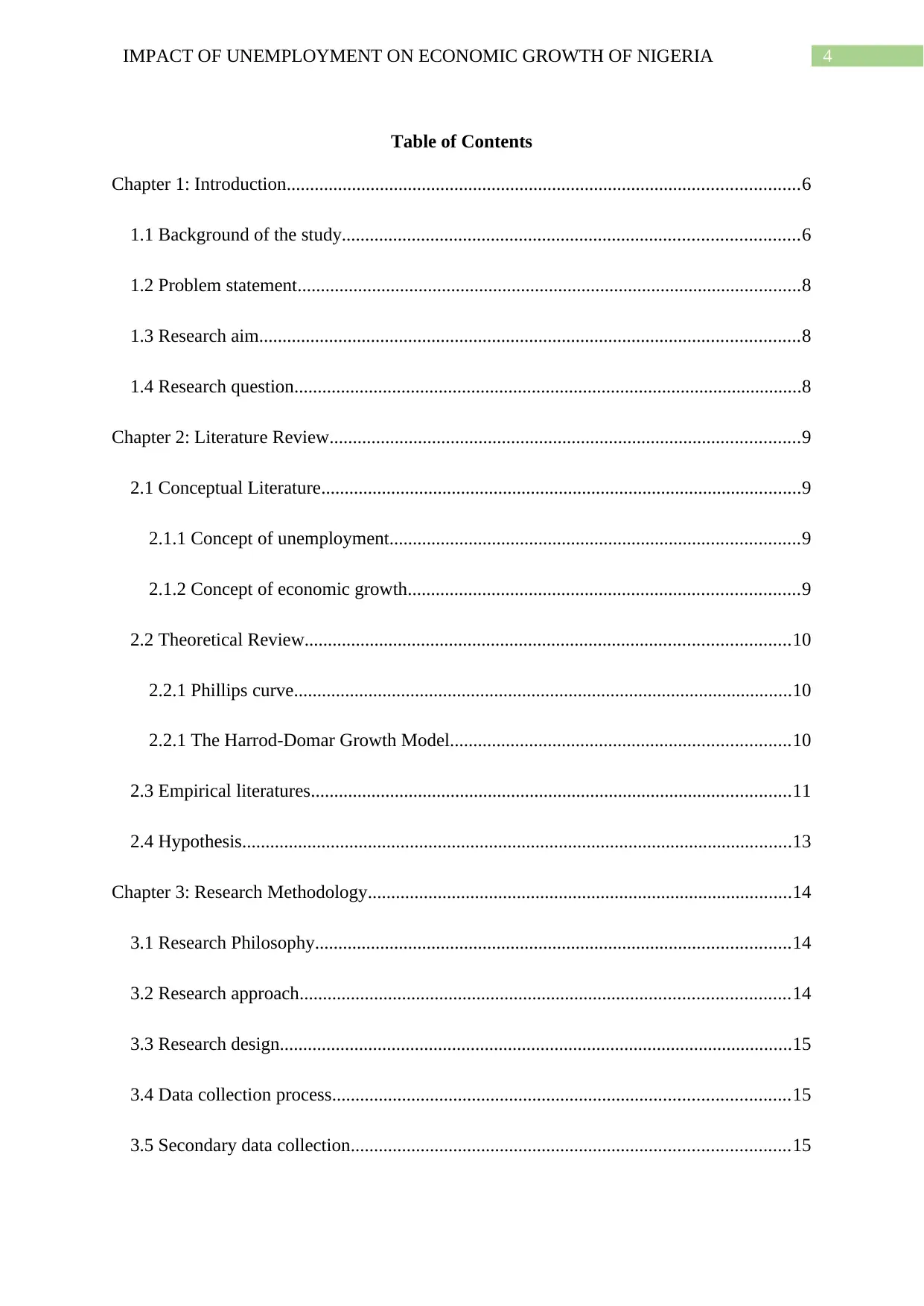
Table of Contents
Chapter 1: Introduction..............................................................................................................6
1.1 Background of the study..................................................................................................6
1.2 Problem statement............................................................................................................8
1.3 Research aim....................................................................................................................8
1.4 Research question.............................................................................................................8
Chapter 2: Literature Review.....................................................................................................9
2.1 Conceptual Literature.......................................................................................................9
2.1.1 Concept of unemployment........................................................................................9
2.1.2 Concept of economic growth....................................................................................9
2.2 Theoretical Review........................................................................................................10
2.2.1 Phillips curve...........................................................................................................10
2.2.1 The Harrod-Domar Growth Model.........................................................................10
2.3 Empirical literatures.......................................................................................................11
2.4 Hypothesis......................................................................................................................13
Chapter 3: Research Methodology...........................................................................................14
3.1 Research Philosophy......................................................................................................14
3.2 Research approach.........................................................................................................14
3.3 Research design..............................................................................................................15
3.4 Data collection process..................................................................................................15
3.5 Secondary data collection..............................................................................................15
Table of Contents
Chapter 1: Introduction..............................................................................................................6
1.1 Background of the study..................................................................................................6
1.2 Problem statement............................................................................................................8
1.3 Research aim....................................................................................................................8
1.4 Research question.............................................................................................................8
Chapter 2: Literature Review.....................................................................................................9
2.1 Conceptual Literature.......................................................................................................9
2.1.1 Concept of unemployment........................................................................................9
2.1.2 Concept of economic growth....................................................................................9
2.2 Theoretical Review........................................................................................................10
2.2.1 Phillips curve...........................................................................................................10
2.2.1 The Harrod-Domar Growth Model.........................................................................10
2.3 Empirical literatures.......................................................................................................11
2.4 Hypothesis......................................................................................................................13
Chapter 3: Research Methodology...........................................................................................14
3.1 Research Philosophy......................................................................................................14
3.2 Research approach.........................................................................................................14
3.3 Research design..............................................................................................................15
3.4 Data collection process..................................................................................................15
3.5 Secondary data collection..............................................................................................15
5IMPACT OF UNEMPLOYMENT ON ECONOMIC GROWTH OF NIGERIA
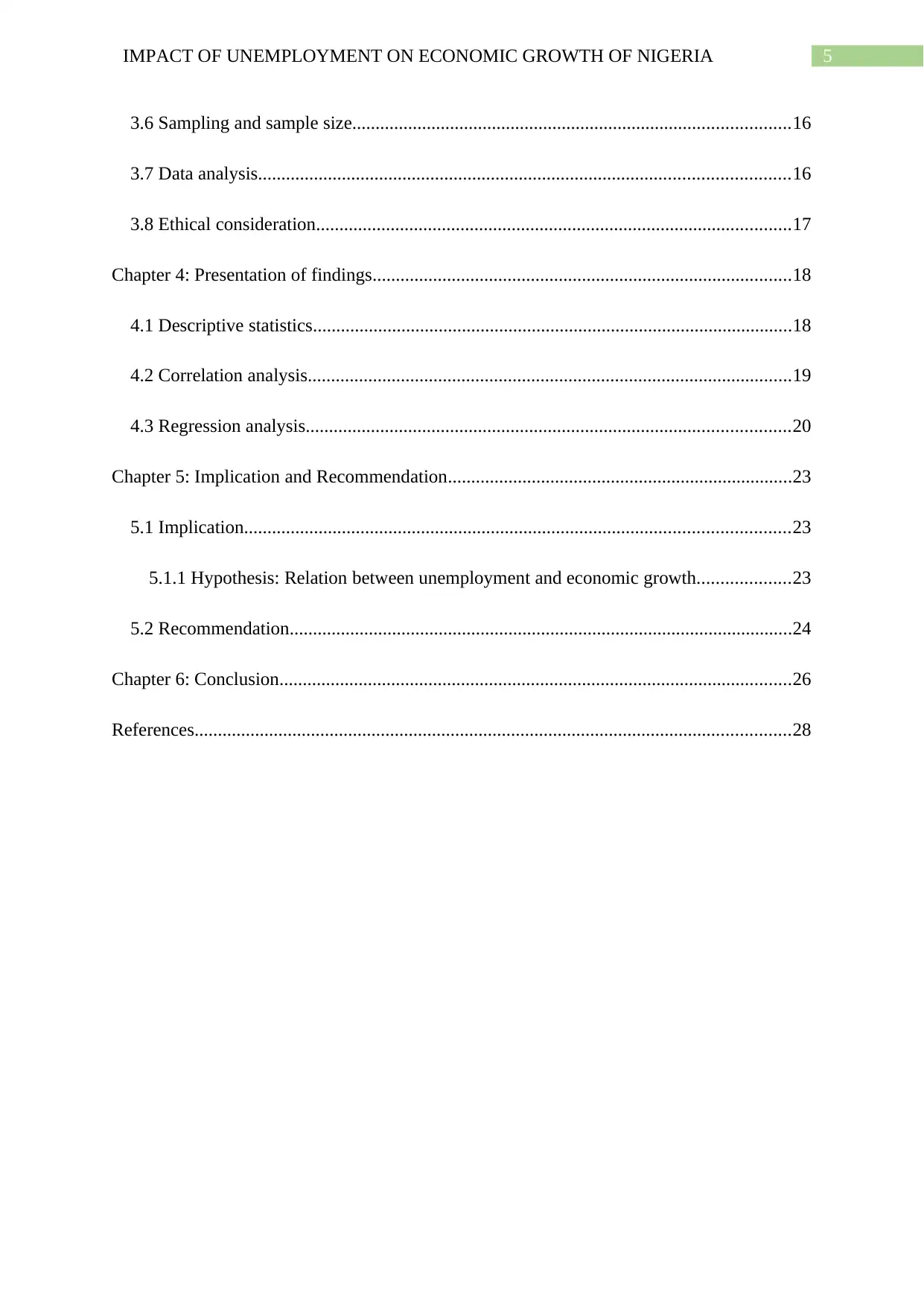
3.6 Sampling and sample size..............................................................................................16
3.7 Data analysis..................................................................................................................16
3.8 Ethical consideration......................................................................................................17
Chapter 4: Presentation of findings..........................................................................................18
4.1 Descriptive statistics.......................................................................................................18
4.2 Correlation analysis........................................................................................................19
4.3 Regression analysis........................................................................................................20
Chapter 5: Implication and Recommendation..........................................................................23
5.1 Implication.....................................................................................................................23
5.1.1 Hypothesis: Relation between unemployment and economic growth....................23
5.2 Recommendation............................................................................................................24
Chapter 6: Conclusion..............................................................................................................26
References................................................................................................................................28
3.6 Sampling and sample size..............................................................................................16
3.7 Data analysis..................................................................................................................16
3.8 Ethical consideration......................................................................................................17
Chapter 4: Presentation of findings..........................................................................................18
4.1 Descriptive statistics.......................................................................................................18
4.2 Correlation analysis........................................................................................................19
4.3 Regression analysis........................................................................................................20
Chapter 5: Implication and Recommendation..........................................................................23
5.1 Implication.....................................................................................................................23
5.1.1 Hypothesis: Relation between unemployment and economic growth....................23
5.2 Recommendation............................................................................................................24
Chapter 6: Conclusion..............................................................................................................26
References................................................................................................................................28
⊘ This is a preview!⊘
Do you want full access?
Subscribe today to unlock all pages.
Trusted by 1+ million students worldwide
6IMPACT OF UNEMPLOYMENT ON ECONOMIC GROWTH OF NIGERIA
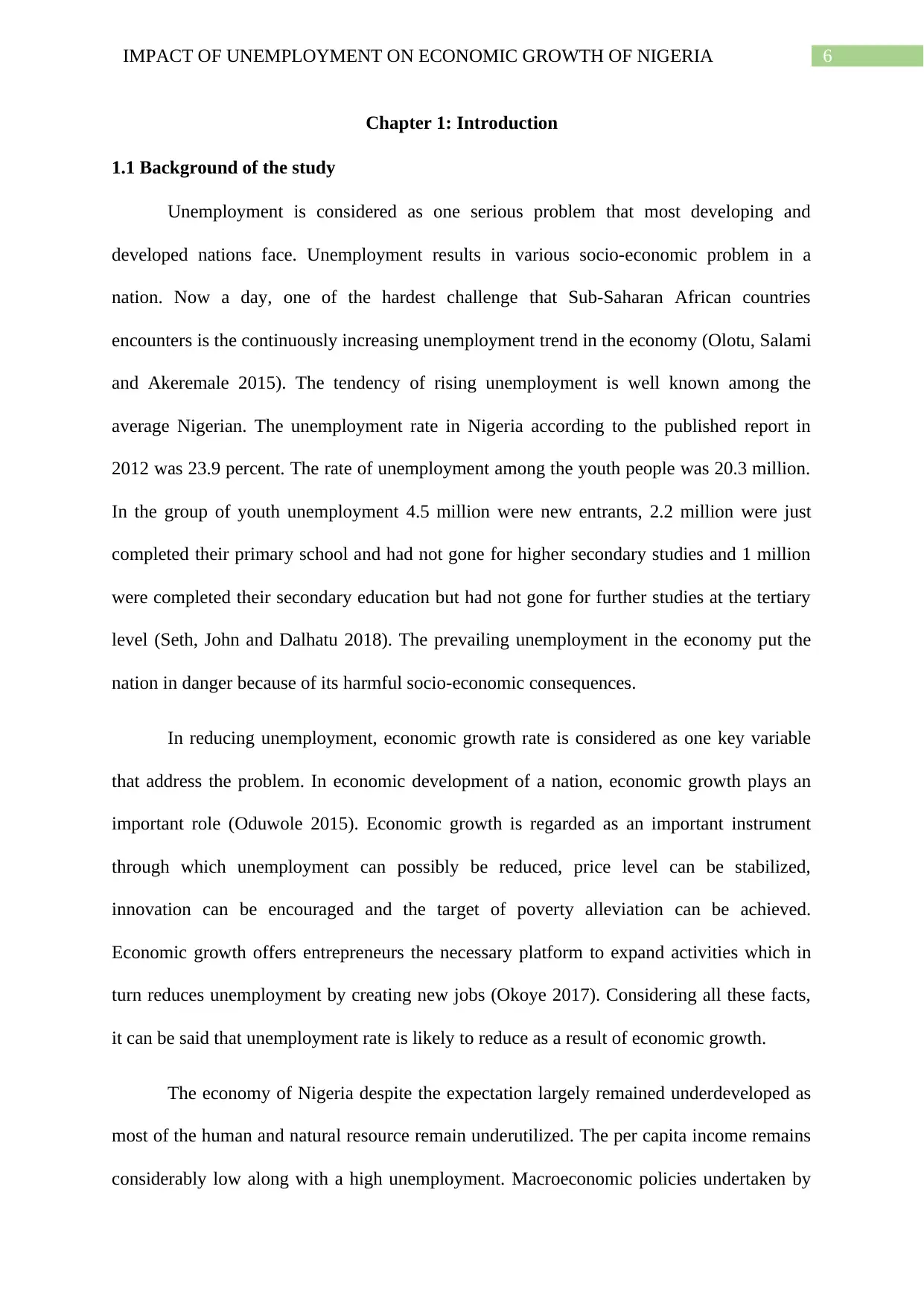
Chapter 1: Introduction
1.1 Background of the study
Unemployment is considered as one serious problem that most developing and
developed nations face. Unemployment results in various socio-economic problem in a
nation. Now a day, one of the hardest challenge that Sub-Saharan African countries
encounters is the continuously increasing unemployment trend in the economy (Olotu, Salami
and Akeremale 2015). The tendency of rising unemployment is well known among the
average Nigerian. The unemployment rate in Nigeria according to the published report in
2012 was 23.9 percent. The rate of unemployment among the youth people was 20.3 million.
In the group of youth unemployment 4.5 million were new entrants, 2.2 million were just
completed their primary school and had not gone for higher secondary studies and 1 million
were completed their secondary education but had not gone for further studies at the tertiary
level (Seth, John and Dalhatu 2018). The prevailing unemployment in the economy put the
nation in danger because of its harmful socio-economic consequences.
In reducing unemployment, economic growth rate is considered as one key variable
that address the problem. In economic development of a nation, economic growth plays an
important role (Oduwole 2015). Economic growth is regarded as an important instrument
through which unemployment can possibly be reduced, price level can be stabilized,
innovation can be encouraged and the target of poverty alleviation can be achieved.
Economic growth offers entrepreneurs the necessary platform to expand activities which in
turn reduces unemployment by creating new jobs (Okoye 2017). Considering all these facts,
it can be said that unemployment rate is likely to reduce as a result of economic growth.
The economy of Nigeria despite the expectation largely remained underdeveloped as
most of the human and natural resource remain underutilized. The per capita income remains
considerably low along with a high unemployment. Macroeconomic policies undertaken by
Chapter 1: Introduction
1.1 Background of the study
Unemployment is considered as one serious problem that most developing and
developed nations face. Unemployment results in various socio-economic problem in a
nation. Now a day, one of the hardest challenge that Sub-Saharan African countries
encounters is the continuously increasing unemployment trend in the economy (Olotu, Salami
and Akeremale 2015). The tendency of rising unemployment is well known among the
average Nigerian. The unemployment rate in Nigeria according to the published report in
2012 was 23.9 percent. The rate of unemployment among the youth people was 20.3 million.
In the group of youth unemployment 4.5 million were new entrants, 2.2 million were just
completed their primary school and had not gone for higher secondary studies and 1 million
were completed their secondary education but had not gone for further studies at the tertiary
level (Seth, John and Dalhatu 2018). The prevailing unemployment in the economy put the
nation in danger because of its harmful socio-economic consequences.
In reducing unemployment, economic growth rate is considered as one key variable
that address the problem. In economic development of a nation, economic growth plays an
important role (Oduwole 2015). Economic growth is regarded as an important instrument
through which unemployment can possibly be reduced, price level can be stabilized,
innovation can be encouraged and the target of poverty alleviation can be achieved.
Economic growth offers entrepreneurs the necessary platform to expand activities which in
turn reduces unemployment by creating new jobs (Okoye 2017). Considering all these facts,
it can be said that unemployment rate is likely to reduce as a result of economic growth.
The economy of Nigeria despite the expectation largely remained underdeveloped as
most of the human and natural resource remain underutilized. The per capita income remains
considerably low along with a high unemployment. Macroeconomic policies undertaken by
Paraphrase This Document
Need a fresh take? Get an instant paraphrase of this document with our AI Paraphraser
7IMPACT OF UNEMPLOYMENT ON ECONOMIC GROWTH OF NIGERIA
the government are unable to successfully reduce unemployment and achieves sustained
growth rate in the economy (Michael, Emeka and Emmanuel 2016). The failure reduce
unemployment has been connected to failure of macroeconomic management. The economy
provided sufficient employment to most of the Nigerian during 1960s and 1970s. This is due
to favorable wage rate and relative peace in most of the industries. The oil boom occurred in
late 1970s led to huge migration. Most of the migrant people are youth. Economic downturn
in the beginning of 1980s aggravated the problem of unemployment (Orji, Orji-Anthony and
Okafor 2015). To combat unemployment and stabilize economic growth government
introduced Structural Adjustment Program (SAP) in the year 1986.
As a result of crude oil glut and adaption of SAP result in an increase in Gross
Domestic Product of Nigeria. Despite economic growth between 1986 and 2014 Nigeria
failed to translate into an economically developed state because of high rate of
unemployment in the economy. The unemployment statistics between 1986 and 2014 were
somewhat puzzling. Statistics of central bank revealed that unemployment constituted an
upward rising trend during this period with rate of unemployment increased from 5.3 percent
in 1986 to 24.7 percent in 2012 (Adu et al. 2019). Unemployment reached to its lowest level
of 1.8 percent and 2.0 percent in the respective years of 1995 and 1990. This was the period
when unemployment rate responded considerably to the economic growth. In other years,
unemployment rate kept on increasing significantly despite recorded economic growth of the
nation. Okun’s law stating an inverse association between unemployment and economic
growth seems to be not applicable for Nigeria.
There are any evidences showing the extent of relationship between unemployment
and economic growth. Some of these evidences support a positive relationship while some
evidences support an inverse relation. The growing rate of unemployment tends to reduce
the government are unable to successfully reduce unemployment and achieves sustained
growth rate in the economy (Michael, Emeka and Emmanuel 2016). The failure reduce
unemployment has been connected to failure of macroeconomic management. The economy
provided sufficient employment to most of the Nigerian during 1960s and 1970s. This is due
to favorable wage rate and relative peace in most of the industries. The oil boom occurred in
late 1970s led to huge migration. Most of the migrant people are youth. Economic downturn
in the beginning of 1980s aggravated the problem of unemployment (Orji, Orji-Anthony and
Okafor 2015). To combat unemployment and stabilize economic growth government
introduced Structural Adjustment Program (SAP) in the year 1986.
As a result of crude oil glut and adaption of SAP result in an increase in Gross
Domestic Product of Nigeria. Despite economic growth between 1986 and 2014 Nigeria
failed to translate into an economically developed state because of high rate of
unemployment in the economy. The unemployment statistics between 1986 and 2014 were
somewhat puzzling. Statistics of central bank revealed that unemployment constituted an
upward rising trend during this period with rate of unemployment increased from 5.3 percent
in 1986 to 24.7 percent in 2012 (Adu et al. 2019). Unemployment reached to its lowest level
of 1.8 percent and 2.0 percent in the respective years of 1995 and 1990. This was the period
when unemployment rate responded considerably to the economic growth. In other years,
unemployment rate kept on increasing significantly despite recorded economic growth of the
nation. Okun’s law stating an inverse association between unemployment and economic
growth seems to be not applicable for Nigeria.
There are any evidences showing the extent of relationship between unemployment
and economic growth. Some of these evidences support a positive relationship while some
evidences support an inverse relation. The growing rate of unemployment tends to reduce
8IMPACT OF UNEMPLOYMENT ON ECONOMIC GROWTH OF NIGERIA
ability of people to purchase goods and services by reducing income. This by lowering
aggregate demand restricts economic growth of the nation.
1.2 Problem statement
Growing unemployment is one of the significant economic problem of Nigeria.
Growing unemployment not only have adverse socio-economic consequences but also
hampers economic growth by restricting productivity of the nation. Despite progressive
economic growth, Nigerian economy still unable to attain sustain reduction in
unemployment. In contrast, growing unemployment continues to hamper economic growth
along with adversely affecting the society and the economy. The paper attempts to address
the problem of unemployment in Nigeria and its impact on economic growth of the nation.
1.3 Research aim
The research study aims to investigate the effect of unemployment on economic
growth of Nigeria. The specific objective is to evaluate consequences of prevailing
unemployment on economic growth of the nation.
1.4 Research question
Depending on the problem statement and objective of the research the particular
research question is
How unemployment rate of Nigeria affects economic growth of the nation?
ability of people to purchase goods and services by reducing income. This by lowering
aggregate demand restricts economic growth of the nation.
1.2 Problem statement
Growing unemployment is one of the significant economic problem of Nigeria.
Growing unemployment not only have adverse socio-economic consequences but also
hampers economic growth by restricting productivity of the nation. Despite progressive
economic growth, Nigerian economy still unable to attain sustain reduction in
unemployment. In contrast, growing unemployment continues to hamper economic growth
along with adversely affecting the society and the economy. The paper attempts to address
the problem of unemployment in Nigeria and its impact on economic growth of the nation.
1.3 Research aim
The research study aims to investigate the effect of unemployment on economic
growth of Nigeria. The specific objective is to evaluate consequences of prevailing
unemployment on economic growth of the nation.
1.4 Research question
Depending on the problem statement and objective of the research the particular
research question is
How unemployment rate of Nigeria affects economic growth of the nation?
⊘ This is a preview!⊘
Do you want full access?
Subscribe today to unlock all pages.
Trusted by 1+ million students worldwide
9IMPACT OF UNEMPLOYMENT ON ECONOMIC GROWTH OF NIGERIA
Chapter 2: Literature Review
2.1 Conceptual Literature
2.1.1 Concept of unemployment
Unemployment refers to the group of people in the labor force who are though willing
to work but are unable to find suitable jobs at the existing wage rate in the labor market.
Unemployment therefore indicates a state of joblessness in the economy (Giugni, Berclaz and
Fuglister 2016). In another study, unemployment has been conceptualized as a condition
where certain members of labor force remain out of work voluntarily. Classical economists’
in contrast defined unemployment as a state resulted from excess labor supply because of
adjustment in the real wage. Unemployment according to classical view is therefore created
whenever wage is set above the market clearing wage (Benigno, Ricci and Surico 2015).
Under this situation number of job seekers exceeds existing vacancies in the labor market.
International Labor Organization defined unemployment as a situation of joblessness
that occurs as people are remained without jobs and this continues for more than four weeks.
Unemployment is measure for prevailing unemployment in the nation and computed by
presenting number of unemployed persons as a percentage of labor force (Hairault, Langot
and Zylberberg 2015).
2.1.2 Concept of economic growth
Different researchers defined economic growth in different way. In one of past
studies, unemployment is considered to be associated with per head capital (Zhang 2018).
The definition of economic growth in this way has been criticized because the concept of
economic growth is not only connected with capital but also there are other requirements. In
another study, economic growth is considered to be affected by different expenditure
components as certain types of expenditures have more effect on economic growth (Solow
Chapter 2: Literature Review
2.1 Conceptual Literature
2.1.1 Concept of unemployment
Unemployment refers to the group of people in the labor force who are though willing
to work but are unable to find suitable jobs at the existing wage rate in the labor market.
Unemployment therefore indicates a state of joblessness in the economy (Giugni, Berclaz and
Fuglister 2016). In another study, unemployment has been conceptualized as a condition
where certain members of labor force remain out of work voluntarily. Classical economists’
in contrast defined unemployment as a state resulted from excess labor supply because of
adjustment in the real wage. Unemployment according to classical view is therefore created
whenever wage is set above the market clearing wage (Benigno, Ricci and Surico 2015).
Under this situation number of job seekers exceeds existing vacancies in the labor market.
International Labor Organization defined unemployment as a situation of joblessness
that occurs as people are remained without jobs and this continues for more than four weeks.
Unemployment is measure for prevailing unemployment in the nation and computed by
presenting number of unemployed persons as a percentage of labor force (Hairault, Langot
and Zylberberg 2015).
2.1.2 Concept of economic growth
Different researchers defined economic growth in different way. In one of past
studies, unemployment is considered to be associated with per head capital (Zhang 2018).
The definition of economic growth in this way has been criticized because the concept of
economic growth is not only connected with capital but also there are other requirements. In
another study, economic growth is considered to be affected by different expenditure
components as certain types of expenditures have more effect on economic growth (Solow
Paraphrase This Document
Need a fresh take? Get an instant paraphrase of this document with our AI Paraphraser
10IMPACT OF UNEMPLOYMENT ON ECONOMIC GROWTH OF NIGERIA
2018). Among these the vital spending is expenditure on infrastructure, maintenance and
operation, legal frameworks and general administration.
The most accepted definition of economic growth is that defined economic growth in
terms of GDP of a nation which represents the nation’s ability to produce goods and services
in order to increase economic welfare of the citizens (McCombie and Thirlwall 2016).
Growth is considered as the stead state process that is related to the increasing productive
capacity of the nation.
2.2 Theoretical Review
2.2.1 Phillips curve
The theory of Phillips curve enjoyed great success soon after its introduction and had
a great influence of designing government policy in 1960s. As this is considered as an
important instrument in designing government policy, government considered to lower
unemployment as long as they are ready to tolerate high inflation and stability in price level
(Coibion and Gorodnichenko 2015). In 1970s, OECD member countries experienced high
inflation along with high unemployment. The existing Phillips curve failed to explain the
incidence of stagflation and a new relation had been discovered between inflation and
unemployment (Coibion, Gorodnichenko and Kamdar 2018). This relationship provided the
basis for modified Phillips curve theory and still holds for many of the developed nations.
The theory has been gradually evolved under series of events incorporated to each other
along with several new elements such as NAIRU, the mechanism of adaptive expectation and
rational expectation mechanism (Blanchard 2016).
2.2.1 The Harrod-Domar Growth Model
The Harrod-Domar model in economic literature is known as only capital model. The
model was taken over from the Rostow growth model because of some unanswered questions
2018). Among these the vital spending is expenditure on infrastructure, maintenance and
operation, legal frameworks and general administration.
The most accepted definition of economic growth is that defined economic growth in
terms of GDP of a nation which represents the nation’s ability to produce goods and services
in order to increase economic welfare of the citizens (McCombie and Thirlwall 2016).
Growth is considered as the stead state process that is related to the increasing productive
capacity of the nation.
2.2 Theoretical Review
2.2.1 Phillips curve
The theory of Phillips curve enjoyed great success soon after its introduction and had
a great influence of designing government policy in 1960s. As this is considered as an
important instrument in designing government policy, government considered to lower
unemployment as long as they are ready to tolerate high inflation and stability in price level
(Coibion and Gorodnichenko 2015). In 1970s, OECD member countries experienced high
inflation along with high unemployment. The existing Phillips curve failed to explain the
incidence of stagflation and a new relation had been discovered between inflation and
unemployment (Coibion, Gorodnichenko and Kamdar 2018). This relationship provided the
basis for modified Phillips curve theory and still holds for many of the developed nations.
The theory has been gradually evolved under series of events incorporated to each other
along with several new elements such as NAIRU, the mechanism of adaptive expectation and
rational expectation mechanism (Blanchard 2016).
2.2.1 The Harrod-Domar Growth Model
The Harrod-Domar model in economic literature is known as only capital model. The
model was taken over from the Rostow growth model because of some unanswered questions
11IMPACT OF UNEMPLOYMENT ON ECONOMIC GROWTH OF NIGERIA
of the model (Boianovsky 2017). The model considered saving accounts a certain proportion
of national income. Net investment in the model has been defined as a change in the stock of
capital. Moreover, the model assumes a direct relationship between Gross National Product
(GNP) and stock of capital (Eltis 2016). The model indicates that addition to the stock of
capital in terms of new investment brings an increase in national output or GNP. This relation
as depicted in the model is called capital-output ratio (Boianovsky 2017).
2.3 Empirical literatures
Several empirical studies have been conducted to evaluate the relation between
unemployment and economic growth. Studies conducted taking cross countries data and
considering international evidences attempt to validate Okun’s proposition regarding the
relation between growth and unemployment (Yelwa, David and Awe 2015). In a paper
designed by Alhdiy et al. (2015) investigated the relation between economic growth and
unemployment considering data of Egypt ranging from 2005 to 2013. The result found that
no co-integration existed between the two variables. More specifically, there was no evidence
of long term co-integration between economic growth and unemployment (Alhdiy et al.
2015). Another study developed on OECD nations found that there was no stable relation
between unemployment and economic growth over time or across countries. The paper
however concluded that there is valid impact of economic growth on unemployment (Adesola
et al. 2017).
A study based on the data of South Africa tends to examine the influence of change in
output on unemployment. The paper investigated relation between economic growth and
unemployment rate (Uz, Donghui and Imran 2016). Findings of the paper supports the
Okun’s law stating that for every 1 percent falls in unemployment rate in US, GNP increases
by 3 percent.
of the model (Boianovsky 2017). The model considered saving accounts a certain proportion
of national income. Net investment in the model has been defined as a change in the stock of
capital. Moreover, the model assumes a direct relationship between Gross National Product
(GNP) and stock of capital (Eltis 2016). The model indicates that addition to the stock of
capital in terms of new investment brings an increase in national output or GNP. This relation
as depicted in the model is called capital-output ratio (Boianovsky 2017).
2.3 Empirical literatures
Several empirical studies have been conducted to evaluate the relation between
unemployment and economic growth. Studies conducted taking cross countries data and
considering international evidences attempt to validate Okun’s proposition regarding the
relation between growth and unemployment (Yelwa, David and Awe 2015). In a paper
designed by Alhdiy et al. (2015) investigated the relation between economic growth and
unemployment considering data of Egypt ranging from 2005 to 2013. The result found that
no co-integration existed between the two variables. More specifically, there was no evidence
of long term co-integration between economic growth and unemployment (Alhdiy et al.
2015). Another study developed on OECD nations found that there was no stable relation
between unemployment and economic growth over time or across countries. The paper
however concluded that there is valid impact of economic growth on unemployment (Adesola
et al. 2017).
A study based on the data of South Africa tends to examine the influence of change in
output on unemployment. The paper investigated relation between economic growth and
unemployment rate (Uz, Donghui and Imran 2016). Findings of the paper supports the
Okun’s law stating that for every 1 percent falls in unemployment rate in US, GNP increases
by 3 percent.
⊘ This is a preview!⊘
Do you want full access?
Subscribe today to unlock all pages.
Trusted by 1+ million students worldwide

1 out of 34


Related Documents


Your All-in-One AI-Powered Toolkit for Academic Success.
+13062052269
info@desklib.com
Available 24*7 on WhatsApp / Email
![[object Object]](/_next/static/media/star-bottom.7253800d.svg)
Unlock your academic potential
Copyright © 2020–2026 A2Z Services. All Rights Reserved. Developed and managed by ZUCOL.