COMM 363: Marketing Analysis Case Study - Jon Blume Company
VerifiedAdded on 2022/08/15
|11
|1802
|11
Case Study
AI Summary
This document presents a comprehensive case study analysis of the Jon Blume Company, examining its market segmentation, sales performance in DFW and non-DFW areas, and strategic challenges. The analysis includes detailed calculations and evaluations of various marketing strategies, such as focusing on architectural coatings, price reductions, and increasing sales representatives. The study delves into the pros and cons of each strategy, providing insights into the company's financial contributions, and the potential impact of competition. The author provides recommendations for future marketing activities, emphasizing the importance of understanding customer price sensitivity and the need for strategic decision-making in a competitive market. The bonus question focuses on the main learning points, which emphasize the importance of marketing and strategy formulation in a competitive industry.
Running head: IMPLEMENT AND MONITOR MARKETING ACTIVITIES
Implement and Monitor Marketing Activities
Name of the Student
Name of the University
Author Note:
Implement and Monitor Marketing Activities
Name of the Student
Name of the University
Author Note:

Paraphrase This Document
Need a fresh take? Get an instant paraphrase of this document with our AI Paraphraser
IMPLEMENT AND MONITOR MARKETING ACTIVITIES
Table of Contents
Answer to Question 1......................................................................................................................2
Answer to Question 2......................................................................................................................2
Answer to Question 3......................................................................................................................2
Answer to Question 4......................................................................................................................3
Answer to Question 5 (a).................................................................................................................3
Answer to Question 5 (b).................................................................................................................4
Answer to Question 5 (c).................................................................................................................4
Answer to Question 6 (a).................................................................................................................5
Answer to Question 6 (b).................................................................................................................5
Answer to Question 6 (c).................................................................................................................6
Answer to Question 7 (a).................................................................................................................7
Answer to Question 7 (b).................................................................................................................7
Answer to Question 7 (c).................................................................................................................7
Answer to Question 8......................................................................................................................8
Answer to Bonus Question..............................................................................................................8
Reference & Bibliographies..........................................................................................................10
Table of Contents
Answer to Question 1......................................................................................................................2
Answer to Question 2......................................................................................................................2
Answer to Question 3......................................................................................................................2
Answer to Question 4......................................................................................................................3
Answer to Question 5 (a).................................................................................................................3
Answer to Question 5 (b).................................................................................................................4
Answer to Question 5 (c).................................................................................................................4
Answer to Question 6 (a).................................................................................................................5
Answer to Question 6 (b).................................................................................................................5
Answer to Question 6 (c).................................................................................................................6
Answer to Question 7 (a).................................................................................................................7
Answer to Question 7 (b).................................................................................................................7
Answer to Question 7 (c).................................................................................................................7
Answer to Question 8......................................................................................................................8
Answer to Bonus Question..............................................................................................................8
Reference & Bibliographies..........................................................................................................10
IMPLEMENT AND MONITOR MARKETING ACTIVITIES
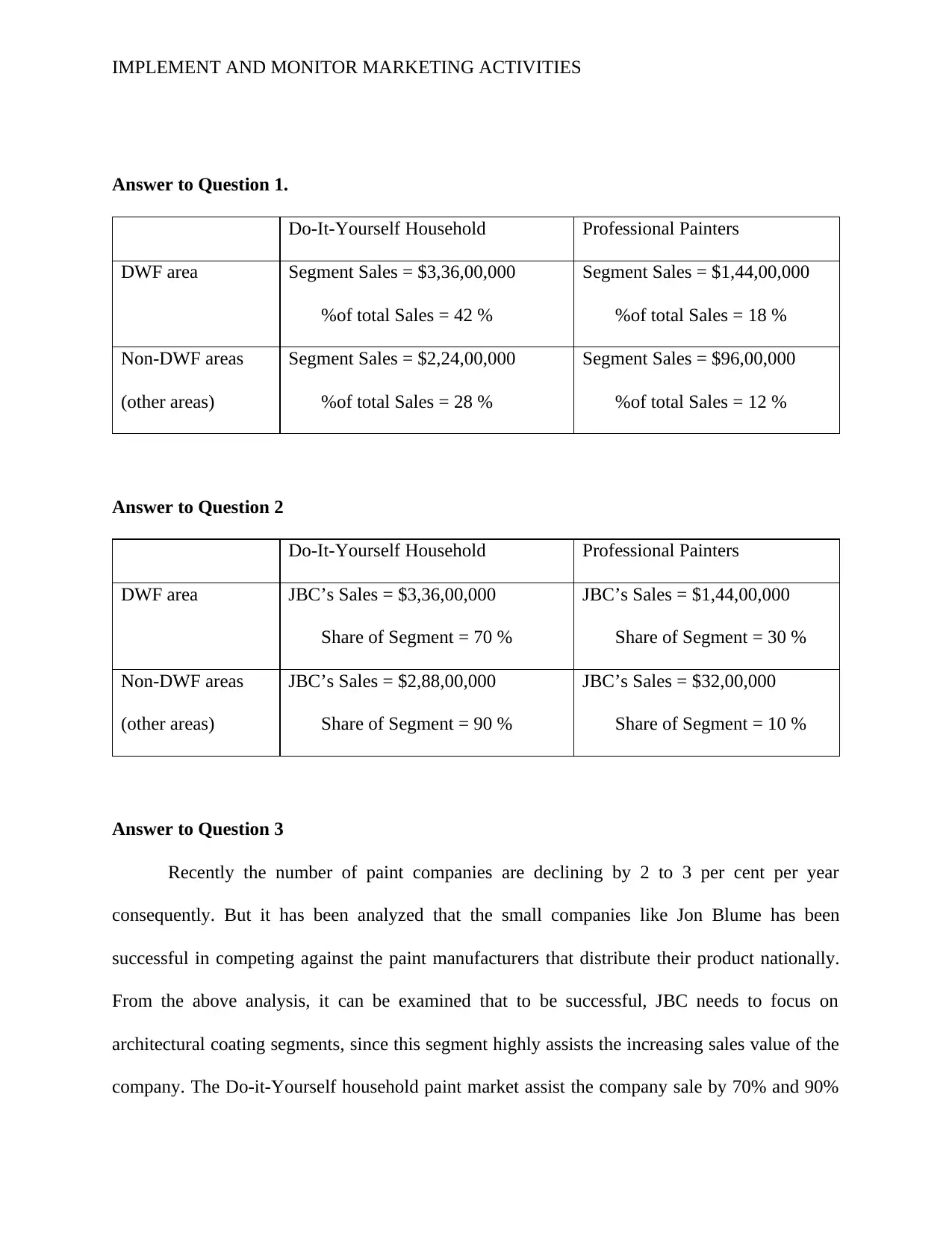
Answer to Question 1.
Do-It-Yourself Household Professional Painters
DWF area Segment Sales = $3,36,00,000
%of total Sales = 42 %
Segment Sales = $1,44,00,000
%of total Sales = 18 %
Non-DWF areas
(other areas)
Segment Sales = $2,24,00,000
%of total Sales = 28 %
Segment Sales = $96,00,000
%of total Sales = 12 %
Answer to Question 2
Do-It-Yourself Household Professional Painters
DWF area JBC’s Sales = $3,36,00,000
Share of Segment = 70 %
JBC’s Sales = $1,44,00,000
Share of Segment = 30 %
Non-DWF areas
(other areas)
JBC’s Sales = $2,88,00,000
Share of Segment = 90 %
JBC’s Sales = $32,00,000
Share of Segment = 10 %
Answer to Question 3
Recently the number of paint companies are declining by 2 to 3 per cent per year
consequently. But it has been analyzed that the small companies like Jon Blume has been
successful in competing against the paint manufacturers that distribute their product nationally.
From the above analysis, it can be examined that to be successful, JBC needs to focus on
architectural coating segments, since this segment highly assists the increasing sales value of the
company. The Do-it-Yourself household paint market assist the company sale by 70% and 90%
Answer to Question 1.
Do-It-Yourself Household Professional Painters
DWF area Segment Sales = $3,36,00,000
%of total Sales = 42 %
Segment Sales = $1,44,00,000
%of total Sales = 18 %
Non-DWF areas
(other areas)
Segment Sales = $2,24,00,000
%of total Sales = 28 %
Segment Sales = $96,00,000
%of total Sales = 12 %
Answer to Question 2
Do-It-Yourself Household Professional Painters
DWF area JBC’s Sales = $3,36,00,000
Share of Segment = 70 %
JBC’s Sales = $1,44,00,000
Share of Segment = 30 %
Non-DWF areas
(other areas)
JBC’s Sales = $2,88,00,000
Share of Segment = 90 %
JBC’s Sales = $32,00,000
Share of Segment = 10 %
Answer to Question 3
Recently the number of paint companies are declining by 2 to 3 per cent per year
consequently. But it has been analyzed that the small companies like Jon Blume has been
successful in competing against the paint manufacturers that distribute their product nationally.
From the above analysis, it can be examined that to be successful, JBC needs to focus on
architectural coating segments, since this segment highly assists the increasing sales value of the
company. The Do-it-Yourself household paint market assist the company sale by 70% and 90%
⊘ This is a preview!⊘
Do you want full access?
Subscribe today to unlock all pages.

Trusted by 1+ million students worldwide
IMPLEMENT AND MONITOR MARKETING ACTIVITIES
in DFW and Non-DFW areas respectively. Moreover, the total sales in these areas has been
increasing in the past few years. Therefore, the paint market of Do-It-Yourself can help the
company to be successful in the future. Also, the architectural coating purchase behavior
suggests that approximately 50% of the total dollar sales are accounted by the do-it-yourself
painters.
Answer to Question 4
The first strategy “no change in focus or increase in expenditures” is beneficial because:
Improving quality becomes easier since there is no variation in the focus.
The price remains same since there is no increase in the expenditure
The cons of applying the strategy is that:
No new areas can be penetrated by the company.
Without increasing the expenditure no advertisement cost can be incurred for marketing
specially in non-DFW areas.
The above strategy is not useful since no change in focus or increase in the expenditure will
make the company unproductive in making base for the new customers. Moreover, any
competitor or new firm can easily acquire their customers as well from the increase expenditure
on marketing.
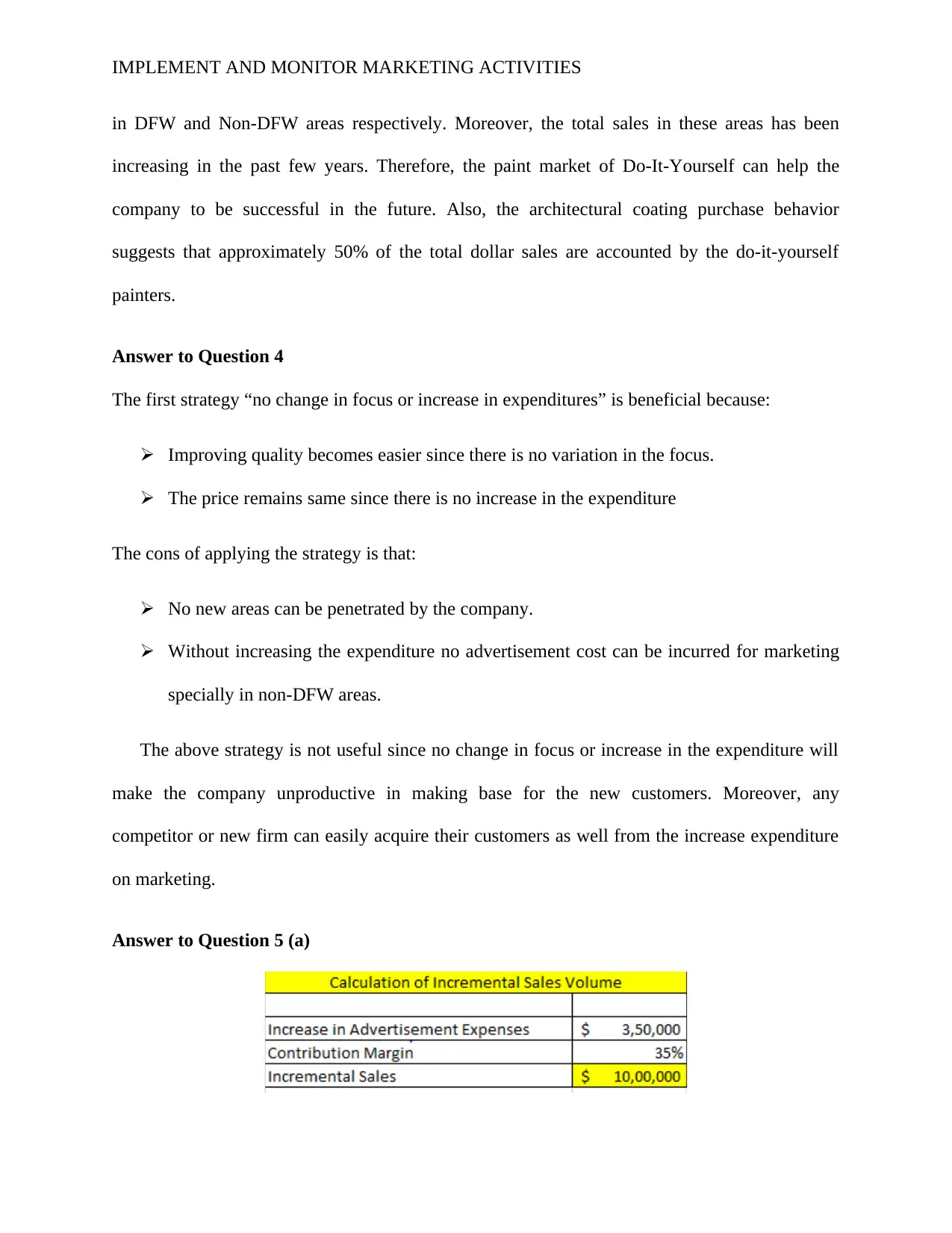
Answer to Question 5 (a)
in DFW and Non-DFW areas respectively. Moreover, the total sales in these areas has been
increasing in the past few years. Therefore, the paint market of Do-It-Yourself can help the
company to be successful in the future. Also, the architectural coating purchase behavior
suggests that approximately 50% of the total dollar sales are accounted by the do-it-yourself
painters.
Answer to Question 4
The first strategy “no change in focus or increase in expenditures” is beneficial because:
Improving quality becomes easier since there is no variation in the focus.
The price remains same since there is no increase in the expenditure
The cons of applying the strategy is that:
No new areas can be penetrated by the company.
Without increasing the expenditure no advertisement cost can be incurred for marketing
specially in non-DFW areas.
The above strategy is not useful since no change in focus or increase in the expenditure will
make the company unproductive in making base for the new customers. Moreover, any
competitor or new firm can easily acquire their customers as well from the increase expenditure
on marketing.
Answer to Question 5 (a)
Paraphrase This Document
Need a fresh take? Get an instant paraphrase of this document with our AI Paraphraser
IMPLEMENT AND MONITOR MARKETING ACTIVITIES
Answer to Question 5 (b)
The share that do-it-yourself will need to achieve the increase in sales volume in DFW
area is 70% of the 60% of total sales ($90million) = $37.8 million.
The share that do-it-yourself will need to achieve the increase in sales volume in non-
DFW area is 90% of the 40% of the total sales ($90million) = $32.4 million.
Answer to Question 5 (c)
The pros of applying the above strategy are as follows:
The corporate brand image will improve.
This advertising expense will increase the company coverage in the non-DFW areas in
additional 15 countries as well.
The cons of applying such strategy:
The overall cost will increase.
Since the competition is aggressive in this industry, the company may face decrease in
demand due to consumer preference towards less expensive substitutes.
The above strategy will improve the brand image ((Wischermann & Shore, 2019) but
consumers are more price sensitive as the company has experienced before and hence increase in
the overall cost will shift the preference of the budgeted professional and household painters
towards competitive products and also the price of Jon Blume company is noticeably higher than
the mass merchandise.
Answer to Question 5 (b)
The share that do-it-yourself will need to achieve the increase in sales volume in DFW
area is 70% of the 60% of total sales ($90million) = $37.8 million.
The share that do-it-yourself will need to achieve the increase in sales volume in non-
DFW area is 90% of the 40% of the total sales ($90million) = $32.4 million.
Answer to Question 5 (c)
The pros of applying the above strategy are as follows:
The corporate brand image will improve.
This advertising expense will increase the company coverage in the non-DFW areas in
additional 15 countries as well.
The cons of applying such strategy:
The overall cost will increase.
Since the competition is aggressive in this industry, the company may face decrease in
demand due to consumer preference towards less expensive substitutes.
The above strategy will improve the brand image ((Wischermann & Shore, 2019) but
consumers are more price sensitive as the company has experienced before and hence increase in
the overall cost will shift the preference of the budgeted professional and household painters
towards competitive products and also the price of Jon Blume company is noticeably higher than
the mass merchandise.
IMPLEMENT AND MONITOR MARKETING ACTIVITIES
Answer to Question 6 (a)
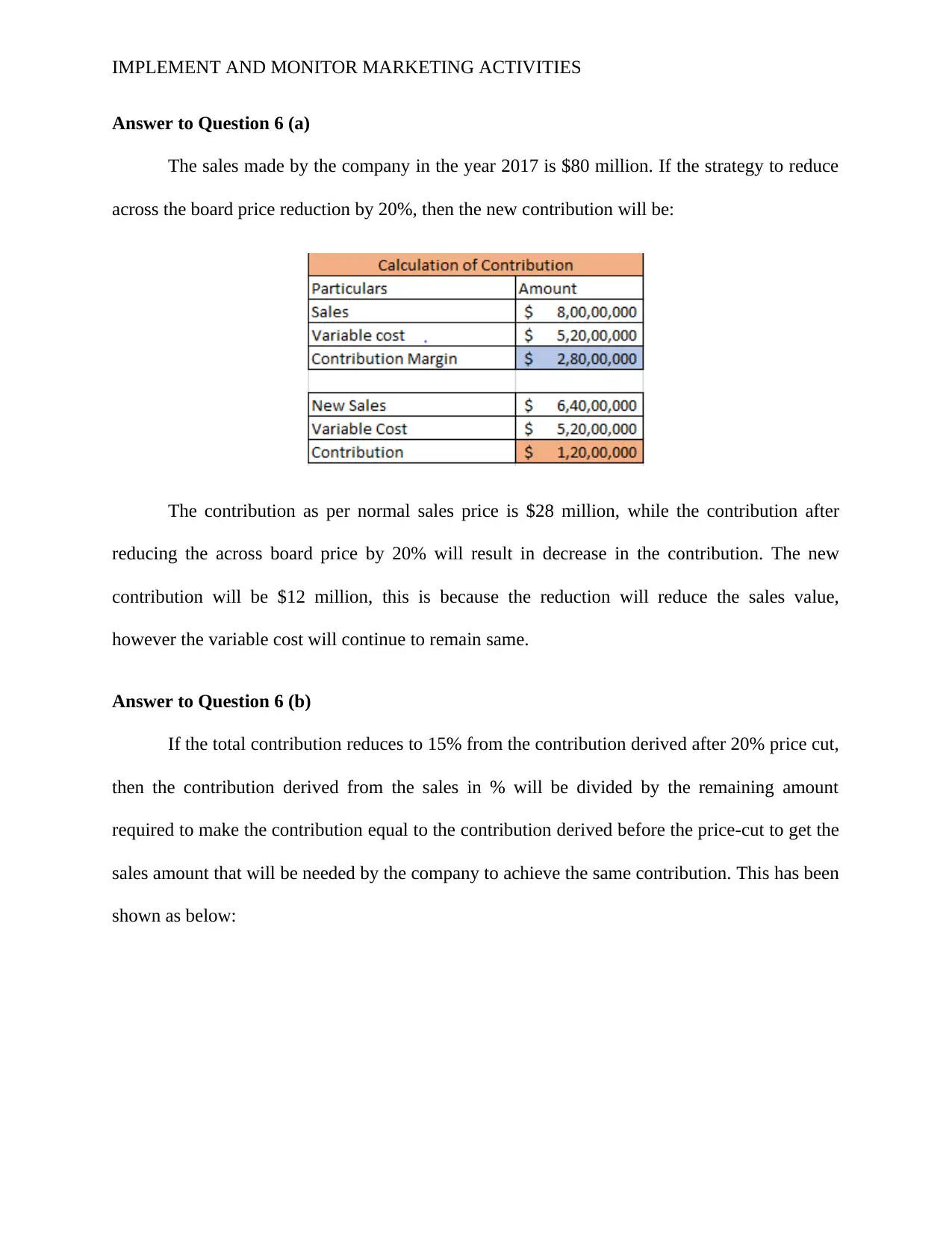
The sales made by the company in the year 2017 is $80 million. If the strategy to reduce
across the board price reduction by 20%, then the new contribution will be:
The contribution as per normal sales price is $28 million, while the contribution after
reducing the across board price by 20% will result in decrease in the contribution. The new
contribution will be $12 million, this is because the reduction will reduce the sales value,
however the variable cost will continue to remain same.
Answer to Question 6 (b)
If the total contribution reduces to 15% from the contribution derived after 20% price cut,
then the contribution derived from the sales in % will be divided by the remaining amount
required to make the contribution equal to the contribution derived before the price-cut to get the
sales amount that will be needed by the company to achieve the same contribution. This has been
shown as below:
Answer to Question 6 (a)
The sales made by the company in the year 2017 is $80 million. If the strategy to reduce
across the board price reduction by 20%, then the new contribution will be:
The contribution as per normal sales price is $28 million, while the contribution after
reducing the across board price by 20% will result in decrease in the contribution. The new
contribution will be $12 million, this is because the reduction will reduce the sales value,
however the variable cost will continue to remain same.
Answer to Question 6 (b)
If the total contribution reduces to 15% from the contribution derived after 20% price cut,
then the contribution derived from the sales in % will be divided by the remaining amount
required to make the contribution equal to the contribution derived before the price-cut to get the
sales amount that will be needed by the company to achieve the same contribution. This has been
shown as below:
⊘ This is a preview!⊘
Do you want full access?
Subscribe today to unlock all pages.
Trusted by 1+ million students worldwide

IMPLEMENT AND MONITOR MARKETING ACTIVITIES
Answer to Question 6 (c)
The pros of the implementing the above strategy are:
The company will be in parity with the other national paint brands.
More customers who has budget constraint may switch to this company.
The cons if implementing the above strategy:
The company is still noticing that the price is higher than the other mass merchandiser
price.
The profit of the company will be reduced.
Though reducing the cost is amongst the best strategy to compete against the competitor
(Tretheway & Kincaid, 2016) but this will considerably reduce the profit of the company and
even the contribution margin. If there is insufficient contribution to cover the fixed cost, then the
company might have to go with the reserves, since reducing the price will not reduce the variable
cost and fixed cost of the company. Therefore, the company should not adopt this strategy.
Answer to Question 6 (c)
The pros of the implementing the above strategy are:
The company will be in parity with the other national paint brands.
More customers who has budget constraint may switch to this company.
The cons if implementing the above strategy:
The company is still noticing that the price is higher than the other mass merchandiser
price.
The profit of the company will be reduced.
Though reducing the cost is amongst the best strategy to compete against the competitor
(Tretheway & Kincaid, 2016) but this will considerably reduce the profit of the company and
even the contribution margin. If there is insufficient contribution to cover the fixed cost, then the
company might have to go with the reserves, since reducing the price will not reduce the variable
cost and fixed cost of the company. Therefore, the company should not adopt this strategy.
Paraphrase This Document
Need a fresh take? Get an instant paraphrase of this document with our AI Paraphraser
IMPLEMENT AND MONITOR MARKETING ACTIVITIES
Answer to Question 7 (a)
Answer to Question 7 (b)
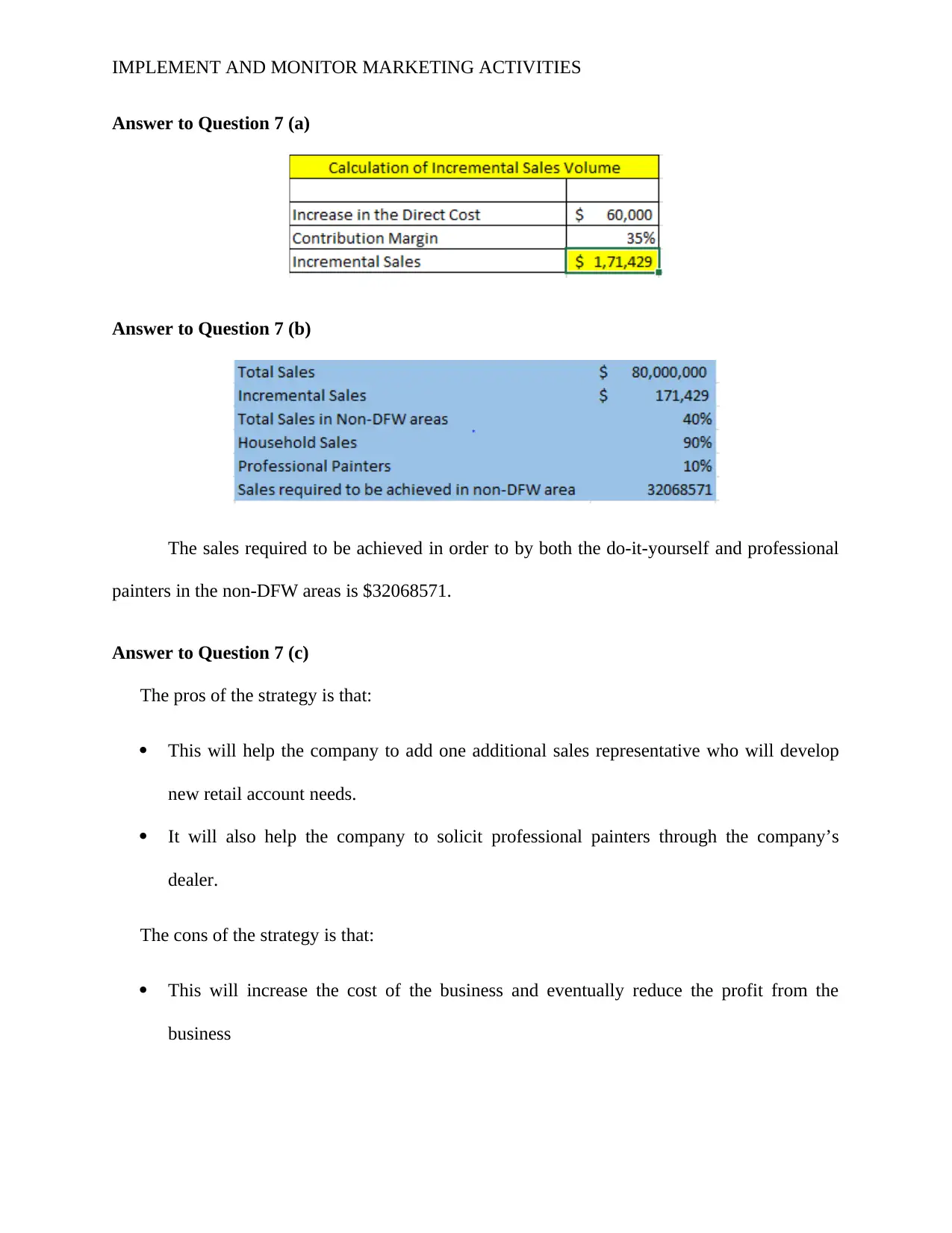
The sales required to be achieved in order to by both the do-it-yourself and professional
painters in the non-DFW areas is $32068571.
Answer to Question 7 (c)
The pros of the strategy is that:
This will help the company to add one additional sales representative who will develop
new retail account needs.
It will also help the company to solicit professional painters through the company’s
dealer.
The cons of the strategy is that:
This will increase the cost of the business and eventually reduce the profit from the
business
Answer to Question 7 (a)
Answer to Question 7 (b)
The sales required to be achieved in order to by both the do-it-yourself and professional
painters in the non-DFW areas is $32068571.
Answer to Question 7 (c)
The pros of the strategy is that:
This will help the company to add one additional sales representative who will develop
new retail account needs.
It will also help the company to solicit professional painters through the company’s
dealer.
The cons of the strategy is that:
This will increase the cost of the business and eventually reduce the profit from the
business
IMPLEMENT AND MONITOR MARKETING ACTIVITIES
Increasing in the direct cost may not provide the assurance that the sales or demand of the
product will increase.
The company should focus on this strategy as this will help the company to penetrate more
into the non-DFW area and also such increase in cost will not affect the profit of the company
since the company has 35% of contribution to cover the fixed cost.
Answer to Question 8.
The company has to be price sensitive since the company has already experienced
customer backing-off from their brand (Simonov, Nosko & Rao, 2018). Moreover, the sales
representative has not been performing well and an incremental increase in the direct cost of
$60,000 will also raise the target sales required to be achieved. Apart from the target, the risk
associated with the incremental amount is that the company has a policy to recoup the non-
capital expenditure within one-year time horizon. The fourth strategy of increasing a sales
representative in the non-DFW area, consisting of 16% of the account penetration, will increase
the sales of the company as the sales representative will be focused on calling the professional
painters to solicit their business through the company’s dealer. Consequently, the profit may
reduce with the incremental cost but this may not affect the company as the company has
sufficient contribution margin to guard the profits.
Answer to Bonus Question
The main learnings from this case is:
Importance of Marketing in a competitive industry
Importance of Appropriate Strategy Formulation.
Increasing in the direct cost may not provide the assurance that the sales or demand of the
product will increase.
The company should focus on this strategy as this will help the company to penetrate more
into the non-DFW area and also such increase in cost will not affect the profit of the company
since the company has 35% of contribution to cover the fixed cost.
Answer to Question 8.
The company has to be price sensitive since the company has already experienced
customer backing-off from their brand (Simonov, Nosko & Rao, 2018). Moreover, the sales
representative has not been performing well and an incremental increase in the direct cost of
$60,000 will also raise the target sales required to be achieved. Apart from the target, the risk
associated with the incremental amount is that the company has a policy to recoup the non-
capital expenditure within one-year time horizon. The fourth strategy of increasing a sales
representative in the non-DFW area, consisting of 16% of the account penetration, will increase
the sales of the company as the sales representative will be focused on calling the professional
painters to solicit their business through the company’s dealer. Consequently, the profit may
reduce with the incremental cost but this may not affect the company as the company has
sufficient contribution margin to guard the profits.
Answer to Bonus Question
The main learnings from this case is:
Importance of Marketing in a competitive industry
Importance of Appropriate Strategy Formulation.
⊘ This is a preview!⊘
Do you want full access?
Subscribe today to unlock all pages.
Trusted by 1+ million students worldwide
IMPLEMENT AND MONITOR MARKETING ACTIVITIES
The market of the US paint industry and how it has been performing over a past decade
(Dao, Furceri & Loungani, 2017), and the role and advancement of do-it-yourself
household.
This learning points is related to the course concept from the previous classes as it provides
learning opportunity on the marketing and strategy formulation which has been discussed
previously in the classes.
The market of the US paint industry and how it has been performing over a past decade
(Dao, Furceri & Loungani, 2017), and the role and advancement of do-it-yourself
household.
This learning points is related to the course concept from the previous classes as it provides
learning opportunity on the marketing and strategy formulation which has been discussed
previously in the classes.
Paraphrase This Document
Need a fresh take? Get an instant paraphrase of this document with our AI Paraphraser
IMPLEMENT AND MONITOR MARKETING ACTIVITIES
Reference & Bibliographies
Dao, M., Furceri, D., & Loungani, P. (2017). Regional labor market adjustment in the United
States: trend and cycle. Review of Economics and Statistics, 99(2), 243-257.
Reisch, M. S. Paints & coatings. Chemical & engineering news, 81(44), 23-23.
Simonov, A., Nosko, C., & Rao, J. M. (2018). Competition and crowd-out for brand keywords in
sponsored search. Marketing Science, 37(2), 200-215.
Tretheway, M., & Kincaid, I. (2016). Competition between airports: occurrence and strategy. In
Airport Competition (pp. 139-156). Routledge.
Webster, D. C., & Ryntz, R. A. (2017). Pigments, Paints, Polymer Coatings, Lacquers, and
Printing Inks. In Handbook of Industrial Chemistry and Biotechnology (pp. 805-822).
Springer, Cham.
Wischermann, C., & Shore, E. (2019). Advertising and the European City: historical
perspectives. Routledge.
Reference & Bibliographies
Dao, M., Furceri, D., & Loungani, P. (2017). Regional labor market adjustment in the United
States: trend and cycle. Review of Economics and Statistics, 99(2), 243-257.
Reisch, M. S. Paints & coatings. Chemical & engineering news, 81(44), 23-23.
Simonov, A., Nosko, C., & Rao, J. M. (2018). Competition and crowd-out for brand keywords in
sponsored search. Marketing Science, 37(2), 200-215.
Tretheway, M., & Kincaid, I. (2016). Competition between airports: occurrence and strategy. In
Airport Competition (pp. 139-156). Routledge.
Webster, D. C., & Ryntz, R. A. (2017). Pigments, Paints, Polymer Coatings, Lacquers, and
Printing Inks. In Handbook of Industrial Chemistry and Biotechnology (pp. 805-822).
Springer, Cham.
Wischermann, C., & Shore, E. (2019). Advertising and the European City: historical
perspectives. Routledge.

1 out of 11


Related Documents


Your All-in-One AI-Powered Toolkit for Academic Success.
+13062052269
info@desklib.com
Available 24*7 on WhatsApp / Email
![[object Object]](/_next/static/media/star-bottom.7253800d.svg)
Unlock your academic potential
Copyright © 2020–2025 A2Z Services. All Rights Reserved. Developed and managed by ZUCOL.