Renewable Energy Storage Implementation: Kerala Community Analysis
VerifiedAdded on 2023/03/23
|40
|8926
|23
Report
AI Summary
This report examines the implementation of renewable energy storage, specifically focusing on the Kerala community in India. The study explores the potential of rechargeable battery storage for buildings and grid support, driven by the need to address climate change and improve energy access in rural areas. The report details the methodology, including interviews, questionnaires, and the development of a Bayesian network to assess the feasibility of the project. It analyzes energy usage patterns, interviews with residents, bank officials, and electricity board representatives to understand the current energy landscape and identify barriers to implementation. The report also discusses technical developments, the impact on the energy system, and proposes solutions such as solar-powered microgrids and financial incentives to overcome challenges and promote clean and affordable electricity for off-grid communities. The study highlights the expected outcomes, including reduced costs, increased energy independence, and positive environmental and economic impacts.
Running head: IMPLEMENTATION OF RENEWABLE ENERGY STORAGE
IMPLEMENTATION OF RENEWABLE ENERGY STORAGE
Name of Student
Institution Affiliation
IMPLEMENTATION OF RENEWABLE ENERGY STORAGE
Name of Student
Institution Affiliation

Paraphrase This Document
Need a fresh take? Get an instant paraphrase of this document with our AI Paraphraser
Rechargeable battery storage – for buildings or grid support.
2
Executive Summary
As a result of the impacts of carbon emission, the world is slowly moving towards adoption of
green energy. One of the challenges that have been identified is the mechanism of the storage of
the energy that has been generated from the renewable sources. This particular study focuses on
the use of rechargeable battery as a means of energy storage. The study has focused on an area
occupied by community called KERALA. Energy storage in a general sense progresses the way
we create, convey, and use power electrical power in the communities of Kerala. Storage of
Energy assists amid crises like power blackouts from storms, gear flaws, mishaps or indeed
terrorist assaults. But the game-changing nature of energy storage is its capacity to adjust power
supply and request instantaneously - within milliseconds - which makes power systems more
resilient, effective, and cleaner than ever before.
Table of content
Contents
Executive Summary.....................................................................................................................................2
Table of content...........................................................................................................................................2
Table of figures...........................................................................................................................................3
Introduction.................................................................................................................................................4
Purpose of the project..................................................................................................................................6
EXPECTED PROJECT OUTCOMES........................................................................................................7
METHODOLOGY TO BE ADOPTED......................................................................................................7
Cognitive matrix development.................................................................................................................8
2
Executive Summary
As a result of the impacts of carbon emission, the world is slowly moving towards adoption of
green energy. One of the challenges that have been identified is the mechanism of the storage of
the energy that has been generated from the renewable sources. This particular study focuses on
the use of rechargeable battery as a means of energy storage. The study has focused on an area
occupied by community called KERALA. Energy storage in a general sense progresses the way
we create, convey, and use power electrical power in the communities of Kerala. Storage of
Energy assists amid crises like power blackouts from storms, gear flaws, mishaps or indeed
terrorist assaults. But the game-changing nature of energy storage is its capacity to adjust power
supply and request instantaneously - within milliseconds - which makes power systems more
resilient, effective, and cleaner than ever before.
Table of content
Contents
Executive Summary.....................................................................................................................................2
Table of content...........................................................................................................................................2
Table of figures...........................................................................................................................................3
Introduction.................................................................................................................................................4
Purpose of the project..................................................................................................................................6
EXPECTED PROJECT OUTCOMES........................................................................................................7
METHODOLOGY TO BE ADOPTED......................................................................................................7
Cognitive matrix development.................................................................................................................8
Rechargeable battery storage – for buildings or grid support.
3
A questionnaire conducted in the COMMUNITIES IN KERALA............................................................13
Interview Residents of Kerala community.............................................................................................13
Energy Usage in KERALA Communities.........................................................................................13
Interview the bank officials...................................................................................................................15
Interview electricity board.....................................................................................................................16
Current state of the technology........................................................................................................16
Interviews Elected Officials..................................................................................................................19
Technical developments, now and into future.....................................................................................20
Impact on the energy system and other fuels.......................................................................................28
Barriers to the implementation............................................................................................................32
Personal View.......................................................................................................................................32
Conclusion.................................................................................................................................................33
References.................................................................................................................................................34
Table of figures
Figure 1: Showing the community of Kerala..................................................................................4
Figure 2: Showing electrical storage system.................................................................................22
Figure 3: Showing Pumped hydroelectric power..........................................................................23
Figure 4: Showing position of the existing hydroelectric dams in Kerala community.................26
Figure 5: Showing Compressed air storage...................................................................................28
Figure 6: Showing areas where the solar plants are situated in Kerala community......................29
Figure 7: Showing the Bayesian Network on the probability of the implementation of the
renewable energy storage in Kerala community...........................................................................31
Figure 8: Showing the Bayesian Network on the probability of the implementation of the
renewable energy storage in Kerala community...........................................................................33
3
A questionnaire conducted in the COMMUNITIES IN KERALA............................................................13
Interview Residents of Kerala community.............................................................................................13
Energy Usage in KERALA Communities.........................................................................................13
Interview the bank officials...................................................................................................................15
Interview electricity board.....................................................................................................................16
Current state of the technology........................................................................................................16
Interviews Elected Officials..................................................................................................................19
Technical developments, now and into future.....................................................................................20
Impact on the energy system and other fuels.......................................................................................28
Barriers to the implementation............................................................................................................32
Personal View.......................................................................................................................................32
Conclusion.................................................................................................................................................33
References.................................................................................................................................................34
Table of figures
Figure 1: Showing the community of Kerala..................................................................................4
Figure 2: Showing electrical storage system.................................................................................22
Figure 3: Showing Pumped hydroelectric power..........................................................................23
Figure 4: Showing position of the existing hydroelectric dams in Kerala community.................26
Figure 5: Showing Compressed air storage...................................................................................28
Figure 6: Showing areas where the solar plants are situated in Kerala community......................29
Figure 7: Showing the Bayesian Network on the probability of the implementation of the
renewable energy storage in Kerala community...........................................................................31
Figure 8: Showing the Bayesian Network on the probability of the implementation of the
renewable energy storage in Kerala community...........................................................................33
⊘ This is a preview!⊘
Do you want full access?
Subscribe today to unlock all pages.

Trusted by 1+ million students worldwide
Rechargeable battery storage – for buildings or grid support.
4
Introduction
The idea behind the prerequisite for genuine clean energy supply is grounded on the need
for concern around the changes in climate. The changes in the climate may be a genuine and
unmistakable problem and nowadays more individuals accept that a more strong utilize of
cleaner energy is one of the mechanisms as well as means for anticipating changes in the climate.
Such mechanisms are planned based on the examination of the properties that influence the
territorial assessment of by and large acknowledged criteria. An elective combination of
conditions can modify the chosen mechanism (Ren, 2017). These characteristics include
different criteria to be input into the decision-making procedures and the prevailing condition. A
few properties to consider, in spite of the fact that not all, are working costs, starting
costs ,amount of work, expeceted capacity, biological effect, natural components and
efficiency(Dahleh, 2015).
Think about bolsters the neighborhood specialists in planning approaches by building
elective scenarios for contributing to atomic vitality or renewable energies. The Bayesian arrange
(BN) technique. India has had independence from 1947 and still there more than 45 million
villages and households in rural India that still has no access to electricity (Hatami, 2016). Even
after the enactment of the electricity actin 2003, adopted by the central government, there are
still numerous rural villages that haven't seen electricity for the past decade'. In this research, I
propose solar-powered microgrids as a solution for rural electrification (Yeniyurt, 2015). Let us
consider the state of Kerala where there are still thousands of villages that still have no access to
electricity.
What I am proposing is setting up of microgrids in those parts of the villages where they
can use solar energy as a source of electricity. On average, a single household has an electric
4
Introduction
The idea behind the prerequisite for genuine clean energy supply is grounded on the need
for concern around the changes in climate. The changes in the climate may be a genuine and
unmistakable problem and nowadays more individuals accept that a more strong utilize of
cleaner energy is one of the mechanisms as well as means for anticipating changes in the climate.
Such mechanisms are planned based on the examination of the properties that influence the
territorial assessment of by and large acknowledged criteria. An elective combination of
conditions can modify the chosen mechanism (Ren, 2017). These characteristics include
different criteria to be input into the decision-making procedures and the prevailing condition. A
few properties to consider, in spite of the fact that not all, are working costs, starting
costs ,amount of work, expeceted capacity, biological effect, natural components and
efficiency(Dahleh, 2015).
Think about bolsters the neighborhood specialists in planning approaches by building
elective scenarios for contributing to atomic vitality or renewable energies. The Bayesian arrange
(BN) technique. India has had independence from 1947 and still there more than 45 million
villages and households in rural India that still has no access to electricity (Hatami, 2016). Even
after the enactment of the electricity actin 2003, adopted by the central government, there are
still numerous rural villages that haven't seen electricity for the past decade'. In this research, I
propose solar-powered microgrids as a solution for rural electrification (Yeniyurt, 2015). Let us
consider the state of Kerala where there are still thousands of villages that still have no access to
electricity.
What I am proposing is setting up of microgrids in those parts of the villages where they
can use solar energy as a source of electricity. On average, a single household has an electric
Paraphrase This Document
Need a fresh take? Get an instant paraphrase of this document with our AI Paraphraser
Rechargeable battery storage – for buildings or grid support.
5
charge of 800-1200 Rs (16-24 AUD) per month. If these households are using solar-powered
microgrids, then they can cut those cost to less than half of the original price and still use the
saved electricity from the solar energy storage devices set up in their houses (Rasmussen, 2015).
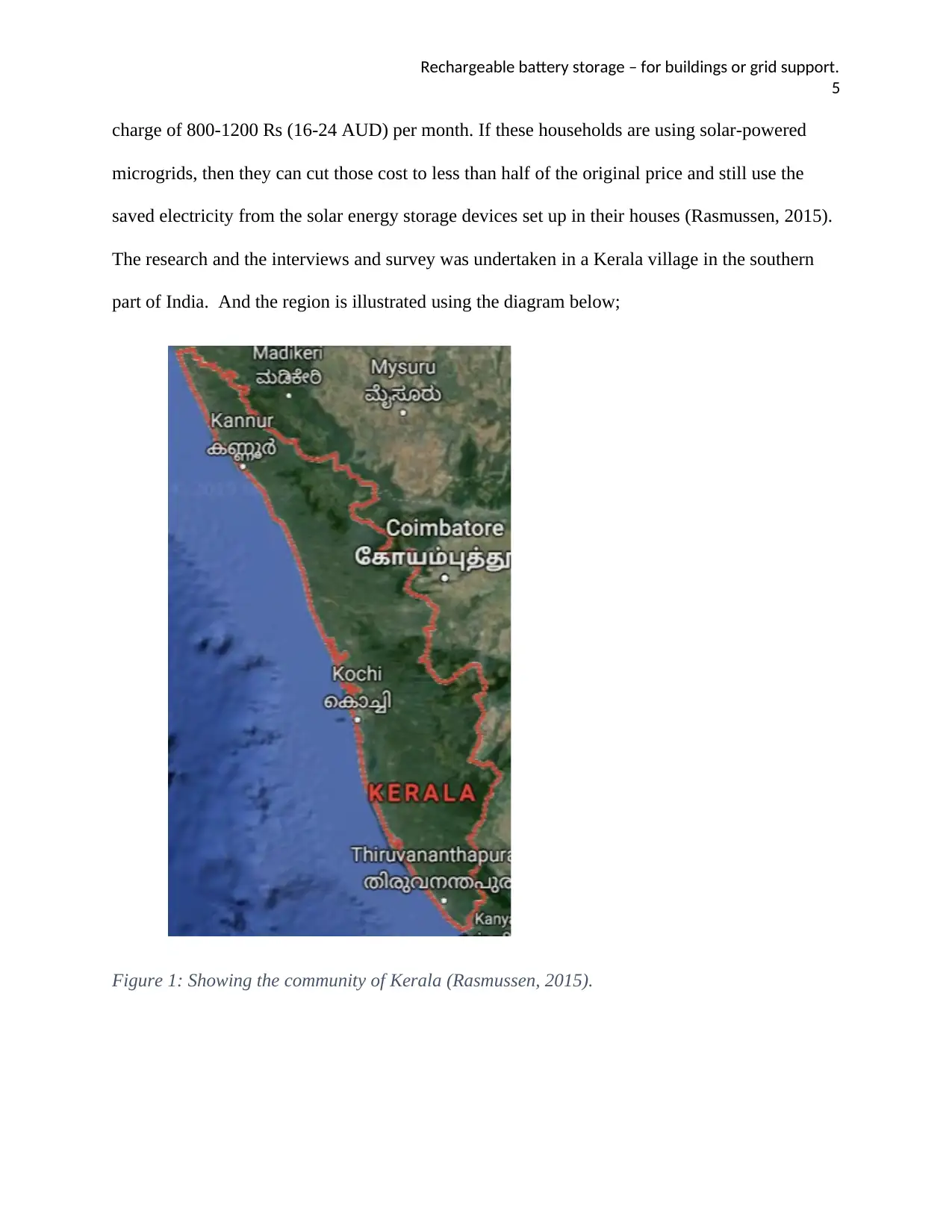
The research and the interviews and survey was undertaken in a Kerala village in the southern
part of India. And the region is illustrated using the diagram below;
Figure 1: Showing the community of Kerala (Rasmussen, 2015).
5
charge of 800-1200 Rs (16-24 AUD) per month. If these households are using solar-powered
microgrids, then they can cut those cost to less than half of the original price and still use the
saved electricity from the solar energy storage devices set up in their houses (Rasmussen, 2015).
The research and the interviews and survey was undertaken in a Kerala village in the southern
part of India. And the region is illustrated using the diagram below;
Figure 1: Showing the community of Kerala (Rasmussen, 2015).
Rechargeable battery storage – for buildings or grid support.
6
Purpose of the project
Since the main issue here is that these villages and households couldn't afford the initial costs
and the overall expenses to the setup of these micro-grids (Song, 2017).I am suggesting
approaching local banks and Kerala state government in building up of policies by which these
expenses can be covered by the government and the bank as a joint venture or the expenses for
the initial setup for each household can be given to them as loans or by another type of funding
by local entrepreneurs with suitable subsidies (Guerrero, 2015). Based on this objective these
research questions have been developed:
Will the state government and the local banks help in building up of policies, so that the
residents of a locality that has very limited access to electricity can set up an energy
storage device?
If the state government is willing to set up microgrids to the off-grid communities and if
the local entrepreneurs are willing to finance any further additional funding for this
project, what are the terms and conditions to be approved by both parties to get the green
light to start this project?
If the banks are willing to provide loans for the project, what are the various terms and
conditions they are looking for?
6
Purpose of the project
Since the main issue here is that these villages and households couldn't afford the initial costs
and the overall expenses to the setup of these micro-grids (Song, 2017).I am suggesting
approaching local banks and Kerala state government in building up of policies by which these
expenses can be covered by the government and the bank as a joint venture or the expenses for
the initial setup for each household can be given to them as loans or by another type of funding
by local entrepreneurs with suitable subsidies (Guerrero, 2015). Based on this objective these
research questions have been developed:
Will the state government and the local banks help in building up of policies, so that the
residents of a locality that has very limited access to electricity can set up an energy
storage device?
If the state government is willing to set up microgrids to the off-grid communities and if
the local entrepreneurs are willing to finance any further additional funding for this
project, what are the terms and conditions to be approved by both parties to get the green
light to start this project?
If the banks are willing to provide loans for the project, what are the various terms and
conditions they are looking for?
⊘ This is a preview!⊘
Do you want full access?
Subscribe today to unlock all pages.
Trusted by 1+ million students worldwide
Rechargeable battery storage – for buildings or grid support.
7
EXPECTED PROJECT OUTCOMES
The most critical outcome that is expected at the end of the project is clean and cheap
electricity for the off-grid communities that have limited access to electricity(Pode, 2015). Also,
by setting up an energy storage device for each house at a locality, they can use renewable
energy source like solar energy to generate electricity at their own house and store them when
they do not have access from the grid (Ribeiro, 2015). By doing so, they can cut the costs as well
as give back excess energy when they do not need it (Liu, 2017). If a single off-grid community
is successful on this then, multiple communities can join on this venture and thereby save a
considerable amount of power and money (Krishnan, 2015). This project would bring a positive
change in both the environmental and economic aspects of a community.
METHODOLOGY TO BE ADOPTED
Basically, this approach of Bayesian network is just a decision network which operates
like a probabilistic acyclic graphical model which is employed in solar renewable electricity
storage (Isa, 2016). The most procedures in Artificial Insights, to be specific Artificial Neural
Systems (ANN) Hereditary Calculations (GAs), Fluffy Rationale and half breed models -which
combine two or more methods-, have as of now been connected to unravel numerous issues in
renewable vitality (Weir, 2015). The inquiry about in this course is growing exceptionally
rapidly and an enormous amount of works have as of now been done (Guan, 2015).
For instance, research has been wiped out the applications of ANN within the forecast of
meteorological factors, such as sun-powered radiation, temperature and wind, which are
pertinent to numerous renewable vitality forms. Moreover, applications in Photovoltaic (PV) and
Sun powered Warm Vitality frameworks, as well as numerous other renewable vitality fields,
7
EXPECTED PROJECT OUTCOMES
The most critical outcome that is expected at the end of the project is clean and cheap
electricity for the off-grid communities that have limited access to electricity(Pode, 2015). Also,
by setting up an energy storage device for each house at a locality, they can use renewable
energy source like solar energy to generate electricity at their own house and store them when
they do not have access from the grid (Ribeiro, 2015). By doing so, they can cut the costs as well
as give back excess energy when they do not need it (Liu, 2017). If a single off-grid community
is successful on this then, multiple communities can join on this venture and thereby save a
considerable amount of power and money (Krishnan, 2015). This project would bring a positive
change in both the environmental and economic aspects of a community.
METHODOLOGY TO BE ADOPTED
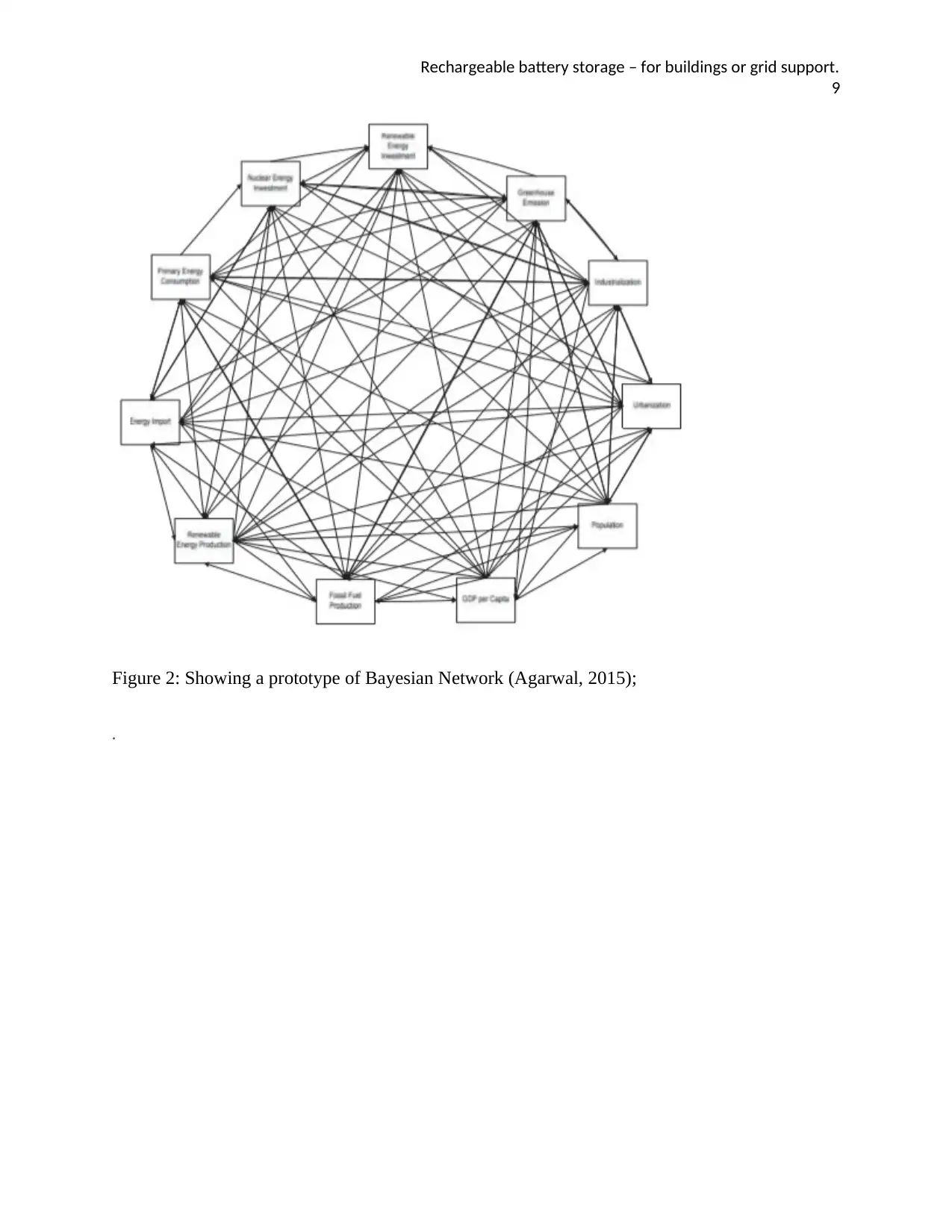
Basically, this approach of Bayesian network is just a decision network which operates
like a probabilistic acyclic graphical model which is employed in solar renewable electricity
storage (Isa, 2016). The most procedures in Artificial Insights, to be specific Artificial Neural
Systems (ANN) Hereditary Calculations (GAs), Fluffy Rationale and half breed models -which
combine two or more methods-, have as of now been connected to unravel numerous issues in
renewable vitality (Weir, 2015). The inquiry about in this course is growing exceptionally
rapidly and an enormous amount of works have as of now been done (Guan, 2015).
For instance, research has been wiped out the applications of ANN within the forecast of
meteorological factors, such as sun-powered radiation, temperature and wind, which are
pertinent to numerous renewable vitality forms. Moreover, applications in Photovoltaic (PV) and
Sun powered Warm Vitality frameworks, as well as numerous other renewable vitality fields,
Paraphrase This Document
Need a fresh take? Get an instant paraphrase of this document with our AI Paraphraser
Rechargeable battery storage – for buildings or grid support.
8
have to been performed (Srinivas, 2015). GAs have been utilized for optimization of Sun
oriented Warm frameworks and other renewable vitality frameworks (Agarwal, 2015).
There are several mechanisms which are employed in Bayesian Network
Cognitive matrix development
A cognitive survey was done among the Oregon electricity authorities (Agarwal, 2015). The
indication of whether the results at positive or negative was answered seven experts interaction.
8
have to been performed (Srinivas, 2015). GAs have been utilized for optimization of Sun
oriented Warm frameworks and other renewable vitality frameworks (Agarwal, 2015).
There are several mechanisms which are employed in Bayesian Network
Cognitive matrix development
A cognitive survey was done among the Oregon electricity authorities (Agarwal, 2015). The
indication of whether the results at positive or negative was answered seven experts interaction.
Rechargeable battery storage – for buildings or grid support.
9
Figure 2: Showing a prototype of Bayesian Network (Agarwal, 2015);
.
9
Figure 2: Showing a prototype of Bayesian Network (Agarwal, 2015);
.
⊘ This is a preview!⊘
Do you want full access?
Subscribe today to unlock all pages.
Trusted by 1+ million students worldwide
Rechargeable battery storage – for buildings or grid support.
10
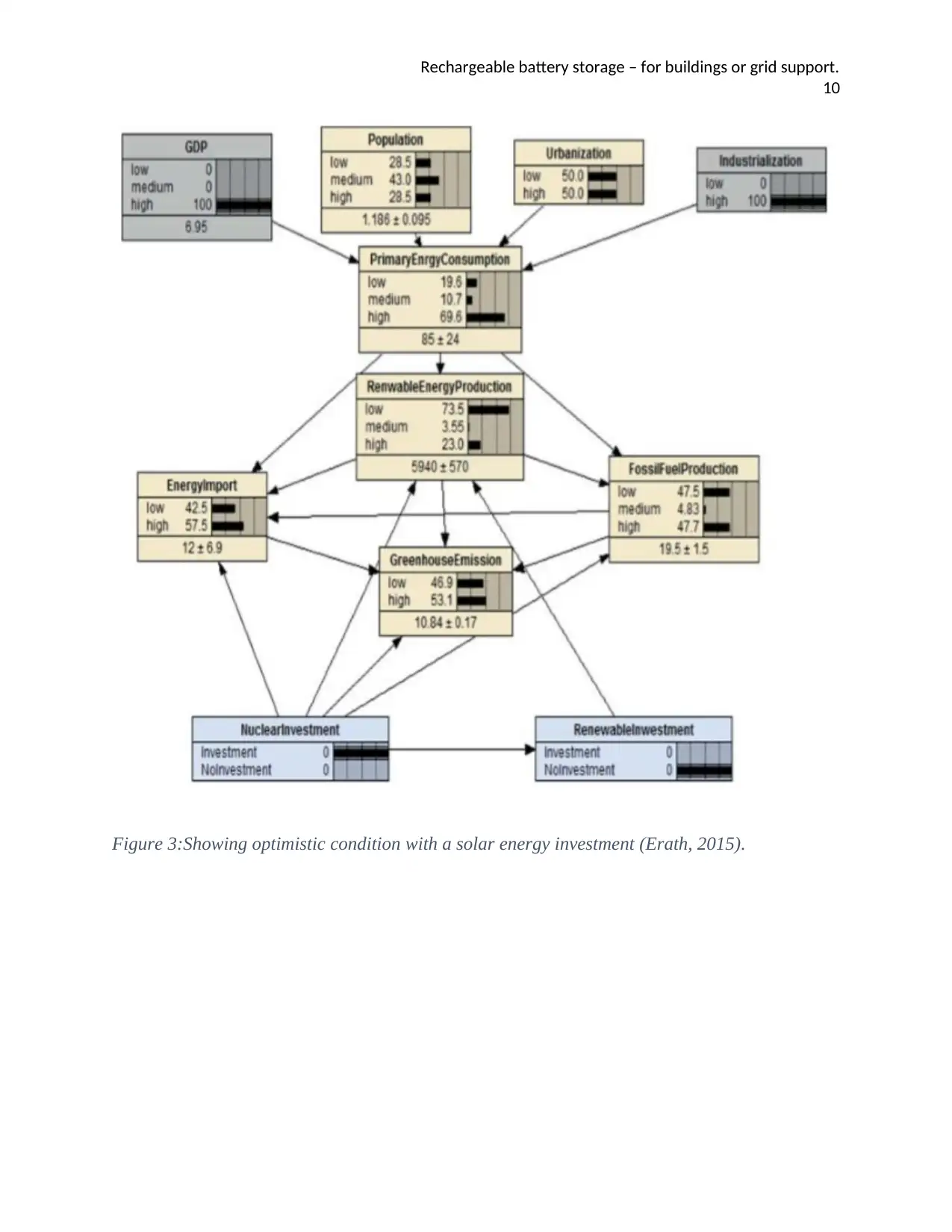
Figure 3:Showing optimistic condition with a solar energy investment (Erath, 2015).
10
Figure 3:Showing optimistic condition with a solar energy investment (Erath, 2015).
Paraphrase This Document
Need a fresh take? Get an instant paraphrase of this document with our AI Paraphraser
Rechargeable battery storage – for buildings or grid support.
11
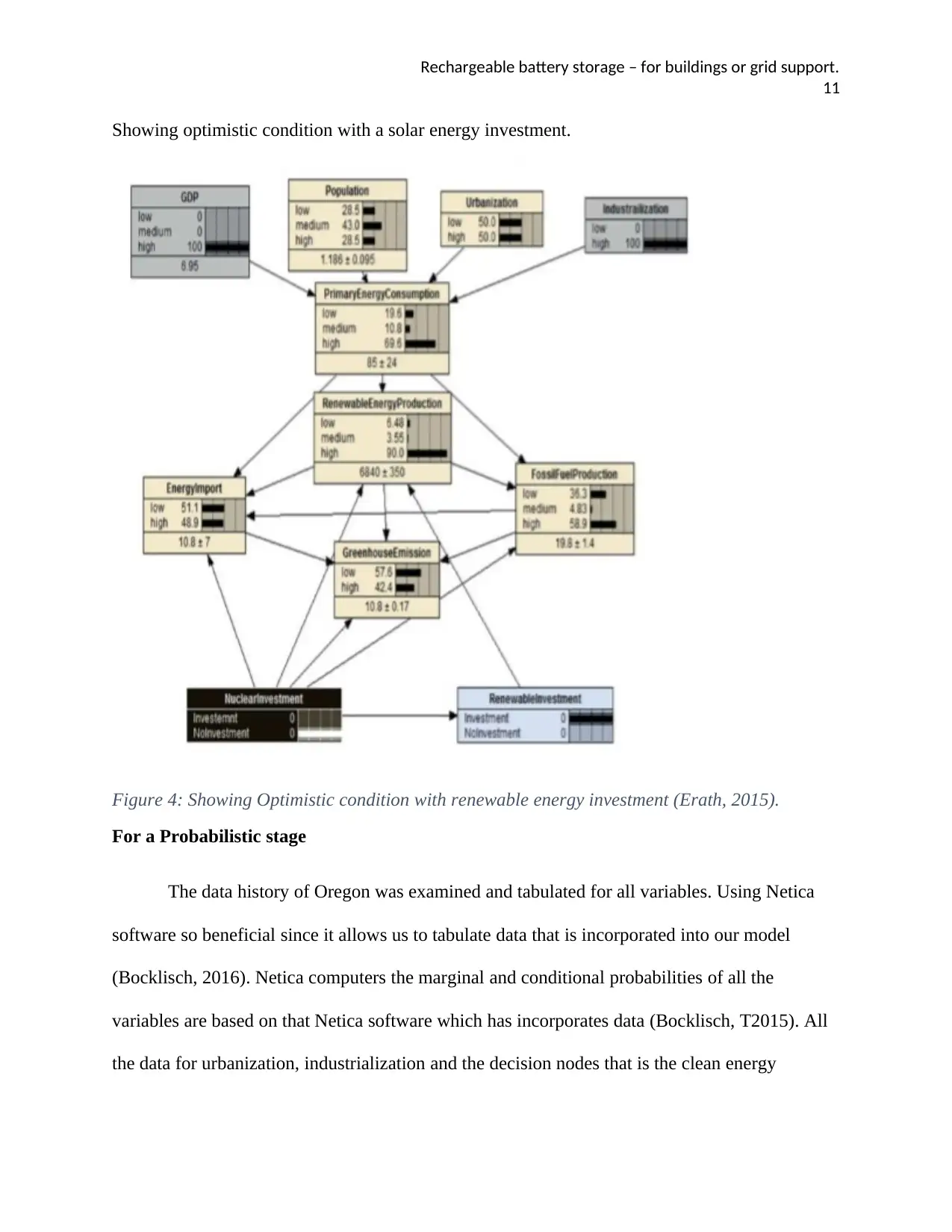
Showing optimistic condition with a solar energy investment.
Figure 4: Showing Optimistic condition with renewable energy investment (Erath, 2015).
For a Probabilistic stage
The data history of Oregon was examined and tabulated for all variables. Using Netica
software so beneficial since it allows us to tabulate data that is incorporated into our model
(Bocklisch, 2016). Netica computers the marginal and conditional probabilities of all the
variables are based on that Netica software which has incorporates data (Bocklisch, T2015). All
the data for urbanization, industrialization and the decision nodes that is the clean energy
11
Showing optimistic condition with a solar energy investment.
Figure 4: Showing Optimistic condition with renewable energy investment (Erath, 2015).
For a Probabilistic stage
The data history of Oregon was examined and tabulated for all variables. Using Netica
software so beneficial since it allows us to tabulate data that is incorporated into our model
(Bocklisch, 2016). Netica computers the marginal and conditional probabilities of all the
variables are based on that Netica software which has incorporates data (Bocklisch, T2015). All
the data for urbanization, industrialization and the decision nodes that is the clean energy
Rechargeable battery storage – for buildings or grid support.
12
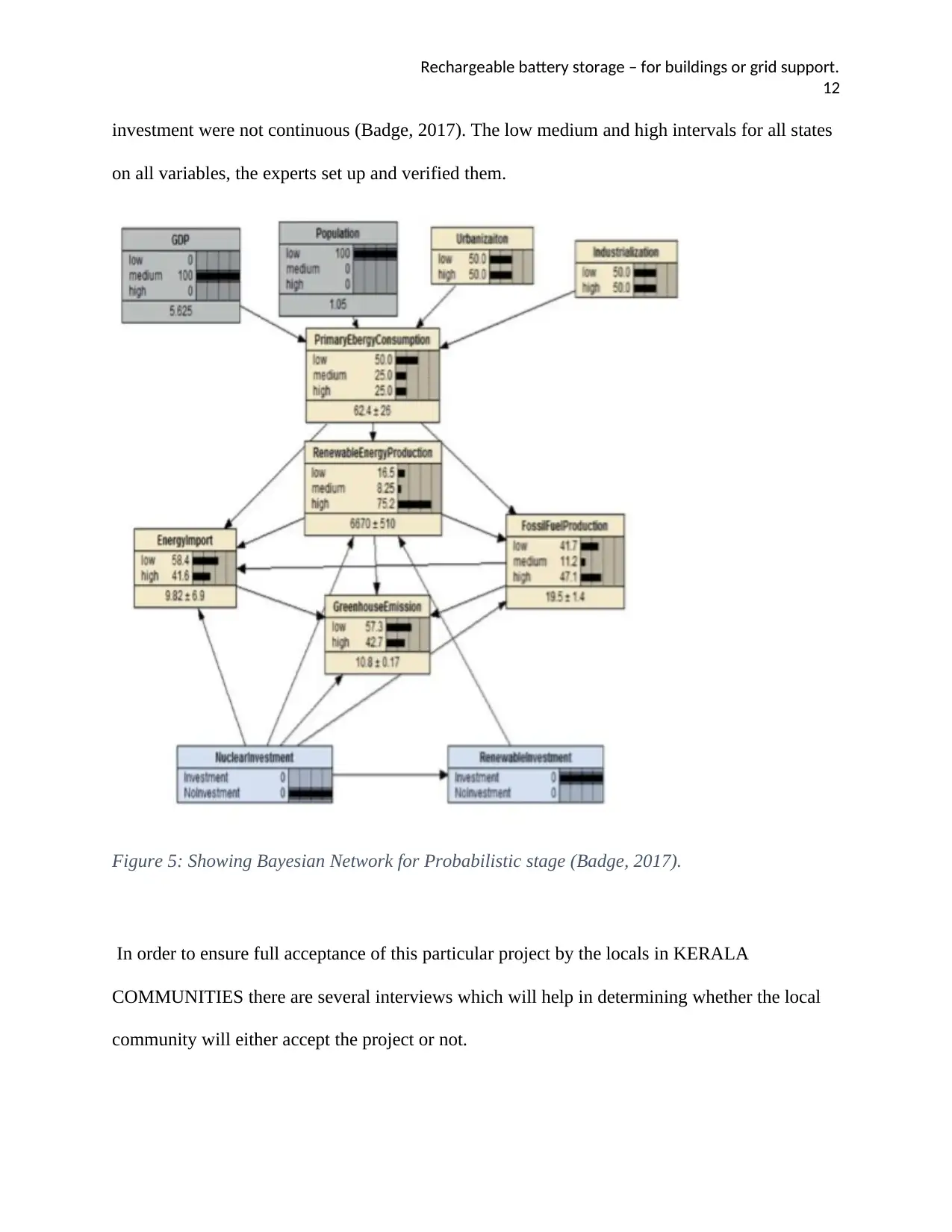
investment were not continuous (Badge, 2017). The low medium and high intervals for all states
on all variables, the experts set up and verified them.
Figure 5: Showing Bayesian Network for Probabilistic stage (Badge, 2017).
In order to ensure full acceptance of this particular project by the locals in KERALA
COMMUNITIES there are several interviews which will help in determining whether the local
community will either accept the project or not.
12
investment were not continuous (Badge, 2017). The low medium and high intervals for all states
on all variables, the experts set up and verified them.
Figure 5: Showing Bayesian Network for Probabilistic stage (Badge, 2017).
In order to ensure full acceptance of this particular project by the locals in KERALA
COMMUNITIES there are several interviews which will help in determining whether the local
community will either accept the project or not.
⊘ This is a preview!⊘
Do you want full access?
Subscribe today to unlock all pages.
Trusted by 1+ million students worldwide

1 out of 40


Your All-in-One AI-Powered Toolkit for Academic Success.
+13062052269
info@desklib.com
Available 24*7 on WhatsApp / Email
![[object Object]](/_next/static/media/star-bottom.7253800d.svg)
Unlock your academic potential
Copyright © 2020–2026 A2Z Services. All Rights Reserved. Developed and managed by ZUCOL.