COBIT 5 Framework Implementation for RFA IT Governance Project
VerifiedAdded on 2022/10/12
|62
|20867
|483
Project
AI Summary
This project examines the implementation of the COBIT 5 framework for IT governance within the Road Fund Administration (RFA), a public sector company in Namibia. The research investigates the current IT governance framework, standards, and processes at RFA, highlighting the challenges faced in IT operations. Through a literature review and qualitative primary research involving interviews and focus group discussions, the project analyzes the effectiveness of the COBIT 5 framework in addressing these challenges. The study focuses on how incorporating the COBIT 5 framework can benefit RFA by improving IT governance and administration, using the framework's five principles for thematic analysis. The project concludes with recommendations for RFA IT personnel on adopting and utilizing the COBIT 5 framework for efficient IT operations. The research includes background on the RFA, problem statements, research aims, questions, and objectives, along with a detailed methodology, findings, and analysis based on the COBIT 5 framework's principles. The project also includes a discussion of limitations and ethical considerations.
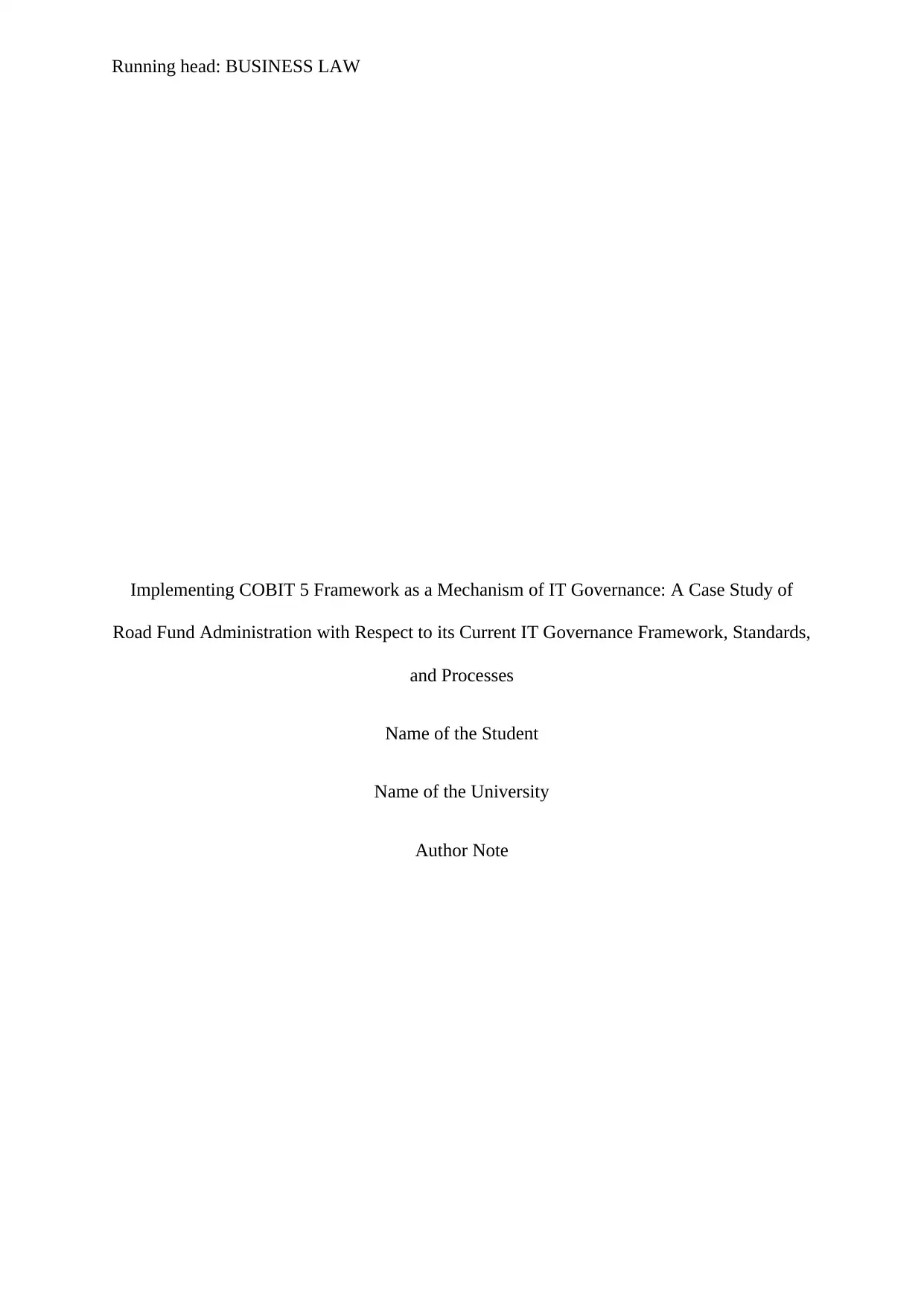
Running head: BUSINESS LAW
Implementing COBIT 5 Framework as a Mechanism of IT Governance: A Case Study of
Road Fund Administration with Respect to its Current IT Governance Framework, Standards,
and Processes
Name of the Student
Name of the University
Author Note
Implementing COBIT 5 Framework as a Mechanism of IT Governance: A Case Study of
Road Fund Administration with Respect to its Current IT Governance Framework, Standards,
and Processes
Name of the Student
Name of the University
Author Note

Paraphrase This Document
Need a fresh take? Get an instant paraphrase of this document with our AI Paraphraser
1BUSINESS LAW
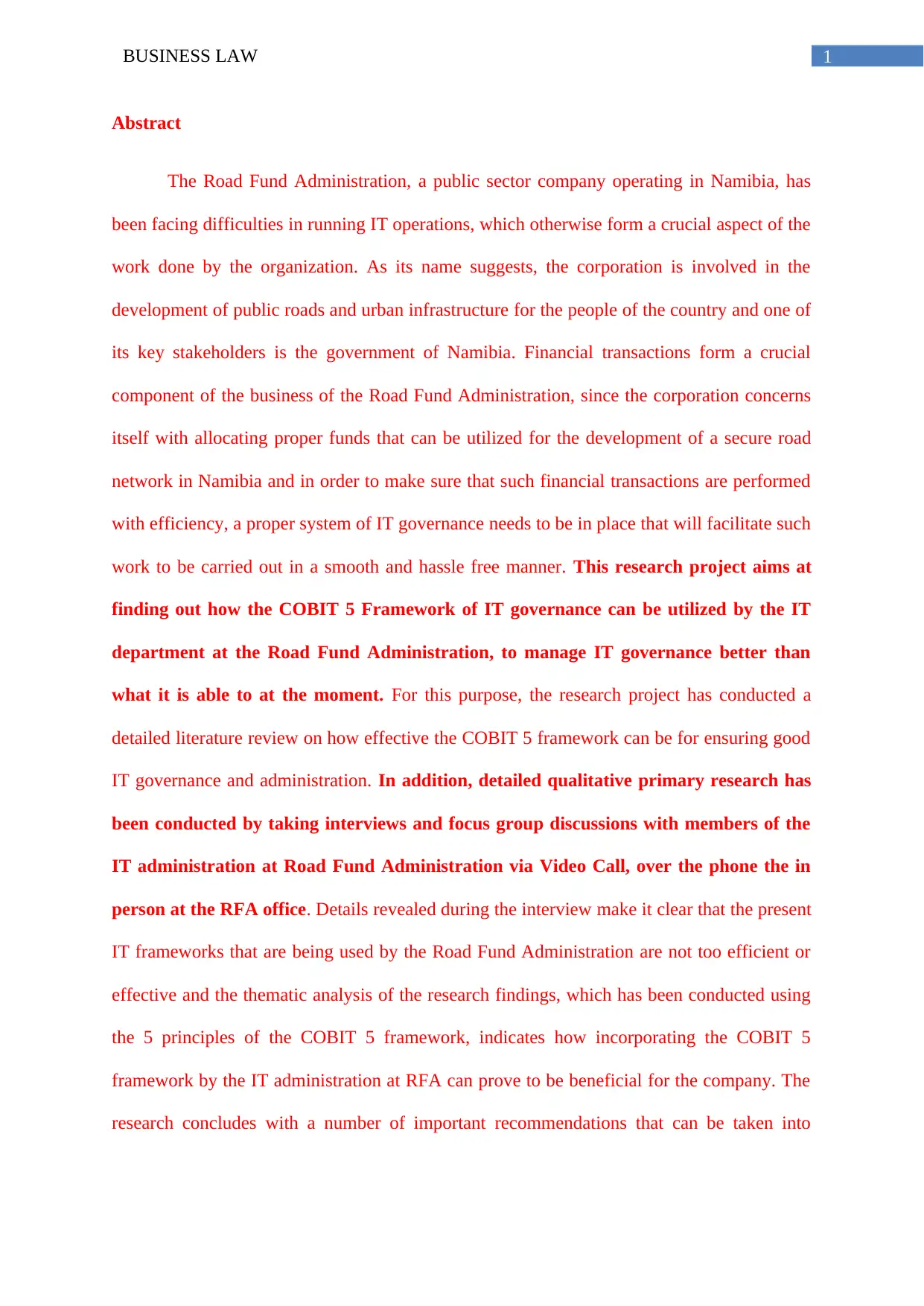
Abstract
The Road Fund Administration, a public sector company operating in Namibia, has
been facing difficulties in running IT operations, which otherwise form a crucial aspect of the
work done by the organization. As its name suggests, the corporation is involved in the
development of public roads and urban infrastructure for the people of the country and one of
its key stakeholders is the government of Namibia. Financial transactions form a crucial
component of the business of the Road Fund Administration, since the corporation concerns
itself with allocating proper funds that can be utilized for the development of a secure road
network in Namibia and in order to make sure that such financial transactions are performed
with efficiency, a proper system of IT governance needs to be in place that will facilitate such
work to be carried out in a smooth and hassle free manner. This research project aims at
finding out how the COBIT 5 Framework of IT governance can be utilized by the IT
department at the Road Fund Administration, to manage IT governance better than
what it is able to at the moment. For this purpose, the research project has conducted a
detailed literature review on how effective the COBIT 5 framework can be for ensuring good
IT governance and administration. In addition, detailed qualitative primary research has
been conducted by taking interviews and focus group discussions with members of the
IT administration at Road Fund Administration via Video Call, over the phone the in
person at the RFA office. Details revealed during the interview make it clear that the present
IT frameworks that are being used by the Road Fund Administration are not too efficient or
effective and the thematic analysis of the research findings, which has been conducted using
the 5 principles of the COBIT 5 framework, indicates how incorporating the COBIT 5
framework by the IT administration at RFA can prove to be beneficial for the company. The
research concludes with a number of important recommendations that can be taken into
Abstract
The Road Fund Administration, a public sector company operating in Namibia, has
been facing difficulties in running IT operations, which otherwise form a crucial aspect of the
work done by the organization. As its name suggests, the corporation is involved in the
development of public roads and urban infrastructure for the people of the country and one of
its key stakeholders is the government of Namibia. Financial transactions form a crucial
component of the business of the Road Fund Administration, since the corporation concerns
itself with allocating proper funds that can be utilized for the development of a secure road
network in Namibia and in order to make sure that such financial transactions are performed
with efficiency, a proper system of IT governance needs to be in place that will facilitate such
work to be carried out in a smooth and hassle free manner. This research project aims at
finding out how the COBIT 5 Framework of IT governance can be utilized by the IT
department at the Road Fund Administration, to manage IT governance better than
what it is able to at the moment. For this purpose, the research project has conducted a
detailed literature review on how effective the COBIT 5 framework can be for ensuring good
IT governance and administration. In addition, detailed qualitative primary research has
been conducted by taking interviews and focus group discussions with members of the
IT administration at Road Fund Administration via Video Call, over the phone the in
person at the RFA office. Details revealed during the interview make it clear that the present
IT frameworks that are being used by the Road Fund Administration are not too efficient or
effective and the thematic analysis of the research findings, which has been conducted using
the 5 principles of the COBIT 5 framework, indicates how incorporating the COBIT 5
framework by the IT administration at RFA can prove to be beneficial for the company. The
research concludes with a number of important recommendations that can be taken into
2BUSINESS LAW
consideration by the RFA IT personnel on incorporating and using COBIT 5 framework to
run IT operations with efficiency for the company.
consideration by the RFA IT personnel on incorporating and using COBIT 5 framework to
run IT operations with efficiency for the company.
⊘ This is a preview!⊘
Do you want full access?
Subscribe today to unlock all pages.

Trusted by 1+ million students worldwide
3BUSINESS LAW
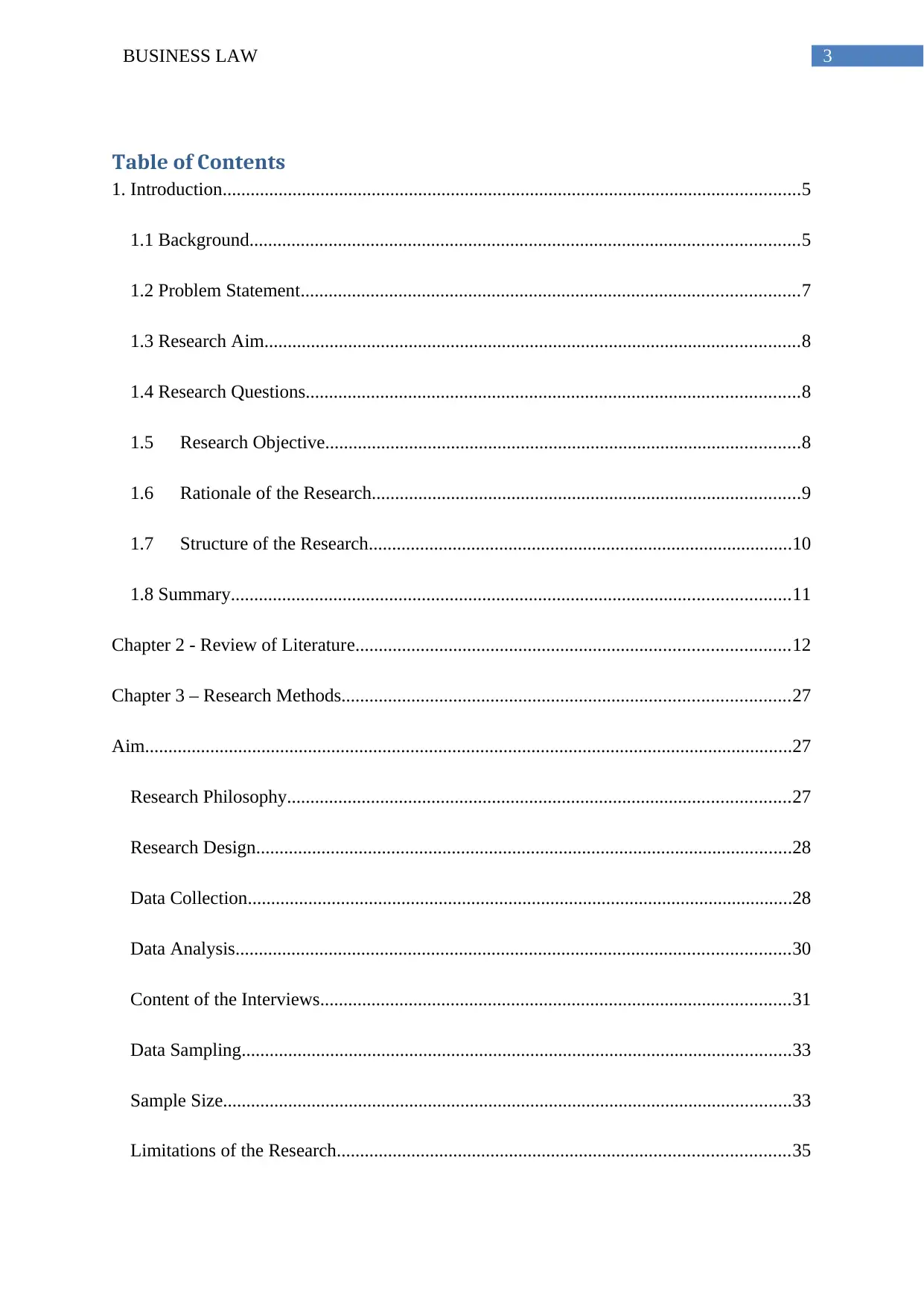
Table of Contents
1. Introduction............................................................................................................................5
1.1 Background......................................................................................................................5
1.2 Problem Statement...........................................................................................................7
1.3 Research Aim...................................................................................................................8
1.4 Research Questions..........................................................................................................8
1.5 Research Objective......................................................................................................8
1.6 Rationale of the Research............................................................................................9
1.7 Structure of the Research...........................................................................................10
1.8 Summary........................................................................................................................11
Chapter 2 - Review of Literature.............................................................................................12
Chapter 3 – Research Methods................................................................................................27
Aim...........................................................................................................................................27
Research Philosophy............................................................................................................27
Research Design...................................................................................................................28
Data Collection.....................................................................................................................28
Data Analysis.......................................................................................................................30
Content of the Interviews.....................................................................................................31
Data Sampling......................................................................................................................33
Sample Size..........................................................................................................................33
Limitations of the Research.................................................................................................35
Table of Contents
1. Introduction............................................................................................................................5
1.1 Background......................................................................................................................5
1.2 Problem Statement...........................................................................................................7
1.3 Research Aim...................................................................................................................8
1.4 Research Questions..........................................................................................................8
1.5 Research Objective......................................................................................................8
1.6 Rationale of the Research............................................................................................9
1.7 Structure of the Research...........................................................................................10
1.8 Summary........................................................................................................................11
Chapter 2 - Review of Literature.............................................................................................12
Chapter 3 – Research Methods................................................................................................27
Aim...........................................................................................................................................27
Research Philosophy............................................................................................................27
Research Design...................................................................................................................28
Data Collection.....................................................................................................................28
Data Analysis.......................................................................................................................30
Content of the Interviews.....................................................................................................31
Data Sampling......................................................................................................................33
Sample Size..........................................................................................................................33
Limitations of the Research.................................................................................................35
Paraphrase This Document
Need a fresh take? Get an instant paraphrase of this document with our AI Paraphraser
4BUSINESS LAW
Ethical Considerations for the Research..............................................................................35
4. Chapter 4 – Findings and Analysis.....................................................................................38
4.1. Theme 1 – Meeting the Needs of the Stakeholders.......................................................39
4.2. Theme 2 – Governing IT from an End to End Enterprise Perspective.........................42
4.3. Theme 3 – Application of a Single and Integrative Framework...................................43
4.4. Theme 4 - Facilitating a Holistic Approach..................................................................45
4.5. Theme 5 – Separation of IT Governance from General Management..........................47
5. Chapter 5 – Conclusion and Recommendations..................................................................50
5.1. Recommendations.........................................................................................................52
5.2. Study Weaknesses.............................................................................................................55
References................................................................................................................................56
Andry, J.F. and Setiawan, A.K., 2019. IT GOVERNANCE EVALUATION USING COBIT
5 FRAMEWORK ON THE NATIONAL LIBRARY. Jurnal Sistem Informasi, 15(1), pp.10-
17..............................................................................................................................................56
Ethical Considerations for the Research..............................................................................35
4. Chapter 4 – Findings and Analysis.....................................................................................38
4.1. Theme 1 – Meeting the Needs of the Stakeholders.......................................................39
4.2. Theme 2 – Governing IT from an End to End Enterprise Perspective.........................42
4.3. Theme 3 – Application of a Single and Integrative Framework...................................43
4.4. Theme 4 - Facilitating a Holistic Approach..................................................................45
4.5. Theme 5 – Separation of IT Governance from General Management..........................47
5. Chapter 5 – Conclusion and Recommendations..................................................................50
5.1. Recommendations.........................................................................................................52
5.2. Study Weaknesses.............................................................................................................55
References................................................................................................................................56
Andry, J.F. and Setiawan, A.K., 2019. IT GOVERNANCE EVALUATION USING COBIT
5 FRAMEWORK ON THE NATIONAL LIBRARY. Jurnal Sistem Informasi, 15(1), pp.10-
17..............................................................................................................................................56
5BUSINESS LAW
1. Introduction
1.1 Background
The corporation involved in this case is the Road Fund Administration (RFA), which is a
public sector company. The recognition of the corporation has been extended by the Act of
the Parliament of Namibia dated on the 1st of April of the year 2000. The objective of this
was to specify a mandate for the purpose of attaining the Namibian Road User Charging
System (RUCS) and the Road Fund. The view with which this achievement was required is
the safety and adequacy that can support the road sector. The RFA consists of a strong senior
organisation which has engaged highly accomplished as well as capable employees (Petrus
and Krygsman 2018). This strong senior organisation has been ensured for the focus of
attaining fitness as well as maintenance of development. The IT environment of the RFA is
ensured to be stable. This stability of the IT environment has resulted in many successes
relating to technology with respect to innovation as well as management. There has been no
rapid growth of knowledge which has the consequence of increasing the efficiency essential
for the initiatives and to merge all the obtainable evidences. These achievements have been
met by the RFA with the efficient exploitation of the diverse methods as well as capitals
(Nekongo 2018). The senior management pertaining to the RFA is of the opinion that the
development of an information technology supremacy outline, which is solitarily combined.
This has been suggested by the senior management belonging to RFA, for the purpose of
eradicating the several frameworks as well as standards that has been undertaken to be
applied all through the years. There has been a desire of the senior management of RFA to
carry out a research study of comprehensive nature for the purpose of analysing the criticality
as well as efficiency with respect to the application of COBIT 5 outline inform of a
mechanism to assist it governance at the RFA (Mohanan and Menon 2016). The analysis
1. Introduction
1.1 Background
The corporation involved in this case is the Road Fund Administration (RFA), which is a
public sector company. The recognition of the corporation has been extended by the Act of
the Parliament of Namibia dated on the 1st of April of the year 2000. The objective of this
was to specify a mandate for the purpose of attaining the Namibian Road User Charging
System (RUCS) and the Road Fund. The view with which this achievement was required is
the safety and adequacy that can support the road sector. The RFA consists of a strong senior
organisation which has engaged highly accomplished as well as capable employees (Petrus
and Krygsman 2018). This strong senior organisation has been ensured for the focus of
attaining fitness as well as maintenance of development. The IT environment of the RFA is
ensured to be stable. This stability of the IT environment has resulted in many successes
relating to technology with respect to innovation as well as management. There has been no
rapid growth of knowledge which has the consequence of increasing the efficiency essential
for the initiatives and to merge all the obtainable evidences. These achievements have been
met by the RFA with the efficient exploitation of the diverse methods as well as capitals
(Nekongo 2018). The senior management pertaining to the RFA is of the opinion that the
development of an information technology supremacy outline, which is solitarily combined.
This has been suggested by the senior management belonging to RFA, for the purpose of
eradicating the several frameworks as well as standards that has been undertaken to be
applied all through the years. There has been a desire of the senior management of RFA to
carry out a research study of comprehensive nature for the purpose of analysing the criticality
as well as efficiency with respect to the application of COBIT 5 outline inform of a
mechanism to assist it governance at the RFA (Mohanan and Menon 2016). The analysis
⊘ This is a preview!⊘
Do you want full access?
Subscribe today to unlock all pages.
Trusted by 1+ million students worldwide
6BUSINESS LAW
needs to be based on the comparison that can be drawn with respect to the present IT
governance Framework with that of the COBIT 5 and the standard and procedures as well as
the present status quo.
COBIT 5 depicts a framework that has been developed by the Information Systems Audit
and Control Association (ISACA). This system has been formulated for the purpose of
ensuring management as well as governance in relation to information technology (IT). The
main objective behind the COBIT 5 framework was to extend a commonly used language to
the business executive for making communication among themselves regarding the it related
objectives, goals as well as consequences. The chief intentions underlying the development of
COBIT 5 can be summarised in the following way (Patón-Romero et al. 2017). Firstly, the
system has been formulated for ensuring accuracy of the information for the purpose of
supporting decisions relating to the business. Secondly, the implementation of the same has
been backed with the objective of achieving strategic goals using the assistance of
information technology. Thirdly, this Framework has been designed for the maintenance of
the operational excellence using the technology in an effective manner. Fourthly, it has been
intended to keep the risks relating to information technology to an acceptable level. Fifthly, it
has been designed to bring down the cost relating to information technology services. Lastly,
it has been intended to maintain the compliance of the regulations and legal principles
(Bartens et al. 2015). Presently, the COBIT 5 framework has assumed the status of a standard
in the industry for the governance and management of information technology. Previously, it
has been developed under the name of Control Objectives for Information and related
Technology. The COBIT 5 has been more concerned about the creation of business value.
This framework consisted of five principles that requires the satisfaction of the needs of the
stakeholders, covering the end to end of an enterprise, application of the single integrated
needs to be based on the comparison that can be drawn with respect to the present IT
governance Framework with that of the COBIT 5 and the standard and procedures as well as
the present status quo.
COBIT 5 depicts a framework that has been developed by the Information Systems Audit
and Control Association (ISACA). This system has been formulated for the purpose of
ensuring management as well as governance in relation to information technology (IT). The
main objective behind the COBIT 5 framework was to extend a commonly used language to
the business executive for making communication among themselves regarding the it related
objectives, goals as well as consequences. The chief intentions underlying the development of
COBIT 5 can be summarised in the following way (Patón-Romero et al. 2017). Firstly, the
system has been formulated for ensuring accuracy of the information for the purpose of
supporting decisions relating to the business. Secondly, the implementation of the same has
been backed with the objective of achieving strategic goals using the assistance of
information technology. Thirdly, this Framework has been designed for the maintenance of
the operational excellence using the technology in an effective manner. Fourthly, it has been
intended to keep the risks relating to information technology to an acceptable level. Fifthly, it
has been designed to bring down the cost relating to information technology services. Lastly,
it has been intended to maintain the compliance of the regulations and legal principles
(Bartens et al. 2015). Presently, the COBIT 5 framework has assumed the status of a standard
in the industry for the governance and management of information technology. Previously, it
has been developed under the name of Control Objectives for Information and related
Technology. The COBIT 5 has been more concerned about the creation of business value.
This framework consisted of five principles that requires the satisfaction of the needs of the
stakeholders, covering the end to end of an enterprise, application of the single integrated
Paraphrase This Document
Need a fresh take? Get an instant paraphrase of this document with our AI Paraphraser
7BUSINESS LAW
framework, ensuring holistic approach and making a separation of management from the
governance (Wilkin et al. 2016).
The present system that has been covering all the aspects relating to the business as well as
revenue streams of RFA is a five year Integrated Strategic Business Plan, which has been
implemented from the year 2050 to the year 2019. The pillars of corporate governance that
has been implemented by RFA are the NAMCODE and the KING III. These structures have
been implemented to extend support to the day to the affairs of the business and streamline
the operations. However the support extended by the recent structure of governance does not
support the IT governance to its entirety and has been proven to be ineffective in certain
circumstances (Huygh et al. 2018). All these inadequacies pertaining to the present system of
governance has paved the way for the need for introduction of COBIT 5 by the senior
management of RFA. This particular framework provides more efficient governance to the
organisation and strives to address and remedy all the inner decreases that have existed in the
previous governance system. This people would strive to analyse the present structure of
governance implemented by the RFA. It will discuss the inadequacy that the senior
management has been facing regarding the present structure of governance framework. It will
also discuss the need for introducing the COBIT 5 IT governance framework within RFA. In
doing that this paper would point out the advantages of COBIT 5 over any other it
governance framework (Murad et al. 2018).
1.2 Problem Statement
The IT governance framework that has been implemented by the RFA are a five year
Integrated Strategic Business Plan running from 2015-2019. The pillars of these corporate
governance Framework are KING III and NAMCODE. These are concerned with the day to
day business operation support and streamlining operations. However, it has been found by
framework, ensuring holistic approach and making a separation of management from the
governance (Wilkin et al. 2016).
The present system that has been covering all the aspects relating to the business as well as
revenue streams of RFA is a five year Integrated Strategic Business Plan, which has been
implemented from the year 2050 to the year 2019. The pillars of corporate governance that
has been implemented by RFA are the NAMCODE and the KING III. These structures have
been implemented to extend support to the day to the affairs of the business and streamline
the operations. However the support extended by the recent structure of governance does not
support the IT governance to its entirety and has been proven to be ineffective in certain
circumstances (Huygh et al. 2018). All these inadequacies pertaining to the present system of
governance has paved the way for the need for introduction of COBIT 5 by the senior
management of RFA. This particular framework provides more efficient governance to the
organisation and strives to address and remedy all the inner decreases that have existed in the
previous governance system. This people would strive to analyse the present structure of
governance implemented by the RFA. It will discuss the inadequacy that the senior
management has been facing regarding the present structure of governance framework. It will
also discuss the need for introducing the COBIT 5 IT governance framework within RFA. In
doing that this paper would point out the advantages of COBIT 5 over any other it
governance framework (Murad et al. 2018).
1.2 Problem Statement
The IT governance framework that has been implemented by the RFA are a five year
Integrated Strategic Business Plan running from 2015-2019. The pillars of these corporate
governance Framework are KING III and NAMCODE. These are concerned with the day to
day business operation support and streamlining operations. However, it has been found by
8BUSINESS LAW
the senior management in many of the instances that the government support was not
effective enough to address all the situations. Several inadequacies has been found in the
present corporate governance Framework used by the organisation. This has made the senior
management to consider the implementation of COBIT 5 as the IT governance and
management framework to be implemented in the organisation. This is because COBIT 5 has
many advantages over any other corporate governance and management Framework existing.
There is a demand in the RFA to implement COBIT 5 as their corporate governance
framework to address all the adequacies that has been prevailing in the present framework.
1.3 Research Aim
The sole objective of this paper is to present an analysis as well as evaluation of the
implementation of COBIT 5 as an IT governance and management framework in the RFA
and pointing out the inadequacies that has been faced with the present framework.
1.4 Research Questions
The key questions that are required to be addressed are:
What are the IT Governance Framework and standards that has been prevailing in
the RFA and whether these framework and standards adequate to upkeep the IT
objectives of the business of RFA?
Whether the IT Governance Framework that has been prevailing in the RFA is
effectively successful in supporting the IT commercial goals, in exploiting the
assets of the business as well as in addressing the risks relating to IT suitably?
What business benefits are supposed to be realized by the proper implementation
of the COBIT 5 charter in the RFA?
the senior management in many of the instances that the government support was not
effective enough to address all the situations. Several inadequacies has been found in the
present corporate governance Framework used by the organisation. This has made the senior
management to consider the implementation of COBIT 5 as the IT governance and
management framework to be implemented in the organisation. This is because COBIT 5 has
many advantages over any other corporate governance and management Framework existing.
There is a demand in the RFA to implement COBIT 5 as their corporate governance
framework to address all the adequacies that has been prevailing in the present framework.
1.3 Research Aim
The sole objective of this paper is to present an analysis as well as evaluation of the
implementation of COBIT 5 as an IT governance and management framework in the RFA
and pointing out the inadequacies that has been faced with the present framework.
1.4 Research Questions
The key questions that are required to be addressed are:
What are the IT Governance Framework and standards that has been prevailing in
the RFA and whether these framework and standards adequate to upkeep the IT
objectives of the business of RFA?
Whether the IT Governance Framework that has been prevailing in the RFA is
effectively successful in supporting the IT commercial goals, in exploiting the
assets of the business as well as in addressing the risks relating to IT suitably?
What business benefits are supposed to be realized by the proper implementation
of the COBIT 5 charter in the RFA?
⊘ This is a preview!⊘
Do you want full access?
Subscribe today to unlock all pages.
Trusted by 1+ million students worldwide
9BUSINESS LAW
1.5 Research Objective
This paper would analyse the effect of the implementation of COBIT 5 framework within
the RFA in form of a mechanism of IT governance in place of the present governance
framework. Certain objective needs to be satisfied for the purpose of attaining the same.
These are:
To evaluate the demand for the implementation of COBIT 5 as the IT Supremacy
Framework within the RFA in place of the present IT governance in use. This
needs to be attained by way of primary research bundled with the literature review.
Determine the advantages that might be accrued for the implementation of COBIT
5 as the IT Supremacy Framework within the RFA in place of the present IT
governance in use. The same would be done by data collection and the use of
secondary research processes.
To arrive at an inference regarding the the advantages that might be accrued for the
implementation of COBIT 5 as the IT Supremacy Framework within the RFA in
place of the present IT governance in use. This would be addressed in the
conclusion section of the paper.
1.6 Rationale of the Research
The research rationale relating to this paper is to evaluate the need for the implementation
of the implementation of COBIT 5 as the IT governance and management framework within
the RFA. It will analyse the present IT governance framework that has been implemented in
the RFA. This paper would detect the inadequacies that have been faced with the usage of the
present framework. It will also provide a discussion on the advantages that COBIT 5 has over
the other frameworks. The COBIT 5 framework has assumed the status of a standard in the
industry for the governance and management of information technology. COBIT 5 depicts a
1.5 Research Objective
This paper would analyse the effect of the implementation of COBIT 5 framework within
the RFA in form of a mechanism of IT governance in place of the present governance
framework. Certain objective needs to be satisfied for the purpose of attaining the same.
These are:
To evaluate the demand for the implementation of COBIT 5 as the IT Supremacy
Framework within the RFA in place of the present IT governance in use. This
needs to be attained by way of primary research bundled with the literature review.
Determine the advantages that might be accrued for the implementation of COBIT
5 as the IT Supremacy Framework within the RFA in place of the present IT
governance in use. The same would be done by data collection and the use of
secondary research processes.
To arrive at an inference regarding the the advantages that might be accrued for the
implementation of COBIT 5 as the IT Supremacy Framework within the RFA in
place of the present IT governance in use. This would be addressed in the
conclusion section of the paper.
1.6 Rationale of the Research
The research rationale relating to this paper is to evaluate the need for the implementation
of the implementation of COBIT 5 as the IT governance and management framework within
the RFA. It will analyse the present IT governance framework that has been implemented in
the RFA. This paper would detect the inadequacies that have been faced with the usage of the
present framework. It will also provide a discussion on the advantages that COBIT 5 has over
the other frameworks. The COBIT 5 framework has assumed the status of a standard in the
industry for the governance and management of information technology. COBIT 5 depicts a
Paraphrase This Document
Need a fresh take? Get an instant paraphrase of this document with our AI Paraphraser
10BUSINESS LAW
framework that has been developed by the Information Systems Audit and Control
Association (ISACA). This system has been formulated for the purpose of ensuring
management as well as governance in relation to information technology (IT) (Haes and
Grembergen 2016).
The pillars of corporate governance that has been implemented by RFA are the
NAMCODE and the KING III. These structures have been implemented to extend support to
the day to the affairs of the business and streamline the operations. The present system that
has been covering all the aspects relating to the business as well as revenue streams of RFA is
a five year Integrated Strategic Business Plan, which has been implemented from the year
2050 to the year 2019. However the support extended by the recent structure of governance
does not support the IT governance to its entirety and has been proven to be ineffective in
certain circumstances. All these inadequacies pertaining to the present system of governance
has paved the way for the need for introduction of COBIT 5 by the senior management of
RFA (De Haes 2016).
1.7 Structure of the Research
2 Introduction – This chapter will contain the evaluation of the demand for the
implementation of COBIT 5 as the IT Supremacy Framework within the RFA in place of
the present IT governance in use. It would determine the advantages that might be
accrued for the implementation of COBIT 5 as the IT Supremacy Framework within the
RFA in place of the present IT governance in use.
3 Literature Review – This chapter will evaluate the need of the COBIT 5 framework in the
RFA and in doing the same it will address the inadequacies in the present system. It will
also present a discussion upon the advantages of this framework over the others.
framework that has been developed by the Information Systems Audit and Control
Association (ISACA). This system has been formulated for the purpose of ensuring
management as well as governance in relation to information technology (IT) (Haes and
Grembergen 2016).
The pillars of corporate governance that has been implemented by RFA are the
NAMCODE and the KING III. These structures have been implemented to extend support to
the day to the affairs of the business and streamline the operations. The present system that
has been covering all the aspects relating to the business as well as revenue streams of RFA is
a five year Integrated Strategic Business Plan, which has been implemented from the year
2050 to the year 2019. However the support extended by the recent structure of governance
does not support the IT governance to its entirety and has been proven to be ineffective in
certain circumstances. All these inadequacies pertaining to the present system of governance
has paved the way for the need for introduction of COBIT 5 by the senior management of
RFA (De Haes 2016).
1.7 Structure of the Research
2 Introduction – This chapter will contain the evaluation of the demand for the
implementation of COBIT 5 as the IT Supremacy Framework within the RFA in place of
the present IT governance in use. It would determine the advantages that might be
accrued for the implementation of COBIT 5 as the IT Supremacy Framework within the
RFA in place of the present IT governance in use.
3 Literature Review – This chapter will evaluate the need of the COBIT 5 framework in the
RFA and in doing the same it will address the inadequacies in the present system. It will
also present a discussion upon the advantages of this framework over the others.
11BUSINESS LAW
4 Research Methodology – This chapter would indicate the various Methodologies that
would be sued by the researcher in conducting this research and for ensuring the
successful collection of appropriate data. This reason for using this particular method
would also be provided.
5 Data Analysis – This chapter will discuss the analysis of the data that has been collected
and implement appropriate tools and techniques regarding the analysis of such data.
6 Conclusion and Recommendation – This chapter will provide a concluding section in
lines with the facts that has been found in the section of literature review and data
analysis. This will also present certain recommendations that would seem to be
appropriate through the paper.
1.8 Summary
Therefore, the present chapter of this paper would provide a summary of the demand for
the implementation of the COBIT 5 as an IT governance and management framework for the
RFA. This is because the present IT governance and management framework that is being
used in RFA is not adequate enough to address the day to day operations with all its
complexities. Moreover, this paper would also provide for certain conclusion as well as
recommendations that can be conceived from the paper.
4 Research Methodology – This chapter would indicate the various Methodologies that
would be sued by the researcher in conducting this research and for ensuring the
successful collection of appropriate data. This reason for using this particular method
would also be provided.
5 Data Analysis – This chapter will discuss the analysis of the data that has been collected
and implement appropriate tools and techniques regarding the analysis of such data.
6 Conclusion and Recommendation – This chapter will provide a concluding section in
lines with the facts that has been found in the section of literature review and data
analysis. This will also present certain recommendations that would seem to be
appropriate through the paper.
1.8 Summary
Therefore, the present chapter of this paper would provide a summary of the demand for
the implementation of the COBIT 5 as an IT governance and management framework for the
RFA. This is because the present IT governance and management framework that is being
used in RFA is not adequate enough to address the day to day operations with all its
complexities. Moreover, this paper would also provide for certain conclusion as well as
recommendations that can be conceived from the paper.
⊘ This is a preview!⊘
Do you want full access?
Subscribe today to unlock all pages.
Trusted by 1+ million students worldwide

1 out of 62


Related Documents


Your All-in-One AI-Powered Toolkit for Academic Success.
+13062052269
info@desklib.com
Available 24*7 on WhatsApp / Email
![[object Object]](/_next/static/media/star-bottom.7253800d.svg)
Unlock your academic potential
Copyright © 2020–2026 A2Z Services. All Rights Reserved. Developed and managed by ZUCOL.