Project: Implementing CSR Activities for Sustainable Objectives
VerifiedAdded on 2023/04/05
|13
|3187
|80
Project
AI Summary
This project focuses on implementing Corporate Social Responsibility (CSR) activities within organizations, specifically Colby Furniture Company Pty Ltd, to meet sustainable objectives. It details the establishment of aims, objectives, and timeframes through a project management plan, including cost estimation, risk assessment, and resource allocation using a Gantt chart and work breakdown structure. The project involves small-scale research, gathering information via interviews and surveys to understand stakeholder expectations, and analyzing the data to support the implementation of CSR activities. The analysis reveals positive attitudes towards CSR from employees, customers, and local communities, highlighting its potential to improve brand reputation, customer retention, and employee engagement. The project concludes with recommendations for effective CSR implementation and a reflection on the value of the project in supporting the organization's sustainable performance.
IMPLEMENTING CSR ACTIVITIES WITHIN
ORGANISATIONS TO MEET SUSTAINABLE OBJECTIVES
Student Name:
Student ID:
Professor Name:
Assignment Name:
1
ORGANISATIONS TO MEET SUSTAINABLE OBJECTIVES
Student Name:
Student ID:
Professor Name:
Assignment Name:
1

Paraphrase This Document
Need a fresh take? Get an instant paraphrase of this document with our AI Paraphraser
Table of Contents
Introduction......................................................................................................................................3
Task 1...............................................................................................................................................3
Establishment of aims, objectives, and timeframes (LO1)..............................................................3
Aims and objectives (P1).................................................................................................................3
Project management plan (P2).........................................................................................................4
Work breakdown structure and Gantt chart (P3).............................................................................5
Task 2...............................................................................................................................................6
Conduction of small-scale research, gathering of information and collection of data (LO2).........6
Small-scale research for meeting the aims and objectives related to project (P4)..........................6
Task 3...............................................................................................................................................7
Presentation of the project and appropriate recommendations (LO3).............................................7
Analysis of the research and data (P5)............................................................................................7
Appropriate recommendations (P6).................................................................................................8
Task 4...............................................................................................................................................9
Reflection with respect to the value from the conduction of the project and its utility for
supporting sustainable performance of the organisation (LO4)......................................................9
Reflection with respect to the value of undertaking the research related activities (P7).................9
Conclusion.......................................................................................................................................9
Bibliography..................................................................................................................................10
2
Introduction......................................................................................................................................3
Task 1...............................................................................................................................................3
Establishment of aims, objectives, and timeframes (LO1)..............................................................3
Aims and objectives (P1).................................................................................................................3
Project management plan (P2).........................................................................................................4
Work breakdown structure and Gantt chart (P3).............................................................................5
Task 2...............................................................................................................................................6
Conduction of small-scale research, gathering of information and collection of data (LO2).........6
Small-scale research for meeting the aims and objectives related to project (P4)..........................6
Task 3...............................................................................................................................................7
Presentation of the project and appropriate recommendations (LO3).............................................7
Analysis of the research and data (P5)............................................................................................7
Appropriate recommendations (P6).................................................................................................8
Task 4...............................................................................................................................................9
Reflection with respect to the value from the conduction of the project and its utility for
supporting sustainable performance of the organisation (LO4)......................................................9
Reflection with respect to the value of undertaking the research related activities (P7).................9
Conclusion.......................................................................................................................................9
Bibliography..................................................................................................................................10
2
Introduction
Implementation of the CSR (Corporate Social Responsibility) has become the matter of prime
importance in the business corporations with the objective of ensuring the existence of ethics in
the business activities (Rasche et al. 2017, p.45). Apart from the achievement of the financial
goals, the business entities intend to ensure that the business activities do not make the impact on
the society as well as in the environment. Colby Furniture Company Pty Ltd has been chosen as
the organisation for this assignment. In this assignment, the sincere efforts will be put in
establishing the aims and objectives along with the timeframes pertinent to the project
management plan. The small-scale research will be conducted with the objective of gathering the
information and data related to project. After that, the effective analysis of the data will be
ensured along with the appropriate recommendations. In addition, the reflective study will be
conducted to understand the value of the project as well as its utility for supporting the
sustainable performance of the organisation. Hence, this assignment aims to assist Colby
Furniture Company Pty Ltd in implementing the corporate social responsibility with the purpose
of meeting the sustainable business objectives.
Task 1
Establishment of aims, objectives, and timeframes (LO1)
Aims and objectives (P1)
Colby Furniture Company Pty Ltd intends to ensure the conduction of the project with the aim of
implementing the corporate social responsibility related activities within the organisations. The
organisation also aims to engage itself in different CSR activities through the development of the
project management plan (Carroll, 2015, p.95). In this way, the organisation aims to maintain
sustainability in the business operations.
Based upon the aim mentioned above, Colby Furniture Company Pty Ltd intends to focus on the
fulfilment of the objectives of the purpose of gaining the competitive advantage over the
industrial rivals. The objectives of the project are as follows:
● To ensure the implementation of the activities related to corporate social responsibilities
● To ensure the development of the effective relationship with the consumers
3
Implementation of the CSR (Corporate Social Responsibility) has become the matter of prime
importance in the business corporations with the objective of ensuring the existence of ethics in
the business activities (Rasche et al. 2017, p.45). Apart from the achievement of the financial
goals, the business entities intend to ensure that the business activities do not make the impact on
the society as well as in the environment. Colby Furniture Company Pty Ltd has been chosen as
the organisation for this assignment. In this assignment, the sincere efforts will be put in
establishing the aims and objectives along with the timeframes pertinent to the project
management plan. The small-scale research will be conducted with the objective of gathering the
information and data related to project. After that, the effective analysis of the data will be
ensured along with the appropriate recommendations. In addition, the reflective study will be
conducted to understand the value of the project as well as its utility for supporting the
sustainable performance of the organisation. Hence, this assignment aims to assist Colby
Furniture Company Pty Ltd in implementing the corporate social responsibility with the purpose
of meeting the sustainable business objectives.
Task 1
Establishment of aims, objectives, and timeframes (LO1)
Aims and objectives (P1)
Colby Furniture Company Pty Ltd intends to ensure the conduction of the project with the aim of
implementing the corporate social responsibility related activities within the organisations. The
organisation also aims to engage itself in different CSR activities through the development of the
project management plan (Carroll, 2015, p.95). In this way, the organisation aims to maintain
sustainability in the business operations.
Based upon the aim mentioned above, Colby Furniture Company Pty Ltd intends to focus on the
fulfilment of the objectives of the purpose of gaining the competitive advantage over the
industrial rivals. The objectives of the project are as follows:
● To ensure the implementation of the activities related to corporate social responsibilities
● To ensure the development of the effective relationship with the consumers
3
⊘ This is a preview!⊘
Do you want full access?
Subscribe today to unlock all pages.

Trusted by 1+ million students worldwide
● To ensure the development of the effective relationship with the employees thereby
resulting in improving the organisational communication and interpersonal relationship
● To ensure the sufficient and reasonable rate of return on the investment with respect to
the corporate social responsibility
● To ensure the engagement with the activities with respect to the protection of the
environment
● To ensure the achievement of the sustainability while conducting the business operation
related activities
● To ensure that the organisation can effectively work with the local communities thereby
resulting in increasing the brand reputation
Project management plan (P2)
For ensuring the implementation of the project management plan, it is essential to shed the bright
light on certain aspects, such as cost, time, communication risk, scope, and resources. The
project management plan will help Colby Furniture Company Pty Ltd in ensuring the effective
management of these aspects for meeting the sustainable business objectives.
Cost
There will be different types of costs, which are related to the project management plan, such as
the fixed cost, variable cost, direct cost, indirect cost etc. The direct cost will be related to the
project management plan, such as compensation for the project team members in terms of
monetary benefits. In addition, there will be indirect cost will also be incurred on the project,
such as the monetary compensation for the supervisors. The variable cost will also be incurred,
such as workforce, materials for completing the project etc. Moreover, the fixed cost will be
incurred on the project, such as the monetary compensation for the suppliers, premium of the
insurance etc.
Cost Estimated Amount (Australian Dollar)
Fixed Cost 500,000
Variable Cost 600,000
4
resulting in improving the organisational communication and interpersonal relationship
● To ensure the sufficient and reasonable rate of return on the investment with respect to
the corporate social responsibility
● To ensure the engagement with the activities with respect to the protection of the
environment
● To ensure the achievement of the sustainability while conducting the business operation
related activities
● To ensure that the organisation can effectively work with the local communities thereby
resulting in increasing the brand reputation
Project management plan (P2)
For ensuring the implementation of the project management plan, it is essential to shed the bright
light on certain aspects, such as cost, time, communication risk, scope, and resources. The
project management plan will help Colby Furniture Company Pty Ltd in ensuring the effective
management of these aspects for meeting the sustainable business objectives.
Cost
There will be different types of costs, which are related to the project management plan, such as
the fixed cost, variable cost, direct cost, indirect cost etc. The direct cost will be related to the
project management plan, such as compensation for the project team members in terms of
monetary benefits. In addition, there will be indirect cost will also be incurred on the project,
such as the monetary compensation for the supervisors. The variable cost will also be incurred,
such as workforce, materials for completing the project etc. Moreover, the fixed cost will be
incurred on the project, such as the monetary compensation for the suppliers, premium of the
insurance etc.
Cost Estimated Amount (Australian Dollar)
Fixed Cost 500,000
Variable Cost 600,000
4
Paraphrase This Document
Need a fresh take? Get an instant paraphrase of this document with our AI Paraphraser
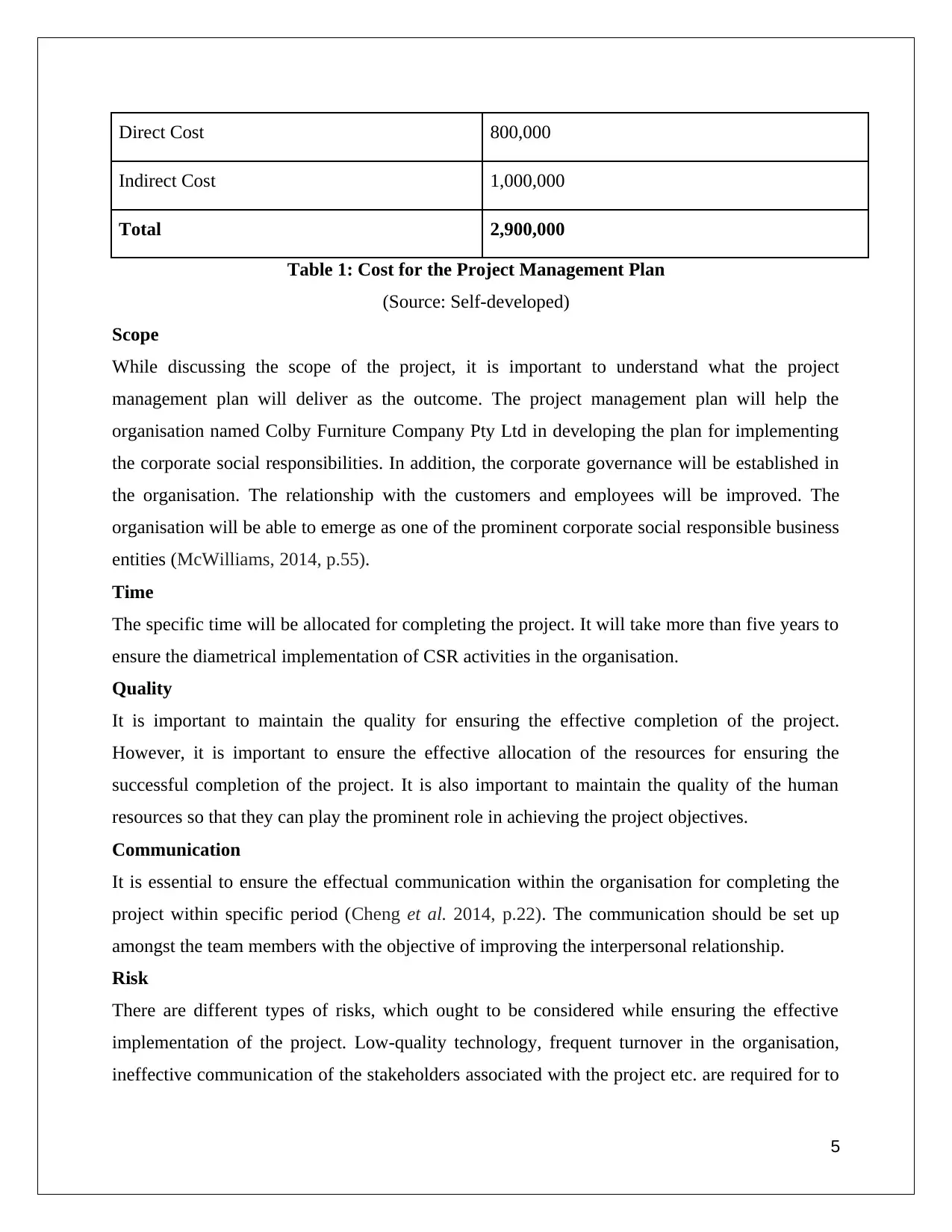
Direct Cost 800,000
Indirect Cost 1,000,000
Total 2,900,000
Table 1: Cost for the Project Management Plan
(Source: Self-developed)
Scope
While discussing the scope of the project, it is important to understand what the project
management plan will deliver as the outcome. The project management plan will help the
organisation named Colby Furniture Company Pty Ltd in developing the plan for implementing
the corporate social responsibilities. In addition, the corporate governance will be established in
the organisation. The relationship with the customers and employees will be improved. The
organisation will be able to emerge as one of the prominent corporate social responsible business
entities (McWilliams, 2014, p.55).
Time
The specific time will be allocated for completing the project. It will take more than five years to
ensure the diametrical implementation of CSR activities in the organisation.
Quality
It is important to maintain the quality for ensuring the effective completion of the project.
However, it is important to ensure the effective allocation of the resources for ensuring the
successful completion of the project. It is also important to maintain the quality of the human
resources so that they can play the prominent role in achieving the project objectives.
Communication
It is essential to ensure the effectual communication within the organisation for completing the
project within specific period (Cheng et al. 2014, p.22). The communication should be set up
amongst the team members with the objective of improving the interpersonal relationship.
Risk
There are different types of risks, which ought to be considered while ensuring the effective
implementation of the project. Low-quality technology, frequent turnover in the organisation,
ineffective communication of the stakeholders associated with the project etc. are required for to
5
Indirect Cost 1,000,000
Total 2,900,000
Table 1: Cost for the Project Management Plan
(Source: Self-developed)
Scope
While discussing the scope of the project, it is important to understand what the project
management plan will deliver as the outcome. The project management plan will help the
organisation named Colby Furniture Company Pty Ltd in developing the plan for implementing
the corporate social responsibilities. In addition, the corporate governance will be established in
the organisation. The relationship with the customers and employees will be improved. The
organisation will be able to emerge as one of the prominent corporate social responsible business
entities (McWilliams, 2014, p.55).
Time
The specific time will be allocated for completing the project. It will take more than five years to
ensure the diametrical implementation of CSR activities in the organisation.
Quality
It is important to maintain the quality for ensuring the effective completion of the project.
However, it is important to ensure the effective allocation of the resources for ensuring the
successful completion of the project. It is also important to maintain the quality of the human
resources so that they can play the prominent role in achieving the project objectives.
Communication
It is essential to ensure the effectual communication within the organisation for completing the
project within specific period (Cheng et al. 2014, p.22). The communication should be set up
amongst the team members with the objective of improving the interpersonal relationship.
Risk
There are different types of risks, which ought to be considered while ensuring the effective
implementation of the project. Low-quality technology, frequent turnover in the organisation,
ineffective communication of the stakeholders associated with the project etc. are required for to
5
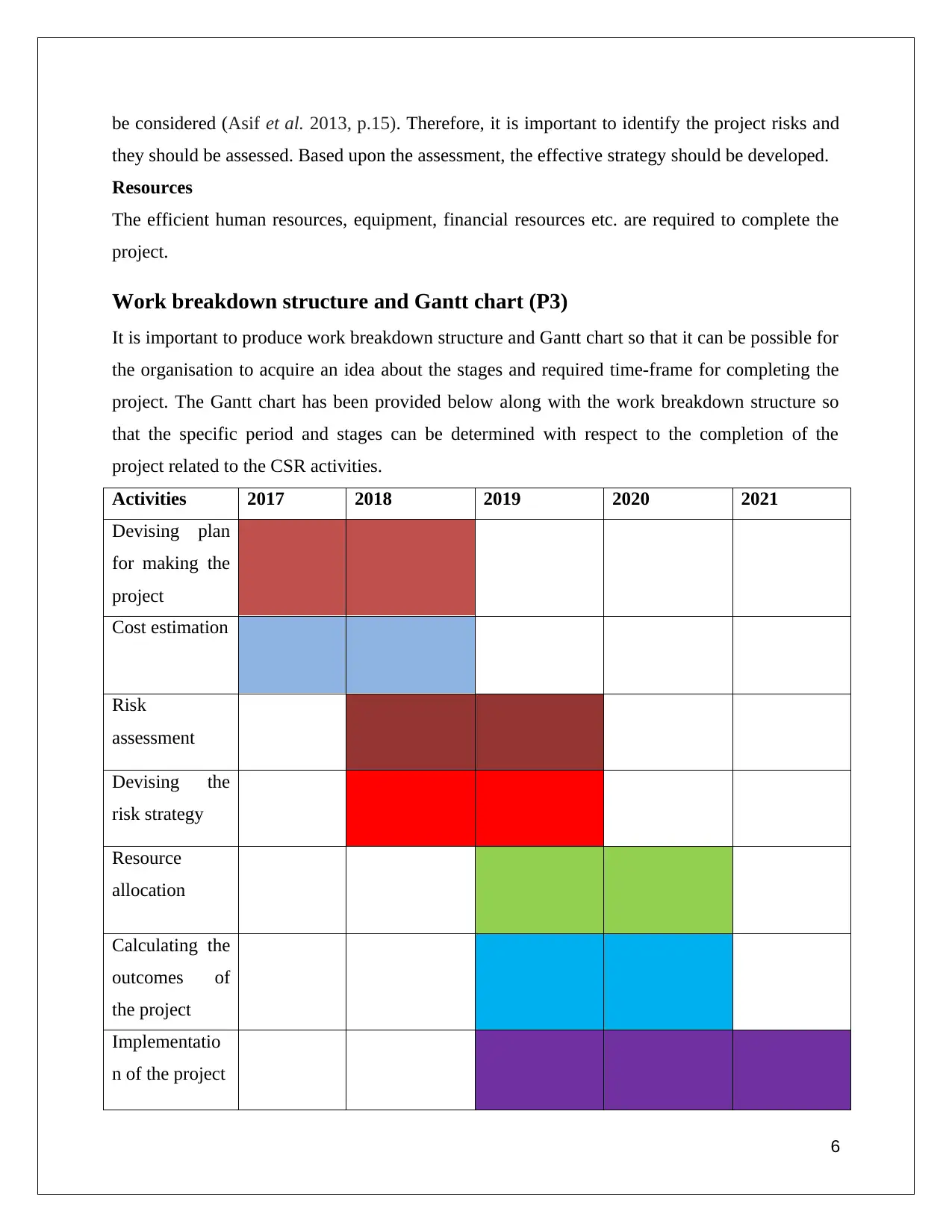
be considered (Asif et al. 2013, p.15). Therefore, it is important to identify the project risks and
they should be assessed. Based upon the assessment, the effective strategy should be developed.
Resources
The efficient human resources, equipment, financial resources etc. are required to complete the
project.
Work breakdown structure and Gantt chart (P3)
It is important to produce work breakdown structure and Gantt chart so that it can be possible for
the organisation to acquire an idea about the stages and required time-frame for completing the
project. The Gantt chart has been provided below along with the work breakdown structure so
that the specific period and stages can be determined with respect to the completion of the
project related to the CSR activities.
Activities 2017 2018 2019 2020 2021
Devising plan
for making the
project
Cost estimation
Risk
assessment
Devising the
risk strategy
Resource
allocation
Calculating the
outcomes of
the project
Implementatio
n of the project
6
they should be assessed. Based upon the assessment, the effective strategy should be developed.
Resources
The efficient human resources, equipment, financial resources etc. are required to complete the
project.
Work breakdown structure and Gantt chart (P3)
It is important to produce work breakdown structure and Gantt chart so that it can be possible for
the organisation to acquire an idea about the stages and required time-frame for completing the
project. The Gantt chart has been provided below along with the work breakdown structure so
that the specific period and stages can be determined with respect to the completion of the
project related to the CSR activities.
Activities 2017 2018 2019 2020 2021
Devising plan
for making the
project
Cost estimation
Risk
assessment
Devising the
risk strategy
Resource
allocation
Calculating the
outcomes of
the project
Implementatio
n of the project
6
⊘ This is a preview!⊘
Do you want full access?
Subscribe today to unlock all pages.
Trusted by 1+ million students worldwide
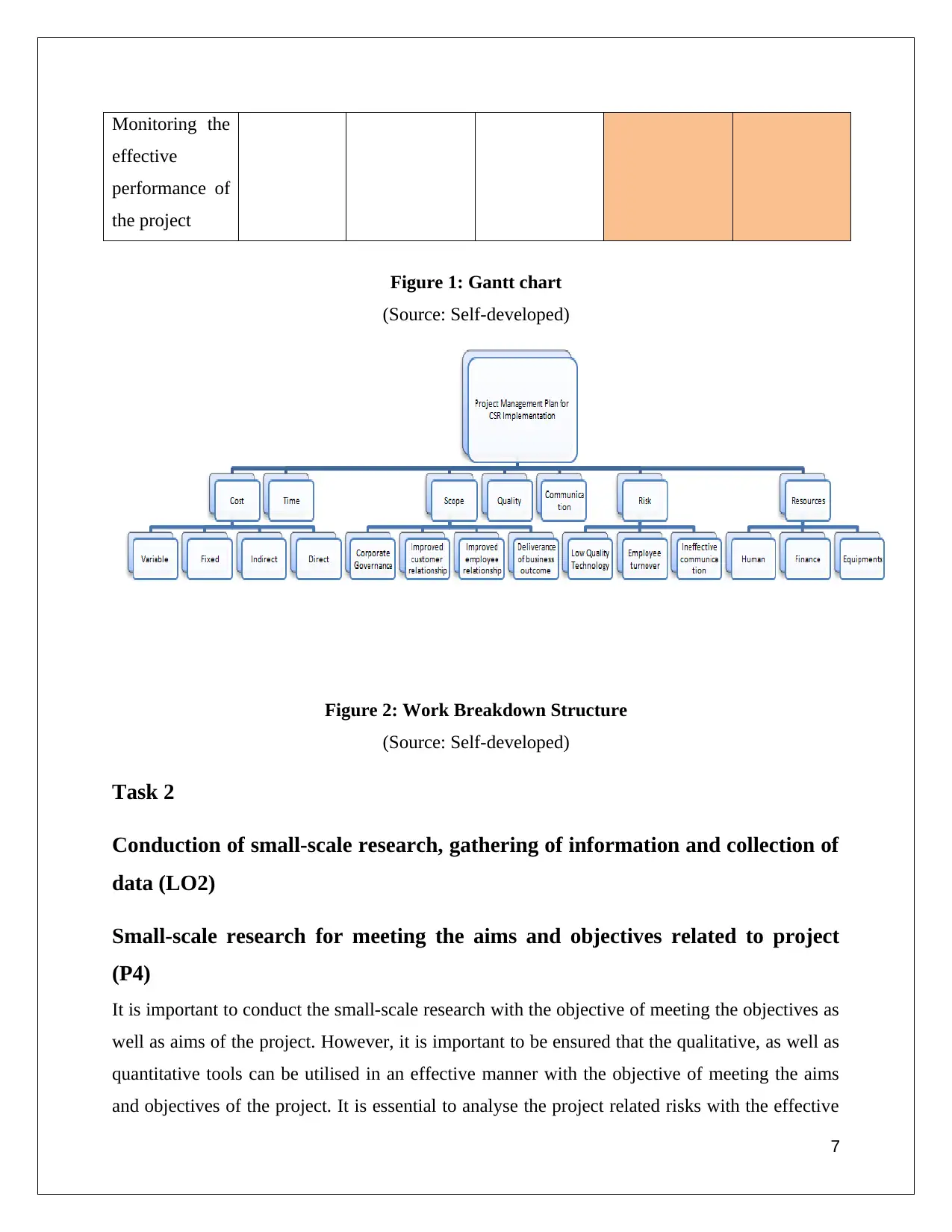
Monitoring the
effective
performance of
the project
Figure 1: Gantt chart
(Source: Self-developed)
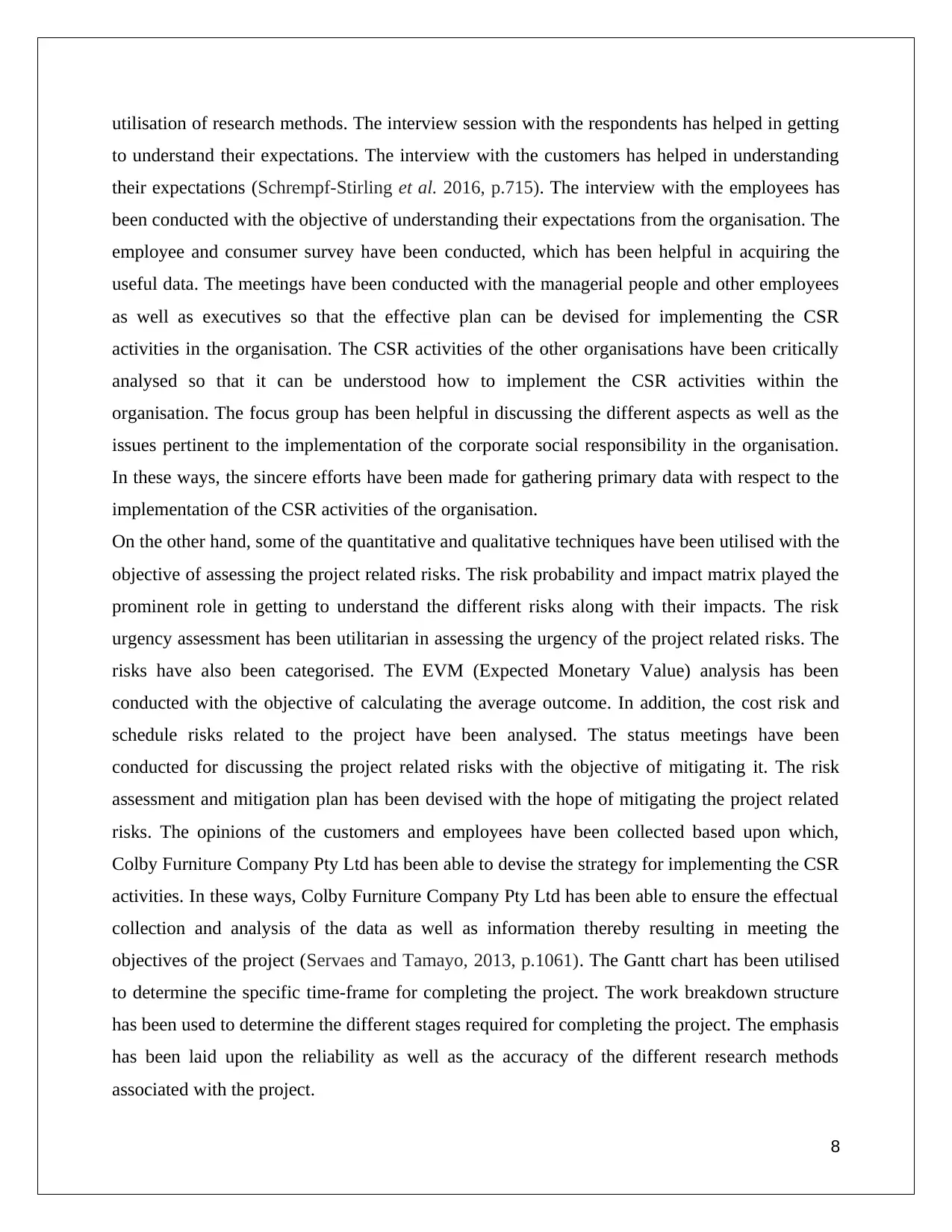
Figure 2: Work Breakdown Structure
(Source: Self-developed)
Task 2
Conduction of small-scale research, gathering of information and collection of
data (LO2)
Small-scale research for meeting the aims and objectives related to project
(P4)
It is important to conduct the small-scale research with the objective of meeting the objectives as
well as aims of the project. However, it is important to be ensured that the qualitative, as well as
quantitative tools can be utilised in an effective manner with the objective of meeting the aims
and objectives of the project. It is essential to analyse the project related risks with the effective
7
effective
performance of
the project
Figure 1: Gantt chart
(Source: Self-developed)
Figure 2: Work Breakdown Structure
(Source: Self-developed)
Task 2
Conduction of small-scale research, gathering of information and collection of
data (LO2)
Small-scale research for meeting the aims and objectives related to project
(P4)
It is important to conduct the small-scale research with the objective of meeting the objectives as
well as aims of the project. However, it is important to be ensured that the qualitative, as well as
quantitative tools can be utilised in an effective manner with the objective of meeting the aims
and objectives of the project. It is essential to analyse the project related risks with the effective
7
Paraphrase This Document
Need a fresh take? Get an instant paraphrase of this document with our AI Paraphraser
utilisation of research methods. The interview session with the respondents has helped in getting
to understand their expectations. The interview with the customers has helped in understanding
their expectations (Schrempf-Stirling et al. 2016, p.715). The interview with the employees has
been conducted with the objective of understanding their expectations from the organisation. The
employee and consumer survey have been conducted, which has been helpful in acquiring the
useful data. The meetings have been conducted with the managerial people and other employees
as well as executives so that the effective plan can be devised for implementing the CSR
activities in the organisation. The CSR activities of the other organisations have been critically
analysed so that it can be understood how to implement the CSR activities within the
organisation. The focus group has been helpful in discussing the different aspects as well as the
issues pertinent to the implementation of the corporate social responsibility in the organisation.
In these ways, the sincere efforts have been made for gathering primary data with respect to the
implementation of the CSR activities of the organisation.
On the other hand, some of the quantitative and qualitative techniques have been utilised with the
objective of assessing the project related risks. The risk probability and impact matrix played the
prominent role in getting to understand the different risks along with their impacts. The risk
urgency assessment has been utilitarian in assessing the urgency of the project related risks. The
risks have also been categorised. The EVM (Expected Monetary Value) analysis has been
conducted with the objective of calculating the average outcome. In addition, the cost risk and
schedule risks related to the project have been analysed. The status meetings have been
conducted for discussing the project related risks with the objective of mitigating it. The risk
assessment and mitigation plan has been devised with the hope of mitigating the project related
risks. The opinions of the customers and employees have been collected based upon which,
Colby Furniture Company Pty Ltd has been able to devise the strategy for implementing the CSR
activities. In these ways, Colby Furniture Company Pty Ltd has been able to ensure the effectual
collection and analysis of the data as well as information thereby resulting in meeting the
objectives of the project (Servaes and Tamayo, 2013, p.1061). The Gantt chart has been utilised
to determine the specific time-frame for completing the project. The work breakdown structure
has been used to determine the different stages required for completing the project. The emphasis
has been laid upon the reliability as well as the accuracy of the different research methods
associated with the project.
8
to understand their expectations. The interview with the customers has helped in understanding
their expectations (Schrempf-Stirling et al. 2016, p.715). The interview with the employees has
been conducted with the objective of understanding their expectations from the organisation. The
employee and consumer survey have been conducted, which has been helpful in acquiring the
useful data. The meetings have been conducted with the managerial people and other employees
as well as executives so that the effective plan can be devised for implementing the CSR
activities in the organisation. The CSR activities of the other organisations have been critically
analysed so that it can be understood how to implement the CSR activities within the
organisation. The focus group has been helpful in discussing the different aspects as well as the
issues pertinent to the implementation of the corporate social responsibility in the organisation.
In these ways, the sincere efforts have been made for gathering primary data with respect to the
implementation of the CSR activities of the organisation.
On the other hand, some of the quantitative and qualitative techniques have been utilised with the
objective of assessing the project related risks. The risk probability and impact matrix played the
prominent role in getting to understand the different risks along with their impacts. The risk
urgency assessment has been utilitarian in assessing the urgency of the project related risks. The
risks have also been categorised. The EVM (Expected Monetary Value) analysis has been
conducted with the objective of calculating the average outcome. In addition, the cost risk and
schedule risks related to the project have been analysed. The status meetings have been
conducted for discussing the project related risks with the objective of mitigating it. The risk
assessment and mitigation plan has been devised with the hope of mitigating the project related
risks. The opinions of the customers and employees have been collected based upon which,
Colby Furniture Company Pty Ltd has been able to devise the strategy for implementing the CSR
activities. In these ways, Colby Furniture Company Pty Ltd has been able to ensure the effectual
collection and analysis of the data as well as information thereby resulting in meeting the
objectives of the project (Servaes and Tamayo, 2013, p.1061). The Gantt chart has been utilised
to determine the specific time-frame for completing the project. The work breakdown structure
has been used to determine the different stages required for completing the project. The emphasis
has been laid upon the reliability as well as the accuracy of the different research methods
associated with the project.
8
Task 3
Presentation of the project and appropriate recommendations (LO3)
Analysis of the research and data (P5)
It is important to conduct the effective analysis of the data through the effective utilisation of the
tools as well as techniques. From the effectual analysis of the data, it has been learned that the
employees are in favour of implementing the corporate social responsibilities. Most of the
employees and employers alike have expressed their opinions in favour of implementing the
corporate social responsibility within the organisations. In accordance with their opinion, it will
help in ensuring the stability of the organisation. Colby Furniture Company Pty Ltd will be able
to increase the level of brand reputation of the organisation. The organisational stability will be
helpful ensuring the business growth. The customers’ retention can be ensured if the organisation
focuses on implementing the CSR activities (Chernev and Blair, 2015, p.1412). Most of the
customers have found the idea of implementing CSR activities interesting. In fact, the local
communities have shown interests on the idea of implementing the corporate social
responsibility within the organisation. In the opinion of the employers, the implementation of the
corporate social responsibility will play important role in increasing the growth rate of business
revenue as it is considered the important factor in improving the customer relationship
management. The implementation of the corporate social responsibility will be playing important
role in decreasing the employee turnover rate thereby resulting in improving the overall
organisational productivity. In addition, the employee relationship management will also be
improved. In the opinions of the managers, the effective implementation of the CSR activities
will be playing the prominent role in creating the positive brand image thereby resulting in
increasing the level of brand reputation (Christensen et al. 2014, p.175).
The utilisation of the different risk assessment tools has been proved as useful in analysing the
different aspects of the project risks. The effective utilisation of the different risk tools has been
useful in assessing the impact of the risks. The statistical analysis tools like EVM analysis have
been utilised in calculating the average outcome with respect to the business operational
activities. The risks have been assessed and analysed in an effectual manner. The status meetings
have played the prominent role in helping the management in devising the strategy for mitigating
9
Presentation of the project and appropriate recommendations (LO3)
Analysis of the research and data (P5)
It is important to conduct the effective analysis of the data through the effective utilisation of the
tools as well as techniques. From the effectual analysis of the data, it has been learned that the
employees are in favour of implementing the corporate social responsibilities. Most of the
employees and employers alike have expressed their opinions in favour of implementing the
corporate social responsibility within the organisations. In accordance with their opinion, it will
help in ensuring the stability of the organisation. Colby Furniture Company Pty Ltd will be able
to increase the level of brand reputation of the organisation. The organisational stability will be
helpful ensuring the business growth. The customers’ retention can be ensured if the organisation
focuses on implementing the CSR activities (Chernev and Blair, 2015, p.1412). Most of the
customers have found the idea of implementing CSR activities interesting. In fact, the local
communities have shown interests on the idea of implementing the corporate social
responsibility within the organisation. In the opinion of the employers, the implementation of the
corporate social responsibility will play important role in increasing the growth rate of business
revenue as it is considered the important factor in improving the customer relationship
management. The implementation of the corporate social responsibility will be playing important
role in decreasing the employee turnover rate thereby resulting in improving the overall
organisational productivity. In addition, the employee relationship management will also be
improved. In the opinions of the managers, the effective implementation of the CSR activities
will be playing the prominent role in creating the positive brand image thereby resulting in
increasing the level of brand reputation (Christensen et al. 2014, p.175).
The utilisation of the different risk assessment tools has been proved as useful in analysing the
different aspects of the project risks. The effective utilisation of the different risk tools has been
useful in assessing the impact of the risks. The statistical analysis tools like EVM analysis have
been utilised in calculating the average outcome with respect to the business operational
activities. The risks have been assessed and analysed in an effectual manner. The status meetings
have played the prominent role in helping the management in devising the strategy for mitigating
9
⊘ This is a preview!⊘
Do you want full access?
Subscribe today to unlock all pages.
Trusted by 1+ million students worldwide
the risks. In this way, the organisation has been able to make effective utilisation of the different
risk related tools and techniques for ensuring the effectual analysis of the data.
Appropriate recommendations (P6)
It is important to recommend suggestive ways with the objective of improving the effectiveness
of the project. The recommendations will help the organisation in improving the business
operations. Following things can be recommended with respect to the improvement in the
project:
● It is recommended that the organisation should be making the effective utilisation of the
different risk assessment tools with the objective of devising the risk strategy. Devising
the effective risk strategy will help the organisation in mitigating the risks to a great
extent.
● It is recommended that the organisation should be ensuring that the employees can be
able to possess the CSR skills. For ensuring the existence of skills related to CSR, the
organisation should introduce the effectual training and development program.
● It is recommended that the organisation focus on increasing the level of organisational
cooperation and coordination for achieving aims and objectives with respect to the
corporate social responsibility (Choi and Moon, 2016, p.1517).
● It is recommended that the organisation should be focusing on the effective use of CSR
audit with the objective of assessing the organisational performance in terms of the
achievement of the aims and objectives of corporate social responsibility.
● It is recommended that the organisation should focus on the introduction of the reward
for the employees so that they can be motivated to perform the CSR-related activities.
● The organisation should be playing the prominent role in enforcing the rules and
regulations with respect to the implementation of the corporate social responsibility. In
this way, the organisation will be able to create a sense of commitment amongst the
organisational members for ensuring the effective performance of the CSR activities.
● The business entity should play important role in communicating the initiatives of CSR to
the stakeholders associated with the organisation (Deng et al. 2013, p.105). It will be
helpful in creating the brand awareness amongst the mind of the employees.
10
risk related tools and techniques for ensuring the effectual analysis of the data.
Appropriate recommendations (P6)
It is important to recommend suggestive ways with the objective of improving the effectiveness
of the project. The recommendations will help the organisation in improving the business
operations. Following things can be recommended with respect to the improvement in the
project:
● It is recommended that the organisation should be making the effective utilisation of the
different risk assessment tools with the objective of devising the risk strategy. Devising
the effective risk strategy will help the organisation in mitigating the risks to a great
extent.
● It is recommended that the organisation should be ensuring that the employees can be
able to possess the CSR skills. For ensuring the existence of skills related to CSR, the
organisation should introduce the effectual training and development program.
● It is recommended that the organisation focus on increasing the level of organisational
cooperation and coordination for achieving aims and objectives with respect to the
corporate social responsibility (Choi and Moon, 2016, p.1517).
● It is recommended that the organisation should be focusing on the effective use of CSR
audit with the objective of assessing the organisational performance in terms of the
achievement of the aims and objectives of corporate social responsibility.
● It is recommended that the organisation should focus on the introduction of the reward
for the employees so that they can be motivated to perform the CSR-related activities.
● The organisation should be playing the prominent role in enforcing the rules and
regulations with respect to the implementation of the corporate social responsibility. In
this way, the organisation will be able to create a sense of commitment amongst the
organisational members for ensuring the effective performance of the CSR activities.
● The business entity should play important role in communicating the initiatives of CSR to
the stakeholders associated with the organisation (Deng et al. 2013, p.105). It will be
helpful in creating the brand awareness amongst the mind of the employees.
10
Paraphrase This Document
Need a fresh take? Get an instant paraphrase of this document with our AI Paraphraser
● The organisation should consider the idea of involving the marketing team so that they
can be able to play leading role with respect to the implementation of the CSR activities.
Task 4
Reflection with respect to the value from the conduction of the project and its
utility for supporting sustainable performance of the organisation (LO4)
Reflection with respect to the value of undertaking the research related
activities (P7)
The undertaking of the research will be the role player in generating the value in terms of
meeting the aims and objectives of the CSR activities. The organisation will be able to support
the sustainable performance through the effective utilisation of the CSR activities. The research
project will be helpful in the effective assessment of the risks associated with the project. The
project management plan will help the organisation in acquiring the knowledge on the effective
utilisation of the strategy for implementing the CSR initiatives (Flammer, 2015, p.2550). In
addition, the implementation of the project management plan will play the prominent role in
creating the positive image of the organisation thereby resulting in ensuring customer as well as
employee retention. The growth of the organisation will be accelerated in terms of business
profitability if the implementation of the CSR activities is ensured.
Conclusion
The CSR activities will help the organisation in creating the happy environment in the
organisation. As a result, the productivity of the organisation will be increased. With the
increment in the productivity, the organisation will be able to increase the market share. In
addition, the people associated with the organisation will be able to get the chance to contribute
to the development of the society as well as the country if the CSR activities are implemented in
an effective manner.
11
can be able to play leading role with respect to the implementation of the CSR activities.
Task 4
Reflection with respect to the value from the conduction of the project and its
utility for supporting sustainable performance of the organisation (LO4)
Reflection with respect to the value of undertaking the research related
activities (P7)
The undertaking of the research will be the role player in generating the value in terms of
meeting the aims and objectives of the CSR activities. The organisation will be able to support
the sustainable performance through the effective utilisation of the CSR activities. The research
project will be helpful in the effective assessment of the risks associated with the project. The
project management plan will help the organisation in acquiring the knowledge on the effective
utilisation of the strategy for implementing the CSR initiatives (Flammer, 2015, p.2550). In
addition, the implementation of the project management plan will play the prominent role in
creating the positive image of the organisation thereby resulting in ensuring customer as well as
employee retention. The growth of the organisation will be accelerated in terms of business
profitability if the implementation of the CSR activities is ensured.
Conclusion
The CSR activities will help the organisation in creating the happy environment in the
organisation. As a result, the productivity of the organisation will be increased. With the
increment in the productivity, the organisation will be able to increase the market share. In
addition, the people associated with the organisation will be able to get the chance to contribute
to the development of the society as well as the country if the CSR activities are implemented in
an effective manner.
11
Bibliography
Asif, M., Searcy, C., Zutshi, A. and Fisscher, O.A. (2013). An integrated management systems
approach to corporate social responsibility. Journal of cleaner production, 56, pp.7-17.
Baumann-Pauly, D., Wickert, C., Spence, L.J. and Scherer, A.G. (2013). Organizing corporate
social responsibility in small and large firms: Size matters. Journal of Business Ethics, 115(4),
pp.693-705.
Carroll, A.B. (2015). Corporate social responsibility. Organizational Dynamics, 44(2), pp.87-96.
Cheng, B., Ioannou, I. and Serafeim, G. (2014). Corporate social responsibility and access to
finance. Strategic Management Journal, 35(1), pp.1-23.
Chernev, A. and Blair, S. (2015). Doing well by doing good: The benevolent halo of corporate
social responsibility. Journal of Consumer Research, 41(6), pp.1412-1425.
Choi, H. and Moon, D. (2016). Perceptions Of Corporate Social Responsibility In The Capital
Market. Journal of Applied Business Research (JABR), 32(5), pp.1507-1518.
Christensen, L.J., Mackey, A. and Whetten, D. (2014). Taking responsibility for corporate social
responsibility: The role of leaders in creating, implementing, sustaining, or avoiding socially
responsible firm behaviors. The Academy of Management Perspectives, 28(2), pp.164-178.
Deng, X., Kang, J.K. and Low, B.S. (2013). Corporate social responsibility and stakeholder
value maximization: Evidence from mergers. Journal of Financial Economics, 110(1), pp.87-
109.
Farooq, O., Payaud, M., Merunka, D. and Valette-Florence, P. (2014). The impact of corporate
social responsibility on organizational commitment: Exploring multiple mediation
mechanisms. Journal of Business Ethics, 125(4), pp.563-580.
Flammer, C. (2015). Does corporate social responsibility lead to superior financial performance?
A regression discontinuity approach. Management Science, 61(11), pp.2549-2568.
Mason, C. and Simmons, J. (2014). Embedding corporate social responsibility in corporate
governance: A stakeholder systems approach. Journal of Business Ethics, 119(1), pp.77-86.
McWilliams, A. (2014). Economics of Corporate Social Responsibility. Cheltenham: Edward
Elgar Publishing.
12
Asif, M., Searcy, C., Zutshi, A. and Fisscher, O.A. (2013). An integrated management systems
approach to corporate social responsibility. Journal of cleaner production, 56, pp.7-17.
Baumann-Pauly, D., Wickert, C., Spence, L.J. and Scherer, A.G. (2013). Organizing corporate
social responsibility in small and large firms: Size matters. Journal of Business Ethics, 115(4),
pp.693-705.
Carroll, A.B. (2015). Corporate social responsibility. Organizational Dynamics, 44(2), pp.87-96.
Cheng, B., Ioannou, I. and Serafeim, G. (2014). Corporate social responsibility and access to
finance. Strategic Management Journal, 35(1), pp.1-23.
Chernev, A. and Blair, S. (2015). Doing well by doing good: The benevolent halo of corporate
social responsibility. Journal of Consumer Research, 41(6), pp.1412-1425.
Choi, H. and Moon, D. (2016). Perceptions Of Corporate Social Responsibility In The Capital
Market. Journal of Applied Business Research (JABR), 32(5), pp.1507-1518.
Christensen, L.J., Mackey, A. and Whetten, D. (2014). Taking responsibility for corporate social
responsibility: The role of leaders in creating, implementing, sustaining, or avoiding socially
responsible firm behaviors. The Academy of Management Perspectives, 28(2), pp.164-178.
Deng, X., Kang, J.K. and Low, B.S. (2013). Corporate social responsibility and stakeholder
value maximization: Evidence from mergers. Journal of Financial Economics, 110(1), pp.87-
109.
Farooq, O., Payaud, M., Merunka, D. and Valette-Florence, P. (2014). The impact of corporate
social responsibility on organizational commitment: Exploring multiple mediation
mechanisms. Journal of Business Ethics, 125(4), pp.563-580.
Flammer, C. (2015). Does corporate social responsibility lead to superior financial performance?
A regression discontinuity approach. Management Science, 61(11), pp.2549-2568.
Mason, C. and Simmons, J. (2014). Embedding corporate social responsibility in corporate
governance: A stakeholder systems approach. Journal of Business Ethics, 119(1), pp.77-86.
McWilliams, A. (2014). Economics of Corporate Social Responsibility. Cheltenham: Edward
Elgar Publishing.
12
⊘ This is a preview!⊘
Do you want full access?
Subscribe today to unlock all pages.
Trusted by 1+ million students worldwide

1 out of 13


Related Documents


Your All-in-One AI-Powered Toolkit for Academic Success.
+13062052269
info@desklib.com
Available 24*7 on WhatsApp / Email
![[object Object]](/_next/static/media/star-bottom.7253800d.svg)
Unlock your academic potential
Copyright © 2020–2026 A2Z Services. All Rights Reserved. Developed and managed by ZUCOL.