Cultural Awareness: Importance, Management, and Understanding

Verified

Added on  2021/06/14

|18
|893
|95
Essay
AI Summary
This essay provides a comprehensive overview of cultural awareness, defining it as the understanding of people's behaviors, values, and perceptions. It explores various degrees of cultural awareness, from parochial to participatory stages, and discusses strategies for managing cultural diversity, such as embedding it into the workplace culture, systematically checking assumptions, and building cultural knowledge. The essay emphasizes the importance of cultural awareness in creating cross-sectional understanding and acceptance, highlighting its significance in both workplaces and homes. It also covers understanding cultural differences in food habits, dress codes, language, body language, religion, and family structures. Furthermore, the essay emphasizes the importance of building cultural awareness by understanding one's own culture, traveling, and maintaining a humble and friendly approach. The conclusion underscores the need to increase cultural awareness for cultural growth, suggesting the use of books and the internet to build knowledge.
Document Page
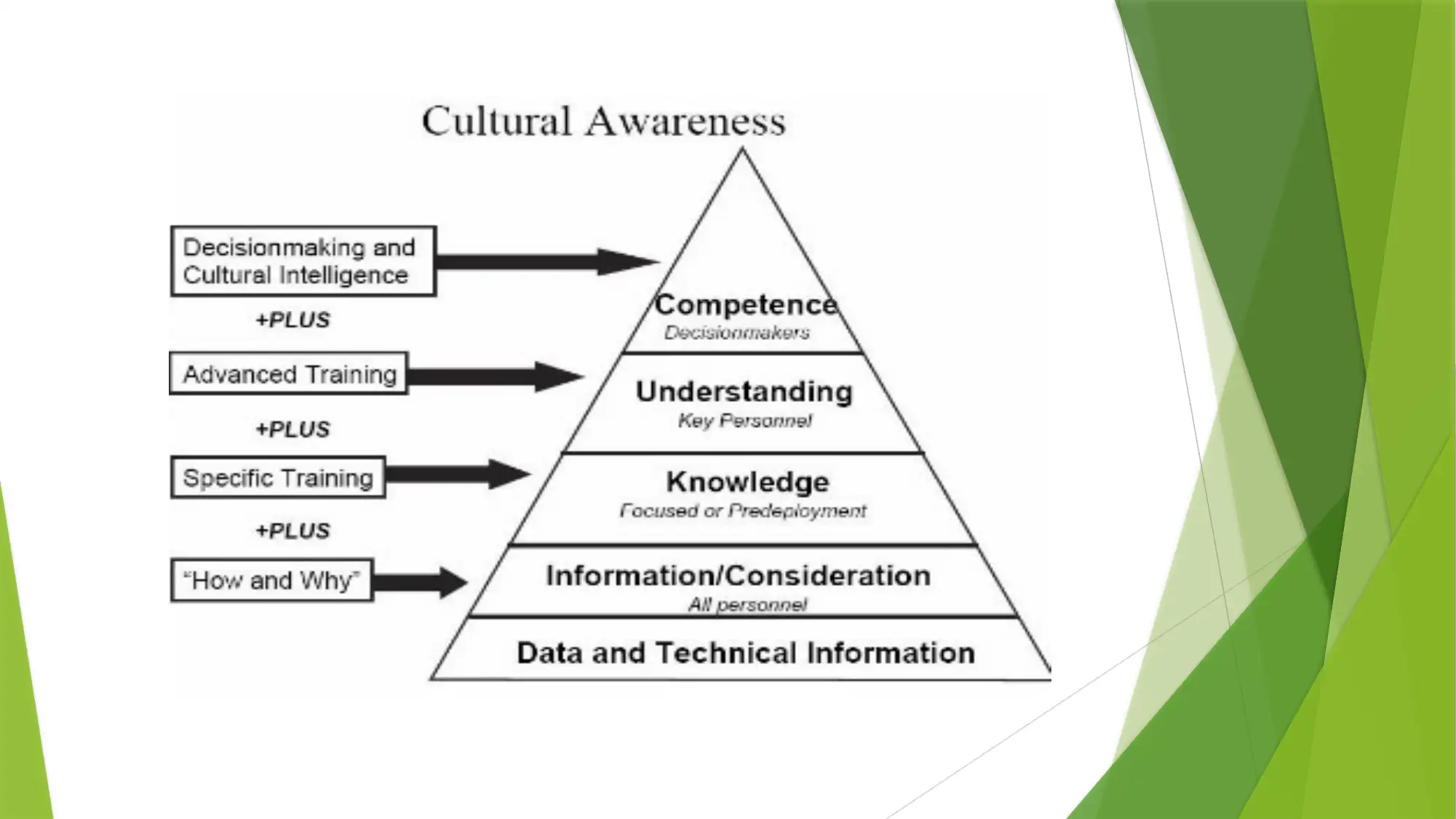
Cultural awareness
tabler-icon-diamond-filled.svg

Paraphrase This Document

Need a fresh take? Get an instant paraphrase of this document with our AI Paraphraser
Document Page
Introduction
Cultural awareness can be defined as the process of
understanding people’s behavior
Cultural awareness is a communicating medium that
involves the awareness of the cultural values, beliefs and
perceptions
Misinterpretations occur primarily due to the lack of
awareness
Document Page
Degree of cultural awareness
There are various degrees of cultural awareness of
which the important points are discussed below:-
My way is the only way and it is also called Parochial
stage where people do things in their own way.
I know their way, but my way is better and it is also
called Ethnocentric stage where people considered
their own way as the best way.
Document Page
continued…
My way and their way and it is also called
Synergistic stage where they thought that
this differences can be both problematic and
beneficial too.
Our way and it is also called Participatory
Third culture stage where people gives
solution about the differences (Ang, & Van
Dyne, 2015).
tabler-icon-diamond-filled.svg

Paraphrase This Document

Need a fresh take? Get an instant paraphrase of this document with our AI Paraphraser
Document Page
Document Page
How do we manage cultural
diversity?
Embedding into the culture of your own work
and not viewing it as an add-on
The first step of managing function is to
recognize it not to fear it
Systematically checking your assumptions
Become comfortable with the situation
Document Page
Group activity
Benefits- the awareness of cultural differences
makes a great success in the environment. Cultural
competence is also an important factor for the
growth of cultural differences (Yamada, 2015)
Build your cultural knowledge- Information about
the different culture has been easily available on
the internet.
tabler-icon-diamond-filled.svg

Paraphrase This Document

Need a fresh take? Get an instant paraphrase of this document with our AI Paraphraser
Document Page
continued…
Treat people as individuals- Be aware of the
situation and try to deal with people as an
individual.
Proper knowledge about the history of the
individual cultures are well studied.
Document Page
Why is cultural awareness
important?
Cultural awareness includes the livelihood of
different parts of the people such as food, dress,
music, building, language and so many
(Mahmud, & Wong, 2016)
It is an important factor for creating a cross-
sectional understanding and acceptance.
Document Page
continued…
Cultural awareness is important in both
workplaces and also in the home
(Kourgiantakis, & Bogo, 2017)
By traveling to different countries and to
different places the cultural discriminatory
should be reduced
tabler-icon-diamond-filled.svg

Paraphrase This Document

Need a fresh take? Get an instant paraphrase of this document with our AI Paraphraser
Document Page
Document Page
Understanding cultural differences
Food habit:
In the Asian country, chopsticks are used
In Europe, knife and fork are used
Beef, pork, fish has been eaten by the different
group of people in different countries (Hayes,
2015)
chevron_up_icon
1 out of 18
circle_padding
hide_on_mobile
zoom_out_icon
[object Object]