The Significance of Studying Design History in Graphic Design
VerifiedAdded on 2020/02/24
|8
|2118
|204
Essay
AI Summary
This essay explores the importance of studying design history, particularly for visual and graphic designers. It argues that understanding design history provides a foundation for extending ideas, offering direct references or borrowing ideas, and developing critical judgment. The essay highlights how history informs design principles, provides context for contemporary work, and helps designers avoid repeating past mistakes. It discusses how studying historical trends, movements, and the work of influential designers like Armin Hoffman and David Carson can enhance a designer's understanding of visual communication and its impact on society. The essay emphasizes the value of historical context in making informed design decisions and developing a strong design philosophy, ultimately leading to more effective and meaningful design work. The essay also mentions the importance of understanding the social and cultural influences on design and how this can shape a designer's critical thinking.
Running head: STUDYING DESIGN HISTORY
Studying design history
(Visual/graphic design)
Name of the student:
Name of the university:
Author Note
Studying design history
(Visual/graphic design)
Name of the student:
Name of the university:
Author Note
Paraphrase This Document
Need a fresh take? Get an instant paraphrase of this document with our AI Paraphraser

1STUDYING DESIGN HISTORY
"Contemporary designers can learn from history. Studying design history is
useful because…"
It is foolishly thought that the history comprises of dusty facts and various faded images.
There is a notion that the history never matters and is irrelevant and inessential in growth. However
studying history has actually proved that people could turn out to be a more efficient designer. They
could create work with higher reason refined meaning and stringer justification (Holt, 2014).
In the following essay the notion is debunked. First of all the visual\graphic design is chosen
as the instance to justify the theme. Three major reasons are demonstrated here. They states that the
graphic design history has been providing with extending the ideas, direct references or borrowing
ideas and developing critical judgment for success and failure.
The graphic designing history has been providing the extension of the ideas. History has the
same importance as that of the theory. The eyes and brains have been working in the same way
through generations. The scenario alters but the visual communication principles survive (Howell &
Christensen, 2013). Here history helps in understanding the principles. In order to understand and
utilize the part of theory appropriately, there is a necessity to know why that has turned to be worth
working. The conditions in which it was developed first and utilized, the reason behind its success
and the original audience and purpose could be determined (Bass et al., 2015). Without the
knowledge it could not be used effectively. Various ideas of the people have been well established.
This has been concerned about the relationships between the text and image, balance and color,
contrast and texture and many more could be assimilated in the infinite possibilities (Dongarra &
Luszczek, 2013). Through the knowledge of why and how the ideas have been developed has been
"Contemporary designers can learn from history. Studying design history is
useful because…"
It is foolishly thought that the history comprises of dusty facts and various faded images.
There is a notion that the history never matters and is irrelevant and inessential in growth. However
studying history has actually proved that people could turn out to be a more efficient designer. They
could create work with higher reason refined meaning and stringer justification (Holt, 2014).
In the following essay the notion is debunked. First of all the visual\graphic design is chosen
as the instance to justify the theme. Three major reasons are demonstrated here. They states that the
graphic design history has been providing with extending the ideas, direct references or borrowing
ideas and developing critical judgment for success and failure.
The graphic designing history has been providing the extension of the ideas. History has the
same importance as that of the theory. The eyes and brains have been working in the same way
through generations. The scenario alters but the visual communication principles survive (Howell &
Christensen, 2013). Here history helps in understanding the principles. In order to understand and
utilize the part of theory appropriately, there is a necessity to know why that has turned to be worth
working. The conditions in which it was developed first and utilized, the reason behind its success
and the original audience and purpose could be determined (Bass et al., 2015). Without the
knowledge it could not be used effectively. Various ideas of the people have been well established.
This has been concerned about the relationships between the text and image, balance and color,
contrast and texture and many more could be assimilated in the infinite possibilities (Dongarra &
Luszczek, 2013). Through the knowledge of why and how the ideas have been developed has been

2STUDYING DESIGN HISTORY
helping to use them currently. By knowing the context where they have been born originally helps to
view same contexts of present day that the theory could be perfectly matching into.
Instead of borrowing the style simple, the concepts about the layout could be explained and
learnt upon. What ideas have worked and what have not could be clearly seen. This permits to skip
the prior mistakes and the forge forward. This has been treading on the latest ground in the shoes
that are familiar with. The graphics designer must be literate enough in designing the history of
graphic design. However able to design has not been always satisfied (Fallan, 2013). By knowing the
origin of design has been needed to do away with the reinvention. This is no less than the inadvertent
plagiarism.
The graphic or virtual design has been providing with the, direct references or borrowing of
ideas. This is the eye that could look at part of work currently and understand whether it could be
hold up in the next few years. Since the people producing aircrafts that have been lasting this period
or more, this is a very powerful train to own.
That direct references or borrowing of ideas has been developed by the realization. People
could view the tasks of the modernists and state that it is impossible to the present to be a sixty years
old. Further there have been people like David Carson, who possess strict opinions whose tasks
appeared to be somehow chaotic and insult to audience (Dongarra & Luszczek, 2013). The most
curious fact has been his wild designing comprises of some philosophical elements similar the open
and clean pages of modernists. Here, both have been basically concerned regarding the interaction
between the content and audience. Their sensibilities were very much different. However history has
been permitting to seek the common ground on which they stood. Somehow the fade design still
possessed the charm to it after a decade (Huppatz, 2015).
helping to use them currently. By knowing the context where they have been born originally helps to
view same contexts of present day that the theory could be perfectly matching into.
Instead of borrowing the style simple, the concepts about the layout could be explained and
learnt upon. What ideas have worked and what have not could be clearly seen. This permits to skip
the prior mistakes and the forge forward. This has been treading on the latest ground in the shoes
that are familiar with. The graphics designer must be literate enough in designing the history of
graphic design. However able to design has not been always satisfied (Fallan, 2013). By knowing the
origin of design has been needed to do away with the reinvention. This is no less than the inadvertent
plagiarism.
The graphic or virtual design has been providing with the, direct references or borrowing of
ideas. This is the eye that could look at part of work currently and understand whether it could be
hold up in the next few years. Since the people producing aircrafts that have been lasting this period
or more, this is a very powerful train to own.
That direct references or borrowing of ideas has been developed by the realization. People
could view the tasks of the modernists and state that it is impossible to the present to be a sixty years
old. Further there have been people like David Carson, who possess strict opinions whose tasks
appeared to be somehow chaotic and insult to audience (Dongarra & Luszczek, 2013). The most
curious fact has been his wild designing comprises of some philosophical elements similar the open
and clean pages of modernists. Here, both have been basically concerned regarding the interaction
between the content and audience. Their sensibilities were very much different. However history has
been permitting to seek the common ground on which they stood. Somehow the fade design still
possessed the charm to it after a decade (Huppatz, 2015).
⊘ This is a preview!⊘
Do you want full access?
Subscribe today to unlock all pages.

Trusted by 1+ million students worldwide

3STUDYING DESIGN HISTORY
History has also been helping to recognize what have not worked. After flicking through the
historical literatures, few blips of expression and style could be found. The tasks that have been
purely tacky were considered cool, great and funky (Fineder & Geisler, 2010). Here history is useful
to know what type of the funky existed only for any absurd moment. Moreover the work of the
Carson could be considered where the absurd situations devoted the followers it has spawned
(Gorman, 2003). This type of the historical education has been helping in understanding what we
have been searching for and what the people might think of that in the following years. It also helps
in noticing the fad from the endless time.
The history of graphic designing has provided with the developing critical judgment for
success and failure. The connections made could be seen along with how an instantaneous time
could lead to the following, how the ideas and styles have been evolved and what impact the social
scenario has played. It has not been sufficient to view Modernism and state simply that they have
been the sick of the ornaments (Fineder & Geisler, 2010). This has been a childish assumption. What
the people have been able to do is to throw Meggs’ to couch and switch to Wikipedia. From there
they learn regarding European, Germanic, Nazism and Facism, the role played by Blackletter,
situation of Europe at that time and so on.
Then with this latest study in tow, people could better be aware why particular decisions
simplicity and cleanliness, unclouded communication has been striving for. Armin Hoffman states
that for after all, the poster have been doing more than just supplying data on the efficiency it has
advertising, it also revealed the state of mind of the society. This has been neither awful nor poorly
written (Sparke, 2013). However this has not been enough. None of the hungers for knowledge could
be satisfied with this. And, a good designer is always hungry.
History has also been helping to recognize what have not worked. After flicking through the
historical literatures, few blips of expression and style could be found. The tasks that have been
purely tacky were considered cool, great and funky (Fineder & Geisler, 2010). Here history is useful
to know what type of the funky existed only for any absurd moment. Moreover the work of the
Carson could be considered where the absurd situations devoted the followers it has spawned
(Gorman, 2003). This type of the historical education has been helping in understanding what we
have been searching for and what the people might think of that in the following years. It also helps
in noticing the fad from the endless time.
The history of graphic designing has provided with the developing critical judgment for
success and failure. The connections made could be seen along with how an instantaneous time
could lead to the following, how the ideas and styles have been evolved and what impact the social
scenario has played. It has not been sufficient to view Modernism and state simply that they have
been the sick of the ornaments (Fineder & Geisler, 2010). This has been a childish assumption. What
the people have been able to do is to throw Meggs’ to couch and switch to Wikipedia. From there
they learn regarding European, Germanic, Nazism and Facism, the role played by Blackletter,
situation of Europe at that time and so on.
Then with this latest study in tow, people could better be aware why particular decisions
simplicity and cleanliness, unclouded communication has been striving for. Armin Hoffman states
that for after all, the poster have been doing more than just supplying data on the efficiency it has
advertising, it also revealed the state of mind of the society. This has been neither awful nor poorly
written (Sparke, 2013). However this has not been enough. None of the hungers for knowledge could
be satisfied with this. And, a good designer is always hungry.
Paraphrase This Document
Need a fresh take? Get an instant paraphrase of this document with our AI Paraphraser

4STUDYING DESIGN HISTORY
Instead of this the statement of Meggs regarding Hoffman could be considered. He stated that
as the time moved on Hoffman evolved the philosophy of design in the basis of the primary graphic-
form language of the line, point, plane, replacing the conventional pictorial concepts with the
modernistic aesthetic (Howell & Christensen, 2013). In the work Hoffman has continued to search
the dynamic harmony where every part of the design has been unified. He saw the relationship of the
contrasting elements in mean of the visual design that is invigorating. The contacts included the
curved to the straight and the light to the dark lines. This also included the form to the counter-form,
from soft to hard and from the dynamic to the static. This has been with the resolution gained as the
designer brought the total to the absolute harmony (Meggs & Purvis, 2016).
Thus it is seen that what Hoffman has pieced together have not just due to the reason that it
was pretty or nice. The main reason was that it was the part of the broader philosophy. Thus it
provided the idea how one could develop their philosophy for exploring.
A few more studying of history has been leading to know that the philosophy assimilated
with the others from area developed and came to be known as the Swiss design internationally.
These ideas have been pushed forward by the 1959 publication named New Graphic Design. Josef
Muller-Brockman was one of the editors. Here the connections and the origin of the work-changing
movement have been found. These threads have been almost limitless as one dive into deeper and
deeper (Bass et al., 2015).
The history has been generally the awful boring topic for subject the people to. This has not
been the fault of the events that took place. However this also been those who have been speaking of
them (Howell & Christensen, 2013). The truth is that it has been often up to the people to seen
interest in history. Hence people must pick at the loose end where they find interest, tug and tear and
pull that. This is to be done till the threads that must run through the decades of ideas. This also
Instead of this the statement of Meggs regarding Hoffman could be considered. He stated that
as the time moved on Hoffman evolved the philosophy of design in the basis of the primary graphic-
form language of the line, point, plane, replacing the conventional pictorial concepts with the
modernistic aesthetic (Howell & Christensen, 2013). In the work Hoffman has continued to search
the dynamic harmony where every part of the design has been unified. He saw the relationship of the
contrasting elements in mean of the visual design that is invigorating. The contacts included the
curved to the straight and the light to the dark lines. This also included the form to the counter-form,
from soft to hard and from the dynamic to the static. This has been with the resolution gained as the
designer brought the total to the absolute harmony (Meggs & Purvis, 2016).
Thus it is seen that what Hoffman has pieced together have not just due to the reason that it
was pretty or nice. The main reason was that it was the part of the broader philosophy. Thus it
provided the idea how one could develop their philosophy for exploring.
A few more studying of history has been leading to know that the philosophy assimilated
with the others from area developed and came to be known as the Swiss design internationally.
These ideas have been pushed forward by the 1959 publication named New Graphic Design. Josef
Muller-Brockman was one of the editors. Here the connections and the origin of the work-changing
movement have been found. These threads have been almost limitless as one dive into deeper and
deeper (Bass et al., 2015).
The history has been generally the awful boring topic for subject the people to. This has not
been the fault of the events that took place. However this also been those who have been speaking of
them (Howell & Christensen, 2013). The truth is that it has been often up to the people to seen
interest in history. Hence people must pick at the loose end where they find interest, tug and tear and
pull that. This is to be done till the threads that must run through the decades of ideas. This also

5STUDYING DESIGN HISTORY
involves the beauty from where one could learn volume and witness how the profession is evolving
(Heskett, 2005). As the past is understood, people would continue the culture legacy of the beautiful
format and efficient communication better. As this legacy is ignored, people run the risk to become
buried in the mindless morass of the communication. Its mole-like perspective neglects the human
needs and values as that burrows forward towards darkness.
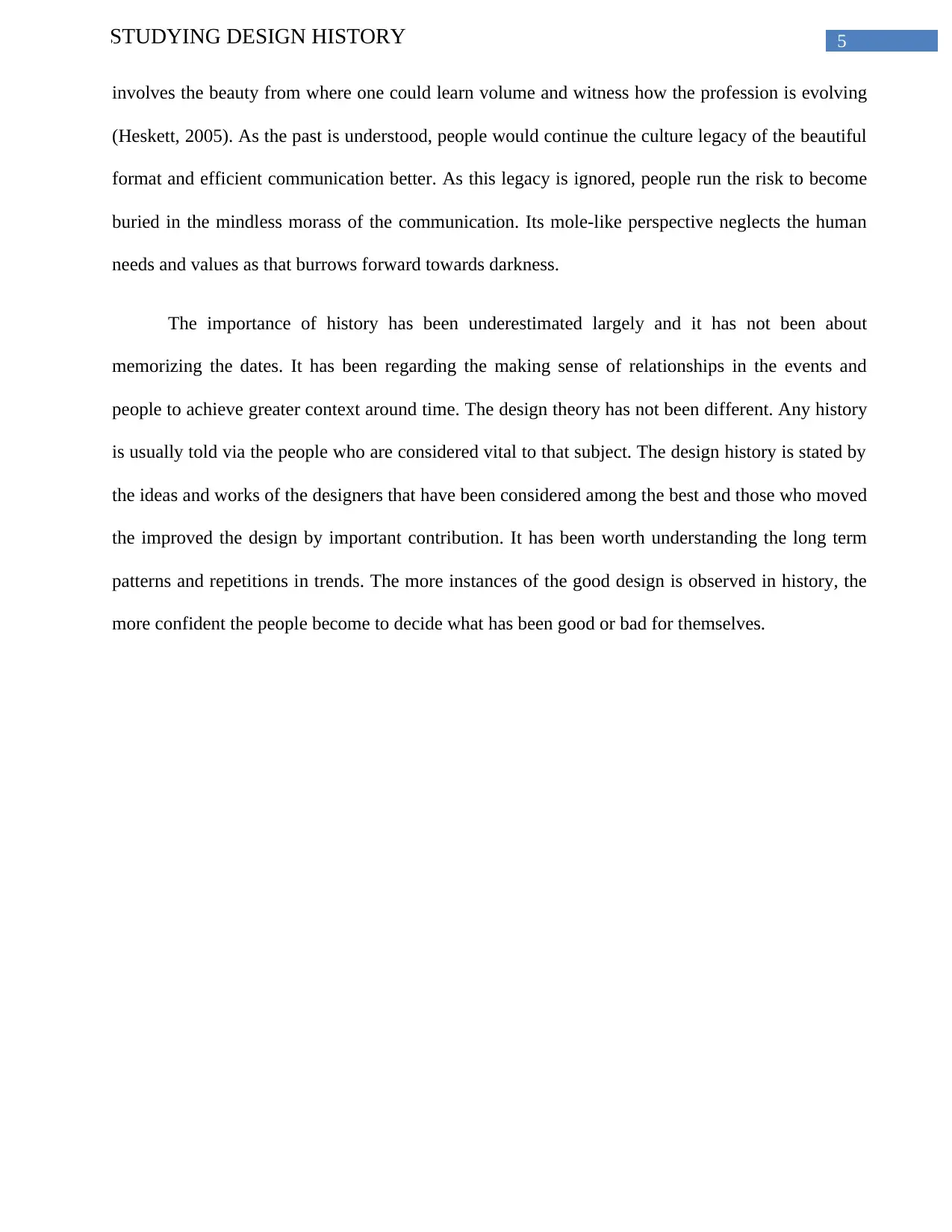
The importance of history has been underestimated largely and it has not been about
memorizing the dates. It has been regarding the making sense of relationships in the events and
people to achieve greater context around time. The design theory has not been different. Any history
is usually told via the people who are considered vital to that subject. The design history is stated by
the ideas and works of the designers that have been considered among the best and those who moved
the improved the design by important contribution. It has been worth understanding the long term
patterns and repetitions in trends. The more instances of the good design is observed in history, the
more confident the people become to decide what has been good or bad for themselves.
involves the beauty from where one could learn volume and witness how the profession is evolving
(Heskett, 2005). As the past is understood, people would continue the culture legacy of the beautiful
format and efficient communication better. As this legacy is ignored, people run the risk to become
buried in the mindless morass of the communication. Its mole-like perspective neglects the human
needs and values as that burrows forward towards darkness.
The importance of history has been underestimated largely and it has not been about
memorizing the dates. It has been regarding the making sense of relationships in the events and
people to achieve greater context around time. The design theory has not been different. Any history
is usually told via the people who are considered vital to that subject. The design history is stated by
the ideas and works of the designers that have been considered among the best and those who moved
the improved the design by important contribution. It has been worth understanding the long term
patterns and repetitions in trends. The more instances of the good design is observed in history, the
more confident the people become to decide what has been good or bad for themselves.
⊘ This is a preview!⊘
Do you want full access?
Subscribe today to unlock all pages.

Trusted by 1+ million students worldwide

6STUDYING DESIGN HISTORY
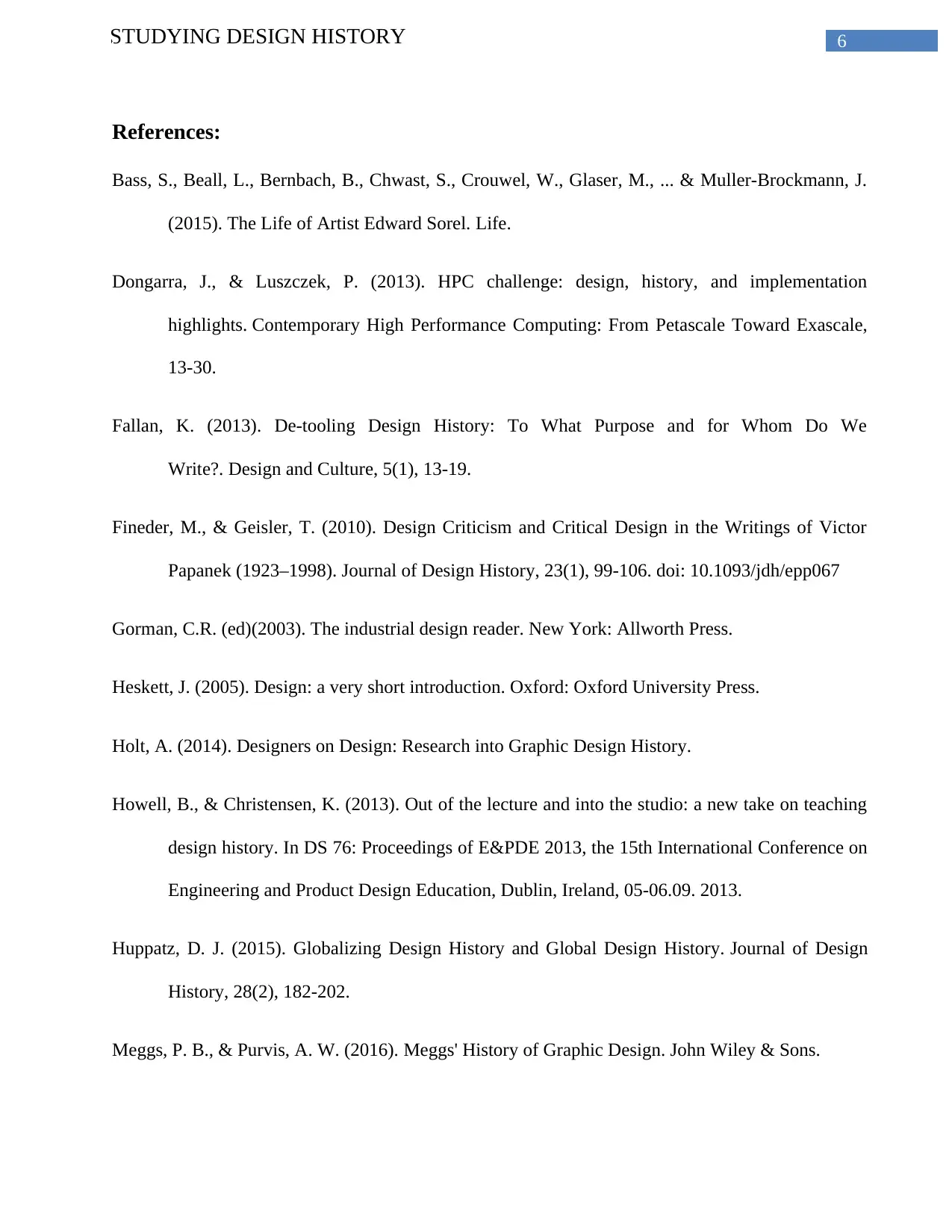
References:
Bass, S., Beall, L., Bernbach, B., Chwast, S., Crouwel, W., Glaser, M., ... & Muller-Brockmann, J.
(2015). The Life of Artist Edward Sorel. Life.
Dongarra, J., & Luszczek, P. (2013). HPC challenge: design, history, and implementation
highlights. Contemporary High Performance Computing: From Petascale Toward Exascale,
13-30.
Fallan, K. (2013). De-tooling Design History: To What Purpose and for Whom Do We
Write?. Design and Culture, 5(1), 13-19.
Fineder, M., & Geisler, T. (2010). Design Criticism and Critical Design in the Writings of Victor
Papanek (1923–1998). Journal of Design History, 23(1), 99-106. doi: 10.1093/jdh/epp067
Gorman, C.R. (ed)(2003). The industrial design reader. New York: Allworth Press.
Heskett, J. (2005). Design: a very short introduction. Oxford: Oxford University Press.
Holt, A. (2014). Designers on Design: Research into Graphic Design History.
Howell, B., & Christensen, K. (2013). Out of the lecture and into the studio: a new take on teaching
design history. In DS 76: Proceedings of E&PDE 2013, the 15th International Conference on
Engineering and Product Design Education, Dublin, Ireland, 05-06.09. 2013.
Huppatz, D. J. (2015). Globalizing Design History and Global Design History. Journal of Design
History, 28(2), 182-202.
Meggs, P. B., & Purvis, A. W. (2016). Meggs' History of Graphic Design. John Wiley & Sons.
References:
Bass, S., Beall, L., Bernbach, B., Chwast, S., Crouwel, W., Glaser, M., ... & Muller-Brockmann, J.
(2015). The Life of Artist Edward Sorel. Life.
Dongarra, J., & Luszczek, P. (2013). HPC challenge: design, history, and implementation
highlights. Contemporary High Performance Computing: From Petascale Toward Exascale,
13-30.
Fallan, K. (2013). De-tooling Design History: To What Purpose and for Whom Do We
Write?. Design and Culture, 5(1), 13-19.
Fineder, M., & Geisler, T. (2010). Design Criticism and Critical Design in the Writings of Victor
Papanek (1923–1998). Journal of Design History, 23(1), 99-106. doi: 10.1093/jdh/epp067
Gorman, C.R. (ed)(2003). The industrial design reader. New York: Allworth Press.
Heskett, J. (2005). Design: a very short introduction. Oxford: Oxford University Press.
Holt, A. (2014). Designers on Design: Research into Graphic Design History.
Howell, B., & Christensen, K. (2013). Out of the lecture and into the studio: a new take on teaching
design history. In DS 76: Proceedings of E&PDE 2013, the 15th International Conference on
Engineering and Product Design Education, Dublin, Ireland, 05-06.09. 2013.
Huppatz, D. J. (2015). Globalizing Design History and Global Design History. Journal of Design
History, 28(2), 182-202.
Meggs, P. B., & Purvis, A. W. (2016). Meggs' History of Graphic Design. John Wiley & Sons.
Paraphrase This Document
Need a fresh take? Get an instant paraphrase of this document with our AI Paraphraser

7STUDYING DESIGN HISTORY
Raizman, P. (2010). History of Modern Design: Graphics and Products since the Industrial
Revolution. 2nd edition. London: Lawrence King
Sparke, P. (2013). An Introduction to Design and Culture: 1900 to the Present, 3rd edition. London:
Routledge.
Raizman, P. (2010). History of Modern Design: Graphics and Products since the Industrial
Revolution. 2nd edition. London: Lawrence King
Sparke, P. (2013). An Introduction to Design and Culture: 1900 to the Present, 3rd edition. London:
Routledge.
1 out of 8
Related Documents
Your All-in-One AI-Powered Toolkit for Academic Success.
+13062052269
info@desklib.com
Available 24*7 on WhatsApp / Email
Unlock your academic potential
Copyright © 2020–2026 A2Z Services. All Rights Reserved. Developed and managed by ZUCOL.