Report on the Importance and Implementation of Lean Management
VerifiedAdded on 2020/05/16
|18
|4255
|132
Report
AI Summary
This report delves into the significance of lean management within organizations, using McDonald's as a practical example. It highlights the core principles of lean management, including waste reduction, process mapping, and Just-in-Time (JIT) inventory management. The report explores how McDonald's has implemented lean strategies to optimize its operations, enhance product quality, and improve customer satisfaction. It also examines the importance of continuous improvement (kaizen) and the elimination of waste (muda) in achieving operational efficiency. The report further discusses the application of lean techniques, such as value stream mapping and design for manufacturing, to streamline processes and reduce costs. Overall, the report provides a comprehensive overview of lean management, its benefits, and its practical application in a real-world business context, demonstrating its crucial role in achieving business goals and maintaining a competitive edge.
Running head: IMPORTANCE OF LEAN MANAGEMENT
IMPORTANCE OF LEAN MANAGEMENT
Name of the Student
Name of the University
Authors Note
IMPORTANCE OF LEAN MANAGEMENT
Name of the Student
Name of the University
Authors Note

Paraphrase This Document
Need a fresh take? Get an instant paraphrase of this document with our AI Paraphraser
1IMPORTANCE OF LEAN MANAGEMENT
Executive summary:
The report throws light on the importance of lean management in an organization. Lean
management applicability and usage is shown in the light of given organization McDonalds.
McDonalds has been one of the leading quick service restaurants practicing lean management.
Lean management is the process used to achieve maximum profit at reduced cost by eliminating
wastes and through proper time management. Any organization practiced this management
approach has strived for improvement. Furthermore, this report provides McDonalds operational
management strategies like Just in Time (JIT) management that includes various process and
techniques. This technique enhances the quality and value of products and services that is
provided to the potential customers at acceptable cost.
Executive summary:
The report throws light on the importance of lean management in an organization. Lean
management applicability and usage is shown in the light of given organization McDonalds.
McDonalds has been one of the leading quick service restaurants practicing lean management.
Lean management is the process used to achieve maximum profit at reduced cost by eliminating
wastes and through proper time management. Any organization practiced this management
approach has strived for improvement. Furthermore, this report provides McDonalds operational
management strategies like Just in Time (JIT) management that includes various process and
techniques. This technique enhances the quality and value of products and services that is
provided to the potential customers at acceptable cost.
2IMPORTANCE OF LEAN MANAGEMENT
Table of Contents
Introduction:....................................................................................................................................3
Process mapping within McDonalds:..............................................................................................4
Implementation of Lean Management:............................................................................................5
Application of Lean Management in McDonalds:........................................................................10
Lean Management practiced within the Organization:..................................................................11
Conclusion:....................................................................................................................................13
References:....................................................................................................................................14
Table of Contents
Introduction:....................................................................................................................................3
Process mapping within McDonalds:..............................................................................................4
Implementation of Lean Management:............................................................................................5
Application of Lean Management in McDonalds:........................................................................10
Lean Management practiced within the Organization:..................................................................11
Conclusion:....................................................................................................................................13
References:....................................................................................................................................14
⊘ This is a preview!⊘
Do you want full access?
Subscribe today to unlock all pages.

Trusted by 1+ million students worldwide
3IMPORTANCE OF LEAN MANAGEMENT
Introduction:
In the current scenario, lean management is used by the organization to not only be
competitive but also make sure that its objectives and goals is achieved at an adequate cost.
McDonald’s is the world’s leading and popular fast food chain company. The core idea of lean
management is maximizing the value of the customers besides reducing wastes (Goetsch and
Davis 2014). It has more than 30,000 local restaurants that serve more than millions of peoples in
117 countries each day (Mcdonalds.com 2018). The main vision of the organization is to provide
its customers the best quick service experience from its restaurant present all over the world.
This means providing its customers with outstanding value and quality services. It operates five
of their offices housing support departments leading from HR to marketing. The marketing
strategy of McDonalds is related with the environment, internal resources and the basic
competencies along with their shareholders. It also aims in serving best food in a more fun and
friendly environment. The main motive is to provide its potential customers with food of high
quality, value and standard. This approch furthermore provides a fair return to their shareholders.
Operation management is the process of efficient production and distribution of process
and services. This also includes development of product and services. This function is generally
managed by the operation managers. McDonalds operation management involve both service
and product management. Through lean management approach the organization is able to
identify its business processes. It seeks in eliminating any waste of money, time and effort by
properly identifying the business process (Distelhorst, Hainmueller and Locke 2016). This
further involves revising or improving the steps that fails to create value. The main customer for
Introduction:
In the current scenario, lean management is used by the organization to not only be
competitive but also make sure that its objectives and goals is achieved at an adequate cost.
McDonald’s is the world’s leading and popular fast food chain company. The core idea of lean
management is maximizing the value of the customers besides reducing wastes (Goetsch and
Davis 2014). It has more than 30,000 local restaurants that serve more than millions of peoples in
117 countries each day (Mcdonalds.com 2018). The main vision of the organization is to provide
its customers the best quick service experience from its restaurant present all over the world.
This means providing its customers with outstanding value and quality services. It operates five
of their offices housing support departments leading from HR to marketing. The marketing
strategy of McDonalds is related with the environment, internal resources and the basic
competencies along with their shareholders. It also aims in serving best food in a more fun and
friendly environment. The main motive is to provide its potential customers with food of high
quality, value and standard. This approch furthermore provides a fair return to their shareholders.
Operation management is the process of efficient production and distribution of process
and services. This also includes development of product and services. This function is generally
managed by the operation managers. McDonalds operation management involve both service
and product management. Through lean management approach the organization is able to
identify its business processes. It seeks in eliminating any waste of money, time and effort by
properly identifying the business process (Distelhorst, Hainmueller and Locke 2016). This
further involves revising or improving the steps that fails to create value. The main customer for
Paraphrase This Document
Need a fresh take? Get an instant paraphrase of this document with our AI Paraphraser
4IMPORTANCE OF LEAN MANAGEMENT
the product and services are wide range of people from family to friends that love happy meals.
Moreover, the workers or office goers prefers this restaurant for breakfast and beverages.
Process mapping within McDonalds:
Business process mapping is the activity that is generally involved in defining the
procedures of business entity. The main objective behind the mapping of business process is to
guide and assist the organizations to become more effective in the recent times (Martínez-Jurado
and Moyano-Fuentes 2014). A clear business process map also allows the internal stakeholders
of the organization to have clear view of the method. This encourages them in providing any
improvement that is to be required in the current manufacturing process.
McDonalds uses lean production system that minimizes waste through accurate stock
management. They develop correct demand forecasts for their products so that it does not need to
be discarded. The business activity in these quick service restaurants involves purchasing of raw
materials, semi-finished components and goods. Then the goods are further combined with
services and changed into finished goods and is further sold to the customers. Lean management
concept was initiated to describe the management practices that are grounded generally on lean
thinking (Fullerton Kennedy and Widener 2014). It is the system that entails large amount of
outputs by only using very limited input. The concept of lean production was first introduced that
follows a comparative study related to Japanese automobile industry and other parts of the world
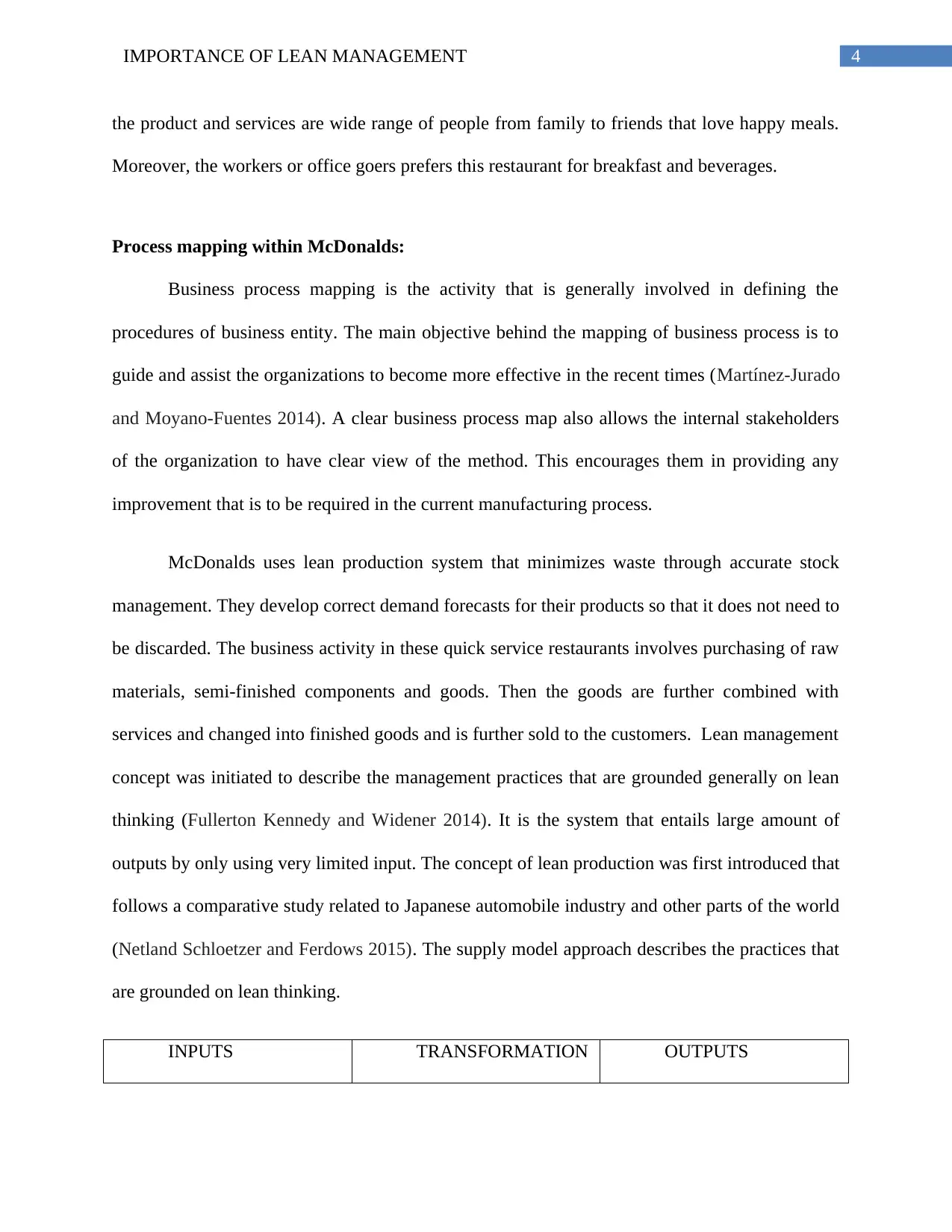
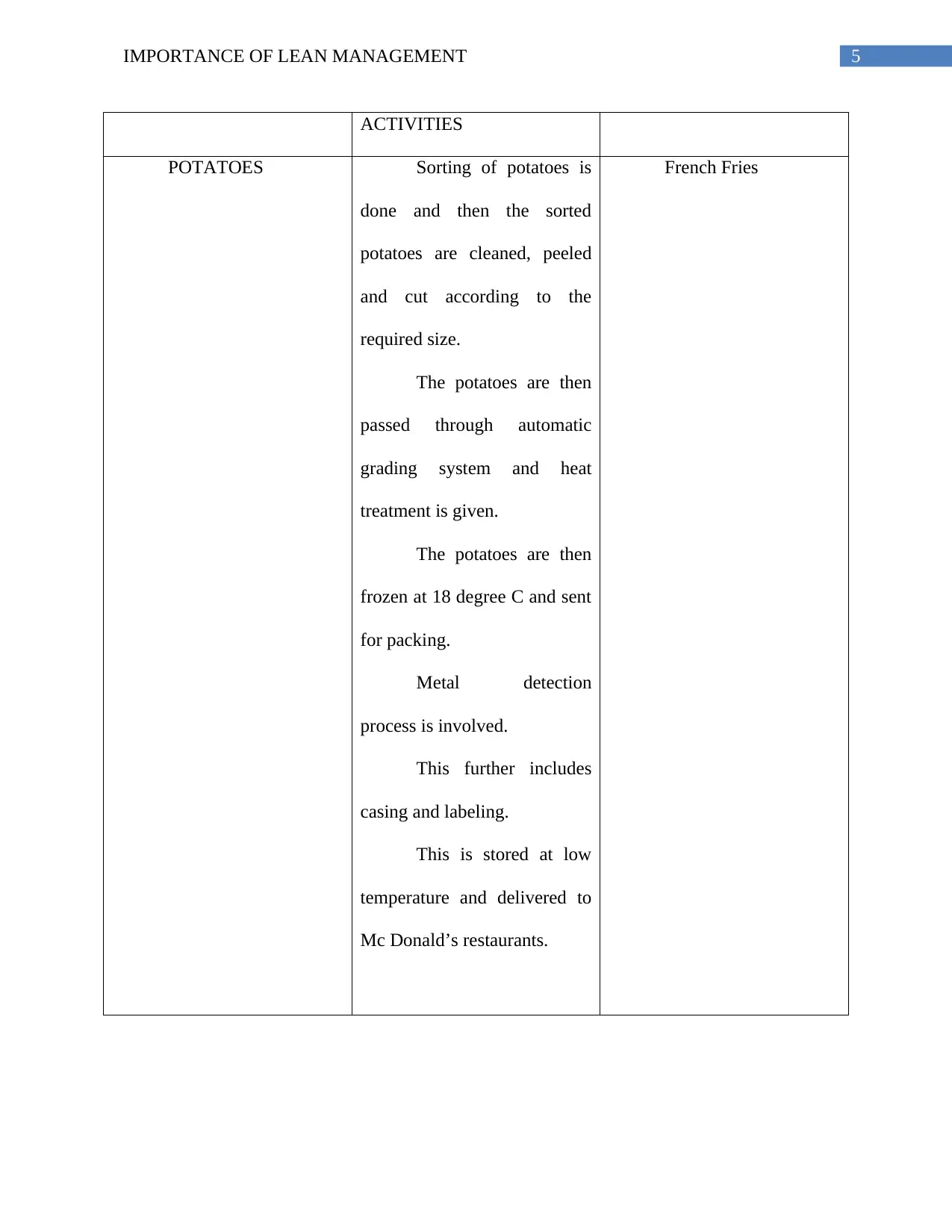
(Netland Schloetzer and Ferdows 2015). The supply model approach describes the practices that
are grounded on lean thinking.
INPUTS TRANSFORMATION OUTPUTS
the product and services are wide range of people from family to friends that love happy meals.
Moreover, the workers or office goers prefers this restaurant for breakfast and beverages.
Process mapping within McDonalds:
Business process mapping is the activity that is generally involved in defining the
procedures of business entity. The main objective behind the mapping of business process is to
guide and assist the organizations to become more effective in the recent times (Martínez-Jurado
and Moyano-Fuentes 2014). A clear business process map also allows the internal stakeholders
of the organization to have clear view of the method. This encourages them in providing any
improvement that is to be required in the current manufacturing process.
McDonalds uses lean production system that minimizes waste through accurate stock
management. They develop correct demand forecasts for their products so that it does not need to
be discarded. The business activity in these quick service restaurants involves purchasing of raw
materials, semi-finished components and goods. Then the goods are further combined with
services and changed into finished goods and is further sold to the customers. Lean management
concept was initiated to describe the management practices that are grounded generally on lean
thinking (Fullerton Kennedy and Widener 2014). It is the system that entails large amount of
outputs by only using very limited input. The concept of lean production was first introduced that
follows a comparative study related to Japanese automobile industry and other parts of the world
(Netland Schloetzer and Ferdows 2015). The supply model approach describes the practices that
are grounded on lean thinking.
INPUTS TRANSFORMATION OUTPUTS
5IMPORTANCE OF LEAN MANAGEMENT
ACTIVITIES
POTATOES Sorting of potatoes is
done and then the sorted
potatoes are cleaned, peeled
and cut according to the
required size.
The potatoes are then
passed through automatic
grading system and heat
treatment is given.
The potatoes are then
frozen at 18 degree C and sent
for packing.
Metal detection
process is involved.
This further includes
casing and labeling.
This is stored at low
temperature and delivered to
Mc Donald’s restaurants.
French Fries
ACTIVITIES
POTATOES Sorting of potatoes is
done and then the sorted
potatoes are cleaned, peeled
and cut according to the
required size.
The potatoes are then
passed through automatic
grading system and heat
treatment is given.
The potatoes are then
frozen at 18 degree C and sent
for packing.
Metal detection
process is involved.
This further includes
casing and labeling.
This is stored at low
temperature and delivered to
Mc Donald’s restaurants.
French Fries
⊘ This is a preview!⊘
Do you want full access?
Subscribe today to unlock all pages.
Trusted by 1+ million students worldwide
6IMPORTANCE OF LEAN MANAGEMENT
Implementation of Lean Management:
Lean management is a systematic method involved for waste minimization in an
organization. This process involves this also takes into account the wastes that is formed due to
the over burden and wastes formed due to unevenness in the workloads (Samuel, Found and
Williams 2015). Lean focuses on evaluating and delivering value to the customers that makes it a
prime concern for management in an organization (Dave et al. 2016). The major concepts
involving lean thinking are used as a framework for improvement of both manufacturing
activities and also the upstream in non-recurring process that involves product development. The
major focuses on efficient creation of values. The implementation of lean techniques in an
organization is usually done through the following ways:
Specifying value from the standpoint of the end customers
Identifying all the steps involved in value stream required for each product family. This
also includes eliminating those steps that fails to create value (Krajewski, Malhotra and
Ritzman 2015).
Making the value creating steps so that the products will flow smoothly towards the end
customers.
As the flow is introduced this involves the customers to put value from their next
upstream activities.
As the value is specified a state of perfection is achieved in which perfect value for the
management is created with no wastage.
The first and major principle that the company must clearly defines is the value of its
products as perceived by its customers. This means scrutinization of every product category for
their excessive complexity, unnecessary features and performance overshoot (Eaidgah et al.
Implementation of Lean Management:
Lean management is a systematic method involved for waste minimization in an
organization. This process involves this also takes into account the wastes that is formed due to
the over burden and wastes formed due to unevenness in the workloads (Samuel, Found and
Williams 2015). Lean focuses on evaluating and delivering value to the customers that makes it a
prime concern for management in an organization (Dave et al. 2016). The major concepts
involving lean thinking are used as a framework for improvement of both manufacturing
activities and also the upstream in non-recurring process that involves product development. The
major focuses on efficient creation of values. The implementation of lean techniques in an
organization is usually done through the following ways:
Specifying value from the standpoint of the end customers
Identifying all the steps involved in value stream required for each product family. This
also includes eliminating those steps that fails to create value (Krajewski, Malhotra and
Ritzman 2015).
Making the value creating steps so that the products will flow smoothly towards the end
customers.
As the flow is introduced this involves the customers to put value from their next
upstream activities.
As the value is specified a state of perfection is achieved in which perfect value for the
management is created with no wastage.
The first and major principle that the company must clearly defines is the value of its
products as perceived by its customers. This means scrutinization of every product category for
their excessive complexity, unnecessary features and performance overshoot (Eaidgah et al.
Paraphrase This Document
Need a fresh take? Get an instant paraphrase of this document with our AI Paraphraser
7IMPORTANCE OF LEAN MANAGEMENT
2016). The main aim is to deliver certain products that match the need of its customer without
waste. The second principles of lean management deliver the value efficiently within the
company. This involves identifying and creating value streams. Value stream are the sequence of
activities and steps that is essential for the creation and delivery of a product (Garza-Reyes
2015). It is a complex network for interrelated activities that could transform a product from raw
inputs to it delivered values.
Mapping the company’s value stream helps in categorizing the activities and tasks into
value added. The third principle involves making the value flow from raw materials to its
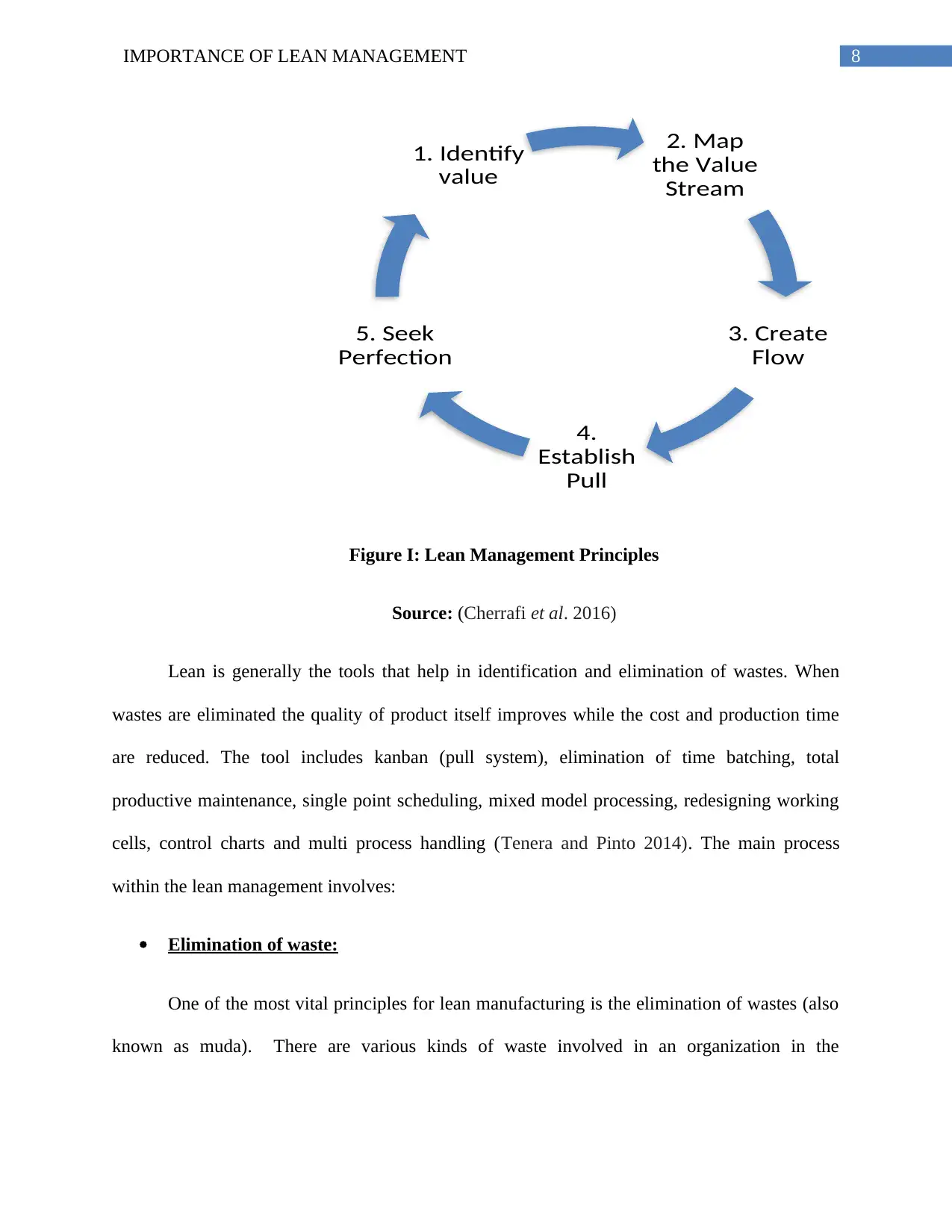
customers. The fourth principle involves pulling the production of the organization and not
pushing it. Lastly lean management strives for perfection (Tortorella et al. 2015). These are the
five basic principles that is the backbone of lean management. This involves creation of value
stream flow for meeting the requirement of its customers and further prevents wastes. When the
value streams are identified and wasted steps are removed in the management (Jasti and Kodali
2015). This lead to the introduction of flow and pull that begins the process again which
continues until the step of perfection is reached.
2016). The main aim is to deliver certain products that match the need of its customer without
waste. The second principles of lean management deliver the value efficiently within the
company. This involves identifying and creating value streams. Value stream are the sequence of
activities and steps that is essential for the creation and delivery of a product (Garza-Reyes
2015). It is a complex network for interrelated activities that could transform a product from raw
inputs to it delivered values.
Mapping the company’s value stream helps in categorizing the activities and tasks into
value added. The third principle involves making the value flow from raw materials to its
customers. The fourth principle involves pulling the production of the organization and not
pushing it. Lastly lean management strives for perfection (Tortorella et al. 2015). These are the
five basic principles that is the backbone of lean management. This involves creation of value
stream flow for meeting the requirement of its customers and further prevents wastes. When the
value streams are identified and wasted steps are removed in the management (Jasti and Kodali
2015). This lead to the introduction of flow and pull that begins the process again which
continues until the step of perfection is reached.
8IMPORTANCE OF LEAN MANAGEMENT
Figure I: Lean Management Principles
Source: (Cherrafi et al. 2016)
Lean is generally the tools that help in identification and elimination of wastes. When
wastes are eliminated the quality of product itself improves while the cost and production time
are reduced. The tool includes kanban (pull system), elimination of time batching, total
productive maintenance, single point scheduling, mixed model processing, redesigning working
cells, control charts and multi process handling (Tenera and Pinto 2014). The main process
within the lean management involves:
Elimination of waste:
One of the most vital principles for lean manufacturing is the elimination of wastes (also
known as muda). There are various kinds of waste involved in an organization in the
2. Map
the Value
Stream
3. Create
Flow
4.
Establish
Pull
5. Seek
Perfection
1. Identify
value
Figure I: Lean Management Principles
Source: (Cherrafi et al. 2016)
Lean is generally the tools that help in identification and elimination of wastes. When
wastes are eliminated the quality of product itself improves while the cost and production time
are reduced. The tool includes kanban (pull system), elimination of time batching, total
productive maintenance, single point scheduling, mixed model processing, redesigning working
cells, control charts and multi process handling (Tenera and Pinto 2014). The main process
within the lean management involves:
Elimination of waste:
One of the most vital principles for lean manufacturing is the elimination of wastes (also
known as muda). There are various kinds of waste involved in an organization in the
2. Map
the Value
Stream
3. Create
Flow
4.
Establish
Pull
5. Seek
Perfection
1. Identify
value
⊘ This is a preview!⊘
Do you want full access?
Subscribe today to unlock all pages.
Trusted by 1+ million students worldwide
9IMPORTANCE OF LEAN MANAGEMENT
manufacturing process. This includes wastes due to over production, unnecessary motion, waste
of inventory, transportation, over processing etc.
Processing wastage: at McDonalds, speedy system is installed for sufficient assembly of the
given order. The different operational processes are linked and united together according to the
assembly line. Therefore reducing handling the items and thus reduces wastage during the order
processing. Previously McDonalds used to prepare sandwiches in different times and batches and
further kept them in warming bins to maintain its freshness but this increased their wastage,
therefore decreasing their goodwill and lead to bad reputation. In the current situation everything
like salad, patty and other required elements are kept ready and only combined together once, an
order has been placed (Mcdonalds.com 2018). Therefore, reduces the risk of wastage and over
production in the long-run.
Continuous improvement:
This is also referred as kaizen in Japanese and is the most vital principle of lean
manufacturing. Without continuous improvement the progress is impossible. This process of
continuous improvement promotes necessary and constant changes to be required in the
achievement of the desired state. The required change can be generally big or small but to
achieve the desired target it lend itself towards improvement. This process is generally
continuous in nature and room for improvement is always there within the operating activities.
Design for manufacturing: Many considerations are taken into account by the producers related
to the packing of the products by the producers (Jiménez-Jiménez et al. 2015). While preparing
Big Mac, the primary thing that is needed to be done is to serve an empty cardboard packing as it
manufacturing process. This includes wastes due to over production, unnecessary motion, waste
of inventory, transportation, over processing etc.
Processing wastage: at McDonalds, speedy system is installed for sufficient assembly of the
given order. The different operational processes are linked and united together according to the
assembly line. Therefore reducing handling the items and thus reduces wastage during the order
processing. Previously McDonalds used to prepare sandwiches in different times and batches and
further kept them in warming bins to maintain its freshness but this increased their wastage,
therefore decreasing their goodwill and lead to bad reputation. In the current situation everything
like salad, patty and other required elements are kept ready and only combined together once, an
order has been placed (Mcdonalds.com 2018). Therefore, reduces the risk of wastage and over
production in the long-run.
Continuous improvement:
This is also referred as kaizen in Japanese and is the most vital principle of lean
manufacturing. Without continuous improvement the progress is impossible. This process of
continuous improvement promotes necessary and constant changes to be required in the
achievement of the desired state. The required change can be generally big or small but to
achieve the desired target it lend itself towards improvement. This process is generally
continuous in nature and room for improvement is always there within the operating activities.
Design for manufacturing: Many considerations are taken into account by the producers related
to the packing of the products by the producers (Jiménez-Jiménez et al. 2015). While preparing
Big Mac, the primary thing that is needed to be done is to serve an empty cardboard packing as it
Paraphrase This Document
Need a fresh take? Get an instant paraphrase of this document with our AI Paraphraser
10IMPORTANCE OF LEAN MANAGEMENT
is required for the lowest and first level of burger assembly. In addition to this, each packing
being involve in the bottom level of the burger serves as an easy means for transportation and
ensures that the burger remains whole and proper within the various stations. This production
process ensures that all materials are provided in small boxes, which can be easier to handle.
Just in Time (JIT)
This is a management practice of producing the goods and services as per the demands of the
customer (Govindan et al 2015). In traditional time, the manufacturer usually predicted the wants
of the customers and created a forecast in which the products will be produced. The customers
had to even wait for weeks or months to get their desired products. On the other hand, a Just in
Time system uses simple tools like Kanbans to pull its production as per the customers’ demands
(Jacobs, Chase and Lummus, 2014). It greatly reduces the amount of available stocks and further
reduces the lead time by a huge amount from weeks to only few hours and days. The following
advantages of Just in Time approach are as follows:
Reduction in order for payment deadline: JIT implementation helps in reducing the time period
considerably to a large extent (Emiliani 2015). Many businesses also suffer cash flow problems
as they require purchasing huge amounts of raw materials before the manufacturing process and
subsequent payment from their customers.
Lead time reductions: the most affected areas are the time taken for the products to flow through
the processes (Adebanjo, Laosirihongthong and Samaranayake 2016). Instead of months or
weeks, this approach results in reducing the lead times for hours or few days as per the demand.
Improved quality: the removal of huge batch manufacturing and handling reduction often results
in quality improvement of the products and services significantly. The workforce is empowered
is required for the lowest and first level of burger assembly. In addition to this, each packing
being involve in the bottom level of the burger serves as an easy means for transportation and
ensures that the burger remains whole and proper within the various stations. This production
process ensures that all materials are provided in small boxes, which can be easier to handle.
Just in Time (JIT)
This is a management practice of producing the goods and services as per the demands of the
customer (Govindan et al 2015). In traditional time, the manufacturer usually predicted the wants
of the customers and created a forecast in which the products will be produced. The customers
had to even wait for weeks or months to get their desired products. On the other hand, a Just in
Time system uses simple tools like Kanbans to pull its production as per the customers’ demands
(Jacobs, Chase and Lummus, 2014). It greatly reduces the amount of available stocks and further
reduces the lead time by a huge amount from weeks to only few hours and days. The following
advantages of Just in Time approach are as follows:
Reduction in order for payment deadline: JIT implementation helps in reducing the time period
considerably to a large extent (Emiliani 2015). Many businesses also suffer cash flow problems
as they require purchasing huge amounts of raw materials before the manufacturing process and
subsequent payment from their customers.
Lead time reductions: the most affected areas are the time taken for the products to flow through
the processes (Adebanjo, Laosirihongthong and Samaranayake 2016). Instead of months or
weeks, this approach results in reducing the lead times for hours or few days as per the demand.
Improved quality: the removal of huge batch manufacturing and handling reduction often results
in quality improvement of the products and services significantly. The workforce is empowered
11IMPORTANCE OF LEAN MANAGEMENT
to tackle its problem with the support they require for other vital part of JIT and lean
implementation.
Employee empowerment: the employees are highly involved in designing and application of the
system. The standard ways of working for all operation activities of employees are ascertained
(Antony, Setijono and Dahlgaard 2016). It ensures the processes to be predictable and reliable.
Application of Lean Management in McDonalds:
One of the processes that could help management structure of McDonalds is Just In time
(JIT). The key benefits provided in application of JIT could help McDonalds in providing better
food at minimum cost (Mcdonalds.com 2018). This strategy implementation would help in
increasing the quality as well as reducing the costs (Bortolotti, Boscari and Danese 2015). JIT
burger assembly would target the potential customers for high quality customer services. The
company should wait until the other customer places their orders.
Pull process: The manageable techniques of fast food production are generally supported
through the Kanban Pull-Process (Arnaboldi, Lapsley and Steccolini 2015). This is quite a
simple process and McDonald’s production philosophy should include the pull process. This
involves the preparation of burger requires only to place order after the payment has been done.
The order received is then electrically sent to the kitchen and henceforth prepared by the cooks.
Moreover, high frequented products like cheeseburger and hamburger are made in advance
through push-process that results in stock and over production.
Obeyka/ lean layout: The production shop floor at McDonalds is highly standardized and
the almost each branch of the restaurant looks similar. In lean management, the term Obeyaka
usually means to describe an open field, where all the processes and operators are generally
to tackle its problem with the support they require for other vital part of JIT and lean
implementation.
Employee empowerment: the employees are highly involved in designing and application of the
system. The standard ways of working for all operation activities of employees are ascertained
(Antony, Setijono and Dahlgaard 2016). It ensures the processes to be predictable and reliable.
Application of Lean Management in McDonalds:
One of the processes that could help management structure of McDonalds is Just In time
(JIT). The key benefits provided in application of JIT could help McDonalds in providing better
food at minimum cost (Mcdonalds.com 2018). This strategy implementation would help in
increasing the quality as well as reducing the costs (Bortolotti, Boscari and Danese 2015). JIT
burger assembly would target the potential customers for high quality customer services. The
company should wait until the other customer places their orders.
Pull process: The manageable techniques of fast food production are generally supported
through the Kanban Pull-Process (Arnaboldi, Lapsley and Steccolini 2015). This is quite a
simple process and McDonald’s production philosophy should include the pull process. This
involves the preparation of burger requires only to place order after the payment has been done.
The order received is then electrically sent to the kitchen and henceforth prepared by the cooks.
Moreover, high frequented products like cheeseburger and hamburger are made in advance
through push-process that results in stock and over production.
Obeyka/ lean layout: The production shop floor at McDonalds is highly standardized and
the almost each branch of the restaurant looks similar. In lean management, the term Obeyaka
usually means to describe an open field, where all the processes and operators are generally
⊘ This is a preview!⊘
Do you want full access?
Subscribe today to unlock all pages.
Trusted by 1+ million students worldwide

1 out of 18


Related Documents


Your All-in-One AI-Powered Toolkit for Academic Success.
+13062052269
info@desklib.com
Available 24*7 on WhatsApp / Email
![[object Object]](/_next/static/media/star-bottom.7253800d.svg)
Unlock your academic potential
Copyright © 2020–2026 A2Z Services. All Rights Reserved. Developed and managed by ZUCOL.