Analyzing the Importance of Design in User Interface Functionality

Verified

Added on  2022/09/09

|7
|1113
|19
Report
AI Summary
This report delves into the critical importance of design in user interfaces, focusing on the interaction between humans and computers. It explores key principles of interaction design, such as consistency and learnability, and identifies crucial factors influencing the design process, including organizational, environmental, and human elements. The report also examines the application of these principles and factors in web design and interactivity, highlighting the significance of elements like typography, graphics, sound, and video in creating engaging and effective user interfaces. The conclusion emphasizes the need for user-friendly interfaces and provides actionable insights for developers to create easy-to-use, useful, and interactive systems. The report aims to help developers understand the key points for designing a user interface.
Document Page
Running head: IMPORTANCE OF DESIGN IN FUNCTIONALITY OF USER INTERFACES
IMPORTANCE OF DESIGN IN FUNCTIONALITY OF USER INTERFACES
Name of the Student
Name of the University
Author note
tabler-icon-diamond-filled.svg

Paraphrase This Document

Need a fresh take? Get an instant paraphrase of this document with our AI Paraphraser
Document Page
1IMPORTANCE OF DESIGN IN FUNCTIONALITY OF USER INTERFACES
Table of Contents
Introduction......................................................................................................................................2
Human Computer Interaction..........................................................................................................2
Principles of Interaction Design......................................................................................................3
Factors important for Interaction design..........................................................................................4
Application to web design and interactivity....................................................................................4
Conclusion.......................................................................................................................................5
References........................................................................................................................................6
Document Page
2IMPORTANCE OF DESIGN IN FUNCTIONALITY OF USER INTERFACES
Introduction
Technology has been improved drastically in recent few years. Best is becoming better,
efficient is becoming more efficient along with the relationship between the computers and
humans. For implementing better interaction of the system, on the basis of human inputs and
their behavior towards the system, a proper requirement, usability and functional analysis is
always important to set the goals of the interaction. This report intends to discuss the interaction
between human and computer and the factors affecting the interaction design. Lastly the possible
application of the factors in the web design and its interactivity. The main purpose of the report
is too identifying the key points for designing a user interface.
Human Computer Interaction
The human-computer interaction is basically about how the user (human) interact with
the system and how the system responds according the interaction. It is mainly linked with the
term usability which describes a system should be useful, usable and used (Colborne 2017). For
a better usability, design of the system or interactions should be well identified from the
functional and usability requirements. For example, in development of a website design, the
purpose, structure, audience of the system, and the linkage between the subsystems should be
clear.
Document Page
3IMPORTANCE OF DESIGN IN FUNCTIONALITY OF USER INTERFACES
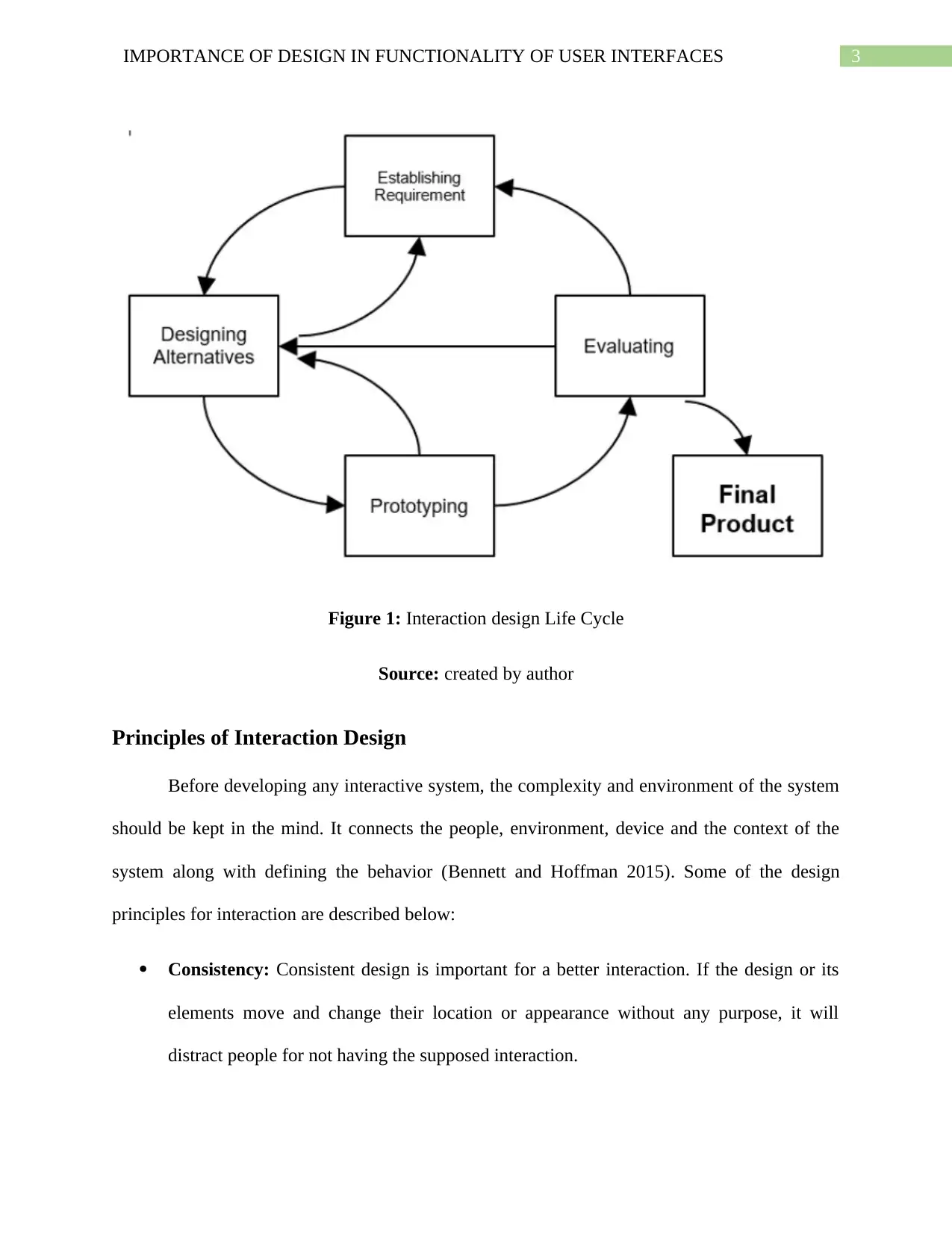
Figure 1: Interaction design Life Cycle
Source: created by author
Principles of Interaction Design
Before developing any interactive system, the complexity and environment of the system
should be kept in the mind. It connects the people, environment, device and the context of the
system along with defining the behavior (Bennett and Hoffman 2015). Some of the design
principles for interaction are described below:
Consistency: Consistent design is important for a better interaction. If the design or its
elements move and change their location or appearance without any purpose, it will
distract people for not having the supposed interaction.
tabler-icon-diamond-filled.svg

Paraphrase This Document

Need a fresh take? Get an instant paraphrase of this document with our AI Paraphraser
Document Page
4IMPORTANCE OF DESIGN IN FUNCTIONALITY OF USER INTERFACES
Learnability: The interactions and their process should be easy to learn. For example,
the Employ NZ’s enrolment program has majority of the student as their users of the
system.
Predictability: The required output from an interaction depends on the good design. The
benefits of the interaction, their results and the level of interaction should be clear.
Factors important for Interaction design
It is important to pay on important factors for interaction design that influence the goal of
the interaction (Hassenzahl 2013). Organization factors, environmental factors (in what condition
the interaction will happen), human factors (their capabilities and learnability), interface,
constraints, proper validation, productivity rate, tasks and comfort etc. are the main factors the
affects the interaction design. Whereas the four main elements that impact on the interactive
media design are the graphics, sound, text and video which are described below:
i. Typography (text): Text or Typography is a most common way to achieve the better
interactive media. The appearance of the texts, size, color and what is written with the
texts, all impacts on the user attraction to the user interface. Apart from that italics, font
type, oblique, boldface, and letter case are also the important aspects.
ii. Graphics: The interface becomes dull without any graphics. The use of digital media has
become common almost everywhere. Using images, animations and effects the interface
design becomes more attractive and smooth.
iii. Sounds: Sounds impacts on the user experience and design of the interaction. For
example, it can be distinguishable by the sound between a successfully performing an
operation and a warning or failure of the operation in an interface.
Document Page
5IMPORTANCE OF DESIGN IN FUNCTIONALITY OF USER INTERFACES
iv. Videos: Videos are comparatively large multimedia elements in a media design. A video
in the interface keeps the user engaged where it can be treated as the user guide for
understanding the business behind the interaction, or learning the interaction, etc.
Application to web design and interactivity
Identification of the type of audience, category of audience their capabilities, enjoyment,
satisfaction and experience also matters (Benyon 2014). Whereas, the interface designs for
accessing, tasks provided, structures of the web pages, commands for input, proper navigation,
language used or supported should be kept in mind for better interaction. The selection of fonts,
hand, use of icons and colors, images and multimedia content is necessary to use to guide the
user to the interactive environment. On the other, the proper constraints with system messages or
error messages, reachability also affects the interaction design along with the validation of right
data.
Conclusion
Developers of the user interface should not mainly rely on the functionality of the system
as it makes difficult to identify which layer of the interface is interacting to which layer by a
user. Human always had the input and output devices along with their sense of interaction. HCI
design is always supposed to help the developers to build a user friendly interface. The
complexities in the interaction are nothing but limitations to the humans. However, the factors
that affects the design are clearly described which can be used by the developers to make an
easy, usable, useful, and interactive interface.
Document Page
6IMPORTANCE OF DESIGN IN FUNCTIONALITY OF USER INTERFACES
References
Bennett, K.B. and Hoffman, R.R., 2015. Principles for interaction design, Part 3: Spanning the
creativity gap. IEEE Intelligent Systems, 30(6), pp.82-91.
Benyon, D., 2014. Designing interactive systems: A comprehensive guide to HCI, UX and
interaction design.
Colborne, G., 2017. Simple and usable web, mobile, and interaction design. New Riders.
Hassenzahl, M., 2013. User experience and experience design. The encyclopedia of human-
computer interaction, 2.
chevron_up_icon
1 out of 7
circle_padding
hide_on_mobile
zoom_out_icon
[object Object]