Social Marketing Plan: Improving Eating Habits of UOIT Students
VerifiedAdded on 2023/05/29
|11
|3184
|316
Report
AI Summary
This report outlines a social marketing plan designed to improve the eating habits of students at the University of Ontario Institute of Technology (UOIT). The plan begins with an overview of the problem of unhealthy eating habits among students and establishes the purpose and focus of the social marketing campaign. It then delves into the application of Exchange Theory to understand student behavior, followed by the identification of the target audience (first-year students) and the application of the Four Ps (Product, Price, Place, Promotion) of social marketing. The report also details the strategies for monitoring and evaluating the campaign's effectiveness, establishing budgets and finding funding sources, and creating an implementation plan to sustain behavioral changes. The report covers key activities, responsibilities, timing, and budget considerations. The plan aims to address issues such as poor diet and promote healthy living to improve student health and well-being.
Social Marketing
Student’s Name:
Student’s ID:
Subject:
Student’s Name:
Student’s ID:
Subject:

Paraphrase This Document
Need a fresh take? Get an instant paraphrase of this document with our AI Paraphraser
1
Table of Contents
Step 5: Exchange Theory.............................................................................................................................2
Step 6: Target Audience..............................................................................................................................3
Step 7: The Four Ps.....................................................................................................................................4
Step 8: Monitoring and Evaluation of Measurements..................................................................................5
Step 9: Establishing Budgets and Finding Funding.....................................................................................6
Step 10: Creating an Implementation Plan and Sustaining Behavior...........................................................7
References...................................................................................................................................................9
Table of Contents
Step 5: Exchange Theory.............................................................................................................................2
Step 6: Target Audience..............................................................................................................................3
Step 7: The Four Ps.....................................................................................................................................4
Step 8: Monitoring and Evaluation of Measurements..................................................................................5
Step 9: Establishing Budgets and Finding Funding.....................................................................................6
Step 10: Creating an Implementation Plan and Sustaining Behavior...........................................................7
References...................................................................................................................................................9
2
Step 5: Exchange Theory
The customer perceived value can be understood by determining the relation between
perceived benefit and perceived cost or the association between personality and risk of choosing
behavior. Risky choice of action can be understood by four domains; ethical, social, gambling,
and risk taking. The University Of Ontario Institute Of Technology has started a project for
maintaining proper health and nutrition among the student. The problem is focused that the post-
secondary students are mainly influenced by unhealthy eating of foods such as junk foods and
street foods on a regular basis in their life (Adamo & Brett, 2014). That is the reason a campaign
has been started in the University to develop the better nutrition practices which will analyze the
overall health and performance of the student.
The Exchange Theory in social marketing signifies that all human relations are created by
utilizing the cost-benefit analysis and comparing the alternatives. It is argued by the Exchange
Theory that people calculate the whole value of a specific link by subtracting its costs, which
might be time, money and effort from the given rewards (Casini, Contini, Romano &
Scozzafava, 2015). The prices are the components of relational life which had a negative impact
on the individual, whereas the rewards have a positive effect such as the sense of acceptance,
assistance, and alliance.
Barriers
Worth = Rewards – Costs
If the worth denotes a positive number, then it is a positive relation, and if the worth
shows a negative number, then it is a negative number. The quality of a connection impacts the
result, or the individual would decide if they want to continue the nutritional project or not take
part in the project. Positive results will make them stay, while the negative consequences will
make the students discontinue from the project.
The benefits consist of material or financial profits, social status, and emotional
securities. The costs usually include sacrifices of time, money, or loss of opportunities.
Step 5: Exchange Theory
The customer perceived value can be understood by determining the relation between
perceived benefit and perceived cost or the association between personality and risk of choosing
behavior. Risky choice of action can be understood by four domains; ethical, social, gambling,
and risk taking. The University Of Ontario Institute Of Technology has started a project for
maintaining proper health and nutrition among the student. The problem is focused that the post-
secondary students are mainly influenced by unhealthy eating of foods such as junk foods and
street foods on a regular basis in their life (Adamo & Brett, 2014). That is the reason a campaign
has been started in the University to develop the better nutrition practices which will analyze the
overall health and performance of the student.
The Exchange Theory in social marketing signifies that all human relations are created by
utilizing the cost-benefit analysis and comparing the alternatives. It is argued by the Exchange
Theory that people calculate the whole value of a specific link by subtracting its costs, which
might be time, money and effort from the given rewards (Casini, Contini, Romano &
Scozzafava, 2015). The prices are the components of relational life which had a negative impact
on the individual, whereas the rewards have a positive effect such as the sense of acceptance,
assistance, and alliance.
Barriers
Worth = Rewards – Costs
If the worth denotes a positive number, then it is a positive relation, and if the worth
shows a negative number, then it is a negative number. The quality of a connection impacts the
result, or the individual would decide if they want to continue the nutritional project or not take
part in the project. Positive results will make them stay, while the negative consequences will
make the students discontinue from the project.
The benefits consist of material or financial profits, social status, and emotional
securities. The costs usually include sacrifices of time, money, or loss of opportunities.
⊘ This is a preview!⊘
Do you want full access?
Subscribe today to unlock all pages.

Trusted by 1+ million students worldwide
3
Competition
The promotion of healthy living for the students is essential to improve their health. If the
students continue to suffer from risky physical and mental lifestyle, their chances of serious
health issues in the future could be considerably increased.
Influential Others
All the relationships have the policy of giving and take. The people those who look this
behavior will think that students are right that they are taking part in the nutritional project to
improve the health issue that they were facing for neglecting the healthy lifestyle.
Step 6: Target Audience
A target audience is determined to be the intended audience of the particular group of
consumers within the target market. The company must adopt social marketing strategy before
targeting the audience. At the University Of Ontario Institute Of Technology, the social
marketing plan will be conducted. The campaign aims to focus the students who had enrolled in
a particular institution (Carins & Rundle-Thiele, 2014).
The campaign will include all genders as nutrition carries equal importance for every
individual. The institute is looking forward to targeting the audience who will be most engaged
and benefited from this marketing plan. Thus, the institution recognized that the first year student
would be most benefited from this marketing strategy. It is observed that it will be beneficial for
the first year students as they are in the transitioning phase and searching for a new setting
(Darmon & Drewnowski, 2015). The first year students are highly receptive to information and
guidance to enhance their university experience. The marketing plan has been executed to target
the first year students as the students are not only responsive to the idea but possess a vast
amount of knowledge related to the significance of nutrition. The students know how to
assimilate the vital concepts into their life at the time of transition.
As the first year students are more likely to be attracted to the social aspects related to
their university experience, thus by using social events they have developed interactions with
drug or alcohol. It can be seen that as the first year students are new where they do not have any
experience hence, there are more chances of getting addicted to drugs or alcohol. The critical aim
of the strategic plan is to provide information to the students related to the deteriorating effects
Competition
The promotion of healthy living for the students is essential to improve their health. If the
students continue to suffer from risky physical and mental lifestyle, their chances of serious
health issues in the future could be considerably increased.
Influential Others
All the relationships have the policy of giving and take. The people those who look this
behavior will think that students are right that they are taking part in the nutritional project to
improve the health issue that they were facing for neglecting the healthy lifestyle.
Step 6: Target Audience
A target audience is determined to be the intended audience of the particular group of
consumers within the target market. The company must adopt social marketing strategy before
targeting the audience. At the University Of Ontario Institute Of Technology, the social
marketing plan will be conducted. The campaign aims to focus the students who had enrolled in
a particular institution (Carins & Rundle-Thiele, 2014).
The campaign will include all genders as nutrition carries equal importance for every
individual. The institute is looking forward to targeting the audience who will be most engaged
and benefited from this marketing plan. Thus, the institution recognized that the first year student
would be most benefited from this marketing strategy. It is observed that it will be beneficial for
the first year students as they are in the transitioning phase and searching for a new setting
(Darmon & Drewnowski, 2015). The first year students are highly receptive to information and
guidance to enhance their university experience. The marketing plan has been executed to target
the first year students as the students are not only responsive to the idea but possess a vast
amount of knowledge related to the significance of nutrition. The students know how to
assimilate the vital concepts into their life at the time of transition.
As the first year students are more likely to be attracted to the social aspects related to
their university experience, thus by using social events they have developed interactions with
drug or alcohol. It can be seen that as the first year students are new where they do not have any
experience hence, there are more chances of getting addicted to drugs or alcohol. The critical aim
of the strategic plan is to provide information to the students related to the deteriorating effects
Paraphrase This Document
Need a fresh take? Get an instant paraphrase of this document with our AI Paraphraser
4
and negative impacts of using drugs or alcohol that will affect the health of the students
(Waisbord, 2018). It will help the students to gather information on how to regulate alcoholic
consumptions and consume little amount of alcohol. Therefore, it is observed that the plan
proves to be beneficial especially for the first year students to get rid of drug or alcohol.
Step 7: The Four Ps.
To summarize the results of the four Ps of social marketing such as Product, Price, Place,
and Promotion was used.
Product
At the time of discussion within the institution information related to the product
included some explanation. The explanations based on student's requirements, benefits of
consuming beverages or nutrient-dense foods and the entrants for the desired behavior. The
perceived benefits and the needs of the behavior change of the students fit in the following
concepts.
1. Personalized Benefits: When the first year students were asked for a valid reason
to consume the targeted foods they frequently discussed their personal experience. It is observed
that consuming targeted foods is related to satisfaction, enjoyment, and taste of the food and a
craving for that particular food (Kelly, Vandevijvere, Freeman & Jenkin, 2015). Most of the
students eat food items such as fruits, milk, chocolate, and yogurt regularly.
2. Generalized Benefits: Whenever the students were asked for the valid reason to
eat whole grains and vegetables they replied by giving impersonal or vague terms. For example,
they are healthy, or it’s good for health and many more.
Price
The number of costs and the appropriate benefits of the first year students is related to
nutrient dense food. It is observed that the first year students perceived the value to be a fair
exchange that is beneficial based on behavior change (Boyland & Whalen, 2015). For
minimizing the cost of the foods, the students within the institution gave some suggestions such
as improve the taste by adding cheese or hot sauce to vegetables, adding chocolate to milk and
many more.
and negative impacts of using drugs or alcohol that will affect the health of the students
(Waisbord, 2018). It will help the students to gather information on how to regulate alcoholic
consumptions and consume little amount of alcohol. Therefore, it is observed that the plan
proves to be beneficial especially for the first year students to get rid of drug or alcohol.
Step 7: The Four Ps.
To summarize the results of the four Ps of social marketing such as Product, Price, Place,
and Promotion was used.
Product
At the time of discussion within the institution information related to the product
included some explanation. The explanations based on student's requirements, benefits of
consuming beverages or nutrient-dense foods and the entrants for the desired behavior. The
perceived benefits and the needs of the behavior change of the students fit in the following
concepts.
1. Personalized Benefits: When the first year students were asked for a valid reason
to consume the targeted foods they frequently discussed their personal experience. It is observed
that consuming targeted foods is related to satisfaction, enjoyment, and taste of the food and a
craving for that particular food (Kelly, Vandevijvere, Freeman & Jenkin, 2015). Most of the
students eat food items such as fruits, milk, chocolate, and yogurt regularly.
2. Generalized Benefits: Whenever the students were asked for the valid reason to
eat whole grains and vegetables they replied by giving impersonal or vague terms. For example,
they are healthy, or it’s good for health and many more.
Price
The number of costs and the appropriate benefits of the first year students is related to
nutrient dense food. It is observed that the first year students perceived the value to be a fair
exchange that is beneficial based on behavior change (Boyland & Whalen, 2015). For
minimizing the cost of the foods, the students within the institution gave some suggestions such
as improve the taste by adding cheese or hot sauce to vegetables, adding chocolate to milk and
many more.
5
Place
The first year students faced various issues related to the place where it is found that it is
difficult to find out their favorite food. It is also observed that parental food preparation and
purchasing behavior affected the availability of food (Guthrie, Mancino & Lin, 2015). It is
suggested that social marketing plan must be implemented to change the food preparation and
purchasing habits and it will also improve the skills of personal food preparation.
Promotion
It can be seen that the change in the behavior of the students is due to the demand of the
nutrient-dense foods. The students mostly prefer good tasting menus that are convenient, readily
available, familiar and visually appealing.
Step 8: Monitoring and Evaluation of Measurements
The social strategy plan uses two measurements such as monitoring and evaluation. The
concept of control is considered to be the measurements that are sometimes conducted after the
launch but before the completion. Whereas, assessment is determined to be the final report and
the measurement. The particular measurement will be performed to fulfill the major
requirements and to help in allocating and prioritizing the resources which are going forward.
The measurement will assist in satisfying the needs of the students based on their eating habits. It
will educate the students related to the eating habits that put a negative impact on their health
(Dibb, 2014). The measurement will also provide the students with significant resources. Within
the social strategy plan, the particular thing that will be measured are outcomes, impact and the
return on investment (ROI).
The outcomes related to the eating habits will be measured along with the negative
impact of consuming unhealthy food items as well as the return on investment. The plan will be
measured by conducting quantitative surveys for the students who have completed their first year
at the institution (Baum & Fisher, 2014). The quantitative studies will help in gathering statistical
data related to the eating habits of the first year students. This will make use of primary and
secondary data that will be helpful for collecting information. The follow-up surveys will include
all the participants who are determined to be the target audience. The measures will be taken
during the implementation of the campaigns that will consist of monitoring and tracking the
Place
The first year students faced various issues related to the place where it is found that it is
difficult to find out their favorite food. It is also observed that parental food preparation and
purchasing behavior affected the availability of food (Guthrie, Mancino & Lin, 2015). It is
suggested that social marketing plan must be implemented to change the food preparation and
purchasing habits and it will also improve the skills of personal food preparation.
Promotion
It can be seen that the change in the behavior of the students is due to the demand of the
nutrient-dense foods. The students mostly prefer good tasting menus that are convenient, readily
available, familiar and visually appealing.
Step 8: Monitoring and Evaluation of Measurements
The social strategy plan uses two measurements such as monitoring and evaluation. The
concept of control is considered to be the measurements that are sometimes conducted after the
launch but before the completion. Whereas, assessment is determined to be the final report and
the measurement. The particular measurement will be performed to fulfill the major
requirements and to help in allocating and prioritizing the resources which are going forward.
The measurement will assist in satisfying the needs of the students based on their eating habits. It
will educate the students related to the eating habits that put a negative impact on their health
(Dibb, 2014). The measurement will also provide the students with significant resources. Within
the social strategy plan, the particular thing that will be measured are outcomes, impact and the
return on investment (ROI).
The outcomes related to the eating habits will be measured along with the negative
impact of consuming unhealthy food items as well as the return on investment. The plan will be
measured by conducting quantitative surveys for the students who have completed their first year
at the institution (Baum & Fisher, 2014). The quantitative studies will help in gathering statistical
data related to the eating habits of the first year students. This will make use of primary and
secondary data that will be helpful for collecting information. The follow-up surveys will include
all the participants who are determined to be the target audience. The measures will be taken
during the implementation of the campaigns that will consist of monitoring and tracking the
⊘ This is a preview!⊘
Do you want full access?
Subscribe today to unlock all pages.
Trusted by 1+ million students worldwide
6
surveys. The measurement will cost a moderate amount based on the observations as well as the
reviews (Glanz et al., 2016). This will help in measuring how many students consume healthy
breakfast at the beginning of the first year in comparison to the end of the year. It will also
measure the importance of healthy eating of the first year students by the end of the year after
their completion of the year.
Step 9: Establishing Budgets and Finding Funding
Most of the managers have excellent concepts of social marketing, but the only thing that
is stopping them from executing it is money. People do not make an investment in theory but on
peoples. If the individual has asked for the budget of social marketing, they have to prove their
employer about the utilization of budget. People often speak about the best strategies connected
with social marketing, but in reality, if they do not find funding for their initiatives, it would not
get the budget to become a successful marketing strategy (Friel & Ford, 2015). Finding funds is
more vital than any other approach. This is because new strategies of marketing are emerging in
last few years, but the firms which are carrying out the same procedure realize that they have to
invest to get the many necessary measures to succeed in the utilizing the new marketing
strategies.
The firms spend millions of money for marketing. The average investment by the
industry is almost $200 to $350 each day on marketing (Garnett, Mathewson, Angelides &
Borthwick, 2015). This average has been surveyed by The Content Factory, which looks at the
budgets of social marketing. They had found that about $4000 to $7000 each month was spent by
the industry. Every budget of social marketing begins with a strategy. Budgeting must have one
full-time staff, consultant or a planner for among one week and one month for planning social
marketing. Social marketing and funding are intimately connected. Most of the companies fund
their marketing from voluntary income and could carry their marketing campaigns without
raising funds. The marketers and the fundraisers have to present concepts in the most powerful
methods. Donation in online unlocks several opportunities for raising funds for social marketing.
Trusts and foundations are also sources of funding for many years in the social marketing
campaigns.
surveys. The measurement will cost a moderate amount based on the observations as well as the
reviews (Glanz et al., 2016). This will help in measuring how many students consume healthy
breakfast at the beginning of the first year in comparison to the end of the year. It will also
measure the importance of healthy eating of the first year students by the end of the year after
their completion of the year.
Step 9: Establishing Budgets and Finding Funding
Most of the managers have excellent concepts of social marketing, but the only thing that
is stopping them from executing it is money. People do not make an investment in theory but on
peoples. If the individual has asked for the budget of social marketing, they have to prove their
employer about the utilization of budget. People often speak about the best strategies connected
with social marketing, but in reality, if they do not find funding for their initiatives, it would not
get the budget to become a successful marketing strategy (Friel & Ford, 2015). Finding funds is
more vital than any other approach. This is because new strategies of marketing are emerging in
last few years, but the firms which are carrying out the same procedure realize that they have to
invest to get the many necessary measures to succeed in the utilizing the new marketing
strategies.
The firms spend millions of money for marketing. The average investment by the
industry is almost $200 to $350 each day on marketing (Garnett, Mathewson, Angelides &
Borthwick, 2015). This average has been surveyed by The Content Factory, which looks at the
budgets of social marketing. They had found that about $4000 to $7000 each month was spent by
the industry. Every budget of social marketing begins with a strategy. Budgeting must have one
full-time staff, consultant or a planner for among one week and one month for planning social
marketing. Social marketing and funding are intimately connected. Most of the companies fund
their marketing from voluntary income and could carry their marketing campaigns without
raising funds. The marketers and the fundraisers have to present concepts in the most powerful
methods. Donation in online unlocks several opportunities for raising funds for social marketing.
Trusts and foundations are also sources of funding for many years in the social marketing
campaigns.
Paraphrase This Document
Need a fresh take? Get an instant paraphrase of this document with our AI Paraphraser
7
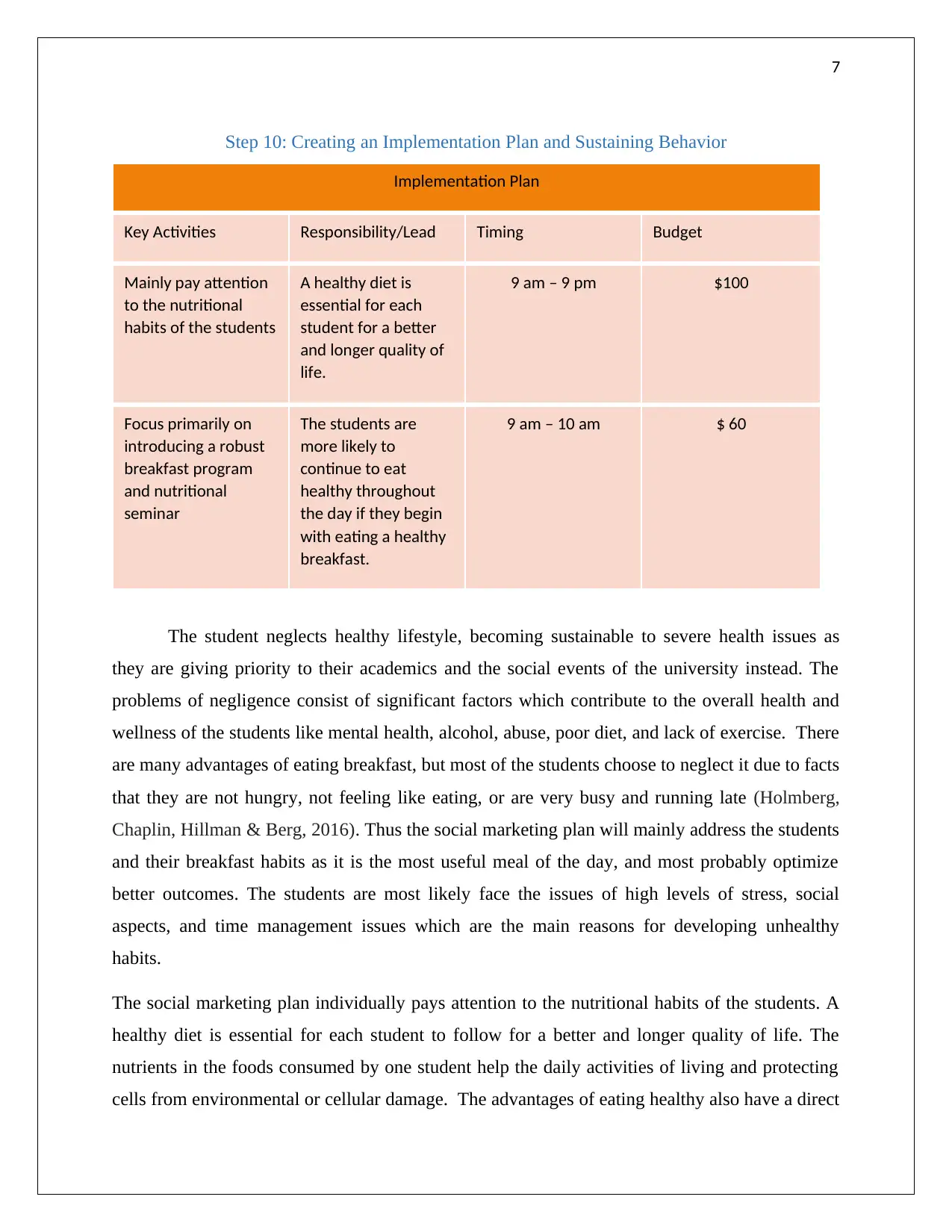
Step 10: Creating an Implementation Plan and Sustaining Behavior
Implementation Plan
Key Activities Responsibility/Lead Timing Budget
Mainly pay attention
to the nutritional
habits of the students
A healthy diet is
essential for each
student for a better
and longer quality of
life.
9 am – 9 pm $100
Focus primarily on
introducing a robust
breakfast program
and nutritional
seminar
The students are
more likely to
continue to eat
healthy throughout
the day if they begin
with eating a healthy
breakfast.
9 am – 10 am $ 60
The student neglects healthy lifestyle, becoming sustainable to severe health issues as
they are giving priority to their academics and the social events of the university instead. The
problems of negligence consist of significant factors which contribute to the overall health and
wellness of the students like mental health, alcohol, abuse, poor diet, and lack of exercise. There
are many advantages of eating breakfast, but most of the students choose to neglect it due to facts
that they are not hungry, not feeling like eating, or are very busy and running late (Holmberg,
Chaplin, Hillman & Berg, 2016). Thus the social marketing plan will mainly address the students
and their breakfast habits as it is the most useful meal of the day, and most probably optimize
better outcomes. The students are most likely face the issues of high levels of stress, social
aspects, and time management issues which are the main reasons for developing unhealthy
habits.
The social marketing plan individually pays attention to the nutritional habits of the students. A
healthy diet is essential for each student to follow for a better and longer quality of life. The
nutrients in the foods consumed by one student help the daily activities of living and protecting
cells from environmental or cellular damage. The advantages of eating healthy also have a direct
Step 10: Creating an Implementation Plan and Sustaining Behavior
Implementation Plan
Key Activities Responsibility/Lead Timing Budget
Mainly pay attention
to the nutritional
habits of the students
A healthy diet is
essential for each
student for a better
and longer quality of
life.
9 am – 9 pm $100
Focus primarily on
introducing a robust
breakfast program
and nutritional
seminar
The students are
more likely to
continue to eat
healthy throughout
the day if they begin
with eating a healthy
breakfast.
9 am – 10 am $ 60
The student neglects healthy lifestyle, becoming sustainable to severe health issues as
they are giving priority to their academics and the social events of the university instead. The
problems of negligence consist of significant factors which contribute to the overall health and
wellness of the students like mental health, alcohol, abuse, poor diet, and lack of exercise. There
are many advantages of eating breakfast, but most of the students choose to neglect it due to facts
that they are not hungry, not feeling like eating, or are very busy and running late (Holmberg,
Chaplin, Hillman & Berg, 2016). Thus the social marketing plan will mainly address the students
and their breakfast habits as it is the most useful meal of the day, and most probably optimize
better outcomes. The students are most likely face the issues of high levels of stress, social
aspects, and time management issues which are the main reasons for developing unhealthy
habits.
The social marketing plan individually pays attention to the nutritional habits of the students. A
healthy diet is essential for each student to follow for a better and longer quality of life. The
nutrients in the foods consumed by one student help the daily activities of living and protecting
cells from environmental or cellular damage. The advantages of eating healthy also have a direct
8
impact on the energy, weight control, prevention of diseases and mood and cognition effects of
the students. As the post-secondary students are engaged in their university academics, they are
more likely to neglect healthy eating habits in their life (Popkin & Hawkes, 2016). As a result,
they have developed unhealthy eating habits like eating junk food regularly not eating in the
daily suggested amounts, and consumption of drug and alcohol. The social marketing plan will
help to develop better nutritional habits among the students, to improve their overall health
(Scrinis, 2016).
impact on the energy, weight control, prevention of diseases and mood and cognition effects of
the students. As the post-secondary students are engaged in their university academics, they are
more likely to neglect healthy eating habits in their life (Popkin & Hawkes, 2016). As a result,
they have developed unhealthy eating habits like eating junk food regularly not eating in the
daily suggested amounts, and consumption of drug and alcohol. The social marketing plan will
help to develop better nutritional habits among the students, to improve their overall health
(Scrinis, 2016).
⊘ This is a preview!⊘
Do you want full access?
Subscribe today to unlock all pages.
Trusted by 1+ million students worldwide
9
References
Adamo, K. B., & Brett, K. E. (2014). Parental perceptions and childhood dietary
quality. Maternal and child health journal, 18(4), 978-995.
Baum, F., & Fisher, M. (2014). Why behavioral health promotion endures despite its failure to
reduce health inequities. Sociology of health & illness, 36(2), 213-225.
Boyland, E. J., & Whalen, R. (2015). Food advertising to children and its effects on the diet: the
review of recent prevalence and impact data. Pediatric diabetes, 16(5), 331-337.
Carins, J. E., & Rundle-Thiele, S. R. (2014). Eating for the better: A social marketing review
(2000–2012). Public Health Nutrition, 17(7), 1628-1639.
Casini, L., Contini, C., Romano, C., & Scozzafava, G. (2015). Trends in food consumptions:
what is happening to generation X? British Food Journal, 117(2), 705-718.
Darmon, N., & Drewnowski, A. (2015). A contribution of food prices and diet cost to
socioeconomic disparities in diet quality and health: a systematic review and analysis.
Nutrition Reviews, 73(10), 643-660.
Dibb, S. (2014). Up, up and away: social marketing breaks free. Journal of Marketing
Management, 30(11-12), 1159-1185.
Friel, S., & Ford, L. (2015). Systems, food security, and human health. Food security, 7(2), 437-
451.
Garnett, T., Mathewson, S., Angelides, P., & Borthwick, F. (2015). Policies and actions to shift
eating patterns: What works? Foresight, 515, 518-522.
Glanz, K., Johnson, L., Yaroch, A. L., Phillips, M., Ayala, G. X., & Davis, E. L. (2016).
Measures of retail food store environments and sales: review and implications for healthy
eating initiatives. Journal of nutrition education and behavior, 48(4), 280-288.
Guthrie, J., Mancino, L., & Lin, C. T. J. (2015). Nudging consumers toward better food choices:
policy approaches to changing food consumption behaviors. Psychology &
Marketing, 32(5), 501-511.
References
Adamo, K. B., & Brett, K. E. (2014). Parental perceptions and childhood dietary
quality. Maternal and child health journal, 18(4), 978-995.
Baum, F., & Fisher, M. (2014). Why behavioral health promotion endures despite its failure to
reduce health inequities. Sociology of health & illness, 36(2), 213-225.
Boyland, E. J., & Whalen, R. (2015). Food advertising to children and its effects on the diet: the
review of recent prevalence and impact data. Pediatric diabetes, 16(5), 331-337.
Carins, J. E., & Rundle-Thiele, S. R. (2014). Eating for the better: A social marketing review
(2000–2012). Public Health Nutrition, 17(7), 1628-1639.
Casini, L., Contini, C., Romano, C., & Scozzafava, G. (2015). Trends in food consumptions:
what is happening to generation X? British Food Journal, 117(2), 705-718.
Darmon, N., & Drewnowski, A. (2015). A contribution of food prices and diet cost to
socioeconomic disparities in diet quality and health: a systematic review and analysis.
Nutrition Reviews, 73(10), 643-660.
Dibb, S. (2014). Up, up and away: social marketing breaks free. Journal of Marketing
Management, 30(11-12), 1159-1185.
Friel, S., & Ford, L. (2015). Systems, food security, and human health. Food security, 7(2), 437-
451.
Garnett, T., Mathewson, S., Angelides, P., & Borthwick, F. (2015). Policies and actions to shift
eating patterns: What works? Foresight, 515, 518-522.
Glanz, K., Johnson, L., Yaroch, A. L., Phillips, M., Ayala, G. X., & Davis, E. L. (2016).
Measures of retail food store environments and sales: review and implications for healthy
eating initiatives. Journal of nutrition education and behavior, 48(4), 280-288.
Guthrie, J., Mancino, L., & Lin, C. T. J. (2015). Nudging consumers toward better food choices:
policy approaches to changing food consumption behaviors. Psychology &
Marketing, 32(5), 501-511.
Paraphrase This Document
Need a fresh take? Get an instant paraphrase of this document with our AI Paraphraser
10
Holmberg, C., Chaplin, J. E., Hillman, T., & Berg, C. (2016). Adolescents' presentation of food
on social media: An explorative study. Appetite, 99, 121-129.
Kelly, B., Vandevijvere, S., Freeman, B., & Jenkin, G. (2015). New media but the same old
tricks: food marketing to children in the digital age. Current obesity reports, 4(1), 37-45.
Popkin, B. M., & Hawkes, C. (2016). Sweetening of the global diet, particularly beverages:
patterns, trends, and policy responses. The Lancet Diabetes & Endocrinology, 4(2), 174-
186.
Scrinis, G. (2016). Reformulation, fortification, and functionalization: Big Food corporations'
nutritional engineering and marketing strategies. The Journal of Peasant Studies, 43(1),
17-37.
Waisbord, S. (2018). Family tree of theories, methodologies, and strategies in development
communication. Handbook of Communication for Development and Social Change, 1-40.
Holmberg, C., Chaplin, J. E., Hillman, T., & Berg, C. (2016). Adolescents' presentation of food
on social media: An explorative study. Appetite, 99, 121-129.
Kelly, B., Vandevijvere, S., Freeman, B., & Jenkin, G. (2015). New media but the same old
tricks: food marketing to children in the digital age. Current obesity reports, 4(1), 37-45.
Popkin, B. M., & Hawkes, C. (2016). Sweetening of the global diet, particularly beverages:
patterns, trends, and policy responses. The Lancet Diabetes & Endocrinology, 4(2), 174-
186.
Scrinis, G. (2016). Reformulation, fortification, and functionalization: Big Food corporations'
nutritional engineering and marketing strategies. The Journal of Peasant Studies, 43(1),
17-37.
Waisbord, S. (2018). Family tree of theories, methodologies, and strategies in development
communication. Handbook of Communication for Development and Social Change, 1-40.

1 out of 11


Related Documents


Your All-in-One AI-Powered Toolkit for Academic Success.
+13062052269
info@desklib.com
Available 24*7 on WhatsApp / Email
![[object Object]](/_next/static/media/star-bottom.7253800d.svg)
Unlock your academic potential
Copyright © 2020–2026 A2Z Services. All Rights Reserved. Developed and managed by ZUCOL.