Report on Strategies to Enhance NHS Quality of Care and Patient Safety
VerifiedAdded on 2020/12/29
|13
|3311
|321
Report
AI Summary
This report examines quality improvement within the NHS, focusing on strategies to enhance patient safety and the quality of care. It begins with an introduction that emphasizes the ongoing challenges of patient safety within healthcare systems and the importance of a patient-centered approach. The report then explains the concept of quality improvement in healthcare, highlighting the need for continuous evaluation and the adoption of programs to improve patient outcomes, reduce costs, and enhance patient experiences. It provides examples of quality improvement measures such as transparent communication and the involvement of patients and staff in project planning. The report also discusses strategies to improve the quality of care and patient safety, including patient-centered care, improved communication, and ongoing feedback. It underscores the importance of strengthening public engagement, patient involvement, and the implementation of techniques and tools for early treatment detection. The report also examines the role of teamwork, skilled workforce development, and the use of technology in improving healthcare services. The report stresses the need for healthcare organizations to address medical errors, improve communication, and implement patient-centered care strategies to foster a safe and effective environment, ultimately aiming to improve patient outcomes and satisfaction within the NHS.

Management and Medico
Legal Studies
Legal Studies

Paraphrase This Document
Need a fresh take? Get an instant paraphrase of this document with our AI Paraphraser
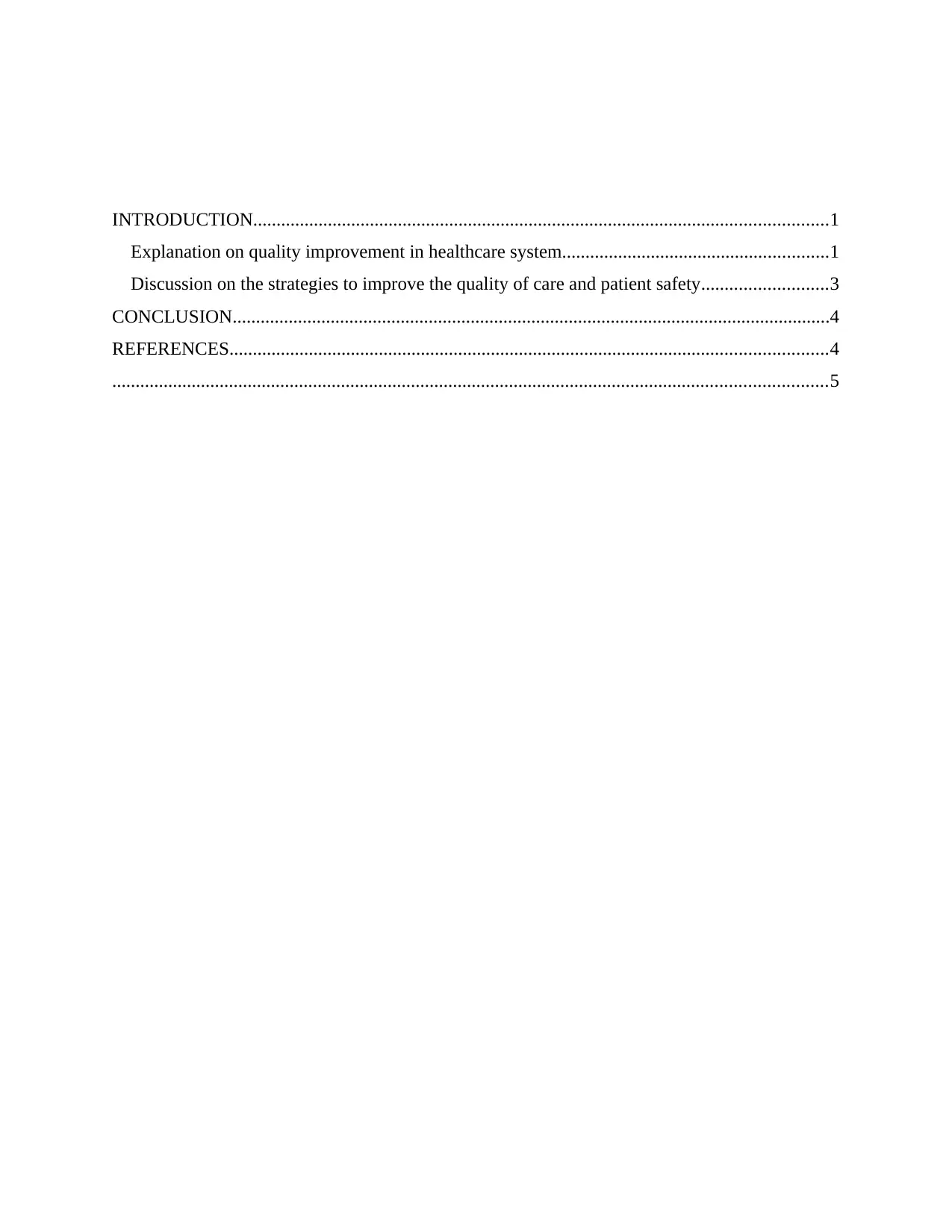
INTRODUCTION...........................................................................................................................1
Explanation on quality improvement in healthcare system.........................................................1
Discussion on the strategies to improve the quality of care and patient safety...........................3
CONCLUSION................................................................................................................................4
REFERENCES................................................................................................................................4
.........................................................................................................................................................5
Explanation on quality improvement in healthcare system.........................................................1
Discussion on the strategies to improve the quality of care and patient safety...........................3
CONCLUSION................................................................................................................................4
REFERENCES................................................................................................................................4
.........................................................................................................................................................5

⊘ This is a preview!⊘
Do you want full access?
Subscribe today to unlock all pages.

Trusted by 1+ million students worldwide
INTRODUCTION
Patient Safety act as an ongoing issue in continuum of Healthcare. In order to effectively
provide quality and safety to patient Healthcare organisations are required to effectively
considered the need of Patient Safety in best effective manner. There are number of medical
errors that can lead towards faulty systems and process that is included in the factors that can
hamper Patient Safety (Adams & Urban, (2015). Thus, it is essential for Healthcare organisation
to effectively considered the patient centred approach in which they are required to offer efficient
and equitable safety equipment’s and other effective measures with the help of which
organisation can effectively able to provide desired health safety to their patients. Present report
has been conducted on NHS. This Healthcare organisation is situated in England and offer
Healthcare services at a free point to ordinarily residents within United Kingdom. In this report
formative discussions have been made on strategies with the help of which quality of care and
patient safety can be effectively improved. Further report includes explanation of quality
improvements within Health Care systems along with formative strategies that can be used by
Healthcare organisations. In order to strengthen the quality of patient care it is essential to
monitor and evaluate new ways with the help of which quality of care can be improved. In
context with this, by having patient centred care and approach Healthcare organisation can
effectively able to provide safety to their patients. In order to effectively provide best care
services to patient NHS can take advantage of inpatient surveys, outpatient surveys and staff
surveys with the help of which the can further improvised their strategies towards offering their
services in better than expected manner. By providing best form of Patient Safety Healthcare
organisations can effectively able to attract reliability of patients on Hospital treatments that can
further initiate their objective towards improving quality of care and patient safety.
Explanation on quality improvement in healthcare system
Quality improvement in Healthcare acts as one of the most important reason with the help
of which Healthcare organisation can effectively able to enhance their readability of patient
health condition. It is essential for Healthcare organisations like, NHS to provide services by
analysing individual requirements, in context with this quality improvement can lead towards
yielding better results with the help which quality improvement within Healthcare patient,
Healthcare experience can be improvised that can further lead towards reducing per capita cost
1
Patient Safety act as an ongoing issue in continuum of Healthcare. In order to effectively
provide quality and safety to patient Healthcare organisations are required to effectively
considered the need of Patient Safety in best effective manner. There are number of medical
errors that can lead towards faulty systems and process that is included in the factors that can
hamper Patient Safety (Adams & Urban, (2015). Thus, it is essential for Healthcare organisation
to effectively considered the patient centred approach in which they are required to offer efficient
and equitable safety equipment’s and other effective measures with the help of which
organisation can effectively able to provide desired health safety to their patients. Present report
has been conducted on NHS. This Healthcare organisation is situated in England and offer
Healthcare services at a free point to ordinarily residents within United Kingdom. In this report
formative discussions have been made on strategies with the help of which quality of care and
patient safety can be effectively improved. Further report includes explanation of quality
improvements within Health Care systems along with formative strategies that can be used by
Healthcare organisations. In order to strengthen the quality of patient care it is essential to
monitor and evaluate new ways with the help of which quality of care can be improved. In
context with this, by having patient centred care and approach Healthcare organisation can
effectively able to provide safety to their patients. In order to effectively provide best care
services to patient NHS can take advantage of inpatient surveys, outpatient surveys and staff
surveys with the help of which the can further improvised their strategies towards offering their
services in better than expected manner. By providing best form of Patient Safety Healthcare
organisations can effectively able to attract reliability of patients on Hospital treatments that can
further initiate their objective towards improving quality of care and patient safety.
Explanation on quality improvement in healthcare system
Quality improvement in Healthcare acts as one of the most important reason with the help
of which Healthcare organisation can effectively able to enhance their readability of patient
health condition. It is essential for Healthcare organisations like, NHS to provide services by
analysing individual requirements, in context with this quality improvement can lead towards
yielding better results with the help which quality improvement within Healthcare patient,
Healthcare experience can be improvised that can further lead towards reducing per capita cost
1
Paraphrase This Document
Need a fresh take? Get an instant paraphrase of this document with our AI Paraphraser
of Healthcare. Quality improvement mainly include continuous and systematic set of actions
with the help of which improvement in Healthcare can be measured and services are effectively
providing to targeted patient groups. In context with NHS organisation, it is required to adopt
continuous quality improvement programs with the help of which they can effectively able to
improve their Healthcare services. In this there is a requirement to identify problems and can
further implement and monitor corrective actions. Further with the help of quality improvement
NHS can effectively able to target triple aim which is related with improving health of
population, reducing per capita cost of care and further increased patient experiences and end
outcomes. There are some examples of quality improvement in Healthcare that includes
communication of results. In addition, with this NHS is required to be transparent of their quality
improvement efforts to the patient, physicians and staff. Along with this it is required to include
entire practice teams along with patients while making a plan and implementation of quality
improvement projects. Further there is a requirement to communicate project priorities, action
needs and results with every individual including patient. As been a nurse manager there are
certain rules which is related with providing vision and securing necessary related resources with
the help of which organisation can effectively ensure quality improvements.
Healthcare system include wide range of complexities in delivering of services and
unpredictable nature of Healthcare. For this NHS is required to considered some effective
measures with the help of which they can improve quality of their services. While challenging
these attributes in best effective manner NHS is required to take advantage of reliable and valid
measures of qualities along with Patient Safety measures. In order to improve the health care
services physician and other related Healthcare professionals within NHS are required to have
focused approach towards reducing preventable harms. In addition, with this practicing clinical
professional society and medical boards are required to effectively evaluate the Patient Safety
requirement and further fill the gap in order to facilitate making Healthcare safer. Moreover,
there are many external forces that are effectively required to be considered by Healthcare units.
Therefore, to effectively improve quality in Healthcare system it is essential for Healthcare
organisations like NHS to become more sophisticated in terms of facing challenges as to keep
patient safe in best manner. Along with this, they are required to perform their activities with
well-trained providers those who are properly well equipped with high quality evidences along
with challenge. In addition, with is utilisation of integrated Technologies with sound policies are
2
with the help of which improvement in Healthcare can be measured and services are effectively
providing to targeted patient groups. In context with NHS organisation, it is required to adopt
continuous quality improvement programs with the help of which they can effectively able to
improve their Healthcare services. In this there is a requirement to identify problems and can
further implement and monitor corrective actions. Further with the help of quality improvement
NHS can effectively able to target triple aim which is related with improving health of
population, reducing per capita cost of care and further increased patient experiences and end
outcomes. There are some examples of quality improvement in Healthcare that includes
communication of results. In addition, with this NHS is required to be transparent of their quality
improvement efforts to the patient, physicians and staff. Along with this it is required to include
entire practice teams along with patients while making a plan and implementation of quality
improvement projects. Further there is a requirement to communicate project priorities, action
needs and results with every individual including patient. As been a nurse manager there are
certain rules which is related with providing vision and securing necessary related resources with
the help of which organisation can effectively ensure quality improvements.
Healthcare system include wide range of complexities in delivering of services and
unpredictable nature of Healthcare. For this NHS is required to considered some effective
measures with the help of which they can improve quality of their services. While challenging
these attributes in best effective manner NHS is required to take advantage of reliable and valid
measures of qualities along with Patient Safety measures. In order to improve the health care
services physician and other related Healthcare professionals within NHS are required to have
focused approach towards reducing preventable harms. In addition, with this practicing clinical
professional society and medical boards are required to effectively evaluate the Patient Safety
requirement and further fill the gap in order to facilitate making Healthcare safer. Moreover,
there are many external forces that are effectively required to be considered by Healthcare units.
Therefore, to effectively improve quality in Healthcare system it is essential for Healthcare
organisations like NHS to become more sophisticated in terms of facing challenges as to keep
patient safe in best manner. Along with this, they are required to perform their activities with
well-trained providers those who are properly well equipped with high quality evidences along
with challenge. In addition, with is utilisation of integrated Technologies with sound policies are
2
required to be reviewed in order to effectively improve quality of Healthcare services. Thus in
order to properly engaging patients and drive their satisfaction towards immense level it is
essential for or Health Care units to considered some basic measures that are, allowing patients
to Excess clinical notes and EHR data source so they can effectively spot any kind of medication
history or any prescription error. In addition, with this NHS is required to take use of feedback
tool with the help of which they can further make improvement in their Healthcare facilities.
Organisation can also take advantage of creating simple and timely appointment schedules that
lead them towards ensuring patient that they are receiving care in timely manner. As there is a
chances to become more sick while keep on waiting for appointment. This can further help
organisation to improve their quality of Healthcare system.
Lastly in order to reduce potential errors it is essential for NHS to considered team working
skills with the help of which they can further improve their services that are provided to patients.
With the help of teamwork skills training clinical performances can be effectively improved that
can lead towards providing effective satisfaction to patients. Teamwork not only reduce medical
errors but can also facilitate other related benefits that can lead to words for the increment in
quality of Healthcare services.
Discussion on the strategies to improve the quality of care and patient safety
It is essential to effectively maintained quality of Healthcare services, this can be further
improve with the advancements in clinical effectiveness and with an aim to accomplish high
reliability towards best care bundles (Strategies to Improve Patient Safety: The Evidence Base
Matures. 2019). For this NHS can lead towards forming qualitative Healthcare services while
reducing medical errors and further ensure safer system and processes. Along with this
Healthcare organisation are required to implement techniques and tools with the help of which
they can able to earlier detect treatments (Robertson, (2016). It is essential for Healthcare
organisation to strengthen public engagement and patience involvement as to effectively
empower their trust level. This can further be improved with the help of patient engagement
strategy. Within this NHS can engage and involve their patients to seek out their voices in order
to effectively monitor quality of care with the help of this they can further improve quality and
ensure their best services by giving experienced and improvised Patient Safety and clinical
effectiveness. This can further lead towards innovating different measures of providing patient
3
order to properly engaging patients and drive their satisfaction towards immense level it is
essential for or Health Care units to considered some basic measures that are, allowing patients
to Excess clinical notes and EHR data source so they can effectively spot any kind of medication
history or any prescription error. In addition, with this NHS is required to take use of feedback
tool with the help of which they can further make improvement in their Healthcare facilities.
Organisation can also take advantage of creating simple and timely appointment schedules that
lead them towards ensuring patient that they are receiving care in timely manner. As there is a
chances to become more sick while keep on waiting for appointment. This can further help
organisation to improve their quality of Healthcare system.
Lastly in order to reduce potential errors it is essential for NHS to considered team working
skills with the help of which they can further improve their services that are provided to patients.
With the help of teamwork skills training clinical performances can be effectively improved that
can lead towards providing effective satisfaction to patients. Teamwork not only reduce medical
errors but can also facilitate other related benefits that can lead to words for the increment in
quality of Healthcare services.
Discussion on the strategies to improve the quality of care and patient safety
It is essential to effectively maintained quality of Healthcare services, this can be further
improve with the advancements in clinical effectiveness and with an aim to accomplish high
reliability towards best care bundles (Strategies to Improve Patient Safety: The Evidence Base
Matures. 2019). For this NHS can lead towards forming qualitative Healthcare services while
reducing medical errors and further ensure safer system and processes. Along with this
Healthcare organisation are required to implement techniques and tools with the help of which
they can able to earlier detect treatments (Robertson, (2016). It is essential for Healthcare
organisation to strengthen public engagement and patience involvement as to effectively
empower their trust level. This can further be improved with the help of patient engagement
strategy. Within this NHS can engage and involve their patients to seek out their voices in order
to effectively monitor quality of care with the help of this they can further improve quality and
ensure their best services by giving experienced and improvised Patient Safety and clinical
effectiveness. This can further lead towards innovating different measures of providing patient
3
⊘ This is a preview!⊘
Do you want full access?
Subscribe today to unlock all pages.
Trusted by 1+ million students worldwide
care, that will effectively strengthen NHS public engagement along with this with the help of
building capacity and skill strategies medical healthcare organisations can effectively able to
satisfy their customers need with the mastery of Quality Services. With the help of highly
educated managers and professional executives NHS can initially offer trustable Healthcare
services and can further improve it in order to maximize quality care to patients. Further with the
help of training and supporting staff organisation can effectively able to improve their network of
learning and can focused organisational approach towards Patient Safety. In addition, with this
by recruiting, developing and retailing experienced and skilled workforce NHS can provide high
standard of services to their patients. Further in order to provide betterment to NHS patients
organisation is required to promote innovative and flexible working hours that can lead towards
supporting value caring. In order to effectively ensure overall process in best effective manner it
is essential to continuously evaluate and measure of progress and take the advantage of staff.
The safety of patient as well as the quality of care is considered as a constant issue that is
bothering the continuum of small and large health care institutions such as NHS. This comprises
of factors such as medical errors, workstation safety, health acquired infection etc. These are just
some of the few examples in relation to this. In addition to this, as per the results of a survey,
medical errors are regarded to be the third biggest cause of deaths within the confines of US
behind cancer as well as heart diseases. The survey results have demonstrated that the most
dominant factors that have resulted in medical errors are inclusive of absence of attention to
detail on part of service providers, poor trained health care service provider, absence of
interactions within multiple care providers, burned out physician etc.
Whether safety of patient is affected by way of diverse set of communication styles or a
badly trained provider, these are all ascertained to be the issues which have the potential to be
addressed for the provision of a safe, healthy and quality care environment. There can be a
number of strategies that can be used and implemented by NHS within its premises so as to bring
improvement in its quality of care and patient’ safety. Out of all the strategies that are
implemented by health care organisation located all across the globe, it is recommended that
NHS should make use of 3 strategies in order to effectively deal with the issue of patient safety
4
building capacity and skill strategies medical healthcare organisations can effectively able to
satisfy their customers need with the mastery of Quality Services. With the help of highly
educated managers and professional executives NHS can initially offer trustable Healthcare
services and can further improve it in order to maximize quality care to patients. Further with the
help of training and supporting staff organisation can effectively able to improve their network of
learning and can focused organisational approach towards Patient Safety. In addition, with this
by recruiting, developing and retailing experienced and skilled workforce NHS can provide high
standard of services to their patients. Further in order to provide betterment to NHS patients
organisation is required to promote innovative and flexible working hours that can lead towards
supporting value caring. In order to effectively ensure overall process in best effective manner it
is essential to continuously evaluate and measure of progress and take the advantage of staff.
The safety of patient as well as the quality of care is considered as a constant issue that is
bothering the continuum of small and large health care institutions such as NHS. This comprises
of factors such as medical errors, workstation safety, health acquired infection etc. These are just
some of the few examples in relation to this. In addition to this, as per the results of a survey,
medical errors are regarded to be the third biggest cause of deaths within the confines of US
behind cancer as well as heart diseases. The survey results have demonstrated that the most
dominant factors that have resulted in medical errors are inclusive of absence of attention to
detail on part of service providers, poor trained health care service provider, absence of
interactions within multiple care providers, burned out physician etc.
Whether safety of patient is affected by way of diverse set of communication styles or a
badly trained provider, these are all ascertained to be the issues which have the potential to be
addressed for the provision of a safe, healthy and quality care environment. There can be a
number of strategies that can be used and implemented by NHS within its premises so as to bring
improvement in its quality of care and patient’ safety. Out of all the strategies that are
implemented by health care organisation located all across the globe, it is recommended that
NHS should make use of 3 strategies in order to effectively deal with the issue of patient safety
4
Paraphrase This Document
Need a fresh take? Get an instant paraphrase of this document with our AI Paraphraser
within the premises being below the preferred institutional benchmark. Such strategies are
briefly described below:-
Patient Centred Care
To enhance the quality of care, it is essential that health service providers adopt as well as
implement a culture whereby the primary emphasis is upon the patient and stresses upon
including them within the decisions taken in the premises of clinic. However, it can be seen that
healthcare entities are still not successful in enabling such a culture. The main reason behind this
as pointed out by researchers and surveyors, is that heavy emphasis is put upon customer-service
trainings or service gimmicks instead of making service user-focussed care central to
organisational culture as well as strategy.
To become effective in terms of outcomes and productivity, it is required by physicians
to stress upon patients more closely instead of upon Electronic Health Records (EHR) as well as
desk-work during office timings. As per the findings of a study of American Medical
Association, doctors all across the globe incur two hours of their office tenure in clerical work
for every hour with patient. This does not give time to medical practitioners and service
providers to indulge in in-depth conversation with service users in regards to various types of
treatment and care options.
Communication and Ongoing Feedback
The guidance and supervision provided by a critical behaviour expert may provide
massive aid in carrying out the improvement of safety and quality concerns within HSC sector. It
is well renowned that they are keen on making health care units adopt a culture of “speaking
up” about the medical errors that take place within the premises of hospitals or care units such as
NHS. The estimates of Joint Commission depicts that almost 80% of serious safety lapse occur
due to poor or ineffective communication amidst HSC professionals. The service provider
community is now seen to be under a constant and significant pressure to reduce this quantum
with many of the experts having the opinion that hospital and other kinds of service providers
need to adopt transparency regarding the negative events that take place within premises. The
steps should then be undertaken to effectively report them and ascertain ways through which
they can be avoided in future course of time.
5
briefly described below:-
Patient Centred Care
To enhance the quality of care, it is essential that health service providers adopt as well as
implement a culture whereby the primary emphasis is upon the patient and stresses upon
including them within the decisions taken in the premises of clinic. However, it can be seen that
healthcare entities are still not successful in enabling such a culture. The main reason behind this
as pointed out by researchers and surveyors, is that heavy emphasis is put upon customer-service
trainings or service gimmicks instead of making service user-focussed care central to
organisational culture as well as strategy.
To become effective in terms of outcomes and productivity, it is required by physicians
to stress upon patients more closely instead of upon Electronic Health Records (EHR) as well as
desk-work during office timings. As per the findings of a study of American Medical
Association, doctors all across the globe incur two hours of their office tenure in clerical work
for every hour with patient. This does not give time to medical practitioners and service
providers to indulge in in-depth conversation with service users in regards to various types of
treatment and care options.
Communication and Ongoing Feedback
The guidance and supervision provided by a critical behaviour expert may provide
massive aid in carrying out the improvement of safety and quality concerns within HSC sector. It
is well renowned that they are keen on making health care units adopt a culture of “speaking
up” about the medical errors that take place within the premises of hospitals or care units such as
NHS. The estimates of Joint Commission depicts that almost 80% of serious safety lapse occur
due to poor or ineffective communication amidst HSC professionals. The service provider
community is now seen to be under a constant and significant pressure to reduce this quantum
with many of the experts having the opinion that hospital and other kinds of service providers
need to adopt transparency regarding the negative events that take place within premises. The
steps should then be undertaken to effectively report them and ascertain ways through which
they can be avoided in future course of time.
5
Teamwork Skills Training
The teams that prevail within the health care organisations such as NHS by
communicating effectively and working collaboratively in an efficient manner can lead to
reduction in potential and major errors by almost 20%. This has been found out by researcher s
on the basis of results obtained from a number of researches and surveys conducted in relation to
HSC department. Further, the team working skills and abilities cannot just enhance the outcomes
in terms of services provided to patients but also the clinical performance by almost 34%,
thereby, enhancing the satisfaction gained by customers, organisational bottom line,
enhancement of talent etc. When the teamwork within NHS is effective and in sync, it leads to
massive reduction in medical errors. Further, when the delivery of health care is centred on the
outcomes received by patient, it is ensured that the whole care team within the healthcare entity
or care unit is on the same page and working towards the common goal of enhancing the quality
of care and maintaining high standards of safety for patients.
CONCLUSION
As per the above mentioned report it has been concluded that, quality improvement is an
ongoing formal process with the help of which Healthcare organisation can effectively able to
measure and monitor their quality of Services within both clinical and operational level that are
provided to patients. Quality improvement plan effectively aid in providing performance in best
effective manner. In order to measure quality in within Healthcare services it is essential for
organisation to take advantage of using data with the help of which they can able to evaluate
performance of health plans with the help of which they can further able to recognise quality
standards. In this report effectiveness of quality management system is given with the help of
which organisation can improve their patient experience, improving health of populations,
reducing clinical hands staff Burnout and reducing per capita cost of Healthcare. With the help of
taking the measure of quality improvement within Healthcare organisation can effectively able to
improve the Healthcare services that are provided by them to patients. With the help of this they
can further able to reduce cost improvement in health care services that can be made with the
6
The teams that prevail within the health care organisations such as NHS by
communicating effectively and working collaboratively in an efficient manner can lead to
reduction in potential and major errors by almost 20%. This has been found out by researcher s
on the basis of results obtained from a number of researches and surveys conducted in relation to
HSC department. Further, the team working skills and abilities cannot just enhance the outcomes
in terms of services provided to patients but also the clinical performance by almost 34%,
thereby, enhancing the satisfaction gained by customers, organisational bottom line,
enhancement of talent etc. When the teamwork within NHS is effective and in sync, it leads to
massive reduction in medical errors. Further, when the delivery of health care is centred on the
outcomes received by patient, it is ensured that the whole care team within the healthcare entity
or care unit is on the same page and working towards the common goal of enhancing the quality
of care and maintaining high standards of safety for patients.
CONCLUSION
As per the above mentioned report it has been concluded that, quality improvement is an
ongoing formal process with the help of which Healthcare organisation can effectively able to
measure and monitor their quality of Services within both clinical and operational level that are
provided to patients. Quality improvement plan effectively aid in providing performance in best
effective manner. In order to measure quality in within Healthcare services it is essential for
organisation to take advantage of using data with the help of which they can able to evaluate
performance of health plans with the help of which they can further able to recognise quality
standards. In this report effectiveness of quality management system is given with the help of
which organisation can improve their patient experience, improving health of populations,
reducing clinical hands staff Burnout and reducing per capita cost of Healthcare. With the help of
taking the measure of quality improvement within Healthcare organisation can effectively able to
improve the Healthcare services that are provided by them to patients. With the help of this they
can further able to reduce cost improvement in health care services that can be made with the
6
⊘ This is a preview!⊘
Do you want full access?
Subscribe today to unlock all pages.
Trusted by 1+ million students worldwide
help of Science and Technology with the help of which enhancement in safety and effectiveness
of Healthcare services can be performed in qualitative and quantitative manner. This report
includes benefits of quality involvement in Healthcare as with the help of which reliability of
patient health conditions can be effectively insured with the help of quality improvement
organisation can lead towards reducing error Productions and can treat patients in best effective
manner. Thus in order to effectively improve quality improvement in Healthcare Services
Healthcare organisation can take advantage of patient centred approach, team work skills
training and communication and ongoing feedback. With the help of all these measures
organisation can further lead towards improving the quality of improvement and treat patients in
best effective manner while accomplishing overall goals and objectives of organisation in
qualitative and quantitative manner.
7
of Healthcare services can be performed in qualitative and quantitative manner. This report
includes benefits of quality involvement in Healthcare as with the help of which reliability of
patient health conditions can be effectively insured with the help of quality improvement
organisation can lead towards reducing error Productions and can treat patients in best effective
manner. Thus in order to effectively improve quality improvement in Healthcare Services
Healthcare organisation can take advantage of patient centred approach, team work skills
training and communication and ongoing feedback. With the help of all these measures
organisation can further lead towards improving the quality of improvement and treat patients in
best effective manner while accomplishing overall goals and objectives of organisation in
qualitative and quantitative manner.
7
Paraphrase This Document
Need a fresh take? Get an instant paraphrase of this document with our AI Paraphraser
REFERENCES
Books & Journals
Adams, M. P., & Urban, C. (2015). Pharmacology: Connection to Nursing. Pearson Education.
Caffey, M. R., Crane, J. W., & Ireland, M. F. (2016). Paramedic student anxiety levels towards
topics in applied pharmacology at a regional university in Australia. Australasian
Journal of Paramedicine, 13(4).
Moradi, Y., Rahmani, A. R., Gholipour, K. H., Mirzaie, R., Samadi, N., & A Sharaa, S. A.
(2016). Nurses' pharmacology knowledge of food-drug interactions in Ayatollah
Taleghani Hospital of Orumieh, Iran. Journal of Chemical and Pharmaceutical
Sciences, 9(3), 1083-1087.
Robertson, D. A. (2016). Essentials of Medicines Management for Mental Health Nurses.
McGraw-Hill/Open University Press.
Doggrell, S., Schaffer, S., Rowe, J. L., & Prasolova, N. (2015). “Success in (Surviving)
Bioscience and Pharmacology”–an eBook to improve the retention of diploma nurses
transitioning to a Bachelor of Nursing course.
Hammad, S. M., Al-Hussami, M., & Darawad, M. W. (2015). Jordanian critical care nurses'
practices regarding enteral nutrition. Gastroenterology Nursing, 38(4), 279-288.
Lim, A. G., & Honey, M. L. (2017). New Graduate Nurses' Knowledge and Skills in Medication
Management: Implications for Clinical Settings. The Journal of Continuing Education
in Nursing, 48(6), 276-281.
Alotaibi, K., Higgins, I., & Chan, S. (2019). Nurses’ Knowledge and Attitude toward Pediatric
Pain Management: A Cross-Sectional Study. Pain Management Nursing, 20(2), 118-
125.
Papadopoulou, E., Meidani, M., Boutsikou, M., Papaspiropoulou, P., Kelaiditou, T., Koukouzli,
A., ... & Kolovou, G. (2017). Heart Score Estimation by Specialized Nurses in a Greek
Urban Population. Current vascular pharmacology, 15(1), 84-90.
Dubovi, I., Dagan, E., Mazbar, O. S., Nassar, L., & Levy, S. T. (2018). Nursing students learning
the pharmacology of diabetes mellitus with complexity-based computerized models: A
quasi-experimental study. Nurse education today, 61, 175-181.
De Angelis, A., Colaceci, S., Giusti, A., Vellone, E., & Alvaro, R. (2016). Factors that condition
the spontaneous reporting of adverse drug reactions among nurses: an integrative
review. Journal of nursing management, 24(2), 151-163.
Sanko, J. S., & Mckay, M. (2017). Impact of simulation-enhanced pharmacology education in
prelicensure nursing education. Nurse educator, 42(5S), S32-S37.
Online
8
Books & Journals
Adams, M. P., & Urban, C. (2015). Pharmacology: Connection to Nursing. Pearson Education.
Caffey, M. R., Crane, J. W., & Ireland, M. F. (2016). Paramedic student anxiety levels towards
topics in applied pharmacology at a regional university in Australia. Australasian
Journal of Paramedicine, 13(4).
Moradi, Y., Rahmani, A. R., Gholipour, K. H., Mirzaie, R., Samadi, N., & A Sharaa, S. A.
(2016). Nurses' pharmacology knowledge of food-drug interactions in Ayatollah
Taleghani Hospital of Orumieh, Iran. Journal of Chemical and Pharmaceutical
Sciences, 9(3), 1083-1087.
Robertson, D. A. (2016). Essentials of Medicines Management for Mental Health Nurses.
McGraw-Hill/Open University Press.
Doggrell, S., Schaffer, S., Rowe, J. L., & Prasolova, N. (2015). “Success in (Surviving)
Bioscience and Pharmacology”–an eBook to improve the retention of diploma nurses
transitioning to a Bachelor of Nursing course.
Hammad, S. M., Al-Hussami, M., & Darawad, M. W. (2015). Jordanian critical care nurses'
practices regarding enteral nutrition. Gastroenterology Nursing, 38(4), 279-288.
Lim, A. G., & Honey, M. L. (2017). New Graduate Nurses' Knowledge and Skills in Medication
Management: Implications for Clinical Settings. The Journal of Continuing Education
in Nursing, 48(6), 276-281.
Alotaibi, K., Higgins, I., & Chan, S. (2019). Nurses’ Knowledge and Attitude toward Pediatric
Pain Management: A Cross-Sectional Study. Pain Management Nursing, 20(2), 118-
125.
Papadopoulou, E., Meidani, M., Boutsikou, M., Papaspiropoulou, P., Kelaiditou, T., Koukouzli,
A., ... & Kolovou, G. (2017). Heart Score Estimation by Specialized Nurses in a Greek
Urban Population. Current vascular pharmacology, 15(1), 84-90.
Dubovi, I., Dagan, E., Mazbar, O. S., Nassar, L., & Levy, S. T. (2018). Nursing students learning
the pharmacology of diabetes mellitus with complexity-based computerized models: A
quasi-experimental study. Nurse education today, 61, 175-181.
De Angelis, A., Colaceci, S., Giusti, A., Vellone, E., & Alvaro, R. (2016). Factors that condition
the spontaneous reporting of adverse drug reactions among nurses: an integrative
review. Journal of nursing management, 24(2), 151-163.
Sanko, J. S., & Mckay, M. (2017). Impact of simulation-enhanced pharmacology education in
prelicensure nursing education. Nurse educator, 42(5S), S32-S37.
Online
8

Strategies to Improve Patient Safety: The Evidence Base Matures [Online]. 2019. Available
through <https://annals.org/aim/fullarticle/1656416/strategies-improve-patient-safety-
evidence-base-matures>
9
through <https://annals.org/aim/fullarticle/1656416/strategies-improve-patient-safety-
evidence-base-matures>
9
⊘ This is a preview!⊘
Do you want full access?
Subscribe today to unlock all pages.
Trusted by 1+ million students worldwide

1 out of 13


Related Documents


Your All-in-One AI-Powered Toolkit for Academic Success.
+13062052269
info@desklib.com
Available 24*7 on WhatsApp / Email
![[object Object]](/_next/static/media/star-bottom.7253800d.svg)
Unlock your academic potential
Copyright © 2020–2025 A2Z Services. All Rights Reserved. Developed and managed by ZUCOL.