Quality Management Report: Improving Service Quality for a Hotel
VerifiedAdded on 2019/12/03
|17
|5536
|76
Report
AI Summary
This report delves into the critical aspects of quality management within a business context, using the Rose and Crown Hotel as a case study. It defines quality in terms of business and service provisions, emphasizing customer satisfaction and the importance of meeting expectations. The report explores the roles of quality control and quality assurance, highlighting their impact on service quality. Various approaches to improve quality management are discussed, including TQM, philosophical approaches, and the application of models like Plan-Do-Check-Act. The report examines customer satisfaction, continuous improvement, and the value of customer feedback through surveys and complaint procedures. It further analyzes self-assessment, communication, and staff consultation, concluding with recommendations for enhancing service quality at the Rose and Crown Hotel, addressing issues like staff morale, customer complaints, and declining sales through improved quality management practices. The report also compares and contrasts different quality management methods such as TQM, Deming's approach, and Juran's trilogy, highlighting their similarities and differences to provide a comprehensive understanding of quality management principles.

Quality management

Paraphrase This Document
Need a fresh take? Get an instant paraphrase of this document with our AI Paraphraser
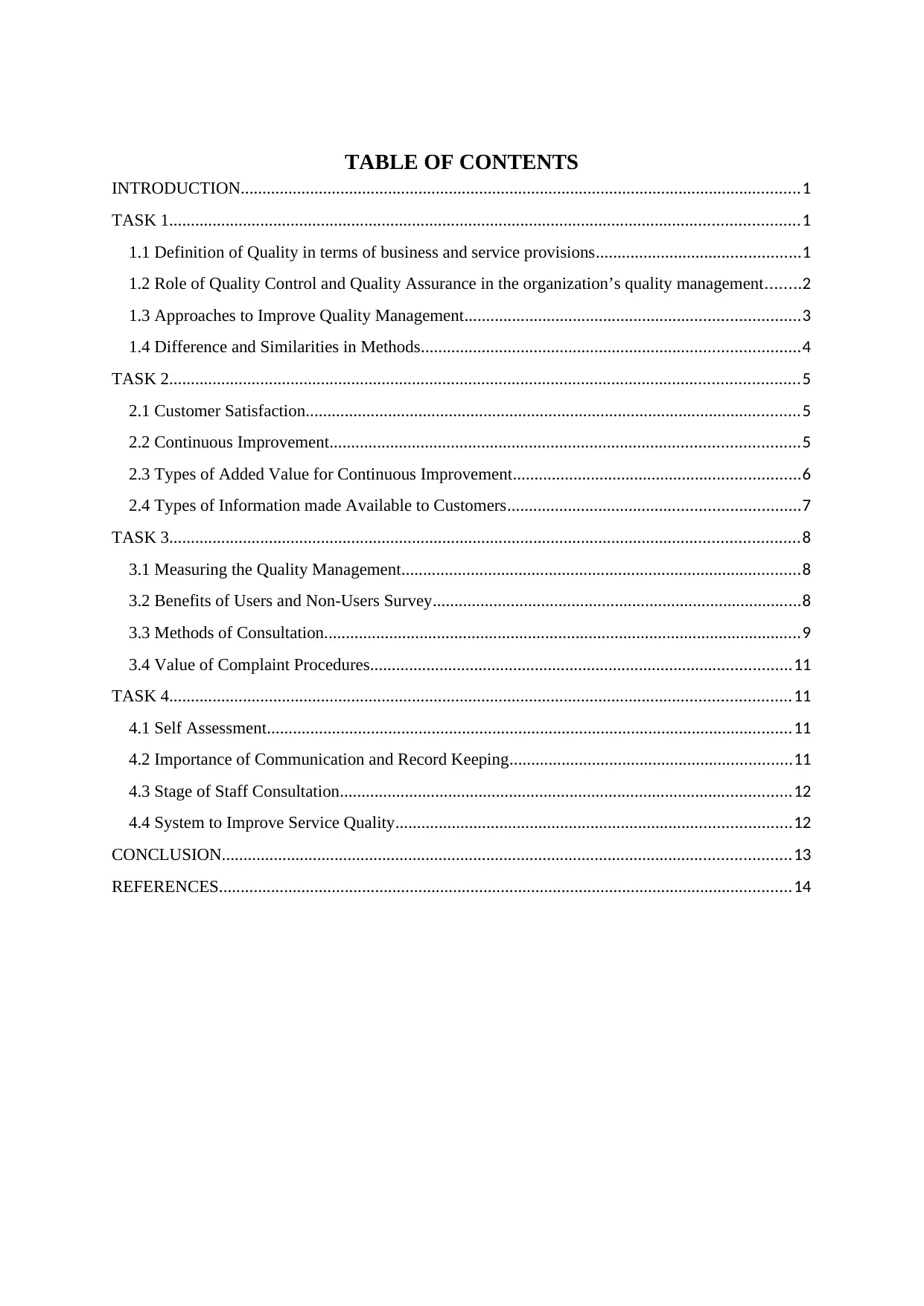
TABLE OF CONTENTS
INTRODUCTION.................................................................................................................................1
TASK 1.................................................................................................................................................1
1.1 Definition of Quality in terms of business and service provisions...............................................1
1.2 Role of Quality Control and Quality Assurance in the organization’s quality management........2
1.3 Approaches to Improve Quality Management.............................................................................3
1.4 Difference and Similarities in Methods.......................................................................................4
TASK 2.................................................................................................................................................5
2.1 Customer Satisfaction..................................................................................................................5
2.2 Continuous Improvement............................................................................................................5
2.3 Types of Added Value for Continuous Improvement..................................................................6
2.4 Types of Information made Available to Customers...................................................................7
TASK 3.................................................................................................................................................8
3.1 Measuring the Quality Management............................................................................................8
3.2 Benefits of Users and Non-Users Survey.....................................................................................8
3.3 Methods of Consultation..............................................................................................................9
3.4 Value of Complaint Procedures.................................................................................................11
TASK 4...............................................................................................................................................11
4.1 Self Assessment.........................................................................................................................11
4.2 Importance of Communication and Record Keeping.................................................................11
4.3 Stage of Staff Consultation........................................................................................................12
4.4 System to Improve Service Quality...........................................................................................12
CONCLUSION...................................................................................................................................13
REFERENCES....................................................................................................................................14
INTRODUCTION.................................................................................................................................1
TASK 1.................................................................................................................................................1
1.1 Definition of Quality in terms of business and service provisions...............................................1
1.2 Role of Quality Control and Quality Assurance in the organization’s quality management........2
1.3 Approaches to Improve Quality Management.............................................................................3
1.4 Difference and Similarities in Methods.......................................................................................4
TASK 2.................................................................................................................................................5
2.1 Customer Satisfaction..................................................................................................................5
2.2 Continuous Improvement............................................................................................................5
2.3 Types of Added Value for Continuous Improvement..................................................................6
2.4 Types of Information made Available to Customers...................................................................7
TASK 3.................................................................................................................................................8
3.1 Measuring the Quality Management............................................................................................8
3.2 Benefits of Users and Non-Users Survey.....................................................................................8
3.3 Methods of Consultation..............................................................................................................9
3.4 Value of Complaint Procedures.................................................................................................11
TASK 4...............................................................................................................................................11
4.1 Self Assessment.........................................................................................................................11
4.2 Importance of Communication and Record Keeping.................................................................11
4.3 Stage of Staff Consultation........................................................................................................12
4.4 System to Improve Service Quality...........................................................................................12
CONCLUSION...................................................................................................................................13
REFERENCES....................................................................................................................................14
INTRODUCTION
In today’s highly competitive era it is one of the most essential tasks for every
organization to maintain the quality of all their products and services. Consumers are the
most essential asset of any company and it is the most important to satisfy the needs of their
customers. An organization needs to satisfy them by providing high quality services as per
their desires. In this respect, quality can be defined a term which is being measured with other
things of similar nature (Swan, Bowers and Grover, 2002). It clearly indicates that whether
the specific thing is of worth paying certain amount or not. Due to the increasing competition,
quality management is first and foremost concept which must be carried out by every
organization. It is the best way through which competency of an organization can be
increased. However, the present is formed in order to attain in depth knowledge about the
quality as well as various concepts about its management. For this, Rose and crown hotel is
taken into consideration which is an independent 3 star hotel located on the outskirts of a city
in the Midlands. They are facing several issues regarding their customer complaints as well
as decreasing market sales. Staff turnover is high and staff morale is low within this hotel
(Nazarko, 2004). Further, this study helps in suggesting some of the best ways through which
quality can be improved and appropriate solution can be achieved with limited resources.
Moreover, emphasis is laid on offering certain recommendations for Rose and Crown through
which they can streamline their quality as they are not able to go through the new product
development.
TASK 1
1.1 Definition of Quality in terms of business and service provisions
Differentiation is one of the most important concepts of any product which can be
easily attained by the way of maintaining its quality different than that of other. Under this, it
can be stated that quality is the crucial component of any product or service and it can also be
denoted as superiority of particular products. It is necessary that particular needs and desires
can be attained. According to the Williams and Buswell (2003) quality is all about producing
services as per the offering of industry standards. With special reference to business it can be
determine that quality relates to the expectations of customers in and effective manner.
However, quality is the most effective element and concept which assist in reflecting value
for money of customers. In terms of service provisions it is the identification which defines
that customers get various services as per the required specifications. It is the only way
through which satisfaction level of customers can be enhanced (Hurst, 2006). As per the
1 | P a g e
In today’s highly competitive era it is one of the most essential tasks for every
organization to maintain the quality of all their products and services. Consumers are the
most essential asset of any company and it is the most important to satisfy the needs of their
customers. An organization needs to satisfy them by providing high quality services as per
their desires. In this respect, quality can be defined a term which is being measured with other
things of similar nature (Swan, Bowers and Grover, 2002). It clearly indicates that whether
the specific thing is of worth paying certain amount or not. Due to the increasing competition,
quality management is first and foremost concept which must be carried out by every
organization. It is the best way through which competency of an organization can be
increased. However, the present is formed in order to attain in depth knowledge about the
quality as well as various concepts about its management. For this, Rose and crown hotel is
taken into consideration which is an independent 3 star hotel located on the outskirts of a city
in the Midlands. They are facing several issues regarding their customer complaints as well
as decreasing market sales. Staff turnover is high and staff morale is low within this hotel
(Nazarko, 2004). Further, this study helps in suggesting some of the best ways through which
quality can be improved and appropriate solution can be achieved with limited resources.
Moreover, emphasis is laid on offering certain recommendations for Rose and Crown through
which they can streamline their quality as they are not able to go through the new product
development.
TASK 1
1.1 Definition of Quality in terms of business and service provisions
Differentiation is one of the most important concepts of any product which can be
easily attained by the way of maintaining its quality different than that of other. Under this, it
can be stated that quality is the crucial component of any product or service and it can also be
denoted as superiority of particular products. It is necessary that particular needs and desires
can be attained. According to the Williams and Buswell (2003) quality is all about producing
services as per the offering of industry standards. With special reference to business it can be
determine that quality relates to the expectations of customers in and effective manner.
However, quality is the most effective element and concept which assist in reflecting value
for money of customers. In terms of service provisions it is the identification which defines
that customers get various services as per the required specifications. It is the only way
through which satisfaction level of customers can be enhanced (Hurst, 2006). As per the
1 | P a g e
⊘ This is a preview!⊘
Do you want full access?
Subscribe today to unlock all pages.

Trusted by 1+ million students worldwide
given scenario of Rose and Crown hotel, quality related with all its hotel services and
offerings as well as amount charged against it. Further, it is essential for cited hotel to set
quality standards which needs to be attained by all their employees. Moreover, David Gravin
defines that there are mainly 8 dimensions of quality which must be attained by organization
i.e. performance, features, reliability, conformance, durability, serviceability, aesthetics and
perceived quality (Presbury, Fitzgerald and Chapman, 2005). All these features must be
attained by Rose and Crown in order to go with the value for money services.
1.2 Role of Quality Control and Quality Assurance in the organization’s quality management
In any organizations inspection and assurance process, quality control and assurance
plays a major role. Quality control highly reflects the process under which overall quality of
the products can be easily measured (Räisänen, 2003). It also helps in evaluating that each
job posses identical results. In order to do so, there are several mechanisms which must be
followed by companies such as using checklist and adhering to various certification that been
set by industry and supervision. By following such measures companies can easily improve
their quality of services and also identify that necessary steps are taken into consideration in
order to adhere to quality. As per the given case scenario, it can be define that plan, do, check
and act is a model which is the most suitable for Rose and Crown. This model is implemented
in order to resolve the upcoming problems and offer high quality hospitality services. Further,
it can be stated that inspection is the most effective and important process which helps in
defining appropriate planning as well as reporting in order to identify loopholes. With the
help of going through appropriate quality assurance company can easily determine that
quality standard. In addition to this, there are so many factors by which customers get
attracted towards the products as well as services of company. Moreover, quality assurance is
a concept that is highly focused with the planning and documentation so that quality can be
maintained. Both quality control and assurance plays a significant role in the quality
management and it ensures that goods and services possess high quality (Berezina and et.al,
2012). It is the best way through which Rose and Crown can increase their sales revenue and
fulfills the ultimate needs of customers.
2 | P a g e
offerings as well as amount charged against it. Further, it is essential for cited hotel to set
quality standards which needs to be attained by all their employees. Moreover, David Gravin
defines that there are mainly 8 dimensions of quality which must be attained by organization
i.e. performance, features, reliability, conformance, durability, serviceability, aesthetics and
perceived quality (Presbury, Fitzgerald and Chapman, 2005). All these features must be
attained by Rose and Crown in order to go with the value for money services.
1.2 Role of Quality Control and Quality Assurance in the organization’s quality management
In any organizations inspection and assurance process, quality control and assurance
plays a major role. Quality control highly reflects the process under which overall quality of
the products can be easily measured (Räisänen, 2003). It also helps in evaluating that each
job posses identical results. In order to do so, there are several mechanisms which must be
followed by companies such as using checklist and adhering to various certification that been
set by industry and supervision. By following such measures companies can easily improve
their quality of services and also identify that necessary steps are taken into consideration in
order to adhere to quality. As per the given case scenario, it can be define that plan, do, check
and act is a model which is the most suitable for Rose and Crown. This model is implemented
in order to resolve the upcoming problems and offer high quality hospitality services. Further,
it can be stated that inspection is the most effective and important process which helps in
defining appropriate planning as well as reporting in order to identify loopholes. With the
help of going through appropriate quality assurance company can easily determine that
quality standard. In addition to this, there are so many factors by which customers get
attracted towards the products as well as services of company. Moreover, quality assurance is
a concept that is highly focused with the planning and documentation so that quality can be
maintained. Both quality control and assurance plays a significant role in the quality
management and it ensures that goods and services possess high quality (Berezina and et.al,
2012). It is the best way through which Rose and Crown can increase their sales revenue and
fulfills the ultimate needs of customers.
2 | P a g e
Paraphrase This Document
Need a fresh take? Get an instant paraphrase of this document with our AI Paraphraser
1.3 Approaches to Improve Quality Management
In order to improve the management of quality there are various approaches which
must be taken into consideration. Working on quality can involve various actions which
simply range to improving the quality of services. A most effective or a formal approach is
quality assurance system. With the help of this system analyst can easily monitor the quality
of service delivery in a range of areas. Further, it can be determine that quality assurance
system is a formal management system that is designed to raise the standard of work and to
ensure the smoothness of process. In this concern, some of the most common approaches are
identified as follows:
Off-the-shelf system
Compliance Model
Evaluative model
In-house or tailor made system
National occupational standards
Setting ISO standards for consistency
Creating the ultimate TQM environment
Zero Defect by Crosby
Quality Planning
Cost benefit analysis of quality
Trilogy of Juran
With the help of using all the above techniques or quality assurance system organizations can
easily meet out to their set expectations and delivery high quality services as well. For Rose
and crown hotel philosophical approach is taken into consideration (Maxwell, McDougall
and Blair, 2000). It is the most effective approach under which Dr. Deming’s 14 Points on
Total Quality Management involved such as:
Reliability of improvement
Acceptance new philosophy
Dependence
Expected improvement
Portfolio of supplier
Training
Leadership
Avoiding barriers
Setting targets and other related
3 | P a g e
In order to improve the management of quality there are various approaches which
must be taken into consideration. Working on quality can involve various actions which
simply range to improving the quality of services. A most effective or a formal approach is
quality assurance system. With the help of this system analyst can easily monitor the quality
of service delivery in a range of areas. Further, it can be determine that quality assurance
system is a formal management system that is designed to raise the standard of work and to
ensure the smoothness of process. In this concern, some of the most common approaches are
identified as follows:
Off-the-shelf system
Compliance Model
Evaluative model
In-house or tailor made system
National occupational standards
Setting ISO standards for consistency
Creating the ultimate TQM environment
Zero Defect by Crosby
Quality Planning
Cost benefit analysis of quality
Trilogy of Juran
With the help of using all the above techniques or quality assurance system organizations can
easily meet out to their set expectations and delivery high quality services as well. For Rose
and crown hotel philosophical approach is taken into consideration (Maxwell, McDougall
and Blair, 2000). It is the most effective approach under which Dr. Deming’s 14 Points on
Total Quality Management involved such as:
Reliability of improvement
Acceptance new philosophy
Dependence
Expected improvement
Portfolio of supplier
Training
Leadership
Avoiding barriers
Setting targets and other related
3 | P a g e
By following all the above given points hotel can boost its quality and enhance their
consumer base as well. It is the most effective total quality management approach through
which manager of Rose and Crown can easily reduce the complaints of their customers. By
adopting philosophical approach they are able to enhance the level of their staff morale (Chen
and Choi, 2008). Through this they can perform effectively and produce high quality services
for all their customers. Further, better leadership and training motivates them to perform
equally and supporting the whole management team to provide high quality services.
1.4 Difference and Similarities in Methods
There are various methods that are considered for the quality management such as:
Following are the methods that are considered for quality management
1. TQM Approach of Dr. Deming
2. Quality Control by Dr. Feigenbaum
3. Zero Defect by Crosby
4. Quality Planning
5. Cost benefit analysis of quality
6. Trilogy of Juran
All the above given approaches help any organization in boosting their quality factors so
that all their resources can be utilized in an appropriate manner. There is a similarity between
the quality approaches of Deming and Juran as they both has introduced the statistical quality
control theory to Japanese industry. Approach of Deming determines that a product or a
service highly possesses quality then it is able to decrease cost because of less rework and
less mistakes as well. He stated that, it captures the overall market with better quality and
reduced cost. He created 14 quality management points for the same. While Juran approach
of Trilogy determines that operational level of any organization need to focus on the
conformance to specifications through the elimination of defects by the use of statistical
methods. Juran’s trilogy philosophy is highly focused with the quality planning, control and
improvement. Both of them have used statistical method in order to determine the quality
performance. Further, the major similarity between these quality management approaches is
the total quality improvement through the use of statistical analysis. Both of these methods
ensure that set quality is maintained at every cost. As per the given scenario, there are various
problems faced by Rose and Crown such as staff complaints about poor communication
between internal departments, lack of consultation, lack of rewards etc. In order to overcome
with all these issues they want to improve the quality with optimal use of resources (Hernon
4 | P a g e
consumer base as well. It is the most effective total quality management approach through
which manager of Rose and Crown can easily reduce the complaints of their customers. By
adopting philosophical approach they are able to enhance the level of their staff morale (Chen
and Choi, 2008). Through this they can perform effectively and produce high quality services
for all their customers. Further, better leadership and training motivates them to perform
equally and supporting the whole management team to provide high quality services.
1.4 Difference and Similarities in Methods
There are various methods that are considered for the quality management such as:
Following are the methods that are considered for quality management
1. TQM Approach of Dr. Deming
2. Quality Control by Dr. Feigenbaum
3. Zero Defect by Crosby
4. Quality Planning
5. Cost benefit analysis of quality
6. Trilogy of Juran
All the above given approaches help any organization in boosting their quality factors so
that all their resources can be utilized in an appropriate manner. There is a similarity between
the quality approaches of Deming and Juran as they both has introduced the statistical quality
control theory to Japanese industry. Approach of Deming determines that a product or a
service highly possesses quality then it is able to decrease cost because of less rework and
less mistakes as well. He stated that, it captures the overall market with better quality and
reduced cost. He created 14 quality management points for the same. While Juran approach
of Trilogy determines that operational level of any organization need to focus on the
conformance to specifications through the elimination of defects by the use of statistical
methods. Juran’s trilogy philosophy is highly focused with the quality planning, control and
improvement. Both of them have used statistical method in order to determine the quality
performance. Further, the major similarity between these quality management approaches is
the total quality improvement through the use of statistical analysis. Both of these methods
ensure that set quality is maintained at every cost. As per the given scenario, there are various
problems faced by Rose and Crown such as staff complaints about poor communication
between internal departments, lack of consultation, lack of rewards etc. In order to overcome
with all these issues they want to improve the quality with optimal use of resources (Hernon
4 | P a g e
⊘ This is a preview!⊘
Do you want full access?
Subscribe today to unlock all pages.
Trusted by 1+ million students worldwide
and Altman, 2010). For this, TQM is very effective method and it is very similar to quality
control. In addition to this, cost benefit analysis reflects that cost that can be incurred to
manage the quality. This approach is quite similar to that of quality planning, TQM and
quality control. In all these approaches decisions are taken regarding quality.
After identifying the similarities mentioned above it can be stated that there are
certain differences also in these approaches. TQM approach is considered as a most effective
approach in which quality can be boost up by including suppliers, leadership etc. Under this
appropriate targets are going to be set in which required changes to be achieved by company.
In this approach, functions after the job are done (Milakovich, 2005). On the very next hand,
functions are taken into consideration previously so get the job done effectively. Moreover,
trilogy is another approach which focuses on planning for further improvements. On the
contrary, Taguchi concept is highly focused with the product and layout of the production
area. Further, it can be stated that all these approaches are having some major differences as
well as similarities.
TASK 2
2.1 Customer Satisfaction
At the time of planning a staff induction manual it is essential to give them proper
information about the customer service policy. It is the best way through which they can
provide high quality services to all their consumers. According to Hernon and Altman (2010)
satisfying the actual needs and demands of consumers by offering them high quality services
leads to define as a customer satisfaction. For every organization as well as their products and
services consumers are different expectations on the basis of its value and amount. However,
satisfaction is a broad term that varies from nature of customers. Further, as per the given
scenario, it is essential to maintain the different services for their corporate guests as well as
leisure guests. These differences must be maintained so that consumer satisfaction can be
enhanced. Customers are highly satisfied if they provide value for money (Nadiri and
Hussain, 2005).
2.2 Continuous Improvement
Continuous improvement can be defined as a process that includes regular
development of different services that are being offered by the company. In the given case
scenario, all the problems can be easily overcome by the way of taking regular feedbacks
5 | P a g e
control. In addition to this, cost benefit analysis reflects that cost that can be incurred to
manage the quality. This approach is quite similar to that of quality planning, TQM and
quality control. In all these approaches decisions are taken regarding quality.
After identifying the similarities mentioned above it can be stated that there are
certain differences also in these approaches. TQM approach is considered as a most effective
approach in which quality can be boost up by including suppliers, leadership etc. Under this
appropriate targets are going to be set in which required changes to be achieved by company.
In this approach, functions after the job are done (Milakovich, 2005). On the very next hand,
functions are taken into consideration previously so get the job done effectively. Moreover,
trilogy is another approach which focuses on planning for further improvements. On the
contrary, Taguchi concept is highly focused with the product and layout of the production
area. Further, it can be stated that all these approaches are having some major differences as
well as similarities.
TASK 2
2.1 Customer Satisfaction
At the time of planning a staff induction manual it is essential to give them proper
information about the customer service policy. It is the best way through which they can
provide high quality services to all their consumers. According to Hernon and Altman (2010)
satisfying the actual needs and demands of consumers by offering them high quality services
leads to define as a customer satisfaction. For every organization as well as their products and
services consumers are different expectations on the basis of its value and amount. However,
satisfaction is a broad term that varies from nature of customers. Further, as per the given
scenario, it is essential to maintain the different services for their corporate guests as well as
leisure guests. These differences must be maintained so that consumer satisfaction can be
enhanced. Customers are highly satisfied if they provide value for money (Nadiri and
Hussain, 2005).
2.2 Continuous Improvement
Continuous improvement can be defined as a process that includes regular
development of different services that are being offered by the company. In the given case
scenario, all the problems can be easily overcome by the way of taking regular feedbacks
5 | P a g e
Paraphrase This Document
Need a fresh take? Get an instant paraphrase of this document with our AI Paraphraser
from their customers. It is the most effective way through which they can identify gaps that
must be fulfilled.
In addition to this, it can be determine there are different approaches of continuous
improvement that basically works for the changes in the process in order to improve the
overall efficiency and quality. It is called Kaizen process which is continuously seeks for the
ways to improve different operations. The overall concept of continuous improvement
focuses on various benchmarks of excellent practices and better employee ownership of the
process as well. It also focuses on the problems related to customers of suppliers. The base of
this approach is the beliefs that virtually any aspect of an operation can be improved. Further,
it can be effectively takes place within an organization by giving appropriate training to
employees about statistical process (SPC) as well as other similar tools. Further, team works
can be developed through which team work can enhanced with the help of appropriate
employee involvement. In addition to this, Rose and Crown can easily identify the existing
loopholes due to which they are covering several problems such as low staff morale, lack of
recognition and rewards etc. by self-assessment and organizational audit (Räisänen, 2003).
These are the most common ways of continuous improvements which helps the organization
in providing the required services to all the consumers as per their needs and expectations.
With the help of incorporating this practice, hotel can easily streamline its present business
activities.
2.3 Types of Added Value for Continuous Improvement
There are various types of added values which can be gained by going through the
continuous improvement. There are some complimentary services options which are
available all the time for the customers. This option helps in attracting huge base of guests
and enhancing the sales of hotel. It helps in enhancing the customer loyalty and generating
higher sales revenues as well (Presbury, Fitzgerald and Chapman, 2005). In addition to this,
overall operational efficiency of the hotel can be enhanced by providing various
complimentary services. In addition to this, there is some of the most common type of added
values such as: low cost, reduction in waste, customer loyalty etc. With the help of all the
given strategies hotel can reduce the ultimate waste of their services and maintain their
quality services as well.
6 | P a g e
must be fulfilled.
In addition to this, it can be determine there are different approaches of continuous
improvement that basically works for the changes in the process in order to improve the
overall efficiency and quality. It is called Kaizen process which is continuously seeks for the
ways to improve different operations. The overall concept of continuous improvement
focuses on various benchmarks of excellent practices and better employee ownership of the
process as well. It also focuses on the problems related to customers of suppliers. The base of
this approach is the beliefs that virtually any aspect of an operation can be improved. Further,
it can be effectively takes place within an organization by giving appropriate training to
employees about statistical process (SPC) as well as other similar tools. Further, team works
can be developed through which team work can enhanced with the help of appropriate
employee involvement. In addition to this, Rose and Crown can easily identify the existing
loopholes due to which they are covering several problems such as low staff morale, lack of
recognition and rewards etc. by self-assessment and organizational audit (Räisänen, 2003).
These are the most common ways of continuous improvements which helps the organization
in providing the required services to all the consumers as per their needs and expectations.
With the help of incorporating this practice, hotel can easily streamline its present business
activities.
2.3 Types of Added Value for Continuous Improvement
There are various types of added values which can be gained by going through the
continuous improvement. There are some complimentary services options which are
available all the time for the customers. This option helps in attracting huge base of guests
and enhancing the sales of hotel. It helps in enhancing the customer loyalty and generating
higher sales revenues as well (Presbury, Fitzgerald and Chapman, 2005). In addition to this,
overall operational efficiency of the hotel can be enhanced by providing various
complimentary services. In addition to this, there is some of the most common type of added
values such as: low cost, reduction in waste, customer loyalty etc. With the help of all the
given strategies hotel can reduce the ultimate waste of their services and maintain their
quality services as well.
6 | P a g e
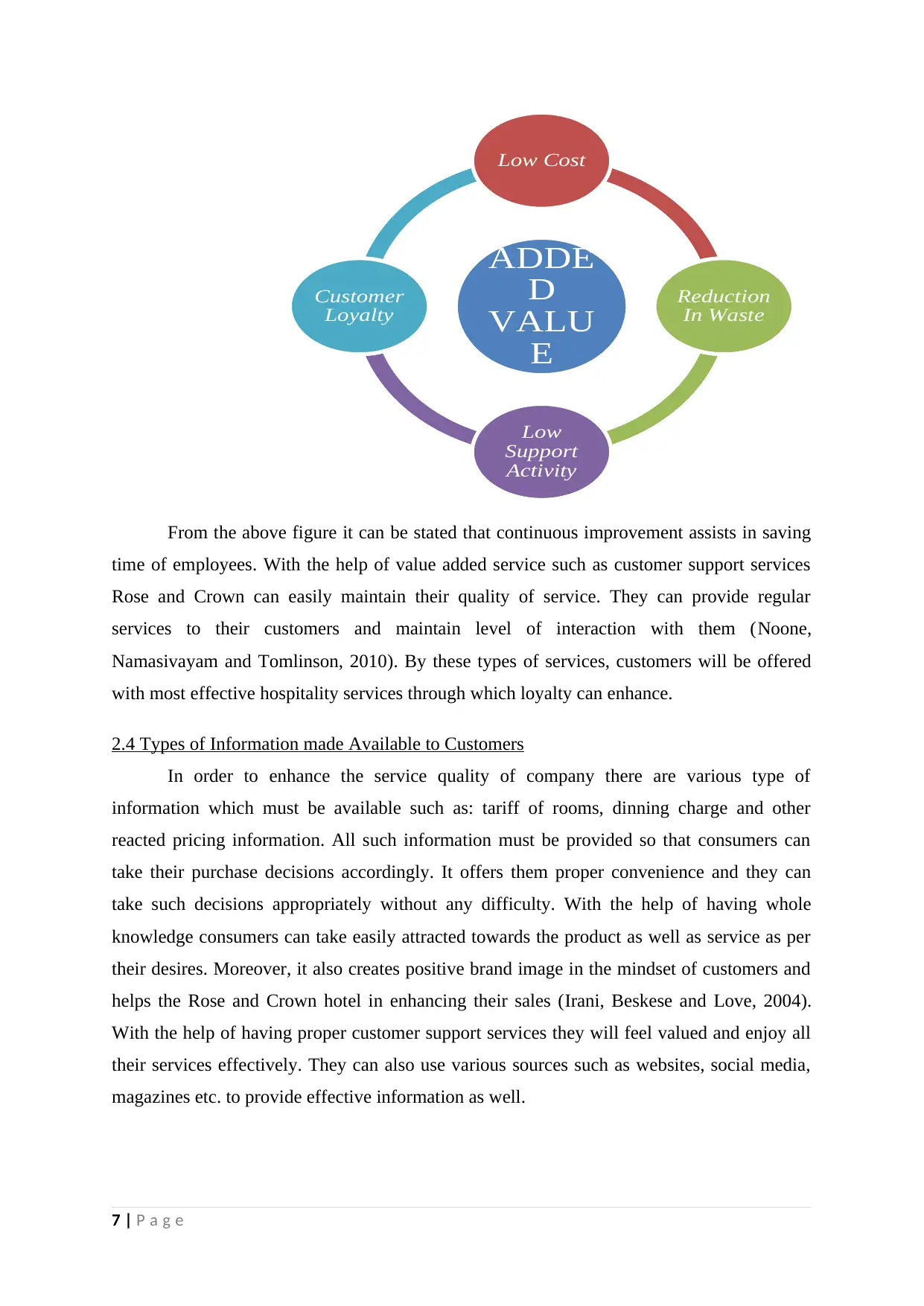
From the above figure it can be stated that continuous improvement assists in saving
time of employees. With the help of value added service such as customer support services
Rose and Crown can easily maintain their quality of service. They can provide regular
services to their customers and maintain level of interaction with them (Noone,
Namasivayam and Tomlinson, 2010). By these types of services, customers will be offered
with most effective hospitality services through which loyalty can enhance.
2.4 Types of Information made Available to Customers
In order to enhance the service quality of company there are various type of
information which must be available such as: tariff of rooms, dinning charge and other
reacted pricing information. All such information must be provided so that consumers can
take their purchase decisions accordingly. It offers them proper convenience and they can
take such decisions appropriately without any difficulty. With the help of having whole
knowledge consumers can take easily attracted towards the product as well as service as per
their desires. Moreover, it also creates positive brand image in the mindset of customers and
helps the Rose and Crown hotel in enhancing their sales (Irani, Beskese and Love, 2004).
With the help of having proper customer support services they will feel valued and enjoy all
their services effectively. They can also use various sources such as websites, social media,
magazines etc. to provide effective information as well.
7 | P a g e
ADDE
D
VALU
E
Low Cost
Reduction
In Waste
Low
Support
Activity
Customer
Loyalty
time of employees. With the help of value added service such as customer support services
Rose and Crown can easily maintain their quality of service. They can provide regular
services to their customers and maintain level of interaction with them (Noone,
Namasivayam and Tomlinson, 2010). By these types of services, customers will be offered
with most effective hospitality services through which loyalty can enhance.
2.4 Types of Information made Available to Customers
In order to enhance the service quality of company there are various type of
information which must be available such as: tariff of rooms, dinning charge and other
reacted pricing information. All such information must be provided so that consumers can
take their purchase decisions accordingly. It offers them proper convenience and they can
take such decisions appropriately without any difficulty. With the help of having whole
knowledge consumers can take easily attracted towards the product as well as service as per
their desires. Moreover, it also creates positive brand image in the mindset of customers and
helps the Rose and Crown hotel in enhancing their sales (Irani, Beskese and Love, 2004).
With the help of having proper customer support services they will feel valued and enjoy all
their services effectively. They can also use various sources such as websites, social media,
magazines etc. to provide effective information as well.
7 | P a g e
ADDE
D
VALU
E
Low Cost
Reduction
In Waste
Low
Support
Activity
Customer
Loyalty
⊘ This is a preview!⊘
Do you want full access?
Subscribe today to unlock all pages.
Trusted by 1+ million students worldwide
TASK 3
3.1 Measuring the Quality Management
As part of measuring the quality management within the context of hospitality
management, varied tools can be used. Same have been enumerated below:
System Documentation: This set of document possesses in-depth definition of the
company quality along with description of benchmark so that it can be adhere by
employees of every level (Chungand et.al., 2008). This set of document is mainly
developed by quality manager by considering the nature and type of work at different
level by acknowledging its impact on overall quality.
Statistical quality Control: With the help of it, quality of service or operation can be
transferred into quantifiable manner. Further, accepted level of quality is determined
so that quality of service or product that doesn’t fit in that can be rejected. It is a
quality control mechanism (Kannanand Tan, 2005).
Six Sigma: This mechanism reflects that there are no discrepancies in the quality of
hospitality firm and hence is the ultimate measurement of quality across the globe.
Past performance: Apart from it, hospitality firm can take decision within the context
of quality by reviewing past performance and feedbacks from customers and internal
stakeholders. This aids in addressing the issue (Sadikogluand Zehir, 2010).
Benchmarking: It is another set of activity that supports in delivering services of set
quality. With the help of it, company is able to attain standardization.
Quality Circle: Additionally, quality can be measured with the help of quality circle.
It is a group of expertise that are placed to ensure the set level quality within the
service operation. This group is also responsible for addressing the issue and
problems that arises in operations (Chenand Choi, 2008).
3.2 Benefits of Users and Non-Users Survey
By surveying the users of the service, following benefits and limitations are there:
Benefits of
Surveying Users
Assessment the specific needs of existing and target customers.
Attainment of idea about the expectation level of the existing
customers
It aids in gaining idea about like and dislikes
It supports in identifying the loopholes that exist in the service
offering (Sallis, 2014).
Identifying the area within hospitality business that needs to be
8 | P a g e
3.1 Measuring the Quality Management
As part of measuring the quality management within the context of hospitality
management, varied tools can be used. Same have been enumerated below:
System Documentation: This set of document possesses in-depth definition of the
company quality along with description of benchmark so that it can be adhere by
employees of every level (Chungand et.al., 2008). This set of document is mainly
developed by quality manager by considering the nature and type of work at different
level by acknowledging its impact on overall quality.
Statistical quality Control: With the help of it, quality of service or operation can be
transferred into quantifiable manner. Further, accepted level of quality is determined
so that quality of service or product that doesn’t fit in that can be rejected. It is a
quality control mechanism (Kannanand Tan, 2005).
Six Sigma: This mechanism reflects that there are no discrepancies in the quality of
hospitality firm and hence is the ultimate measurement of quality across the globe.
Past performance: Apart from it, hospitality firm can take decision within the context
of quality by reviewing past performance and feedbacks from customers and internal
stakeholders. This aids in addressing the issue (Sadikogluand Zehir, 2010).
Benchmarking: It is another set of activity that supports in delivering services of set
quality. With the help of it, company is able to attain standardization.
Quality Circle: Additionally, quality can be measured with the help of quality circle.
It is a group of expertise that are placed to ensure the set level quality within the
service operation. This group is also responsible for addressing the issue and
problems that arises in operations (Chenand Choi, 2008).
3.2 Benefits of Users and Non-Users Survey
By surveying the users of the service, following benefits and limitations are there:
Benefits of
Surveying Users
Assessment the specific needs of existing and target customers.
Attainment of idea about the expectation level of the existing
customers
It aids in gaining idea about like and dislikes
It supports in identifying the loopholes that exist in the service
offering (Sallis, 2014).
Identifying the area within hospitality business that needs to be
8 | P a g e
Paraphrase This Document
Need a fresh take? Get an instant paraphrase of this document with our AI Paraphraser
improved.
Better decision making through which needs of customers
fulfilled.
Limitation of
Survey
It leads to confined knowledge only as only users are involved.
This practice also doesn’t help in gaining comparative ideas
between the two set of hospitality (Wang, Chenand Chen, 2012).
It doesn’t help in attaining knowledge about the market trends.
Apart from it, following are benefits and limitations of the surveying non users of service:
Benefits of
Surveying Users
It supports in gaining idea about existing market trends
Aids in assessing actual needs and wants of potential customers.
Gaining idea about the brand image of company
It supports in identifying the barriers of gaining services of cited
firm.
It helps in developing strategies through which non-users can be
converted into users (Akbaba, 2006).
Limitation of
Survey
It only helps in gaining general information from customers.
It is quite time consuming as sample size of such survey are quite
large.
It doesn’t aids in gaining information about the flaws that exist in
company.
Based on this discussion, it is recommended that company must go for survey of users
only as it aids in gaining actual and specific information from the target population. Through
this, effective decision can be taken from which existing efficiency of company can be
increased. Additionally, company can attain generic information through secondary data also
which is quite simple and cost effective measures. This can be used for developing new set of
products or services. Hence, it can be state that surveying users is best option for company.
3.3 Methods of Consultation
Consultation can be referred to a practice of gaining suggestions or support from any
professional bodies or quality circle so that required results can be attained. In this regard,
there are various mode of consultation that can be used for the purpose of boosting quality of
the company. This involves questionnaire, focus group, suggestion schemes, meeting with
expertise, complaint mechanism, observation and other related.
9 | P a g e
Better decision making through which needs of customers
fulfilled.
Limitation of
Survey
It leads to confined knowledge only as only users are involved.
This practice also doesn’t help in gaining comparative ideas
between the two set of hospitality (Wang, Chenand Chen, 2012).
It doesn’t help in attaining knowledge about the market trends.
Apart from it, following are benefits and limitations of the surveying non users of service:
Benefits of
Surveying Users
It supports in gaining idea about existing market trends
Aids in assessing actual needs and wants of potential customers.
Gaining idea about the brand image of company
It supports in identifying the barriers of gaining services of cited
firm.
It helps in developing strategies through which non-users can be
converted into users (Akbaba, 2006).
Limitation of
Survey
It only helps in gaining general information from customers.
It is quite time consuming as sample size of such survey are quite
large.
It doesn’t aids in gaining information about the flaws that exist in
company.
Based on this discussion, it is recommended that company must go for survey of users
only as it aids in gaining actual and specific information from the target population. Through
this, effective decision can be taken from which existing efficiency of company can be
increased. Additionally, company can attain generic information through secondary data also
which is quite simple and cost effective measures. This can be used for developing new set of
products or services. Hence, it can be state that surveying users is best option for company.
3.3 Methods of Consultation
Consultation can be referred to a practice of gaining suggestions or support from any
professional bodies or quality circle so that required results can be attained. In this regard,
there are various mode of consultation that can be used for the purpose of boosting quality of
the company. This involves questionnaire, focus group, suggestion schemes, meeting with
expertise, complaint mechanism, observation and other related.
9 | P a g e
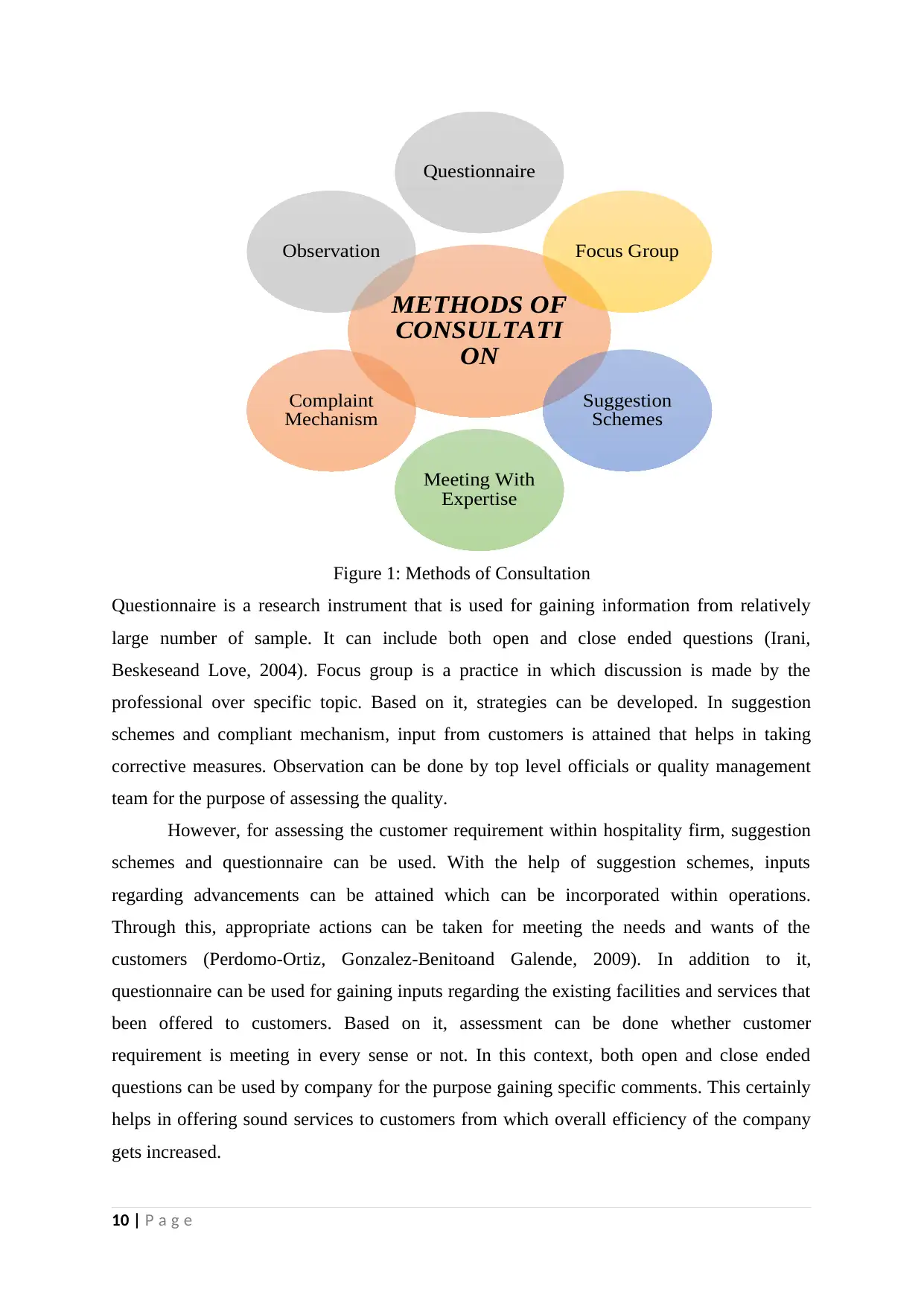
Figure 1: Methods of Consultation
Questionnaire is a research instrument that is used for gaining information from relatively
large number of sample. It can include both open and close ended questions (Irani,
Beskeseand Love, 2004). Focus group is a practice in which discussion is made by the
professional over specific topic. Based on it, strategies can be developed. In suggestion
schemes and compliant mechanism, input from customers is attained that helps in taking
corrective measures. Observation can be done by top level officials or quality management
team for the purpose of assessing the quality.
However, for assessing the customer requirement within hospitality firm, suggestion
schemes and questionnaire can be used. With the help of suggestion schemes, inputs
regarding advancements can be attained which can be incorporated within operations.
Through this, appropriate actions can be taken for meeting the needs and wants of the
customers (Perdomo-Ortiz, Gonzalez-Benitoand Galende, 2009). In addition to it,
questionnaire can be used for gaining inputs regarding the existing facilities and services that
been offered to customers. Based on it, assessment can be done whether customer
requirement is meeting in every sense or not. In this context, both open and close ended
questions can be used by company for the purpose gaining specific comments. This certainly
helps in offering sound services to customers from which overall efficiency of the company
gets increased.
10 | P a g e
METHODS OF
CONSULTATI
ON
Questionnaire
Focus Group
Suggestion
Schemes
Meeting With
Expertise
Complaint
Mechanism
Observation
Questionnaire is a research instrument that is used for gaining information from relatively
large number of sample. It can include both open and close ended questions (Irani,
Beskeseand Love, 2004). Focus group is a practice in which discussion is made by the
professional over specific topic. Based on it, strategies can be developed. In suggestion
schemes and compliant mechanism, input from customers is attained that helps in taking
corrective measures. Observation can be done by top level officials or quality management
team for the purpose of assessing the quality.
However, for assessing the customer requirement within hospitality firm, suggestion
schemes and questionnaire can be used. With the help of suggestion schemes, inputs
regarding advancements can be attained which can be incorporated within operations.
Through this, appropriate actions can be taken for meeting the needs and wants of the
customers (Perdomo-Ortiz, Gonzalez-Benitoand Galende, 2009). In addition to it,
questionnaire can be used for gaining inputs regarding the existing facilities and services that
been offered to customers. Based on it, assessment can be done whether customer
requirement is meeting in every sense or not. In this context, both open and close ended
questions can be used by company for the purpose gaining specific comments. This certainly
helps in offering sound services to customers from which overall efficiency of the company
gets increased.
10 | P a g e
METHODS OF
CONSULTATI
ON
Questionnaire
Focus Group
Suggestion
Schemes
Meeting With
Expertise
Complaint
Mechanism
Observation
⊘ This is a preview!⊘
Do you want full access?
Subscribe today to unlock all pages.
Trusted by 1+ million students worldwide

1 out of 17


Related Documents


Your All-in-One AI-Powered Toolkit for Academic Success.
+13062052269
info@desklib.com
Available 24*7 on WhatsApp / Email
![[object Object]](/_next/static/media/star-bottom.7253800d.svg)
Unlock your academic potential
Copyright © 2020–2026 A2Z Services. All Rights Reserved. Developed and managed by ZUCOL.