In Vitro Meat: A Review of Production and Consumer Attitudes
VerifiedAdded on 2023/01/23
|6
|1902
|71
Report
AI Summary
This report provides a comprehensive overview of in vitro meat, also known as cultured meat, examining its production methods, environmental impacts, and consumer attitudes. It analyzes the process of producing meat from animal cells, highlighting the potential to replace traditional livestock farming. The report explores the environmental benefits, such as reduced land and water use, and lower greenhouse gas emissions, while also addressing the technological challenges and ethical concerns associated with in vitro meat production. It further investigates consumer acceptance, including surveys on willingness to try the product, and the factors influencing consumer perceptions, such as taste, price, and appeal. The report draws on research from various sources including Wilks & Phillips, Sharma et al., Bhat et al., FAO, and Tuomisto & Mattos, providing a well-rounded perspective on the current state and future prospects of in vitro meat as a sustainable food source. The report concludes by discussing the potential role of in vitro meat in addressing global food security and reducing the environmental footprint of meat production.
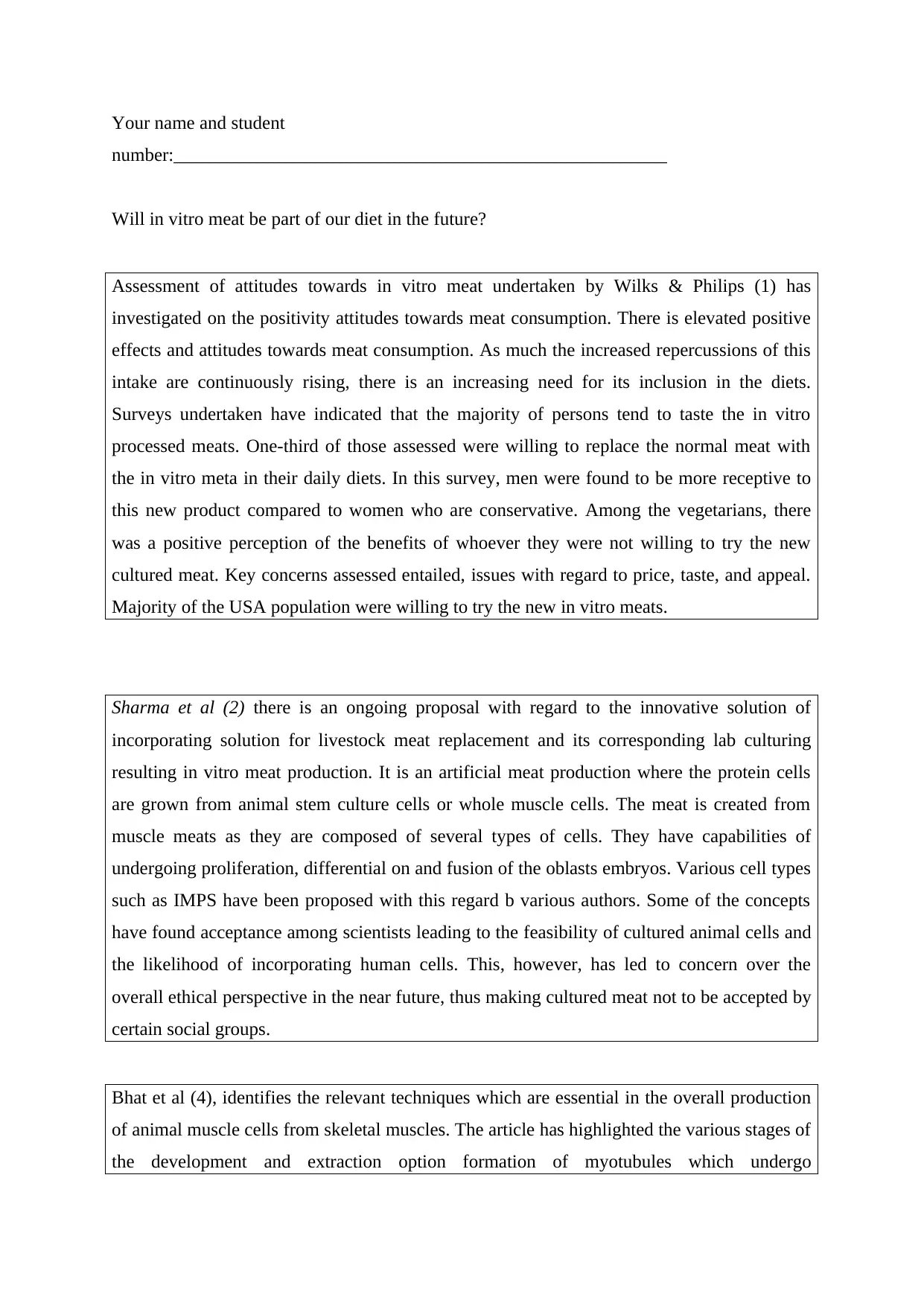
Your name and student
number:_____________________________________________________
Will in vitro meat be part of our diet in the future?
Assessment of attitudes towards in vitro meat undertaken by Wilks & Philips (1) has
investigated on the positivity attitudes towards meat consumption. There is elevated positive
effects and attitudes towards meat consumption. As much the increased repercussions of this
intake are continuously rising, there is an increasing need for its inclusion in the diets.
Surveys undertaken have indicated that the majority of persons tend to taste the in vitro
processed meats. One-third of those assessed were willing to replace the normal meat with
the in vitro meta in their daily diets. In this survey, men were found to be more receptive to
this new product compared to women who are conservative. Among the vegetarians, there
was a positive perception of the benefits of whoever they were not willing to try the new
cultured meat. Key concerns assessed entailed, issues with regard to price, taste, and appeal.
Majority of the USA population were willing to try the new in vitro meats.
Sharma et al (2) there is an ongoing proposal with regard to the innovative solution of
incorporating solution for livestock meat replacement and its corresponding lab culturing
resulting in vitro meat production. It is an artificial meat production where the protein cells
are grown from animal stem culture cells or whole muscle cells. The meat is created from
muscle meats as they are composed of several types of cells. They have capabilities of
undergoing proliferation, differential on and fusion of the oblasts embryos. Various cell types
such as IMPS have been proposed with this regard b various authors. Some of the concepts
have found acceptance among scientists leading to the feasibility of cultured animal cells and
the likelihood of incorporating human cells. This, however, has led to concern over the
overall ethical perspective in the near future, thus making cultured meat not to be accepted by
certain social groups.
Bhat et al (4), identifies the relevant techniques which are essential in the overall production
of animal muscle cells from skeletal muscles. The article has highlighted the various stages of
the development and extraction option formation of myotubules which undergo
number:_____________________________________________________
Will in vitro meat be part of our diet in the future?
Assessment of attitudes towards in vitro meat undertaken by Wilks & Philips (1) has
investigated on the positivity attitudes towards meat consumption. There is elevated positive
effects and attitudes towards meat consumption. As much the increased repercussions of this
intake are continuously rising, there is an increasing need for its inclusion in the diets.
Surveys undertaken have indicated that the majority of persons tend to taste the in vitro
processed meats. One-third of those assessed were willing to replace the normal meat with
the in vitro meta in their daily diets. In this survey, men were found to be more receptive to
this new product compared to women who are conservative. Among the vegetarians, there
was a positive perception of the benefits of whoever they were not willing to try the new
cultured meat. Key concerns assessed entailed, issues with regard to price, taste, and appeal.
Majority of the USA population were willing to try the new in vitro meats.
Sharma et al (2) there is an ongoing proposal with regard to the innovative solution of
incorporating solution for livestock meat replacement and its corresponding lab culturing
resulting in vitro meat production. It is an artificial meat production where the protein cells
are grown from animal stem culture cells or whole muscle cells. The meat is created from
muscle meats as they are composed of several types of cells. They have capabilities of
undergoing proliferation, differential on and fusion of the oblasts embryos. Various cell types
such as IMPS have been proposed with this regard b various authors. Some of the concepts
have found acceptance among scientists leading to the feasibility of cultured animal cells and
the likelihood of incorporating human cells. This, however, has led to concern over the
overall ethical perspective in the near future, thus making cultured meat not to be accepted by
certain social groups.
Bhat et al (4), identifies the relevant techniques which are essential in the overall production
of animal muscle cells from skeletal muscles. The article has highlighted the various stages of
the development and extraction option formation of myotubules which undergo

Paraphrase This Document
Need a fresh take? Get an instant paraphrase of this document with our AI Paraphraser
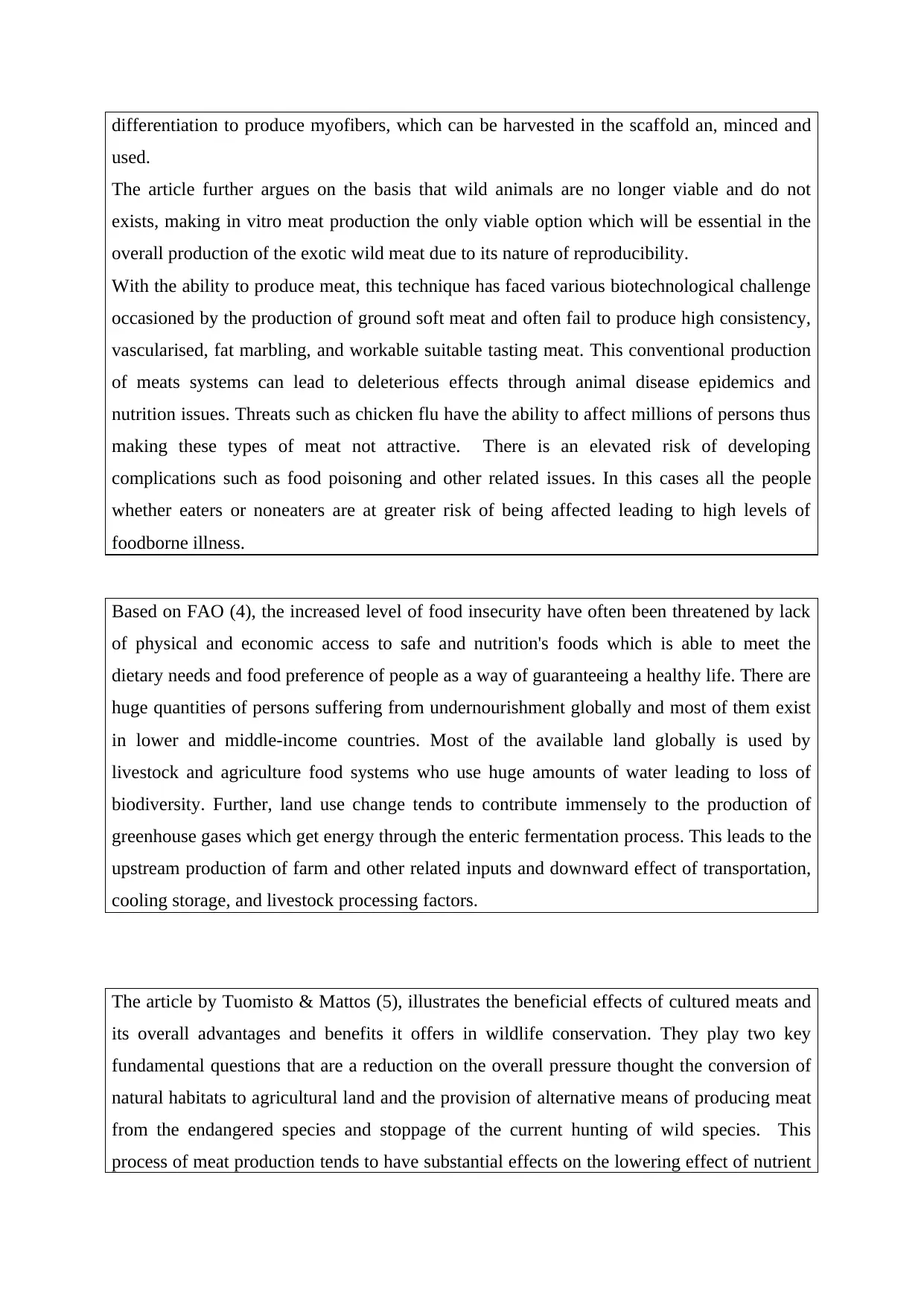
differentiation to produce myofibers, which can be harvested in the scaffold an, minced and
used.
The article further argues on the basis that wild animals are no longer viable and do not
exists, making in vitro meat production the only viable option which will be essential in the
overall production of the exotic wild meat due to its nature of reproducibility.
With the ability to produce meat, this technique has faced various biotechnological challenge
occasioned by the production of ground soft meat and often fail to produce high consistency,
vascularised, fat marbling, and workable suitable tasting meat. This conventional production
of meats systems can lead to deleterious effects through animal disease epidemics and
nutrition issues. Threats such as chicken flu have the ability to affect millions of persons thus
making these types of meat not attractive. There is an elevated risk of developing
complications such as food poisoning and other related issues. In this cases all the people
whether eaters or noneaters are at greater risk of being affected leading to high levels of
foodborne illness.
Based on FAO (4), the increased level of food insecurity have often been threatened by lack
of physical and economic access to safe and nutrition's foods which is able to meet the
dietary needs and food preference of people as a way of guaranteeing a healthy life. There are
huge quantities of persons suffering from undernourishment globally and most of them exist
in lower and middle-income countries. Most of the available land globally is used by
livestock and agriculture food systems who use huge amounts of water leading to loss of
biodiversity. Further, land use change tends to contribute immensely to the production of
greenhouse gases which get energy through the enteric fermentation process. This leads to the
upstream production of farm and other related inputs and downward effect of transportation,
cooling storage, and livestock processing factors.
The article by Tuomisto & Mattos (5), illustrates the beneficial effects of cultured meats and
its overall advantages and benefits it offers in wildlife conservation. They play two key
fundamental questions that are a reduction on the overall pressure thought the conversion of
natural habitats to agricultural land and the provision of alternative means of producing meat
from the endangered species and stoppage of the current hunting of wild species. This
process of meat production tends to have substantial effects on the lowering effect of nutrient
used.
The article further argues on the basis that wild animals are no longer viable and do not
exists, making in vitro meat production the only viable option which will be essential in the
overall production of the exotic wild meat due to its nature of reproducibility.
With the ability to produce meat, this technique has faced various biotechnological challenge
occasioned by the production of ground soft meat and often fail to produce high consistency,
vascularised, fat marbling, and workable suitable tasting meat. This conventional production
of meats systems can lead to deleterious effects through animal disease epidemics and
nutrition issues. Threats such as chicken flu have the ability to affect millions of persons thus
making these types of meat not attractive. There is an elevated risk of developing
complications such as food poisoning and other related issues. In this cases all the people
whether eaters or noneaters are at greater risk of being affected leading to high levels of
foodborne illness.
Based on FAO (4), the increased level of food insecurity have often been threatened by lack
of physical and economic access to safe and nutrition's foods which is able to meet the
dietary needs and food preference of people as a way of guaranteeing a healthy life. There are
huge quantities of persons suffering from undernourishment globally and most of them exist
in lower and middle-income countries. Most of the available land globally is used by
livestock and agriculture food systems who use huge amounts of water leading to loss of
biodiversity. Further, land use change tends to contribute immensely to the production of
greenhouse gases which get energy through the enteric fermentation process. This leads to the
upstream production of farm and other related inputs and downward effect of transportation,
cooling storage, and livestock processing factors.
The article by Tuomisto & Mattos (5), illustrates the beneficial effects of cultured meats and
its overall advantages and benefits it offers in wildlife conservation. They play two key
fundamental questions that are a reduction on the overall pressure thought the conversion of
natural habitats to agricultural land and the provision of alternative means of producing meat
from the endangered species and stoppage of the current hunting of wild species. This
process of meat production tends to have substantial effects on the lowering effect of nutrient
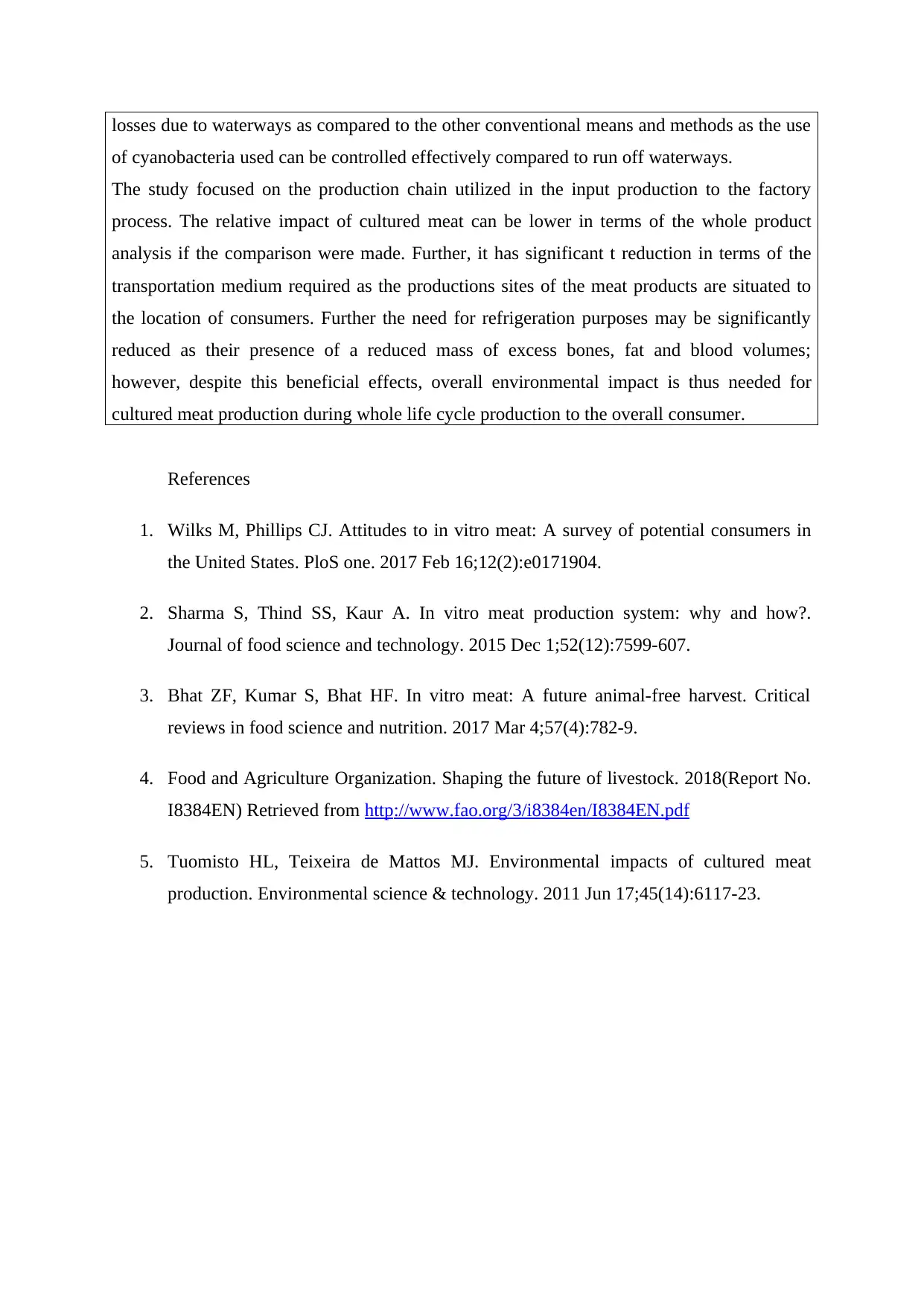
losses due to waterways as compared to the other conventional means and methods as the use
of cyanobacteria used can be controlled effectively compared to run off waterways.
The study focused on the production chain utilized in the input production to the factory
process. The relative impact of cultured meat can be lower in terms of the whole product
analysis if the comparison were made. Further, it has significant t reduction in terms of the
transportation medium required as the productions sites of the meat products are situated to
the location of consumers. Further the need for refrigeration purposes may be significantly
reduced as their presence of a reduced mass of excess bones, fat and blood volumes;
however, despite this beneficial effects, overall environmental impact is thus needed for
cultured meat production during whole life cycle production to the overall consumer.
References
1. Wilks M, Phillips CJ. Attitudes to in vitro meat: A survey of potential consumers in
the United States. PloS one. 2017 Feb 16;12(2):e0171904.
2. Sharma S, Thind SS, Kaur A. In vitro meat production system: why and how?.
Journal of food science and technology. 2015 Dec 1;52(12):7599-607.
3. Bhat ZF, Kumar S, Bhat HF. In vitro meat: A future animal-free harvest. Critical
reviews in food science and nutrition. 2017 Mar 4;57(4):782-9.
4. Food and Agriculture Organization. Shaping the future of livestock. 2018(Report No.
I8384EN) Retrieved from http://www.fao.org/3/i8384en/I8384EN.pdf
5. Tuomisto HL, Teixeira de Mattos MJ. Environmental impacts of cultured meat
production. Environmental science & technology. 2011 Jun 17;45(14):6117-23.
of cyanobacteria used can be controlled effectively compared to run off waterways.
The study focused on the production chain utilized in the input production to the factory
process. The relative impact of cultured meat can be lower in terms of the whole product
analysis if the comparison were made. Further, it has significant t reduction in terms of the
transportation medium required as the productions sites of the meat products are situated to
the location of consumers. Further the need for refrigeration purposes may be significantly
reduced as their presence of a reduced mass of excess bones, fat and blood volumes;
however, despite this beneficial effects, overall environmental impact is thus needed for
cultured meat production during whole life cycle production to the overall consumer.
References
1. Wilks M, Phillips CJ. Attitudes to in vitro meat: A survey of potential consumers in
the United States. PloS one. 2017 Feb 16;12(2):e0171904.
2. Sharma S, Thind SS, Kaur A. In vitro meat production system: why and how?.
Journal of food science and technology. 2015 Dec 1;52(12):7599-607.
3. Bhat ZF, Kumar S, Bhat HF. In vitro meat: A future animal-free harvest. Critical
reviews in food science and nutrition. 2017 Mar 4;57(4):782-9.
4. Food and Agriculture Organization. Shaping the future of livestock. 2018(Report No.
I8384EN) Retrieved from http://www.fao.org/3/i8384en/I8384EN.pdf
5. Tuomisto HL, Teixeira de Mattos MJ. Environmental impacts of cultured meat
production. Environmental science & technology. 2011 Jun 17;45(14):6117-23.
⊘ This is a preview!⊘
Do you want full access?
Subscribe today to unlock all pages.

Trusted by 1+ million students worldwide
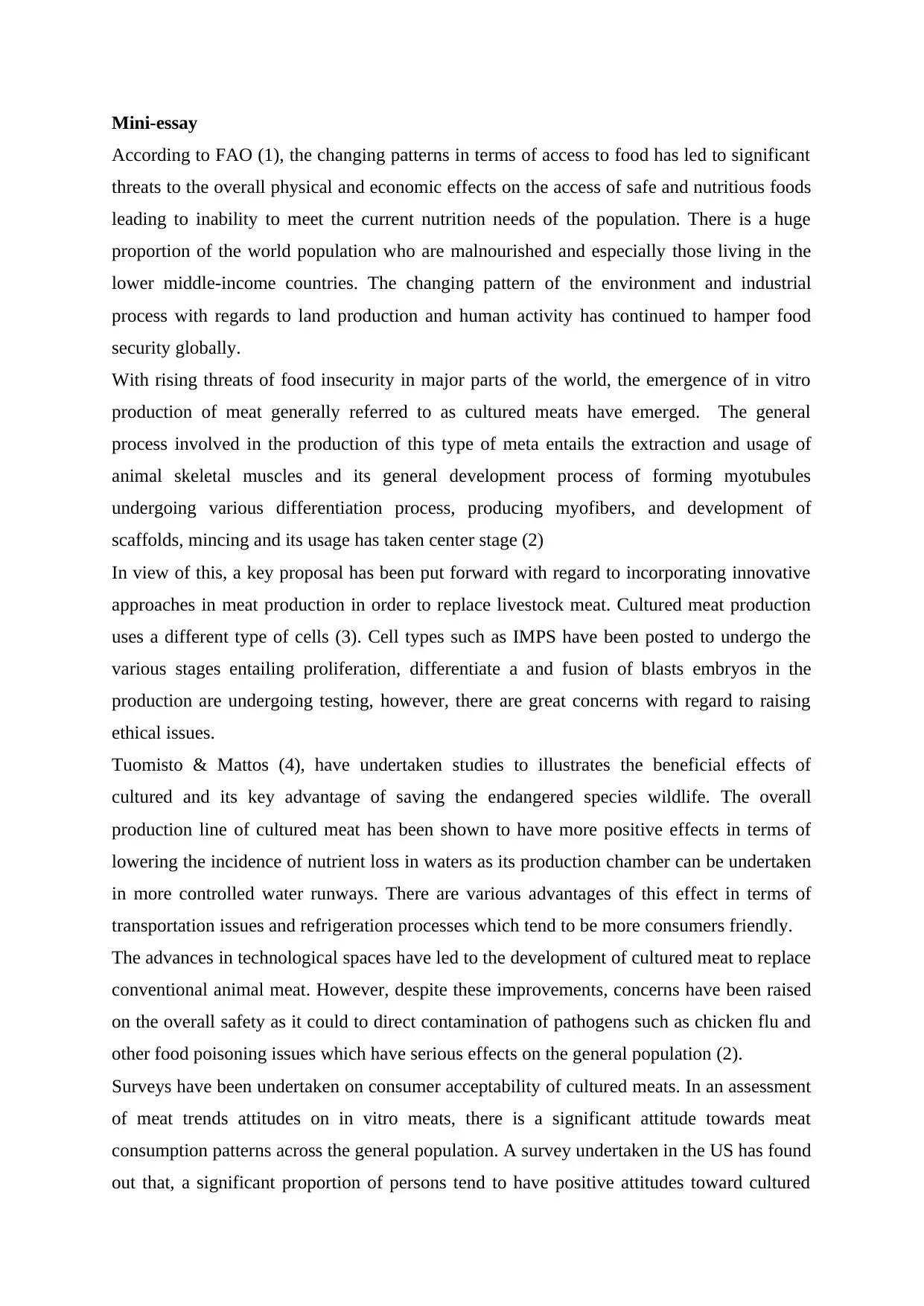
Mini-essay
According to FAO (1), the changing patterns in terms of access to food has led to significant
threats to the overall physical and economic effects on the access of safe and nutritious foods
leading to inability to meet the current nutrition needs of the population. There is a huge
proportion of the world population who are malnourished and especially those living in the
lower middle-income countries. The changing pattern of the environment and industrial
process with regards to land production and human activity has continued to hamper food
security globally.
With rising threats of food insecurity in major parts of the world, the emergence of in vitro
production of meat generally referred to as cultured meats have emerged. The general
process involved in the production of this type of meta entails the extraction and usage of
animal skeletal muscles and its general development process of forming myotubules
undergoing various differentiation process, producing myofibers, and development of
scaffolds, mincing and its usage has taken center stage (2)
In view of this, a key proposal has been put forward with regard to incorporating innovative
approaches in meat production in order to replace livestock meat. Cultured meat production
uses a different type of cells (3). Cell types such as IMPS have been posted to undergo the
various stages entailing proliferation, differentiate a and fusion of blasts embryos in the
production are undergoing testing, however, there are great concerns with regard to raising
ethical issues.
Tuomisto & Mattos (4), have undertaken studies to illustrates the beneficial effects of
cultured and its key advantage of saving the endangered species wildlife. The overall
production line of cultured meat has been shown to have more positive effects in terms of
lowering the incidence of nutrient loss in waters as its production chamber can be undertaken
in more controlled water runways. There are various advantages of this effect in terms of
transportation issues and refrigeration processes which tend to be more consumers friendly.
The advances in technological spaces have led to the development of cultured meat to replace
conventional animal meat. However, despite these improvements, concerns have been raised
on the overall safety as it could to direct contamination of pathogens such as chicken flu and
other food poisoning issues which have serious effects on the general population (2).
Surveys have been undertaken on consumer acceptability of cultured meats. In an assessment
of meat trends attitudes on in vitro meats, there is a significant attitude towards meat
consumption patterns across the general population. A survey undertaken in the US has found
out that, a significant proportion of persons tend to have positive attitudes toward cultured
According to FAO (1), the changing patterns in terms of access to food has led to significant
threats to the overall physical and economic effects on the access of safe and nutritious foods
leading to inability to meet the current nutrition needs of the population. There is a huge
proportion of the world population who are malnourished and especially those living in the
lower middle-income countries. The changing pattern of the environment and industrial
process with regards to land production and human activity has continued to hamper food
security globally.
With rising threats of food insecurity in major parts of the world, the emergence of in vitro
production of meat generally referred to as cultured meats have emerged. The general
process involved in the production of this type of meta entails the extraction and usage of
animal skeletal muscles and its general development process of forming myotubules
undergoing various differentiation process, producing myofibers, and development of
scaffolds, mincing and its usage has taken center stage (2)
In view of this, a key proposal has been put forward with regard to incorporating innovative
approaches in meat production in order to replace livestock meat. Cultured meat production
uses a different type of cells (3). Cell types such as IMPS have been posted to undergo the
various stages entailing proliferation, differentiate a and fusion of blasts embryos in the
production are undergoing testing, however, there are great concerns with regard to raising
ethical issues.
Tuomisto & Mattos (4), have undertaken studies to illustrates the beneficial effects of
cultured and its key advantage of saving the endangered species wildlife. The overall
production line of cultured meat has been shown to have more positive effects in terms of
lowering the incidence of nutrient loss in waters as its production chamber can be undertaken
in more controlled water runways. There are various advantages of this effect in terms of
transportation issues and refrigeration processes which tend to be more consumers friendly.
The advances in technological spaces have led to the development of cultured meat to replace
conventional animal meat. However, despite these improvements, concerns have been raised
on the overall safety as it could to direct contamination of pathogens such as chicken flu and
other food poisoning issues which have serious effects on the general population (2).
Surveys have been undertaken on consumer acceptability of cultured meats. In an assessment
of meat trends attitudes on in vitro meats, there is a significant attitude towards meat
consumption patterns across the general population. A survey undertaken in the US has found
out that, a significant proportion of persons tend to have positive attitudes toward cultured
Paraphrase This Document
Need a fresh take? Get an instant paraphrase of this document with our AI Paraphraser
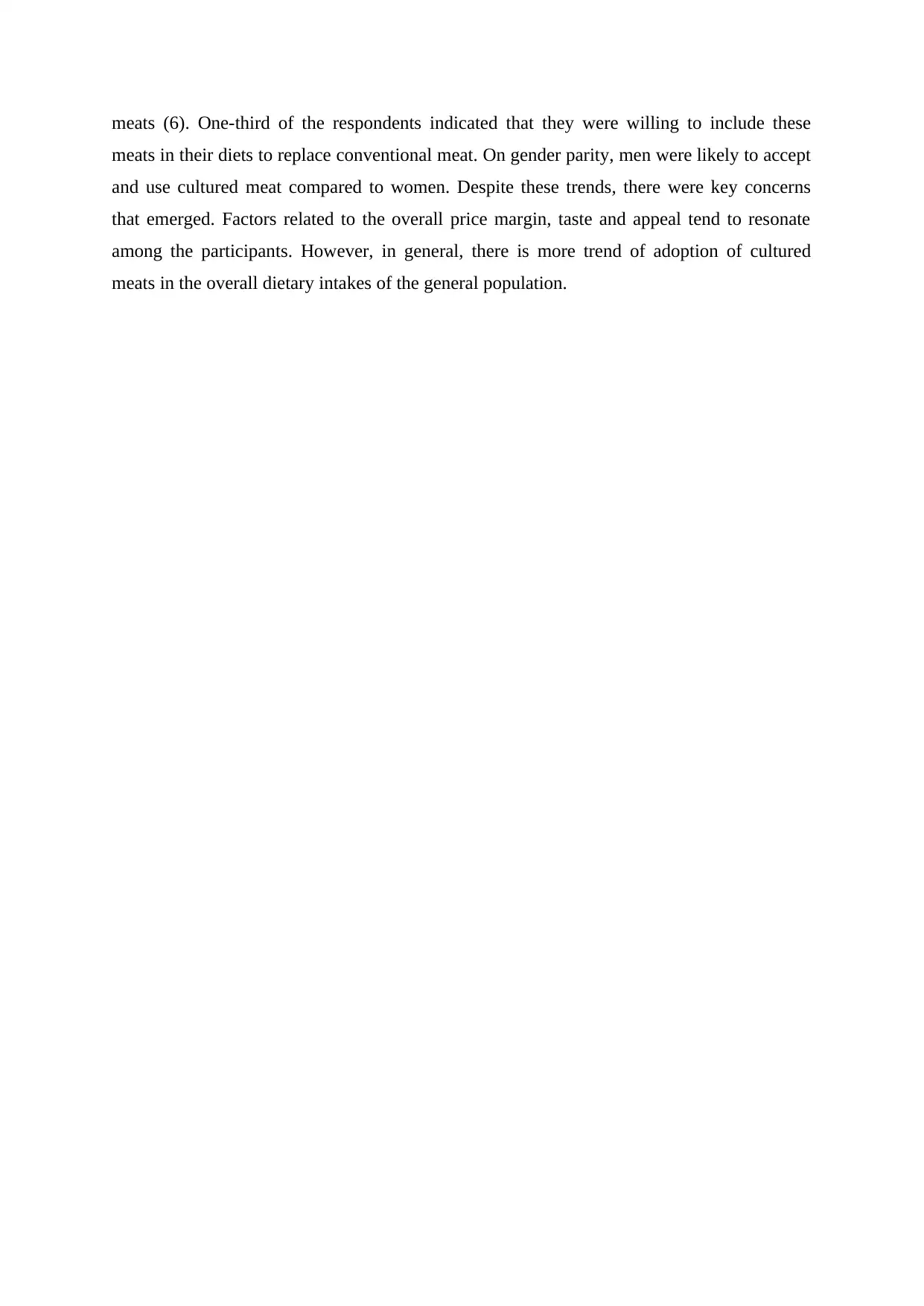
meats (6). One-third of the respondents indicated that they were willing to include these
meats in their diets to replace conventional meat. On gender parity, men were likely to accept
and use cultured meat compared to women. Despite these trends, there were key concerns
that emerged. Factors related to the overall price margin, taste and appeal tend to resonate
among the participants. However, in general, there is more trend of adoption of cultured
meats in the overall dietary intakes of the general population.
meats in their diets to replace conventional meat. On gender parity, men were likely to accept
and use cultured meat compared to women. Despite these trends, there were key concerns
that emerged. Factors related to the overall price margin, taste and appeal tend to resonate
among the participants. However, in general, there is more trend of adoption of cultured
meats in the overall dietary intakes of the general population.
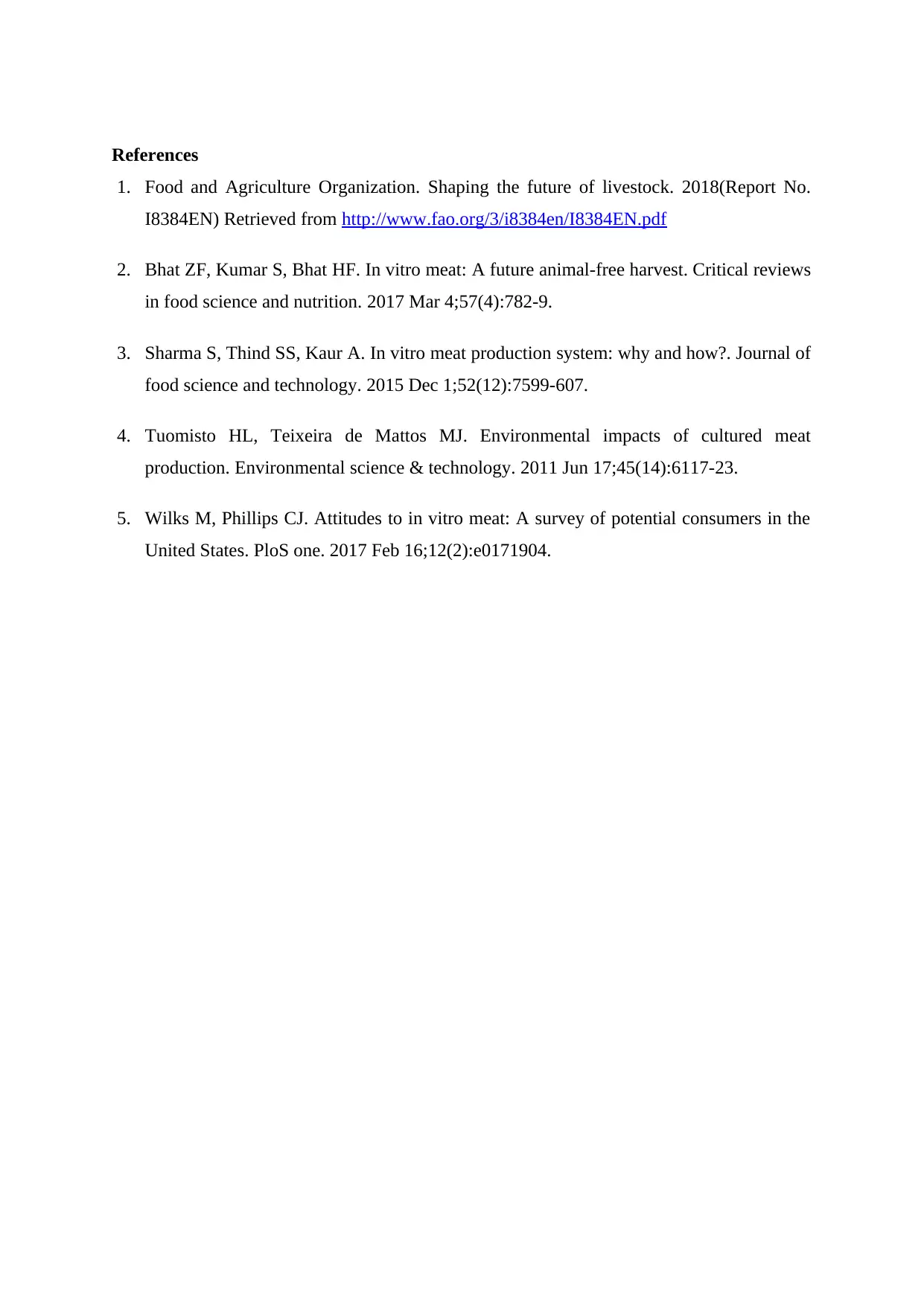
References
1. Food and Agriculture Organization. Shaping the future of livestock. 2018(Report No.
I8384EN) Retrieved from http://www.fao.org/3/i8384en/I8384EN.pdf
2. Bhat ZF, Kumar S, Bhat HF. In vitro meat: A future animal-free harvest. Critical reviews
in food science and nutrition. 2017 Mar 4;57(4):782-9.
3. Sharma S, Thind SS, Kaur A. In vitro meat production system: why and how?. Journal of
food science and technology. 2015 Dec 1;52(12):7599-607.
4. Tuomisto HL, Teixeira de Mattos MJ. Environmental impacts of cultured meat
production. Environmental science & technology. 2011 Jun 17;45(14):6117-23.
5. Wilks M, Phillips CJ. Attitudes to in vitro meat: A survey of potential consumers in the
United States. PloS one. 2017 Feb 16;12(2):e0171904.
1. Food and Agriculture Organization. Shaping the future of livestock. 2018(Report No.
I8384EN) Retrieved from http://www.fao.org/3/i8384en/I8384EN.pdf
2. Bhat ZF, Kumar S, Bhat HF. In vitro meat: A future animal-free harvest. Critical reviews
in food science and nutrition. 2017 Mar 4;57(4):782-9.
3. Sharma S, Thind SS, Kaur A. In vitro meat production system: why and how?. Journal of
food science and technology. 2015 Dec 1;52(12):7599-607.
4. Tuomisto HL, Teixeira de Mattos MJ. Environmental impacts of cultured meat
production. Environmental science & technology. 2011 Jun 17;45(14):6117-23.
5. Wilks M, Phillips CJ. Attitudes to in vitro meat: A survey of potential consumers in the
United States. PloS one. 2017 Feb 16;12(2):e0171904.
⊘ This is a preview!⊘
Do you want full access?
Subscribe today to unlock all pages.
Trusted by 1+ million students worldwide

1 out of 6


Your All-in-One AI-Powered Toolkit for Academic Success.
+13062052269
info@desklib.com
Available 24*7 on WhatsApp / Email
![[object Object]](/_next/static/media/star-bottom.7253800d.svg)
Unlock your academic potential
Copyright © 2020–2026 A2Z Services. All Rights Reserved. Developed and managed by ZUCOL.