Epidemiology of Alzheimer's Disease and Dementia in Australia: A Study
VerifiedAdded on 2023/06/10
|20
|4867
|342
Project
AI Summary
This project is a research proposal investigating the epidemiology of Alzheimer's disease and dementia in Australia, with a focus on the effects of inactivity as a risk factor. The study aims to determine the prevalence of the disease, establish the relationship between physical and mental inactivity and the development of Alzheimer's disease, and explore how changes in activity levels might impact the disease's progression. The research methodology includes a systematic review of peer-reviewed literature and a mini-review of hospital data, followed by a cross-sectional case study. The project outlines the aims, objectives, and hypotheses, along with a detailed literature review, methodology, data analysis plan, ethical considerations, and a timeline. The study anticipates providing valuable insights into the disease burden and potential preventative strategies for the Australian population, with the ultimate goal of informing health organizations and future research endeavors. The project highlights the increasing prevalence of Alzheimer's disease, especially in the aging population, and the need for further research to understand its causes and develop effective interventions.
Running head: ALZHEIMER’S DISEASE AND DEMENTIA 1
Epidemiology of Alzheimer’s disease and Dementia in Australia
Name:
Institutional Affiliation
Epidemiology of Alzheimer’s disease and Dementia in Australia
Name:
Institutional Affiliation

Paraphrase This Document
Need a fresh take? Get an instant paraphrase of this document with our AI Paraphraser
ALZHEIMER’S DISEASE AND DEMENTIA 2
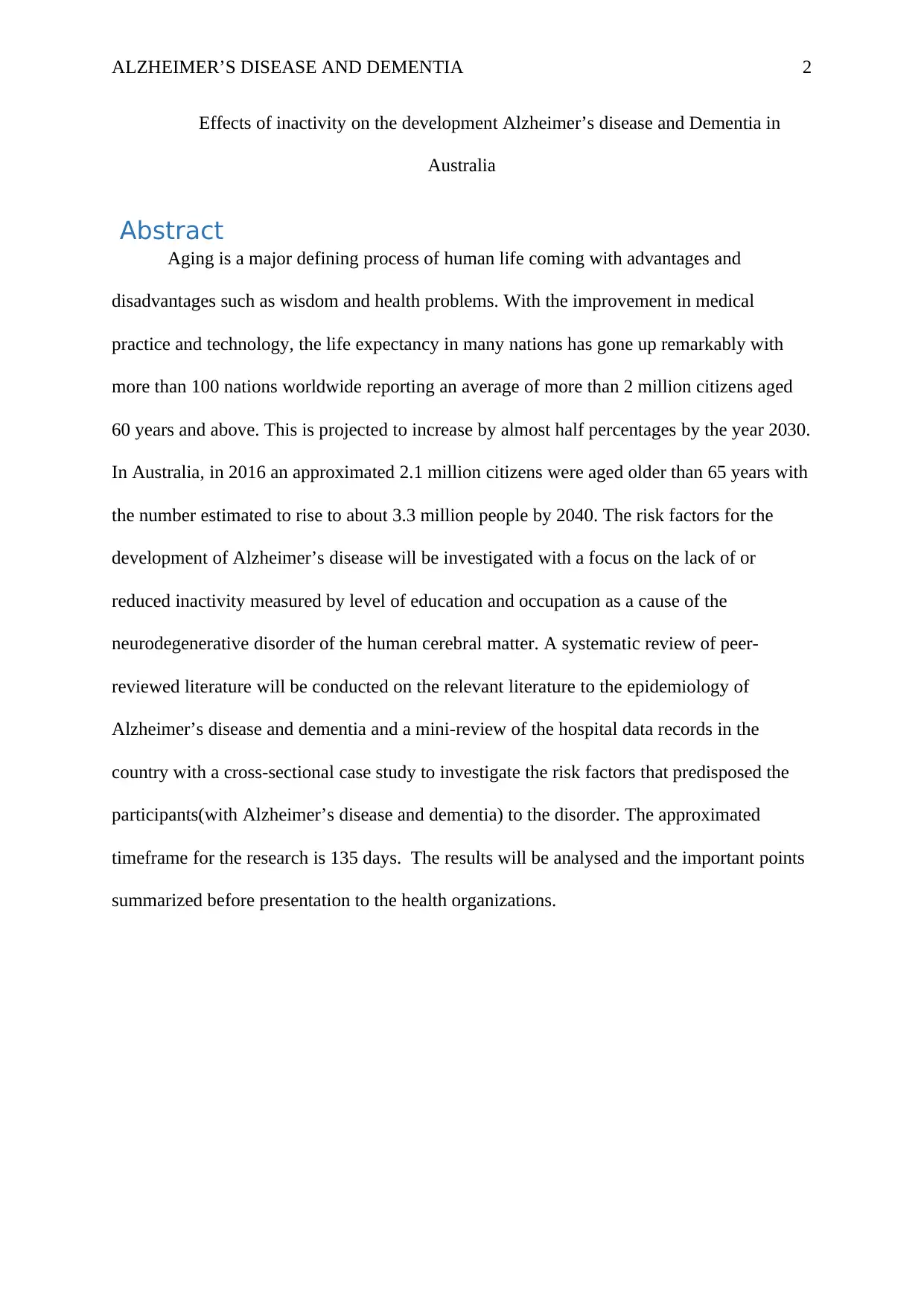
Effects of inactivity on the development Alzheimer’s disease and Dementia in
Australia
Abstract
Aging is a major defining process of human life coming with advantages and
disadvantages such as wisdom and health problems. With the improvement in medical
practice and technology, the life expectancy in many nations has gone up remarkably with
more than 100 nations worldwide reporting an average of more than 2 million citizens aged
60 years and above. This is projected to increase by almost half percentages by the year 2030.
In Australia, in 2016 an approximated 2.1 million citizens were aged older than 65 years with
the number estimated to rise to about 3.3 million people by 2040. The risk factors for the
development of Alzheimer’s disease will be investigated with a focus on the lack of or
reduced inactivity measured by level of education and occupation as a cause of the
neurodegenerative disorder of the human cerebral matter. A systematic review of peer-
reviewed literature will be conducted on the relevant literature to the epidemiology of
Alzheimer’s disease and dementia and a mini-review of the hospital data records in the
country with a cross-sectional case study to investigate the risk factors that predisposed the
participants(with Alzheimer’s disease and dementia) to the disorder. The approximated
timeframe for the research is 135 days. The results will be analysed and the important points
summarized before presentation to the health organizations.
Effects of inactivity on the development Alzheimer’s disease and Dementia in
Australia
Abstract
Aging is a major defining process of human life coming with advantages and
disadvantages such as wisdom and health problems. With the improvement in medical
practice and technology, the life expectancy in many nations has gone up remarkably with
more than 100 nations worldwide reporting an average of more than 2 million citizens aged
60 years and above. This is projected to increase by almost half percentages by the year 2030.
In Australia, in 2016 an approximated 2.1 million citizens were aged older than 65 years with
the number estimated to rise to about 3.3 million people by 2040. The risk factors for the
development of Alzheimer’s disease will be investigated with a focus on the lack of or
reduced inactivity measured by level of education and occupation as a cause of the
neurodegenerative disorder of the human cerebral matter. A systematic review of peer-
reviewed literature will be conducted on the relevant literature to the epidemiology of
Alzheimer’s disease and dementia and a mini-review of the hospital data records in the
country with a cross-sectional case study to investigate the risk factors that predisposed the
participants(with Alzheimer’s disease and dementia) to the disorder. The approximated
timeframe for the research is 135 days. The results will be analysed and the important points
summarized before presentation to the health organizations.
ALZHEIMER’S DISEASE AND DEMENTIA 3
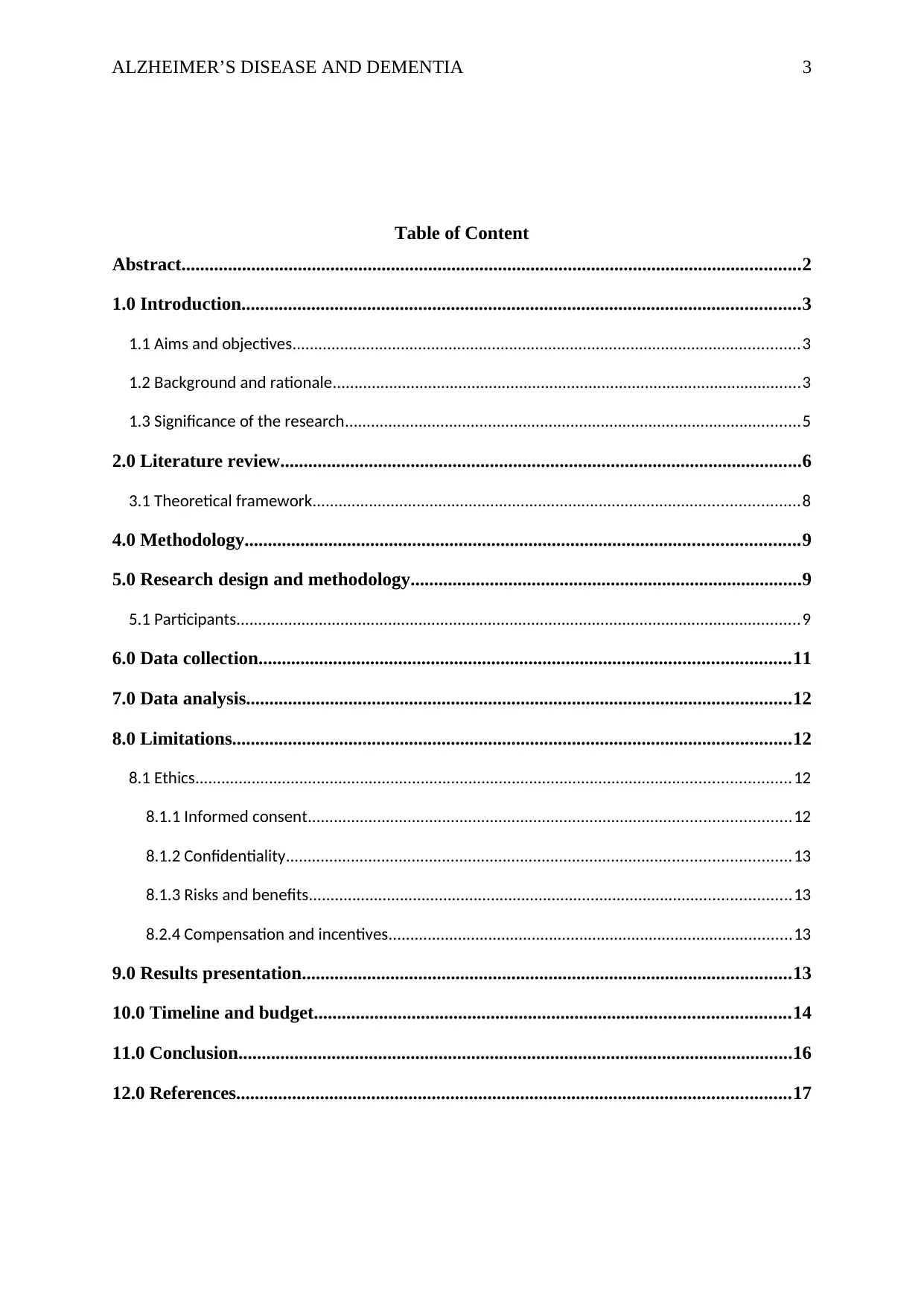
Table of Content
Abstract.....................................................................................................................................2
1.0 Introduction........................................................................................................................3
1.1 Aims and objectives.....................................................................................................................3
1.2 Background and rationale............................................................................................................3
1.3 Significance of the research.........................................................................................................5
2.0 Literature review................................................................................................................6
3.1 Theoretical framework................................................................................................................8
4.0 Methodology.......................................................................................................................9
5.0 Research design and methodology....................................................................................9
5.1 Participants..................................................................................................................................9
6.0 Data collection..................................................................................................................11
7.0 Data analysis.....................................................................................................................12
8.0 Limitations........................................................................................................................12
8.1 Ethics.........................................................................................................................................12
8.1.1 Informed consent...............................................................................................................12
8.1.2 Confidentiality....................................................................................................................13
8.1.3 Risks and benefits...............................................................................................................13
8.2.4 Compensation and incentives.............................................................................................13
9.0 Results presentation.........................................................................................................13
10.0 Timeline and budget......................................................................................................14
11.0 Conclusion.......................................................................................................................16
12.0 References.......................................................................................................................17
Table of Content
Abstract.....................................................................................................................................2
1.0 Introduction........................................................................................................................3
1.1 Aims and objectives.....................................................................................................................3
1.2 Background and rationale............................................................................................................3
1.3 Significance of the research.........................................................................................................5
2.0 Literature review................................................................................................................6
3.1 Theoretical framework................................................................................................................8
4.0 Methodology.......................................................................................................................9
5.0 Research design and methodology....................................................................................9
5.1 Participants..................................................................................................................................9
6.0 Data collection..................................................................................................................11
7.0 Data analysis.....................................................................................................................12
8.0 Limitations........................................................................................................................12
8.1 Ethics.........................................................................................................................................12
8.1.1 Informed consent...............................................................................................................12
8.1.2 Confidentiality....................................................................................................................13
8.1.3 Risks and benefits...............................................................................................................13
8.2.4 Compensation and incentives.............................................................................................13
9.0 Results presentation.........................................................................................................13
10.0 Timeline and budget......................................................................................................14
11.0 Conclusion.......................................................................................................................16
12.0 References.......................................................................................................................17
⊘ This is a preview!⊘
Do you want full access?
Subscribe today to unlock all pages.

Trusted by 1+ million students worldwide
ALZHEIMER’S DISEASE AND DEMENTIA 4
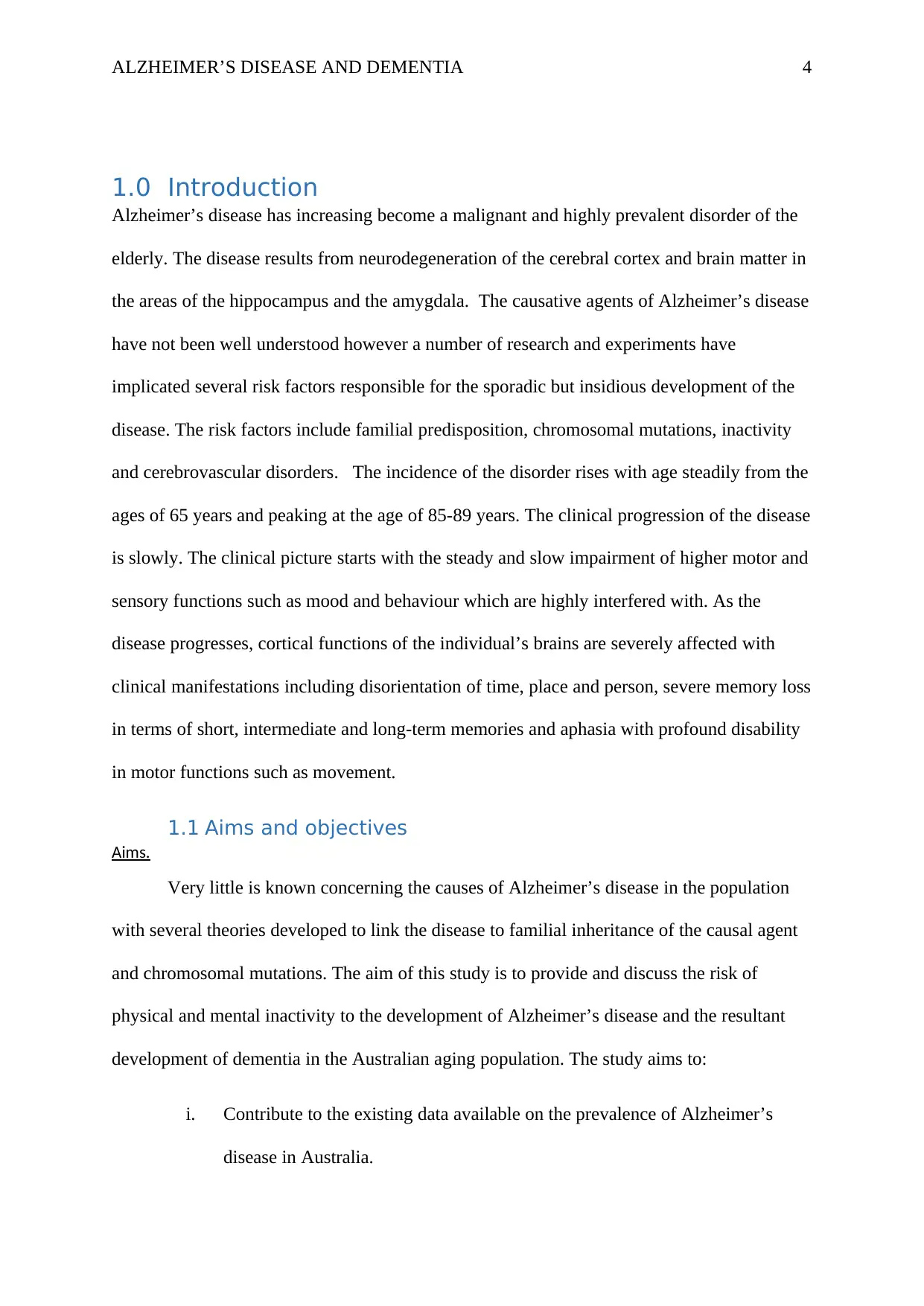
1.0 Introduction
Alzheimer’s disease has increasing become a malignant and highly prevalent disorder of the
elderly. The disease results from neurodegeneration of the cerebral cortex and brain matter in
the areas of the hippocampus and the amygdala. The causative agents of Alzheimer’s disease
have not been well understood however a number of research and experiments have
implicated several risk factors responsible for the sporadic but insidious development of the
disease. The risk factors include familial predisposition, chromosomal mutations, inactivity
and cerebrovascular disorders. The incidence of the disorder rises with age steadily from the
ages of 65 years and peaking at the age of 85-89 years. The clinical progression of the disease
is slowly. The clinical picture starts with the steady and slow impairment of higher motor and
sensory functions such as mood and behaviour which are highly interfered with. As the
disease progresses, cortical functions of the individual’s brains are severely affected with
clinical manifestations including disorientation of time, place and person, severe memory loss
in terms of short, intermediate and long-term memories and aphasia with profound disability
in motor functions such as movement.
1.1 Aims and objectives
Aims.
Very little is known concerning the causes of Alzheimer’s disease in the population
with several theories developed to link the disease to familial inheritance of the causal agent
and chromosomal mutations. The aim of this study is to provide and discuss the risk of
physical and mental inactivity to the development of Alzheimer’s disease and the resultant
development of dementia in the Australian aging population. The study aims to:
i. Contribute to the existing data available on the prevalence of Alzheimer’s
disease in Australia.
1.0 Introduction
Alzheimer’s disease has increasing become a malignant and highly prevalent disorder of the
elderly. The disease results from neurodegeneration of the cerebral cortex and brain matter in
the areas of the hippocampus and the amygdala. The causative agents of Alzheimer’s disease
have not been well understood however a number of research and experiments have
implicated several risk factors responsible for the sporadic but insidious development of the
disease. The risk factors include familial predisposition, chromosomal mutations, inactivity
and cerebrovascular disorders. The incidence of the disorder rises with age steadily from the
ages of 65 years and peaking at the age of 85-89 years. The clinical progression of the disease
is slowly. The clinical picture starts with the steady and slow impairment of higher motor and
sensory functions such as mood and behaviour which are highly interfered with. As the
disease progresses, cortical functions of the individual’s brains are severely affected with
clinical manifestations including disorientation of time, place and person, severe memory loss
in terms of short, intermediate and long-term memories and aphasia with profound disability
in motor functions such as movement.
1.1 Aims and objectives
Aims.
Very little is known concerning the causes of Alzheimer’s disease in the population
with several theories developed to link the disease to familial inheritance of the causal agent
and chromosomal mutations. The aim of this study is to provide and discuss the risk of
physical and mental inactivity to the development of Alzheimer’s disease and the resultant
development of dementia in the Australian aging population. The study aims to:
i. Contribute to the existing data available on the prevalence of Alzheimer’s
disease in Australia.
Paraphrase This Document
Need a fresh take? Get an instant paraphrase of this document with our AI Paraphraser
ALZHEIMER’S DISEASE AND DEMENTIA 5
ii. Establish the relationship between physical and mental inactivity and the
development of Alzheimer’s disease.
iii. Establish how changing in the levels of inactivity will reduce the progress or
delay the sporadic onset of Alzheimer’s disease in the population with the
disorder or additional risk factors such as a positive family history of the
disease.
The specific objectives of the study are:
1) To determine the prevalence of Alzheimer’s disease in the Australian population.
2) To investigate the association between mental and physical inactivity to the sporadic
development of AD in an individual with a positive family history of the disorder or
Down’s syndrome.
3) To find out the changes in diagnosis, onset and progression of Alzheimer’s disease in
an individual with remarkable risk factors.
Hypothesis.
Hypothetically, this case study is to define and discuss the association between physical and
mental inactivity to the development of Alzheimer’s disease.
Hypothesis 1. Lower levels of activity and immobility is associated with an earlier age of
onset for Alzheimer’s disease.
Hypothesis 2. Lower levels of mental activity such as educational achievements positively
relate to the early diagnosis, development and progression of Alzheimer’s disease.
Hypothesis 3. Higher levels of mental and physical activity does not alter the age of onset of
Alzheimer’s disease but only delay the diagnosis.
ii. Establish the relationship between physical and mental inactivity and the
development of Alzheimer’s disease.
iii. Establish how changing in the levels of inactivity will reduce the progress or
delay the sporadic onset of Alzheimer’s disease in the population with the
disorder or additional risk factors such as a positive family history of the
disease.
The specific objectives of the study are:
1) To determine the prevalence of Alzheimer’s disease in the Australian population.
2) To investigate the association between mental and physical inactivity to the sporadic
development of AD in an individual with a positive family history of the disorder or
Down’s syndrome.
3) To find out the changes in diagnosis, onset and progression of Alzheimer’s disease in
an individual with remarkable risk factors.
Hypothesis.
Hypothetically, this case study is to define and discuss the association between physical and
mental inactivity to the development of Alzheimer’s disease.
Hypothesis 1. Lower levels of activity and immobility is associated with an earlier age of
onset for Alzheimer’s disease.
Hypothesis 2. Lower levels of mental activity such as educational achievements positively
relate to the early diagnosis, development and progression of Alzheimer’s disease.
Hypothesis 3. Higher levels of mental and physical activity does not alter the age of onset of
Alzheimer’s disease but only delay the diagnosis.
ALZHEIMER’S DISEASE AND DEMENTIA 6
1.2 Background and rationale
Alzheimer’s disease is a disorder of the human brain that is characterized by
neurodegeneration of the brain matter resulting in impaired cognitive and behavioural
functions that was first described by Alois Alzheimer, 1906. The impairment therefore
severely interferes with the social, economic and occupational life of the affected individuals
resulting in a high cost of management and patient care. Alzheimer’s disease is a chronic
condition that is not transmissible from person to person. The curative mechanisms of the
disease are not yet developed and therefore Alzheimer’s disease is incurable. As chronic as
AD is, it takes a long preclinical duration of time and progresses over time until death
ensures.
There is no well understood d causative agents of Alzheimer’s disease. However,
genetic composition of the affected individuals has been implicated to try and explain the
pathogenesis of the disorder. In the elderly, Alzheimer’s disease is the primarily the cause of
dementia. Dementia is defined as a broad category of brain disorders that result in the
reduction in the ability to think and remember information hence a poor quality of life with
affected functioning of routine activities. In this instance therefore, Alzheimer’s disease and
dementia will be investigated together as a single entity in this research proposal.
Clinical studies such as medical imaging using magnetic resonance images, the
affected brain is found to have atrophied in the cortical regions with very wide sulci and
enlargement of the ventricles. Structures in the midbrain such as the hippocampus and
amygdala arte involved in the neurodegeneration early in the disease and thus are severely
affected as the disease progresses. Histologically, neuritic plaques of amyloid peptides are
deposited in the cortical matter of the brain resulting in diffuse neurofibrillary tangles that
1.2 Background and rationale
Alzheimer’s disease is a disorder of the human brain that is characterized by
neurodegeneration of the brain matter resulting in impaired cognitive and behavioural
functions that was first described by Alois Alzheimer, 1906. The impairment therefore
severely interferes with the social, economic and occupational life of the affected individuals
resulting in a high cost of management and patient care. Alzheimer’s disease is a chronic
condition that is not transmissible from person to person. The curative mechanisms of the
disease are not yet developed and therefore Alzheimer’s disease is incurable. As chronic as
AD is, it takes a long preclinical duration of time and progresses over time until death
ensures.
There is no well understood d causative agents of Alzheimer’s disease. However,
genetic composition of the affected individuals has been implicated to try and explain the
pathogenesis of the disorder. In the elderly, Alzheimer’s disease is the primarily the cause of
dementia. Dementia is defined as a broad category of brain disorders that result in the
reduction in the ability to think and remember information hence a poor quality of life with
affected functioning of routine activities. In this instance therefore, Alzheimer’s disease and
dementia will be investigated together as a single entity in this research proposal.
Clinical studies such as medical imaging using magnetic resonance images, the
affected brain is found to have atrophied in the cortical regions with very wide sulci and
enlargement of the ventricles. Structures in the midbrain such as the hippocampus and
amygdala arte involved in the neurodegeneration early in the disease and thus are severely
affected as the disease progresses. Histologically, neuritic plaques of amyloid peptides are
deposited in the cortical matter of the brain resulting in diffuse neurofibrillary tangles that
⊘ This is a preview!⊘
Do you want full access?
Subscribe today to unlock all pages.
Trusted by 1+ million students worldwide
ALZHEIMER’S DISEASE AND DEMENTIA 7
progresses severely resulting with reactive gliosis and neuronal loss as the ultimate
complications hence dementia.
Alzheimer’s disease and dementia rarely presents in individuals younger than 50
years of age. The incidence of the disorder rises with age steadily from the ages of 65 years
and peaking at the age of 85-89 years. The clinical progression of the disease is slowly. The
clinical picture starts with the steady and slow impairment of higher motor and sensory
functions such as mood and behaviour which are highly interfered with. As the disease
progresses, cortical functions of the individual’s brains are severely affected with clinical
manifestations including disorientation of time, place and person, severe memory loss in
terms of short, intermediate and long-term memories and aphasia with profound disability in
motor functions such as movement. Ultimately, as the disease progression severely affects the
patient with peak neurodegeneration and accumulation of the amyloid peptides, the individual
becomes totally disabled, dyskinesia sets in and mute depending 100% on their caregivers for
thus increasing the socioeconomic, medical and financial problems on the family, friends and
the nation.
Alzheimer’s disease is majorly sporadic with a smaller fraction of the affected
individuals showing a positive familial inheritance model. No treatments modality and
regimes has been developed to cure, prevent or reverse the progression of Alzheimer’s
disease and dementia. However, some drugs are used to relieve the symptoms by increasing
the quantity of neuropeptide transmitters in the brain. As of 2015, there were 29.8 million
reported and documented cases of Alzheimer’s disease with a mortality number recorded at
1.9 million (Lancet, 2016).
1.3 Significance of the research
This research will provide great impact to the department of health, hospitals and medical
schools with the latest information on the epidemiology of Alzheimer’s disease and its
progresses severely resulting with reactive gliosis and neuronal loss as the ultimate
complications hence dementia.
Alzheimer’s disease and dementia rarely presents in individuals younger than 50
years of age. The incidence of the disorder rises with age steadily from the ages of 65 years
and peaking at the age of 85-89 years. The clinical progression of the disease is slowly. The
clinical picture starts with the steady and slow impairment of higher motor and sensory
functions such as mood and behaviour which are highly interfered with. As the disease
progresses, cortical functions of the individual’s brains are severely affected with clinical
manifestations including disorientation of time, place and person, severe memory loss in
terms of short, intermediate and long-term memories and aphasia with profound disability in
motor functions such as movement. Ultimately, as the disease progression severely affects the
patient with peak neurodegeneration and accumulation of the amyloid peptides, the individual
becomes totally disabled, dyskinesia sets in and mute depending 100% on their caregivers for
thus increasing the socioeconomic, medical and financial problems on the family, friends and
the nation.
Alzheimer’s disease is majorly sporadic with a smaller fraction of the affected
individuals showing a positive familial inheritance model. No treatments modality and
regimes has been developed to cure, prevent or reverse the progression of Alzheimer’s
disease and dementia. However, some drugs are used to relieve the symptoms by increasing
the quantity of neuropeptide transmitters in the brain. As of 2015, there were 29.8 million
reported and documented cases of Alzheimer’s disease with a mortality number recorded at
1.9 million (Lancet, 2016).
1.3 Significance of the research
This research will provide great impact to the department of health, hospitals and medical
schools with the latest information on the epidemiology of Alzheimer’s disease and its
Paraphrase This Document
Need a fresh take? Get an instant paraphrase of this document with our AI Paraphraser
ALZHEIMER’S DISEASE AND DEMENTIA 8
complication of dementia. From the report, the Australian population will understand the
disease burden provided by the AD and dementia. Thus, will be able to develop strategies and
interventions that would be effective in the prevention of the Alzheimer’s disease and reduce
the disease effects in the society. Finally, the research will create a foundation for the future
researcher to conduct research in the Australian population by providing the basic
information as a literature publication.
2.0 Literature review
Alzheimer’s disease and dementia rarely presents in individuals younger than 50 years of age.
The incidence of the disorder rises with age steadily from the ages of 65 years and peaking at
the age of 85-89 years. The clinical progression of the disease is slowly. The clinical picture
starts with the steady and slow impairment of higher motor and sensory functions such as
mood and behaviour which are highly interfered with. As the disease progresses, cortical
functions of the individual’s brains are severely affected with clinical manifestations
including disorientation of time, place and person, severe memory loss in terms of short,
intermediate and long-term memories and aphasia with profound disability in motor functions
such as movement. Ultimately, as the disease progression severely affects the patient with
peak neurodegeneration and accumulation of the amyloid peptides, the individual becomes
totally disabled, dyskinesia sets in and mute depending 100% on their caregivers for thus
increasing the socioeconomic, medical and financial problems on the family, friends and the
nation (Robin &Cotlan 2001.)
In the study by Ana Luisa, 2012, a mini-systematic review concluded that the
epidemiological data on Alzheimer’s disease and dementia is so large to warrant the
intervention of dementia as a national and worldwide health problem. Since the recent
researches, meta-analyses and peer-reviewed literatures have failed to identify the cause or
strategies and interventions for the prevention of AD, the age-related heterogeneous disorder
complication of dementia. From the report, the Australian population will understand the
disease burden provided by the AD and dementia. Thus, will be able to develop strategies and
interventions that would be effective in the prevention of the Alzheimer’s disease and reduce
the disease effects in the society. Finally, the research will create a foundation for the future
researcher to conduct research in the Australian population by providing the basic
information as a literature publication.
2.0 Literature review
Alzheimer’s disease and dementia rarely presents in individuals younger than 50 years of age.
The incidence of the disorder rises with age steadily from the ages of 65 years and peaking at
the age of 85-89 years. The clinical progression of the disease is slowly. The clinical picture
starts with the steady and slow impairment of higher motor and sensory functions such as
mood and behaviour which are highly interfered with. As the disease progresses, cortical
functions of the individual’s brains are severely affected with clinical manifestations
including disorientation of time, place and person, severe memory loss in terms of short,
intermediate and long-term memories and aphasia with profound disability in motor functions
such as movement. Ultimately, as the disease progression severely affects the patient with
peak neurodegeneration and accumulation of the amyloid peptides, the individual becomes
totally disabled, dyskinesia sets in and mute depending 100% on their caregivers for thus
increasing the socioeconomic, medical and financial problems on the family, friends and the
nation (Robin &Cotlan 2001.)
In the study by Ana Luisa, 2012, a mini-systematic review concluded that the
epidemiological data on Alzheimer’s disease and dementia is so large to warrant the
intervention of dementia as a national and worldwide health problem. Since the recent
researches, meta-analyses and peer-reviewed literatures have failed to identify the cause or
strategies and interventions for the prevention of AD, the age-related heterogeneous disorder
ALZHEIMER’S DISEASE AND DEMENTIA 9
should be considered a public health priority to reduce the projected large incidence rate by
the year 2030.
Focusing on the developing world, Kalaria et al, 2008 conducted studies to determine
the disease burden of Alzheimer’s disease and dementia in Latin America, Asia and Africa.
In the research, the authors identified the risk factors to development of AD and determined
the mortality incidences due to Alzheimer’s disease and dementia within the population.
Despite a high mortality and morbidity rate due to infective diseases, poverty and conflicts,
the article discusses the remarkable impacts of AD on the mortality rates in the developing
countries and how the values are projected to increase globally affecting both developed and
developing countries due to either sporadic or familial Alzheimer’s disease and dementia.
A systemic review and metaanalysis on the on the prevalence of Alzheimer’s disease
and dementia with a peer review of global literatures on dementia focusing on publications
from the year 1980 to 2009. The prevalence of dementia, primarily depended on the diagnosis
of Alzheimer’s disease is substantially similar across the globe with a convergence on the
ages above 65 years, Prince et al, 2012. With the better healthcare provided globally, the
prevalence was estimated to rise by a double figure by the year 2020 which will require the
different countries structure an Alzheimer’s survey regularly with research on progression
prevention and cure.
With a looming epidemic of Alzheimer’s disease and dementia on the globe due to the
aging of the world population, therapeutic and preventive measures effective for the delay
and progression of the disorder should be addressed. This is because the disease burden of
AD is estimated to grow rapidly by the year 2050 to an estimated 84 million affected elderly
patients (Brookmeyer et al, 2007)
should be considered a public health priority to reduce the projected large incidence rate by
the year 2030.
Focusing on the developing world, Kalaria et al, 2008 conducted studies to determine
the disease burden of Alzheimer’s disease and dementia in Latin America, Asia and Africa.
In the research, the authors identified the risk factors to development of AD and determined
the mortality incidences due to Alzheimer’s disease and dementia within the population.
Despite a high mortality and morbidity rate due to infective diseases, poverty and conflicts,
the article discusses the remarkable impacts of AD on the mortality rates in the developing
countries and how the values are projected to increase globally affecting both developed and
developing countries due to either sporadic or familial Alzheimer’s disease and dementia.
A systemic review and metaanalysis on the on the prevalence of Alzheimer’s disease
and dementia with a peer review of global literatures on dementia focusing on publications
from the year 1980 to 2009. The prevalence of dementia, primarily depended on the diagnosis
of Alzheimer’s disease is substantially similar across the globe with a convergence on the
ages above 65 years, Prince et al, 2012. With the better healthcare provided globally, the
prevalence was estimated to rise by a double figure by the year 2020 which will require the
different countries structure an Alzheimer’s survey regularly with research on progression
prevention and cure.
With a looming epidemic of Alzheimer’s disease and dementia on the globe due to the
aging of the world population, therapeutic and preventive measures effective for the delay
and progression of the disorder should be addressed. This is because the disease burden of
AD is estimated to grow rapidly by the year 2050 to an estimated 84 million affected elderly
patients (Brookmeyer et al, 2007)
⊘ This is a preview!⊘
Do you want full access?
Subscribe today to unlock all pages.
Trusted by 1+ million students worldwide
ALZHEIMER’S DISEASE AND DEMENTIA 10
In the Australian population, studies conducted using the case control methodology,
clinically diagnosed and reported cases of Alzheimer’s disease and dementia between the
ages of 52-96 were interviewed to determine the risk factors associated with the development
of the disorder. The article discusses four risk factors involved in the development of AD as a
previous history of dementia, previous diagnosis of AD, chromosomal mutations resulting in
Down’s syndrome in the family and a previous history of underactivity in academic and
occupational life (Broe et al, 1990).
This study therefore seeks to determine and estimate the prevalence and epidemiology
data on Alzheimer’s disease and dementia in Australia. Defined as a public health priority
and one of the non-communicable disease burdens globally, the research focuses will focus
on the link between the levels of activity and the development, progression and diagnosis of
Alzheimer’s disease. As a public health benefit, this study will help address design the
structure and interventions effective in the prevention of the effects of AD while also give
room and foundation for more researches on the prevention and cure Alzheimer’s disease
before progression to dementia and death.
3.1 Theoretical framework
Australia being a developed country with a large elderly population, the prevalence and
incidence rates of Alzheimer’s disease and dementia are high and therefore pose a huge
burden on the Australian public health agency to prevent and reduce the impacts on the
economy and social aspects of the nation. Drawing insights from previous literature, the risks
factors for developing AD are majorly the age factor, occupational and academic inactivity,
familial inheritance and chromosomal mutations associated with Down’s syndrome (Broe et
al, 1990).
4.0 RESEARCH PLAN.
Considering previous literature, this study will be conducted in two phases:
In the Australian population, studies conducted using the case control methodology,
clinically diagnosed and reported cases of Alzheimer’s disease and dementia between the
ages of 52-96 were interviewed to determine the risk factors associated with the development
of the disorder. The article discusses four risk factors involved in the development of AD as a
previous history of dementia, previous diagnosis of AD, chromosomal mutations resulting in
Down’s syndrome in the family and a previous history of underactivity in academic and
occupational life (Broe et al, 1990).
This study therefore seeks to determine and estimate the prevalence and epidemiology
data on Alzheimer’s disease and dementia in Australia. Defined as a public health priority
and one of the non-communicable disease burdens globally, the research focuses will focus
on the link between the levels of activity and the development, progression and diagnosis of
Alzheimer’s disease. As a public health benefit, this study will help address design the
structure and interventions effective in the prevention of the effects of AD while also give
room and foundation for more researches on the prevention and cure Alzheimer’s disease
before progression to dementia and death.
3.1 Theoretical framework
Australia being a developed country with a large elderly population, the prevalence and
incidence rates of Alzheimer’s disease and dementia are high and therefore pose a huge
burden on the Australian public health agency to prevent and reduce the impacts on the
economy and social aspects of the nation. Drawing insights from previous literature, the risks
factors for developing AD are majorly the age factor, occupational and academic inactivity,
familial inheritance and chromosomal mutations associated with Down’s syndrome (Broe et
al, 1990).
4.0 RESEARCH PLAN.
Considering previous literature, this study will be conducted in two phases:
Paraphrase This Document
Need a fresh take? Get an instant paraphrase of this document with our AI Paraphraser
ALZHEIMER’S DISEASE AND DEMENTIA 11
Phase one of the field study to determine and estimate the prevalence and incidence
rates of Alzheimer’s disease and dementia in the Australian population. Additionally, to
define the distribution and prognosis of AD in the population. The following methods of data
collection will be utilized in this phase, interviews, hospital records access, questionnaires
and participatory observation in obtaining data from eight public Australian hospitals in the
states.
Phase two of the study will focus on the selected participants in the study identified
randomly from the patients diagnosed with Alzheimer’s disease and under management to
identify the risk factors in their past medical and social history and the effects of the disease
on the family social and financial aspects.
5.0 STUDY DESIGN AND METHODOLOGY
5.1 Participants
The study will be conducted in Australia. The research participants will be selected to fulfil
the methodology criteria in two phases.
In phase 1, a stratified random sampling method will be used to determine the
hospitals to be used in the data collection and analysis process. The characters of the hospitals
to be identified are;
A hospital from either one of the eight states.
A public hospital.
Hospital is a teaching and referral hospital.
From the sampling, the following hospitals were identified:
Austin hospital
St. George hospital
Phase one of the field study to determine and estimate the prevalence and incidence
rates of Alzheimer’s disease and dementia in the Australian population. Additionally, to
define the distribution and prognosis of AD in the population. The following methods of data
collection will be utilized in this phase, interviews, hospital records access, questionnaires
and participatory observation in obtaining data from eight public Australian hospitals in the
states.
Phase two of the study will focus on the selected participants in the study identified
randomly from the patients diagnosed with Alzheimer’s disease and under management to
identify the risk factors in their past medical and social history and the effects of the disease
on the family social and financial aspects.
5.0 STUDY DESIGN AND METHODOLOGY
5.1 Participants
The study will be conducted in Australia. The research participants will be selected to fulfil
the methodology criteria in two phases.
In phase 1, a stratified random sampling method will be used to determine the
hospitals to be used in the data collection and analysis process. The characters of the hospitals
to be identified are;
A hospital from either one of the eight states.
A public hospital.
Hospital is a teaching and referral hospital.
From the sampling, the following hospitals were identified:
Austin hospital
St. George hospital
ALZHEIMER’S DISEASE AND DEMENTIA 12
Queen Elizabeth hospital.
Calvary John James hospital
Frankston hospital
Launceston hospital
Fiona Stanley hospital
Gold Coast University Hospital.
In phase 2, a Quota sampling methods will be used to identify the patients to
participate in the research. The sample population is characterized basing on:
At least 2 years of medication after a diagnosis of AD was made.
Either male or female.
Married with a family, for follow up on development of AD, a clinical
trial.
On medication, at least for 6 months.
With a positive family history of Alzheimer’s disease or Down’s
syndrome.
A sample size of 144 patients will be used in the research. The patient’s family will be
interviewed in the research, especially the caregivers.
6.0 Data collection
The process of data collection will be carried using the following methods:
In-depth interviews: the participants will be asked questions and allowed to freely air
their views about the structured subtopics relating to Alzheimer’s disease and dementia.
Those interviewed will be medical professionals, patients still well oriented, patients’
caregivers and other family members.
Queen Elizabeth hospital.
Calvary John James hospital
Frankston hospital
Launceston hospital
Fiona Stanley hospital
Gold Coast University Hospital.
In phase 2, a Quota sampling methods will be used to identify the patients to
participate in the research. The sample population is characterized basing on:
At least 2 years of medication after a diagnosis of AD was made.
Either male or female.
Married with a family, for follow up on development of AD, a clinical
trial.
On medication, at least for 6 months.
With a positive family history of Alzheimer’s disease or Down’s
syndrome.
A sample size of 144 patients will be used in the research. The patient’s family will be
interviewed in the research, especially the caregivers.
6.0 Data collection
The process of data collection will be carried using the following methods:
In-depth interviews: the participants will be asked questions and allowed to freely air
their views about the structured subtopics relating to Alzheimer’s disease and dementia.
Those interviewed will be medical professionals, patients still well oriented, patients’
caregivers and other family members.
⊘ This is a preview!⊘
Do you want full access?
Subscribe today to unlock all pages.
Trusted by 1+ million students worldwide

1 out of 20


Related Documents


Your All-in-One AI-Powered Toolkit for Academic Success.
+13062052269
info@desklib.com
Available 24*7 on WhatsApp / Email
![[object Object]](/_next/static/media/star-bottom.7253800d.svg)
Unlock your academic potential
Copyright © 2020–2026 A2Z Services. All Rights Reserved. Developed and managed by ZUCOL.