Inclusive Practice for Disadvantaged Populations in Australian Nursing
VerifiedAdded on 2022/10/12
|13
|3546
|313
Essay
AI Summary
This essay delves into the principles of inclusive practice within the context of Australian nursing, focusing on the role of registered nurses in providing equitable healthcare to disadvantaged and vulnerable populations. It defines inclusive practice, emphasizing the importance of valuing, respecting, and caring for culturally diverse patients. The essay explores strategies for implementing inclusive practices, such as effective communication, addressing patient needs, and modifying nurse attitudes to foster a non-judgmental environment. It also examines the social and political elements influencing inclusive healthcare, including government policies and community involvement. The discussion highlights the importance of patient-centered care and the need for continued political support to ensure equitable health access. The essay concludes by emphasizing the responsibility of nurses to promote inclusive practice, acknowledging the impact of socioeconomic and cultural factors on vulnerable populations and promoting patient potential. References from peer-reviewed journals are incorporated throughout the essay, adhering to APA 6th referencing style.
Running head: PRINCIPLES OF INCLUSIVE PRACTICE
PRINCIPLES OF INCLUSIVE PRACTICE
Name of Student:
Name of University:
Author’s Note:
PRINCIPLES OF INCLUSIVE PRACTICE
Name of Student:
Name of University:
Author’s Note:

Paraphrase This Document
Need a fresh take? Get an instant paraphrase of this document with our AI Paraphraser
1PRINCIPLES OF INCLUSIVE PRACTICE
Introduction
The vulnerable population of Australia is at great risk of unequal health access due to
their ethnic, cultural and economic traits (Friis, Lasgaard, Osborne & Maindal, 2016). It includes
those population who are ethnic and racial minorities or socioeconomic disadvantaged elderly
peoples or people with critical medical condition. It is known that vulnerable population tends to
have uncertain health condition which is worsened by gratuitously inadequate health care (Patel
et al., 2019). Therefore, the main aim of the essay to understand the role of registered nurse by
addressing the health issue of vulnerable population and acknowledging Principle of inclusive
practice. The essay comprehensively discusses the strategies by which it can be applied in daily
nursing practice. The essay has also considered the social and political elements of inclusive
healthcare practice.
Principles of inclusive practice
Australia is the country which comprises of different culture, race and ethnic group of
people. The health care system of Australia is majorly responsible to give care to its diverse
population (Forrest, Lean & Dunn, 2017). The term “inclusion” refers to the social inclusion
where people involves themselves and get include other peoples in a group regardless of their
disabilities, culture and vulnerability (Simplican, Leader, Kosciulek & Leahy, 2015). In field of
nursing, Principle of inclusive practice refers to practice where the nurse gives value, respect and
care to culturally different patients (McCormack & McCance, 2016). In inclusive practice, nurse
focus on to provide equal care so that the basic needs and assistance are met in a nurturing
environment (Willis, Maegusuku-Hewett, Raithby & Miles, 2016). Such practice allows the
culturally vulnerable and disadvantage patient to be treated with respect and dignity, where they
Introduction
The vulnerable population of Australia is at great risk of unequal health access due to
their ethnic, cultural and economic traits (Friis, Lasgaard, Osborne & Maindal, 2016). It includes
those population who are ethnic and racial minorities or socioeconomic disadvantaged elderly
peoples or people with critical medical condition. It is known that vulnerable population tends to
have uncertain health condition which is worsened by gratuitously inadequate health care (Patel
et al., 2019). Therefore, the main aim of the essay to understand the role of registered nurse by
addressing the health issue of vulnerable population and acknowledging Principle of inclusive
practice. The essay comprehensively discusses the strategies by which it can be applied in daily
nursing practice. The essay has also considered the social and political elements of inclusive
healthcare practice.
Principles of inclusive practice
Australia is the country which comprises of different culture, race and ethnic group of
people. The health care system of Australia is majorly responsible to give care to its diverse
population (Forrest, Lean & Dunn, 2017). The term “inclusion” refers to the social inclusion
where people involves themselves and get include other peoples in a group regardless of their
disabilities, culture and vulnerability (Simplican, Leader, Kosciulek & Leahy, 2015). In field of
nursing, Principle of inclusive practice refers to practice where the nurse gives value, respect and
care to culturally different patients (McCormack & McCance, 2016). In inclusive practice, nurse
focus on to provide equal care so that the basic needs and assistance are met in a nurturing
environment (Willis, Maegusuku-Hewett, Raithby & Miles, 2016). Such practice allows the
culturally vulnerable and disadvantage patient to be treated with respect and dignity, where they
2PRINCIPLES OF INCLUSIVE PRACTICE
also get regular care and health care service like the general population. Inclusive practice by the
nurse makes use of interactive strategies that value and acknowledge the disadvantaged and
culturally diverse people. According to Palinkas et al. (2015), such practice is implemented to
give equal access to health care service to the disadvantaged people. A respectful relationship is
built by the nurse through experiencing the interest, appreciation and acknowledging the
diversity of population. It extends further than being an individual and include the aspect of
which signifies the vulnerable population (Jacobs, 2016)
The inclusive practice mainly focuses on the vulnerable population and cover them like a
general population in giving health care (Fuchs et al., 2015). In nursing, inclusive practice has
been conducted and promoted to accept diversity in culture in the health care sector. It is mainly
seen that vulnerable population suffers from discrimination in the term of health care service,
education and other facilities which is seek by the general population (Felton & Harrison, 2017).
It is reported in the study of Bolin and Kurtz (2018) that in Australia, vulnerable population
facing racial discrimination because of lower socio-economic background. It is observed that
aboriginal and Torres Strait Islander are susceptible to poverty and do not equal health facilities
(Bolin & Kurtz, 2018).
Due to such inequality, the Principle of inclusion has been implemented in the health
care, where nurse are given teaching and training of including the whole group of population and
provide respect and value to each of the patients (Agu, Lobo, Crawford & Chigwada, 2016). As
per the theory of patient centered care, it is the responsibility of nurse to give respect and
maintain dignity in their practice. Such theory is associated with the inclusive practice by the
nurse (Castro et al., 2016). Thus, it can be said that Principle of inclusion tends to create an
also get regular care and health care service like the general population. Inclusive practice by the
nurse makes use of interactive strategies that value and acknowledge the disadvantaged and
culturally diverse people. According to Palinkas et al. (2015), such practice is implemented to
give equal access to health care service to the disadvantaged people. A respectful relationship is
built by the nurse through experiencing the interest, appreciation and acknowledging the
diversity of population. It extends further than being an individual and include the aspect of
which signifies the vulnerable population (Jacobs, 2016)
The inclusive practice mainly focuses on the vulnerable population and cover them like a
general population in giving health care (Fuchs et al., 2015). In nursing, inclusive practice has
been conducted and promoted to accept diversity in culture in the health care sector. It is mainly
seen that vulnerable population suffers from discrimination in the term of health care service,
education and other facilities which is seek by the general population (Felton & Harrison, 2017).
It is reported in the study of Bolin and Kurtz (2018) that in Australia, vulnerable population
facing racial discrimination because of lower socio-economic background. It is observed that
aboriginal and Torres Strait Islander are susceptible to poverty and do not equal health facilities
(Bolin & Kurtz, 2018).
Due to such inequality, the Principle of inclusion has been implemented in the health
care, where nurse are given teaching and training of including the whole group of population and
provide respect and value to each of the patients (Agu, Lobo, Crawford & Chigwada, 2016). As
per the theory of patient centered care, it is the responsibility of nurse to give respect and
maintain dignity in their practice. Such theory is associated with the inclusive practice by the
nurse (Castro et al., 2016). Thus, it can be said that Principle of inclusion tends to create an
⊘ This is a preview!⊘
Do you want full access?
Subscribe today to unlock all pages.

Trusted by 1+ million students worldwide
3PRINCIPLES OF INCLUSIVE PRACTICE
environment that requires respects, clear communication by the nurse and explicit understanding
of effective care.
Role of registered nurse in promotion of inclusive practice in disadvantaged or vulnerable
populations in an Australia
The Australian health care system is responsible for giving health service to an increasing
community, which is diverse in vulnerability and disadvantages peoples (Wagner et al., 2017).
To execute, it is the work and dedication of the nursing practice that can bring it into reality.
Nurses are in the position where they can positively influence the better outcome of health of
growing population of Australia. Nurse actively address and emphasize the different group of
population and bring effective care and inclusive practice into their experience (Browne et al.,
2016). Role of registered nurse is their way of practice can view promotion of inclusive practice.
This may include consultation, patient educations, prevention of illness, and follow up treatment.
The nurse can promote the Principle of inclusion by exhibiting the holistic approach towards the
care of the disadvantaged group of population (Goldman & Trimmer, 2019).
Strategies to implement the Principle of inclusive practice in nursing
It has been discussed that nurse are the responsible body to include inclusive training for
patient-centred care to the vulnerable and disadvantaged population of Australia (Fisk et al.,
2018). To implement the inclusive practice in nursing, several studies have been conducted. It is
evident from the study of the MacLean, Kelly, Geddes and Della (2017) that quality
communication skills of the nurse can make the vulnerable people understand the effectiveness
of treatment and promote their inclusion in health care system. Hence, first strategy would be to
environment that requires respects, clear communication by the nurse and explicit understanding
of effective care.
Role of registered nurse in promotion of inclusive practice in disadvantaged or vulnerable
populations in an Australia
The Australian health care system is responsible for giving health service to an increasing
community, which is diverse in vulnerability and disadvantages peoples (Wagner et al., 2017).
To execute, it is the work and dedication of the nursing practice that can bring it into reality.
Nurses are in the position where they can positively influence the better outcome of health of
growing population of Australia. Nurse actively address and emphasize the different group of
population and bring effective care and inclusive practice into their experience (Browne et al.,
2016). Role of registered nurse is their way of practice can view promotion of inclusive practice.
This may include consultation, patient educations, prevention of illness, and follow up treatment.
The nurse can promote the Principle of inclusion by exhibiting the holistic approach towards the
care of the disadvantaged group of population (Goldman & Trimmer, 2019).
Strategies to implement the Principle of inclusive practice in nursing
It has been discussed that nurse are the responsible body to include inclusive training for
patient-centred care to the vulnerable and disadvantaged population of Australia (Fisk et al.,
2018). To implement the inclusive practice in nursing, several studies have been conducted. It is
evident from the study of the MacLean, Kelly, Geddes and Della (2017) that quality
communication skills of the nurse can make the vulnerable people understand the effectiveness
of treatment and promote their inclusion in health care system. Hence, first strategy would be to
Paraphrase This Document
Need a fresh take? Get an instant paraphrase of this document with our AI Paraphraser
4PRINCIPLES OF INCLUSIVE PRACTICE
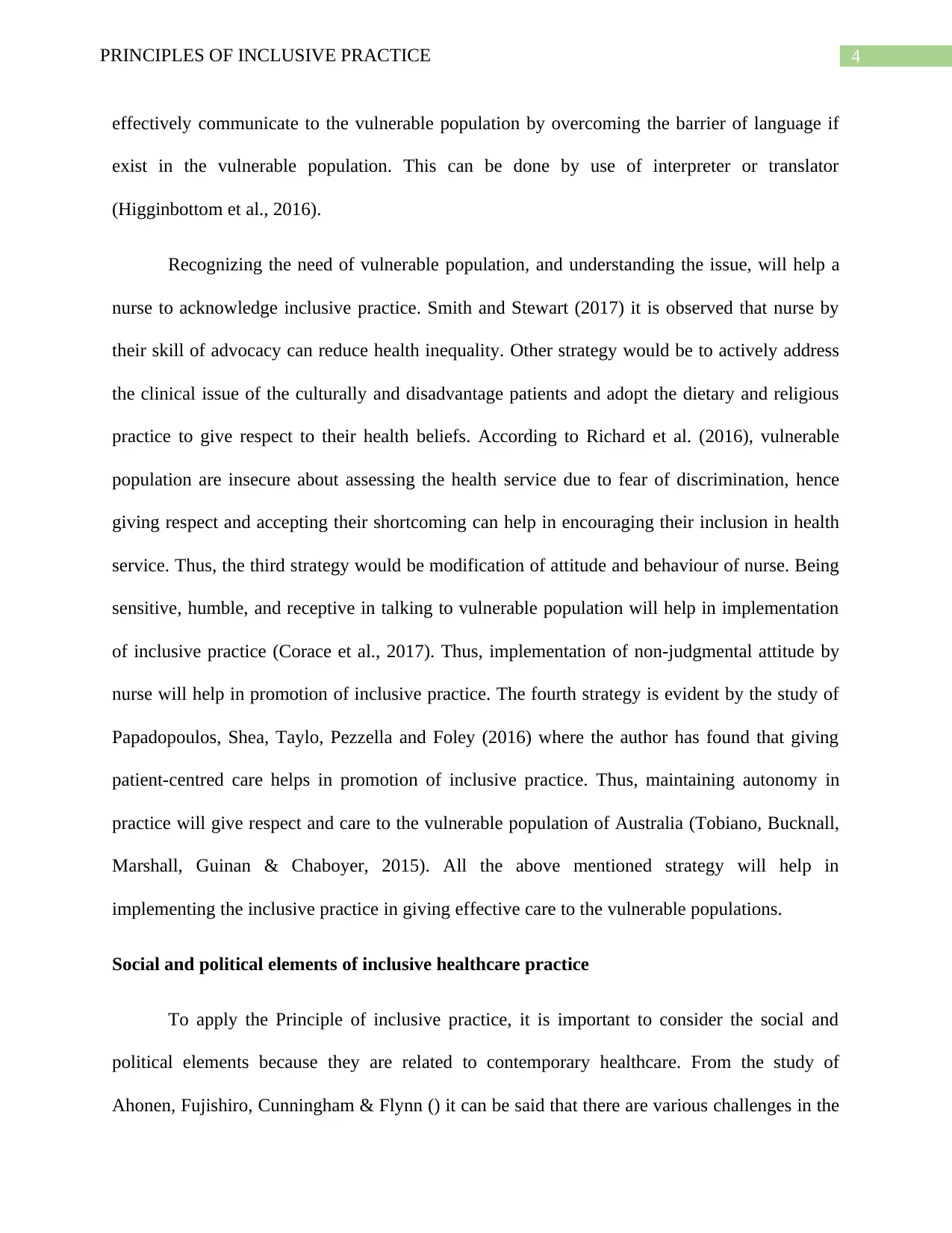
effectively communicate to the vulnerable population by overcoming the barrier of language if
exist in the vulnerable population. This can be done by use of interpreter or translator
(Higginbottom et al., 2016).
Recognizing the need of vulnerable population, and understanding the issue, will help a
nurse to acknowledge inclusive practice. Smith and Stewart (2017) it is observed that nurse by
their skill of advocacy can reduce health inequality. Other strategy would be to actively address
the clinical issue of the culturally and disadvantage patients and adopt the dietary and religious
practice to give respect to their health beliefs. According to Richard et al. (2016), vulnerable
population are insecure about assessing the health service due to fear of discrimination, hence
giving respect and accepting their shortcoming can help in encouraging their inclusion in health
service. Thus, the third strategy would be modification of attitude and behaviour of nurse. Being
sensitive, humble, and receptive in talking to vulnerable population will help in implementation
of inclusive practice (Corace et al., 2017). Thus, implementation of non-judgmental attitude by
nurse will help in promotion of inclusive practice. The fourth strategy is evident by the study of
Papadopoulos, Shea, Taylo, Pezzella and Foley (2016) where the author has found that giving
patient-centred care helps in promotion of inclusive practice. Thus, maintaining autonomy in
practice will give respect and care to the vulnerable population of Australia (Tobiano, Bucknall,
Marshall, Guinan & Chaboyer, 2015). All the above mentioned strategy will help in
implementing the inclusive practice in giving effective care to the vulnerable populations.
Social and political elements of inclusive healthcare practice
To apply the Principle of inclusive practice, it is important to consider the social and
political elements because they are related to contemporary healthcare. From the study of
Ahonen, Fujishiro, Cunningham & Flynn () it can be said that there are various challenges in the
effectively communicate to the vulnerable population by overcoming the barrier of language if
exist in the vulnerable population. This can be done by use of interpreter or translator
(Higginbottom et al., 2016).
Recognizing the need of vulnerable population, and understanding the issue, will help a
nurse to acknowledge inclusive practice. Smith and Stewart (2017) it is observed that nurse by
their skill of advocacy can reduce health inequality. Other strategy would be to actively address
the clinical issue of the culturally and disadvantage patients and adopt the dietary and religious
practice to give respect to their health beliefs. According to Richard et al. (2016), vulnerable
population are insecure about assessing the health service due to fear of discrimination, hence
giving respect and accepting their shortcoming can help in encouraging their inclusion in health
service. Thus, the third strategy would be modification of attitude and behaviour of nurse. Being
sensitive, humble, and receptive in talking to vulnerable population will help in implementation
of inclusive practice (Corace et al., 2017). Thus, implementation of non-judgmental attitude by
nurse will help in promotion of inclusive practice. The fourth strategy is evident by the study of
Papadopoulos, Shea, Taylo, Pezzella and Foley (2016) where the author has found that giving
patient-centred care helps in promotion of inclusive practice. Thus, maintaining autonomy in
practice will give respect and care to the vulnerable population of Australia (Tobiano, Bucknall,
Marshall, Guinan & Chaboyer, 2015). All the above mentioned strategy will help in
implementing the inclusive practice in giving effective care to the vulnerable populations.
Social and political elements of inclusive healthcare practice
To apply the Principle of inclusive practice, it is important to consider the social and
political elements because they are related to contemporary healthcare. From the study of
Ahonen, Fujishiro, Cunningham & Flynn () it can be said that there are various challenges in the
5PRINCIPLES OF INCLUSIVE PRACTICE
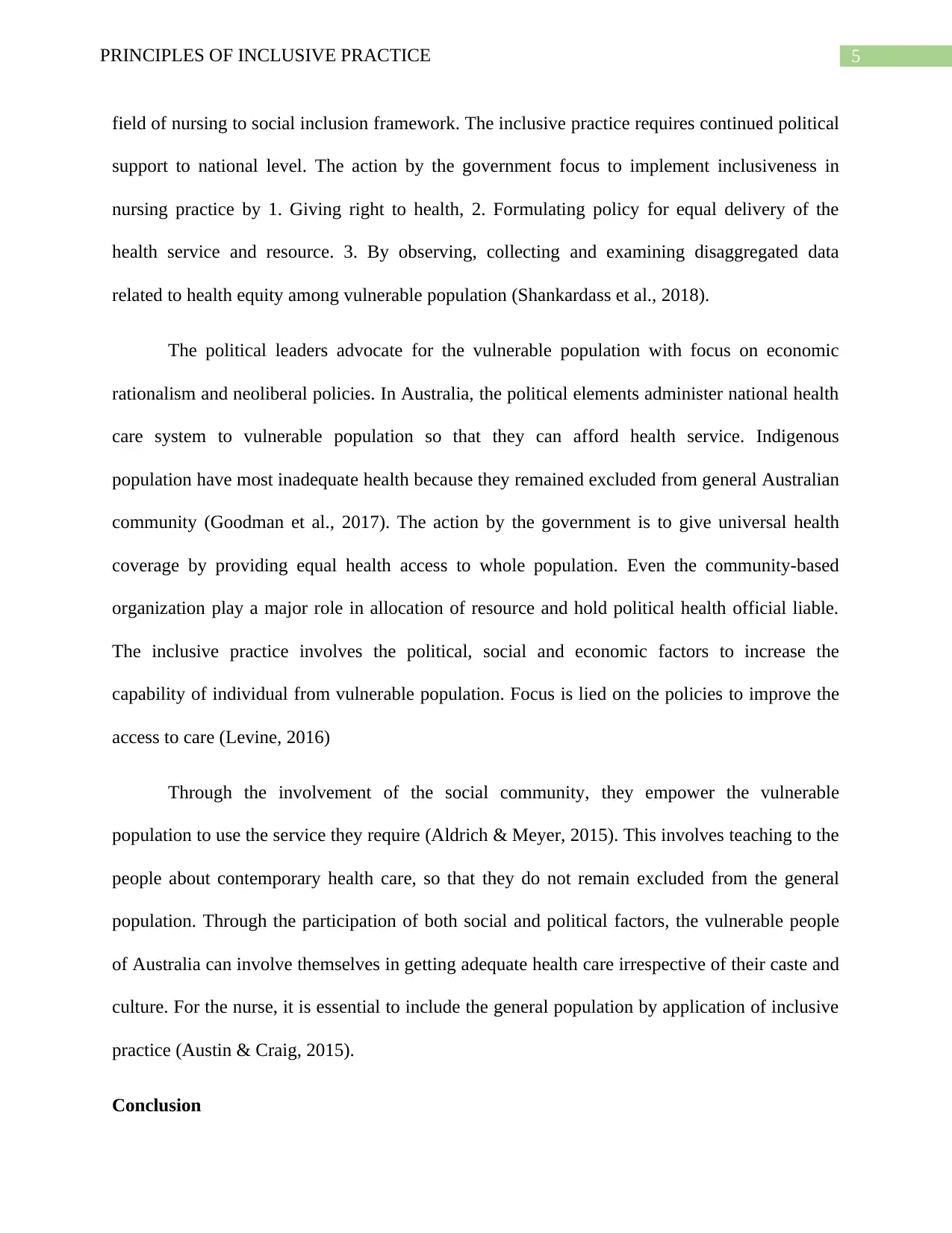
field of nursing to social inclusion framework. The inclusive practice requires continued political
support to national level. The action by the government focus to implement inclusiveness in
nursing practice by 1. Giving right to health, 2. Formulating policy for equal delivery of the
health service and resource. 3. By observing, collecting and examining disaggregated data
related to health equity among vulnerable population (Shankardass et al., 2018).
The political leaders advocate for the vulnerable population with focus on economic
rationalism and neoliberal policies. In Australia, the political elements administer national health
care system to vulnerable population so that they can afford health service. Indigenous
population have most inadequate health because they remained excluded from general Australian
community (Goodman et al., 2017). The action by the government is to give universal health
coverage by providing equal health access to whole population. Even the community-based
organization play a major role in allocation of resource and hold political health official liable.
The inclusive practice involves the political, social and economic factors to increase the
capability of individual from vulnerable population. Focus is lied on the policies to improve the
access to care (Levine, 2016)
Through the involvement of the social community, they empower the vulnerable
population to use the service they require (Aldrich & Meyer, 2015). This involves teaching to the
people about contemporary health care, so that they do not remain excluded from the general
population. Through the participation of both social and political factors, the vulnerable people
of Australia can involve themselves in getting adequate health care irrespective of their caste and
culture. For the nurse, it is essential to include the general population by application of inclusive
practice (Austin & Craig, 2015).
Conclusion
field of nursing to social inclusion framework. The inclusive practice requires continued political
support to national level. The action by the government focus to implement inclusiveness in
nursing practice by 1. Giving right to health, 2. Formulating policy for equal delivery of the
health service and resource. 3. By observing, collecting and examining disaggregated data
related to health equity among vulnerable population (Shankardass et al., 2018).
The political leaders advocate for the vulnerable population with focus on economic
rationalism and neoliberal policies. In Australia, the political elements administer national health
care system to vulnerable population so that they can afford health service. Indigenous
population have most inadequate health because they remained excluded from general Australian
community (Goodman et al., 2017). The action by the government is to give universal health
coverage by providing equal health access to whole population. Even the community-based
organization play a major role in allocation of resource and hold political health official liable.
The inclusive practice involves the political, social and economic factors to increase the
capability of individual from vulnerable population. Focus is lied on the policies to improve the
access to care (Levine, 2016)
Through the involvement of the social community, they empower the vulnerable
population to use the service they require (Aldrich & Meyer, 2015). This involves teaching to the
people about contemporary health care, so that they do not remain excluded from the general
population. Through the participation of both social and political factors, the vulnerable people
of Australia can involve themselves in getting adequate health care irrespective of their caste and
culture. For the nurse, it is essential to include the general population by application of inclusive
practice (Austin & Craig, 2015).
Conclusion
⊘ This is a preview!⊘
Do you want full access?
Subscribe today to unlock all pages.
Trusted by 1+ million students worldwide
6PRINCIPLES OF INCLUSIVE PRACTICE
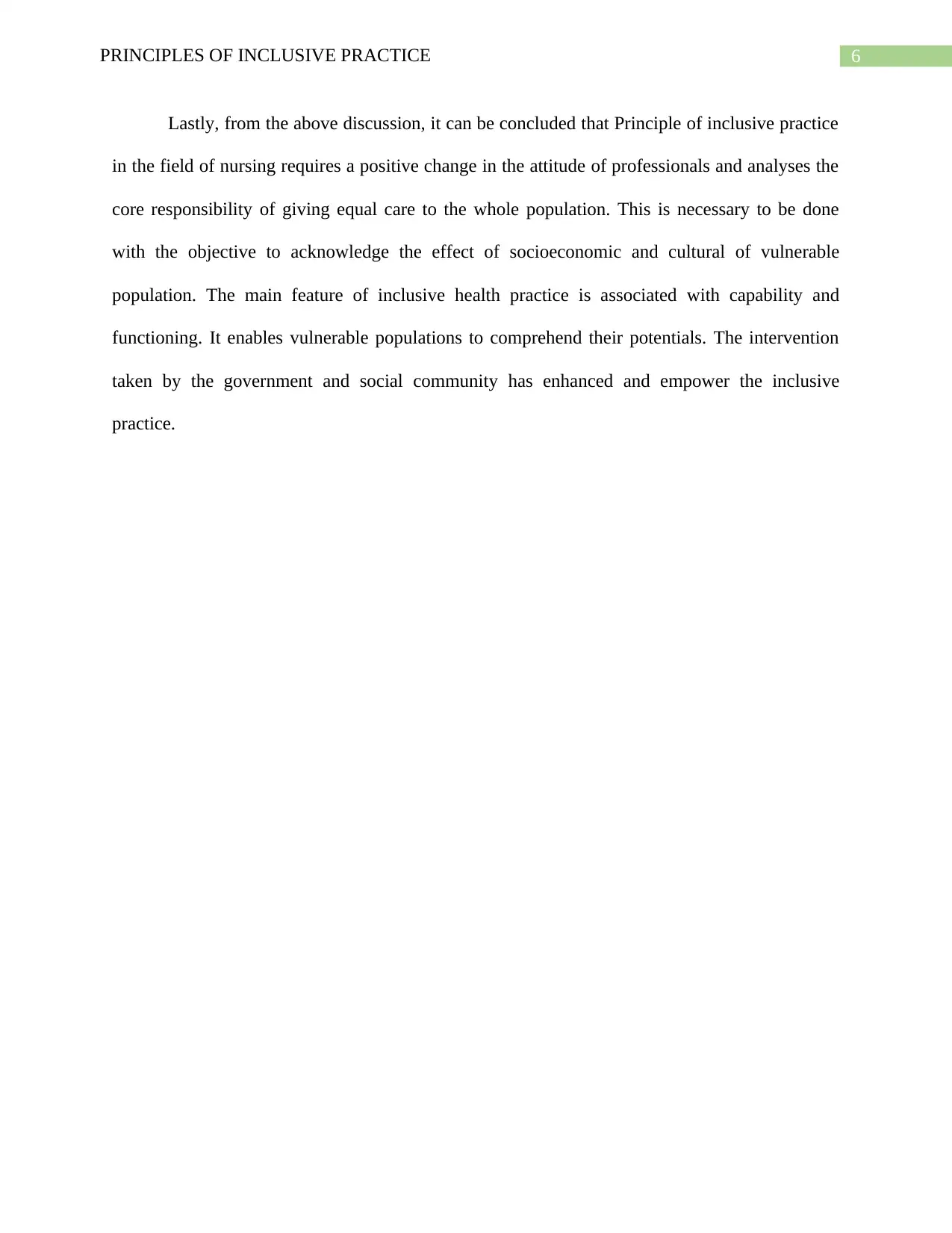
Lastly, from the above discussion, it can be concluded that Principle of inclusive practice
in the field of nursing requires a positive change in the attitude of professionals and analyses the
core responsibility of giving equal care to the whole population. This is necessary to be done
with the objective to acknowledge the effect of socioeconomic and cultural of vulnerable
population. The main feature of inclusive health practice is associated with capability and
functioning. It enables vulnerable populations to comprehend their potentials. The intervention
taken by the government and social community has enhanced and empower the inclusive
practice.
Lastly, from the above discussion, it can be concluded that Principle of inclusive practice
in the field of nursing requires a positive change in the attitude of professionals and analyses the
core responsibility of giving equal care to the whole population. This is necessary to be done
with the objective to acknowledge the effect of socioeconomic and cultural of vulnerable
population. The main feature of inclusive health practice is associated with capability and
functioning. It enables vulnerable populations to comprehend their potentials. The intervention
taken by the government and social community has enhanced and empower the inclusive
practice.
Paraphrase This Document
Need a fresh take? Get an instant paraphrase of this document with our AI Paraphraser
7PRINCIPLES OF INCLUSIVE PRACTICE
Reference
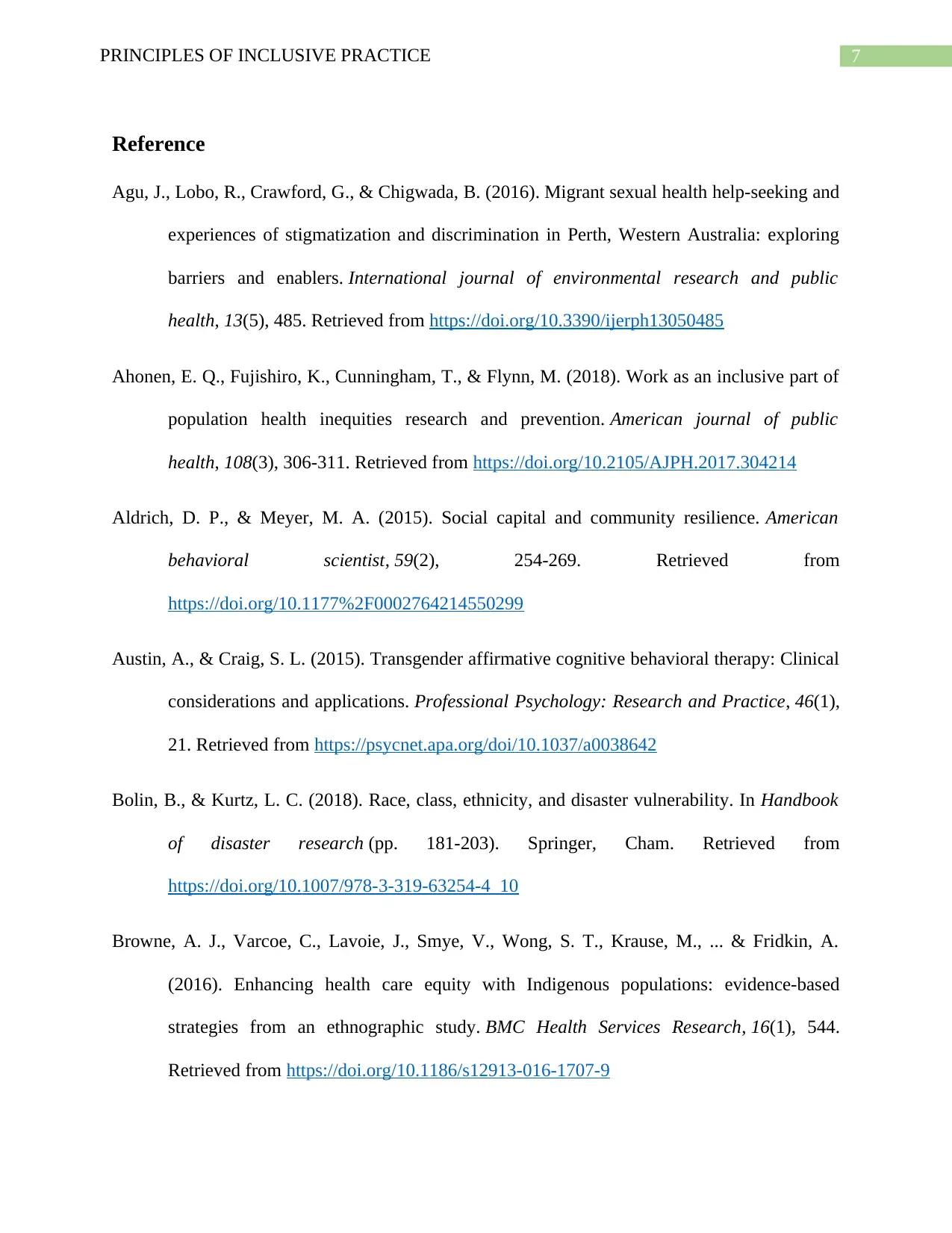
Agu, J., Lobo, R., Crawford, G., & Chigwada, B. (2016). Migrant sexual health help-seeking and
experiences of stigmatization and discrimination in Perth, Western Australia: exploring
barriers and enablers. International journal of environmental research and public
health, 13(5), 485. Retrieved from https://doi.org/10.3390/ijerph13050485
Ahonen, E. Q., Fujishiro, K., Cunningham, T., & Flynn, M. (2018). Work as an inclusive part of
population health inequities research and prevention. American journal of public
health, 108(3), 306-311. Retrieved from https://doi.org/10.2105/AJPH.2017.304214
Aldrich, D. P., & Meyer, M. A. (2015). Social capital and community resilience. American
behavioral scientist, 59(2), 254-269. Retrieved from
https://doi.org/10.1177%2F0002764214550299
Austin, A., & Craig, S. L. (2015). Transgender affirmative cognitive behavioral therapy: Clinical
considerations and applications. Professional Psychology: Research and Practice, 46(1),
21. Retrieved from https://psycnet.apa.org/doi/10.1037/a0038642
Bolin, B., & Kurtz, L. C. (2018). Race, class, ethnicity, and disaster vulnerability. In Handbook
of disaster research (pp. 181-203). Springer, Cham. Retrieved from
https://doi.org/10.1007/978-3-319-63254-4_10
Browne, A. J., Varcoe, C., Lavoie, J., Smye, V., Wong, S. T., Krause, M., ... & Fridkin, A.
(2016). Enhancing health care equity with Indigenous populations: evidence-based
strategies from an ethnographic study. BMC Health Services Research, 16(1), 544.
Retrieved from https://doi.org/10.1186/s12913-016-1707-9
Reference
Agu, J., Lobo, R., Crawford, G., & Chigwada, B. (2016). Migrant sexual health help-seeking and
experiences of stigmatization and discrimination in Perth, Western Australia: exploring
barriers and enablers. International journal of environmental research and public
health, 13(5), 485. Retrieved from https://doi.org/10.3390/ijerph13050485
Ahonen, E. Q., Fujishiro, K., Cunningham, T., & Flynn, M. (2018). Work as an inclusive part of
population health inequities research and prevention. American journal of public
health, 108(3), 306-311. Retrieved from https://doi.org/10.2105/AJPH.2017.304214
Aldrich, D. P., & Meyer, M. A. (2015). Social capital and community resilience. American
behavioral scientist, 59(2), 254-269. Retrieved from
https://doi.org/10.1177%2F0002764214550299
Austin, A., & Craig, S. L. (2015). Transgender affirmative cognitive behavioral therapy: Clinical
considerations and applications. Professional Psychology: Research and Practice, 46(1),
21. Retrieved from https://psycnet.apa.org/doi/10.1037/a0038642
Bolin, B., & Kurtz, L. C. (2018). Race, class, ethnicity, and disaster vulnerability. In Handbook
of disaster research (pp. 181-203). Springer, Cham. Retrieved from
https://doi.org/10.1007/978-3-319-63254-4_10
Browne, A. J., Varcoe, C., Lavoie, J., Smye, V., Wong, S. T., Krause, M., ... & Fridkin, A.
(2016). Enhancing health care equity with Indigenous populations: evidence-based
strategies from an ethnographic study. BMC Health Services Research, 16(1), 544.
Retrieved from https://doi.org/10.1186/s12913-016-1707-9
8PRINCIPLES OF INCLUSIVE PRACTICE
Castro, E. M., Van Regenmortel, T., Vanhaecht, K., Sermeus, W., & Van Hecke, A. (2016).
Patient empowerment, patient participation and patient-centeredness in hospital care: a
concept analysis based on a literature review. Patient education and counseling, 99(12),
1923-1939. Retrieved from https://doi.org/10.1016/j.pec.2016.07.026
Corace, K. M., Srigley, J. A., Hargadon, D. P., Yu, D., MacDonald, T. K., Fabrigar, L. R., &
Garber, G. E. (2016). Using behavior change frameworks to improve healthcare worker
influenza vaccination rates: a systematic review. Vaccine, 34(28), 3235-3242. Retrieved
from https://doi.org/10.1016/j.vaccine.2016.04.071
Felton, K., & Harrison, G. (2017). Supporting inclusive practicum experiences for international
students across the social sciences: Building industry capacity. Higher Education
Research & Development, 36(1), 88-101. Retrieved from
https://doi.org/10.1080/07294360.2016.1170766
Fisk, R. P., Dean, A. M., Alkire, L., Joubert, A., Previte, J., Robertson, N., & Rosenbaum, M. S.
(2018). Design for service inclusion: creating inclusive service systems by 2050. Journal
of Service Management, 29(5), 834-858. Retrieved from
https://www.emerald.com/insight/content/doi/10.1108/JOSM-05-2018-0121/full/html
Forrest, J., Lean, G., & Dunn, K. (2017). Attitudes of classroom teachers to cultural diversity and
multicultural education in country New South Wales, Australia. Australian Journal of
Teacher Education, 42(5), 2. Retrieved from http://dx.doi.org/10.14221/ajte.2017v42n5.2
Friis, K., Lasgaard, M., Osborne, R. H., & Maindal, H. T. (2016). Gaps in understanding health
and engagement with healthcare providers across common long-term conditions: a
Castro, E. M., Van Regenmortel, T., Vanhaecht, K., Sermeus, W., & Van Hecke, A. (2016).
Patient empowerment, patient participation and patient-centeredness in hospital care: a
concept analysis based on a literature review. Patient education and counseling, 99(12),
1923-1939. Retrieved from https://doi.org/10.1016/j.pec.2016.07.026
Corace, K. M., Srigley, J. A., Hargadon, D. P., Yu, D., MacDonald, T. K., Fabrigar, L. R., &
Garber, G. E. (2016). Using behavior change frameworks to improve healthcare worker
influenza vaccination rates: a systematic review. Vaccine, 34(28), 3235-3242. Retrieved
from https://doi.org/10.1016/j.vaccine.2016.04.071
Felton, K., & Harrison, G. (2017). Supporting inclusive practicum experiences for international
students across the social sciences: Building industry capacity. Higher Education
Research & Development, 36(1), 88-101. Retrieved from
https://doi.org/10.1080/07294360.2016.1170766
Fisk, R. P., Dean, A. M., Alkire, L., Joubert, A., Previte, J., Robertson, N., & Rosenbaum, M. S.
(2018). Design for service inclusion: creating inclusive service systems by 2050. Journal
of Service Management, 29(5), 834-858. Retrieved from
https://www.emerald.com/insight/content/doi/10.1108/JOSM-05-2018-0121/full/html
Forrest, J., Lean, G., & Dunn, K. (2017). Attitudes of classroom teachers to cultural diversity and
multicultural education in country New South Wales, Australia. Australian Journal of
Teacher Education, 42(5), 2. Retrieved from http://dx.doi.org/10.14221/ajte.2017v42n5.2
Friis, K., Lasgaard, M., Osborne, R. H., & Maindal, H. T. (2016). Gaps in understanding health
and engagement with healthcare providers across common long-term conditions: a
⊘ This is a preview!⊘
Do you want full access?
Subscribe today to unlock all pages.
Trusted by 1+ million students worldwide
9PRINCIPLES OF INCLUSIVE PRACTICE
population survey of health literacy in 29 473 Danish citizens. BMJ open, 6(1), e009627.
Retrieved from http://dx.doi.org/10.1136/bmjopen-2015-009627
Fuchs, L. S., Fuchs, D., Compton, D. L., Wehby, J., Schumacher, R. F., Gersten, R., & Jordan,
N. C. (2015). Inclusion versus specialized intervention for very-low-performing students:
What does access mean in an era of academic challenge?. Exceptional Children, 81(2),
134-157. Retrieved from https://doi.org/10.1057/ejdr.2015.30
Goldman, N., & Trimmer, K. (2019). Towards a Culturally Inclusive Model of Care: Quality
Practice and Care Through the Lens of a Practising Nurse. In Ensuring Quality in
Professional Education Volume I (pp. 123-149). Palgrave Macmillan, Cham. Retrieved
from https://doi.org/10.1007/978-3-030-01096-6_6
Goodman, A., Fleming, K., Markwick, N., Morrison, T., Lagimodiere, L., Kerr, T., & Society,
W. A. H. R. (2017). “They treated me like crap and I know it was because I was Native”:
The healthcare experiences of Aboriginal peoples living in Vancouver's inner city. Social
Science & Medicine, 178, 87-94. Retrieved from
https://doi.org/10.1016/j.socscimed.2017.01.053
Higginbottom, G. M., Safipour, J., Yohani, S., O’Brien, B., Mumtaz, Z., & Paton, P. (2015). An
ethnographic study of communication challenges in maternity care for immigrant women
in rural Alberta. Midwifery, 31(2), 297-304. Retrieved from
https://doi.org/10.1016/j.midw.2014.09.009
Jacobs, B. B. (2016). Respect for human dignity in nursing: Philosophical and practical
perspectives. Canadian Journal of Nursing Research Archive, 32(2). Retrieved from
http://cjnr.archive.mcgill.ca/article/view/1574
population survey of health literacy in 29 473 Danish citizens. BMJ open, 6(1), e009627.
Retrieved from http://dx.doi.org/10.1136/bmjopen-2015-009627
Fuchs, L. S., Fuchs, D., Compton, D. L., Wehby, J., Schumacher, R. F., Gersten, R., & Jordan,
N. C. (2015). Inclusion versus specialized intervention for very-low-performing students:
What does access mean in an era of academic challenge?. Exceptional Children, 81(2),
134-157. Retrieved from https://doi.org/10.1057/ejdr.2015.30
Goldman, N., & Trimmer, K. (2019). Towards a Culturally Inclusive Model of Care: Quality
Practice and Care Through the Lens of a Practising Nurse. In Ensuring Quality in
Professional Education Volume I (pp. 123-149). Palgrave Macmillan, Cham. Retrieved
from https://doi.org/10.1007/978-3-030-01096-6_6
Goodman, A., Fleming, K., Markwick, N., Morrison, T., Lagimodiere, L., Kerr, T., & Society,
W. A. H. R. (2017). “They treated me like crap and I know it was because I was Native”:
The healthcare experiences of Aboriginal peoples living in Vancouver's inner city. Social
Science & Medicine, 178, 87-94. Retrieved from
https://doi.org/10.1016/j.socscimed.2017.01.053
Higginbottom, G. M., Safipour, J., Yohani, S., O’Brien, B., Mumtaz, Z., & Paton, P. (2015). An
ethnographic study of communication challenges in maternity care for immigrant women
in rural Alberta. Midwifery, 31(2), 297-304. Retrieved from
https://doi.org/10.1016/j.midw.2014.09.009
Jacobs, B. B. (2016). Respect for human dignity in nursing: Philosophical and practical
perspectives. Canadian Journal of Nursing Research Archive, 32(2). Retrieved from
http://cjnr.archive.mcgill.ca/article/view/1574
Paraphrase This Document
Need a fresh take? Get an instant paraphrase of this document with our AI Paraphraser
10PRINCIPLES OF INCLUSIVE PRACTICE
Levine, J. R. (2016). The privatization of political representation: Community-based
organizations as nonelected neighborhood representatives. American Sociological
Review, 81(6), 1251-1275. Retrieved from
https://doi.org/10.1177%2F0003122416670655
MacLean, S., Kelly, M., Geddes, F., & Della, P. (2017). Use of simulated patients to develop
communication skills in nursing education: An integrative review. Nurse education
today, 48, 90-98. Retrieved from https://doi.org/10.1016/j.nedt.2016.09.018
McCormack, B., & McCance, T. (Eds.). (2016). Person-centred practice in nursing and health
care: theory and practice. John Wiley & Sons. Retrieved from
https://books.google.co.in/books?
hl=en&lr=&id=o8pJDAAAQBAJ&oi=fnd&pg=PR9&dq=Principle+of+inclusive+practic
e+nursing&ots=PJaHTZrI5_&sig=ytT-
C9d6gWEdMocYU3RgGTSHkb8#v=onepage&q=Principle%20of%20inclusive
%20practice%20nursing&f=false
Palinkas, L. A., Horwitz, S. M., Green, C. A., Wisdom, J. P., Duan, N., & Hoagwood, K. (2015).
Purposeful sampling for qualitative data collection and analysis in mixed method
implementation research. Administration and policy in mental health and mental health
services research, 42(5), 533-544. Retrieved from https://doi.org/10.1007/s10488-013-
0528-y
Papadopoulos, I., Shea, S., Taylor, G., Pezzella, A., & Foley, L. (2016). Developing tools to
promote culturally competent compassion, courage, and intercultural communication in
Levine, J. R. (2016). The privatization of political representation: Community-based
organizations as nonelected neighborhood representatives. American Sociological
Review, 81(6), 1251-1275. Retrieved from
https://doi.org/10.1177%2F0003122416670655
MacLean, S., Kelly, M., Geddes, F., & Della, P. (2017). Use of simulated patients to develop
communication skills in nursing education: An integrative review. Nurse education
today, 48, 90-98. Retrieved from https://doi.org/10.1016/j.nedt.2016.09.018
McCormack, B., & McCance, T. (Eds.). (2016). Person-centred practice in nursing and health
care: theory and practice. John Wiley & Sons. Retrieved from
https://books.google.co.in/books?
hl=en&lr=&id=o8pJDAAAQBAJ&oi=fnd&pg=PR9&dq=Principle+of+inclusive+practic
e+nursing&ots=PJaHTZrI5_&sig=ytT-
C9d6gWEdMocYU3RgGTSHkb8#v=onepage&q=Principle%20of%20inclusive
%20practice%20nursing&f=false
Palinkas, L. A., Horwitz, S. M., Green, C. A., Wisdom, J. P., Duan, N., & Hoagwood, K. (2015).
Purposeful sampling for qualitative data collection and analysis in mixed method
implementation research. Administration and policy in mental health and mental health
services research, 42(5), 533-544. Retrieved from https://doi.org/10.1007/s10488-013-
0528-y
Papadopoulos, I., Shea, S., Taylor, G., Pezzella, A., & Foley, L. (2016). Developing tools to
promote culturally competent compassion, courage, and intercultural communication in
11PRINCIPLES OF INCLUSIVE PRACTICE
healthcare. Journal of Compassionate Health Care, 3(1), 2. Retrieved from
https://doi.org/10.1186/s40639-016-0019-6
Patel, D., Jian, L., Xiao, J., Jansz, J., Yun, G., Lin, T., & Robertson, A. (2019). Joint effects of
heatwaves and air quality on ambulance services for vulnerable populations in Perth,
western Australia. Environmental Pollution, 252, 532-542. Retrieved from
https://doi.org/10.1016/j.envpol.2019.05.125
Richard, L., Furler, J., Densley, K., Haggerty, J., Russell, G., Levesque, J. F., & Gunn, J. (2016).
Equity of access to primary healthcare for vulnerable populations: the IMPACT
international online survey of innovations. International journal for equity in
health, 15(1), 64. Retrieved from https://doi.org/10.1186/s12939-016-0351-7
Shankardass, K., Muntaner, C., Kokkinen, L., Shahidi, F. V., Freiler, A., Oneka, G., ... &
O’Campo, P. (2018). The implementation of Health in All Policies initiatives: a systems
framework for government action. Health research policy and systems, 16(1), 26.
Retrieved from https://doi.org/10.1186/s12961-018-0295-z
Simplican, S. C., Leader, G., Kosciulek, J., & Leahy, M. (2015). Defining social inclusion of
people with intellectual and developmental disabilities: An ecological model of social
networks and community participation. Research in developmental disabilities, 38, 18-
29. Retrieved from https://doi.org/10.1016/j.ridd.2014.10.008
Smith, K. E., & Stewart, E. A. (2017). Academic advocacy in public health: Disciplinary
‘duty’or political ‘propaganda’?. Social Science & Medicine, 189, 35-43. Retrieved from
https://doi.org/10.1016/j.socscimed.2017.07.014
healthcare. Journal of Compassionate Health Care, 3(1), 2. Retrieved from
https://doi.org/10.1186/s40639-016-0019-6
Patel, D., Jian, L., Xiao, J., Jansz, J., Yun, G., Lin, T., & Robertson, A. (2019). Joint effects of
heatwaves and air quality on ambulance services for vulnerable populations in Perth,
western Australia. Environmental Pollution, 252, 532-542. Retrieved from
https://doi.org/10.1016/j.envpol.2019.05.125
Richard, L., Furler, J., Densley, K., Haggerty, J., Russell, G., Levesque, J. F., & Gunn, J. (2016).
Equity of access to primary healthcare for vulnerable populations: the IMPACT
international online survey of innovations. International journal for equity in
health, 15(1), 64. Retrieved from https://doi.org/10.1186/s12939-016-0351-7
Shankardass, K., Muntaner, C., Kokkinen, L., Shahidi, F. V., Freiler, A., Oneka, G., ... &
O’Campo, P. (2018). The implementation of Health in All Policies initiatives: a systems
framework for government action. Health research policy and systems, 16(1), 26.
Retrieved from https://doi.org/10.1186/s12961-018-0295-z
Simplican, S. C., Leader, G., Kosciulek, J., & Leahy, M. (2015). Defining social inclusion of
people with intellectual and developmental disabilities: An ecological model of social
networks and community participation. Research in developmental disabilities, 38, 18-
29. Retrieved from https://doi.org/10.1016/j.ridd.2014.10.008
Smith, K. E., & Stewart, E. A. (2017). Academic advocacy in public health: Disciplinary
‘duty’or political ‘propaganda’?. Social Science & Medicine, 189, 35-43. Retrieved from
https://doi.org/10.1016/j.socscimed.2017.07.014
⊘ This is a preview!⊘
Do you want full access?
Subscribe today to unlock all pages.
Trusted by 1+ million students worldwide

1 out of 13


Related Documents


Your All-in-One AI-Powered Toolkit for Academic Success.
+13062052269
info@desklib.com
Available 24*7 on WhatsApp / Email
![[object Object]](/_next/static/media/star-bottom.7253800d.svg)
Unlock your academic potential
Copyright © 2020–2026 A2Z Services. All Rights Reserved. Developed and managed by ZUCOL.