Inclusive Practice Report: Personal, Professional and Organisational
VerifiedAdded on 2022/12/26
|13
|4157
|4
Report
AI Summary
This report provides a comprehensive overview of inclusive practice in education. It begins by examining the impact of personal, social, and cultural factors, as well as cognitive, physical, and sensory abilities, on student learning. The report then delves into relevant policy and regulatory frameworks, such as the Equity Act 2010, and their influence on organizational policies and individual practices. The report further explores the roles and responsibilities associated with inclusive practice, including strategies for promoting student inclusion and addressing inappropriate behavior. It also highlights the key features and benefits of inclusive learning environments and offers strategies for effective collaboration among professionals. Finally, the report includes a review of the author's own inclusive learning practices, a SWOT analysis, an action plan for improvement, and a conclusion summarizing the key findings and recommendations.
Inclusive Practice

Paraphrase This Document
Need a fresh take? Get an instant paraphrase of this document with our AI Paraphraser
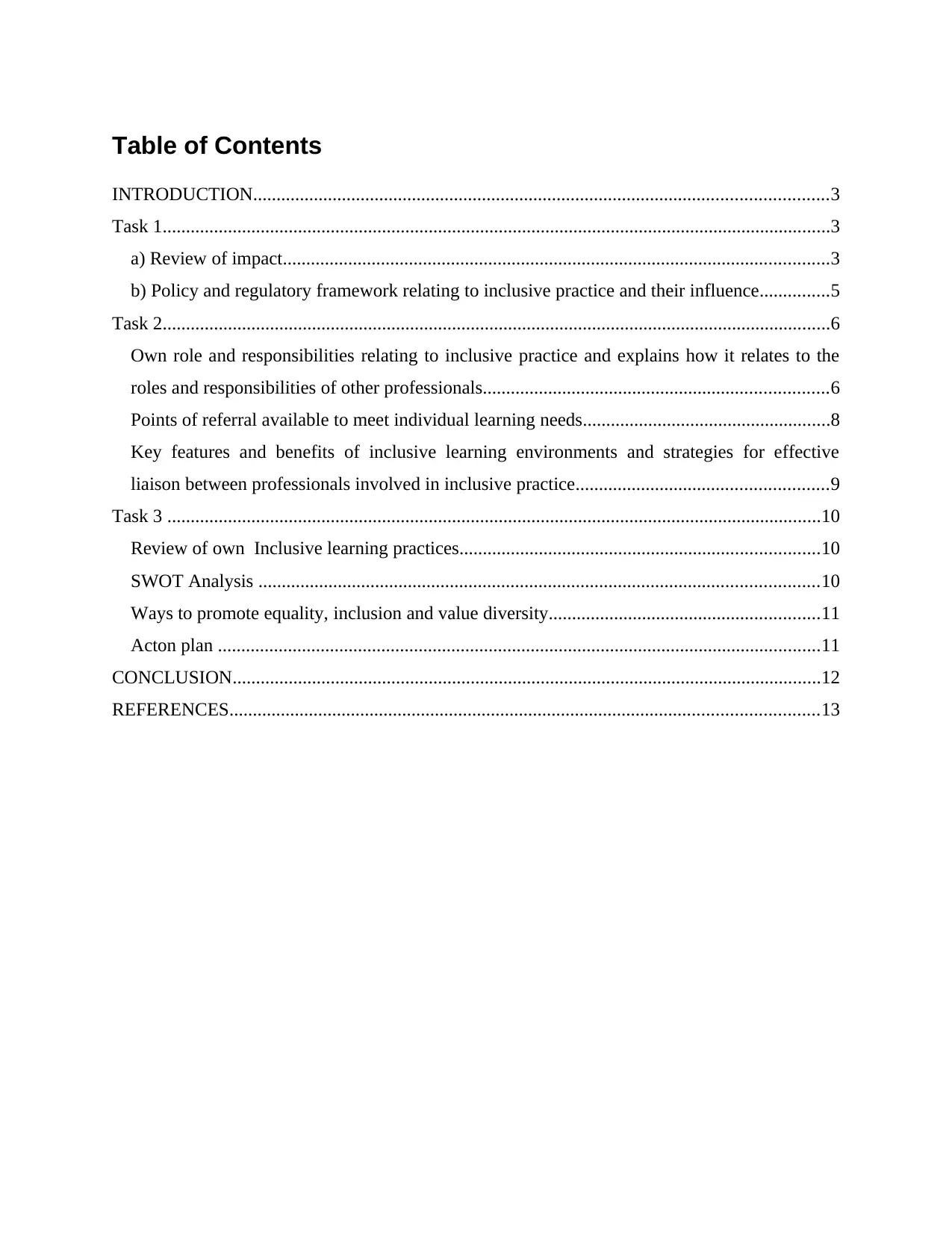
Table of Contents
INTRODUCTION...........................................................................................................................3
Task 1...............................................................................................................................................3
a) Review of impact.....................................................................................................................3
b) Policy and regulatory framework relating to inclusive practice and their influence...............5
Task 2...............................................................................................................................................6
Own role and responsibilities relating to inclusive practice and explains how it relates to the
roles and responsibilities of other professionals..........................................................................6
Points of referral available to meet individual learning needs.....................................................8
Key features and benefits of inclusive learning environments and strategies for effective
liaison between professionals involved in inclusive practice......................................................9
Task 3 ............................................................................................................................................10
Review of own Inclusive learning practices.............................................................................10
SWOT Analysis ........................................................................................................................10
Ways to promote equality, inclusion and value diversity..........................................................11
Acton plan .................................................................................................................................11
CONCLUSION..............................................................................................................................12
REFERENCES..............................................................................................................................13
INTRODUCTION...........................................................................................................................3
Task 1...............................................................................................................................................3
a) Review of impact.....................................................................................................................3
b) Policy and regulatory framework relating to inclusive practice and their influence...............5
Task 2...............................................................................................................................................6
Own role and responsibilities relating to inclusive practice and explains how it relates to the
roles and responsibilities of other professionals..........................................................................6
Points of referral available to meet individual learning needs.....................................................8
Key features and benefits of inclusive learning environments and strategies for effective
liaison between professionals involved in inclusive practice......................................................9
Task 3 ............................................................................................................................................10
Review of own Inclusive learning practices.............................................................................10
SWOT Analysis ........................................................................................................................10
Ways to promote equality, inclusion and value diversity..........................................................11
Acton plan .................................................................................................................................11
CONCLUSION..............................................................................................................................12
REFERENCES..............................................................................................................................13
INTRODUCTION
Inclusive practice refers to a practice of teaching approach that recognises difference
between students and this information and knowledge is used to ensure that all students access
educational content and can participate in learning. In this it is considered that no two individuals
are same and this is why their learning is based on this knowledge and information. This report
aims at discussing inclusive practice and what factors affect inclusive practice and will identify
impact of personal, social and cultural factors on learning. Later report will discuss about impact
of different cognitive, physical and sensory abilities on learning of individual. Regulatory
frameworks and policies related to inclusive practice their influence on organisational policies
and own practices will also be discussed in report. Followed by this, report will also discuss
about role and responsibilities related to inclusive practice and referrals that can be used to meet
needs of learner. Followed by this report will also discuss about features and benefits of inclusive
learning environment. Lastly report will include review of effectiveness of own inclusive
practices and plan for improving own skills in inclusive practice.
Task 1
a) Review of impact
Impact of personal, social and cultural factors on learning
There are several factors that affect learning of an individual and in these factors personal factors
include age, gender, confidence, peer pressure, cultural and religious attitude, educational
backgrounds, financial situation, development of language, and multilingualism.
Age has very important impact on learning because it is associated with reduction in cognitive
abilities of individual and this is why learning at young age is easier (Abbas and et.al., 2019).
Regarding impact of gender it has very considerable impact in high school education of girls and
boys. In this boys are likely to choose science and mathematics subject for higher studies
whereas girls tend to study high in assets and literacy irrespective of capabilities of girls.
Confidence is a factor that affect how capable a student is when they are expected to show their
known and demonstrate their skills. In audition to this students with high confidence are able to
understand problems easily and they are more critical to understanding problem. Cultural and
religious attitude of individuals have strong impact on their learning. In this, learning of
Individuals gets affected in several ways one of them is importance of learning in their life and
subject and area of expertise in which they learn.
Inclusive practice refers to a practice of teaching approach that recognises difference
between students and this information and knowledge is used to ensure that all students access
educational content and can participate in learning. In this it is considered that no two individuals
are same and this is why their learning is based on this knowledge and information. This report
aims at discussing inclusive practice and what factors affect inclusive practice and will identify
impact of personal, social and cultural factors on learning. Later report will discuss about impact
of different cognitive, physical and sensory abilities on learning of individual. Regulatory
frameworks and policies related to inclusive practice their influence on organisational policies
and own practices will also be discussed in report. Followed by this, report will also discuss
about role and responsibilities related to inclusive practice and referrals that can be used to meet
needs of learner. Followed by this report will also discuss about features and benefits of inclusive
learning environment. Lastly report will include review of effectiveness of own inclusive
practices and plan for improving own skills in inclusive practice.
Task 1
a) Review of impact
Impact of personal, social and cultural factors on learning
There are several factors that affect learning of an individual and in these factors personal factors
include age, gender, confidence, peer pressure, cultural and religious attitude, educational
backgrounds, financial situation, development of language, and multilingualism.
Age has very important impact on learning because it is associated with reduction in cognitive
abilities of individual and this is why learning at young age is easier (Abbas and et.al., 2019).
Regarding impact of gender it has very considerable impact in high school education of girls and
boys. In this boys are likely to choose science and mathematics subject for higher studies
whereas girls tend to study high in assets and literacy irrespective of capabilities of girls.
Confidence is a factor that affect how capable a student is when they are expected to show their
known and demonstrate their skills. In audition to this students with high confidence are able to
understand problems easily and they are more critical to understanding problem. Cultural and
religious attitude of individuals have strong impact on their learning. In this, learning of
Individuals gets affected in several ways one of them is importance of learning in their life and
subject and area of expertise in which they learn.
⊘ This is a preview!⊘
Do you want full access?
Subscribe today to unlock all pages.

Trusted by 1+ million students worldwide
Social and cultural barriers also have significant impact on learning of individuals. Peer pressure
is also a social factor that has very important impact on learning. Individual is when is teased for
having good grades and performing well in academics in that situation they are likely to reduce
their efforts in learning. Similarly, when students are teased for more performing well in
education from peers, in such situation they are likely to increase their efforts in learning.
Emphasis and attention provided towards learning by a certain society in which learners are
living also has important effect on their learning (Schunk and DiBenedetto, 2020). There are
certain societies in which individuals start their employment at very early age because of poverty
and this affect their learning. Learners or students when do not have positive attitude towards
learning and education they are likely to challenges for teacher in effectively educating children.
Impact of different cognitive, physical and sensory abilities on learning
There are different cognitive, physical and sensory abilities and these abilities of children
and individual have very important effect on their learning ability. Certain factors are-
Nature Vs nurture- On the basis of both nature and nurture children differentiate and
considering this is inclusive practice is very important. Nature is concerned with inherited factors
and capabilities of children and nurture is concerned with effect of family, peer, school and other
elements associated with children when they are raised (Farina and et.al., 2019). On the basis of
these factors and elements all children are different from each other and their capabilities for
learning are different and make strong impact on learning of children.
Reading ability- This is a cognitive ability and this has its impact on learning because those who
read more and have better learning and they are also tend to perform better in test compared to
those who read less. Reading ability of individuals is also linked with higher achievement in
academic, vocabulary, and mathematics.
Analytical skills- Analytical skills are those skills that allow individuals to find solution to a
problem and make informed decisions. Individuals with strong analytical skills are likely to
perform better in mathematical subjects and also learn better where they are require to use
analytical skills for learning.
Aptitude- Aptitude is concerned with skill of individual and it has very important effect of
learning because individual who has aptitude is certain skill or subject they are likely to learn
better in that subject. Such as learner with language aptitude is likely to learn better those
subjects that are related to language.
is also a social factor that has very important impact on learning. Individual is when is teased for
having good grades and performing well in academics in that situation they are likely to reduce
their efforts in learning. Similarly, when students are teased for more performing well in
education from peers, in such situation they are likely to increase their efforts in learning.
Emphasis and attention provided towards learning by a certain society in which learners are
living also has important effect on their learning (Schunk and DiBenedetto, 2020). There are
certain societies in which individuals start their employment at very early age because of poverty
and this affect their learning. Learners or students when do not have positive attitude towards
learning and education they are likely to challenges for teacher in effectively educating children.
Impact of different cognitive, physical and sensory abilities on learning
There are different cognitive, physical and sensory abilities and these abilities of children
and individual have very important effect on their learning ability. Certain factors are-
Nature Vs nurture- On the basis of both nature and nurture children differentiate and
considering this is inclusive practice is very important. Nature is concerned with inherited factors
and capabilities of children and nurture is concerned with effect of family, peer, school and other
elements associated with children when they are raised (Farina and et.al., 2019). On the basis of
these factors and elements all children are different from each other and their capabilities for
learning are different and make strong impact on learning of children.
Reading ability- This is a cognitive ability and this has its impact on learning because those who
read more and have better learning and they are also tend to perform better in test compared to
those who read less. Reading ability of individuals is also linked with higher achievement in
academic, vocabulary, and mathematics.
Analytical skills- Analytical skills are those skills that allow individuals to find solution to a
problem and make informed decisions. Individuals with strong analytical skills are likely to
perform better in mathematical subjects and also learn better where they are require to use
analytical skills for learning.
Aptitude- Aptitude is concerned with skill of individual and it has very important effect of
learning because individual who has aptitude is certain skill or subject they are likely to learn
better in that subject. Such as learner with language aptitude is likely to learn better those
subjects that are related to language.
Paraphrase This Document
Need a fresh take? Get an instant paraphrase of this document with our AI Paraphraser
Specific learning disability- This is a disorder that creates difficulty for individual by
interfering wit their ability to listen, think, speak, write and do mathematics. This ability affect
learning by creating difficulties for learner to learn well.
Physical disability- This is concerned with an individual facing difficulty because of lacking
certain abilities than other. This also has impact on learning which is likely to vary on the basis
of physical impairment or disability (Weisberg and Newcombe, 2017). Mild disability in walking
might not affect learning but individual severely affected by disability have difficulty in learning.
b) Policy and regulatory framework relating to inclusive practice and their influence
Equity act 2010, is a very important policy and regulatory framework that affect inclusive
practice. As per this act it is mandatory to treat every learner equally regardless of their protected
characteristics including age, gender, disability, race and religion. This act require teachers and
educators to avoid all kind of discrimination in learners.
Deaf awareness is another policy according to which educators are required to promote positive
aspects of deafness and social inclusion. This is very important policy for learning as one in
every 5 adult in UK is deaf or has hearing loss. In such situation educators are required to
possess knowledge of how they can facilitate communication for people with deafness and
hearing loss.
Visual awareness- This involves that students with visual impairment are provided with extra
attention to enable them to learn effectively (Benn, 2020). Teachers are required to and expected
to make adequate time to meet special needs of students with visual impairment.
Tomlinson framework- This is a model in which teachers are required to adjust the content,
process and products of lesson in such a way that they can improve and increase engagement and
achievement of students.
Moser framework- This is a tool for analysis of gender in developmental planning and goal of
this is to free women from any kind of subordination and allowing them to achieve equality,
equity and empowerment. This means that in inclusive learning both male and female students
are required to teach equally.
Kennedy Model- This is a framework that argues that no culture is better than other culture and
culture emerges from as a result of circumstances. Value of culture lies in using it to understand
interfering wit their ability to listen, think, speak, write and do mathematics. This ability affect
learning by creating difficulties for learner to learn well.
Physical disability- This is concerned with an individual facing difficulty because of lacking
certain abilities than other. This also has impact on learning which is likely to vary on the basis
of physical impairment or disability (Weisberg and Newcombe, 2017). Mild disability in walking
might not affect learning but individual severely affected by disability have difficulty in learning.
b) Policy and regulatory framework relating to inclusive practice and their influence
Equity act 2010, is a very important policy and regulatory framework that affect inclusive
practice. As per this act it is mandatory to treat every learner equally regardless of their protected
characteristics including age, gender, disability, race and religion. This act require teachers and
educators to avoid all kind of discrimination in learners.
Deaf awareness is another policy according to which educators are required to promote positive
aspects of deafness and social inclusion. This is very important policy for learning as one in
every 5 adult in UK is deaf or has hearing loss. In such situation educators are required to
possess knowledge of how they can facilitate communication for people with deafness and
hearing loss.
Visual awareness- This involves that students with visual impairment are provided with extra
attention to enable them to learn effectively (Benn, 2020). Teachers are required to and expected
to make adequate time to meet special needs of students with visual impairment.
Tomlinson framework- This is a model in which teachers are required to adjust the content,
process and products of lesson in such a way that they can improve and increase engagement and
achievement of students.
Moser framework- This is a tool for analysis of gender in developmental planning and goal of
this is to free women from any kind of subordination and allowing them to achieve equality,
equity and empowerment. This means that in inclusive learning both male and female students
are required to teach equally.
Kennedy Model- This is a framework that argues that no culture is better than other culture and
culture emerges from as a result of circumstances. Value of culture lies in using it to understand
how culture evolves ad how various elements of culture can be managed and using it to teach
students in accordance with their culture (Huang and et.al., 2020).
Equality of Opportunity- This means that every student or learner should be provided equal
opportunity to learn and to demonstrate their capabilities in learning.
14-19 curriculum- This is a curriculum that involves content of learning for 14-19 years old.
This is to improve quality of learning and education.
Increased flexibility programmes (IFP)- This is a programme that supports partnership of
school and further education college and provide for work-based learning to improve
opportunities for vocational learning of students.
Professional and vocational standards- These standards are statement of a teachers' profession
attributes, professional knowledge and understanding and professional skills.
Organisational policies
Policies of organisation are highly in accordance with different regulatory and legal
requirements. This means that in organisation teachers are required to provide extra time and
attention for students those who require extra attention or have special need. Policies also
involve adequately nominated roles and responsibilities for students and there are appropriate
quality assurance procedures to ensure that every student or learner's learning quality can be
assured.
Own practice
In individual practices several elements were considered and firstly needs of individuals were
analysed to ensure they get quality learning experience. In this deaf awareness was considered
because of some students with hearing issue (Huang and et.al., 2020). Quality assurance
procedures were also followed in own practice. Along with this in Own Practice emphasis on
continuous professional development was also placed.
Task 2
Own role and responsibilities relating to inclusive practice and explains how it relates to the roles
and responsibilities of other professionals
Working with organisational policies- This is one of the very important role that require to
work as per policies of organisation regarding learning and educating and fulfilling requirement
of different children and individuals as per policies of learning.
students in accordance with their culture (Huang and et.al., 2020).
Equality of Opportunity- This means that every student or learner should be provided equal
opportunity to learn and to demonstrate their capabilities in learning.
14-19 curriculum- This is a curriculum that involves content of learning for 14-19 years old.
This is to improve quality of learning and education.
Increased flexibility programmes (IFP)- This is a programme that supports partnership of
school and further education college and provide for work-based learning to improve
opportunities for vocational learning of students.
Professional and vocational standards- These standards are statement of a teachers' profession
attributes, professional knowledge and understanding and professional skills.
Organisational policies
Policies of organisation are highly in accordance with different regulatory and legal
requirements. This means that in organisation teachers are required to provide extra time and
attention for students those who require extra attention or have special need. Policies also
involve adequately nominated roles and responsibilities for students and there are appropriate
quality assurance procedures to ensure that every student or learner's learning quality can be
assured.
Own practice
In individual practices several elements were considered and firstly needs of individuals were
analysed to ensure they get quality learning experience. In this deaf awareness was considered
because of some students with hearing issue (Huang and et.al., 2020). Quality assurance
procedures were also followed in own practice. Along with this in Own Practice emphasis on
continuous professional development was also placed.
Task 2
Own role and responsibilities relating to inclusive practice and explains how it relates to the roles
and responsibilities of other professionals
Working with organisational policies- This is one of the very important role that require to
work as per policies of organisation regarding learning and educating and fulfilling requirement
of different children and individuals as per policies of learning.
⊘ This is a preview!⊘
Do you want full access?
Subscribe today to unlock all pages.
Trusted by 1+ million students worldwide
Promoting Inclusive Practice- This is another role and responsibility according to which
individual is required to consider differences in individuals on the basis of personal, social and
cultural factors as well as on the basis of their abilities (Pit-ten Cate and et.al., 2018).
Considering this impact professionals are require developing strategies and adopt practices that
every child can learn effectively.
Promoting student inclusion- This is a role and responsibility in which educator or professional
is required to promote inclusion of children in learning practices. This means that students are
given opportunity to take decision about their learning decision and become more interactive
with educator regarding their learning.
Challenging inappropriate behaviour- This is another responsibility in which teacher is
required to challenge inappropriate behaviour of students. Inappropriate behaviour of students
include angry and aggressive communication, and immature, irritating or thoughtless behaviour
of students. Such behaviour can be challenged in different ways including punishment or
working to make students realise their inappropriate behaviour. In this assistance of others can
also be taken to challenge inappropriate behaviour of students.
Giving students responsibility for own actions- This is also an important responsibility of
teachers to ensure that they give responsibility to students for their own action. This is required
to make students realise what are their right and wrong actions and what they need to improve in
their behaviour.
Celebrating successes- In this, teachers can take assistance of others and involve other
professionals and celebrate success of students (Pantiwati and Husamah, 2017). Success of
students when is shared with other professionals this play very important role in motivating
students for performing better.
Encouraging self- and peer assessment- This is a role and responsibility in which teachers
motivate students for their self-assessment as well as peer assessment. Peer assessment involves
assessment of children and their activities by their peers.
Recognising the need for boundaries- This involves identifying and defining limits for
students. This involves setting limits in which students can and should behave when they are in
school or at institution.
Safeguarding Officer
individual is required to consider differences in individuals on the basis of personal, social and
cultural factors as well as on the basis of their abilities (Pit-ten Cate and et.al., 2018).
Considering this impact professionals are require developing strategies and adopt practices that
every child can learn effectively.
Promoting student inclusion- This is a role and responsibility in which educator or professional
is required to promote inclusion of children in learning practices. This means that students are
given opportunity to take decision about their learning decision and become more interactive
with educator regarding their learning.
Challenging inappropriate behaviour- This is another responsibility in which teacher is
required to challenge inappropriate behaviour of students. Inappropriate behaviour of students
include angry and aggressive communication, and immature, irritating or thoughtless behaviour
of students. Such behaviour can be challenged in different ways including punishment or
working to make students realise their inappropriate behaviour. In this assistance of others can
also be taken to challenge inappropriate behaviour of students.
Giving students responsibility for own actions- This is also an important responsibility of
teachers to ensure that they give responsibility to students for their own action. This is required
to make students realise what are their right and wrong actions and what they need to improve in
their behaviour.
Celebrating successes- In this, teachers can take assistance of others and involve other
professionals and celebrate success of students (Pantiwati and Husamah, 2017). Success of
students when is shared with other professionals this play very important role in motivating
students for performing better.
Encouraging self- and peer assessment- This is a role and responsibility in which teachers
motivate students for their self-assessment as well as peer assessment. Peer assessment involves
assessment of children and their activities by their peers.
Recognising the need for boundaries- This involves identifying and defining limits for
students. This involves setting limits in which students can and should behave when they are in
school or at institution.
Safeguarding Officer
Paraphrase This Document
Need a fresh take? Get an instant paraphrase of this document with our AI Paraphraser
Safeguarding officer has role and responsibilities in which they are required to safeguard
in their organisation. Safeguarding officer have in-depth knowledge of safeguarding guidance for
Keeping children safe in education and working together to safeguard children and they also
have knowledge about legislation that workplace must follow (Pit-ten Cate and et.al., 2018). This
means that teachers have to work with safeguarding officer so that they can ensure that children
are learning in a safe environment.
Working with the course team
Course team has responsibility to design and develop course for students and their
responsibility involves determining requirements of students regarding their learning and
determining different regulations regarding course and contains of course for learning of student.
Teacher has very important responsibility and working with course team involves
communicating capabilities and requirement of students . This is because teachers who are
directly involved with students are better at understanding their requirements as well as their
capabilities and how they can teach students.
Points of referral available to meet individual learning needs
Organisation resources and policies for support and referral process- This is one of the point
available in which students can be suggested to use organisational resources and policies for
support so that they can meet their learning needs (Fiorineschi, 2018).
‘Traffic-light’ system- This is a tool through which teachers or educators can frequently
diagnose whether students feel that they can apply a concept or idea. In this, teachers can
immediately see results and adjust their teaching style for rest of the class.
Referring students for functional- Functional skills are basic skills that students can learn and
develop to meet their learning needs. Functional skills that students can learn include
communication skills, team-working skills, problem-solving skills and these skills are
transferable to other areas of life.
Tutorial or mentor support- Tutoring or mentor support includes providing extra support to
students so that they can learn better and understand better. Mentor is concerned with providing
individualised support to student through mentor.
Specialist subject support- This is a referral in which students are provided with support of
specialist or support in which students learn from experts of subject.
in their organisation. Safeguarding officer have in-depth knowledge of safeguarding guidance for
Keeping children safe in education and working together to safeguard children and they also
have knowledge about legislation that workplace must follow (Pit-ten Cate and et.al., 2018). This
means that teachers have to work with safeguarding officer so that they can ensure that children
are learning in a safe environment.
Working with the course team
Course team has responsibility to design and develop course for students and their
responsibility involves determining requirements of students regarding their learning and
determining different regulations regarding course and contains of course for learning of student.
Teacher has very important responsibility and working with course team involves
communicating capabilities and requirement of students . This is because teachers who are
directly involved with students are better at understanding their requirements as well as their
capabilities and how they can teach students.
Points of referral available to meet individual learning needs
Organisation resources and policies for support and referral process- This is one of the point
available in which students can be suggested to use organisational resources and policies for
support so that they can meet their learning needs (Fiorineschi, 2018).
‘Traffic-light’ system- This is a tool through which teachers or educators can frequently
diagnose whether students feel that they can apply a concept or idea. In this, teachers can
immediately see results and adjust their teaching style for rest of the class.
Referring students for functional- Functional skills are basic skills that students can learn and
develop to meet their learning needs. Functional skills that students can learn include
communication skills, team-working skills, problem-solving skills and these skills are
transferable to other areas of life.
Tutorial or mentor support- Tutoring or mentor support includes providing extra support to
students so that they can learn better and understand better. Mentor is concerned with providing
individualised support to student through mentor.
Specialist subject support- This is a referral in which students are provided with support of
specialist or support in which students learn from experts of subject.
Employer or work-based learning provider- This is a referral in which students are referred to
employers so that they can develop skills for employment (Fuller and Unwin, 2019).
Counselling or referral to external agencies where appropriate- This is a referral in which
specific students with certain mental or other issues are referred for counselling and to external
agencies where they can develop abilities and meet learning needs.
Key features and benefits of inclusive learning environments and strategies for effective liaison
between professionals involved in inclusive practice
Inclusive learning and the teaching style helps to recognize the student's entitlement to a
learning experiences that respectively enable the participation of the students, motivates them,
diversify them and remove the barriers from the student's learning. Here are various features an
d benefits of the inclusive learning-
Student's motivation
Inclusive learning to provide motivation to the students because teachers encourage them
to take participation in the various activities (Coughlan and et.al., 2019). Activities make the
student's motivate, and they can also build the trust with the other student's and learning more
effectively thorough the Inclusive learning.
Celebration of achievements
teachers celebrate the achievements of the student's in the Inclusive learning and it is
most important part of the Inclusive learning where students get more confident and other
students also at motivated to give their best to they can also get the appreciation from the
student's' and create completion in the learning.
Respecting other
Teachers who provide Inclusive learning also make the student' learn how they should
communicate with the older people, and they should respect the old age people. Which means
that student's also learn to respect other, and they help to learn other as well.
Create positive attitude
Inclusive learning also include the learning of positive attitude is the student's. Teachers
who are providing the Inclusive learning focus to create positive attitude within the student's and
make them understand that why they should always be positive in each and every situationist.
Thorough the game and making them within in the games create the positive nature in the
students' and they can carry this positive nature with them in the future.
employers so that they can develop skills for employment (Fuller and Unwin, 2019).
Counselling or referral to external agencies where appropriate- This is a referral in which
specific students with certain mental or other issues are referred for counselling and to external
agencies where they can develop abilities and meet learning needs.
Key features and benefits of inclusive learning environments and strategies for effective liaison
between professionals involved in inclusive practice
Inclusive learning and the teaching style helps to recognize the student's entitlement to a
learning experiences that respectively enable the participation of the students, motivates them,
diversify them and remove the barriers from the student's learning. Here are various features an
d benefits of the inclusive learning-
Student's motivation
Inclusive learning to provide motivation to the students because teachers encourage them
to take participation in the various activities (Coughlan and et.al., 2019). Activities make the
student's motivate, and they can also build the trust with the other student's and learning more
effectively thorough the Inclusive learning.
Celebration of achievements
teachers celebrate the achievements of the student's in the Inclusive learning and it is
most important part of the Inclusive learning where students get more confident and other
students also at motivated to give their best to they can also get the appreciation from the
student's' and create completion in the learning.
Respecting other
Teachers who provide Inclusive learning also make the student' learn how they should
communicate with the older people, and they should respect the old age people. Which means
that student's also learn to respect other, and they help to learn other as well.
Create positive attitude
Inclusive learning also include the learning of positive attitude is the student's. Teachers
who are providing the Inclusive learning focus to create positive attitude within the student's and
make them understand that why they should always be positive in each and every situationist.
Thorough the game and making them within in the games create the positive nature in the
students' and they can carry this positive nature with them in the future.
⊘ This is a preview!⊘
Do you want full access?
Subscribe today to unlock all pages.
Trusted by 1+ million students worldwide
Collaborative working
Teachers organize the games and learning methods in the Inclusive learning where
student's work together and help each other in the task (Kaukko and Wilkinson., 2020). It creates
a collaborative skills in themselves which not only make the effective team but student's also
create good relationship with each other.
effective liaison between professionals involved in inclusive practice
meetings
professionals in the Inclusive learning to organize the meetings where they ask question
about the learning band identify the problems faced by the student's and teachers have to identify
the problems and together they solve the issues to provide better Inclusive learning.
Emails
professional teachers or Inclusive learning providers e- mail the learning notes to the
students for their regular updates and remembering of learning. They also provide the
information about the next learning.
Share informations
Inclusive learning professionals also share their personal information to the student's from the
better learning, and they can learn more from the experience of the teachers and it also helps to
inspired the student's
Task 3
Review of own Inclusive learning practices
To provide a Inclusive learning to the student I personally use various Inclusive learning
practices and one of them is task related learning where I give a task to the students where
student's learn with the fun activities. In my opinion it is one of the est practices that helps me to
build trust and I can make the students open with me, and they also share their opinion with me
(López Jiménez and et.al., 2021).
Similarly I also run use the collaborative working practices which is also a part of
Inclusive learning. Student's learn to work together and students can also involve with each other
thorough the collaborative practices, and they can create good relationship with each and helps
each other in the work as well.
SWOT Analysis
Strength Weakness
Teachers organize the games and learning methods in the Inclusive learning where
student's work together and help each other in the task (Kaukko and Wilkinson., 2020). It creates
a collaborative skills in themselves which not only make the effective team but student's also
create good relationship with each other.
effective liaison between professionals involved in inclusive practice
meetings
professionals in the Inclusive learning to organize the meetings where they ask question
about the learning band identify the problems faced by the student's and teachers have to identify
the problems and together they solve the issues to provide better Inclusive learning.
Emails
professional teachers or Inclusive learning providers e- mail the learning notes to the
students for their regular updates and remembering of learning. They also provide the
information about the next learning.
Share informations
Inclusive learning professionals also share their personal information to the student's from the
better learning, and they can learn more from the experience of the teachers and it also helps to
inspired the student's
Task 3
Review of own Inclusive learning practices
To provide a Inclusive learning to the student I personally use various Inclusive learning
practices and one of them is task related learning where I give a task to the students where
student's learn with the fun activities. In my opinion it is one of the est practices that helps me to
build trust and I can make the students open with me, and they also share their opinion with me
(López Jiménez and et.al., 2021).
Similarly I also run use the collaborative working practices which is also a part of
Inclusive learning. Student's learn to work together and students can also involve with each other
thorough the collaborative practices, and they can create good relationship with each and helps
each other in the work as well.
SWOT Analysis
Strength Weakness
Paraphrase This Document
Need a fresh take? Get an instant paraphrase of this document with our AI Paraphraser
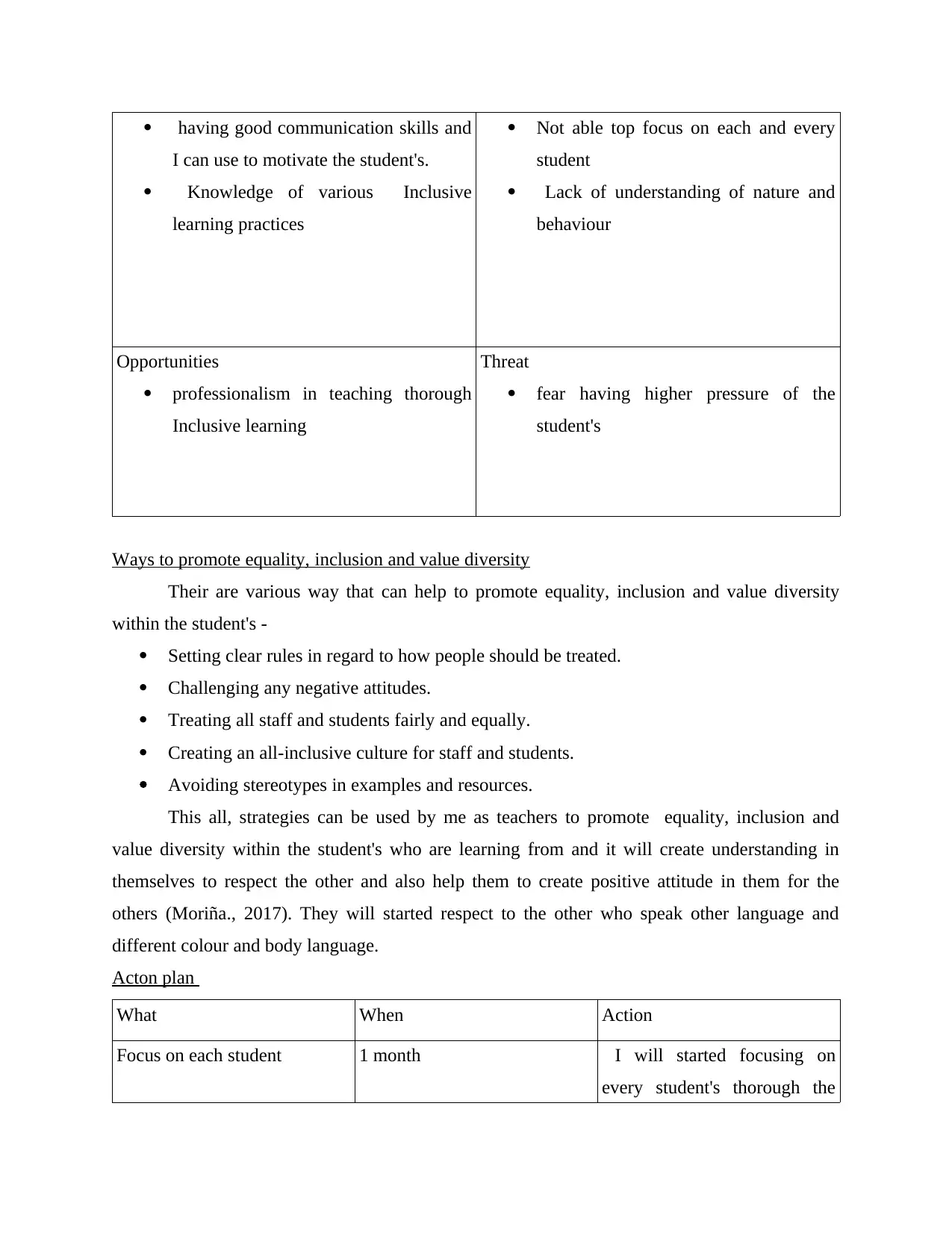
having good communication skills and
I can use to motivate the student's.
Knowledge of various Inclusive
learning practices
Not able top focus on each and every
student
Lack of understanding of nature and
behaviour
Opportunities
professionalism in teaching thorough
Inclusive learning
Threat
fear having higher pressure of the
student's
Ways to promote equality, inclusion and value diversity
Their are various way that can help to promote equality, inclusion and value diversity
within the student's -
Setting clear rules in regard to how people should be treated.
Challenging any negative attitudes.
Treating all staff and students fairly and equally.
Creating an all-inclusive culture for staff and students.
Avoiding stereotypes in examples and resources.
This all, strategies can be used by me as teachers to promote equality, inclusion and
value diversity within the student's who are learning from and it will create understanding in
themselves to respect the other and also help them to create positive attitude in them for the
others (Moriña., 2017). They will started respect to the other who speak other language and
different colour and body language.
Acton plan
What When Action
Focus on each student 1 month I will started focusing on
every student's thorough the
I can use to motivate the student's.
Knowledge of various Inclusive
learning practices
Not able top focus on each and every
student
Lack of understanding of nature and
behaviour
Opportunities
professionalism in teaching thorough
Inclusive learning
Threat
fear having higher pressure of the
student's
Ways to promote equality, inclusion and value diversity
Their are various way that can help to promote equality, inclusion and value diversity
within the student's -
Setting clear rules in regard to how people should be treated.
Challenging any negative attitudes.
Treating all staff and students fairly and equally.
Creating an all-inclusive culture for staff and students.
Avoiding stereotypes in examples and resources.
This all, strategies can be used by me as teachers to promote equality, inclusion and
value diversity within the student's who are learning from and it will create understanding in
themselves to respect the other and also help them to create positive attitude in them for the
others (Moriña., 2017). They will started respect to the other who speak other language and
different colour and body language.
Acton plan
What When Action
Focus on each student 1 month I will started focusing on
every student's thorough the
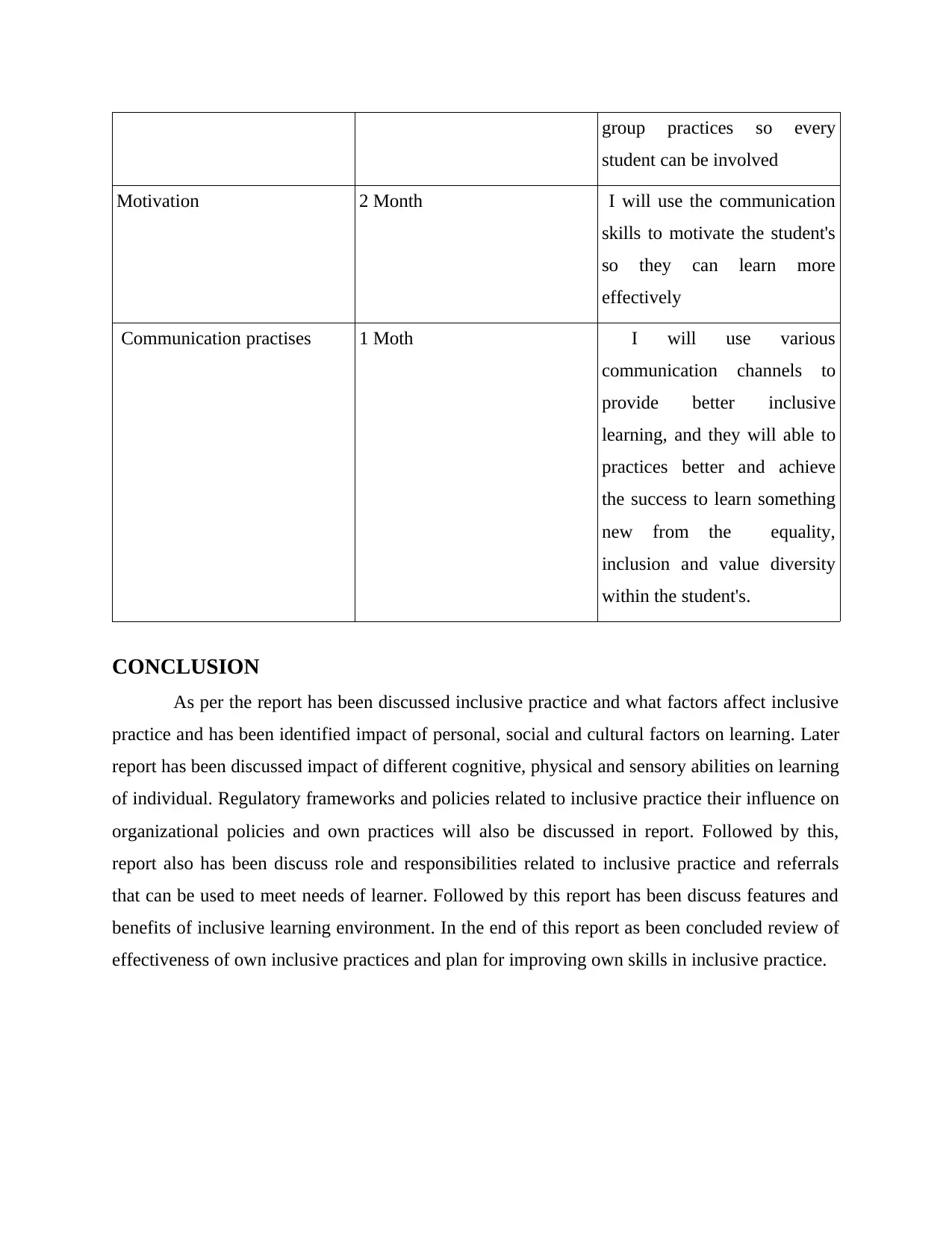
group practices so every
student can be involved
Motivation 2 Month I will use the communication
skills to motivate the student's
so they can learn more
effectively
Communication practises 1 Moth I will use various
communication channels to
provide better inclusive
learning, and they will able to
practices better and achieve
the success to learn something
new from the equality,
inclusion and value diversity
within the student's.
CONCLUSION
As per the report has been discussed inclusive practice and what factors affect inclusive
practice and has been identified impact of personal, social and cultural factors on learning. Later
report has been discussed impact of different cognitive, physical and sensory abilities on learning
of individual. Regulatory frameworks and policies related to inclusive practice their influence on
organizational policies and own practices will also be discussed in report. Followed by this,
report also has been discuss role and responsibilities related to inclusive practice and referrals
that can be used to meet needs of learner. Followed by this report has been discuss features and
benefits of inclusive learning environment. In the end of this report as been concluded review of
effectiveness of own inclusive practices and plan for improving own skills in inclusive practice.
student can be involved
Motivation 2 Month I will use the communication
skills to motivate the student's
so they can learn more
effectively
Communication practises 1 Moth I will use various
communication channels to
provide better inclusive
learning, and they will able to
practices better and achieve
the success to learn something
new from the equality,
inclusion and value diversity
within the student's.
CONCLUSION
As per the report has been discussed inclusive practice and what factors affect inclusive
practice and has been identified impact of personal, social and cultural factors on learning. Later
report has been discussed impact of different cognitive, physical and sensory abilities on learning
of individual. Regulatory frameworks and policies related to inclusive practice their influence on
organizational policies and own practices will also be discussed in report. Followed by this,
report also has been discuss role and responsibilities related to inclusive practice and referrals
that can be used to meet needs of learner. Followed by this report has been discuss features and
benefits of inclusive learning environment. In the end of this report as been concluded review of
effectiveness of own inclusive practices and plan for improving own skills in inclusive practice.
⊘ This is a preview!⊘
Do you want full access?
Subscribe today to unlock all pages.
Trusted by 1+ million students worldwide

1 out of 13


Related Documents


Your All-in-One AI-Powered Toolkit for Academic Success.
+13062052269
info@desklib.com
Available 24*7 on WhatsApp / Email
![[object Object]](/_next/static/media/star-bottom.7253800d.svg)
Unlock your academic potential
Copyright © 2020–2026 A2Z Services. All Rights Reserved. Developed and managed by ZUCOL.