Circular Flow of Income: UK SME Challenges and Government Role
VerifiedAdded on 2023/06/08
|9
|2623
|322
Essay
AI Summary
This essay examines the impact of the circular flow of income on Small and Medium Enterprises (SMEs) in the UK, particularly in the context of the Covid-19 pandemic. It identifies key challenges impacting the internal environment of businesses, such as workforce unavailability, funding shortages, increased operational costs, and raw material scarcity. The essay also highlights the role of the UK government in supporting SMEs through schemes like the Coronavirus Business Interruption Loan Scheme and Bounce Bank Loan Scheme, including benefits like tax payment deferrals and sick pay relief. Furthermore, it explores strategies adopted by SMEs to analyze the external environment, focusing on economic factors, technology advancements, regulatory changes, supplier requirements, and customer expectations, emphasizing the importance of environmental audits and sustainable practices for long-term stability. Desklib provides access to similar essays and study resources for students.
CIRCULAR FLOW
OF INCOME-
Individual Essay
OF INCOME-
Individual Essay

Paraphrase This Document
Need a fresh take? Get an instant paraphrase of this document with our AI Paraphraser
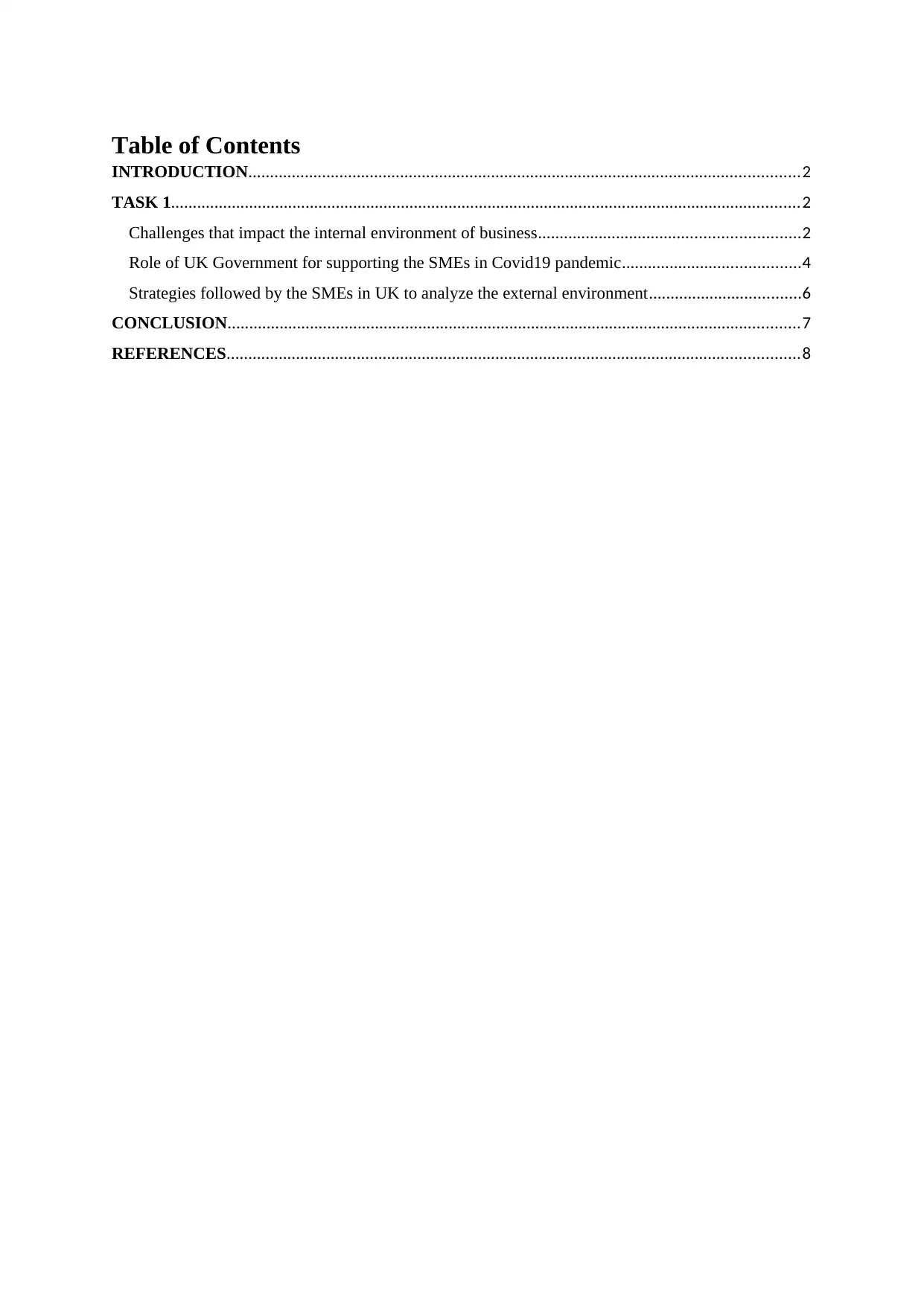
Table of Contents
INTRODUCTION...............................................................................................................................2
TASK 1.................................................................................................................................................2
Challenges that impact the internal environment of business............................................................2
Role of UK Government for supporting the SMEs in Covid19 pandemic.........................................4
Strategies followed by the SMEs in UK to analyze the external environment...................................6
CONCLUSION....................................................................................................................................7
REFERENCES....................................................................................................................................8
INTRODUCTION...............................................................................................................................2
TASK 1.................................................................................................................................................2
Challenges that impact the internal environment of business............................................................2
Role of UK Government for supporting the SMEs in Covid19 pandemic.........................................4
Strategies followed by the SMEs in UK to analyze the external environment...................................6
CONCLUSION....................................................................................................................................7
REFERENCES....................................................................................................................................8
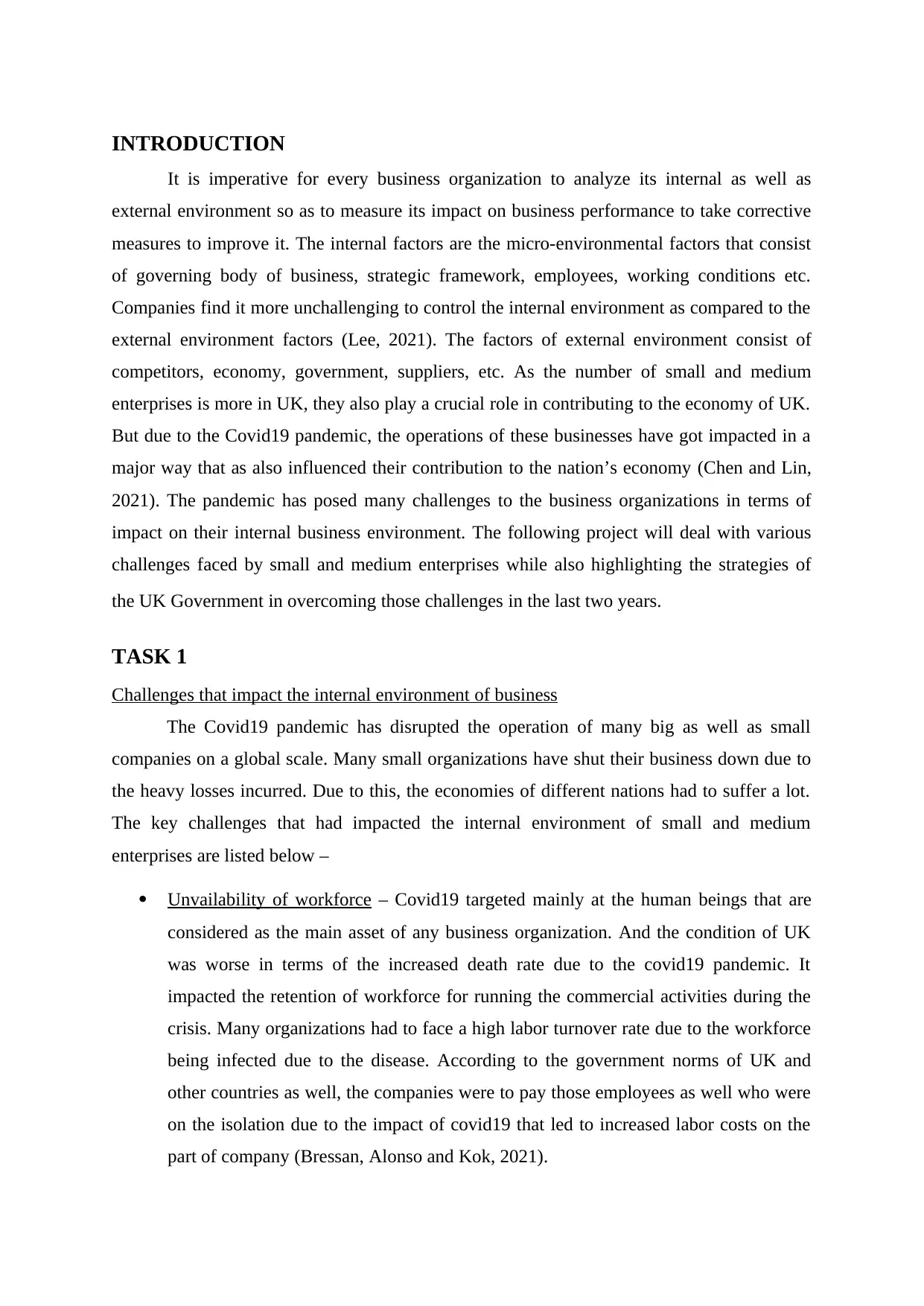
INTRODUCTION
It is imperative for every business organization to analyze its internal as well as
external environment so as to measure its impact on business performance to take corrective
measures to improve it. The internal factors are the micro-environmental factors that consist
of governing body of business, strategic framework, employees, working conditions etc.
Companies find it more unchallenging to control the internal environment as compared to the
external environment factors (Lee, 2021). The factors of external environment consist of
competitors, economy, government, suppliers, etc. As the number of small and medium
enterprises is more in UK, they also play a crucial role in contributing to the economy of UK.
But due to the Covid19 pandemic, the operations of these businesses have got impacted in a
major way that as also influenced their contribution to the nation’s economy (Chen and Lin,
2021). The pandemic has posed many challenges to the business organizations in terms of
impact on their internal business environment. The following project will deal with various
challenges faced by small and medium enterprises while also highlighting the strategies of
the UK Government in overcoming those challenges in the last two years.
TASK 1
Challenges that impact the internal environment of business
The Covid19 pandemic has disrupted the operation of many big as well as small
companies on a global scale. Many small organizations have shut their business down due to
the heavy losses incurred. Due to this, the economies of different nations had to suffer a lot.
The key challenges that had impacted the internal environment of small and medium
enterprises are listed below –
Unvailability of workforce – Covid19 targeted mainly at the human beings that are
considered as the main asset of any business organization. And the condition of UK
was worse in terms of the increased death rate due to the covid19 pandemic. It
impacted the retention of workforce for running the commercial activities during the
crisis. Many organizations had to face a high labor turnover rate due to the workforce
being infected due to the disease. According to the government norms of UK and
other countries as well, the companies were to pay those employees as well who were
on the isolation due to the impact of covid19 that led to increased labor costs on the
part of company (Bressan, Alonso and Kok, 2021).
It is imperative for every business organization to analyze its internal as well as
external environment so as to measure its impact on business performance to take corrective
measures to improve it. The internal factors are the micro-environmental factors that consist
of governing body of business, strategic framework, employees, working conditions etc.
Companies find it more unchallenging to control the internal environment as compared to the
external environment factors (Lee, 2021). The factors of external environment consist of
competitors, economy, government, suppliers, etc. As the number of small and medium
enterprises is more in UK, they also play a crucial role in contributing to the economy of UK.
But due to the Covid19 pandemic, the operations of these businesses have got impacted in a
major way that as also influenced their contribution to the nation’s economy (Chen and Lin,
2021). The pandemic has posed many challenges to the business organizations in terms of
impact on their internal business environment. The following project will deal with various
challenges faced by small and medium enterprises while also highlighting the strategies of
the UK Government in overcoming those challenges in the last two years.
TASK 1
Challenges that impact the internal environment of business
The Covid19 pandemic has disrupted the operation of many big as well as small
companies on a global scale. Many small organizations have shut their business down due to
the heavy losses incurred. Due to this, the economies of different nations had to suffer a lot.
The key challenges that had impacted the internal environment of small and medium
enterprises are listed below –
Unvailability of workforce – Covid19 targeted mainly at the human beings that are
considered as the main asset of any business organization. And the condition of UK
was worse in terms of the increased death rate due to the covid19 pandemic. It
impacted the retention of workforce for running the commercial activities during the
crisis. Many organizations had to face a high labor turnover rate due to the workforce
being infected due to the disease. According to the government norms of UK and
other countries as well, the companies were to pay those employees as well who were
on the isolation due to the impact of covid19 that led to increased labor costs on the
part of company (Bressan, Alonso and Kok, 2021).
⊘ This is a preview!⊘
Do you want full access?
Subscribe today to unlock all pages.

Trusted by 1+ million students worldwide
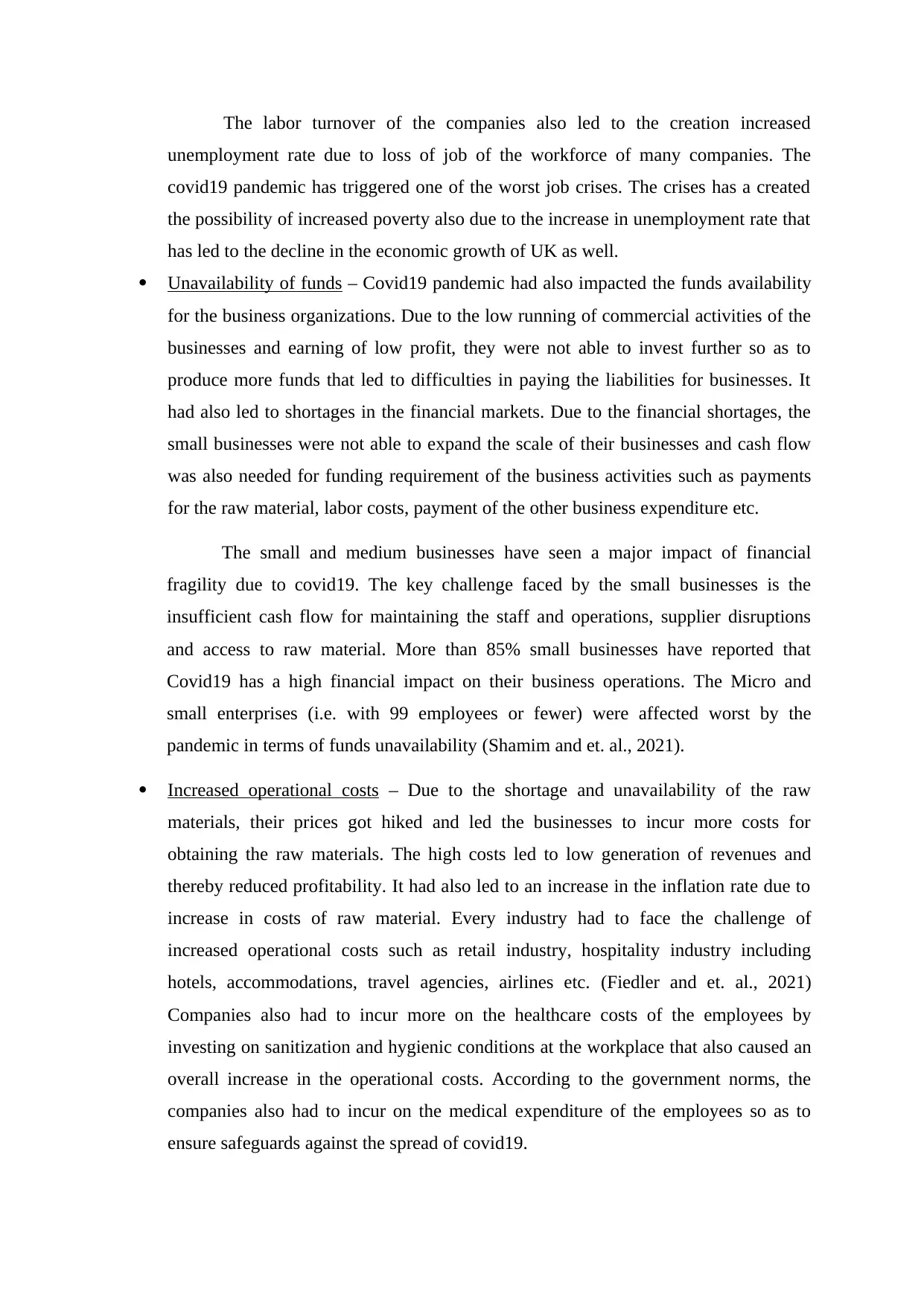
The labor turnover of the companies also led to the creation increased
unemployment rate due to loss of job of the workforce of many companies. The
covid19 pandemic has triggered one of the worst job crises. The crises has a created
the possibility of increased poverty also due to the increase in unemployment rate that
has led to the decline in the economic growth of UK as well.
Unavailability of funds – Covid19 pandemic had also impacted the funds availability
for the business organizations. Due to the low running of commercial activities of the
businesses and earning of low profit, they were not able to invest further so as to
produce more funds that led to difficulties in paying the liabilities for businesses. It
had also led to shortages in the financial markets. Due to the financial shortages, the
small businesses were not able to expand the scale of their businesses and cash flow
was also needed for funding requirement of the business activities such as payments
for the raw material, labor costs, payment of the other business expenditure etc.
The small and medium businesses have seen a major impact of financial
fragility due to covid19. The key challenge faced by the small businesses is the
insufficient cash flow for maintaining the staff and operations, supplier disruptions
and access to raw material. More than 85% small businesses have reported that
Covid19 has a high financial impact on their business operations. The Micro and
small enterprises (i.e. with 99 employees or fewer) were affected worst by the
pandemic in terms of funds unavailability (Shamim and et. al., 2021).
Increased operational costs – Due to the shortage and unavailability of the raw
materials, their prices got hiked and led the businesses to incur more costs for
obtaining the raw materials. The high costs led to low generation of revenues and
thereby reduced profitability. It had also led to an increase in the inflation rate due to
increase in costs of raw material. Every industry had to face the challenge of
increased operational costs such as retail industry, hospitality industry including
hotels, accommodations, travel agencies, airlines etc. (Fiedler and et. al., 2021)
Companies also had to incur more on the healthcare costs of the employees by
investing on sanitization and hygienic conditions at the workplace that also caused an
overall increase in the operational costs. According to the government norms, the
companies also had to incur on the medical expenditure of the employees so as to
ensure safeguards against the spread of covid19.
unemployment rate due to loss of job of the workforce of many companies. The
covid19 pandemic has triggered one of the worst job crises. The crises has a created
the possibility of increased poverty also due to the increase in unemployment rate that
has led to the decline in the economic growth of UK as well.
Unavailability of funds – Covid19 pandemic had also impacted the funds availability
for the business organizations. Due to the low running of commercial activities of the
businesses and earning of low profit, they were not able to invest further so as to
produce more funds that led to difficulties in paying the liabilities for businesses. It
had also led to shortages in the financial markets. Due to the financial shortages, the
small businesses were not able to expand the scale of their businesses and cash flow
was also needed for funding requirement of the business activities such as payments
for the raw material, labor costs, payment of the other business expenditure etc.
The small and medium businesses have seen a major impact of financial
fragility due to covid19. The key challenge faced by the small businesses is the
insufficient cash flow for maintaining the staff and operations, supplier disruptions
and access to raw material. More than 85% small businesses have reported that
Covid19 has a high financial impact on their business operations. The Micro and
small enterprises (i.e. with 99 employees or fewer) were affected worst by the
pandemic in terms of funds unavailability (Shamim and et. al., 2021).
Increased operational costs – Due to the shortage and unavailability of the raw
materials, their prices got hiked and led the businesses to incur more costs for
obtaining the raw materials. The high costs led to low generation of revenues and
thereby reduced profitability. It had also led to an increase in the inflation rate due to
increase in costs of raw material. Every industry had to face the challenge of
increased operational costs such as retail industry, hospitality industry including
hotels, accommodations, travel agencies, airlines etc. (Fiedler and et. al., 2021)
Companies also had to incur more on the healthcare costs of the employees by
investing on sanitization and hygienic conditions at the workplace that also caused an
overall increase in the operational costs. According to the government norms, the
companies also had to incur on the medical expenditure of the employees so as to
ensure safeguards against the spread of covid19.
Paraphrase This Document
Need a fresh take? Get an instant paraphrase of this document with our AI Paraphraser
Unavailability of raw material – The pandemic has made the businesses for
maintaining the supply of raw material on a consistent basis and at the reasonable
prices. It had created supply chain problems for the production companies. The
manufacturing processes of the small companies observed a major hit. This led to
increase in the operating cycle period so as to maintain the working capital
requirement. Due to the shut-down of production businesses also, the businesses
observed lack of availability of sources of obtaining the raw material as the very
source of obtaining raw material is the producer itself and the production businesses
were also closed during the pandemic (Morris, Morris and Bowen, 2022).
The business organizations that are dependent on the imported raw material
to run their business activities have to suffer a lot due to the restrictions made by the
government of different nations on the import or export of products or raw materials.
Due to this, the businesses started to find out other sources of supply chain that led
top increase in the cost of acquisition of raw materials. The firms were having the
options either to purchase the raw material at high costs or wait till the situation
becomes normal.
Role of UK Government for supporting the SMEs in Covid19 pandemic
The Government of UK has depicted its essential role in dealing with the covid19
crises. To support the small and medium enterprises, the UK government had launched 2
schemes i.e. Coronavirus Business Interruption Loan Scheme and Bounce Bank Loan
Scheme. Apart from this, a new Coronavirus business Interruption Loan Scheme that will
measure banks offer loans upto £5 million for supporting the SMEs. The government will
meet the costs of interest on these loans for the first 6 months. In September, 2019, the
government had also provided the job opportunities for many SMEs workers. The businesses
such as the Logistics business, construction business, Farm businesses, etc. were majorly hit
by the pandemic in terms of their operational performance. The government provided many
benefits to the small businesses like deferred tax payments, protection schemes, and sick pay
relief etc. (Bastas and Garza-Reyes, 2022)
The government had also supported the employees in adopting work from home by
providing them with effective technology in performing their duties and tasks. By stipulating
The Employment right Act, the government also provided the right to the workers to choose
their place of work so as to avoid any infection form covid19. This has led to the increased
productivity of the businesses because of ensuring safety of the employees at all times during
maintaining the supply of raw material on a consistent basis and at the reasonable
prices. It had created supply chain problems for the production companies. The
manufacturing processes of the small companies observed a major hit. This led to
increase in the operating cycle period so as to maintain the working capital
requirement. Due to the shut-down of production businesses also, the businesses
observed lack of availability of sources of obtaining the raw material as the very
source of obtaining raw material is the producer itself and the production businesses
were also closed during the pandemic (Morris, Morris and Bowen, 2022).
The business organizations that are dependent on the imported raw material
to run their business activities have to suffer a lot due to the restrictions made by the
government of different nations on the import or export of products or raw materials.
Due to this, the businesses started to find out other sources of supply chain that led
top increase in the cost of acquisition of raw materials. The firms were having the
options either to purchase the raw material at high costs or wait till the situation
becomes normal.
Role of UK Government for supporting the SMEs in Covid19 pandemic
The Government of UK has depicted its essential role in dealing with the covid19
crises. To support the small and medium enterprises, the UK government had launched 2
schemes i.e. Coronavirus Business Interruption Loan Scheme and Bounce Bank Loan
Scheme. Apart from this, a new Coronavirus business Interruption Loan Scheme that will
measure banks offer loans upto £5 million for supporting the SMEs. The government will
meet the costs of interest on these loans for the first 6 months. In September, 2019, the
government had also provided the job opportunities for many SMEs workers. The businesses
such as the Logistics business, construction business, Farm businesses, etc. were majorly hit
by the pandemic in terms of their operational performance. The government provided many
benefits to the small businesses like deferred tax payments, protection schemes, and sick pay
relief etc. (Bastas and Garza-Reyes, 2022)
The government had also supported the employees in adopting work from home by
providing them with effective technology in performing their duties and tasks. By stipulating
The Employment right Act, the government also provided the right to the workers to choose
their place of work so as to avoid any infection form covid19. This has led to the increased
productivity of the businesses because of ensuring safety of the employees at all times during
the pandemic. The purpose of launching these schemes is to diminish the financial burden of
small and medium enterprises so as to ensure smooth running of their operations in order to
support their survival by dealing with the Covid18 crises effectively. Some of the key
benefits that were provided to the SMEs are listed below –
Reduction in the work burden by ensuring division of the work in two shifts.
Supporting in the closure of businesses for a small period.
Ensured reduction in the working hours.
Providing the advantage of work from home to the employees.
Some of the schemes that were introduced by the UK government to support the SMEs
during the Covid crises are discussed below –
Coronavirus Business Interruption Loan – The government granted loans to the SMEs
that showed the yearly turnover of less than £45 million so as to support the
businesses in ensuring long term stability in the market by running the business
operations smoothly.
Grant of Funds – The SMEs that were having the property worth not more than
£15000 were granted an amount of £1000. SMEs got the advantage of acquiring the
fixed assets for the businesses such as plant and machinery, building etc. as a rural
rate relief.
Advantage of HMRC time for paying tax – The government had provided some
relaxations in the payment of tax such as payment of tax at later times by the SMEs so
as to cope up with the pandemic while managing the annual revenues and investments
of safety measures (Mustafa, 2022).
Deferment of Self-Assessment payments – In the entire UK, the tax payers were
allowed to make payment of tax till June 2020. To provide convenience in the
payment of tax, the government had also supported an online facility to support the
payment of tax in an online mode. The benefit of VAT holiday was also provided to
the tax payers.
Strategies followed by the SMEs in UK to analyze the external environment
To deal with the covid19 pandemic, SMEs had also conducted an environmental audit
so as to measure the impact of external environment factors in the performance of business to
take corrective measures to improve the performance of business so as to ensure its survival
and stability in the marketplace by ensuring long-term sustainability. For analyzing the
small and medium enterprises so as to ensure smooth running of their operations in order to
support their survival by dealing with the Covid18 crises effectively. Some of the key
benefits that were provided to the SMEs are listed below –
Reduction in the work burden by ensuring division of the work in two shifts.
Supporting in the closure of businesses for a small period.
Ensured reduction in the working hours.
Providing the advantage of work from home to the employees.
Some of the schemes that were introduced by the UK government to support the SMEs
during the Covid crises are discussed below –
Coronavirus Business Interruption Loan – The government granted loans to the SMEs
that showed the yearly turnover of less than £45 million so as to support the
businesses in ensuring long term stability in the market by running the business
operations smoothly.
Grant of Funds – The SMEs that were having the property worth not more than
£15000 were granted an amount of £1000. SMEs got the advantage of acquiring the
fixed assets for the businesses such as plant and machinery, building etc. as a rural
rate relief.
Advantage of HMRC time for paying tax – The government had provided some
relaxations in the payment of tax such as payment of tax at later times by the SMEs so
as to cope up with the pandemic while managing the annual revenues and investments
of safety measures (Mustafa, 2022).
Deferment of Self-Assessment payments – In the entire UK, the tax payers were
allowed to make payment of tax till June 2020. To provide convenience in the
payment of tax, the government had also supported an online facility to support the
payment of tax in an online mode. The benefit of VAT holiday was also provided to
the tax payers.
Strategies followed by the SMEs in UK to analyze the external environment
To deal with the covid19 pandemic, SMEs had also conducted an environmental audit
so as to measure the impact of external environment factors in the performance of business to
take corrective measures to improve the performance of business so as to ensure its survival
and stability in the marketplace by ensuring long-term sustainability. For analyzing the
⊘ This is a preview!⊘
Do you want full access?
Subscribe today to unlock all pages.
Trusted by 1+ million students worldwide
macro-environment, they took into consideration the analysis of competitors. Suppliers,
technology, economy etc. The strategies followed by the SMEs in analyzing the external
environment are as follows –
Economic factors – The SMEs have considered the economic factors like rate of
unemployment due to the Covid19 pandemic and put more emphasis on creating more
employment opportunities and providing safe working conditions to the workforce so
as to reduce the labor turnover.
Technology Advancement – With the advancement in technology, the company has
adopted the strategy of contacting with the employees and providing them tasks while
working from home. By this, the company can have the benefit of reduced operational
fixed costs (Russo and Schena, 2021).
Regulatory changes – Keeping in mind the legal factors or regulatory factors of
government of different countries, they have developed their strategies for imports
and exports while complying with the laws for the safety of employees and their
payments during the pandemic.
Supplier Requirements – The SMEs are preparing the strategies for an uninterrupted
supply chains while maintaining healthy relations with the large businesses so as to
ensure timely availability of the required material. Post the pandemic, the SMEs are
following the strategies of Digital supply chain operations and Technology solutions,
Supply chain logistics management and leadership strategy.
Customers’ Expectations – To satisfy the demand of customers in the post pandemic
world, the SMEs are offering the products at reasonable prices while not
compromising with the quality of products. They are developing strategies to develop
a loyal customer base after the pandemic. They are focusing more on collecting
customers’ feedbacks to develop customer loyalty.
CONCLUSION
It can be analyzed for the above report that Small and medium enterprises have
experienced a major hit on their financial as well as operational performance due to the
covid19 pandemic. It has posed many challenges to the small businesses in terms of
unavailability of skillful workforce, raw material etc. That caused lack of flexibility in
meeting with the uncertainties as a result of which overall profitability of the business got
reduced that affected the national economies of the countries. In context with UK, its
technology, economy etc. The strategies followed by the SMEs in analyzing the external
environment are as follows –
Economic factors – The SMEs have considered the economic factors like rate of
unemployment due to the Covid19 pandemic and put more emphasis on creating more
employment opportunities and providing safe working conditions to the workforce so
as to reduce the labor turnover.
Technology Advancement – With the advancement in technology, the company has
adopted the strategy of contacting with the employees and providing them tasks while
working from home. By this, the company can have the benefit of reduced operational
fixed costs (Russo and Schena, 2021).
Regulatory changes – Keeping in mind the legal factors or regulatory factors of
government of different countries, they have developed their strategies for imports
and exports while complying with the laws for the safety of employees and their
payments during the pandemic.
Supplier Requirements – The SMEs are preparing the strategies for an uninterrupted
supply chains while maintaining healthy relations with the large businesses so as to
ensure timely availability of the required material. Post the pandemic, the SMEs are
following the strategies of Digital supply chain operations and Technology solutions,
Supply chain logistics management and leadership strategy.
Customers’ Expectations – To satisfy the demand of customers in the post pandemic
world, the SMEs are offering the products at reasonable prices while not
compromising with the quality of products. They are developing strategies to develop
a loyal customer base after the pandemic. They are focusing more on collecting
customers’ feedbacks to develop customer loyalty.
CONCLUSION
It can be analyzed for the above report that Small and medium enterprises have
experienced a major hit on their financial as well as operational performance due to the
covid19 pandemic. It has posed many challenges to the small businesses in terms of
unavailability of skillful workforce, raw material etc. That caused lack of flexibility in
meeting with the uncertainties as a result of which overall profitability of the business got
reduced that affected the national economies of the countries. In context with UK, its
Paraphrase This Document
Need a fresh take? Get an instant paraphrase of this document with our AI Paraphraser
Government took a major participation in dealing with the covid crises to support the SMEs,
it has provided many benefits in the form of tax relaxations, grant of loan etc. so as to be back
to the normal position. Apart from this, the SMEs are also conducting an analysis of the
external environment so as to develop effective strategies for surviving in the post pandemic
world by considering the factors like economics, technology, competition etc.
it has provided many benefits in the form of tax relaxations, grant of loan etc. so as to be back
to the normal position. Apart from this, the SMEs are also conducting an analysis of the
external environment so as to develop effective strategies for surviving in the post pandemic
world by considering the factors like economics, technology, competition etc.
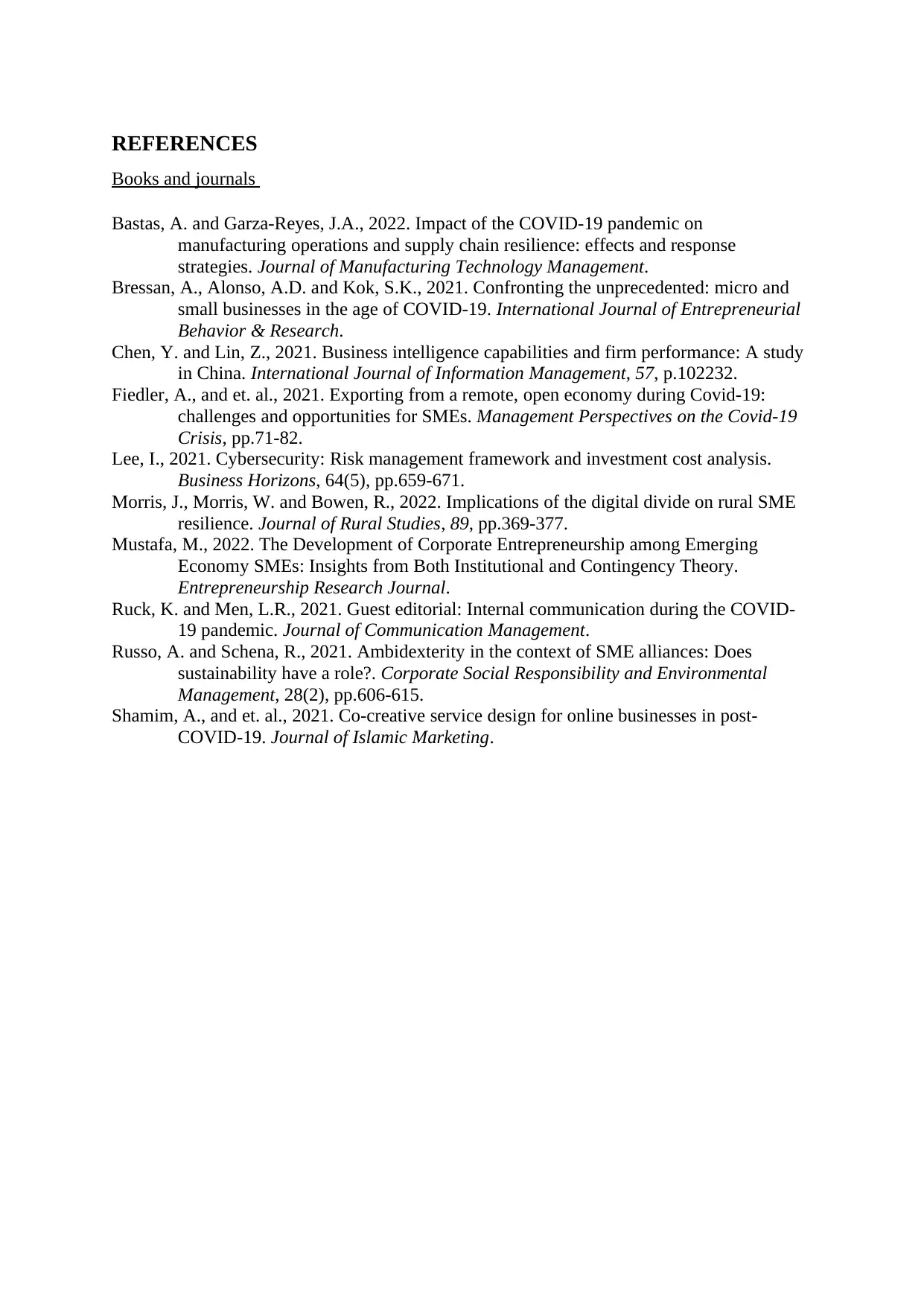
REFERENCES
Books and journals
Bastas, A. and Garza-Reyes, J.A., 2022. Impact of the COVID-19 pandemic on
manufacturing operations and supply chain resilience: effects and response
strategies. Journal of Manufacturing Technology Management.
Bressan, A., Alonso, A.D. and Kok, S.K., 2021. Confronting the unprecedented: micro and
small businesses in the age of COVID-19. International Journal of Entrepreneurial
Behavior & Research.
Chen, Y. and Lin, Z., 2021. Business intelligence capabilities and firm performance: A study
in China. International Journal of Information Management, 57, p.102232.
Fiedler, A., and et. al., 2021. Exporting from a remote, open economy during Covid-19:
challenges and opportunities for SMEs. Management Perspectives on the Covid-19
Crisis, pp.71-82.
Lee, I., 2021. Cybersecurity: Risk management framework and investment cost analysis.
Business Horizons, 64(5), pp.659-671.
Morris, J., Morris, W. and Bowen, R., 2022. Implications of the digital divide on rural SME
resilience. Journal of Rural Studies, 89, pp.369-377.
Mustafa, M., 2022. The Development of Corporate Entrepreneurship among Emerging
Economy SMEs: Insights from Both Institutional and Contingency Theory.
Entrepreneurship Research Journal.
Ruck, K. and Men, L.R., 2021. Guest editorial: Internal communication during the COVID-
19 pandemic. Journal of Communication Management.
Russo, A. and Schena, R., 2021. Ambidexterity in the context of SME alliances: Does
sustainability have a role?. Corporate Social Responsibility and Environmental
Management, 28(2), pp.606-615.
Shamim, A., and et. al., 2021. Co-creative service design for online businesses in post-
COVID-19. Journal of Islamic Marketing.
Books and journals
Bastas, A. and Garza-Reyes, J.A., 2022. Impact of the COVID-19 pandemic on
manufacturing operations and supply chain resilience: effects and response
strategies. Journal of Manufacturing Technology Management.
Bressan, A., Alonso, A.D. and Kok, S.K., 2021. Confronting the unprecedented: micro and
small businesses in the age of COVID-19. International Journal of Entrepreneurial
Behavior & Research.
Chen, Y. and Lin, Z., 2021. Business intelligence capabilities and firm performance: A study
in China. International Journal of Information Management, 57, p.102232.
Fiedler, A., and et. al., 2021. Exporting from a remote, open economy during Covid-19:
challenges and opportunities for SMEs. Management Perspectives on the Covid-19
Crisis, pp.71-82.
Lee, I., 2021. Cybersecurity: Risk management framework and investment cost analysis.
Business Horizons, 64(5), pp.659-671.
Morris, J., Morris, W. and Bowen, R., 2022. Implications of the digital divide on rural SME
resilience. Journal of Rural Studies, 89, pp.369-377.
Mustafa, M., 2022. The Development of Corporate Entrepreneurship among Emerging
Economy SMEs: Insights from Both Institutional and Contingency Theory.
Entrepreneurship Research Journal.
Ruck, K. and Men, L.R., 2021. Guest editorial: Internal communication during the COVID-
19 pandemic. Journal of Communication Management.
Russo, A. and Schena, R., 2021. Ambidexterity in the context of SME alliances: Does
sustainability have a role?. Corporate Social Responsibility and Environmental
Management, 28(2), pp.606-615.
Shamim, A., and et. al., 2021. Co-creative service design for online businesses in post-
COVID-19. Journal of Islamic Marketing.
⊘ This is a preview!⊘
Do you want full access?
Subscribe today to unlock all pages.
Trusted by 1+ million students worldwide

1 out of 9


Related Documents


Your All-in-One AI-Powered Toolkit for Academic Success.
+13062052269
info@desklib.com
Available 24*7 on WhatsApp / Email
![[object Object]](/_next/static/media/star-bottom.7253800d.svg)
Unlock your academic potential
Copyright © 2020–2026 A2Z Services. All Rights Reserved. Developed and managed by ZUCOL.