Taxation Analysis: Assessable Income, Car Fringe Benefit, and CGT
VerifiedAdded on 2023/06/11
|10
|2570
|385
Homework Assignment
AI Summary
This assignment provides a comprehensive analysis of various taxation concepts, including the assessment of income from personal exertion, the calculation of taxable car fringe benefits using the statutory formula, and the implications of capital gains tax (CGT) in different scenarios. It examines the taxability of income derived from skills and hobbies, explores the computation of fringe benefits provided to employees, and discusses the tax consequences of intra-family loans. Furthermore, the analysis delves into the complexities of CGT, considering factors such as the date of property acquisition, improvements made to the property, and the potential impact of selling property to family members or through a company. The assignment concludes by highlighting the importance of tax compliance and the distinct tax obligations of individuals and companies, emphasizing the need to adhere to applicable tax rules to avoid penalties. Desklib offers a wealth of resources, including past papers and solved assignments, to support students in mastering these complex topics.

Taxation
Tax analysis
Tax analysis

Paraphrase This Document
Need a fresh take? Get an instant paraphrase of this document with our AI Paraphraser
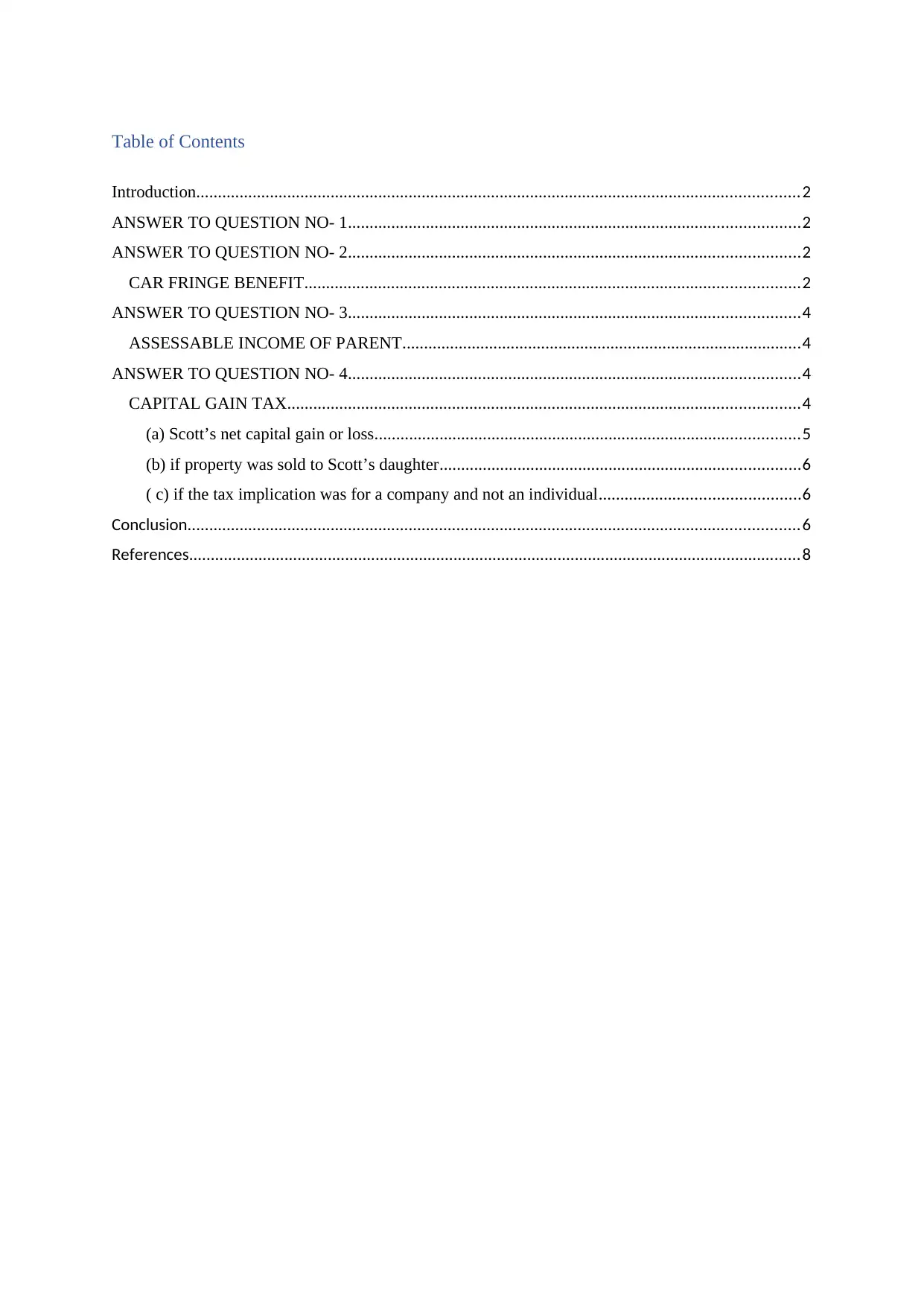
Table of Contents
Introduction...........................................................................................................................................2
ANSWER TO QUESTION NO- 1........................................................................................................2
ANSWER TO QUESTION NO- 2........................................................................................................2
CAR FRINGE BENEFIT..................................................................................................................2
ANSWER TO QUESTION NO- 3........................................................................................................4
ASSESSABLE INCOME OF PARENT............................................................................................4
ANSWER TO QUESTION NO- 4........................................................................................................4
CAPITAL GAIN TAX......................................................................................................................4
(a) Scott’s net capital gain or loss..................................................................................................5
(b) if property was sold to Scott’s daughter...................................................................................6
( c) if the tax implication was for a company and not an individual..............................................6
Conclusion.............................................................................................................................................6
References.............................................................................................................................................8
Introduction...........................................................................................................................................2
ANSWER TO QUESTION NO- 1........................................................................................................2
ANSWER TO QUESTION NO- 2........................................................................................................2
CAR FRINGE BENEFIT..................................................................................................................2
ANSWER TO QUESTION NO- 3........................................................................................................4
ASSESSABLE INCOME OF PARENT............................................................................................4
ANSWER TO QUESTION NO- 4........................................................................................................4
CAPITAL GAIN TAX......................................................................................................................4
(a) Scott’s net capital gain or loss..................................................................................................5
(b) if property was sold to Scott’s daughter...................................................................................6
( c) if the tax implication was for a company and not an individual..............................................6
Conclusion.............................................................................................................................................6
References.............................................................................................................................................8
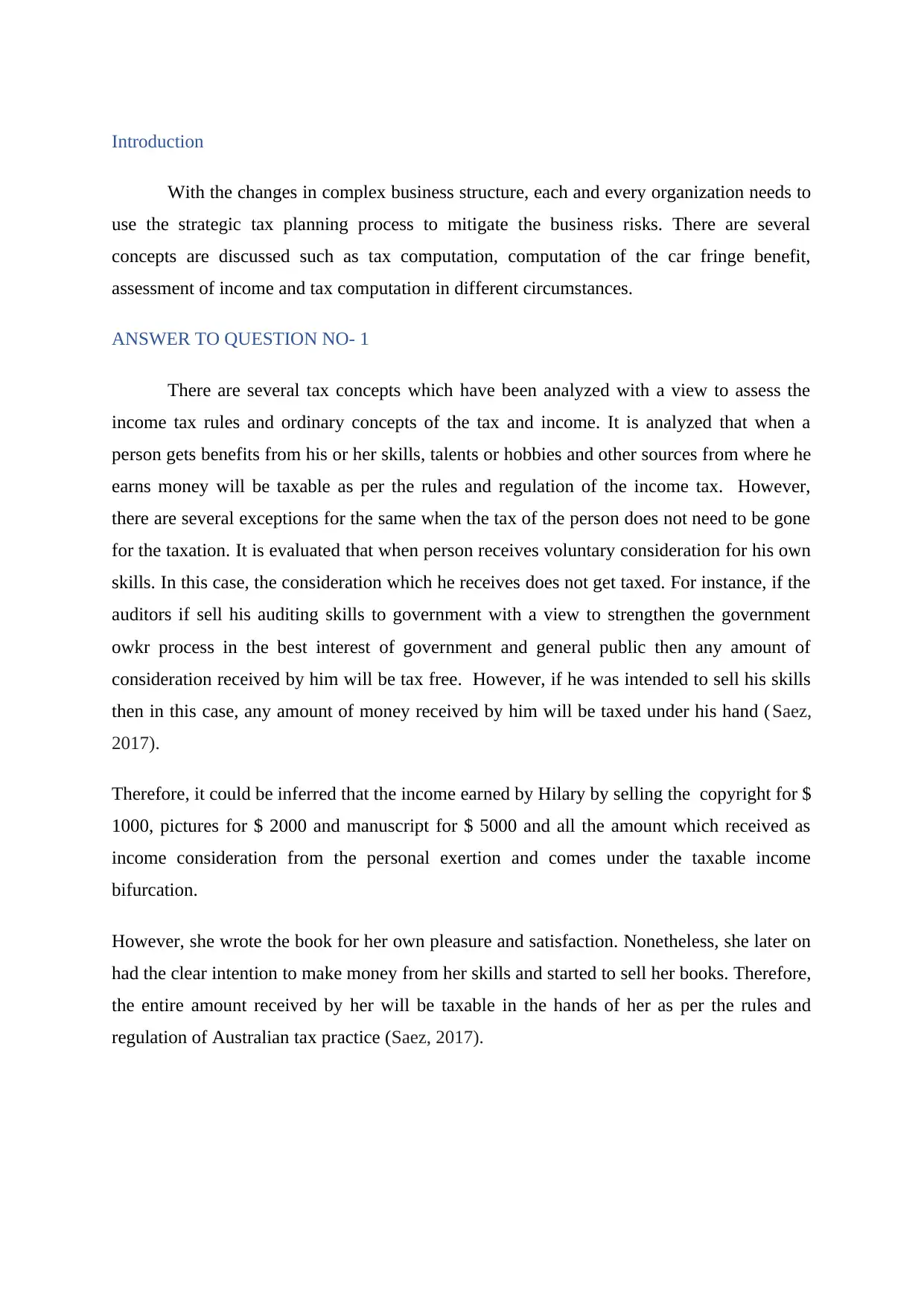
Introduction
With the changes in complex business structure, each and every organization needs to
use the strategic tax planning process to mitigate the business risks. There are several
concepts are discussed such as tax computation, computation of the car fringe benefit,
assessment of income and tax computation in different circumstances.
ANSWER TO QUESTION NO- 1
There are several tax concepts which have been analyzed with a view to assess the
income tax rules and ordinary concepts of the tax and income. It is analyzed that when a
person gets benefits from his or her skills, talents or hobbies and other sources from where he
earns money will be taxable as per the rules and regulation of the income tax. However,
there are several exceptions for the same when the tax of the person does not need to be gone
for the taxation. It is evaluated that when person receives voluntary consideration for his own
skills. In this case, the consideration which he receives does not get taxed. For instance, if the
auditors if sell his auditing skills to government with a view to strengthen the government
owkr process in the best interest of government and general public then any amount of
consideration received by him will be tax free. However, if he was intended to sell his skills
then in this case, any amount of money received by him will be taxed under his hand (Saez,
2017).
Therefore, it could be inferred that the income earned by Hilary by selling the copyright for $
1000, pictures for $ 2000 and manuscript for $ 5000 and all the amount which received as
income consideration from the personal exertion and comes under the taxable income
bifurcation.
However, she wrote the book for her own pleasure and satisfaction. Nonetheless, she later on
had the clear intention to make money from her skills and started to sell her books. Therefore,
the entire amount received by her will be taxable in the hands of her as per the rules and
regulation of Australian tax practice (Saez, 2017).
With the changes in complex business structure, each and every organization needs to
use the strategic tax planning process to mitigate the business risks. There are several
concepts are discussed such as tax computation, computation of the car fringe benefit,
assessment of income and tax computation in different circumstances.
ANSWER TO QUESTION NO- 1
There are several tax concepts which have been analyzed with a view to assess the
income tax rules and ordinary concepts of the tax and income. It is analyzed that when a
person gets benefits from his or her skills, talents or hobbies and other sources from where he
earns money will be taxable as per the rules and regulation of the income tax. However,
there are several exceptions for the same when the tax of the person does not need to be gone
for the taxation. It is evaluated that when person receives voluntary consideration for his own
skills. In this case, the consideration which he receives does not get taxed. For instance, if the
auditors if sell his auditing skills to government with a view to strengthen the government
owkr process in the best interest of government and general public then any amount of
consideration received by him will be tax free. However, if he was intended to sell his skills
then in this case, any amount of money received by him will be taxed under his hand (Saez,
2017).
Therefore, it could be inferred that the income earned by Hilary by selling the copyright for $
1000, pictures for $ 2000 and manuscript for $ 5000 and all the amount which received as
income consideration from the personal exertion and comes under the taxable income
bifurcation.
However, she wrote the book for her own pleasure and satisfaction. Nonetheless, she later on
had the clear intention to make money from her skills and started to sell her books. Therefore,
the entire amount received by her will be taxable in the hands of her as per the rules and
regulation of Australian tax practice (Saez, 2017).
⊘ This is a preview!⊘
Do you want full access?
Subscribe today to unlock all pages.

Trusted by 1+ million students worldwide
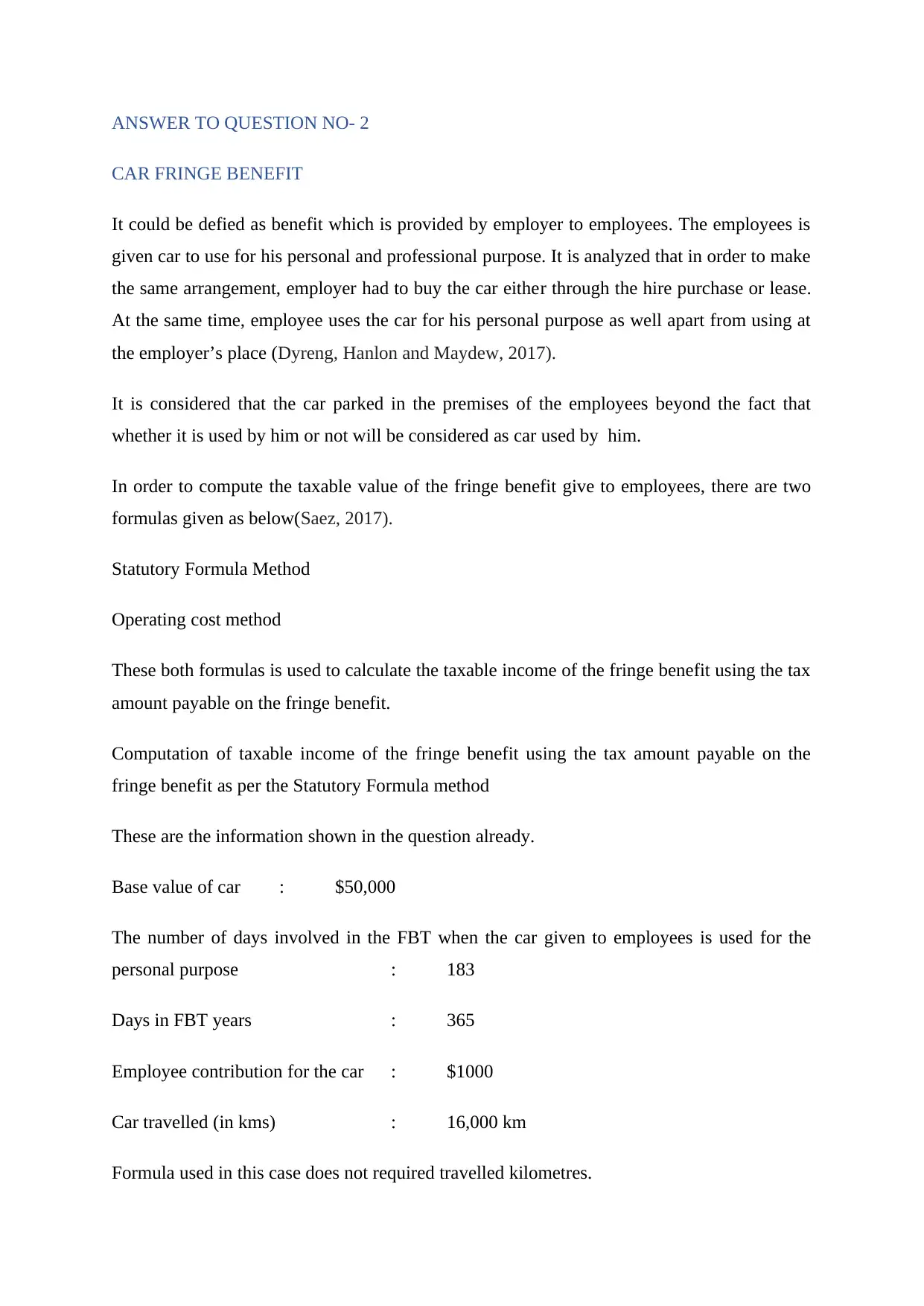
ANSWER TO QUESTION NO- 2
CAR FRINGE BENEFIT
It could be defied as benefit which is provided by employer to employees. The employees is
given car to use for his personal and professional purpose. It is analyzed that in order to make
the same arrangement, employer had to buy the car either through the hire purchase or lease.
At the same time, employee uses the car for his personal purpose as well apart from using at
the employer’s place (Dyreng, Hanlon and Maydew, 2017).
It is considered that the car parked in the premises of the employees beyond the fact that
whether it is used by him or not will be considered as car used by him.
In order to compute the taxable value of the fringe benefit give to employees, there are two
formulas given as below(Saez, 2017).
Statutory Formula Method
Operating cost method
These both formulas is used to calculate the taxable income of the fringe benefit using the tax
amount payable on the fringe benefit.
Computation of taxable income of the fringe benefit using the tax amount payable on the
fringe benefit as per the Statutory Formula method
These are the information shown in the question already.
Base value of car : $50,000
The number of days involved in the FBT when the car given to employees is used for the
personal purpose : 183
Days in FBT years : 365
Employee contribution for the car : $1000
Car travelled (in kms) : 16,000 km
Formula used in this case does not required travelled kilometres.
CAR FRINGE BENEFIT
It could be defied as benefit which is provided by employer to employees. The employees is
given car to use for his personal and professional purpose. It is analyzed that in order to make
the same arrangement, employer had to buy the car either through the hire purchase or lease.
At the same time, employee uses the car for his personal purpose as well apart from using at
the employer’s place (Dyreng, Hanlon and Maydew, 2017).
It is considered that the car parked in the premises of the employees beyond the fact that
whether it is used by him or not will be considered as car used by him.
In order to compute the taxable value of the fringe benefit give to employees, there are two
formulas given as below(Saez, 2017).
Statutory Formula Method
Operating cost method
These both formulas is used to calculate the taxable income of the fringe benefit using the tax
amount payable on the fringe benefit.
Computation of taxable income of the fringe benefit using the tax amount payable on the
fringe benefit as per the Statutory Formula method
These are the information shown in the question already.
Base value of car : $50,000
The number of days involved in the FBT when the car given to employees is used for the
personal purpose : 183
Days in FBT years : 365
Employee contribution for the car : $1000
Car travelled (in kms) : 16,000 km
Formula used in this case does not required travelled kilometres.
Paraphrase This Document
Need a fresh take? Get an instant paraphrase of this document with our AI Paraphraser
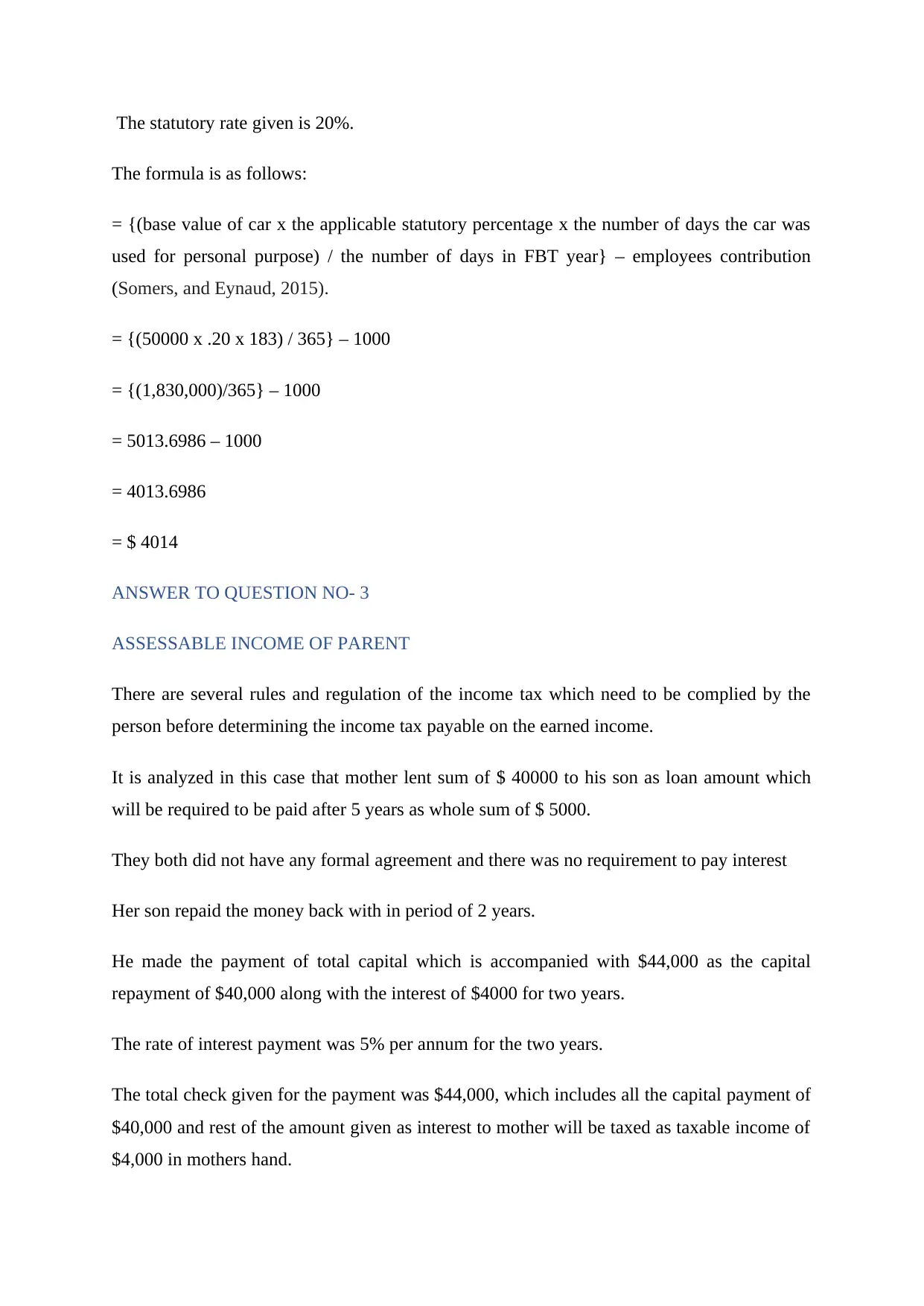
The statutory rate given is 20%.
The formula is as follows:
= {(base value of car x the applicable statutory percentage x the number of days the car was
used for personal purpose) / the number of days in FBT year} – employees contribution
(Somers, and Eynaud, 2015).
= {(50000 x .20 x 183) / 365} – 1000
= {(1,830,000)/365} – 1000
= 5013.6986 – 1000
= 4013.6986
= $ 4014
ANSWER TO QUESTION NO- 3
ASSESSABLE INCOME OF PARENT
There are several rules and regulation of the income tax which need to be complied by the
person before determining the income tax payable on the earned income.
It is analyzed in this case that mother lent sum of $ 40000 to his son as loan amount which
will be required to be paid after 5 years as whole sum of $ 5000.
They both did not have any formal agreement and there was no requirement to pay interest
Her son repaid the money back with in period of 2 years.
He made the payment of total capital which is accompanied with $44,000 as the capital
repayment of $40,000 along with the interest of $4000 for two years.
The rate of interest payment was 5% per annum for the two years.
The total check given for the payment was $44,000, which includes all the capital payment of
$40,000 and rest of the amount given as interest to mother will be taxed as taxable income of
$4,000 in mothers hand.
The formula is as follows:
= {(base value of car x the applicable statutory percentage x the number of days the car was
used for personal purpose) / the number of days in FBT year} – employees contribution
(Somers, and Eynaud, 2015).
= {(50000 x .20 x 183) / 365} – 1000
= {(1,830,000)/365} – 1000
= 5013.6986 – 1000
= 4013.6986
= $ 4014
ANSWER TO QUESTION NO- 3
ASSESSABLE INCOME OF PARENT
There are several rules and regulation of the income tax which need to be complied by the
person before determining the income tax payable on the earned income.
It is analyzed in this case that mother lent sum of $ 40000 to his son as loan amount which
will be required to be paid after 5 years as whole sum of $ 5000.
They both did not have any formal agreement and there was no requirement to pay interest
Her son repaid the money back with in period of 2 years.
He made the payment of total capital which is accompanied with $44,000 as the capital
repayment of $40,000 along with the interest of $4000 for two years.
The rate of interest payment was 5% per annum for the two years.
The total check given for the payment was $44,000, which includes all the capital payment of
$40,000 and rest of the amount given as interest to mother will be taxed as taxable income of
$4,000 in mothers hand.
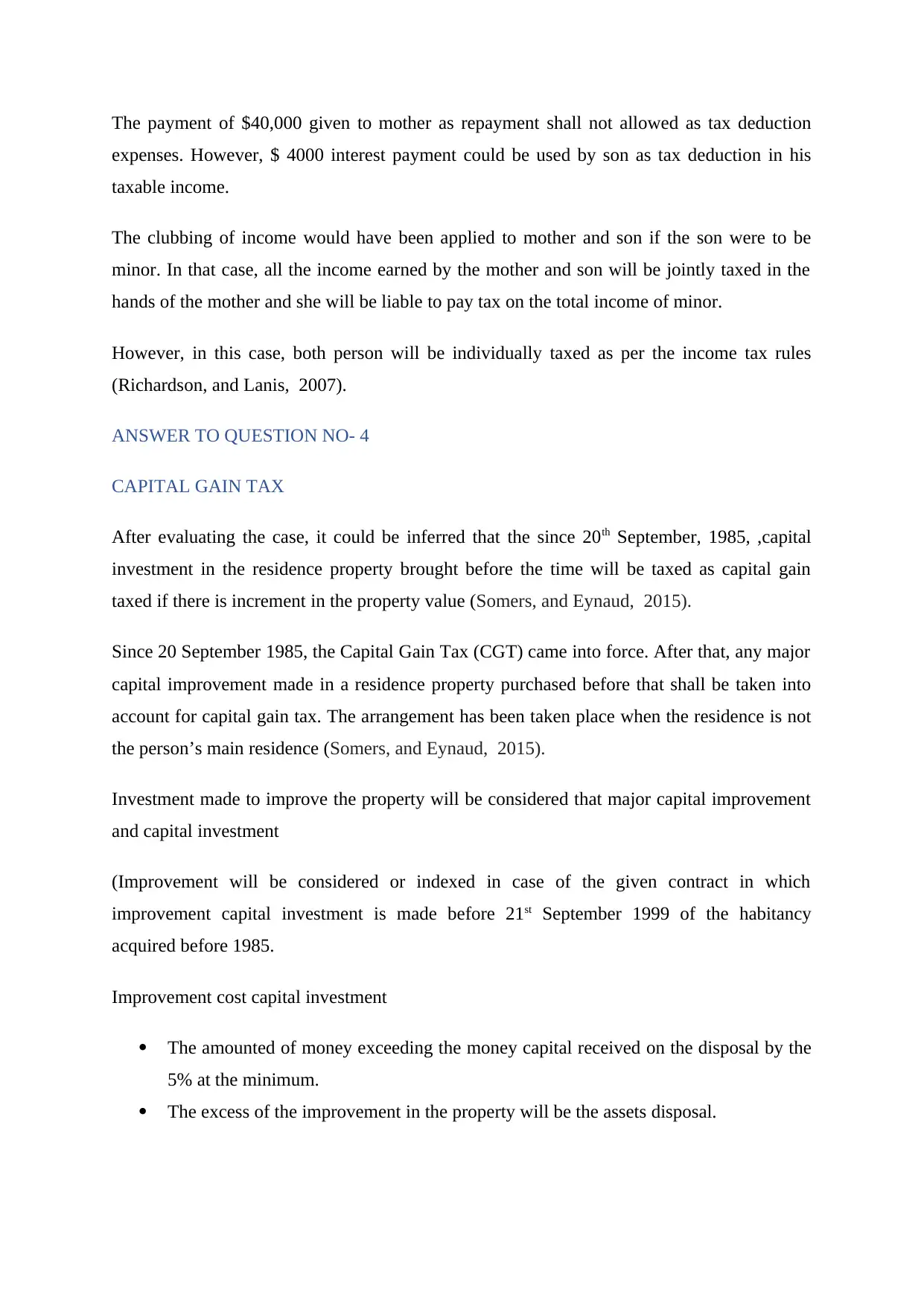
The payment of $40,000 given to mother as repayment shall not allowed as tax deduction
expenses. However, $ 4000 interest payment could be used by son as tax deduction in his
taxable income.
The clubbing of income would have been applied to mother and son if the son were to be
minor. In that case, all the income earned by the mother and son will be jointly taxed in the
hands of the mother and she will be liable to pay tax on the total income of minor.
However, in this case, both person will be individually taxed as per the income tax rules
(Richardson, and Lanis, 2007).
ANSWER TO QUESTION NO- 4
CAPITAL GAIN TAX
After evaluating the case, it could be inferred that the since 20th September, 1985, ,capital
investment in the residence property brought before the time will be taxed as capital gain
taxed if there is increment in the property value (Somers, and Eynaud, 2015).
Since 20 September 1985, the Capital Gain Tax (CGT) came into force. After that, any major
capital improvement made in a residence property purchased before that shall be taken into
account for capital gain tax. The arrangement has been taken place when the residence is not
the person’s main residence (Somers, and Eynaud, 2015).
Investment made to improve the property will be considered that major capital improvement
and capital investment
(Improvement will be considered or indexed in case of the given contract in which
improvement capital investment is made before 21st September 1999 of the habitancy
acquired before 1985.
Improvement cost capital investment
The amounted of money exceeding the money capital received on the disposal by the
5% at the minimum.
The excess of the improvement in the property will be the assets disposal.
expenses. However, $ 4000 interest payment could be used by son as tax deduction in his
taxable income.
The clubbing of income would have been applied to mother and son if the son were to be
minor. In that case, all the income earned by the mother and son will be jointly taxed in the
hands of the mother and she will be liable to pay tax on the total income of minor.
However, in this case, both person will be individually taxed as per the income tax rules
(Richardson, and Lanis, 2007).
ANSWER TO QUESTION NO- 4
CAPITAL GAIN TAX
After evaluating the case, it could be inferred that the since 20th September, 1985, ,capital
investment in the residence property brought before the time will be taxed as capital gain
taxed if there is increment in the property value (Somers, and Eynaud, 2015).
Since 20 September 1985, the Capital Gain Tax (CGT) came into force. After that, any major
capital improvement made in a residence property purchased before that shall be taken into
account for capital gain tax. The arrangement has been taken place when the residence is not
the person’s main residence (Somers, and Eynaud, 2015).
Investment made to improve the property will be considered that major capital improvement
and capital investment
(Improvement will be considered or indexed in case of the given contract in which
improvement capital investment is made before 21st September 1999 of the habitancy
acquired before 1985.
Improvement cost capital investment
The amounted of money exceeding the money capital received on the disposal by the
5% at the minimum.
The excess of the improvement in the property will be the assets disposal.
⊘ This is a preview!⊘
Do you want full access?
Subscribe today to unlock all pages.
Trusted by 1+ million students worldwide
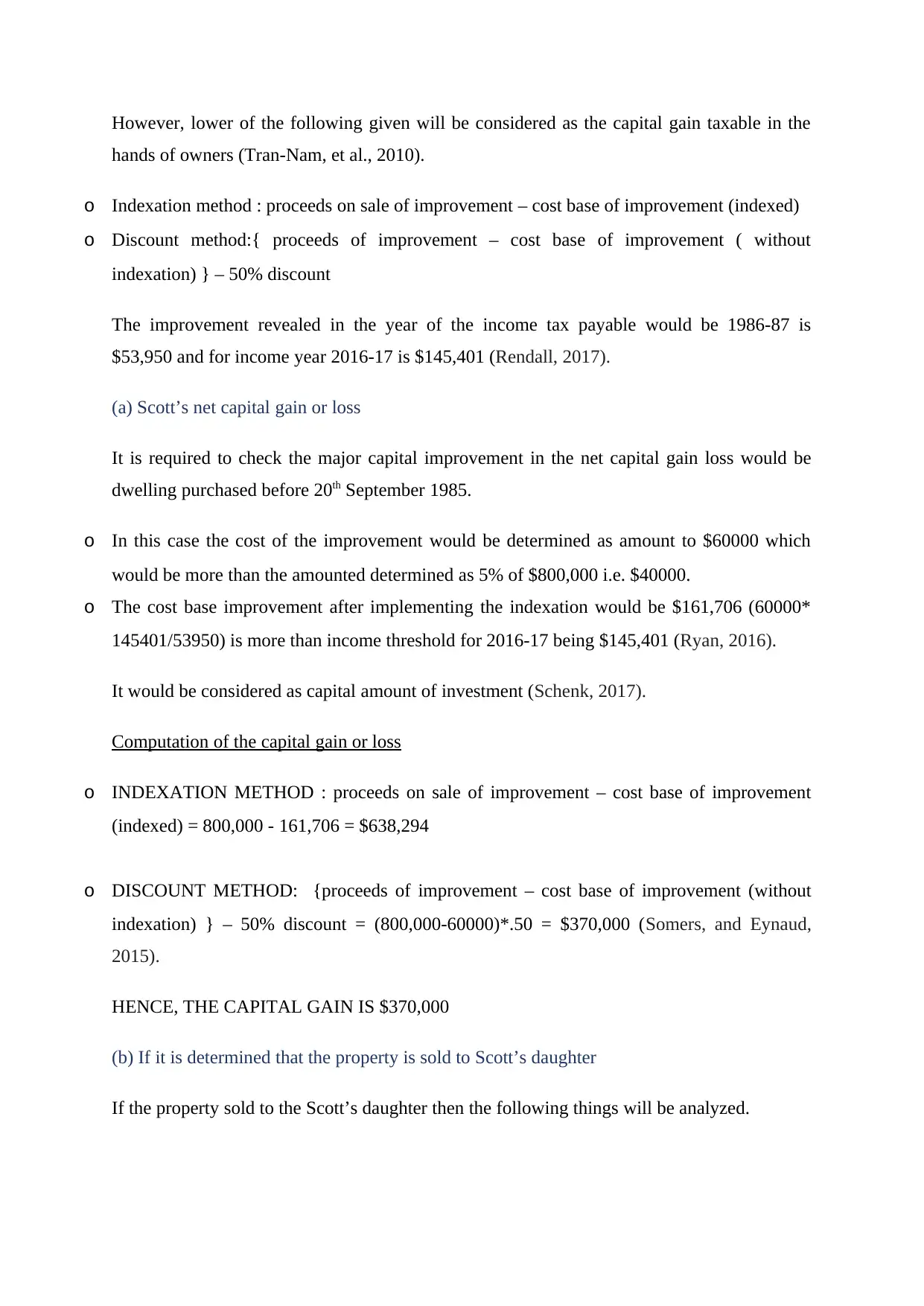
However, lower of the following given will be considered as the capital gain taxable in the
hands of owners (Tran-Nam, et al., 2010).
o Indexation method : proceeds on sale of improvement – cost base of improvement (indexed)
o Discount method:{ proceeds of improvement – cost base of improvement ( without
indexation) } – 50% discount
The improvement revealed in the year of the income tax payable would be 1986-87 is
$53,950 and for income year 2016-17 is $145,401 (Rendall, 2017).
(a) Scott’s net capital gain or loss
It is required to check the major capital improvement in the net capital gain loss would be
dwelling purchased before 20th September 1985.
o In this case the cost of the improvement would be determined as amount to $60000 which
would be more than the amounted determined as 5% of $800,000 i.e. $40000.
o The cost base improvement after implementing the indexation would be $161,706 (60000*
145401/53950) is more than income threshold for 2016-17 being $145,401 (Ryan, 2016).
It would be considered as capital amount of investment (Schenk, 2017).
Computation of the capital gain or loss
o INDEXATION METHOD : proceeds on sale of improvement – cost base of improvement
(indexed) = 800,000 - 161,706 = $638,294
o DISCOUNT METHOD: {proceeds of improvement – cost base of improvement (without
indexation) } – 50% discount = (800,000-60000)*.50 = $370,000 (Somers, and Eynaud,
2015).
HENCE, THE CAPITAL GAIN IS $370,000
(b) If it is determined that the property is sold to Scott’s daughter
If the property sold to the Scott’s daughter then the following things will be analyzed.
hands of owners (Tran-Nam, et al., 2010).
o Indexation method : proceeds on sale of improvement – cost base of improvement (indexed)
o Discount method:{ proceeds of improvement – cost base of improvement ( without
indexation) } – 50% discount
The improvement revealed in the year of the income tax payable would be 1986-87 is
$53,950 and for income year 2016-17 is $145,401 (Rendall, 2017).
(a) Scott’s net capital gain or loss
It is required to check the major capital improvement in the net capital gain loss would be
dwelling purchased before 20th September 1985.
o In this case the cost of the improvement would be determined as amount to $60000 which
would be more than the amounted determined as 5% of $800,000 i.e. $40000.
o The cost base improvement after implementing the indexation would be $161,706 (60000*
145401/53950) is more than income threshold for 2016-17 being $145,401 (Ryan, 2016).
It would be considered as capital amount of investment (Schenk, 2017).
Computation of the capital gain or loss
o INDEXATION METHOD : proceeds on sale of improvement – cost base of improvement
(indexed) = 800,000 - 161,706 = $638,294
o DISCOUNT METHOD: {proceeds of improvement – cost base of improvement (without
indexation) } – 50% discount = (800,000-60000)*.50 = $370,000 (Somers, and Eynaud,
2015).
HENCE, THE CAPITAL GAIN IS $370,000
(b) If it is determined that the property is sold to Scott’s daughter
If the property sold to the Scott’s daughter then the following things will be analyzed.
Paraphrase This Document
Need a fresh take? Get an instant paraphrase of this document with our AI Paraphraser
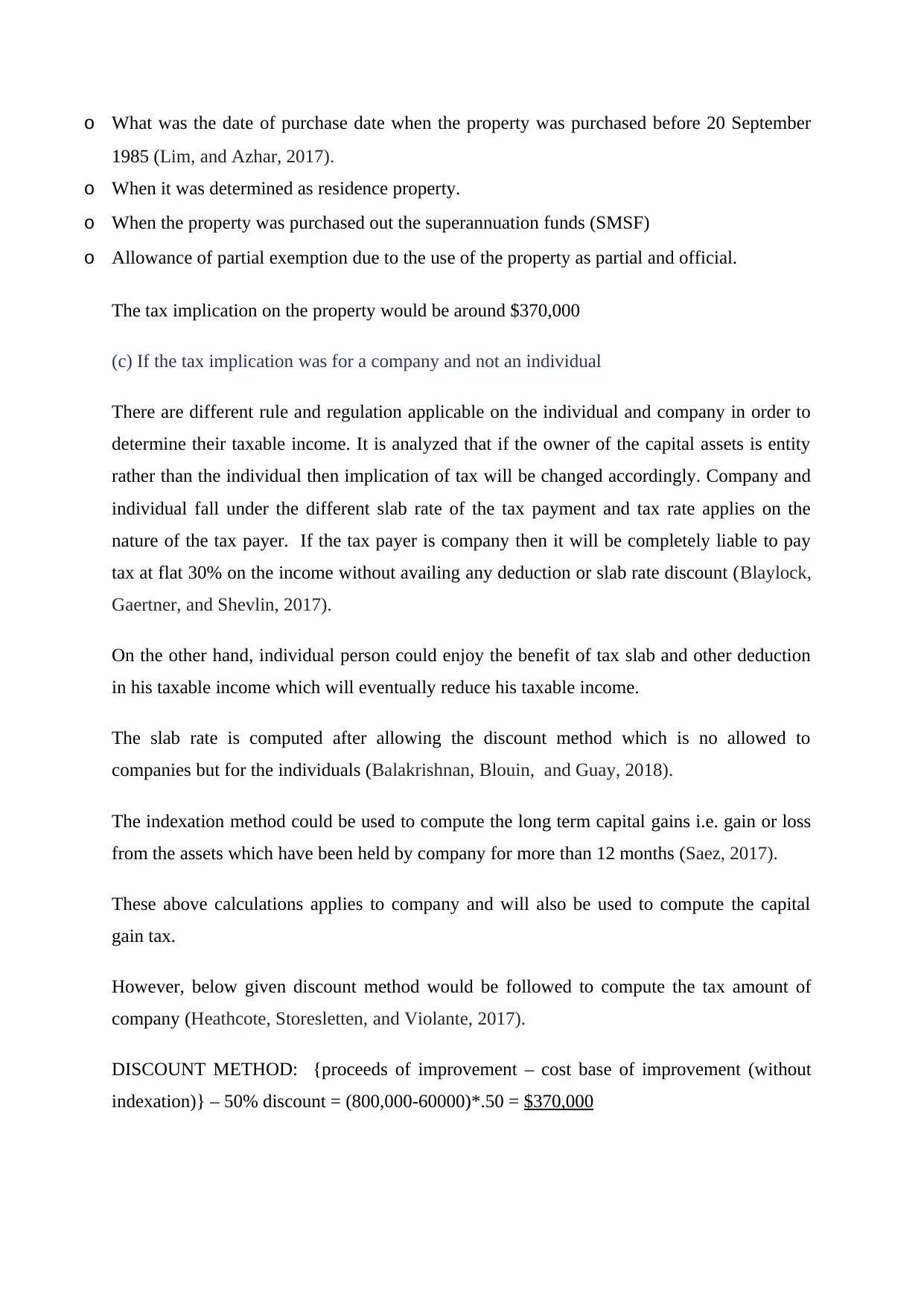
o What was the date of purchase date when the property was purchased before 20 September
1985 (Lim, and Azhar, 2017).
o When it was determined as residence property.
o When the property was purchased out the superannuation funds (SMSF)
o Allowance of partial exemption due to the use of the property as partial and official.
The tax implication on the property would be around $370,000
(c) If the tax implication was for a company and not an individual
There are different rule and regulation applicable on the individual and company in order to
determine their taxable income. It is analyzed that if the owner of the capital assets is entity
rather than the individual then implication of tax will be changed accordingly. Company and
individual fall under the different slab rate of the tax payment and tax rate applies on the
nature of the tax payer. If the tax payer is company then it will be completely liable to pay
tax at flat 30% on the income without availing any deduction or slab rate discount (Blaylock,
Gaertner, and Shevlin, 2017).
On the other hand, individual person could enjoy the benefit of tax slab and other deduction
in his taxable income which will eventually reduce his taxable income.
The slab rate is computed after allowing the discount method which is no allowed to
companies but for the individuals (Balakrishnan, Blouin, and Guay, 2018).
The indexation method could be used to compute the long term capital gains i.e. gain or loss
from the assets which have been held by company for more than 12 months (Saez, 2017).
These above calculations applies to company and will also be used to compute the capital
gain tax.
However, below given discount method would be followed to compute the tax amount of
company (Heathcote, Storesletten, and Violante, 2017).
DISCOUNT METHOD: {proceeds of improvement – cost base of improvement (without
indexation)} – 50% discount = (800,000-60000)*.50 = $370,000
1985 (Lim, and Azhar, 2017).
o When it was determined as residence property.
o When the property was purchased out the superannuation funds (SMSF)
o Allowance of partial exemption due to the use of the property as partial and official.
The tax implication on the property would be around $370,000
(c) If the tax implication was for a company and not an individual
There are different rule and regulation applicable on the individual and company in order to
determine their taxable income. It is analyzed that if the owner of the capital assets is entity
rather than the individual then implication of tax will be changed accordingly. Company and
individual fall under the different slab rate of the tax payment and tax rate applies on the
nature of the tax payer. If the tax payer is company then it will be completely liable to pay
tax at flat 30% on the income without availing any deduction or slab rate discount (Blaylock,
Gaertner, and Shevlin, 2017).
On the other hand, individual person could enjoy the benefit of tax slab and other deduction
in his taxable income which will eventually reduce his taxable income.
The slab rate is computed after allowing the discount method which is no allowed to
companies but for the individuals (Balakrishnan, Blouin, and Guay, 2018).
The indexation method could be used to compute the long term capital gains i.e. gain or loss
from the assets which have been held by company for more than 12 months (Saez, 2017).
These above calculations applies to company and will also be used to compute the capital
gain tax.
However, below given discount method would be followed to compute the tax amount of
company (Heathcote, Storesletten, and Violante, 2017).
DISCOUNT METHOD: {proceeds of improvement – cost base of improvement (without
indexation)} – 50% discount = (800,000-60000)*.50 = $370,000
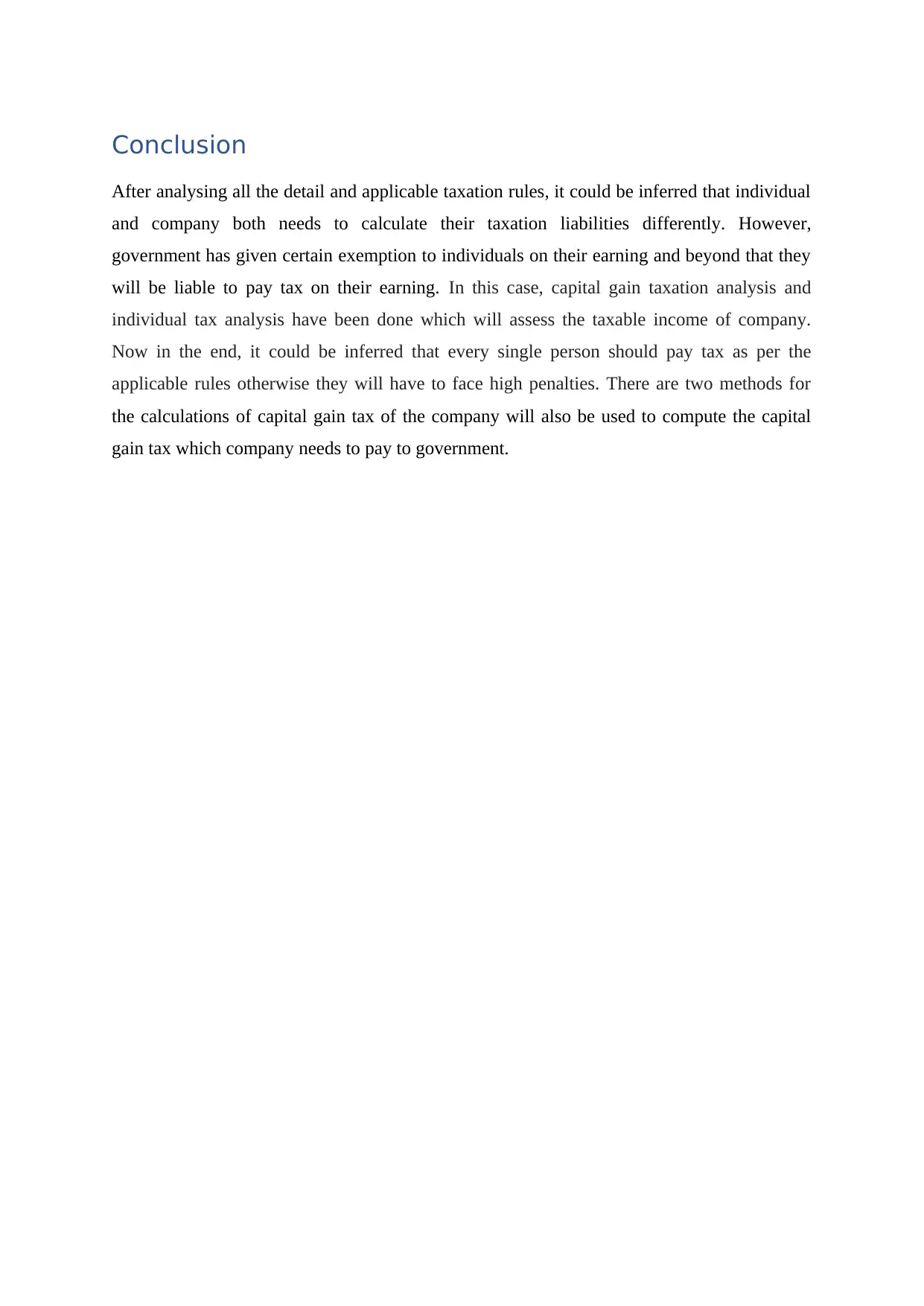
Conclusion
After analysing all the detail and applicable taxation rules, it could be inferred that individual
and company both needs to calculate their taxation liabilities differently. However,
government has given certain exemption to individuals on their earning and beyond that they
will be liable to pay tax on their earning. In this case, capital gain taxation analysis and
individual tax analysis have been done which will assess the taxable income of company.
Now in the end, it could be inferred that every single person should pay tax as per the
applicable rules otherwise they will have to face high penalties. There are two methods for
the calculations of capital gain tax of the company will also be used to compute the capital
gain tax which company needs to pay to government.
After analysing all the detail and applicable taxation rules, it could be inferred that individual
and company both needs to calculate their taxation liabilities differently. However,
government has given certain exemption to individuals on their earning and beyond that they
will be liable to pay tax on their earning. In this case, capital gain taxation analysis and
individual tax analysis have been done which will assess the taxable income of company.
Now in the end, it could be inferred that every single person should pay tax as per the
applicable rules otherwise they will have to face high penalties. There are two methods for
the calculations of capital gain tax of the company will also be used to compute the capital
gain tax which company needs to pay to government.
⊘ This is a preview!⊘
Do you want full access?
Subscribe today to unlock all pages.
Trusted by 1+ million students worldwide
References
Richardson, G. and Lanis, R., 2007. Determinants of the variability in corporate effective tax
rates and tax reform: Evidence from Australia. Journal of Accounting and Public
Policy, 26(6), pp.689-704.
Somers, R. and Eynaud, A., 2015. A matter of trusts: The ATO's proposed treatment of
unpaid present entitlements: Part 1. Taxation in Australia, 50(2), p.90.
Tran-Nam, B., Evans, C., Walpole, M. and Ritchie, K., 2010. Tax compliance costs:
Research methodology and empirical evidence from Australia. National Tax Journal, pp.229-
252.
Rendall, M., 2017. Female market work, tax regimes, and the rise of the service
sector. Review of Economic Dynamics.
Schenk, D.H., 2017. Federal Taxation of S Corporations. Law Journal Press.
Lim, T.C. and Azhar, Z., 2017. A Review of the Opportunities, Risk and Challenges of E-
Commerce Tax Administration in Malaysia and Other Selected Countries.
Blaylock, B., Gaertner, F.B. and Shevlin, T., 2017. Book-tax conformity and capital
structure. Review of Accounting Studies, 22(2), pp.903-932.
Balakrishnan, K., Blouin, J. and Guay, W., 2018. Tax Aggressiveness and Corporate
Transparency. The Accounting Review.
Saez, E., 2017. Taxing the rich more: Preliminary evidence from the 2013 Tax Increase. Tax
Policy and the Economy, 31(1), pp.71-120.
Heathcote, J., Storesletten, K. and Violante, G.L., 2017. Optimal tax progressivity: An
analytical framework. The Quarterly Journal of Economics, 132(4), pp.1693-1754.
Dyreng, S., Hanlon, M. and Maydew, E., 2017. When does tax avoidance result in tax
uncertainty?.
Richardson, G. and Lanis, R., 2007. Determinants of the variability in corporate effective tax
rates and tax reform: Evidence from Australia. Journal of Accounting and Public
Policy, 26(6), pp.689-704.
Somers, R. and Eynaud, A., 2015. A matter of trusts: The ATO's proposed treatment of
unpaid present entitlements: Part 1. Taxation in Australia, 50(2), p.90.
Tran-Nam, B., Evans, C., Walpole, M. and Ritchie, K., 2010. Tax compliance costs:
Research methodology and empirical evidence from Australia. National Tax Journal, pp.229-
252.
Rendall, M., 2017. Female market work, tax regimes, and the rise of the service
sector. Review of Economic Dynamics.
Schenk, D.H., 2017. Federal Taxation of S Corporations. Law Journal Press.
Lim, T.C. and Azhar, Z., 2017. A Review of the Opportunities, Risk and Challenges of E-
Commerce Tax Administration in Malaysia and Other Selected Countries.
Blaylock, B., Gaertner, F.B. and Shevlin, T., 2017. Book-tax conformity and capital
structure. Review of Accounting Studies, 22(2), pp.903-932.
Balakrishnan, K., Blouin, J. and Guay, W., 2018. Tax Aggressiveness and Corporate
Transparency. The Accounting Review.
Saez, E., 2017. Taxing the rich more: Preliminary evidence from the 2013 Tax Increase. Tax
Policy and the Economy, 31(1), pp.71-120.
Heathcote, J., Storesletten, K. and Violante, G.L., 2017. Optimal tax progressivity: An
analytical framework. The Quarterly Journal of Economics, 132(4), pp.1693-1754.
Dyreng, S., Hanlon, M. and Maydew, E., 2017. When does tax avoidance result in tax
uncertainty?.

1 out of 10


Related Documents


Your All-in-One AI-Powered Toolkit for Academic Success.
+13062052269
info@desklib.com
Available 24*7 on WhatsApp / Email
![[object Object]](/_next/static/media/star-bottom.7253800d.svg)
Unlock your academic potential
Copyright © 2020–2025 A2Z Services. All Rights Reserved. Developed and managed by ZUCOL.