Exploring the Kuznets Curve: Income Inequality, Growth, and Economics

Verified

Added on  2020/05/28

|4
|458
|260
Report
AI Summary
This report delves into the Kuznets Curve, a crucial concept in economics, and its explanation of the relationship between income inequality and economic growth. The report begins by introducing the Kuznets Curve, which posits an inverted U-shaped relationship: initially, as income levels rise, inequality increases, but eventually, as income continues to grow, inequality decreases. It explains how this curve reflects the transition from agricultural to industrialized societies and the impact of urbanization and migration on income distribution. As economies develop, the report explains, market forces initially exacerbate inequality, but with further growth, the benefits of the trickle-down effect reduce the income gap. The report references the works of Heng, Liutang, and Fu (2006), Moffatt (2017), and Worstall (2009) to support its arguments. The report concludes by emphasizing the curve's significance in illuminating the dynamics between income inequality and economic development.
Document Page
Kuznets Curve 1
HOW THE KUZNETS CURVE EXPLAINS THE RELATIONSHIP BETWEEN INCOME
INEQUALITY AND GROWTH
Student’s Name
Course
Professor’s Name
University
(City) State
Date
tabler-icon-diamond-filled.svg

Paraphrase This Document

Need a fresh take? Get an instant paraphrase of this document with our AI Paraphraser
Document Page
Kuznets Curve 2
How the Kuznets Curve Explains the Relationship between Income Inequality and Growth
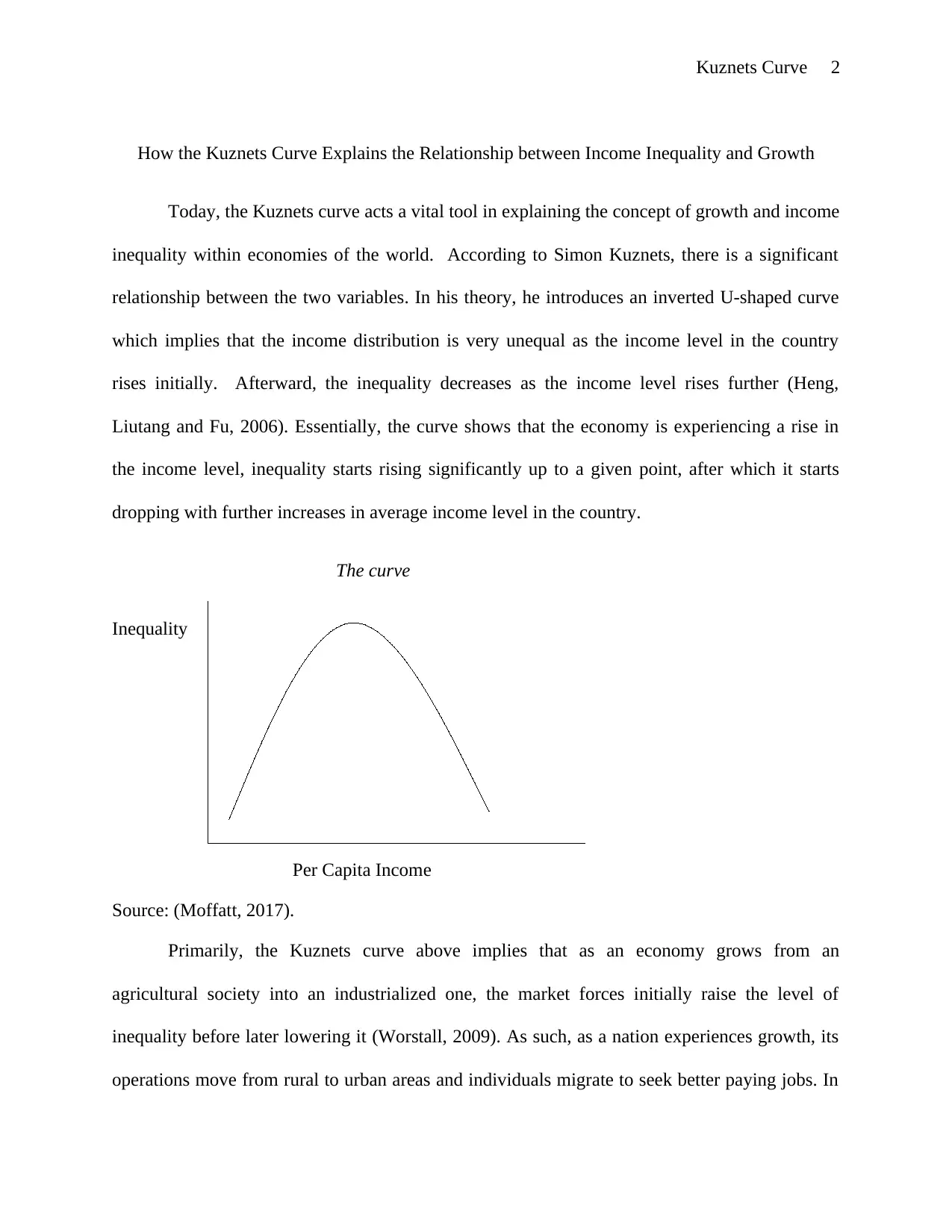
Today, the Kuznets curve acts a vital tool in explaining the concept of growth and income
inequality within economies of the world. According to Simon Kuznets, there is a significant
relationship between the two variables. In his theory, he introduces an inverted U-shaped curve
which implies that the income distribution is very unequal as the income level in the country
rises initially. Afterward, the inequality decreases as the income level rises further (Heng,
Liutang and Fu, 2006). Essentially, the curve shows that the economy is experiencing a rise in
the income level, inequality starts rising significantly up to a given point, after which it starts
dropping with further increases in average income level in the country.
The curve
Inequality
Per Capita Income
Source: (Moffatt, 2017).
Primarily, the Kuznets curve above implies that as an economy grows from an
agricultural society into an industrialized one, the market forces initially raise the level of
inequality before later lowering it (Worstall, 2009). As such, as a nation experiences growth, its
operations move from rural to urban areas and individuals migrate to seek better paying jobs. In
Document Page
Kuznets Curve 3
turn, the migration brings about a wide urban-rural income gap as rural populations decline while
the urban populations rise. After a while, the economic inequality decreases when an average
income level is reached. At this point of growth, the society begins to benefit from the trickle-
down effect and increases in average incomes thereby decreasing the economic inequality. Thus,
the theory provides a rational elucidation and enlightens society on the relationship between the
two variables.
Document Page
Kuznets Curve 4
Reference List
Heng, Y., Liutang, G., & Heng-fu, Z. (2006). Income inequality and economic growth—the
Kuznets curve revisited. Frontiers of Economics in China [online] 1(2), p. 1-2. Available at:
https://link.springer.com/article/10.1007/s11459-006-0004-7 [Accessed Date Accessed].
Moffatt, M. (2017). Essential Economics Terms: Kuznets Curve. [Online] ThoughtCo. Available
at: https://www.adamsmith.org/blog/international/the-kuznets-curve-and-inequality [Accessed 12
Jan 2018].
Worstall, T. (2009). The Kuznets Curve and inequality. [Online] Adam Smith Institute. Available
at: https://www.adamsmith.org/blog/international/the-kuznets-curve-and-inequality [Accessed 12
Jan 2018].
chevron_up_icon
1 out of 4
circle_padding
hide_on_mobile
zoom_out_icon
[object Object]