SSC211e TMA01: An Analysis of Income Inequality in Singapore
VerifiedAdded on 2023/06/08
|10
|1832
|348
Report
AI Summary
This report investigates income inequality in Singapore, a pressing social issue in the country. The research explores the concepts of income inequality, social mobility, and social integration, highlighting the unequal distribution of income and its implications for class division. The study aims to identify the causes of income inequality and propose suitable solutions. The methodology involves both primary and secondary data collection, employing a positivism research philosophy and stratified sampling. The report reviews existing literature, analyzes the income inequality, and discusses the challenges faced by Singapore. The study also addresses ethical considerations and provides a timeline for the research activities. The research utilizes both qualitative and quantitative data analysis methods to offer a comprehensive perspective on the issue.
Running head: INCOME INEQUALITY IN SINGAPORE
INCOME INEQUALITY IN SINGAPORE
Name of the student:
Name of the university:
Author note:
INCOME INEQUALITY IN SINGAPORE
Name of the student:
Name of the university:
Author note:
Paraphrase This Document
Need a fresh take? Get an instant paraphrase of this document with our AI Paraphraser

2INCOME INEQUALITY IN SINGAPORE
Abstract
Singapore is a city as well as country that have been one of the countries that have given top
priority to social issues. Like any other developed countries, it is faced with the issue of social
and economic inequality. The unequal distribution of income among the citizen has lead to class
based social stratification. The main focus of this research will be the concept of income
inequality and problem derived from uneven income distribution. Singapore possesses
multiculturalism and therefore the problem of class division is a concerned issue that Singapore
wishes to pay more attention. Therefore the research will be carried out to investigate on income
inequality that is leading to social inequality.
Abstract
Singapore is a city as well as country that have been one of the countries that have given top
priority to social issues. Like any other developed countries, it is faced with the issue of social
and economic inequality. The unequal distribution of income among the citizen has lead to class
based social stratification. The main focus of this research will be the concept of income
inequality and problem derived from uneven income distribution. Singapore possesses
multiculturalism and therefore the problem of class division is a concerned issue that Singapore
wishes to pay more attention. Therefore the research will be carried out to investigate on income
inequality that is leading to social inequality.

3INCOME INEQUALITY IN SINGAPORE
INCOME INEQUALITY IN SINGAPORE
Introduction
Background of the study:
Singapore’s idea of income equality is connected to the concept of fair and equal division
of income. In Singapore, income inequality is considered a significant problem. Due to certain
economic pattern there is an misbalance between the wealthy and poor people where only the
wealthy people are found with advantages of society. There have been numerous studies
conducted on Singapore present situation of income equality such as ‘Inequality and the need for
a new social compact’ by Kim Song TAN (2013) that discusses the impact of income inequality
such as wage stagnation and decline in real wage. This paper is aimed at the inequality of income
in Singapore. The paper also examines how the characteristic of unequal income leads to social
inequality.
Statement of the problem:
In recent times, Singapore has been faced with a socio-economic problem of income
inequality (Solt, 2016). The country is majorly concerned with social harmony and has
constantly made it the priority of government. The problem of inequality of income distribution,
has affected other aspects such as social inequality, social mobility and social integration has
lead to many other associated issues in the state. Therefore, the study has been developed to
explore and investigate three aspects in Singapore that include income inequality, social mobility
and social integration.
INCOME INEQUALITY IN SINGAPORE
Introduction
Background of the study:
Singapore’s idea of income equality is connected to the concept of fair and equal division
of income. In Singapore, income inequality is considered a significant problem. Due to certain
economic pattern there is an misbalance between the wealthy and poor people where only the
wealthy people are found with advantages of society. There have been numerous studies
conducted on Singapore present situation of income equality such as ‘Inequality and the need for
a new social compact’ by Kim Song TAN (2013) that discusses the impact of income inequality
such as wage stagnation and decline in real wage. This paper is aimed at the inequality of income
in Singapore. The paper also examines how the characteristic of unequal income leads to social
inequality.
Statement of the problem:
In recent times, Singapore has been faced with a socio-economic problem of income
inequality (Solt, 2016). The country is majorly concerned with social harmony and has
constantly made it the priority of government. The problem of inequality of income distribution,
has affected other aspects such as social inequality, social mobility and social integration has
lead to many other associated issues in the state. Therefore, the study has been developed to
explore and investigate three aspects in Singapore that include income inequality, social mobility
and social integration.
⊘ This is a preview!⊘
Do you want full access?
Subscribe today to unlock all pages.

Trusted by 1+ million students worldwide

4INCOME INEQUALITY IN SINGAPORE
Rationale of the research: why do this research?
The growing problem due to unequal income researchers has successfully dragged the
attention of the researchers. Although Singapore is one of the developed and organized states it is
facing social and economic challenges. Therefore, the question arises regarding social inequality,
social mobility and social integrity and the reasons for the following issue’s occurrence. The
reason for this study is to find out the causes and suitable solution for the challenges.
Research aims and objectives:
The aim of the study is to develop a study to investigate and explore aspects of social
inequality in Singapore.
The objective of the study are-
Identify the concepts related to the issues faced by Singapore such as income inequality,
social mobility and social integration.
Discuss the related problems with income equality faced by Singapore.
To investigate the reasons for the occurring social issues in Singapore.
Research questions:
RQ1. What is income inequality?
RQ2. What caused Singapore face with income inequality?
RQ3. How Singapore is dealing with income inequality?
RQ4. What are the related theories that explain income inequality and related proble,.
Rationale of the research: why do this research?
The growing problem due to unequal income researchers has successfully dragged the
attention of the researchers. Although Singapore is one of the developed and organized states it is
facing social and economic challenges. Therefore, the question arises regarding social inequality,
social mobility and social integrity and the reasons for the following issue’s occurrence. The
reason for this study is to find out the causes and suitable solution for the challenges.
Research aims and objectives:
The aim of the study is to develop a study to investigate and explore aspects of social
inequality in Singapore.
The objective of the study are-
Identify the concepts related to the issues faced by Singapore such as income inequality,
social mobility and social integration.
Discuss the related problems with income equality faced by Singapore.
To investigate the reasons for the occurring social issues in Singapore.
Research questions:
RQ1. What is income inequality?
RQ2. What caused Singapore face with income inequality?
RQ3. How Singapore is dealing with income inequality?
RQ4. What are the related theories that explain income inequality and related proble,.
Paraphrase This Document
Need a fresh take? Get an instant paraphrase of this document with our AI Paraphraser

5INCOME INEQUALITY IN SINGAPORE
Literature Review
Income inequality conceptualization:
Income inequality refers to distribution of income in an uneven manner among the
citizens of the state. It is the gap between the rich and other people existing in the same society
(Corak, 2013). With all the economic growth of individual countries often the dispersion of the
income among the population is uneven and unfair. There can be several reasons that can cause
unequal inequality in a state however, the causes may vary depending on other related factors
responsible for the changes.
Income inequality in Singapore
Singapore is one of the countries who have always given priority to the problem of social
inequality. Therefore the country remains to be an egalitarian and multicultural (Sai, 2013). The
present social issue that has been Singapore’s concern is unequal income among the
Singaporean. The wealth gap between the rich and poor is considered the result of unequal
income distribution. Over the last years of 20th century the income inequality has increased in
Singapore along with other developed countries. However, the issue has seen a decline over the
last decade in Singapore and an increase in the real per capita household income.
The technology and globalization has facilitated the income inequality in the state and
considered as a major cause of income inequality (Jaumotte, Lall & Papageorgiou, 2013). Since
a person’s income is directly based on capabilities and education qualification, it is an absolute
necessity to make quality education available to every citizen to eliminate the income inequality.
Also, the lower income groups who fail to earn sufficient amount for living needs help and
support. Singapore has been taking significance measures to fight against the challenge and the
Literature Review
Income inequality conceptualization:
Income inequality refers to distribution of income in an uneven manner among the
citizens of the state. It is the gap between the rich and other people existing in the same society
(Corak, 2013). With all the economic growth of individual countries often the dispersion of the
income among the population is uneven and unfair. There can be several reasons that can cause
unequal inequality in a state however, the causes may vary depending on other related factors
responsible for the changes.
Income inequality in Singapore
Singapore is one of the countries who have always given priority to the problem of social
inequality. Therefore the country remains to be an egalitarian and multicultural (Sai, 2013). The
present social issue that has been Singapore’s concern is unequal income among the
Singaporean. The wealth gap between the rich and poor is considered the result of unequal
income distribution. Over the last years of 20th century the income inequality has increased in
Singapore along with other developed countries. However, the issue has seen a decline over the
last decade in Singapore and an increase in the real per capita household income.
The technology and globalization has facilitated the income inequality in the state and
considered as a major cause of income inequality (Jaumotte, Lall & Papageorgiou, 2013). Since
a person’s income is directly based on capabilities and education qualification, it is an absolute
necessity to make quality education available to every citizen to eliminate the income inequality.
Also, the lower income groups who fail to earn sufficient amount for living needs help and
support. Singapore has been taking significance measures to fight against the challenge and the

6INCOME INEQUALITY IN SINGAPORE
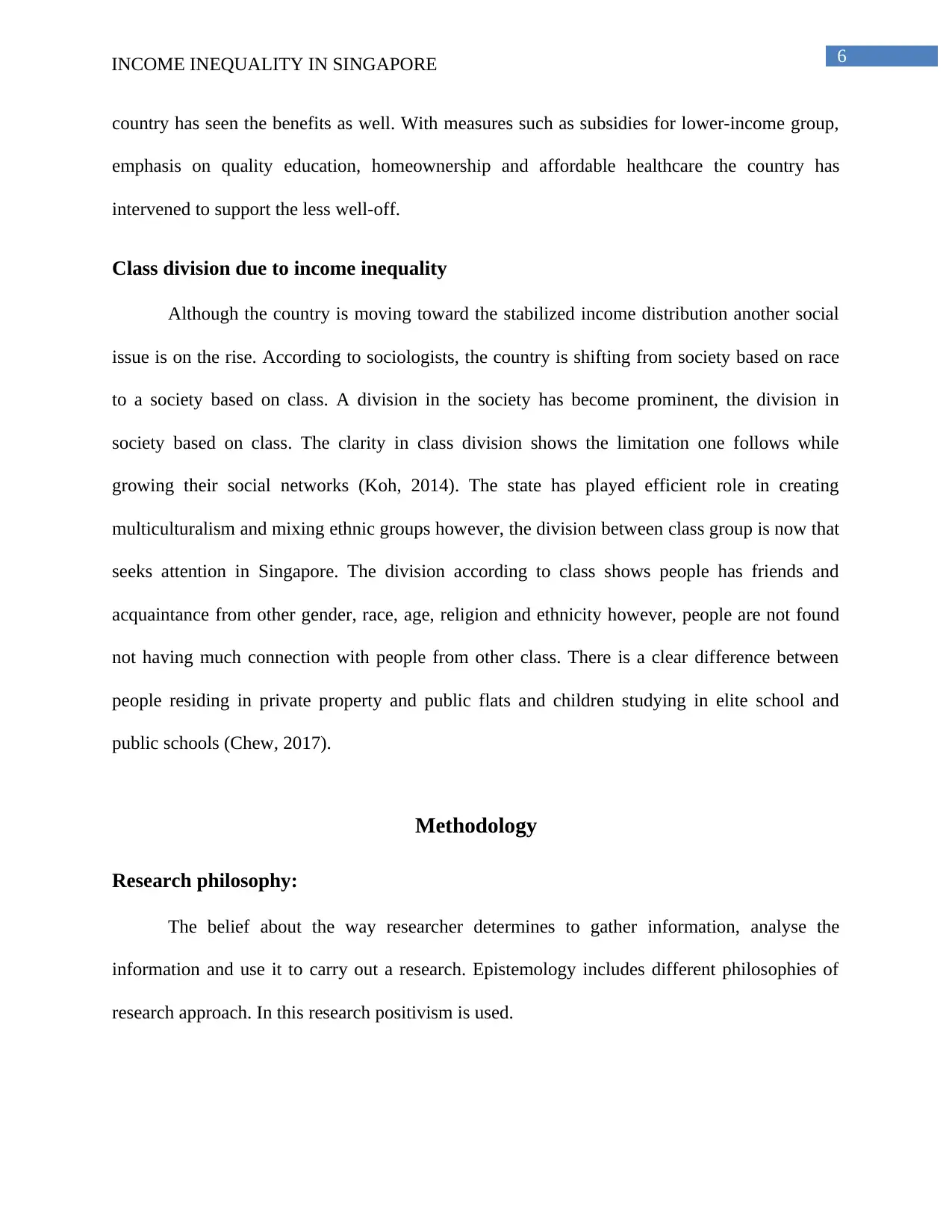
country has seen the benefits as well. With measures such as subsidies for lower-income group,
emphasis on quality education, homeownership and affordable healthcare the country has
intervened to support the less well-off.
Class division due to income inequality
Although the country is moving toward the stabilized income distribution another social
issue is on the rise. According to sociologists, the country is shifting from society based on race
to a society based on class. A division in the society has become prominent, the division in
society based on class. The clarity in class division shows the limitation one follows while
growing their social networks (Koh, 2014). The state has played efficient role in creating
multiculturalism and mixing ethnic groups however, the division between class group is now that
seeks attention in Singapore. The division according to class shows people has friends and
acquaintance from other gender, race, age, religion and ethnicity however, people are not found
not having much connection with people from other class. There is a clear difference between
people residing in private property and public flats and children studying in elite school and
public schools (Chew, 2017).
Methodology
Research philosophy:
The belief about the way researcher determines to gather information, analyse the
information and use it to carry out a research. Epistemology includes different philosophies of
research approach. In this research positivism is used.
country has seen the benefits as well. With measures such as subsidies for lower-income group,
emphasis on quality education, homeownership and affordable healthcare the country has
intervened to support the less well-off.
Class division due to income inequality
Although the country is moving toward the stabilized income distribution another social
issue is on the rise. According to sociologists, the country is shifting from society based on race
to a society based on class. A division in the society has become prominent, the division in
society based on class. The clarity in class division shows the limitation one follows while
growing their social networks (Koh, 2014). The state has played efficient role in creating
multiculturalism and mixing ethnic groups however, the division between class group is now that
seeks attention in Singapore. The division according to class shows people has friends and
acquaintance from other gender, race, age, religion and ethnicity however, people are not found
not having much connection with people from other class. There is a clear difference between
people residing in private property and public flats and children studying in elite school and
public schools (Chew, 2017).
Methodology
Research philosophy:
The belief about the way researcher determines to gather information, analyse the
information and use it to carry out a research. Epistemology includes different philosophies of
research approach. In this research positivism is used.
⊘ This is a preview!⊘
Do you want full access?
Subscribe today to unlock all pages.

Trusted by 1+ million students worldwide

7INCOME INEQUALITY IN SINGAPORE
Data collection method:
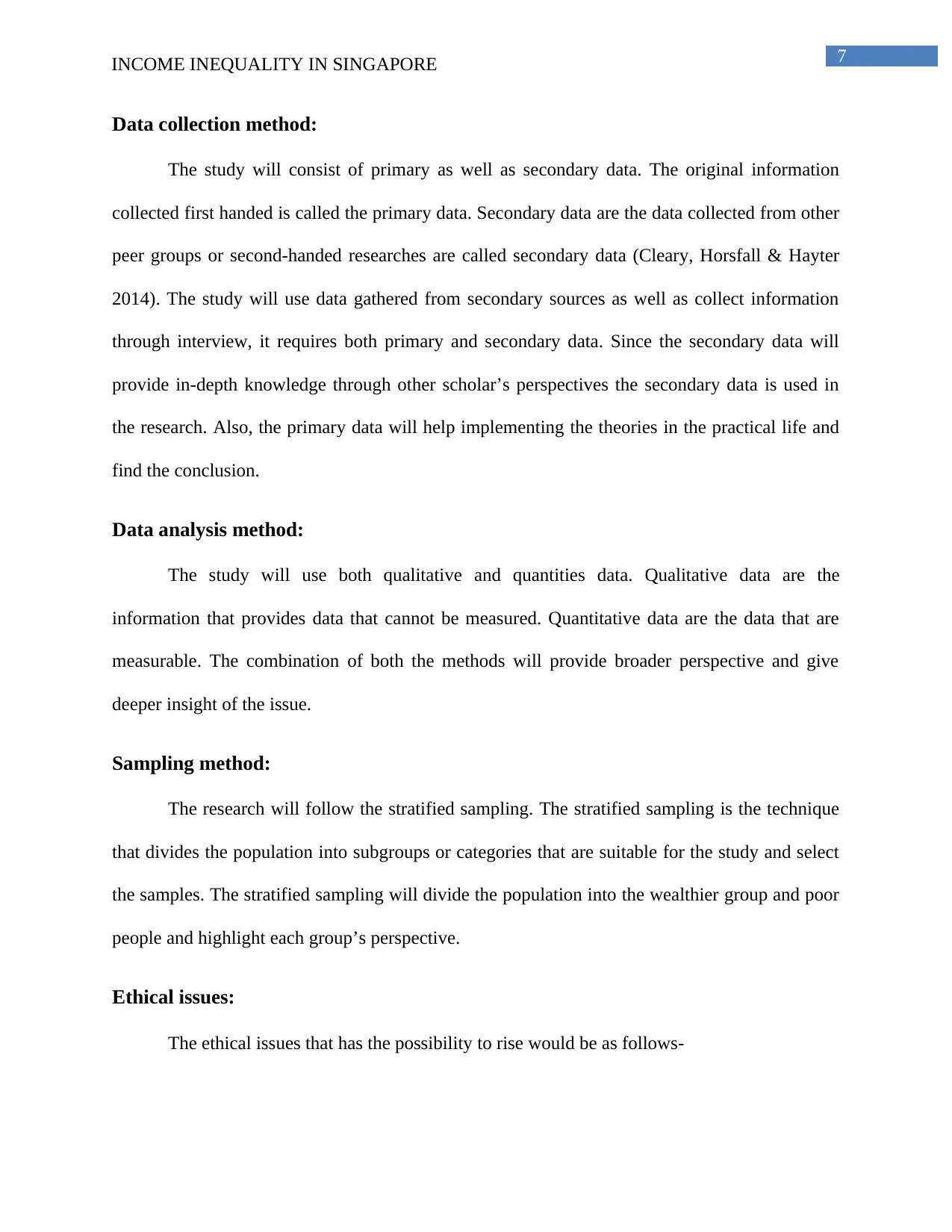
The study will consist of primary as well as secondary data. The original information
collected first handed is called the primary data. Secondary data are the data collected from other
peer groups or second-handed researches are called secondary data (Cleary, Horsfall & Hayter
2014). The study will use data gathered from secondary sources as well as collect information
through interview, it requires both primary and secondary data. Since the secondary data will
provide in-depth knowledge through other scholar’s perspectives the secondary data is used in
the research. Also, the primary data will help implementing the theories in the practical life and
find the conclusion.
Data analysis method:
The study will use both qualitative and quantities data. Qualitative data are the
information that provides data that cannot be measured. Quantitative data are the data that are
measurable. The combination of both the methods will provide broader perspective and give
deeper insight of the issue.
Sampling method:
The research will follow the stratified sampling. The stratified sampling is the technique
that divides the population into subgroups or categories that are suitable for the study and select
the samples. The stratified sampling will divide the population into the wealthier group and poor
people and highlight each group’s perspective.
Ethical issues:
The ethical issues that has the possibility to rise would be as follows-
Data collection method:
The study will consist of primary as well as secondary data. The original information
collected first handed is called the primary data. Secondary data are the data collected from other
peer groups or second-handed researches are called secondary data (Cleary, Horsfall & Hayter
2014). The study will use data gathered from secondary sources as well as collect information
through interview, it requires both primary and secondary data. Since the secondary data will
provide in-depth knowledge through other scholar’s perspectives the secondary data is used in
the research. Also, the primary data will help implementing the theories in the practical life and
find the conclusion.
Data analysis method:
The study will use both qualitative and quantities data. Qualitative data are the
information that provides data that cannot be measured. Quantitative data are the data that are
measurable. The combination of both the methods will provide broader perspective and give
deeper insight of the issue.
Sampling method:
The research will follow the stratified sampling. The stratified sampling is the technique
that divides the population into subgroups or categories that are suitable for the study and select
the samples. The stratified sampling will divide the population into the wealthier group and poor
people and highlight each group’s perspective.
Ethical issues:
The ethical issues that has the possibility to rise would be as follows-
Paraphrase This Document
Need a fresh take? Get an instant paraphrase of this document with our AI Paraphraser

8INCOME INEQUALITY IN SINGAPORE
Collecting authorized data from the legal corners of Singapore can be one of the
significant problems which need to be overcome. Although the study will follow
the legal processes, it may face trouble.
Openness of the people may arise as people do not feel comfortable talking about
income and their socio-economic status.
Collecting authorized data from the legal corners of Singapore can be one of the
significant problems which need to be overcome. Although the study will follow
the legal processes, it may face trouble.
Openness of the people may arise as people do not feel comfortable talking about
income and their socio-economic status.

9INCOME INEQUALITY IN SINGAPORE
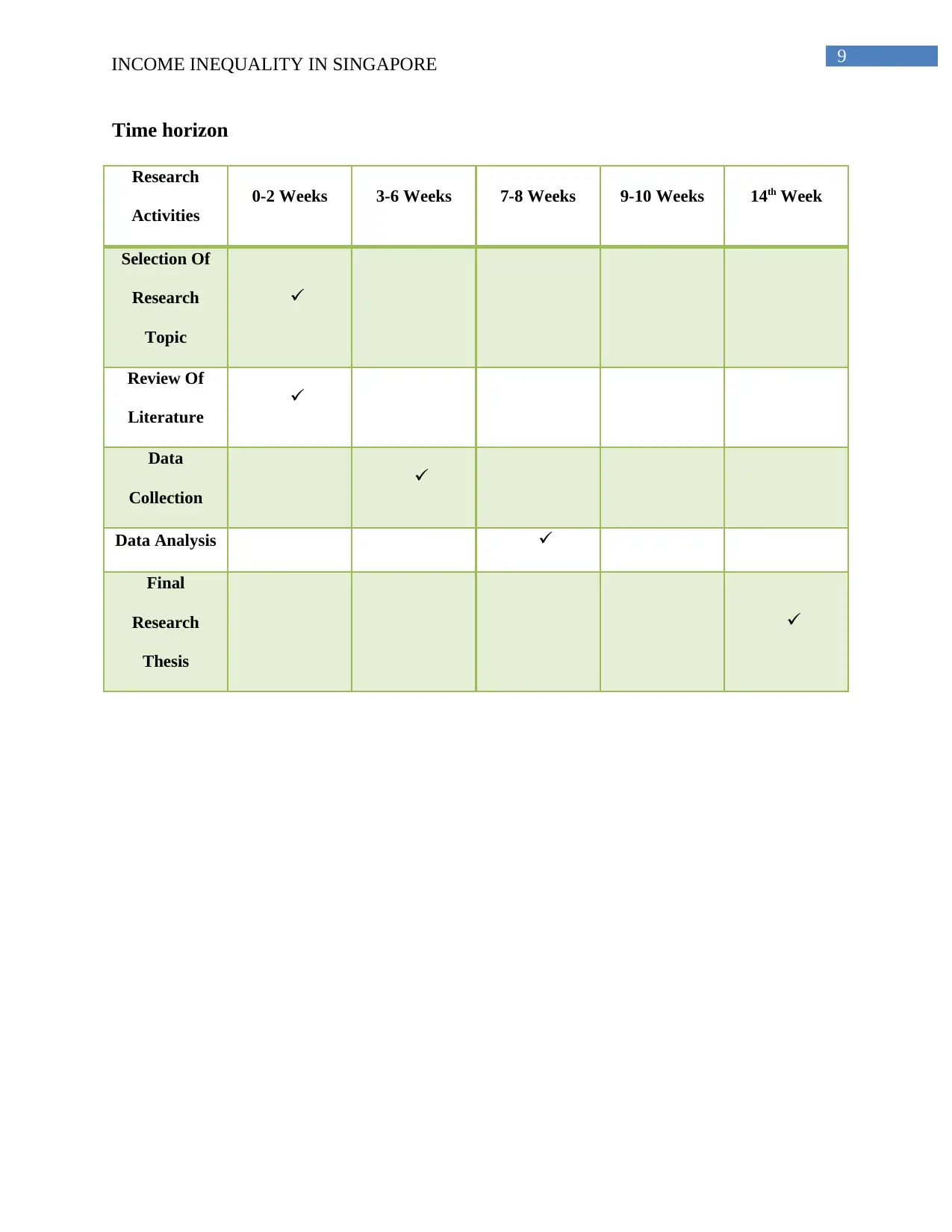
Time horizon
Research
Activities
0-2 Weeks 3-6 Weeks 7-8 Weeks 9-10 Weeks 14th Week
Selection Of
Research
Topic
Review Of
Literature
Data
Collection
Data Analysis
Final
Research
Thesis
Time horizon
Research
Activities
0-2 Weeks 3-6 Weeks 7-8 Weeks 9-10 Weeks 14th Week
Selection Of
Research
Topic
Review Of
Literature
Data
Collection
Data Analysis
Final
Research
Thesis
⊘ This is a preview!⊘
Do you want full access?
Subscribe today to unlock all pages.

Trusted by 1+ million students worldwide

10INCOME INEQUALITY IN SINGAPORE
References:
Chew, P. G. L. (2017). Remaking Singapore: Language, culture, and identity in a globalized
world. In Language policy, culture, and identity in Asian contexts (pp. 83-104).
Routledge.
Cleary, M., Horsfall, J., & Hayter, M. (2014). Data collection and sampling in qualitative
research: does size matter?. Journal of advanced nursing, 70(3), 473-475.
Corak, M. (2013). Income inequality, equality of opportunity, and intergenerational
mobility. Journal of Economic Perspectives, 27(3), 79-102.
Jaumotte, F., Lall, S., & Papageorgiou, C. (2013). Rising income inequality: technology, or trade
and financial globalization?. IMF Economic Review, 61(2), 271-309.
Koh, A. (2014). Doing class analysis in Singapore's elite education: unravelling the smokescreen
of ‘meritocratic talk’. Globalisation, Societies and Education, 12(2), 196-210.
Sai, S. M. (2013). Educating multicultural citizens: Colonial nationalism, imperial citizenship
and education in late colonial Singapore. Journal of Southeast Asian Studies, 44(1), 49-
73.
Solt, F. (2016). The standardized world income inequality database. Social science
quarterly, 97(5), 1267-1281.
TAN, K. S. (2013). Inequality and the need for a new social compact.
References:
Chew, P. G. L. (2017). Remaking Singapore: Language, culture, and identity in a globalized
world. In Language policy, culture, and identity in Asian contexts (pp. 83-104).
Routledge.
Cleary, M., Horsfall, J., & Hayter, M. (2014). Data collection and sampling in qualitative
research: does size matter?. Journal of advanced nursing, 70(3), 473-475.
Corak, M. (2013). Income inequality, equality of opportunity, and intergenerational
mobility. Journal of Economic Perspectives, 27(3), 79-102.
Jaumotte, F., Lall, S., & Papageorgiou, C. (2013). Rising income inequality: technology, or trade
and financial globalization?. IMF Economic Review, 61(2), 271-309.
Koh, A. (2014). Doing class analysis in Singapore's elite education: unravelling the smokescreen
of ‘meritocratic talk’. Globalisation, Societies and Education, 12(2), 196-210.
Sai, S. M. (2013). Educating multicultural citizens: Colonial nationalism, imperial citizenship
and education in late colonial Singapore. Journal of Southeast Asian Studies, 44(1), 49-
73.
Solt, F. (2016). The standardized world income inequality database. Social science
quarterly, 97(5), 1267-1281.
TAN, K. S. (2013). Inequality and the need for a new social compact.
1 out of 10
Related Documents
Your All-in-One AI-Powered Toolkit for Academic Success.
+13062052269
info@desklib.com
Available 24*7 on WhatsApp / Email
Unlock your academic potential
Copyright © 2020–2025 A2Z Services. All Rights Reserved. Developed and managed by ZUCOL.