Income Tax Assessment: Deduction and Small Business CGT Concession
VerifiedAdded on 2023/06/05
|20
|5871
|144
Report
AI Summary
This report provides a detailed analysis of income tax consequences for individuals and small businesses in Australia, focusing on allowable deductions under Section 8-1 of ITAA 1997 and the Capital Gains Tax (CGT) concessions available to small businesses. It examines the conditions under which taxpayers can claim deductions for various expenses, including bank interest, lease payments, equipment purchases, and employee wages, while also identifying non-deductible expenses such as personal expenditures and certain business start-up costs. The report further explores the complexities and benefits of the small business CGT concessions, highlighting their role in supporting the Australian economy and reducing the tax compliance burden for small enterprises. It references relevant legal cases and statutory provisions to provide a comprehensive understanding of the current tax law system in Australia. Desklib offers a platform to access similar solved assignments and past papers for students.
Running head: TAXATION
Tax
Name of the Student:
Name of the university:
Authors Note:
Tax
Name of the Student:
Name of the university:
Authors Note:

Paraphrase This Document
Need a fresh take? Get an instant paraphrase of this document with our AI Paraphraser
1TAXATION
Table of Contents
Answer To Part A:.....................................................................................................................2
Answer To Part B:......................................................................................................................5
Reference..................................................................................................................................17
Table of Contents
Answer To Part A:.....................................................................................................................2
Answer To Part B:......................................................................................................................5
Reference..................................................................................................................................17
2TAXATION
Answer To Part A:
Issue:
The current issue is regarding the income tax consequence for the financial year
ended 2018 for Anna. In other words, to be exact the issue is, whether the person paying tax
qualifies for deduction under section “8-1 of ITAA 1997”?
Rule:
The provision of “section 8-1 of ITAA 1997” says that, a person paying tax can claim
deduction relating to transaction mentioned under the general deduction clause of the said act.
An expense or loss may be considered as deduction under section 8-1 and under certain
specific provision. A person paying tax can be allowed to claim deduction from the income
that is taxable only if the expense is a consequence of earning that income (Becker et al.,
2015). A taxpayer is not allowed to claim deduction under the negative or non-permissible
limb of section 8-1(2) of ITAA 1997. Expenses in the nature of capital, private or domestic is
not allowed for deduction.
If a person acquires loan for buying equipment and stock, then it is allowed for
deduction under the positive limb of the section 8-1 of ITAA 1997. The reason being, those
expenses are a result of producing assessable income or operating business with the intention
of creating an income that is taxable in nature (Saad, 2014).
The tax commissioner in the case of “Lunney v FCT” decided that the pre-requisite
of deriving income that is taxable should be considered. A person paying tax is allowed to
claim deduction under the general provision of section 8-1 of ITAA 1997, regarding the pre-
commencement of income producing acts. As decided by the court of law in the case of
“Softwood Pulp and paper v FCT”, the commissioner denied the deduction as the expense
Answer To Part A:
Issue:
The current issue is regarding the income tax consequence for the financial year
ended 2018 for Anna. In other words, to be exact the issue is, whether the person paying tax
qualifies for deduction under section “8-1 of ITAA 1997”?
Rule:
The provision of “section 8-1 of ITAA 1997” says that, a person paying tax can claim
deduction relating to transaction mentioned under the general deduction clause of the said act.
An expense or loss may be considered as deduction under section 8-1 and under certain
specific provision. A person paying tax can be allowed to claim deduction from the income
that is taxable only if the expense is a consequence of earning that income (Becker et al.,
2015). A taxpayer is not allowed to claim deduction under the negative or non-permissible
limb of section 8-1(2) of ITAA 1997. Expenses in the nature of capital, private or domestic is
not allowed for deduction.
If a person acquires loan for buying equipment and stock, then it is allowed for
deduction under the positive limb of the section 8-1 of ITAA 1997. The reason being, those
expenses are a result of producing assessable income or operating business with the intention
of creating an income that is taxable in nature (Saad, 2014).
The tax commissioner in the case of “Lunney v FCT” decided that the pre-requisite
of deriving income that is taxable should be considered. A person paying tax is allowed to
claim deduction under the general provision of section 8-1 of ITAA 1997, regarding the pre-
commencement of income producing acts. As decided by the court of law in the case of
“Softwood Pulp and paper v FCT”, the commissioner denied the deduction as the expense
⊘ This is a preview!⊘
Do you want full access?
Subscribe today to unlock all pages.

Trusted by 1+ million students worldwide
3TAXATION
was not incurred for producing taxable income (Lang et al., 2018). It was used to establish
the business and the actual income producing activity. This deduction can be claimed only in
situation where the expense was incurred in earning the actual income. Thus, purchasing any
tool or equipment which assist in earing income will qualify for deduction which can be
claimed for the entire or a part depending on the cost of business and private use of asset
(Richardson et al., 2015).
A person can claim deduction when some of act travelling or employee traveling
result to expense. As said under section 25-100 of ITAA 1997, deduction for the travel
expense can be claimed in situation where the travel places are related income generating
activities. The taxpayer can claim deduction for travel expense when it forms part-performing
duties related to the job or business.
An individual who pays tax is allowed to assert deduction for majority of the expenses
that is incurred in carrying or running the business. The expenses incurred for purchase of
jewellery represents the mercantilism stock expense and it is allowed as deductions. On the
opposite hand, a private person paying tax is allowed to assert for the salaries and wages
that's paid to the worker or staff (Wilkins, 2015). If a person operates because the sole dealer,
or the business owner and not because the worker of the business and thus the owner of the
business cannot pay remuneration to themselves. However, on creating any variety of
nominal payment within the variety of regular payment or wages is usually control because
the profit distribution that does not forms the part of deductions.
Application:
The present case says that Anna has a jewellery business and she incurred a bank
interest of $6000 for acquiring equipment and stocks. She can claim deduction under the
affirmative wing of section 8-1 of ITAA 1997. Anna sustained the expenses in producing the
was not incurred for producing taxable income (Lang et al., 2018). It was used to establish
the business and the actual income producing activity. This deduction can be claimed only in
situation where the expense was incurred in earning the actual income. Thus, purchasing any
tool or equipment which assist in earing income will qualify for deduction which can be
claimed for the entire or a part depending on the cost of business and private use of asset
(Richardson et al., 2015).
A person can claim deduction when some of act travelling or employee traveling
result to expense. As said under section 25-100 of ITAA 1997, deduction for the travel
expense can be claimed in situation where the travel places are related income generating
activities. The taxpayer can claim deduction for travel expense when it forms part-performing
duties related to the job or business.
An individual who pays tax is allowed to assert deduction for majority of the expenses
that is incurred in carrying or running the business. The expenses incurred for purchase of
jewellery represents the mercantilism stock expense and it is allowed as deductions. On the
opposite hand, a private person paying tax is allowed to assert for the salaries and wages
that's paid to the worker or staff (Wilkins, 2015). If a person operates because the sole dealer,
or the business owner and not because the worker of the business and thus the owner of the
business cannot pay remuneration to themselves. However, on creating any variety of
nominal payment within the variety of regular payment or wages is usually control because
the profit distribution that does not forms the part of deductions.
Application:
The present case says that Anna has a jewellery business and she incurred a bank
interest of $6000 for acquiring equipment and stocks. She can claim deduction under the
affirmative wing of section 8-1 of ITAA 1997. Anna sustained the expenses in producing the
Paraphrase This Document
Need a fresh take? Get an instant paraphrase of this document with our AI Paraphraser
4TAXATION
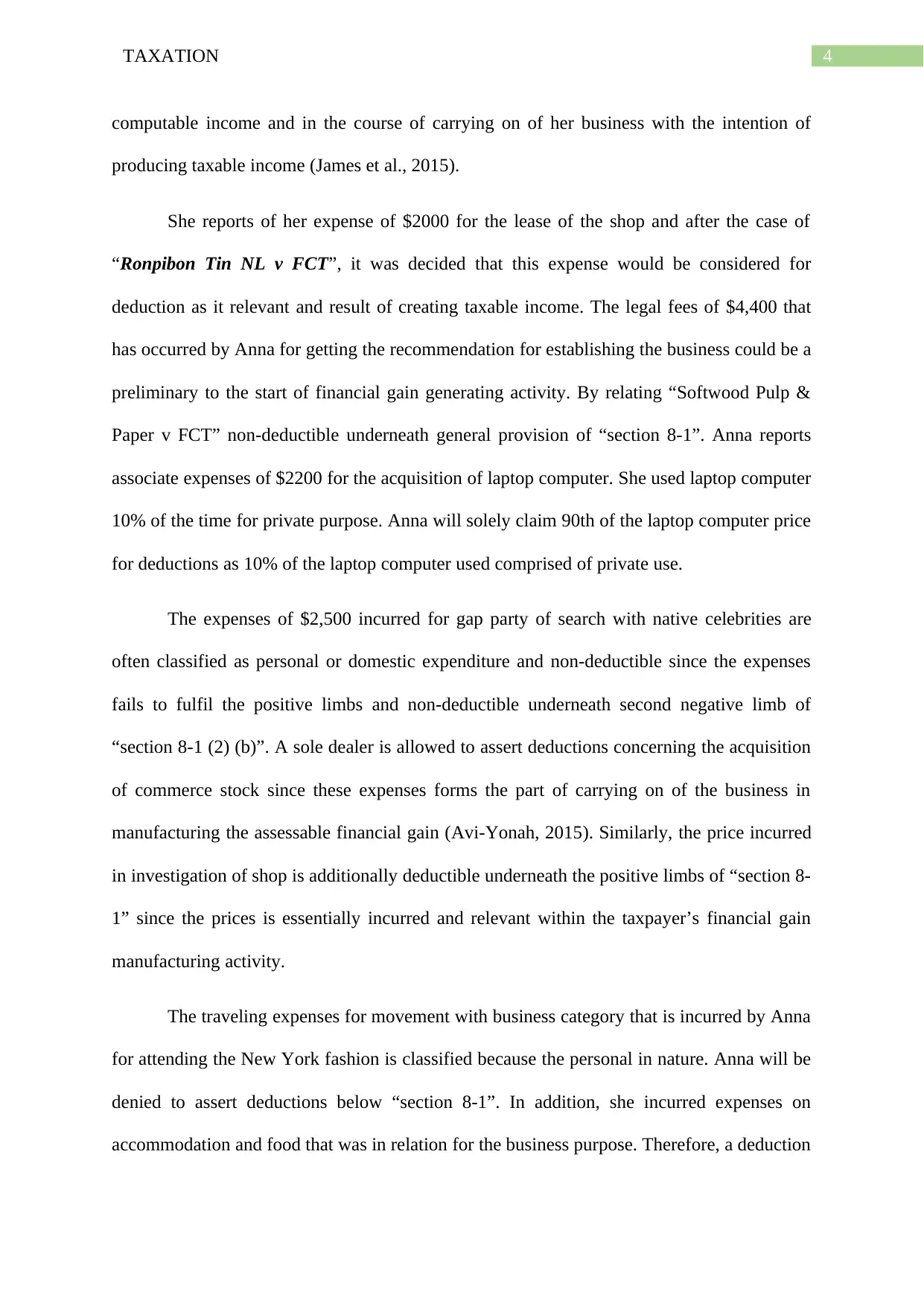
computable income and in the course of carrying on of her business with the intention of
producing taxable income (James et al., 2015).
She reports of her expense of $2000 for the lease of the shop and after the case of
“Ronpibon Tin NL v FCT”, it was decided that this expense would be considered for
deduction as it relevant and result of creating taxable income. The legal fees of $4,400 that
has occurred by Anna for getting the recommendation for establishing the business could be a
preliminary to the start of financial gain generating activity. By relating “Softwood Pulp &
Paper v FCT” non-deductible underneath general provision of “section 8-1”. Anna reports
associate expenses of $2200 for the acquisition of laptop computer. She used laptop computer
10% of the time for private purpose. Anna will solely claim 90th of the laptop computer price
for deductions as 10% of the laptop computer used comprised of private use.
The expenses of $2,500 incurred for gap party of search with native celebrities are
often classified as personal or domestic expenditure and non-deductible since the expenses
fails to fulfil the positive limbs and non-deductible underneath second negative limb of
“section 8-1 (2) (b)”. A sole dealer is allowed to assert deductions concerning the acquisition
of commerce stock since these expenses forms the part of carrying on of the business in
manufacturing the assessable financial gain (Avi-Yonah, 2015). Similarly, the price incurred
in investigation of shop is additionally deductible underneath the positive limbs of “section 8-
1” since the prices is essentially incurred and relevant within the taxpayer’s financial gain
manufacturing activity.
The traveling expenses for movement with business category that is incurred by Anna
for attending the New York fashion is classified because the personal in nature. Anna will be
denied to assert deductions below “section 8-1”. In addition, she incurred expenses on
accommodation and food that was in relation for the business purpose. Therefore, a deduction
computable income and in the course of carrying on of her business with the intention of
producing taxable income (James et al., 2015).
She reports of her expense of $2000 for the lease of the shop and after the case of
“Ronpibon Tin NL v FCT”, it was decided that this expense would be considered for
deduction as it relevant and result of creating taxable income. The legal fees of $4,400 that
has occurred by Anna for getting the recommendation for establishing the business could be a
preliminary to the start of financial gain generating activity. By relating “Softwood Pulp &
Paper v FCT” non-deductible underneath general provision of “section 8-1”. Anna reports
associate expenses of $2200 for the acquisition of laptop computer. She used laptop computer
10% of the time for private purpose. Anna will solely claim 90th of the laptop computer price
for deductions as 10% of the laptop computer used comprised of private use.
The expenses of $2,500 incurred for gap party of search with native celebrities are
often classified as personal or domestic expenditure and non-deductible since the expenses
fails to fulfil the positive limbs and non-deductible underneath second negative limb of
“section 8-1 (2) (b)”. A sole dealer is allowed to assert deductions concerning the acquisition
of commerce stock since these expenses forms the part of carrying on of the business in
manufacturing the assessable financial gain (Avi-Yonah, 2015). Similarly, the price incurred
in investigation of shop is additionally deductible underneath the positive limbs of “section 8-
1” since the prices is essentially incurred and relevant within the taxpayer’s financial gain
manufacturing activity.
The traveling expenses for movement with business category that is incurred by Anna
for attending the New York fashion is classified because the personal in nature. Anna will be
denied to assert deductions below “section 8-1”. In addition, she incurred expenses on
accommodation and food that was in relation for the business purpose. Therefore, a deduction
5TAXATION
is allowable. Citing the instances of “Lunney v FCT” the price incurred by anna to catch up
along with her friends is personal in nature and non-deductible below positive limbs of
“section 8-1”. Anna will claim deductions for wage and wages paid to staff but the wage paid
to herself is non-deductible since it constitutes nominal payment of remuneration and it'd be
treated as profit distribution (Bankman et al., 2017).
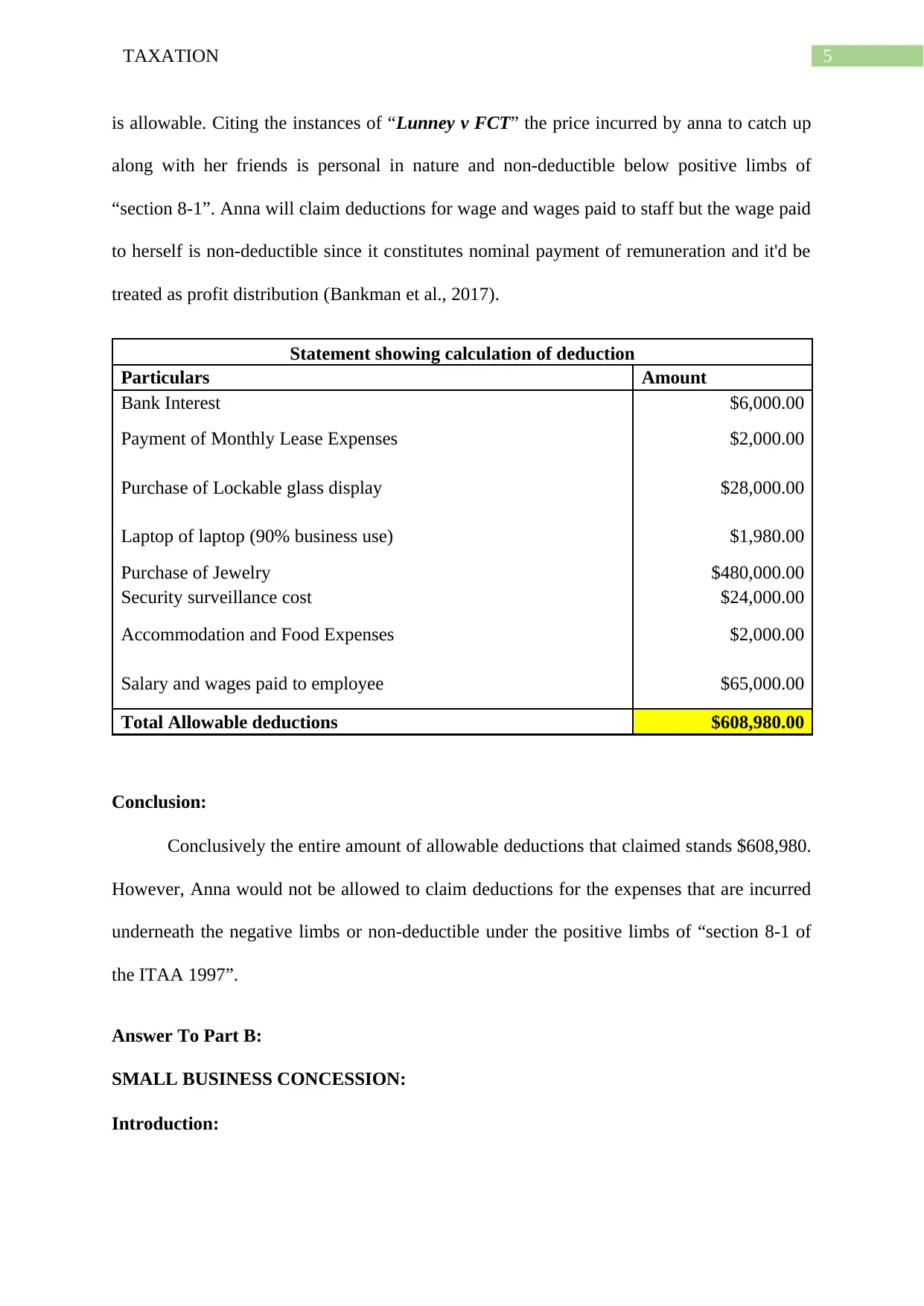
Statement showing calculation of deduction
Particulars Amount
Bank Interest $6,000.00
Payment of Monthly Lease Expenses $2,000.00
Purchase of Lockable glass display $28,000.00
Laptop of laptop (90% business use) $1,980.00
Purchase of Jewelry $480,000.00
Security surveillance cost $24,000.00
Accommodation and Food Expenses $2,000.00
Salary and wages paid to employee $65,000.00
Total Allowable deductions $608,980.00
Conclusion:
Conclusively the entire amount of allowable deductions that claimed stands $608,980.
However, Anna would not be allowed to claim deductions for the expenses that are incurred
underneath the negative limbs or non-deductible under the positive limbs of “section 8-1 of
the ITAA 1997”.
Answer To Part B:
SMALL BUSINESS CONCESSION:
Introduction:
is allowable. Citing the instances of “Lunney v FCT” the price incurred by anna to catch up
along with her friends is personal in nature and non-deductible below positive limbs of
“section 8-1”. Anna will claim deductions for wage and wages paid to staff but the wage paid
to herself is non-deductible since it constitutes nominal payment of remuneration and it'd be
treated as profit distribution (Bankman et al., 2017).
Statement showing calculation of deduction
Particulars Amount
Bank Interest $6,000.00
Payment of Monthly Lease Expenses $2,000.00
Purchase of Lockable glass display $28,000.00
Laptop of laptop (90% business use) $1,980.00
Purchase of Jewelry $480,000.00
Security surveillance cost $24,000.00
Accommodation and Food Expenses $2,000.00
Salary and wages paid to employee $65,000.00
Total Allowable deductions $608,980.00
Conclusion:
Conclusively the entire amount of allowable deductions that claimed stands $608,980.
However, Anna would not be allowed to claim deductions for the expenses that are incurred
underneath the negative limbs or non-deductible under the positive limbs of “section 8-1 of
the ITAA 1997”.
Answer To Part B:
SMALL BUSINESS CONCESSION:
Introduction:
⊘ This is a preview!⊘
Do you want full access?
Subscribe today to unlock all pages.
Trusted by 1+ million students worldwide
6TAXATION
In Australia, though big companies come into picture when it comes to shaping the
economy, the small business has an overall strong hold over the economy as well. All small
business together has a huge collective effect on the economy. In this part of the paper, we
will discuss about how small business can claim concession under the current tax law system
of Australia. When it comes to capital gain tax, small business enterprise has been given
more space compared to big companies. Section 152 of ITAA 1997, talks about small
business concession (Geljic et al., 2016). There are various policies under the current tax
regime that grants space to claim concession, thus in this part we will discuss about the
detailed statutory explanation of policies available for concession.
Small Business Concession
The private venture division of Australia has frequently sought after the testing
necessities value, effortlessness and effectiveness under the salary tax administration by
particularly setting centre around the idea of straightforwardness. Throughout the most recent
decade, various endeavours have been made to offer the private venture in Australian with
effortlessness and decrease weight of tax consistence with the assistance of disentangled
arrangement of taxation (Sanderson, 2015). By and by, disregarding making a few revisions
in the course of the most recent decade, the improved tax framework has been broadly
censured by the tax experts.
The small business frames the significant part of Australian economy. The small
business of Australia is around valued at $1.5 trillion. In a report distributed by Australian
Bureau of Statistics these small business with under $2 million turnover for each annum
makes up around 97% of the business in Australia. The small business is regularly named as
the motor for the Australian economy (Festa, 2018). The small business is particularly unfit
to accomplish the economies of expansive scale profits by their more prominent counterparts.
In Australia, though big companies come into picture when it comes to shaping the
economy, the small business has an overall strong hold over the economy as well. All small
business together has a huge collective effect on the economy. In this part of the paper, we
will discuss about how small business can claim concession under the current tax law system
of Australia. When it comes to capital gain tax, small business enterprise has been given
more space compared to big companies. Section 152 of ITAA 1997, talks about small
business concession (Geljic et al., 2016). There are various policies under the current tax
regime that grants space to claim concession, thus in this part we will discuss about the
detailed statutory explanation of policies available for concession.
Small Business Concession
The private venture division of Australia has frequently sought after the testing
necessities value, effortlessness and effectiveness under the salary tax administration by
particularly setting centre around the idea of straightforwardness. Throughout the most recent
decade, various endeavours have been made to offer the private venture in Australian with
effortlessness and decrease weight of tax consistence with the assistance of disentangled
arrangement of taxation (Sanderson, 2015). By and by, disregarding making a few revisions
in the course of the most recent decade, the improved tax framework has been broadly
censured by the tax experts.
The small business frames the significant part of Australian economy. The small
business of Australia is around valued at $1.5 trillion. In a report distributed by Australian
Bureau of Statistics these small business with under $2 million turnover for each annum
makes up around 97% of the business in Australia. The small business is regularly named as
the motor for the Australian economy (Festa, 2018). The small business is particularly unfit
to accomplish the economies of expansive scale profits by their more prominent counterparts.
Paraphrase This Document
Need a fresh take? Get an instant paraphrase of this document with our AI Paraphraser
7TAXATION
With developing significance of small business, the administration has routinely attempted of
decreasing the tax consistence cost. In the long run, with low acknowledgment rate and
across the board feedback, drove the modernized and rebadged frameworks for concessions
known as SBE administration.
As indicated by the leading body of taxation a well-made tax concessionary
administration and subsidisations is gone for helping the small business that are looked with
particular difficulties. The small business concession can assume an indispensable part in
helping the small businesses at each period of their business life expectancy. This reaches
from essential start up face to development and retirement of business proprietors (Evans et
al., 2014). The present writing would diagram the small business CGT concession in
Australia and would basically evaluate the CGT concession for small business together with
the general targets of policy. The investigation would likewise evaluate whether the
concessionary administration meets the policy goals went with facilitate fundamental
suggestions to the plan.
The Small Business CGT Concession:
Any small business element that fulfils the basic criteria that is sketched out under the
"section 152 of the ITAA 1997" is qualified for a wide assortment of CGT concessions that
are expressed under the "subdivision 152Bto 152E". The imperative effect of the concessions
gave to small business incorporates that the capital gains that starts on influencing the
dynamic asset sale to be brought down by half and 100%. In any case, unique in relation to
the next five concessions that are accessible to small business, the taxpayers of small business
substance barely chooses to execute these necessities (Sadiq and Marsden, 2014). Given that
a small business unit satisfies the basic conditions, the element acquires the CGT alleviation.
Subsequently, the tax consultants would frequently utilize arrangement of small business
With developing significance of small business, the administration has routinely attempted of
decreasing the tax consistence cost. In the long run, with low acknowledgment rate and
across the board feedback, drove the modernized and rebadged frameworks for concessions
known as SBE administration.
As indicated by the leading body of taxation a well-made tax concessionary
administration and subsidisations is gone for helping the small business that are looked with
particular difficulties. The small business concession can assume an indispensable part in
helping the small businesses at each period of their business life expectancy. This reaches
from essential start up face to development and retirement of business proprietors (Evans et
al., 2014). The present writing would diagram the small business CGT concession in
Australia and would basically evaluate the CGT concession for small business together with
the general targets of policy. The investigation would likewise evaluate whether the
concessionary administration meets the policy goals went with facilitate fundamental
suggestions to the plan.
The Small Business CGT Concession:
Any small business element that fulfils the basic criteria that is sketched out under the
"section 152 of the ITAA 1997" is qualified for a wide assortment of CGT concessions that
are expressed under the "subdivision 152Bto 152E". The imperative effect of the concessions
gave to small business incorporates that the capital gains that starts on influencing the
dynamic asset sale to be brought down by half and 100%. In any case, unique in relation to
the next five concessions that are accessible to small business, the taxpayers of small business
substance barely chooses to execute these necessities (Sadiq and Marsden, 2014). Given that
a small business unit satisfies the basic conditions, the element acquires the CGT alleviation.
Subsequently, the tax consultants would frequently utilize arrangement of small business
8TAXATION
CGT concessions that are given under the "Division 152 of the ITAA 1997" when the
customers of small business make the sale of dynamic asset.
By actualizing the specific provisions of concessions, the tax consultants can bring
down tax liability of capital gains beginning from the sale of their customer's business. As
clear, the main boss parts of the tax consultants are to decrease the taxpayer's issues of
diminished tax liability anyway the small business CGT concessions are viewed as one of the
strategy through which the tax specialists can significantly get the concession for the small
business substance (Yuan, 2014).
As per Sadiq and Marsden (2014) the small business CGT concessions is viewed as
one of most troublesome provision under the ITAA. While the taxpayers are anxious to
implement the small business CGT concessions however a few taxpayers have referred to
that the provision is not anything but difficult to implement and regularly devours time to
explore through which at last includes the tax consistence costs (Ma, 2015). There were
remarks that the CGT concessions is certainly well known strategy yet includes broad
measure of exertion. As expressed by a business can cause a cost that would run somewhere
in the range of $5000 and $10,000 for their company to learn whether the business meets all
requirements for the concessions under the small business CGT administration.
In spite of the trouble and higher inalienable costs related with the utilization of small
business CGT concessions, taxpayers see the tax concession administration as the profoundly
refreshing concession. This can be portrayed through the sheer size of tax minimization
advantage which can be acquired through utilizing the small business CGT concession.
Experimental confirmations have proposed that the small business concessions expressed
under Division 152 is exceptionally intricate and in the end results in vital cost of compliance
for the taxpayers (Tran‐Nam et al., 2016). In opposite, the tax specialist's remarks showed up
CGT concessions that are given under the "Division 152 of the ITAA 1997" when the
customers of small business make the sale of dynamic asset.
By actualizing the specific provisions of concessions, the tax consultants can bring
down tax liability of capital gains beginning from the sale of their customer's business. As
clear, the main boss parts of the tax consultants are to decrease the taxpayer's issues of
diminished tax liability anyway the small business CGT concessions are viewed as one of the
strategy through which the tax specialists can significantly get the concession for the small
business substance (Yuan, 2014).
As per Sadiq and Marsden (2014) the small business CGT concessions is viewed as
one of most troublesome provision under the ITAA. While the taxpayers are anxious to
implement the small business CGT concessions however a few taxpayers have referred to
that the provision is not anything but difficult to implement and regularly devours time to
explore through which at last includes the tax consistence costs (Ma, 2015). There were
remarks that the CGT concessions is certainly well known strategy yet includes broad
measure of exertion. As expressed by a business can cause a cost that would run somewhere
in the range of $5000 and $10,000 for their company to learn whether the business meets all
requirements for the concessions under the small business CGT administration.
In spite of the trouble and higher inalienable costs related with the utilization of small
business CGT concessions, taxpayers see the tax concession administration as the profoundly
refreshing concession. This can be portrayed through the sheer size of tax minimization
advantage which can be acquired through utilizing the small business CGT concession.
Experimental confirmations have proposed that the small business concessions expressed
under Division 152 is exceptionally intricate and in the end results in vital cost of compliance
for the taxpayers (Tran‐Nam et al., 2016). In opposite, the tax specialist's remarks showed up
⊘ This is a preview!⊘
Do you want full access?
Subscribe today to unlock all pages.
Trusted by 1+ million students worldwide
9TAXATION
inverse. The tax master saw the CGT concession as the advantage that potentially stream
toward the taxpayers and by implementing this tax concession administration, they can
exceed the cost compliance costs.
Existing writing has seen that the CGT concession for small business upsets the
principle of straightforwardness. As indicated by the taxpayers are all the more regularly
compelled to invest a substantial measure of energy in deciding if their business fulfil the
basic conditions and are from now on qualified for at least one CGT concessions (Chung,
2016). This sort of trouble existent in the eligibility govern drives the customer to confront
increment aggregate of bookkeeping expenses due to the time that is spend by the tax
operator in evaluating every concession and discovering which concessions fits well to the
business.
As an outcome of this, it is plausible where the professionals trust that the attainable
quality of the markdown is marginal with taxpayers may be exhorted that the costs that are
caused in inquiring about the attainable quality of the tax concession and implementing the
same may be high to legitimize. This speaks to that the inalienable cost that are connected
with the tax concessions multifaceted nature, couple of qualified business will most likely be
unable to utilize those regimes of tax concession as they can't bear the cost of the risk of
carrying the costs with no benefits identified with it. Thusly, the regimes of tax concessions
damages the tax principle of equity (Lignier et al., 2014). On a decisive note, the small
business CGT concessions are seen as an instrument of more noteworthy advantage anyway
the trouble in eligibility rules is extremely limiting and costly; maybe require a direct
extensive assessment.
Overall Policy Objective under Present System of Taxation:
inverse. The tax master saw the CGT concession as the advantage that potentially stream
toward the taxpayers and by implementing this tax concession administration, they can
exceed the cost compliance costs.
Existing writing has seen that the CGT concession for small business upsets the
principle of straightforwardness. As indicated by the taxpayers are all the more regularly
compelled to invest a substantial measure of energy in deciding if their business fulfil the
basic conditions and are from now on qualified for at least one CGT concessions (Chung,
2016). This sort of trouble existent in the eligibility govern drives the customer to confront
increment aggregate of bookkeeping expenses due to the time that is spend by the tax
operator in evaluating every concession and discovering which concessions fits well to the
business.
As an outcome of this, it is plausible where the professionals trust that the attainable
quality of the markdown is marginal with taxpayers may be exhorted that the costs that are
caused in inquiring about the attainable quality of the tax concession and implementing the
same may be high to legitimize. This speaks to that the inalienable cost that are connected
with the tax concessions multifaceted nature, couple of qualified business will most likely be
unable to utilize those regimes of tax concession as they can't bear the cost of the risk of
carrying the costs with no benefits identified with it. Thusly, the regimes of tax concessions
damages the tax principle of equity (Lignier et al., 2014). On a decisive note, the small
business CGT concessions are seen as an instrument of more noteworthy advantage anyway
the trouble in eligibility rules is extremely limiting and costly; maybe require a direct
extensive assessment.
Overall Policy Objective under Present System of Taxation:
Paraphrase This Document
Need a fresh take? Get an instant paraphrase of this document with our AI Paraphraser
10TAXATION
The tax concessions for the taxpayers of small business frames a vital component of
the present system of Australian taxation system. There are various policy targets that
supports the tax concession. Certain policies are gone for decreasing the weight of
compliance while different policies are gone for offering more prominent tax help to elevate
the entrance to business achievement. While different policies are gone for elevating more
extensive access to acquire finance for their retirement and with concessions that are made to
meet the mix of the above expressed goals (Woellner et al., 2015).
The lower company tax rate concession was started amid 2015-16 with decrease the
rate of company tax to 28.5 for business that have a yearly-accumulated turnover of lower
than $2 million. In the next year 2015-17 the rate of company tax rate was additionally
brought down to 27.5% for business that have the yearly turnover of lower than $10 million.
The Capital gains tax concession is another policy where the proprietors of the net assets of
not more noteworthy than $6 million. The yearly sales turnover of lower than $2 million are
qualified for a small business CGT concession on the small business dynamic assets which is
held continually for a time of 15 years or where the taxpayers accomplishes the age of 55 and
resigns (Trad and Freudenberg, 2017).
The small business CGT concession give half decrease of the capital gains that starts
from the sale of dynamic small business assets together with the general CGT discount. The
policy gives the small business the exemption until the lifetime top of $500,000 on the capital
gains beginning from the sale of dynamic small business assets and where the sale continues
of the assets are utilized to finance the retirement (Evans and Krever, 2017). The present
policy gives the small business the CGT rollover helps for the capital gains beginning upon
the sale of the small business dynamic assets given the sales continues are employed in the
buy of dynamic small business assets.
The tax concessions for the taxpayers of small business frames a vital component of
the present system of Australian taxation system. There are various policy targets that
supports the tax concession. Certain policies are gone for decreasing the weight of
compliance while different policies are gone for offering more prominent tax help to elevate
the entrance to business achievement. While different policies are gone for elevating more
extensive access to acquire finance for their retirement and with concessions that are made to
meet the mix of the above expressed goals (Woellner et al., 2015).
The lower company tax rate concession was started amid 2015-16 with decrease the
rate of company tax to 28.5 for business that have a yearly-accumulated turnover of lower
than $2 million. In the next year 2015-17 the rate of company tax rate was additionally
brought down to 27.5% for business that have the yearly turnover of lower than $10 million.
The Capital gains tax concession is another policy where the proprietors of the net assets of
not more noteworthy than $6 million. The yearly sales turnover of lower than $2 million are
qualified for a small business CGT concession on the small business dynamic assets which is
held continually for a time of 15 years or where the taxpayers accomplishes the age of 55 and
resigns (Trad and Freudenberg, 2017).
The small business CGT concession give half decrease of the capital gains that starts
from the sale of dynamic small business assets together with the general CGT discount. The
policy gives the small business the exemption until the lifetime top of $500,000 on the capital
gains beginning from the sale of dynamic small business assets and where the sale continues
of the assets are utilized to finance the retirement (Evans and Krever, 2017). The present
policy gives the small business the CGT rollover helps for the capital gains beginning upon
the sale of the small business dynamic assets given the sales continues are employed in the
buy of dynamic small business assets.
11TAXATION
The present policy gives the small business the moment asset discounting under the
rearranged depreciation rules. The small business elements that have the aggregate turnover
of lower than $10 million can get the entrance of concessional depreciation course of action
for its business assets (Freudenberg et al., 2017). Under such concessions, the business
elements are permitted to promptly assert reasonings for those assets that costs lower than as
far as possible. Policies, for example, rebuild rollover alleviation gives the small business
proprietors of dynamic assets with the CGT and salary tax rollover help identifying with bona
fide business rebuild in view of the conditions that the economic responsibility for assets is
unaltered. The rollover is accessible for the business that have the aggregate turnover of
lower than $10 million.
The present policy objective gives the small business improved tenets of exchanging
stock. Small businesses that have the aggregated yearly sales turnover of lower than $10
million may utilize the disentangled exchanging stock regimes. Under these regimes, the
small business can choose not to represent the adjustments in the stock values for the wage
year finished given the distinction between the opening estimation of the stock close by and
the assessed stock close by toward the year's end would not go past $5000. The policy
objective convincingly conveys that the tax system likewise masterminds positive results to
the section of small business by making it simple to pull in the consideration of financial
specialists (Freebairn, 2016).
Critical Evaluation of SBE Concession:
The customary tax policy needs a tax regime with the goal that it can satisfy certain
number of assorted and as often as possible clashing criteria to be estimated as the great tax
policy. The principles of equity, comfort, sureness and economy is regularly seen as the old-
style gauges where distinctive government and administrative units generally attempt these
criteria in some frame while applying the new provision of tax regimes alongside the general
The present policy gives the small business the moment asset discounting under the
rearranged depreciation rules. The small business elements that have the aggregate turnover
of lower than $10 million can get the entrance of concessional depreciation course of action
for its business assets (Freudenberg et al., 2017). Under such concessions, the business
elements are permitted to promptly assert reasonings for those assets that costs lower than as
far as possible. Policies, for example, rebuild rollover alleviation gives the small business
proprietors of dynamic assets with the CGT and salary tax rollover help identifying with bona
fide business rebuild in view of the conditions that the economic responsibility for assets is
unaltered. The rollover is accessible for the business that have the aggregate turnover of
lower than $10 million.
The present policy objective gives the small business improved tenets of exchanging
stock. Small businesses that have the aggregated yearly sales turnover of lower than $10
million may utilize the disentangled exchanging stock regimes. Under these regimes, the
small business can choose not to represent the adjustments in the stock values for the wage
year finished given the distinction between the opening estimation of the stock close by and
the assessed stock close by toward the year's end would not go past $5000. The policy
objective convincingly conveys that the tax system likewise masterminds positive results to
the section of small business by making it simple to pull in the consideration of financial
specialists (Freebairn, 2016).
Critical Evaluation of SBE Concession:
The customary tax policy needs a tax regime with the goal that it can satisfy certain
number of assorted and as often as possible clashing criteria to be estimated as the great tax
policy. The principles of equity, comfort, sureness and economy is regularly seen as the old-
style gauges where distinctive government and administrative units generally attempt these
criteria in some frame while applying the new provision of tax regimes alongside the general
⊘ This is a preview!⊘
Do you want full access?
Subscribe today to unlock all pages.
Trusted by 1+ million students worldwide

1 out of 20


Related Documents


Your All-in-One AI-Powered Toolkit for Academic Success.
+13062052269
info@desklib.com
Available 24*7 on WhatsApp / Email
![[object Object]](/_next/static/media/star-bottom.7253800d.svg)
Unlock your academic potential
Copyright © 2020–2026 A2Z Services. All Rights Reserved. Developed and managed by ZUCOL.