Division 6, Income Tax Assessment Act 1936: Analysis of Trust Taxation

Verified

Added on  2023/04/06

|4
|678
|220
Essay
AI Summary
This essay critically examines Division 6 of the Income Tax Assessment Act 1936, focusing on the controversies surrounding its operation concerning trust taxation. It analyzes the flow-through and entity approaches, evaluating their merits in the context of legal and equitable relationships between trustees and beneficiaries. The essay also considers the differences between fixed and discretionary trusts and the treatment of distributions, capital gains, and corpus under each approach. Ultimately, the paper recommends the most appropriate approach based on the analysis, drawing upon various articles and the Act itself to support its conclusions.
Document Page
Running head: TAXATION OF TRUSTS
Taxation of Trusts
Name of the Student
Name of the University
Author Note
tabler-icon-diamond-filled.svg

Paraphrase This Document

Need a fresh take? Get an instant paraphrase of this document with our AI Paraphraser
Document Page
1TAXATION OF TRUSTS
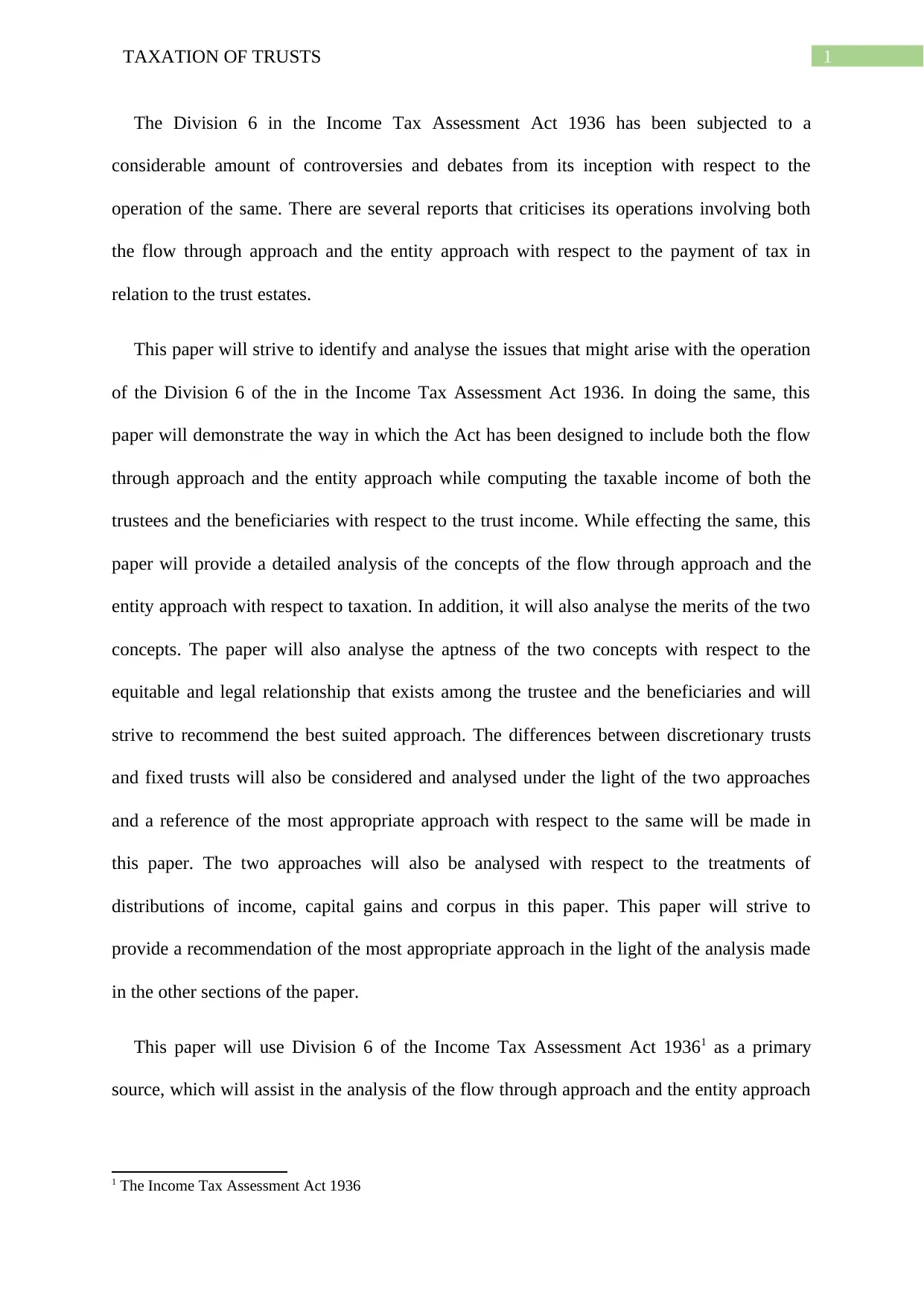
The Division 6 in the Income Tax Assessment Act 1936 has been subjected to a
considerable amount of controversies and debates from its inception with respect to the
operation of the same. There are several reports that criticises its operations involving both
the flow through approach and the entity approach with respect to the payment of tax in
relation to the trust estates.
This paper will strive to identify and analyse the issues that might arise with the operation
of the Division 6 of the in the Income Tax Assessment Act 1936. In doing the same, this
paper will demonstrate the way in which the Act has been designed to include both the flow
through approach and the entity approach while computing the taxable income of both the
trustees and the beneficiaries with respect to the trust income. While effecting the same, this
paper will provide a detailed analysis of the concepts of the flow through approach and the
entity approach with respect to taxation. In addition, it will also analyse the merits of the two
concepts. The paper will also analyse the aptness of the two concepts with respect to the
equitable and legal relationship that exists among the trustee and the beneficiaries and will
strive to recommend the best suited approach. The differences between discretionary trusts
and fixed trusts will also be considered and analysed under the light of the two approaches
and a reference of the most appropriate approach with respect to the same will be made in
this paper. The two approaches will also be analysed with respect to the treatments of
distributions of income, capital gains and corpus in this paper. This paper will strive to
provide a recommendation of the most appropriate approach in the light of the analysis made
in the other sections of the paper.
This paper will use Division 6 of the Income Tax Assessment Act 19361 as a primary
source, which will assist in the analysis of the flow through approach and the entity approach
1 The Income Tax Assessment Act 1936
Document Page
2TAXATION OF TRUSTS
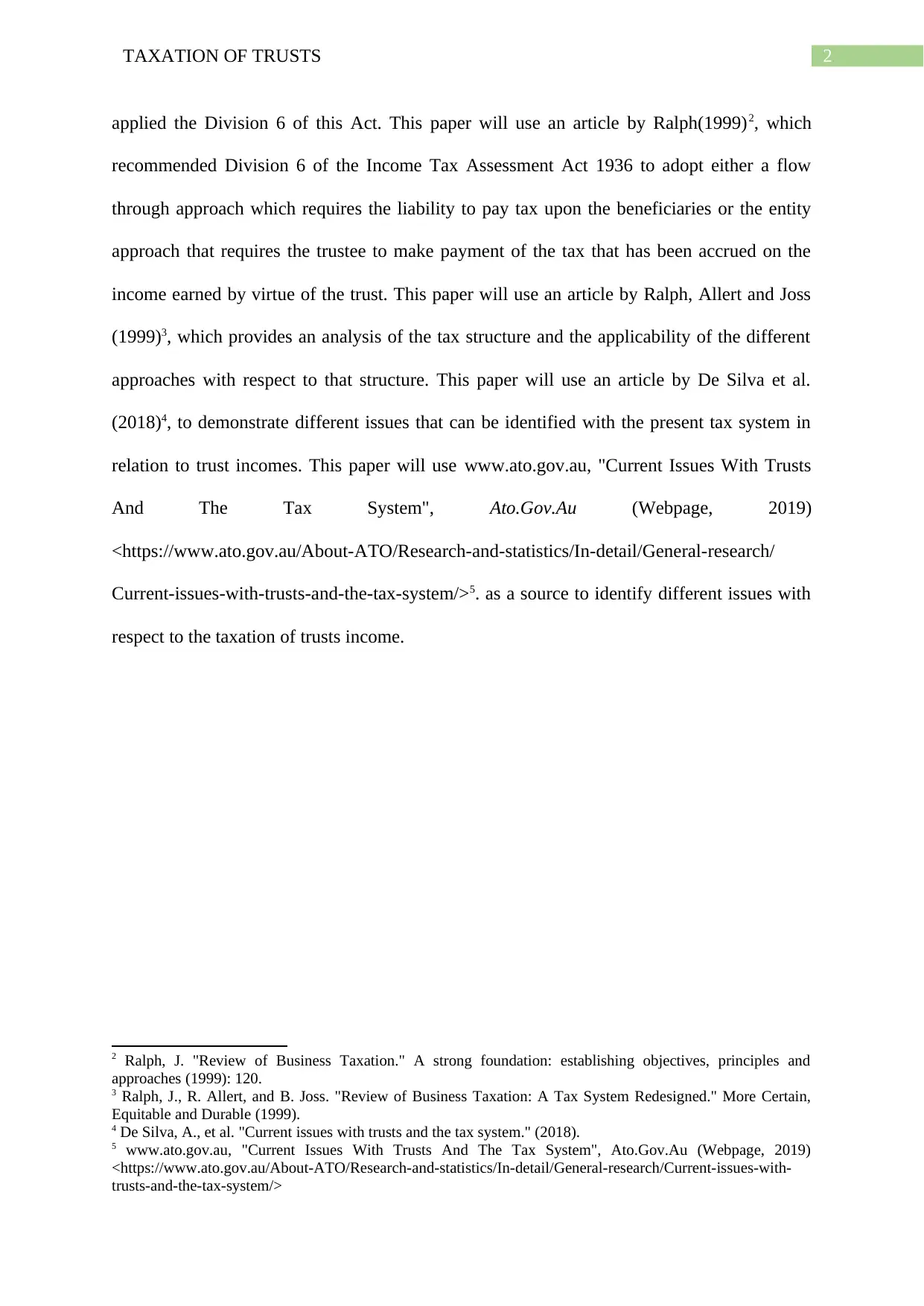
applied the Division 6 of this Act. This paper will use an article by Ralph(1999)2, which
recommended Division 6 of the Income Tax Assessment Act 1936 to adopt either a flow
through approach which requires the liability to pay tax upon the beneficiaries or the entity
approach that requires the trustee to make payment of the tax that has been accrued on the
income earned by virtue of the trust. This paper will use an article by Ralph, Allert and Joss
(1999)3, which provides an analysis of the tax structure and the applicability of the different
approaches with respect to that structure. This paper will use an article by De Silva et al.
(2018)4, to demonstrate different issues that can be identified with the present tax system in
relation to trust incomes. This paper will use www.ato.gov.au, "Current Issues With Trusts
And The Tax System", Ato.Gov.Au (Webpage, 2019)
<https://www.ato.gov.au/About-ATO/Research-and-statistics/In-detail/General-research/
Current-issues-with-trusts-and-the-tax-system/>5. as a source to identify different issues with
respect to the taxation of trusts income.
2 Ralph, J. "Review of Business Taxation." A strong foundation: establishing objectives, principles and
approaches (1999): 120.
3 Ralph, J., R. Allert, and B. Joss. "Review of Business Taxation: A Tax System Redesigned." More Certain,
Equitable and Durable (1999).
4 De Silva, A., et al. "Current issues with trusts and the tax system." (2018).
5 www.ato.gov.au, "Current Issues With Trusts And The Tax System", Ato.Gov.Au (Webpage, 2019)
<https://www.ato.gov.au/About-ATO/Research-and-statistics/In-detail/General-research/Current-issues-with-
trusts-and-the-tax-system/>
Document Page
3TAXATION OF TRUSTS
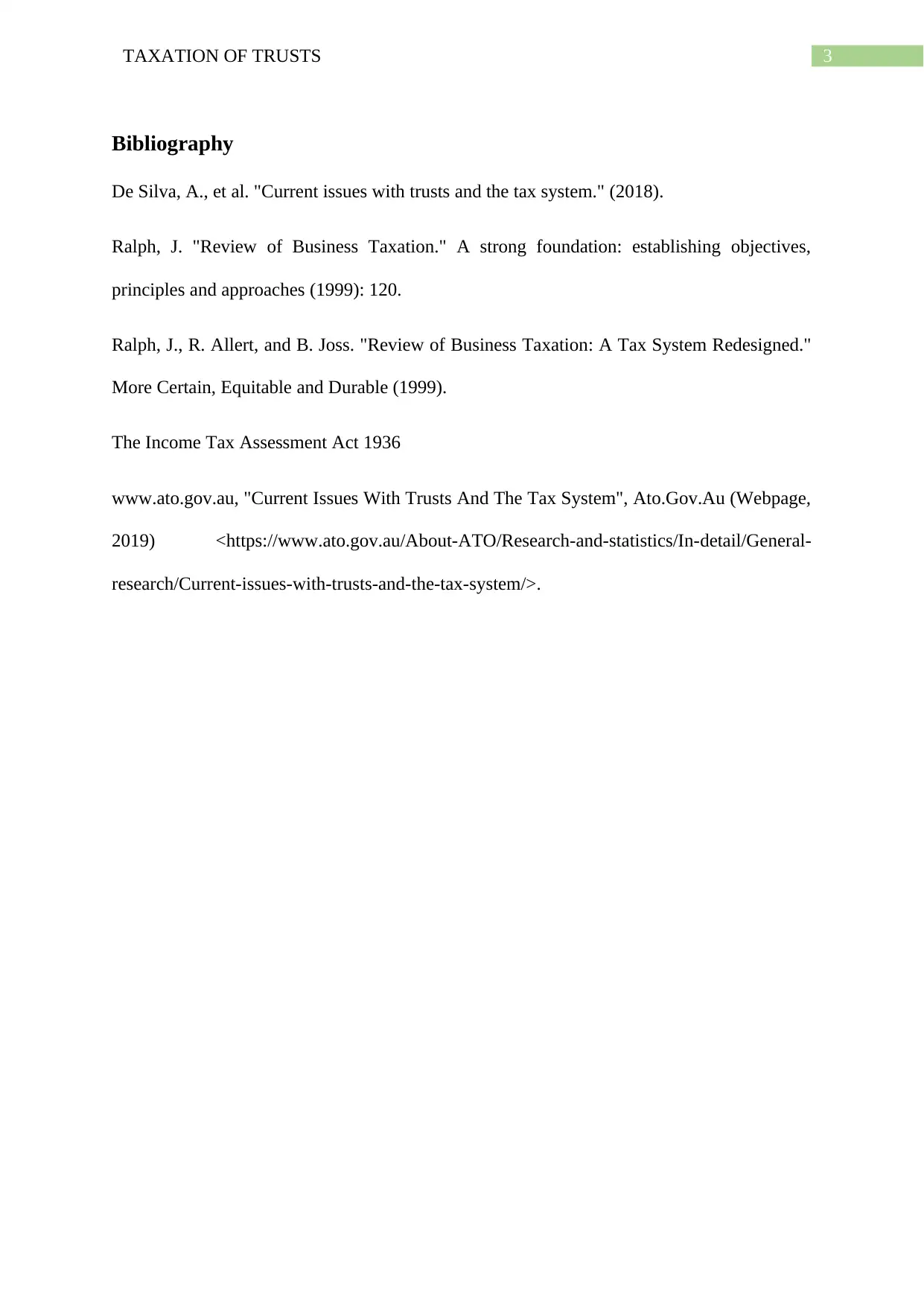
Bibliography
De Silva, A., et al. "Current issues with trusts and the tax system." (2018).
Ralph, J. "Review of Business Taxation." A strong foundation: establishing objectives,
principles and approaches (1999): 120.
Ralph, J., R. Allert, and B. Joss. "Review of Business Taxation: A Tax System Redesigned."
More Certain, Equitable and Durable (1999).
The Income Tax Assessment Act 1936
www.ato.gov.au, "Current Issues With Trusts And The Tax System", Ato.Gov.Au (Webpage,
2019) <https://www.ato.gov.au/About-ATO/Research-and-statistics/In-detail/General-
research/Current-issues-with-trusts-and-the-tax-system/>.
chevron_up_icon
1 out of 4
circle_padding
hide_on_mobile
zoom_out_icon
[object Object]