Employment Relations: India and Australia Business Expansion
VerifiedAdded on 2019/10/31
|19
|3471
|178
Report
AI Summary
This report provides a comprehensive analysis of the employment relations between India and Australia, examining various facets such as economic indicators, trade agreements, and investment dynamics. It begins with an executive summary highlighting the importance of ethical and trade relations for business expansion between the two countries. The report delves into the Indian economy, discussing GDP, tax structures, the role of information technology, and the impact of Free Trade Agreements (FTAs) and Foreign Direct Investment (FDI) on employment. It also explores the Australian economy and provides a comparison between the two nations. The analysis covers employment statistics, including the employment diaspora and the impact of various governmental policies. The report concludes by summarizing the key findings and offering insights for managers seeking to expand their businesses overseas, emphasizing the benefits of understanding the economic and employment landscapes of both countries. The report also addresses challenges such as infrastructural development and unemployment, offering a holistic view of the employment relations between India and Australia.
Running head: EMPLOYMENT RELATIONS
Employment relations between India and Australia
Name of the student:
Name of the university:
Author note:
Employment relations between India and Australia
Name of the student:
Name of the university:
Author note:

Paraphrase This Document
Need a fresh take? Get an instant paraphrase of this document with our AI Paraphraser
1
EMPLOYMENT RELATIONS
Executive summary
Two countries and partners indulge in partnerships with each other for achieving expansion in
their business. For this, both the countries need to abide by the ethics along with the trade
relations, which avert them from the illegal instances. This assignment forms a study guide for
the individuals intending to move abroad for the sake of expanding the scope and arena of their
business. An insight into the economies of both the countries enhances the clarity of business in
terms of the market scenario. This enables them to think about the factors, which would prove
beneficial and which factors would pose as an obstacle in their identified and the specified goals.
Viewing it from other perspective, selection of Australia for business expansion is appropriate in
response to the diversified workforce. On the other hand, adding firmness to the present business
in India would result in its development. Thinking about better employment opportunities in a
country like Australia brings the aspect of geographical diversity into the discussion.
EMPLOYMENT RELATIONS
Executive summary
Two countries and partners indulge in partnerships with each other for achieving expansion in
their business. For this, both the countries need to abide by the ethics along with the trade
relations, which avert them from the illegal instances. This assignment forms a study guide for
the individuals intending to move abroad for the sake of expanding the scope and arena of their
business. An insight into the economies of both the countries enhances the clarity of business in
terms of the market scenario. This enables them to think about the factors, which would prove
beneficial and which factors would pose as an obstacle in their identified and the specified goals.
Viewing it from other perspective, selection of Australia for business expansion is appropriate in
response to the diversified workforce. On the other hand, adding firmness to the present business
in India would result in its development. Thinking about better employment opportunities in a
country like Australia brings the aspect of geographical diversity into the discussion.
2
EMPLOYMENT RELATIONS
Table of contents
Insight into employment relations...................................................................................................2
Employment in India.......................................................................................................................2
Indian economy...........................................................................................................................2
GDP.........................................................................................................................................2
Tax...........................................................................................................................................3
Information Technology..........................................................................................................4
Free Trade Agreement (FTA)..................................................................................................5
Investments..............................................................................................................................6
Employment.............................................................................................................................7
Employment diaspora............................................................................................................10
Australian economy.......................................................................................................................10
Comparison between India and Australia......................................................................................12
Conclusion.....................................................................................................................................14
References and bibliography.........................................................................................................15
EMPLOYMENT RELATIONS
Table of contents
Insight into employment relations...................................................................................................2
Employment in India.......................................................................................................................2
Indian economy...........................................................................................................................2
GDP.........................................................................................................................................2
Tax...........................................................................................................................................3
Information Technology..........................................................................................................4
Free Trade Agreement (FTA)..................................................................................................5
Investments..............................................................................................................................6
Employment.............................................................................................................................7
Employment diaspora............................................................................................................10
Australian economy.......................................................................................................................10
Comparison between India and Australia......................................................................................12
Conclusion.....................................................................................................................................14
References and bibliography.........................................................................................................15
⊘ This is a preview!⊘
Do you want full access?
Subscribe today to unlock all pages.

Trusted by 1+ million students worldwide
3
EMPLOYMENT RELATIONS
Insight into employment relations
Employment is a collaborative aspect, which involves the cooperation of two or more
partners for the execution of the business activities. This cooperation has different perspectives-
partnership between two companies, relationship between two business partners, two different
countries among others. Viewing it from the other perspective, employment relations can be
related with contracts, deals, trades and transactions. Within this, conscious attitude towards the
maintenance of ethics enhances the stability in the relationship between the two countries. This
assignment focuses on the employment relation between two countries: India and Australia.
Within this perspective, there are different parameters such as the employment trade,
legislations, and ethics among others. In view of these aspects, the thesis statement of the
assignment is to speculate the benefits of establishing their business overseas for the managers
in future, which would result in their professional development.
Employment in India
Indian economy
GDP
GDP of $2.454 million has placed India in the sixth position in terms of nominal GDP.
This also includes $9.489 million GDP in terms of purchasing power parity, which has bestowed
the third position on India. In terms of the market size, India’s GDP encountered an
unprecedented growth of 7% in October-December 2016 (Mhrd.gov.in 2017). As a whole, India
has been ranked 141st in the nominal GDP. The major drive behind this is the GDP amount of
$1723. Consistent efforts of the finance personnel have resulted in noticeable improvement in the
GDP amount of the purchasing power parity. As a matter of specification, in the era of 2016, the
EMPLOYMENT RELATIONS
Insight into employment relations
Employment is a collaborative aspect, which involves the cooperation of two or more
partners for the execution of the business activities. This cooperation has different perspectives-
partnership between two companies, relationship between two business partners, two different
countries among others. Viewing it from the other perspective, employment relations can be
related with contracts, deals, trades and transactions. Within this, conscious attitude towards the
maintenance of ethics enhances the stability in the relationship between the two countries. This
assignment focuses on the employment relation between two countries: India and Australia.
Within this perspective, there are different parameters such as the employment trade,
legislations, and ethics among others. In view of these aspects, the thesis statement of the
assignment is to speculate the benefits of establishing their business overseas for the managers
in future, which would result in their professional development.
Employment in India
Indian economy
GDP
GDP of $2.454 million has placed India in the sixth position in terms of nominal GDP.
This also includes $9.489 million GDP in terms of purchasing power parity, which has bestowed
the third position on India. In terms of the market size, India’s GDP encountered an
unprecedented growth of 7% in October-December 2016 (Mhrd.gov.in 2017). As a whole, India
has been ranked 141st in the nominal GDP. The major drive behind this is the GDP amount of
$1723. Consistent efforts of the finance personnel have resulted in noticeable improvement in the
GDP amount of the purchasing power parity. As a matter of specification, in the era of 2016, the
Paraphrase This Document
Need a fresh take? Get an instant paraphrase of this document with our AI Paraphraser
4
EMPLOYMENT RELATIONS
GDP amount mounted up to $6616, which placed India in the 123rd position. These growths
resulted in the all together growth of 7.2% in the gross domestic product, which surpassed the
forecasting of the Indian government regarding the development of the Indian economy.
This growth percent has attained an important position in the meetings of the G20
summit. According to the estimations of Indian Monetary Fund (IMF), this value would rise to
7.7% by the financial year of 2017-18 (Mhrd.gov.in 2017).
Tax
This is one such parameter, with which the quotation, “by the people and for the people”
can be related. The tax deposited by the people is used for providing them with the basic
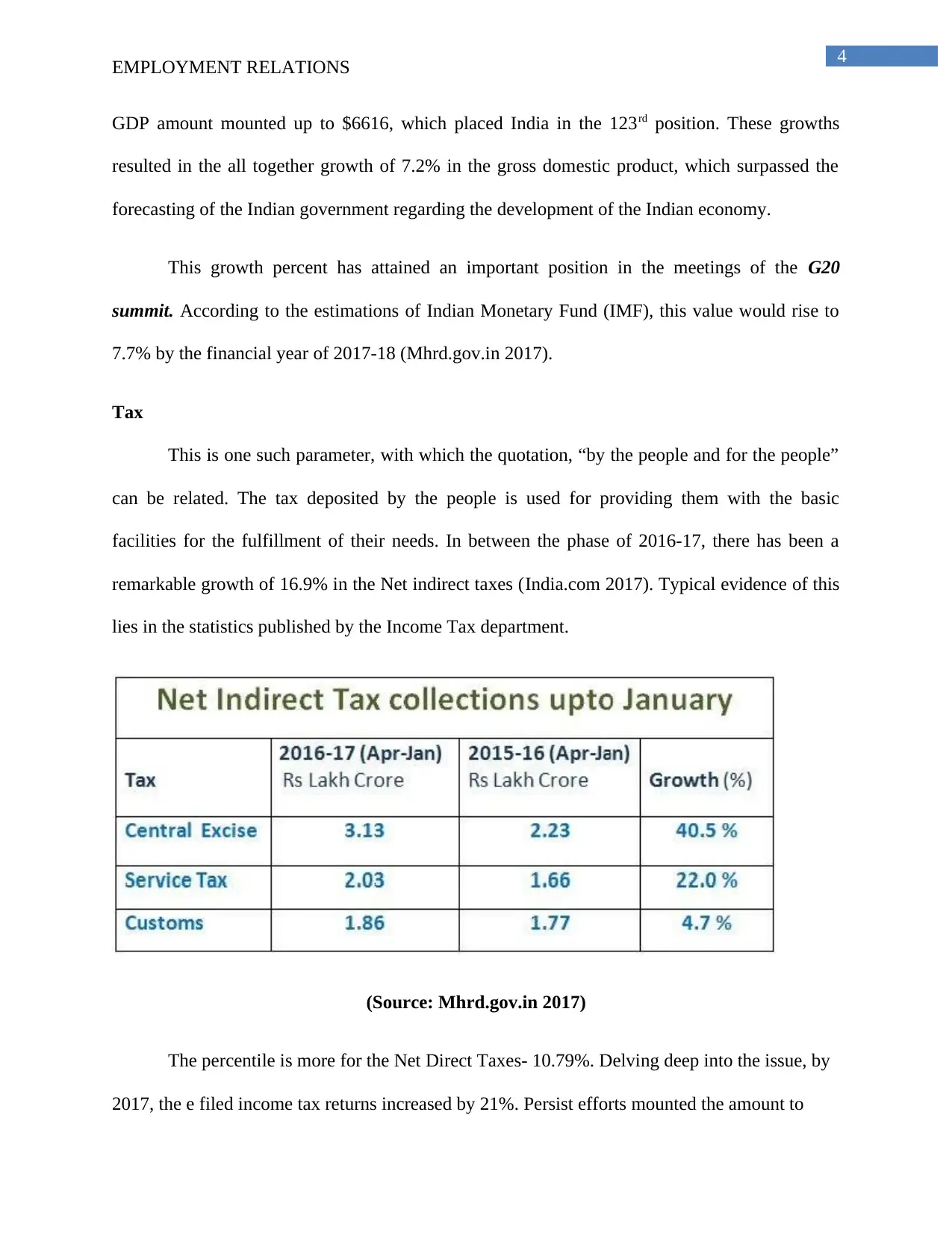
facilities for the fulfillment of their needs. In between the phase of 2016-17, there has been a
remarkable growth of 16.9% in the Net indirect taxes (India.com 2017). Typical evidence of this
lies in the statistics published by the Income Tax department.
(Source: Mhrd.gov.in 2017)
The percentile is more for the Net Direct Taxes- 10.79%. Delving deep into the issue, by
2017, the e filed income tax returns increased by 21%. Persist efforts mounted the amount to
EMPLOYMENT RELATIONS
GDP amount mounted up to $6616, which placed India in the 123rd position. These growths
resulted in the all together growth of 7.2% in the gross domestic product, which surpassed the
forecasting of the Indian government regarding the development of the Indian economy.
This growth percent has attained an important position in the meetings of the G20
summit. According to the estimations of Indian Monetary Fund (IMF), this value would rise to
7.7% by the financial year of 2017-18 (Mhrd.gov.in 2017).
Tax
This is one such parameter, with which the quotation, “by the people and for the people”
can be related. The tax deposited by the people is used for providing them with the basic
facilities for the fulfillment of their needs. In between the phase of 2016-17, there has been a
remarkable growth of 16.9% in the Net indirect taxes (India.com 2017). Typical evidence of this
lies in the statistics published by the Income Tax department.
(Source: Mhrd.gov.in 2017)
The percentile is more for the Net Direct Taxes- 10.79%. Delving deep into the issue, by
2017, the e filed income tax returns increased by 21%. Persist efforts mounted the amount to
5
EMPLOYMENT RELATIONS
42.1 million until the entries of 28th February 2017. On the contrary, consistency was maintained
for the total number of e-returns processed.
Information Technology
Information technology is one of the most important fields, which has revolutionizes the
Indian economy. IT services and BPO has expanded the scope and arena of this parameter.
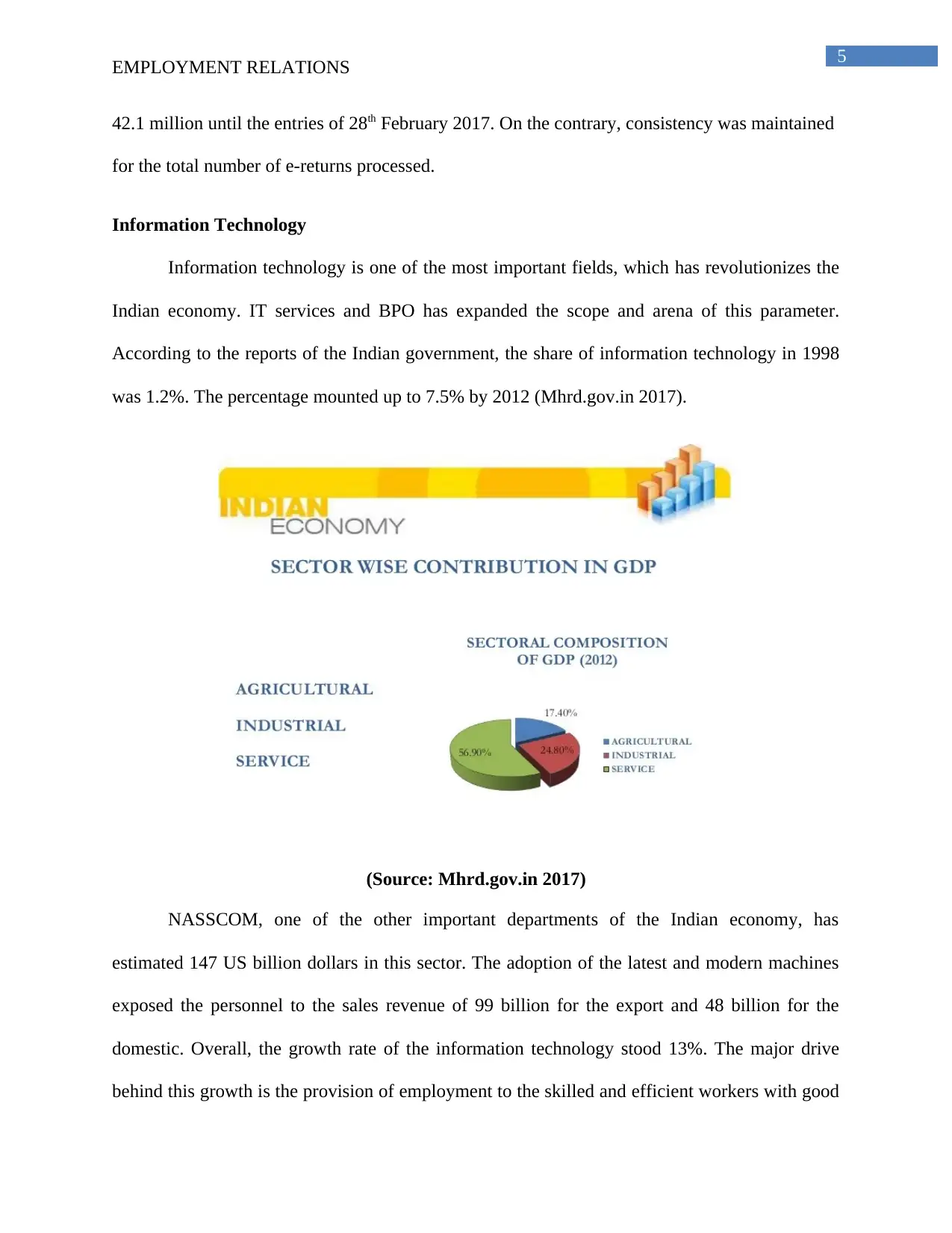
According to the reports of the Indian government, the share of information technology in 1998
was 1.2%. The percentage mounted up to 7.5% by 2012 (Mhrd.gov.in 2017).
(Source: Mhrd.gov.in 2017)
NASSCOM, one of the other important departments of the Indian economy, has
estimated 147 US billion dollars in this sector. The adoption of the latest and modern machines
exposed the personnel to the sales revenue of 99 billion for the export and 48 billion for the
domestic. Overall, the growth rate of the information technology stood 13%. The major drive
behind this growth is the provision of employment to the skilled and efficient workers with good
EMPLOYMENT RELATIONS
42.1 million until the entries of 28th February 2017. On the contrary, consistency was maintained
for the total number of e-returns processed.
Information Technology
Information technology is one of the most important fields, which has revolutionizes the
Indian economy. IT services and BPO has expanded the scope and arena of this parameter.
According to the reports of the Indian government, the share of information technology in 1998
was 1.2%. The percentage mounted up to 7.5% by 2012 (Mhrd.gov.in 2017).
(Source: Mhrd.gov.in 2017)
NASSCOM, one of the other important departments of the Indian economy, has
estimated 147 US billion dollars in this sector. The adoption of the latest and modern machines
exposed the personnel to the sales revenue of 99 billion for the export and 48 billion for the
domestic. Overall, the growth rate of the information technology stood 13%. The major drive
behind this growth is the provision of employment to the skilled and efficient workers with good
⊘ This is a preview!⊘
Do you want full access?
Subscribe today to unlock all pages.
Trusted by 1+ million students worldwide
6
EMPLOYMENT RELATIONS
command over English. This is in response to the increased demand of business outsourcing
from the neighboring countries. 2.2% increase in the IT industry’s share in the total GDP has
enlisted the Indian firms in the top most position of the technological outsourcing companies of
the world (Mhrd.gov.in 2017).
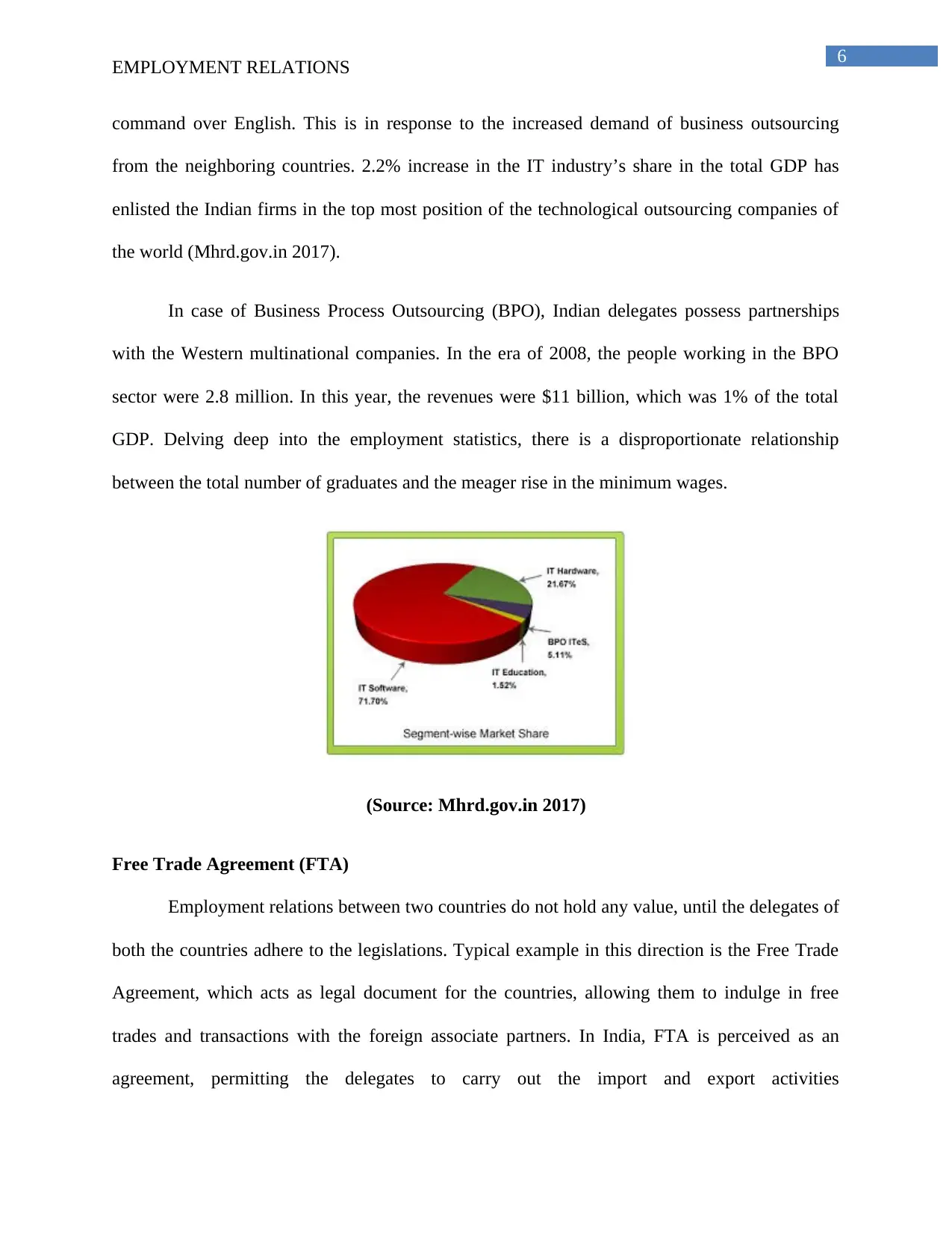
In case of Business Process Outsourcing (BPO), Indian delegates possess partnerships
with the Western multinational companies. In the era of 2008, the people working in the BPO
sector were 2.8 million. In this year, the revenues were $11 billion, which was 1% of the total
GDP. Delving deep into the employment statistics, there is a disproportionate relationship
between the total number of graduates and the meager rise in the minimum wages.
(Source: Mhrd.gov.in 2017)
Free Trade Agreement (FTA)
Employment relations between two countries do not hold any value, until the delegates of
both the countries adhere to the legislations. Typical example in this direction is the Free Trade
Agreement, which acts as legal document for the countries, allowing them to indulge in free
trades and transactions with the foreign associate partners. In India, FTA is perceived as an
agreement, permitting the delegates to carry out the import and export activities
EMPLOYMENT RELATIONS
command over English. This is in response to the increased demand of business outsourcing
from the neighboring countries. 2.2% increase in the IT industry’s share in the total GDP has
enlisted the Indian firms in the top most position of the technological outsourcing companies of
the world (Mhrd.gov.in 2017).
In case of Business Process Outsourcing (BPO), Indian delegates possess partnerships
with the Western multinational companies. In the era of 2008, the people working in the BPO
sector were 2.8 million. In this year, the revenues were $11 billion, which was 1% of the total
GDP. Delving deep into the employment statistics, there is a disproportionate relationship
between the total number of graduates and the meager rise in the minimum wages.
(Source: Mhrd.gov.in 2017)
Free Trade Agreement (FTA)
Employment relations between two countries do not hold any value, until the delegates of
both the countries adhere to the legislations. Typical example in this direction is the Free Trade
Agreement, which acts as legal document for the countries, allowing them to indulge in free
trades and transactions with the foreign associate partners. In India, FTA is perceived as an
agreement, permitting the delegates to carry out the import and export activities
Paraphrase This Document
Need a fresh take? Get an instant paraphrase of this document with our AI Paraphraser

7
EMPLOYMENT RELATIONS
(Commerce.gov.in 2017). Along with this, the agreement is an allowance for the foreign
delegates to make lucrative investments in the goods and services. Recruitment of the skilled
labors aligns with the ethics regarding the work-age population. Here, the most important aspects
are to ensure the allotment of the task according to the capability and skills. Compliance to the
domestic laws and legislations helps the Indian government officials to conduct legal trades,
deals and transactions with the partners.
Investments
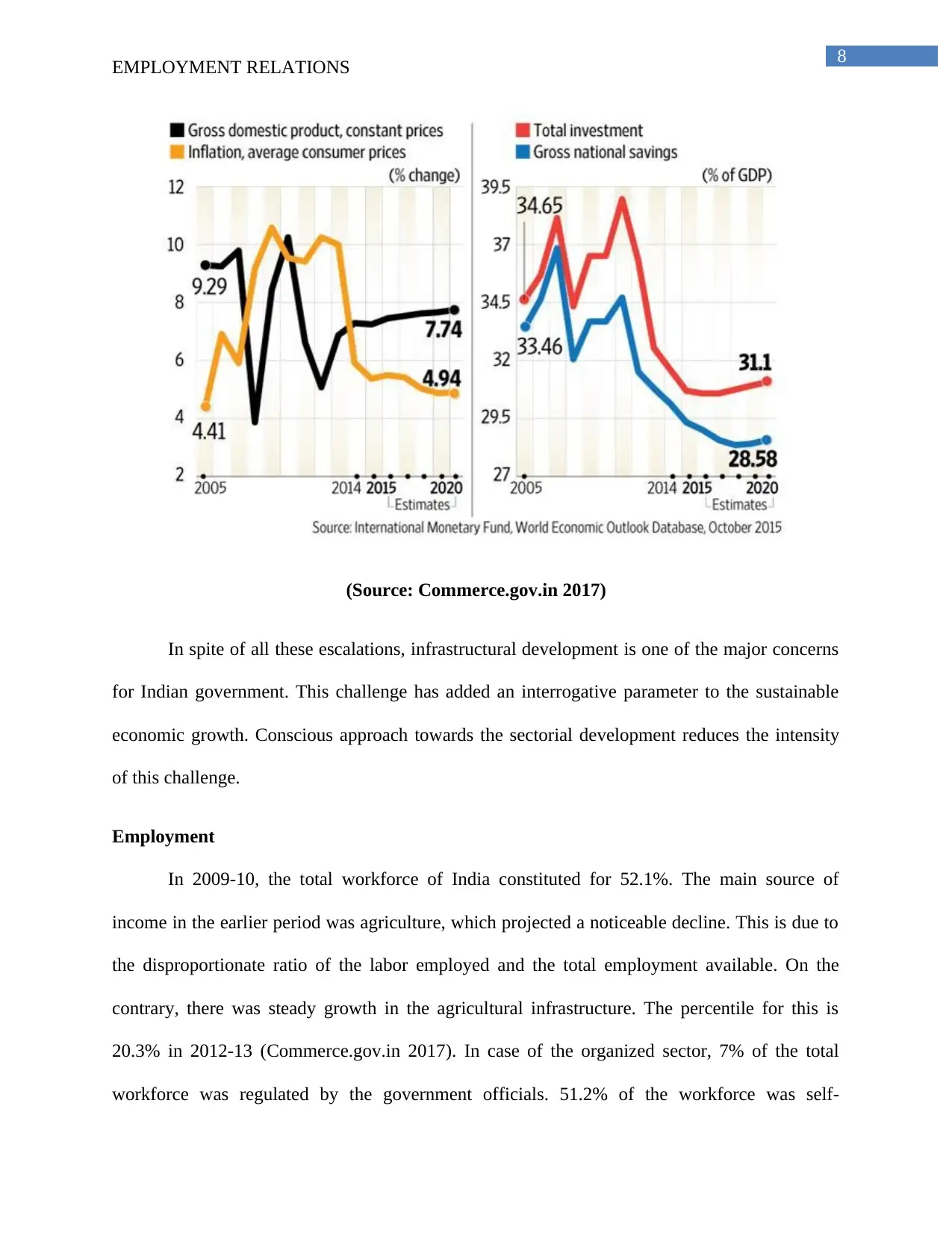
Proportionate ratio has been projected between the GDP growth rate and savings rate.
The reason behind this is an increase in the investment rates. As a matter of specification, the
growth rate for domestic investment in 2007 was 36%. In the same year, the savings rate for
GDP escalated to 21% (Commerce.gov.in 2017). However, in the pre-reform period was
estimated to be 36%. Foreign Direct Investment (FDI) has maintained the balance between the
foreign imports and exports. Various reforms have expanded the economic markets of countries
like India. Typical examples in this direction is the adoption of latest machines, which has
enabled companies like Capgemini, HCL Technologies, NIIT, Oracle, Wipro, TCS, Tech
Mahindra among others to encounter infrastructural development. As a result of this, FDI
inflows to the India took the investment rates to 23 billion US dollars in the era of 2007
(Commerce.gov.in 2017).
EMPLOYMENT RELATIONS
(Commerce.gov.in 2017). Along with this, the agreement is an allowance for the foreign
delegates to make lucrative investments in the goods and services. Recruitment of the skilled
labors aligns with the ethics regarding the work-age population. Here, the most important aspects
are to ensure the allotment of the task according to the capability and skills. Compliance to the
domestic laws and legislations helps the Indian government officials to conduct legal trades,
deals and transactions with the partners.
Investments
Proportionate ratio has been projected between the GDP growth rate and savings rate.
The reason behind this is an increase in the investment rates. As a matter of specification, the
growth rate for domestic investment in 2007 was 36%. In the same year, the savings rate for
GDP escalated to 21% (Commerce.gov.in 2017). However, in the pre-reform period was
estimated to be 36%. Foreign Direct Investment (FDI) has maintained the balance between the
foreign imports and exports. Various reforms have expanded the economic markets of countries
like India. Typical examples in this direction is the adoption of latest machines, which has
enabled companies like Capgemini, HCL Technologies, NIIT, Oracle, Wipro, TCS, Tech
Mahindra among others to encounter infrastructural development. As a result of this, FDI
inflows to the India took the investment rates to 23 billion US dollars in the era of 2007
(Commerce.gov.in 2017).
8
EMPLOYMENT RELATIONS
(Source: Commerce.gov.in 2017)
In spite of all these escalations, infrastructural development is one of the major concerns
for Indian government. This challenge has added an interrogative parameter to the sustainable
economic growth. Conscious approach towards the sectorial development reduces the intensity
of this challenge.
Employment
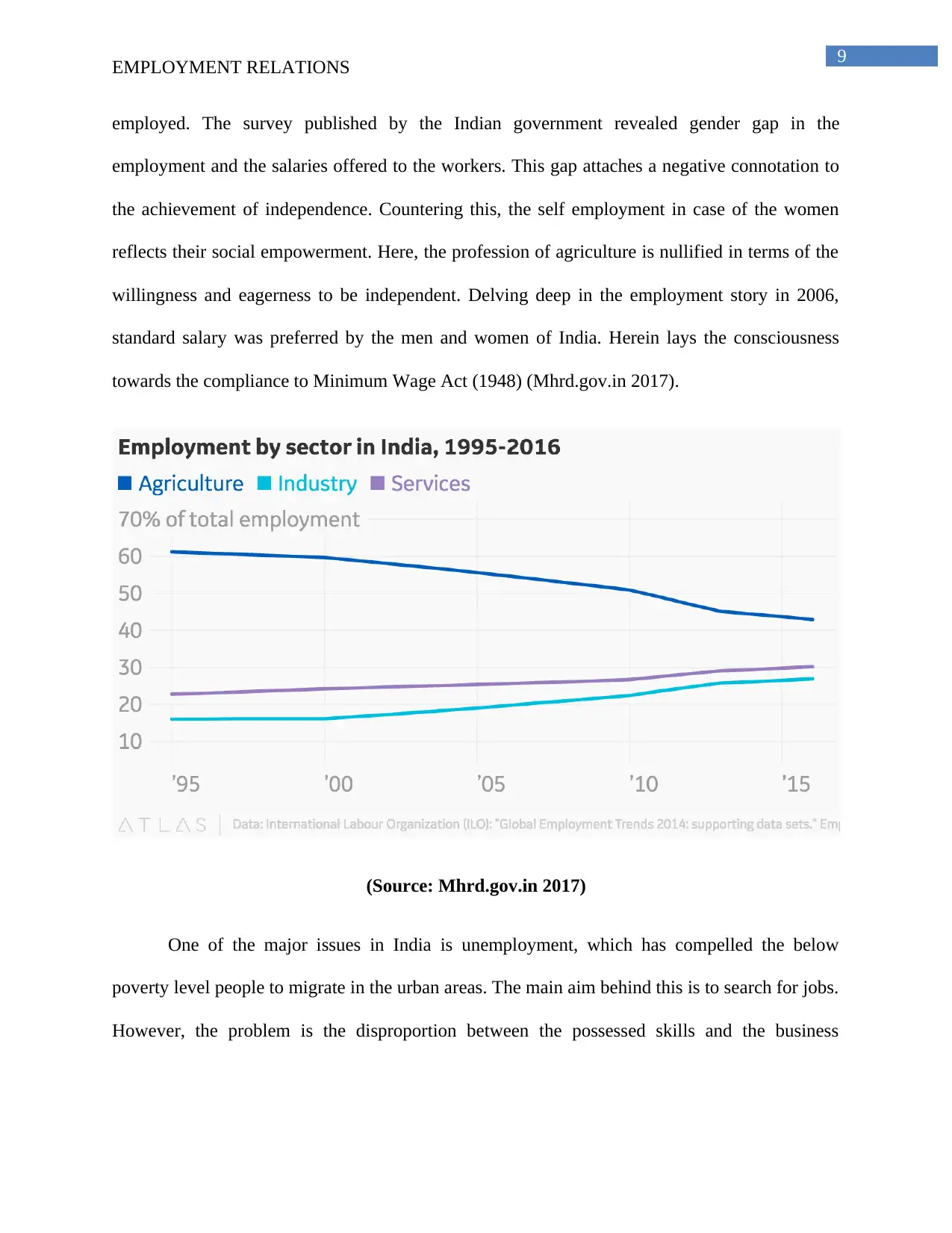
In 2009-10, the total workforce of India constituted for 52.1%. The main source of
income in the earlier period was agriculture, which projected a noticeable decline. This is due to
the disproportionate ratio of the labor employed and the total employment available. On the
contrary, there was steady growth in the agricultural infrastructure. The percentile for this is
20.3% in 2012-13 (Commerce.gov.in 2017). In case of the organized sector, 7% of the total
workforce was regulated by the government officials. 51.2% of the workforce was self-
EMPLOYMENT RELATIONS
(Source: Commerce.gov.in 2017)
In spite of all these escalations, infrastructural development is one of the major concerns
for Indian government. This challenge has added an interrogative parameter to the sustainable
economic growth. Conscious approach towards the sectorial development reduces the intensity
of this challenge.
Employment
In 2009-10, the total workforce of India constituted for 52.1%. The main source of
income in the earlier period was agriculture, which projected a noticeable decline. This is due to
the disproportionate ratio of the labor employed and the total employment available. On the
contrary, there was steady growth in the agricultural infrastructure. The percentile for this is
20.3% in 2012-13 (Commerce.gov.in 2017). In case of the organized sector, 7% of the total
workforce was regulated by the government officials. 51.2% of the workforce was self-
⊘ This is a preview!⊘
Do you want full access?
Subscribe today to unlock all pages.
Trusted by 1+ million students worldwide
9
EMPLOYMENT RELATIONS
employed. The survey published by the Indian government revealed gender gap in the
employment and the salaries offered to the workers. This gap attaches a negative connotation to
the achievement of independence. Countering this, the self employment in case of the women
reflects their social empowerment. Here, the profession of agriculture is nullified in terms of the
willingness and eagerness to be independent. Delving deep in the employment story in 2006,
standard salary was preferred by the men and women of India. Herein lays the consciousness
towards the compliance to Minimum Wage Act (1948) (Mhrd.gov.in 2017).
(Source: Mhrd.gov.in 2017)
One of the major issues in India is unemployment, which has compelled the below
poverty level people to migrate in the urban areas. The main aim behind this is to search for jobs.
However, the problem is the disproportion between the possessed skills and the business
EMPLOYMENT RELATIONS
employed. The survey published by the Indian government revealed gender gap in the
employment and the salaries offered to the workers. This gap attaches a negative connotation to
the achievement of independence. Countering this, the self employment in case of the women
reflects their social empowerment. Here, the profession of agriculture is nullified in terms of the
willingness and eagerness to be independent. Delving deep in the employment story in 2006,
standard salary was preferred by the men and women of India. Herein lays the consciousness
towards the compliance to Minimum Wage Act (1948) (Mhrd.gov.in 2017).
(Source: Mhrd.gov.in 2017)
One of the major issues in India is unemployment, which has compelled the below
poverty level people to migrate in the urban areas. The main aim behind this is to search for jobs.
However, the problem is the disproportion between the possessed skills and the business
Paraphrase This Document
Need a fresh take? Get an instant paraphrase of this document with our AI Paraphraser

10
EMPLOYMENT RELATIONS
requirements of the companies. Heavy labor regulations have led to the construction of plans to
abolish them in terms of creating more and more job opportunities.
Child labor has left a negative mark on the purity of innocence and the education needed
for its enhancement. Along with this, inadequate facilities in the education sector are one of the
main obstacles in the employment sector. Delving deep into the matter, schools lack basic
education, which would prepare the students for the workplace environment. The issue of child
labor is mainly due to the increased share of below poverty level people in the total population
(Mhrd.gov.in 2017). From 1990’s governmental attempts like mid-day meals, breakfast
programs have proved beneficial in curbing child labor to a great extent. Typical evidence of this
fact lies in the application of strict laws for employing children under 10 years for employment.
According to the governmental surveys, only 2% of the children work in the factories, stalls and
shops. This is for the sake of fulfilling the basic needs of their family. Apart from this, the survey
also projects 9% of the children, who assist their parents in their agricultural activities
(Mhrd.gov.in 2017).
(Source: Mhrd.gov.in 2017)
EMPLOYMENT RELATIONS
requirements of the companies. Heavy labor regulations have led to the construction of plans to
abolish them in terms of creating more and more job opportunities.
Child labor has left a negative mark on the purity of innocence and the education needed
for its enhancement. Along with this, inadequate facilities in the education sector are one of the
main obstacles in the employment sector. Delving deep into the matter, schools lack basic
education, which would prepare the students for the workplace environment. The issue of child
labor is mainly due to the increased share of below poverty level people in the total population
(Mhrd.gov.in 2017). From 1990’s governmental attempts like mid-day meals, breakfast
programs have proved beneficial in curbing child labor to a great extent. Typical evidence of this
fact lies in the application of strict laws for employing children under 10 years for employment.
According to the governmental surveys, only 2% of the children work in the factories, stalls and
shops. This is for the sake of fulfilling the basic needs of their family. Apart from this, the survey
also projects 9% of the children, who assist their parents in their agricultural activities
(Mhrd.gov.in 2017).
(Source: Mhrd.gov.in 2017)
11
EMPLOYMENT RELATIONS
Employment diaspora
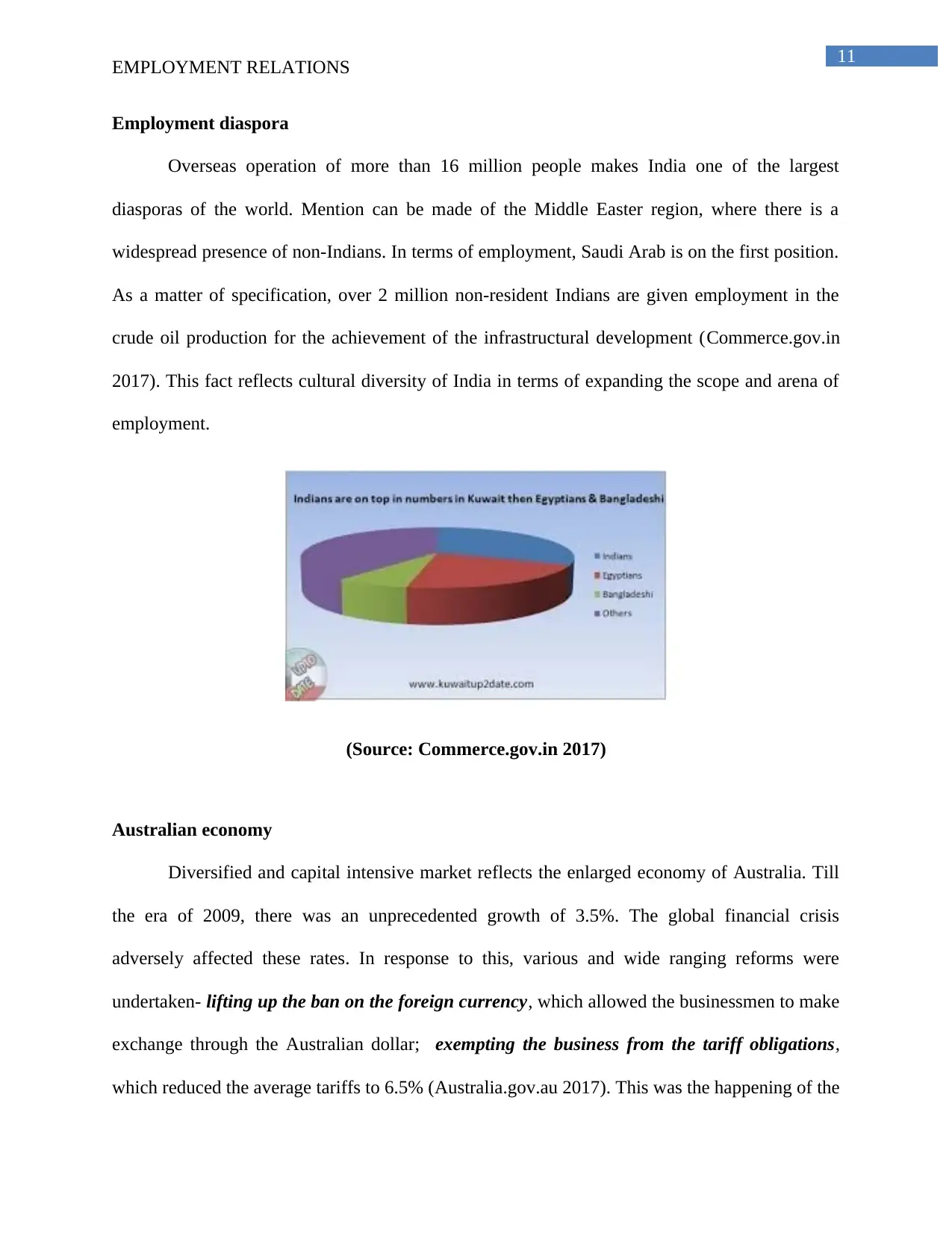
Overseas operation of more than 16 million people makes India one of the largest
diasporas of the world. Mention can be made of the Middle Easter region, where there is a
widespread presence of non-Indians. In terms of employment, Saudi Arab is on the first position.
As a matter of specification, over 2 million non-resident Indians are given employment in the
crude oil production for the achievement of the infrastructural development (Commerce.gov.in
2017). This fact reflects cultural diversity of India in terms of expanding the scope and arena of
employment.
(Source: Commerce.gov.in 2017)
Australian economy
Diversified and capital intensive market reflects the enlarged economy of Australia. Till
the era of 2009, there was an unprecedented growth of 3.5%. The global financial crisis
adversely affected these rates. In response to this, various and wide ranging reforms were
undertaken- lifting up the ban on the foreign currency, which allowed the businessmen to make
exchange through the Australian dollar; exempting the business from the tariff obligations,
which reduced the average tariffs to 6.5% (Australia.gov.au 2017). This was the happening of the
EMPLOYMENT RELATIONS
Employment diaspora
Overseas operation of more than 16 million people makes India one of the largest
diasporas of the world. Mention can be made of the Middle Easter region, where there is a
widespread presence of non-Indians. In terms of employment, Saudi Arab is on the first position.
As a matter of specification, over 2 million non-resident Indians are given employment in the
crude oil production for the achievement of the infrastructural development (Commerce.gov.in
2017). This fact reflects cultural diversity of India in terms of expanding the scope and arena of
employment.
(Source: Commerce.gov.in 2017)
Australian economy
Diversified and capital intensive market reflects the enlarged economy of Australia. Till
the era of 2009, there was an unprecedented growth of 3.5%. The global financial crisis
adversely affected these rates. In response to this, various and wide ranging reforms were
undertaken- lifting up the ban on the foreign currency, which allowed the businessmen to make
exchange through the Australian dollar; exempting the business from the tariff obligations,
which reduced the average tariffs to 6.5% (Australia.gov.au 2017). This was the happening of the
⊘ This is a preview!⊘
Do you want full access?
Subscribe today to unlock all pages.
Trusted by 1+ million students worldwide

1 out of 19


Related Documents


Your All-in-One AI-Powered Toolkit for Academic Success.
+13062052269
info@desklib.com
Available 24*7 on WhatsApp / Email
![[object Object]](/_next/static/media/star-bottom.7253800d.svg)
Unlock your academic potential
Copyright © 2020–2026 A2Z Services. All Rights Reserved. Developed and managed by ZUCOL.