Banking System Analysis: India and New Zealand, FINC123, Semester 2
VerifiedAdded on 2023/06/07
|24
|5972
|65
Report
AI Summary
This report provides a comprehensive comparison of the banking systems in India and New Zealand. It begins with an executive summary, followed by an introduction to banking and its significance in economic growth. The report then compares the legal frameworks, regulatory authorities, and liquidity standards of both countries, highlighting the roles of the Reserve Bank of India and the Reserve Bank of New Zealand. A qualitative and quantitative analysis is conducted on ICICI Bank and ANZ Bank, examining their services, customer relationship management, and financial data from the perspective of a depositor. The analysis includes a discussion of strengths, weaknesses, opportunities, and threats to the banks in both countries, as well as a detailed look at their products and services. The report concludes with a summary of the key findings and references to the sources used.

Running head: A REPORT ON BANKING SYSTEM
A Report on Banking System
Name of the Student:
Name of the University:
Author Note:
A Report on Banking System
Name of the Student:
Name of the University:
Author Note:

Paraphrase This Document
Need a fresh take? Get an instant paraphrase of this document with our AI Paraphraser
1A REPORT ON BANKING SYSTEM
Executive Summary:
Banking sector is the most important element of the monetary system and it plays the essential
role in the growth and of an economy. The report is being designed to briefly discuss the banking
system. In this report comparison between the Indian Banking and New Zealand Banking system
is done on the basis of its regulatory body and other criteria. To conclude a clear picture on the
banking system of two countries the two leading banks of both the countries are taken for a
qualitative and quantitative analysis. The analysis is done on the financial data and on its
business.
Introduction:
Banking started at ancient times, when model type merchants use to give loans to the
framers and to the exporters who carried the products to different cities. This event was named as
barter system. The beginning of contemporary banking started from the medieval times. In the
17th century banking notes were emerged. In the traditional sense banking means a trend of
taking deposits of money from the citizen. These deposits are used as lending and investment by
the banks for the growth of economy. These deposits are done according to the distinct and
appropriate features of withdrawable by a slip called cheque. This is a unique system that no
other financial institution offers. An economy reflects the minor mirror of banking.( Acharya et
al. 2013). It is the most essential component of the world for its growth in the economy. The key
of success is banking for any country moving towards development. Bank and economy is
unified to each other. Banks are the important financial institution as they support economy in
creating and channelizing the flow of money. Banking is the helping hand for the citizen who are
Executive Summary:
Banking sector is the most important element of the monetary system and it plays the essential
role in the growth and of an economy. The report is being designed to briefly discuss the banking
system. In this report comparison between the Indian Banking and New Zealand Banking system
is done on the basis of its regulatory body and other criteria. To conclude a clear picture on the
banking system of two countries the two leading banks of both the countries are taken for a
qualitative and quantitative analysis. The analysis is done on the financial data and on its
business.
Introduction:
Banking started at ancient times, when model type merchants use to give loans to the
framers and to the exporters who carried the products to different cities. This event was named as
barter system. The beginning of contemporary banking started from the medieval times. In the
17th century banking notes were emerged. In the traditional sense banking means a trend of
taking deposits of money from the citizen. These deposits are used as lending and investment by
the banks for the growth of economy. These deposits are done according to the distinct and
appropriate features of withdrawable by a slip called cheque. This is a unique system that no
other financial institution offers. An economy reflects the minor mirror of banking.( Acharya et
al. 2013). It is the most essential component of the world for its growth in the economy. The key
of success is banking for any country moving towards development. Bank and economy is
unified to each other. Banks are the important financial institution as they support economy in
creating and channelizing the flow of money. Banking is the helping hand for the citizen who are
2A REPORT ON BANKING SYSTEM
depositors for banks to secure their money. The deposited money acts as a supply chain of
capital for the citizens establishing business in the economy and enhancing employment. Banks
are regulated worldwide.
In the nation to get it support and make stability in the monetary institution there is
banking structure nationally and internationally. The monetary institution that supports the
economy in being stabilized now days. In the globe of banking and investment nothi ng
stands still. The chief revolutionize of everyone is in the, range of the trade of banking.
Banking in its customary form is concerned with the approval of money deposited by the citizen
in their respective accounts, as deposits are lender to seekers. Apart from customary trade, banks
in today`s time offer a ample series of services to p l e a s e t h e c u s t o m e r s ’ n e e d s t h o u g h
t h e n e e d i t b e m o n e t a r y o r n o n - m o n e t a r y . The series of military accessible depends
on bank type and size. (Lee and Choi 2013).
Discussion:
Comparison between the Indian and New Zealand Banking System
Indian Banking System
Legal Framework:
Business related to banking and fiscal services are monitored by the Banking Regulation Act
1949. The act gives power to Reserve Bank of India regarding the issues of regulations,
guidelines, rules and direction on a broad variety of problems related to monetary and banking
sector. RBI is the primary and central bank of India.
depositors for banks to secure their money. The deposited money acts as a supply chain of
capital for the citizens establishing business in the economy and enhancing employment. Banks
are regulated worldwide.
In the nation to get it support and make stability in the monetary institution there is
banking structure nationally and internationally. The monetary institution that supports the
economy in being stabilized now days. In the globe of banking and investment nothi ng
stands still. The chief revolutionize of everyone is in the, range of the trade of banking.
Banking in its customary form is concerned with the approval of money deposited by the citizen
in their respective accounts, as deposits are lender to seekers. Apart from customary trade, banks
in today`s time offer a ample series of services to p l e a s e t h e c u s t o m e r s ’ n e e d s t h o u g h
t h e n e e d i t b e m o n e t a r y o r n o n - m o n e t a r y . The series of military accessible depends
on bank type and size. (Lee and Choi 2013).
Discussion:
Comparison between the Indian and New Zealand Banking System
Indian Banking System
Legal Framework:
Business related to banking and fiscal services are monitored by the Banking Regulation Act
1949. The act gives power to Reserve Bank of India regarding the issues of regulations,
guidelines, rules and direction on a broad variety of problems related to monetary and banking
sector. RBI is the primary and central bank of India.
⊘ This is a preview!⊘
Do you want full access?
Subscribe today to unlock all pages.

Trusted by 1+ million students worldwide
3A REPORT ON BANKING SYSTEM
Regulatory authorities
Regulatory authority sets norms, give license and guidelines for banks even for those branches
that are out of India. They even set norms for the products and services given by the bank. They
also look after the debt management for the government and currencies are also managed by the
authority.
Other authorities
There sub divisions for regulating the different monetary sector in India. These are:
Insolvency and Bankruptcy Board of India (IBBI) that regulates the development
connecting to conduct bankruptcy procedures under the Insolvency and Bankruptcy Code
(IBC).
Securities Exchange Board of India (SEBI) that is the regulatory power for the securities
market in India.
Insurance Regulatory and Development Authority of India (IRDAI) that regulates the
insurance sector.
Others
The Ministry of Finance deals in legislating and supervising upon the functions of banks and
financial institutions. Acting all the way through its Department of Financial Services, it:
Monitoring the operations that is related in banking.
Lay down the guidelines of sound operating system and functions of public sector banks.
Regulatory authorities
Regulatory authority sets norms, give license and guidelines for banks even for those branches
that are out of India. They even set norms for the products and services given by the bank. They
also look after the debt management for the government and currencies are also managed by the
authority.
Other authorities
There sub divisions for regulating the different monetary sector in India. These are:
Insolvency and Bankruptcy Board of India (IBBI) that regulates the development
connecting to conduct bankruptcy procedures under the Insolvency and Bankruptcy Code
(IBC).
Securities Exchange Board of India (SEBI) that is the regulatory power for the securities
market in India.
Insurance Regulatory and Development Authority of India (IRDAI) that regulates the
insurance sector.
Others
The Ministry of Finance deals in legislating and supervising upon the functions of banks and
financial institutions. Acting all the way through its Department of Financial Services, it:
Monitoring the operations that is related in banking.
Lay down the guidelines of sound operating system and functions of public sector banks.
Paraphrase This Document
Need a fresh take? Get an instant paraphrase of this document with our AI Paraphraser
4A REPORT ON BANKING SYSTEM
Liquidity and capital adequacy
Role of international standards
It is mandatory from April 2013 to implement Basel III capital regulations. This is to ensure
sound transactions to meet the minimum requirement of Basel III capital ratios. The RBI has
previously unconfined guidelines on preservation and calculation of liquidity ratio, the RBI has
in recent times issued strategy on Net Stable Funding Ratio (NSFR) which is based on
concluding rules on NSFR available by the Basel Committee. The NSFR should be equivalent to
at least 100% on a continuing basis. Though, the NSFR would be supplemented by decision-
making appraisal of the steady financial support and liquidity risk figure of a bank. On the basis
of such assessment, the RBI may require a person bank to accept more rigorous standards. The
obligation to preserve 100% NSFR would be compulsory on banks with effect from a date which
will be communicated by the RBI in due route.
Main liquidity
The cash reserve ratio (CRR) is utmost important for every bank to maintain with RBI. It is
average day to day balance that every bank maintains as a part of the total demand and time
liabilities deposits (NDTL). Current rate is 4% the statutory liquidity ratio (SLR) is also
important for every bank to maintain in order to safeguard itself from the crisis impact. It should
also maintain liquid assets in way of gold, cash and government securities. SLR rate is 19.5% at
present.
Liquidity and capital adequacy
Role of international standards
It is mandatory from April 2013 to implement Basel III capital regulations. This is to ensure
sound transactions to meet the minimum requirement of Basel III capital ratios. The RBI has
previously unconfined guidelines on preservation and calculation of liquidity ratio, the RBI has
in recent times issued strategy on Net Stable Funding Ratio (NSFR) which is based on
concluding rules on NSFR available by the Basel Committee. The NSFR should be equivalent to
at least 100% on a continuing basis. Though, the NSFR would be supplemented by decision-
making appraisal of the steady financial support and liquidity risk figure of a bank. On the basis
of such assessment, the RBI may require a person bank to accept more rigorous standards. The
obligation to preserve 100% NSFR would be compulsory on banks with effect from a date which
will be communicated by the RBI in due route.
Main liquidity
The cash reserve ratio (CRR) is utmost important for every bank to maintain with RBI. It is
average day to day balance that every bank maintains as a part of the total demand and time
liabilities deposits (NDTL). Current rate is 4% the statutory liquidity ratio (SLR) is also
important for every bank to maintain in order to safeguard itself from the crisis impact. It should
also maintain liquid assets in way of gold, cash and government securities. SLR rate is 19.5% at
present.
5A REPORT ON BANKING SYSTEM
New Zealand Banking System
Legal framework
New Zealand has a two way approach towards banking regulations with a different prudential
and conduct regulator. The Reserve Bank of New Zealand Act 1989 (RBNZ Act) is the type
portion of legislation surroundings out the powers of Reserve Bank of New Zealand (RBNZ) as
New Zealand's canny regulator. The RBNZ Act regulates with bank registration and enables the
RBNZ to:
Lay conditions for process of registration
Outsourcing facts from the banks
Managing bank failure
The Financial Markets Conduct Act 2013 (FMCA) has the rules for conducting financial and in
fastidious of giving licensing for issuing derivatives, one who is operating in market and
different investment schemes managers.
Regulatory authorities
Lead bank regulators
Reserve Bank of New Zealand (RBNZ) is the primary regulators of banks in New Zealand that
got established by the Reserve Bank of New Zealand Act 1989. In New Zealand RBNZ act as a
canny regulator and regulates all aspects that come under the bank’s commerce. RBNZ does not
have a statutory objective to protect its depositors rather its statutory objective is managing
banking business. In New Zealand the Financial Market Authority (FMA) deals in all the
financial matters of the country. (Ball et al.2013).
New Zealand Banking System
Legal framework
New Zealand has a two way approach towards banking regulations with a different prudential
and conduct regulator. The Reserve Bank of New Zealand Act 1989 (RBNZ Act) is the type
portion of legislation surroundings out the powers of Reserve Bank of New Zealand (RBNZ) as
New Zealand's canny regulator. The RBNZ Act regulates with bank registration and enables the
RBNZ to:
Lay conditions for process of registration
Outsourcing facts from the banks
Managing bank failure
The Financial Markets Conduct Act 2013 (FMCA) has the rules for conducting financial and in
fastidious of giving licensing for issuing derivatives, one who is operating in market and
different investment schemes managers.
Regulatory authorities
Lead bank regulators
Reserve Bank of New Zealand (RBNZ) is the primary regulators of banks in New Zealand that
got established by the Reserve Bank of New Zealand Act 1989. In New Zealand RBNZ act as a
canny regulator and regulates all aspects that come under the bank’s commerce. RBNZ does not
have a statutory objective to protect its depositors rather its statutory objective is managing
banking business. In New Zealand the Financial Market Authority (FMA) deals in all the
financial matters of the country. (Ball et al.2013).
⊘ This is a preview!⊘
Do you want full access?
Subscribe today to unlock all pages.
Trusted by 1+ million students worldwide
6A REPORT ON BANKING SYSTEM
Others
The council of Financial Regulators consists of:
Financial Markets Authority (FMA)
Ministry of Business, Innovation and Employment
New Zealand Treasury.
Reserve Bank of New Zealand (RBNZ).
Liquidity
Role of international standards
The Reserve Bank of New Zealand (RBNZ) has incorporated the major components of the Basel
Committee on Banking Supervision Basel III Capital Accords (Basel III) in New Zealand by
updating its capital adequacy and liquidity standards in the Banking Supervision Handbook to
replicate the Basel III necessities. Locally incorporated banks have been compulsory to comply
with the least amount capital ratios from January 2013. The capital conservation cushion came
into effect in New Zealand on January 2014, as did the Reserve Bank's power to locate a
countercyclical shock absorber.
Main liquidity
The Reserve Bank of New Zealand's (RBNZ) Liquidity Policy comprising BS13 and BS13A of
the Banking Supervision Handbook introduced in April 2010 in response to the global financial
crisis. The Liquidity Policy has four main apparatus:
Publicly disclosing the requirement of some information about liquidity risk and about
their management by the banks.
Standing orders on risk management.
Others
The council of Financial Regulators consists of:
Financial Markets Authority (FMA)
Ministry of Business, Innovation and Employment
New Zealand Treasury.
Reserve Bank of New Zealand (RBNZ).
Liquidity
Role of international standards
The Reserve Bank of New Zealand (RBNZ) has incorporated the major components of the Basel
Committee on Banking Supervision Basel III Capital Accords (Basel III) in New Zealand by
updating its capital adequacy and liquidity standards in the Banking Supervision Handbook to
replicate the Basel III necessities. Locally incorporated banks have been compulsory to comply
with the least amount capital ratios from January 2013. The capital conservation cushion came
into effect in New Zealand on January 2014, as did the Reserve Bank's power to locate a
countercyclical shock absorber.
Main liquidity
The Reserve Bank of New Zealand's (RBNZ) Liquidity Policy comprising BS13 and BS13A of
the Banking Supervision Handbook introduced in April 2010 in response to the global financial
crisis. The Liquidity Policy has four main apparatus:
Publicly disclosing the requirement of some information about liquidity risk and about
their management by the banks.
Standing orders on risk management.
Paraphrase This Document
Need a fresh take? Get an instant paraphrase of this document with our AI Paraphraser
7A REPORT ON BANKING SYSTEM
Regular updating of the liquidity position of the banks
Qualitative and Quantitative Analysis of ICICI Bank and ANZ bank of New Zealand:
Qualitative Analysis:
ANZ Bank:
In Australia ANZ is among the largest company who has attended the majority of hold in
international banking sector and monetary team. This is known amongst the big four banks of
Australia. In 1970 ANZ bank was established leading a merger with English, Scottish and
Australian Bank Limited (ES&A). After this merger Australia and New Zealand Banking Group
Limited was established. The team sustained to cultivate, regardless of the pay for the first and
foremost Indian-based Grind lays Bank, which submit an evidence of a not as much of ideal
commerce robust and the cluster deprived itself in year 1999. 16088 people were employees of
ANZ Bank and it had 807 branches in Australia by the end of 1999. In the year 1970 among the
lead the way banks of Australia it combined with the networks of SWIFT. The idea of electronic
services of banking started in 1997 but Internet banking was launched in April 1999.
Subsequently, it had a joint venture agreement with ERG and Telstra. This joint venture was
done to form a smart card association that followed an additional planned association with
E*Trade Australia. This association was to develop a foremost online stock market trading. From
the tactical perspective, it can be seen that ANZ has been taking a very practical move toward,
with cooperative ventures, association, and ventures into online banking for trading to linger
cutthroat. It has also incorporated its army, to tender the buyer a ‘one stop’ atmosphere.
Customer Relationship Management (CRM) -nearly everyone touted ready for action tool of
banks in attendance. At present, ANZ is contribution a variety of armed forces counting, account
Regular updating of the liquidity position of the banks
Qualitative and Quantitative Analysis of ICICI Bank and ANZ bank of New Zealand:
Qualitative Analysis:
ANZ Bank:
In Australia ANZ is among the largest company who has attended the majority of hold in
international banking sector and monetary team. This is known amongst the big four banks of
Australia. In 1970 ANZ bank was established leading a merger with English, Scottish and
Australian Bank Limited (ES&A). After this merger Australia and New Zealand Banking Group
Limited was established. The team sustained to cultivate, regardless of the pay for the first and
foremost Indian-based Grind lays Bank, which submit an evidence of a not as much of ideal
commerce robust and the cluster deprived itself in year 1999. 16088 people were employees of
ANZ Bank and it had 807 branches in Australia by the end of 1999. In the year 1970 among the
lead the way banks of Australia it combined with the networks of SWIFT. The idea of electronic
services of banking started in 1997 but Internet banking was launched in April 1999.
Subsequently, it had a joint venture agreement with ERG and Telstra. This joint venture was
done to form a smart card association that followed an additional planned association with
E*Trade Australia. This association was to develop a foremost online stock market trading. From
the tactical perspective, it can be seen that ANZ has been taking a very practical move toward,
with cooperative ventures, association, and ventures into online banking for trading to linger
cutthroat. It has also incorporated its army, to tender the buyer a ‘one stop’ atmosphere.
Customer Relationship Management (CRM) -nearly everyone touted ready for action tool of
banks in attendance. At present, ANZ is contribution a variety of armed forces counting, account
8A REPORT ON BANKING SYSTEM
administration, credit cards managing payments, payments of bills, trading shares, fund transfer
and investment administration. The reimburse anybody trait allows the client to shift finances to
the bank account of any individual with a participating fiscal organization. The bank was
performing upon buyer hassle to power. The result of internet banking is updated in the website
through monthly survey with a motive of improving and developing the new facilities. This has
helped the depositors to accept the internet based banking. The bank had achieved a great
success in transforming ATM, phone and branch customers to Internet form of banking. The
maximum exchange rate of 8.6 percent amongst its client is marked of achievement in internet
business by ANZ. (Adge et al. 2014).
ICICI Bank:
A clandestine assembly in India set ICICI bank under commercial banking head. In January 1994
it was registered and got the licensed by RBI for its operations. At the end of 1999, it had 64
branches at all over India that was featured by state of the art technology and systems.
Networking is done through V-SAT technology. At the end of the year 2000 it had more than
100 branches, 200 ATMs that were spread over the country. ICICI bank gives a wide variety of
banking services domestically and internationally. This done for facilitating the trade cross-
borders businesses and investment also the treasury and services provided in foreign exchanges.
ICICI bank was the first one to launch the Internet Banking named as Infinity. It also offer free
phone banking. The phone-banking offer services for transferring of funds, payments of bill and
payment of e-bills and e shopping. (Altman 2013).
Strategically, at the time when deregulation was at peak ICICI had a benefit of a first
mover advantage as it started it operations at the rising time of technologies that was lacking
administration, credit cards managing payments, payments of bills, trading shares, fund transfer
and investment administration. The reimburse anybody trait allows the client to shift finances to
the bank account of any individual with a participating fiscal organization. The bank was
performing upon buyer hassle to power. The result of internet banking is updated in the website
through monthly survey with a motive of improving and developing the new facilities. This has
helped the depositors to accept the internet based banking. The bank had achieved a great
success in transforming ATM, phone and branch customers to Internet form of banking. The
maximum exchange rate of 8.6 percent amongst its client is marked of achievement in internet
business by ANZ. (Adge et al. 2014).
ICICI Bank:
A clandestine assembly in India set ICICI bank under commercial banking head. In January 1994
it was registered and got the licensed by RBI for its operations. At the end of 1999, it had 64
branches at all over India that was featured by state of the art technology and systems.
Networking is done through V-SAT technology. At the end of the year 2000 it had more than
100 branches, 200 ATMs that were spread over the country. ICICI bank gives a wide variety of
banking services domestically and internationally. This done for facilitating the trade cross-
borders businesses and investment also the treasury and services provided in foreign exchanges.
ICICI bank was the first one to launch the Internet Banking named as Infinity. It also offer free
phone banking. The phone-banking offer services for transferring of funds, payments of bill and
payment of e-bills and e shopping. (Altman 2013).
Strategically, at the time when deregulation was at peak ICICI had a benefit of a first
mover advantage as it started it operations at the rising time of technologies that was lacking
⊘ This is a preview!⊘
Do you want full access?
Subscribe today to unlock all pages.
Trusted by 1+ million students worldwide
9A REPORT ON BANKING SYSTEM
with older banks. A tie- up was made with the technology providers such as software trainers
like NIIT, ISP Satyam Online and Compaq to spread it reach. These types of alliances are
growing more than 50% every year. (Ball et al. 2013). The expansion of its own share prices is
analytic of the organization’s success. Pay seal was launched in July 2000 that was a payment
gateway ensuring the safety and security for the transactions done. It interfaces along the web
merchant, banking system and internet shopper to facilitate online payments in a safe
environment. On September 22, 1999 subsidiary of ICICI got listed on the NYSE. ICICI was a
commercial bank who was first from India to be listed on NYSE and second Asian bank. Since it
was listed the share price was constant any movements was seen due to the effect of US
elections. The growth trend shows overall a good health. The bank target young professionals
who belonged to urban areas to maintain its tag line. It strategy was based on services that were
on demand like payments of bills loans- car, home, education, products for investment. ICICI
planned for branching out from getting support of professionals and being amalgamated with
other private sector banks for enabling its growth in the rural sector. The continuous momentum
of internet development is estimated to assist its expansion. However, strategically in spite of
regulations and issues regarding infrastructure it had been able to make profit on the path of
technical growth. For boosting its competitive benefit it gives offers in a wide variety in online
banking. ( Laudon and Laudon 2016).
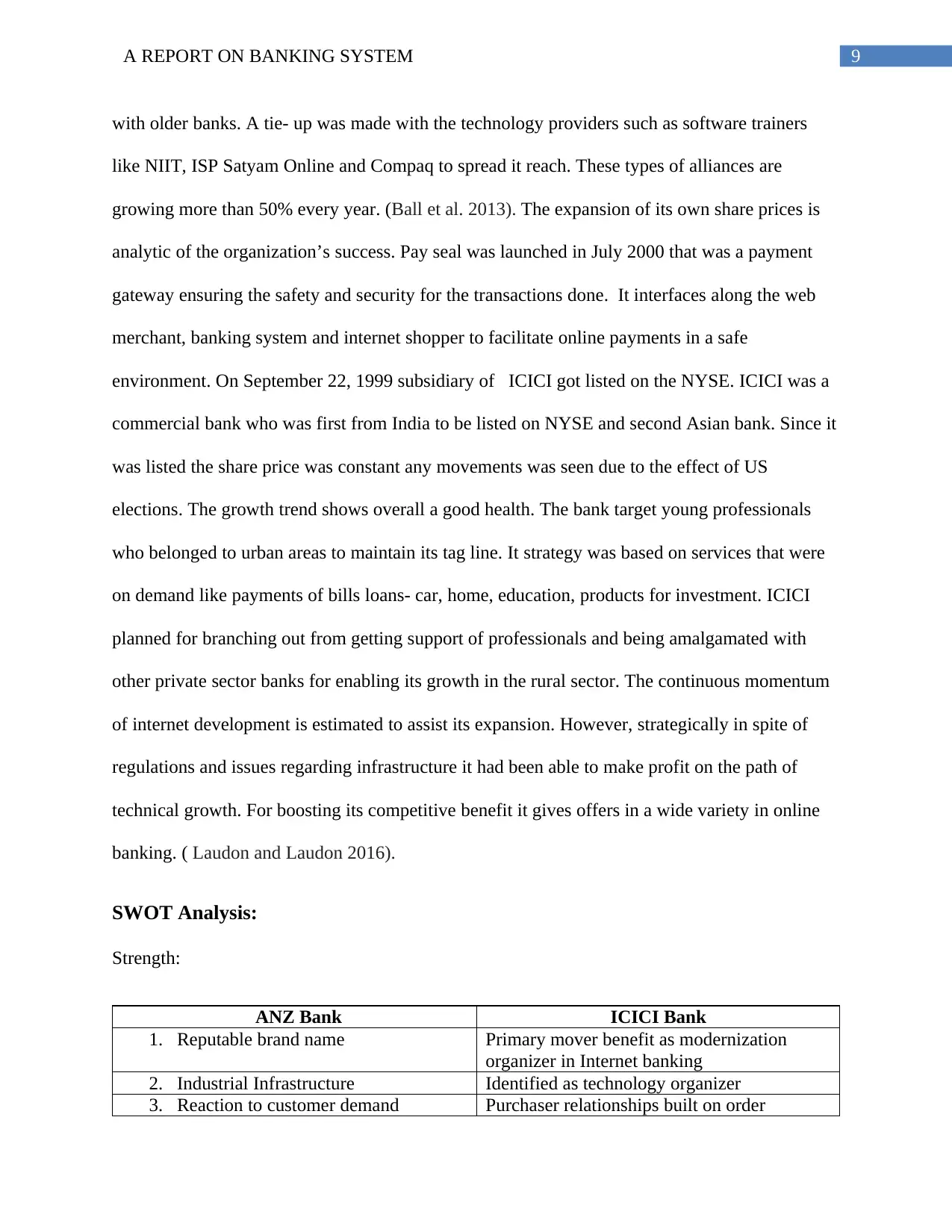
SWOT Analysis:
Strength:
ANZ Bank ICICI Bank
1. Reputable brand name Primary mover benefit as modernization
organizer in Internet banking
2. Industrial Infrastructure Identified as technology organizer
3. Reaction to customer demand Purchaser relationships built on order
with older banks. A tie- up was made with the technology providers such as software trainers
like NIIT, ISP Satyam Online and Compaq to spread it reach. These types of alliances are
growing more than 50% every year. (Ball et al. 2013). The expansion of its own share prices is
analytic of the organization’s success. Pay seal was launched in July 2000 that was a payment
gateway ensuring the safety and security for the transactions done. It interfaces along the web
merchant, banking system and internet shopper to facilitate online payments in a safe
environment. On September 22, 1999 subsidiary of ICICI got listed on the NYSE. ICICI was a
commercial bank who was first from India to be listed on NYSE and second Asian bank. Since it
was listed the share price was constant any movements was seen due to the effect of US
elections. The growth trend shows overall a good health. The bank target young professionals
who belonged to urban areas to maintain its tag line. It strategy was based on services that were
on demand like payments of bills loans- car, home, education, products for investment. ICICI
planned for branching out from getting support of professionals and being amalgamated with
other private sector banks for enabling its growth in the rural sector. The continuous momentum
of internet development is estimated to assist its expansion. However, strategically in spite of
regulations and issues regarding infrastructure it had been able to make profit on the path of
technical growth. For boosting its competitive benefit it gives offers in a wide variety in online
banking. ( Laudon and Laudon 2016).
SWOT Analysis:
Strength:
ANZ Bank ICICI Bank
1. Reputable brand name Primary mover benefit as modernization
organizer in Internet banking
2. Industrial Infrastructure Identified as technology organizer
3. Reaction to customer demand Purchaser relationships built on order
Paraphrase This Document
Need a fresh take? Get an instant paraphrase of this document with our AI Paraphraser
10A REPORT ON BANKING SYSTEM
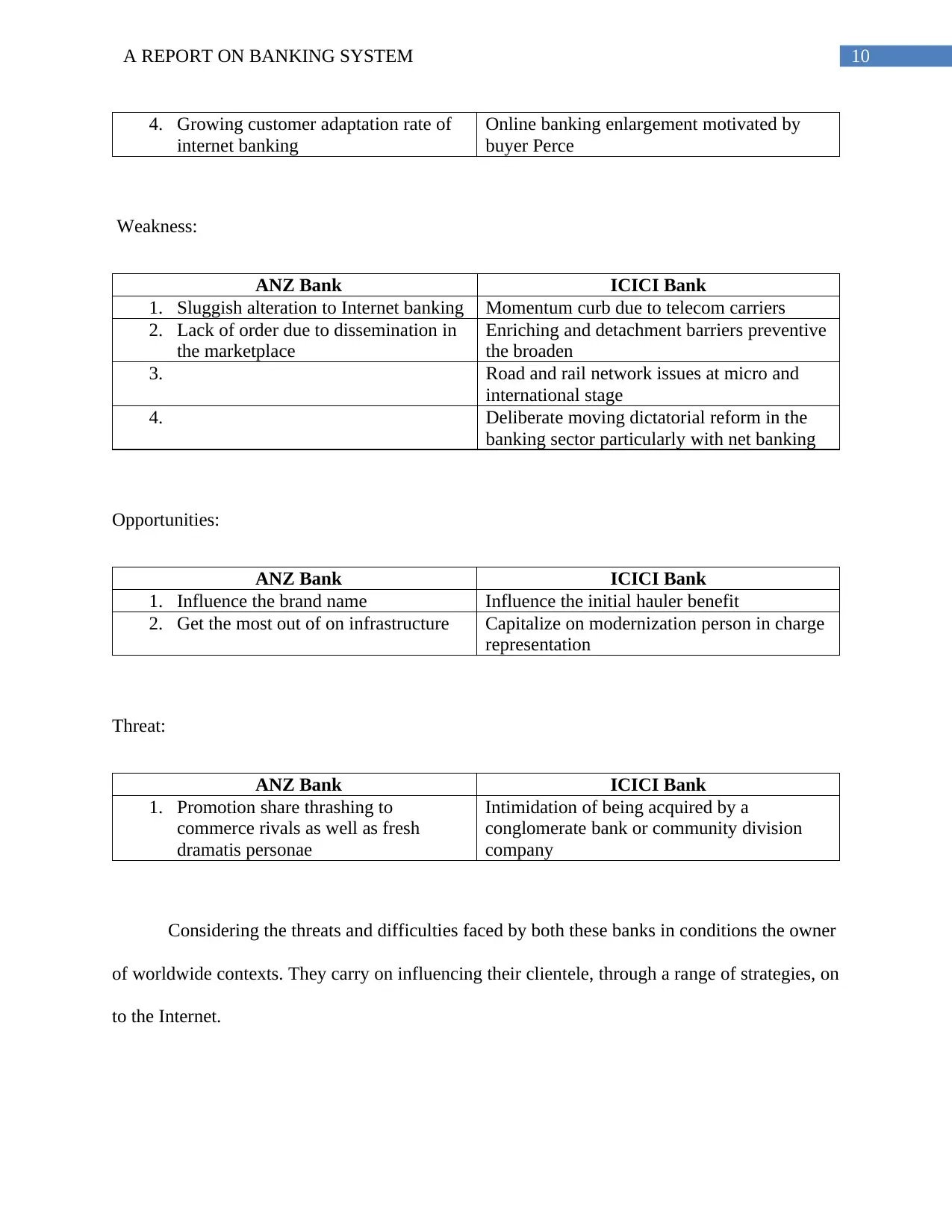
4. Growing customer adaptation rate of
internet banking
Online banking enlargement motivated by
buyer Perce
Weakness:
ANZ Bank ICICI Bank
1. Sluggish alteration to Internet banking Momentum curb due to telecom carriers
2. Lack of order due to dissemination in
the marketplace
Enriching and detachment barriers preventive
the broaden
3. Road and rail network issues at micro and
international stage
4. Deliberate moving dictatorial reform in the
banking sector particularly with net banking
Opportunities:
ANZ Bank ICICI Bank
1. Influence the brand name Influence the initial hauler benefit
2. Get the most out of on infrastructure Capitalize on modernization person in charge
representation
Threat:
ANZ Bank ICICI Bank
1. Promotion share thrashing to
commerce rivals as well as fresh
dramatis personae
Intimidation of being acquired by a
conglomerate bank or community division
company
Considering the threats and difficulties faced by both these banks in conditions the owner
of worldwide contexts. They carry on influencing their clientele, through a range of strategies, on
to the Internet.
4. Growing customer adaptation rate of
internet banking
Online banking enlargement motivated by
buyer Perce
Weakness:
ANZ Bank ICICI Bank
1. Sluggish alteration to Internet banking Momentum curb due to telecom carriers
2. Lack of order due to dissemination in
the marketplace
Enriching and detachment barriers preventive
the broaden
3. Road and rail network issues at micro and
international stage
4. Deliberate moving dictatorial reform in the
banking sector particularly with net banking
Opportunities:
ANZ Bank ICICI Bank
1. Influence the brand name Influence the initial hauler benefit
2. Get the most out of on infrastructure Capitalize on modernization person in charge
representation
Threat:
ANZ Bank ICICI Bank
1. Promotion share thrashing to
commerce rivals as well as fresh
dramatis personae
Intimidation of being acquired by a
conglomerate bank or community division
company
Considering the threats and difficulties faced by both these banks in conditions the owner
of worldwide contexts. They carry on influencing their clientele, through a range of strategies, on
to the Internet.
11A REPORT ON BANKING SYSTEM
As these banks are adapting internet banks and participating in their chain value in the internet
services that are helping them to cut down their transaction cost so that they can elevate their
picture as pioneer and innovative bankers. Acharya (2013) states that attractive the principal
agent role in banking delivers one’s participants with the chance to trail, with an improved-
intended or more urbane service. There is rising request for operational banking services, as the
involvements of these two innovator administrations have revealed.
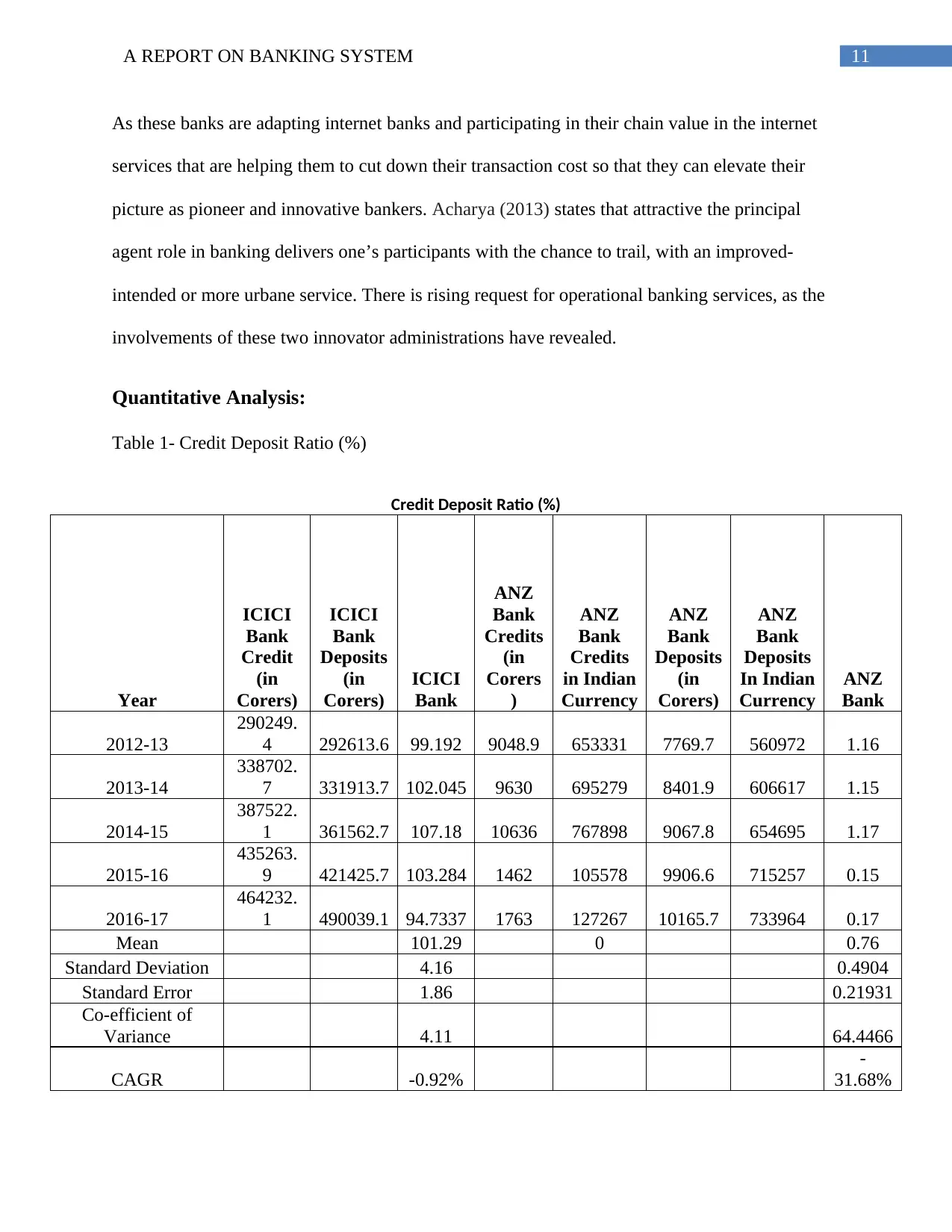
Quantitative Analysis:
Table 1- Credit Deposit Ratio (%)
Credit Deposit Ratio (%)
Year
ICICI
Bank
Credit
(in
Corers)
ICICI
Bank
Deposits
(in
Corers)
ICICI
Bank
ANZ
Bank
Credits
(in
Corers
)
ANZ
Bank
Credits
in Indian
Currency
ANZ
Bank
Deposits
(in
Corers)
ANZ
Bank
Deposits
In Indian
Currency
ANZ
Bank
2012-13
290249.
4 292613.6 99.192 9048.9 653331 7769.7 560972 1.16
2013-14
338702.
7 331913.7 102.045 9630 695279 8401.9 606617 1.15
2014-15
387522.
1 361562.7 107.18 10636 767898 9067.8 654695 1.17
2015-16
435263.
9 421425.7 103.284 1462 105578 9906.6 715257 0.15
2016-17
464232.
1 490039.1 94.7337 1763 127267 10165.7 733964 0.17
Mean 101.29 0 0.76
Standard Deviation 4.16 0.4904
Standard Error 1.86 0.21931
Co-efficient of
Variance 4.11 64.4466
CAGR -0.92%
-
31.68%
As these banks are adapting internet banks and participating in their chain value in the internet
services that are helping them to cut down their transaction cost so that they can elevate their
picture as pioneer and innovative bankers. Acharya (2013) states that attractive the principal
agent role in banking delivers one’s participants with the chance to trail, with an improved-
intended or more urbane service. There is rising request for operational banking services, as the
involvements of these two innovator administrations have revealed.
Quantitative Analysis:
Table 1- Credit Deposit Ratio (%)
Credit Deposit Ratio (%)
Year
ICICI
Bank
Credit
(in
Corers)
ICICI
Bank
Deposits
(in
Corers)
ICICI
Bank
ANZ
Bank
Credits
(in
Corers
)
ANZ
Bank
Credits
in Indian
Currency
ANZ
Bank
Deposits
(in
Corers)
ANZ
Bank
Deposits
In Indian
Currency
ANZ
Bank
2012-13
290249.
4 292613.6 99.192 9048.9 653331 7769.7 560972 1.16
2013-14
338702.
7 331913.7 102.045 9630 695279 8401.9 606617 1.15
2014-15
387522.
1 361562.7 107.18 10636 767898 9067.8 654695 1.17
2015-16
435263.
9 421425.7 103.284 1462 105578 9906.6 715257 0.15
2016-17
464232.
1 490039.1 94.7337 1763 127267 10165.7 733964 0.17
Mean 101.29 0 0.76
Standard Deviation 4.16 0.4904
Standard Error 1.86 0.21931
Co-efficient of
Variance 4.11 64.4466
CAGR -0.92%
-
31.68%
⊘ This is a preview!⊘
Do you want full access?
Subscribe today to unlock all pages.
Trusted by 1+ million students worldwide

1 out of 24


Related Documents


Your All-in-One AI-Powered Toolkit for Academic Success.
+13062052269
info@desklib.com
Available 24*7 on WhatsApp / Email
![[object Object]](/_next/static/media/star-bottom.7253800d.svg)
Unlock your academic potential
Copyright © 2020–2026 A2Z Services. All Rights Reserved. Developed and managed by ZUCOL.