India-Pakistan Conflict: Historical Analysis and Contemporary Issues

Verified

Added on  2023/01/05

|7
|1637
|65
Essay
AI Summary
This essay provides a thorough analysis of the enduring India-Pakistan conflict. It begins with a brief overview of the current state of affairs, including recent events like the Pulwama attack and Balakot airstrike, and then delves into the historical roots of the conflict, tracing its origins back to the partition of India in 1947 and subsequent conflicts. The essay examines key issues such as the Kashmir dispute, militant attacks, and the impact of nuclear weapons. It utilizes classical realist theory to explain the underlying dynamics of the conflict, focusing on the roles of national interest, power, and the inherent flaws of human nature. The essay also discusses the shared heritage of the two countries and the issues that continue to define their relationship. In conclusion, the essay highlights the complexities of the conflict and suggests the need for further research to gain a more comprehensive understanding of the issues involved.
Document Page
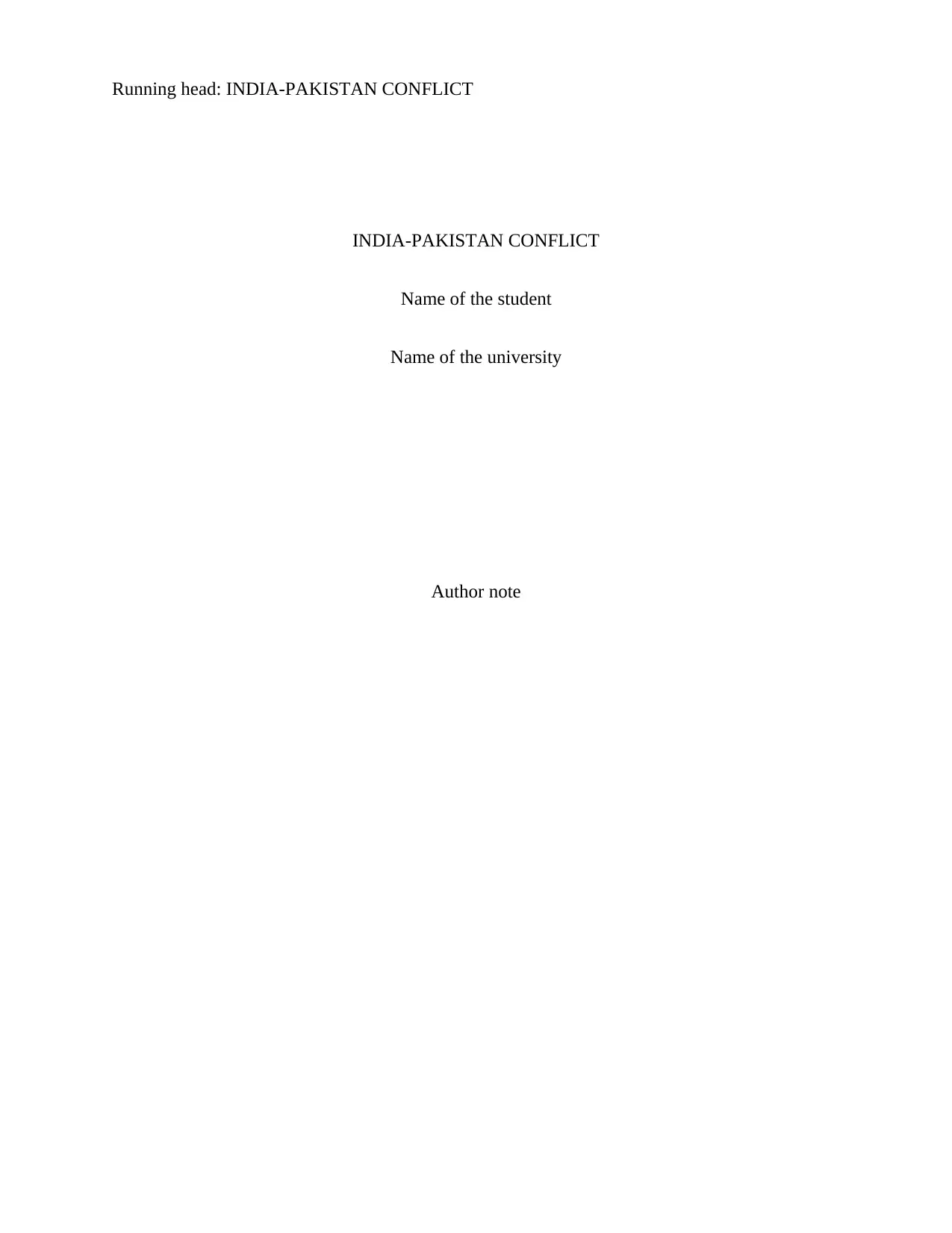
Running head: INDIA-PAKISTAN CONFLICT
INDIA-PAKISTAN CONFLICT
Name of the student
Name of the university
Author note
tabler-icon-diamond-filled.svg

Paraphrase This Document

Need a fresh take? Get an instant paraphrase of this document with our AI Paraphraser
Document Page
1INDIA-PAKISTAN CONFLICT
Introduction
India and Pakistan are the two neighbouring countries of South Asia who have always
been in conflict since the time of independence.
The essay aims to provide a thorough discussion on the India-Pakistan conflict that is
continuing even today. The essay will first provide a brief background of the current state of
affairs between the two countries including the recent conflicts. Then, the essay will discuss the
past incidences of conflict between the two countries that led to the growing differences. The
essay will also describe the heritage of the two countries and the issues that define them. The
essay will use the classical realist theory to explain the way the two countries are situated at
present.
Discussion
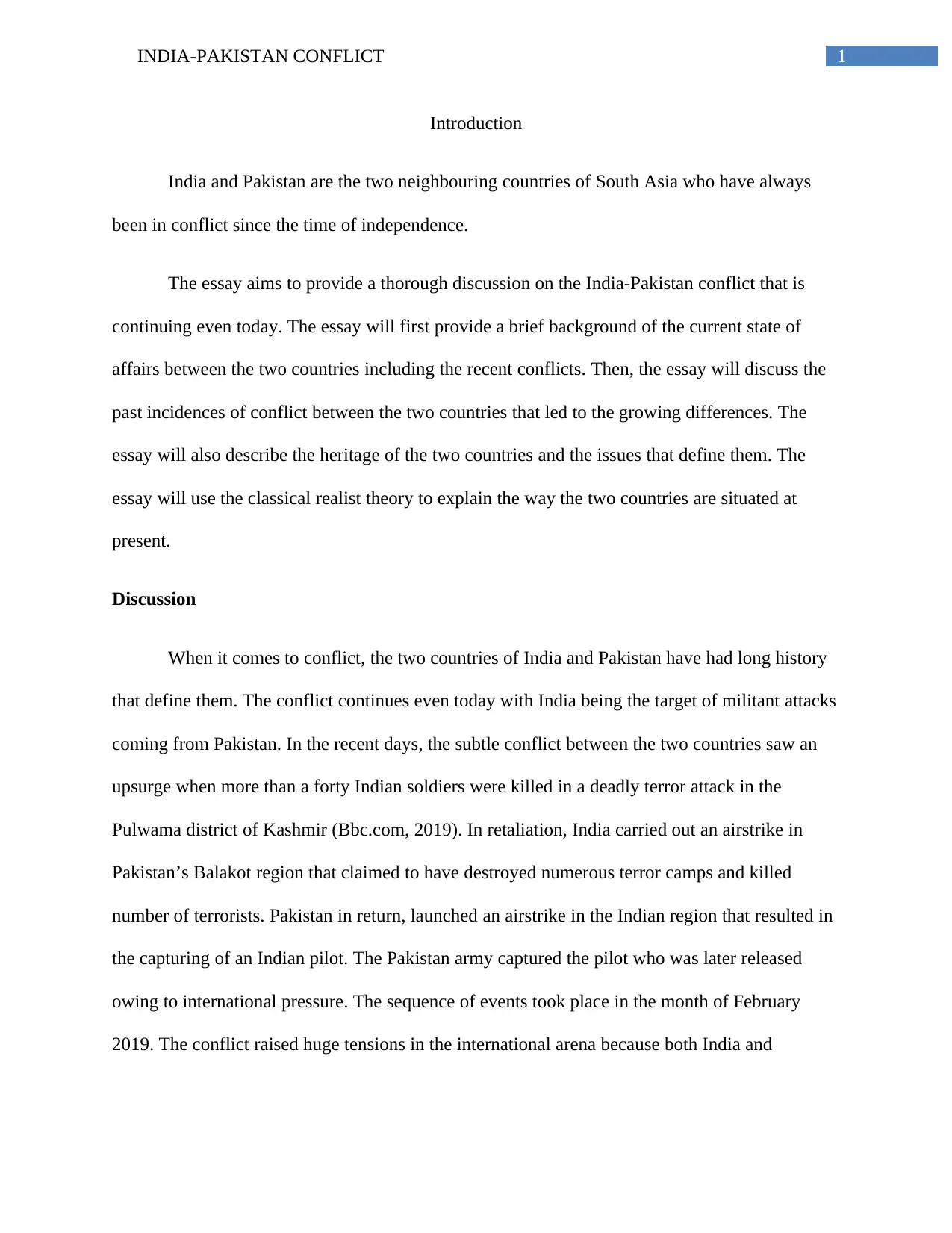
When it comes to conflict, the two countries of India and Pakistan have had long history
that define them. The conflict continues even today with India being the target of militant attacks
coming from Pakistan. In the recent days, the subtle conflict between the two countries saw an
upsurge when more than a forty Indian soldiers were killed in a deadly terror attack in the
Pulwama district of Kashmir (Bbc.com, 2019). In retaliation, India carried out an airstrike in
Pakistan’s Balakot region that claimed to have destroyed numerous terror camps and killed
number of terrorists. Pakistan in return, launched an airstrike in the Indian region that resulted in
the capturing of an Indian pilot. The Pakistan army captured the pilot who was later released
owing to international pressure. The sequence of events took place in the month of February
2019. The conflict raised huge tensions in the international arena because both India and
Document Page
2INDIA-PAKISTAN CONFLICT
Pakistan are armed with nuclear weapons and any conflict between these countries raises doubts
of a possible nuclear warfare.
The conflict between the two nuclear-armed states dates back to 1947 when India
achieved its independence from the British. The country achieved independence on 15 August
1947 and one day prior to the independence, India was partitioned to form Pakistan with Muslim
majority population (Sathasivam, 2017). The seeds of conflict were sown at that time only with
millions of people being killed during the partition. The communal violence claimed about half a
million lives and around the same people was left without any shelters. The first major conflict
began in October the same year when Pakistan decided to support a Muslim militant insurgency
in Kashmir. The conflict went on for more than a year ending in January 1949. In 1965, the
countries again came face-to-face after Pakistan engaged in a covert offensive across the line of
ceasefire into Kashmir (Sathasivam, 2017). In retaliation, India too became offensive and
crossed into Lahore. The conflict ended after the UN intervened. The third conflict occurred in
the year 1971 when citizens of East Pakistan raised demands of independence from Islamabad.
The conflict escalated and forced Delhi to intervene after 10 million people from East Pakistan
left for India. The conflict saw the surrender of over 90,000 Pakistani soldiers and the creation of
the new country, Bangladesh (Chester, 2017). The Kargil War of 1999 was the third large-scale
conflict between the two countries. It began after India launched airstrikes against Pakistan
owing to the heavy infiltration of Pakistan-supported militants into the Indian-administered
Kashmir. In the subsequent years, numerous militant attacks were carried out in India including
the 2001 attack on Indian parliament and the 2008 attacks on the Indian city of Mumbai. India
has always claimed and has been claiming that Pakistan provides both diplomatic and financial
support to the terror groups to carry out attacks in the Indian Territory.
Document Page
3INDIA-PAKISTAN CONFLICT
Owing to these direct and indirect conflicts, tensions continue to persist between the two
nations with both blaming each other. When it comes to heritage, both countries share a common
heritage because Pakistan was a part of India. India has always been a secular country allowing
people from all religions to stay in peace although it is a Hindu majority country. After partition,
the heritage of the country was also divided. India retained most of the heritage with several
temples, mosques, ancient structures with the most prominent being the Taj Mahal
(Knowindia.gov.in, 2019). The heritage of Pakistan includes various shrines, tombs, buildings,
monuments, places of worship and residences.
The situation between the two countries and the reasons behind their conflicts could be
understood further using the classical realist theory. Classical realism states that the conflicts
amongst international states occur due to the inherent human nature. The classical realists
believed that conflicts occur due to the struggle for power, which in an inherent nature of human
beings. Thinkers like Thomas Hobbes, Niccolo Machiavelli in the ancient times focused on
human nature as being the root cause of conflict (McQueen, 2018). They argued that order in
international relations is fragile and formed by consistent tensions amongst nations. Hans
Morgenthau, one of the most prominent modern classical realist thinkers further argued, “Politics
is governed by objective laws that have their roots in human nature and human nature is
inherently flawed” (Morgenthau, 2014). From this perspective, the India-Pakistan conflict could
be stated as the result of the flawed human nature. The emphasis has been laid on the acquisition
of military power by both the nations as the reasons for conflict according to classical realism.
According to classical realism, both India and Pakistan came into conflict due to national
interest, politics and power. While Pakistan was focused on acquiring more power by annexing
tabler-icon-diamond-filled.svg

Paraphrase This Document

Need a fresh take? Get an instant paraphrase of this document with our AI Paraphraser
Document Page
4INDIA-PAKISTAN CONFLICT
the Kashmir region, India was focused more on safeguarding its national interest by not letting
Pakistan acquire Kashmir.
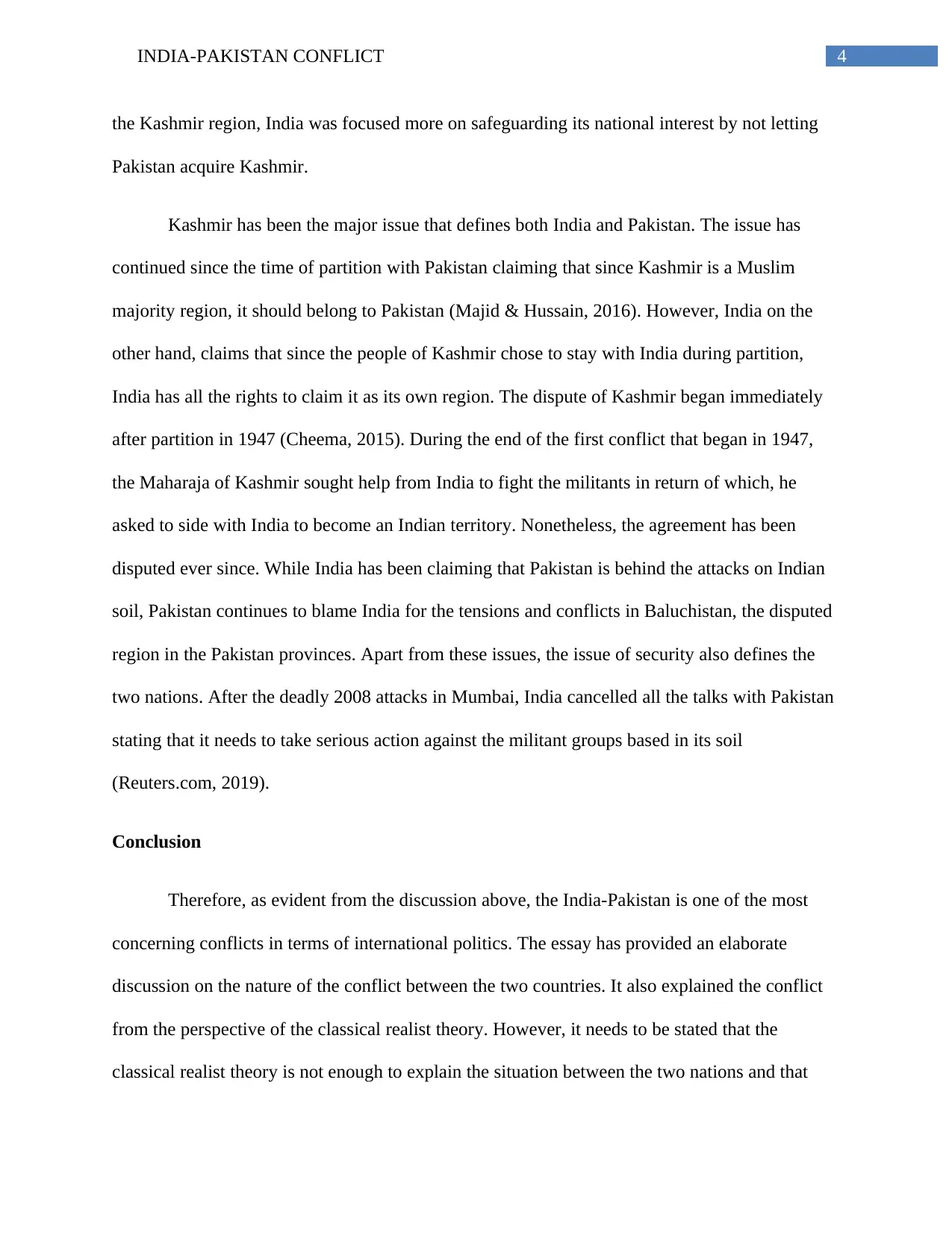
Kashmir has been the major issue that defines both India and Pakistan. The issue has
continued since the time of partition with Pakistan claiming that since Kashmir is a Muslim
majority region, it should belong to Pakistan (Majid & Hussain, 2016). However, India on the
other hand, claims that since the people of Kashmir chose to stay with India during partition,
India has all the rights to claim it as its own region. The dispute of Kashmir began immediately
after partition in 1947 (Cheema, 2015). During the end of the first conflict that began in 1947,
the Maharaja of Kashmir sought help from India to fight the militants in return of which, he
asked to side with India to become an Indian territory. Nonetheless, the agreement has been
disputed ever since. While India has been claiming that Pakistan is behind the attacks on Indian
soil, Pakistan continues to blame India for the tensions and conflicts in Baluchistan, the disputed
region in the Pakistan provinces. Apart from these issues, the issue of security also defines the
two nations. After the deadly 2008 attacks in Mumbai, India cancelled all the talks with Pakistan
stating that it needs to take serious action against the militant groups based in its soil
(Reuters.com, 2019).
Conclusion
Therefore, as evident from the discussion above, the India-Pakistan is one of the most
concerning conflicts in terms of international politics. The essay has provided an elaborate
discussion on the nature of the conflict between the two countries. It also explained the conflict
from the perspective of the classical realist theory. However, it needs to be stated that the
classical realist theory is not enough to explain the situation between the two nations and that
Document Page
5INDIA-PAKISTAN CONFLICT
other theories could also be used to understand the nature of the conflict. The essay also provided
a history of the conflicts that took place between the two South Asian countries and the heritage
they have. Further research on the issues between the two countries is suggested.
Document Page
6INDIA-PAKISTAN CONFLICT
References:
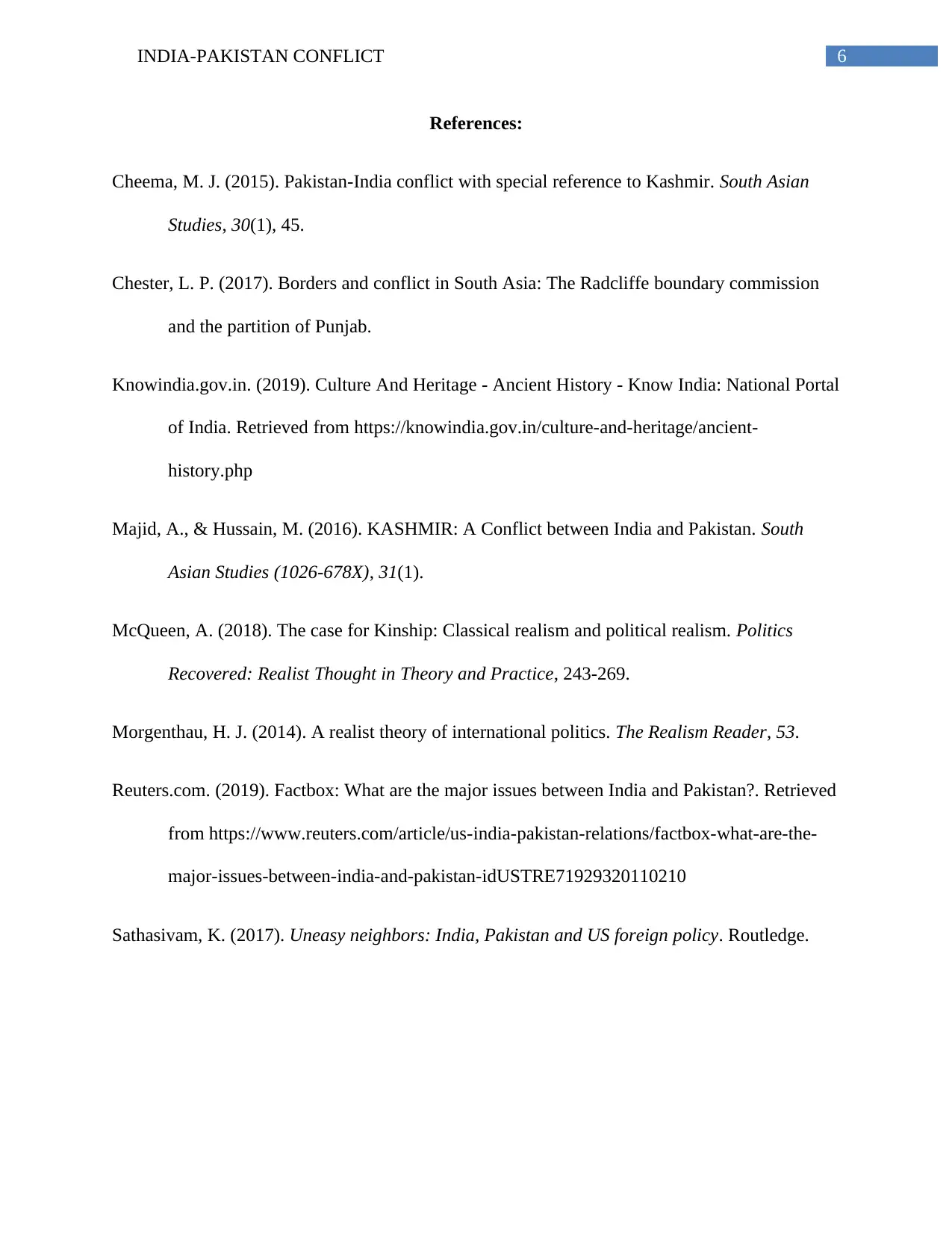
Cheema, M. J. (2015). Pakistan-India conflict with special reference to Kashmir. South Asian
Studies, 30(1), 45.
Chester, L. P. (2017). Borders and conflict in South Asia: The Radcliffe boundary commission
and the partition of Punjab.
Knowindia.gov.in. (2019). Culture And Heritage - Ancient History - Know India: National Portal
of India. Retrieved from https://knowindia.gov.in/culture-and-heritage/ancient-
history.php
Majid, A., & Hussain, M. (2016). KASHMIR: A Conflict between India and Pakistan. South
Asian Studies (1026-678X), 31(1).
McQueen, A. (2018). The case for Kinship: Classical realism and political realism. Politics
Recovered: Realist Thought in Theory and Practice, 243-269.
Morgenthau, H. J. (2014). A realist theory of international politics. The Realism Reader, 53.
Reuters.com. (2019). Factbox: What are the major issues between India and Pakistan?. Retrieved
from https://www.reuters.com/article/us-india-pakistan-relations/factbox-what-are-the-
major-issues-between-india-and-pakistan-idUSTRE71929320110210
Sathasivam, K. (2017). Uneasy neighbors: India, Pakistan and US foreign policy. Routledge.
chevron_up_icon
1 out of 7
circle_padding
hide_on_mobile
zoom_out_icon
[object Object]