Essay on Australian Indigenous Economic Development Strategy 2011-2018
VerifiedAdded on 2020/06/03
|6
|1438
|140
Essay
AI Summary
This argumentative essay critically analyzes the Indigenous Economic Development Strategy 2011-2018 in Australia, focusing on historical, cultural, and economic inequalities between Indigenous and non-Indigenous Australians. The essay explores the government's initiatives aimed at providing equal opportunities in education, employment, and economic facilities. It examines the strategy's priorities, including strengthening supportive environments, investing in education, and improving skills development. The essay highlights the persistent economic disadvantages faced by Indigenous Australians, the income disparities, and the role of cultural differences in creating inequality. It discusses the government's investments and the challenges in achieving its goals, while also considering the importance of partnerships with private organizations. The conclusion emphasizes the effectiveness of the strategy in improving the conditions of Indigenous Australians and suggests that continuous changes can help minimize the gap between Indigenous and non-Indigenous populations.
ARGUMENTATIVE ESSAY
Paraphrase This Document
Need a fresh take? Get an instant paraphrase of this document with our AI Paraphraser

Table of Contents
INTRODUCTION...........................................................................................................................1
MAIN BODY...................................................................................................................................1
CONCLUSION................................................................................................................................3
REFERENCES................................................................................................................................4
INTRODUCTION...........................................................................................................................1
MAIN BODY...................................................................................................................................1
CONCLUSION................................................................................................................................3
REFERENCES................................................................................................................................4

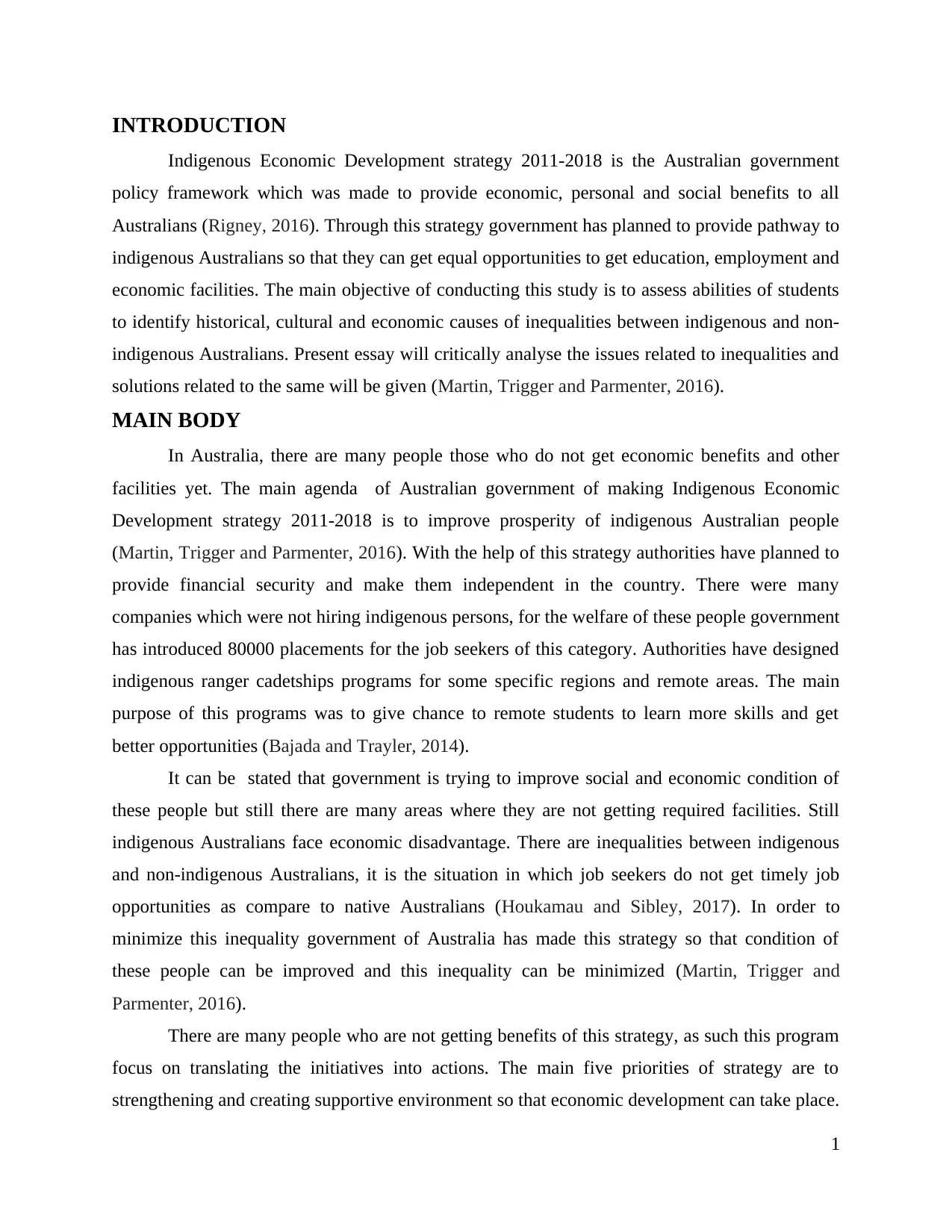
INTRODUCTION
Indigenous Economic Development strategy 2011-2018 is the Australian government
policy framework which was made to provide economic, personal and social benefits to all
Australians (Rigney, 2016). Through this strategy government has planned to provide pathway to
indigenous Australians so that they can get equal opportunities to get education, employment and
economic facilities. The main objective of conducting this study is to assess abilities of students
to identify historical, cultural and economic causes of inequalities between indigenous and non-
indigenous Australians. Present essay will critically analyse the issues related to inequalities and
solutions related to the same will be given (Martin, Trigger and Parmenter, 2016).
MAIN BODY
In Australia, there are many people those who do not get economic benefits and other
facilities yet. The main agenda of Australian government of making Indigenous Economic
Development strategy 2011-2018 is to improve prosperity of indigenous Australian people
(Martin, Trigger and Parmenter, 2016). With the help of this strategy authorities have planned to
provide financial security and make them independent in the country. There were many
companies which were not hiring indigenous persons, for the welfare of these people government
has introduced 80000 placements for the job seekers of this category. Authorities have designed
indigenous ranger cadetships programs for some specific regions and remote areas. The main
purpose of this programs was to give chance to remote students to learn more skills and get
better opportunities (Bajada and Trayler, 2014).
It can be stated that government is trying to improve social and economic condition of
these people but still there are many areas where they are not getting required facilities. Still
indigenous Australians face economic disadvantage. There are inequalities between indigenous
and non-indigenous Australians, it is the situation in which job seekers do not get timely job
opportunities as compare to native Australians (Houkamau and Sibley, 2017). In order to
minimize this inequality government of Australia has made this strategy so that condition of
these people can be improved and this inequality can be minimized (Martin, Trigger and
Parmenter, 2016).
There are many people who are not getting benefits of this strategy, as such this program
focus on translating the initiatives into actions. The main five priorities of strategy are to
strengthening and creating supportive environment so that economic development can take place.
1
Indigenous Economic Development strategy 2011-2018 is the Australian government
policy framework which was made to provide economic, personal and social benefits to all
Australians (Rigney, 2016). Through this strategy government has planned to provide pathway to
indigenous Australians so that they can get equal opportunities to get education, employment and
economic facilities. The main objective of conducting this study is to assess abilities of students
to identify historical, cultural and economic causes of inequalities between indigenous and non-
indigenous Australians. Present essay will critically analyse the issues related to inequalities and
solutions related to the same will be given (Martin, Trigger and Parmenter, 2016).
MAIN BODY
In Australia, there are many people those who do not get economic benefits and other
facilities yet. The main agenda of Australian government of making Indigenous Economic
Development strategy 2011-2018 is to improve prosperity of indigenous Australian people
(Martin, Trigger and Parmenter, 2016). With the help of this strategy authorities have planned to
provide financial security and make them independent in the country. There were many
companies which were not hiring indigenous persons, for the welfare of these people government
has introduced 80000 placements for the job seekers of this category. Authorities have designed
indigenous ranger cadetships programs for some specific regions and remote areas. The main
purpose of this programs was to give chance to remote students to learn more skills and get
better opportunities (Bajada and Trayler, 2014).
It can be stated that government is trying to improve social and economic condition of
these people but still there are many areas where they are not getting required facilities. Still
indigenous Australians face economic disadvantage. There are inequalities between indigenous
and non-indigenous Australians, it is the situation in which job seekers do not get timely job
opportunities as compare to native Australians (Houkamau and Sibley, 2017). In order to
minimize this inequality government of Australia has made this strategy so that condition of
these people can be improved and this inequality can be minimized (Martin, Trigger and
Parmenter, 2016).
There are many people who are not getting benefits of this strategy, as such this program
focus on translating the initiatives into actions. The main five priorities of strategy are to
strengthening and creating supportive environment so that economic development can take place.
1
⊘ This is a preview!⊘
Do you want full access?
Subscribe today to unlock all pages.

Trusted by 1+ million students worldwide

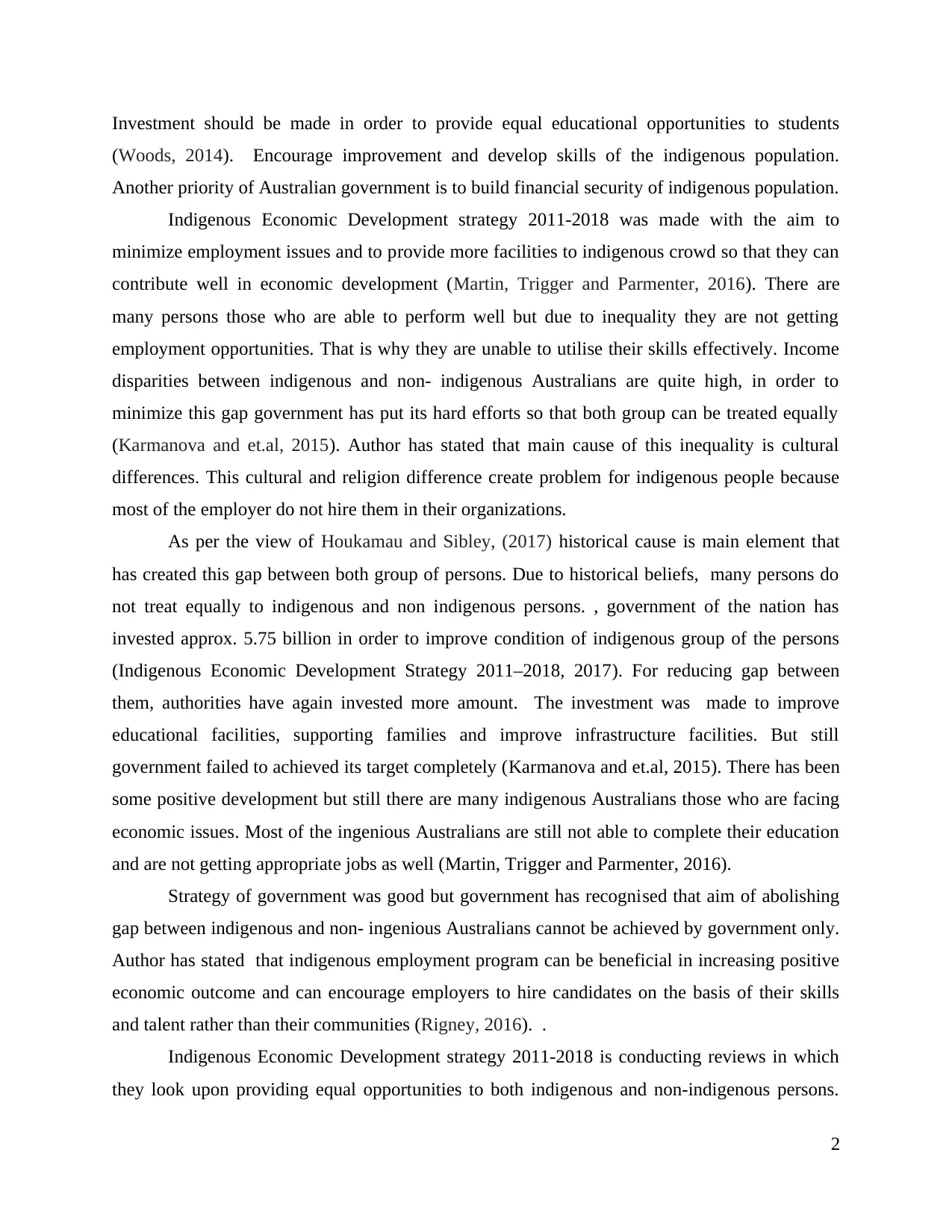
Investment should be made in order to provide equal educational opportunities to students
(Woods, 2014). Encourage improvement and develop skills of the indigenous population.
Another priority of Australian government is to build financial security of indigenous population.
Indigenous Economic Development strategy 2011-2018 was made with the aim to
minimize employment issues and to provide more facilities to indigenous crowd so that they can
contribute well in economic development (Martin, Trigger and Parmenter, 2016). There are
many persons those who are able to perform well but due to inequality they are not getting
employment opportunities. That is why they are unable to utilise their skills effectively. Income
disparities between indigenous and non- indigenous Australians are quite high, in order to
minimize this gap government has put its hard efforts so that both group can be treated equally
(Karmanova and et.al, 2015). Author has stated that main cause of this inequality is cultural
differences. This cultural and religion difference create problem for indigenous people because
most of the employer do not hire them in their organizations.
As per the view of Houkamau and Sibley, (2017) historical cause is main element that
has created this gap between both group of persons. Due to historical beliefs, many persons do
not treat equally to indigenous and non indigenous persons. , government of the nation has
invested approx. 5.75 billion in order to improve condition of indigenous group of the persons
(Indigenous Economic Development Strategy 2011–2018, 2017). For reducing gap between
them, authorities have again invested more amount. The investment was made to improve
educational facilities, supporting families and improve infrastructure facilities. But still
government failed to achieved its target completely (Karmanova and et.al, 2015). There has been
some positive development but still there are many indigenous Australians those who are facing
economic issues. Most of the ingenious Australians are still not able to complete their education
and are not getting appropriate jobs as well (Martin, Trigger and Parmenter, 2016).
Strategy of government was good but government has recognised that aim of abolishing
gap between indigenous and non- ingenious Australians cannot be achieved by government only.
Author has stated that indigenous employment program can be beneficial in increasing positive
economic outcome and can encourage employers to hire candidates on the basis of their skills
and talent rather than their communities (Rigney, 2016). .
Indigenous Economic Development strategy 2011-2018 is conducting reviews in which
they look upon providing equal opportunities to both indigenous and non-indigenous persons.
2
(Woods, 2014). Encourage improvement and develop skills of the indigenous population.
Another priority of Australian government is to build financial security of indigenous population.
Indigenous Economic Development strategy 2011-2018 was made with the aim to
minimize employment issues and to provide more facilities to indigenous crowd so that they can
contribute well in economic development (Martin, Trigger and Parmenter, 2016). There are
many persons those who are able to perform well but due to inequality they are not getting
employment opportunities. That is why they are unable to utilise their skills effectively. Income
disparities between indigenous and non- indigenous Australians are quite high, in order to
minimize this gap government has put its hard efforts so that both group can be treated equally
(Karmanova and et.al, 2015). Author has stated that main cause of this inequality is cultural
differences. This cultural and religion difference create problem for indigenous people because
most of the employer do not hire them in their organizations.
As per the view of Houkamau and Sibley, (2017) historical cause is main element that
has created this gap between both group of persons. Due to historical beliefs, many persons do
not treat equally to indigenous and non indigenous persons. , government of the nation has
invested approx. 5.75 billion in order to improve condition of indigenous group of the persons
(Indigenous Economic Development Strategy 2011–2018, 2017). For reducing gap between
them, authorities have again invested more amount. The investment was made to improve
educational facilities, supporting families and improve infrastructure facilities. But still
government failed to achieved its target completely (Karmanova and et.al, 2015). There has been
some positive development but still there are many indigenous Australians those who are facing
economic issues. Most of the ingenious Australians are still not able to complete their education
and are not getting appropriate jobs as well (Martin, Trigger and Parmenter, 2016).
Strategy of government was good but government has recognised that aim of abolishing
gap between indigenous and non- ingenious Australians cannot be achieved by government only.
Author has stated that indigenous employment program can be beneficial in increasing positive
economic outcome and can encourage employers to hire candidates on the basis of their skills
and talent rather than their communities (Rigney, 2016). .
Indigenous Economic Development strategy 2011-2018 is conducting reviews in which
they look upon providing equal opportunities to both indigenous and non-indigenous persons.
2
Paraphrase This Document
Need a fresh take? Get an instant paraphrase of this document with our AI Paraphraser

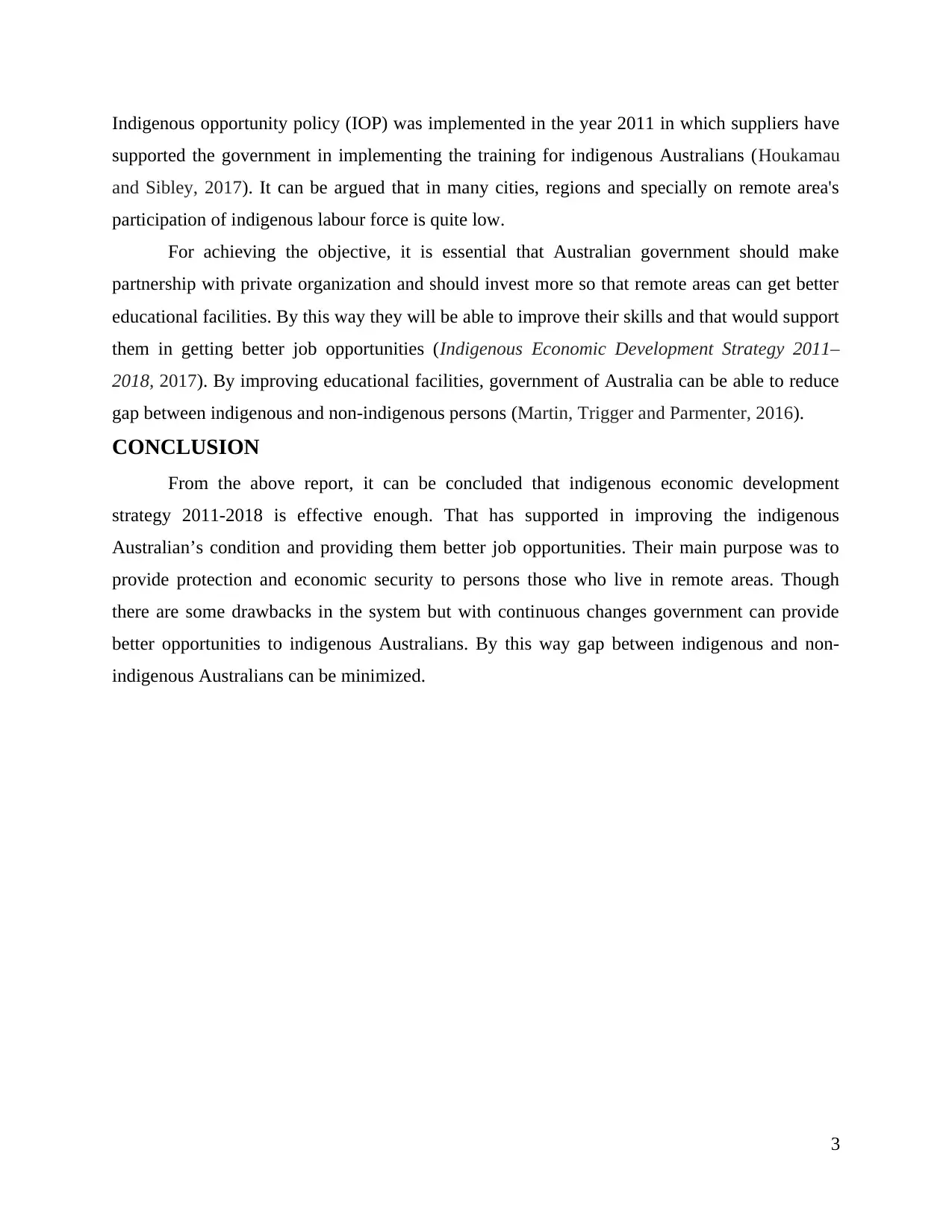
Indigenous opportunity policy (IOP) was implemented in the year 2011 in which suppliers have
supported the government in implementing the training for indigenous Australians (Houkamau
and Sibley, 2017). It can be argued that in many cities, regions and specially on remote area's
participation of indigenous labour force is quite low.
For achieving the objective, it is essential that Australian government should make
partnership with private organization and should invest more so that remote areas can get better
educational facilities. By this way they will be able to improve their skills and that would support
them in getting better job opportunities (Indigenous Economic Development Strategy 2011–
2018, 2017). By improving educational facilities, government of Australia can be able to reduce
gap between indigenous and non-indigenous persons (Martin, Trigger and Parmenter, 2016).
CONCLUSION
From the above report, it can be concluded that indigenous economic development
strategy 2011-2018 is effective enough. That has supported in improving the indigenous
Australian’s condition and providing them better job opportunities. Their main purpose was to
provide protection and economic security to persons those who live in remote areas. Though
there are some drawbacks in the system but with continuous changes government can provide
better opportunities to indigenous Australians. By this way gap between indigenous and non-
indigenous Australians can be minimized.
3
supported the government in implementing the training for indigenous Australians (Houkamau
and Sibley, 2017). It can be argued that in many cities, regions and specially on remote area's
participation of indigenous labour force is quite low.
For achieving the objective, it is essential that Australian government should make
partnership with private organization and should invest more so that remote areas can get better
educational facilities. By this way they will be able to improve their skills and that would support
them in getting better job opportunities (Indigenous Economic Development Strategy 2011–
2018, 2017). By improving educational facilities, government of Australia can be able to reduce
gap between indigenous and non-indigenous persons (Martin, Trigger and Parmenter, 2016).
CONCLUSION
From the above report, it can be concluded that indigenous economic development
strategy 2011-2018 is effective enough. That has supported in improving the indigenous
Australian’s condition and providing them better job opportunities. Their main purpose was to
provide protection and economic security to persons those who live in remote areas. Though
there are some drawbacks in the system but with continuous changes government can provide
better opportunities to indigenous Australians. By this way gap between indigenous and non-
indigenous Australians can be minimized.
3

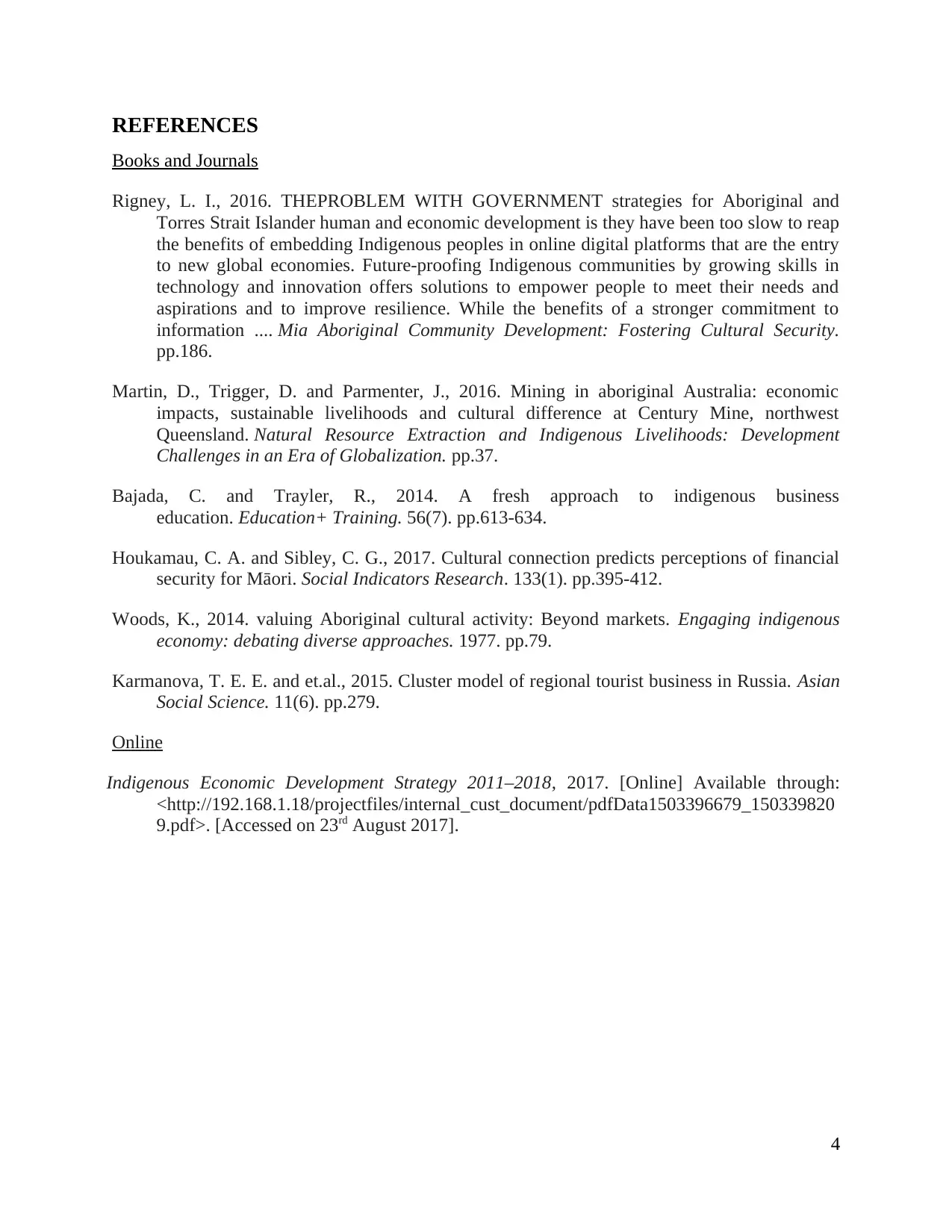
REFERENCES
Books and Journals
Rigney, L. I., 2016. THEPROBLEM WITH GOVERNMENT strategies for Aboriginal and
Torres Strait Islander human and economic development is they have been too slow to reap
the benefits of embedding Indigenous peoples in online digital platforms that are the entry
to new global economies. Future-proofing Indigenous communities by growing skills in
technology and innovation offers solutions to empower people to meet their needs and
aspirations and to improve resilience. While the benefits of a stronger commitment to
information .... Mia Aboriginal Community Development: Fostering Cultural Security.
pp.186.
Martin, D., Trigger, D. and Parmenter, J., 2016. Mining in aboriginal Australia: economic
impacts, sustainable livelihoods and cultural difference at Century Mine, northwest
Queensland. Natural Resource Extraction and Indigenous Livelihoods: Development
Challenges in an Era of Globalization. pp.37.
Bajada, C. and Trayler, R., 2014. A fresh approach to indigenous business
education. Education+ Training. 56(7). pp.613-634.
Houkamau, C. A. and Sibley, C. G., 2017. Cultural connection predicts perceptions of financial
security for Māori. Social Indicators Research. 133(1). pp.395-412.
Woods, K., 2014. valuing Aboriginal cultural activity: Beyond markets. Engaging indigenous
economy: debating diverse approaches. 1977. pp.79.
Karmanova, T. E. E. and et.al., 2015. Cluster model of regional tourist business in Russia. Asian
Social Science. 11(6). pp.279.
Online
Indigenous Economic Development Strategy 2011–2018, 2017. [Online] Available through:
<http://192.168.1.18/projectfiles/internal_cust_document/pdfData1503396679_150339820
9.pdf>. [Accessed on 23rd August 2017].
4
Books and Journals
Rigney, L. I., 2016. THEPROBLEM WITH GOVERNMENT strategies for Aboriginal and
Torres Strait Islander human and economic development is they have been too slow to reap
the benefits of embedding Indigenous peoples in online digital platforms that are the entry
to new global economies. Future-proofing Indigenous communities by growing skills in
technology and innovation offers solutions to empower people to meet their needs and
aspirations and to improve resilience. While the benefits of a stronger commitment to
information .... Mia Aboriginal Community Development: Fostering Cultural Security.
pp.186.
Martin, D., Trigger, D. and Parmenter, J., 2016. Mining in aboriginal Australia: economic
impacts, sustainable livelihoods and cultural difference at Century Mine, northwest
Queensland. Natural Resource Extraction and Indigenous Livelihoods: Development
Challenges in an Era of Globalization. pp.37.
Bajada, C. and Trayler, R., 2014. A fresh approach to indigenous business
education. Education+ Training. 56(7). pp.613-634.
Houkamau, C. A. and Sibley, C. G., 2017. Cultural connection predicts perceptions of financial
security for Māori. Social Indicators Research. 133(1). pp.395-412.
Woods, K., 2014. valuing Aboriginal cultural activity: Beyond markets. Engaging indigenous
economy: debating diverse approaches. 1977. pp.79.
Karmanova, T. E. E. and et.al., 2015. Cluster model of regional tourist business in Russia. Asian
Social Science. 11(6). pp.279.
Online
Indigenous Economic Development Strategy 2011–2018, 2017. [Online] Available through:
<http://192.168.1.18/projectfiles/internal_cust_document/pdfData1503396679_150339820
9.pdf>. [Accessed on 23rd August 2017].
4
⊘ This is a preview!⊘
Do you want full access?
Subscribe today to unlock all pages.

Trusted by 1+ million students worldwide
1 out of 6
Related Documents
Your All-in-One AI-Powered Toolkit for Academic Success.
+13062052269
info@desklib.com
Available 24*7 on WhatsApp / Email
Unlock your academic potential
Copyright © 2020–2025 A2Z Services. All Rights Reserved. Developed and managed by ZUCOL.