Report on Decolonizing Education: A Critical Analysis

Verified

Added on  2023/01/23

|3
|837
|75
Report
AI Summary
This report examines the concept of decolonizing education, drawing from Marie Battiste's work at the University of Saskatchewan. It explores the historical context of forced assimilation of Indigenous peoples, the suppression of their knowledge, and the injustices within the education system. The report highlights the Mi'kmaw education system, emphasizing community participation, experiential learning, and the preservation of oral traditions. It calls for a critical examination of Eurocentric biases and the adoption of inclusive curricula that recognize Indigenous knowledge and perspectives. The author's research emphasizes the need for systemic changes to benefit not only Indigenous communities but all of society, advocating for a shift in thinking and writing to challenge and transform educational practices.
Document Page
1
Running head: DECOLONIZING EDUCATION
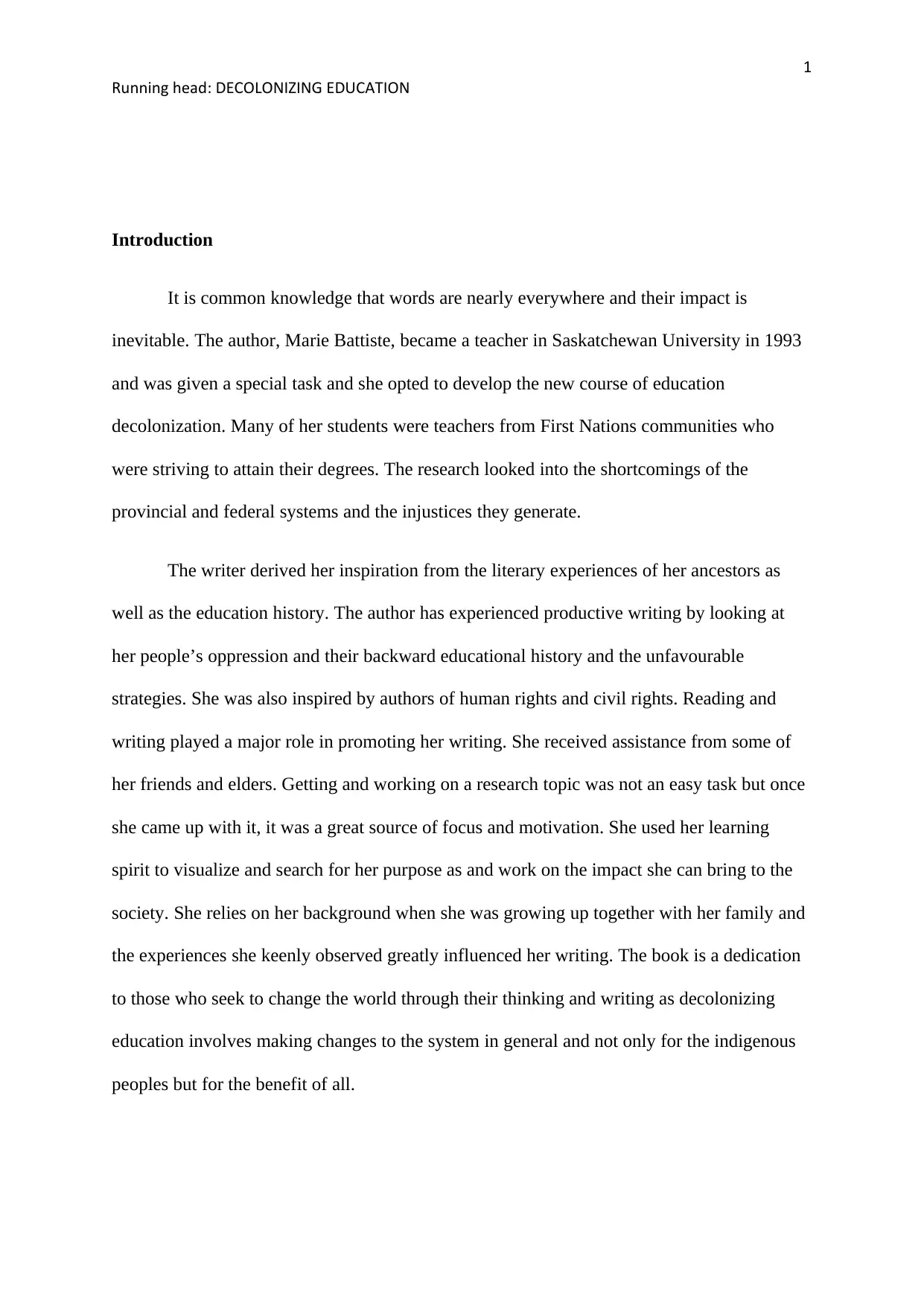
Introduction
It is common knowledge that words are nearly everywhere and their impact is
inevitable. The author, Marie Battiste, became a teacher in Saskatchewan University in 1993
and was given a special task and she opted to develop the new course of education
decolonization. Many of her students were teachers from First Nations communities who
were striving to attain their degrees. The research looked into the shortcomings of the
provincial and federal systems and the injustices they generate.
The writer derived her inspiration from the literary experiences of her ancestors as
well as the education history. The author has experienced productive writing by looking at
her people’s oppression and their backward educational history and the unfavourable
strategies. She was also inspired by authors of human rights and civil rights. Reading and
writing played a major role in promoting her writing. She received assistance from some of
her friends and elders. Getting and working on a research topic was not an easy task but once
she came up with it, it was a great source of focus and motivation. She used her learning
spirit to visualize and search for her purpose as and work on the impact she can bring to the
society. She relies on her background when she was growing up together with her family and
the experiences she keenly observed greatly influenced her writing. The book is a dedication
to those who seek to change the world through their thinking and writing as decolonizing
education involves making changes to the system in general and not only for the indigenous
peoples but for the benefit of all.
tabler-icon-diamond-filled.svg

Paraphrase This Document

Need a fresh take? Get an instant paraphrase of this document with our AI Paraphraser
Document Page
2
Running head: DECOLONIZING EDUCATION
The Indigenous Peoples’ legacy in Forced Assimilative Education
Indigenous students have been subjected to a plan of forced assimilation for a period
exceeding a century. This has been actualised by rejecting and suppressing their knowledge
as well as indigenous heritage. They also suffer from victimization by the system of
education. Assimilation is a real challenge as it affects the healing quest and is a subject
which every Canadian ought to be well conversant with because they all have a connection
with it.
In Canada, this form of education imposed on the Aboriginal peoples cannot be
compared with the options available for immigrants coming into Canada as the immigrants
would have no option but to embrace a specific culture. Aboriginal rights for the First
Nations are upheld by particular agreements with the Canadian federal government and they
receive the support of the Canadian Constitution. Courts have however applied their
discretion to go against the established education clauses favouring First Nations by imposing
a doctrine of the Crown’s honour and fiduciary duty. An education system which is
Eurocentric creates tensions as it does not trust the indigenous systems of knowledge, their
inner spirit of learning and the wisdom of the elders. In order to realise fruitful education, the
academic institutions in Canada need to tackle the negativity resulting from colonialism,
racism and linguistic biasness characterised by the current modern curriculum.
Roots and Routes of Mi’kmaw Education
Document Page
3
Running head: DECOLONIZING EDUCATION
Decolonization involves concentrating on the human beings’ concerns and
perspectives around the world and then conducting research and developing their own
perspectives to benefit them. The peoples of Mi’kmaw include the first tribes who met
European missionaries, sailors and explorers. They have preserved their oral traditions to
remind them of the historical encounters. The characteristics of Mi’kmaw education system
included participation by the community, learning from experience and observation. The
European people began to face language barriers and struggles for survival and sought
assistance of the Mi’kmaq in language interpretation and the right routes for their adventures.
Most missionaries and explorers developed written local languages to promote the conversion
of the indigenous peoples into Christianity and to influence and mobilise the European
political leadership.
I think that the process of decolonizing education is an important topic which should
be accorded the concentration it deserves. The author Marrie Battiste, did an amazing job in
her research and the specific focus she put on the history and culture of the indigenous
peoples must be recognized and encouraged by every means possible and available. Forcing
assimilative education system which did not favour the indigenous people is a depiction of
discrimination and unfair system and such systems must be shied away from at all costs. To
conclude, as seen in Mi’kmaw education, the indigenous peoples should not abandon all their
historical practices, cultures and traditions which have a positive impact in their lives because
of the influence of outsiders such as the European influence using Christianity as a tool.
chevron_up_icon
1 out of 3
circle_padding
hide_on_mobile
zoom_out_icon
[object Object]