World History: Discrimination Faced by Indigenous Peoples in Canada
VerifiedAdded on 2019/09/21
|10
|2372
|136
Essay
AI Summary
This essay examines the historical and contemporary discrimination faced by Indigenous Peoples in Canada. It begins by establishing the link between the discrimination faced by Indigenous groups and the transatlantic slave trade. The essay then explores the human rights violations in residential schools, the impact of racial discrimination and the role of the Catholic Church in the discrimination. It details the historical context of residential schools, where Indigenous children were forced to assimilate, and provides personal accounts of discrimination. The essay further analyzes the impact of the Enlightenment and racial biases on Indigenous communities, highlighting the social and psychological effects of discrimination, including its impact on health and well-being. The conclusion emphasizes the ongoing nature of discrimination and its historical roots, underscoring the need for continued efforts to address these issues and protect Indigenous rights.
Running Head: WORLD HISTORY 1
World History
World History

Paraphrase This Document
Need a fresh take? Get an instant paraphrase of this document with our AI Paraphraser
WORLD HISTORY 2
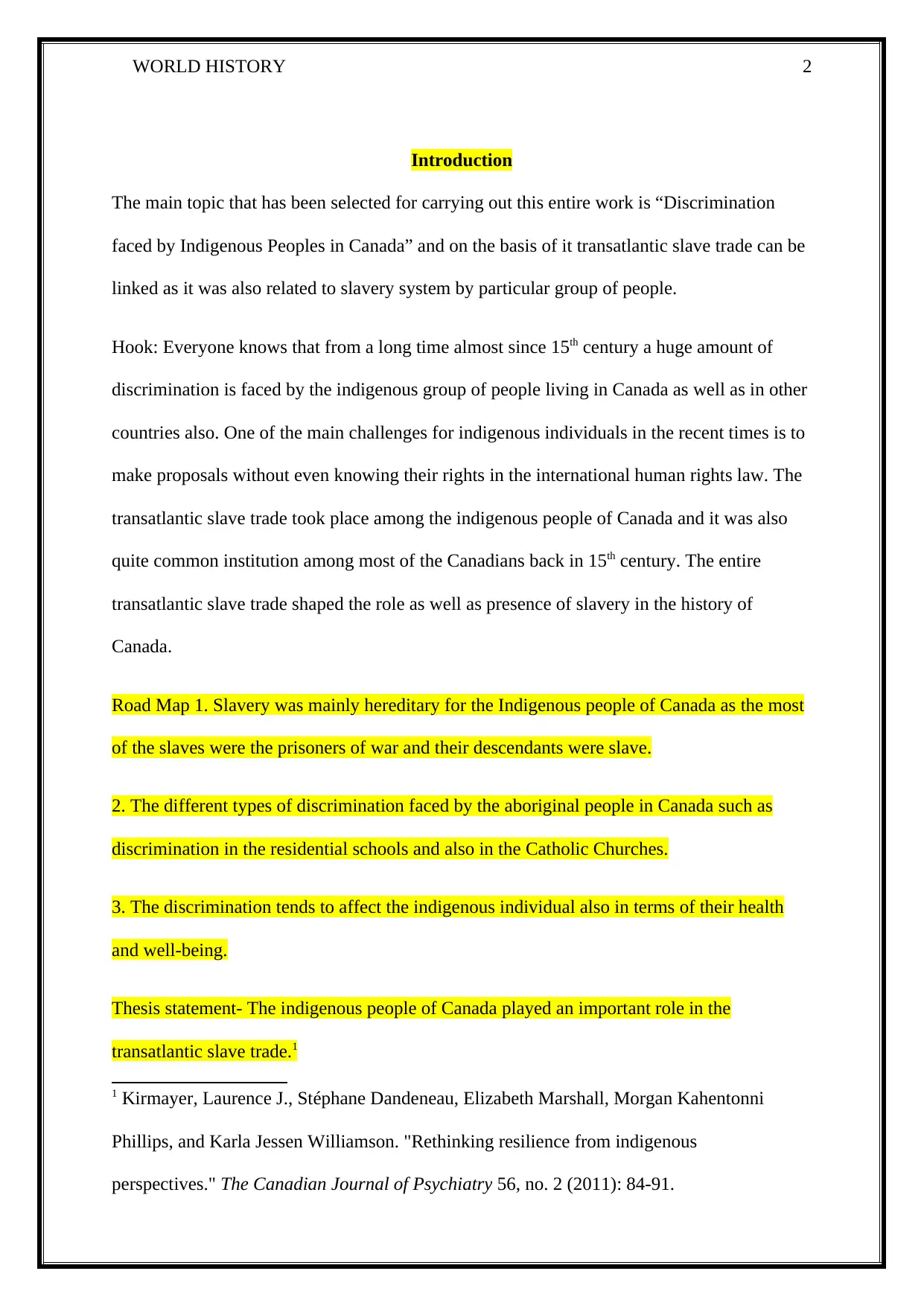
Introduction
The main topic that has been selected for carrying out this entire work is “Discrimination
faced by Indigenous Peoples in Canada” and on the basis of it transatlantic slave trade can be
linked as it was also related to slavery system by particular group of people.
Hook: Everyone knows that from a long time almost since 15th century a huge amount of
discrimination is faced by the indigenous group of people living in Canada as well as in other
countries also. One of the main challenges for indigenous individuals in the recent times is to
make proposals without even knowing their rights in the international human rights law. The
transatlantic slave trade took place among the indigenous people of Canada and it was also
quite common institution among most of the Canadians back in 15th century. The entire
transatlantic slave trade shaped the role as well as presence of slavery in the history of
Canada.
Road Map 1. Slavery was mainly hereditary for the Indigenous people of Canada as the most
of the slaves were the prisoners of war and their descendants were slave.
2. The different types of discrimination faced by the aboriginal people in Canada such as
discrimination in the residential schools and also in the Catholic Churches.
3. The discrimination tends to affect the indigenous individual also in terms of their health
and well-being.
Thesis statement- The indigenous people of Canada played an important role in the
transatlantic slave trade.1
1 Kirmayer, Laurence J., Stéphane Dandeneau, Elizabeth Marshall, Morgan Kahentonni
Phillips, and Karla Jessen Williamson. "Rethinking resilience from indigenous
perspectives." The Canadian Journal of Psychiatry 56, no. 2 (2011): 84-91.
Introduction
The main topic that has been selected for carrying out this entire work is “Discrimination
faced by Indigenous Peoples in Canada” and on the basis of it transatlantic slave trade can be
linked as it was also related to slavery system by particular group of people.
Hook: Everyone knows that from a long time almost since 15th century a huge amount of
discrimination is faced by the indigenous group of people living in Canada as well as in other
countries also. One of the main challenges for indigenous individuals in the recent times is to
make proposals without even knowing their rights in the international human rights law. The
transatlantic slave trade took place among the indigenous people of Canada and it was also
quite common institution among most of the Canadians back in 15th century. The entire
transatlantic slave trade shaped the role as well as presence of slavery in the history of
Canada.
Road Map 1. Slavery was mainly hereditary for the Indigenous people of Canada as the most
of the slaves were the prisoners of war and their descendants were slave.
2. The different types of discrimination faced by the aboriginal people in Canada such as
discrimination in the residential schools and also in the Catholic Churches.
3. The discrimination tends to affect the indigenous individual also in terms of their health
and well-being.
Thesis statement- The indigenous people of Canada played an important role in the
transatlantic slave trade.1
1 Kirmayer, Laurence J., Stéphane Dandeneau, Elizabeth Marshall, Morgan Kahentonni
Phillips, and Karla Jessen Williamson. "Rethinking resilience from indigenous
perspectives." The Canadian Journal of Psychiatry 56, no. 2 (2011): 84-91.
WORLD HISTORY 3
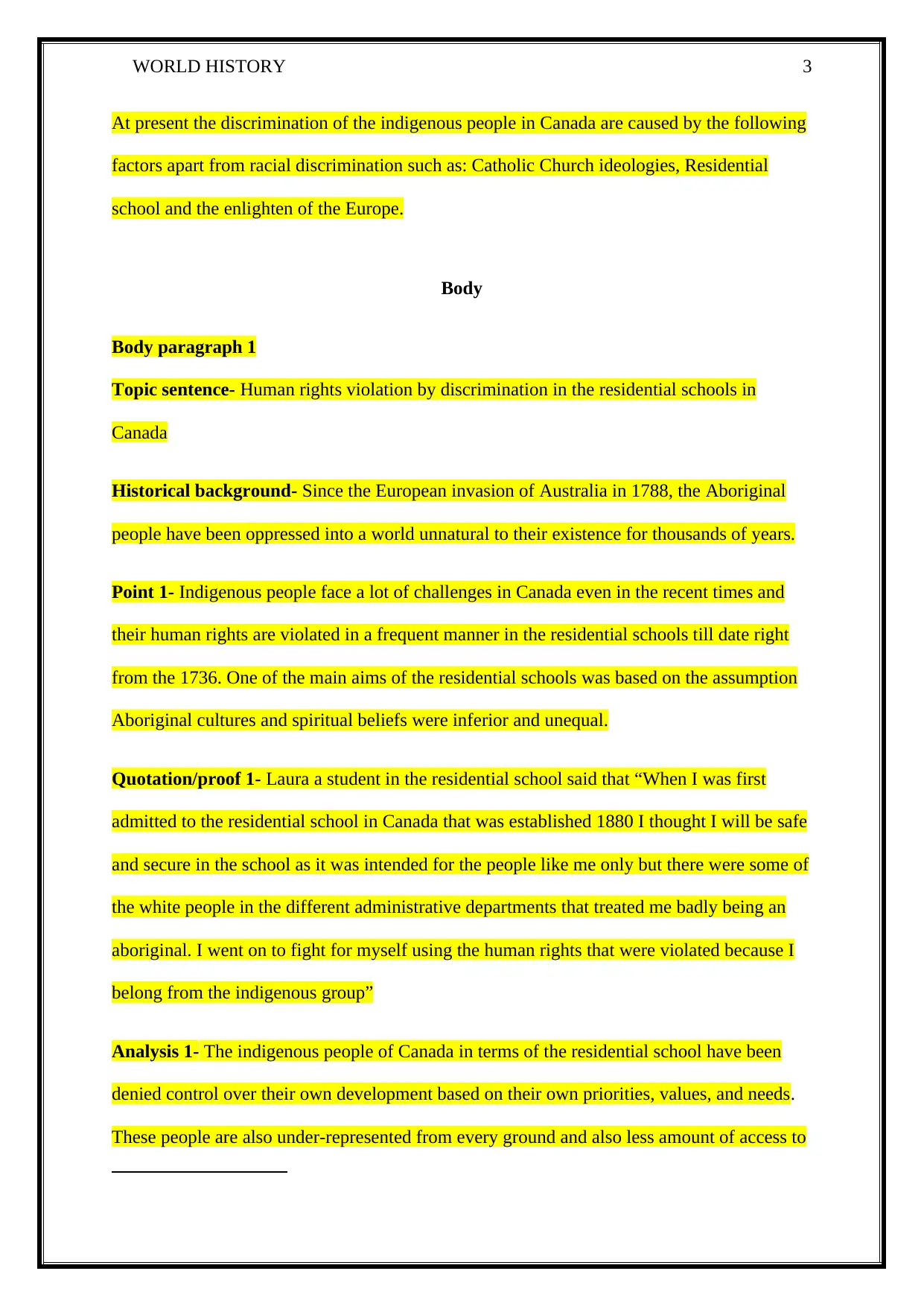
At present the discrimination of the indigenous people in Canada are caused by the following
factors apart from racial discrimination such as: Catholic Church ideologies, Residential
school and the enlighten of the Europe.
Body
Body paragraph 1
Topic sentence- Human rights violation by discrimination in the residential schools in
Canada
Historical background- Since the European invasion of Australia in 1788, the Aboriginal
people have been oppressed into a world unnatural to their existence for thousands of years.
Point 1- Indigenous people face a lot of challenges in Canada even in the recent times and
their human rights are violated in a frequent manner in the residential schools till date right
from the 1736. One of the main aims of the residential schools was based on the assumption
Aboriginal cultures and spiritual beliefs were inferior and unequal.
Quotation/proof 1- Laura a student in the residential school said that “When I was first
admitted to the residential school in Canada that was established 1880 I thought I will be safe
and secure in the school as it was intended for the people like me only but there were some of
the white people in the different administrative departments that treated me badly being an
aboriginal. I went on to fight for myself using the human rights that were violated because I
belong from the indigenous group”
Analysis 1- The indigenous people of Canada in terms of the residential school have been
denied control over their own development based on their own priorities, values, and needs.
These people are also under-represented from every ground and also less amount of access to
At present the discrimination of the indigenous people in Canada are caused by the following
factors apart from racial discrimination such as: Catholic Church ideologies, Residential
school and the enlighten of the Europe.
Body
Body paragraph 1
Topic sentence- Human rights violation by discrimination in the residential schools in
Canada
Historical background- Since the European invasion of Australia in 1788, the Aboriginal
people have been oppressed into a world unnatural to their existence for thousands of years.
Point 1- Indigenous people face a lot of challenges in Canada even in the recent times and
their human rights are violated in a frequent manner in the residential schools till date right
from the 1736. One of the main aims of the residential schools was based on the assumption
Aboriginal cultures and spiritual beliefs were inferior and unequal.
Quotation/proof 1- Laura a student in the residential school said that “When I was first
admitted to the residential school in Canada that was established 1880 I thought I will be safe
and secure in the school as it was intended for the people like me only but there were some of
the white people in the different administrative departments that treated me badly being an
aboriginal. I went on to fight for myself using the human rights that were violated because I
belong from the indigenous group”
Analysis 1- The indigenous people of Canada in terms of the residential school have been
denied control over their own development based on their own priorities, values, and needs.
These people are also under-represented from every ground and also less amount of access to
⊘ This is a preview!⊘
Do you want full access?
Subscribe today to unlock all pages.

Trusted by 1+ million students worldwide
WORLD HISTORY 4
the other services and the social welfare. The indigenous people are also marginalized when
it generally comes to the project that is affecting their lands and they have been also the
victims of the forced displacement2.
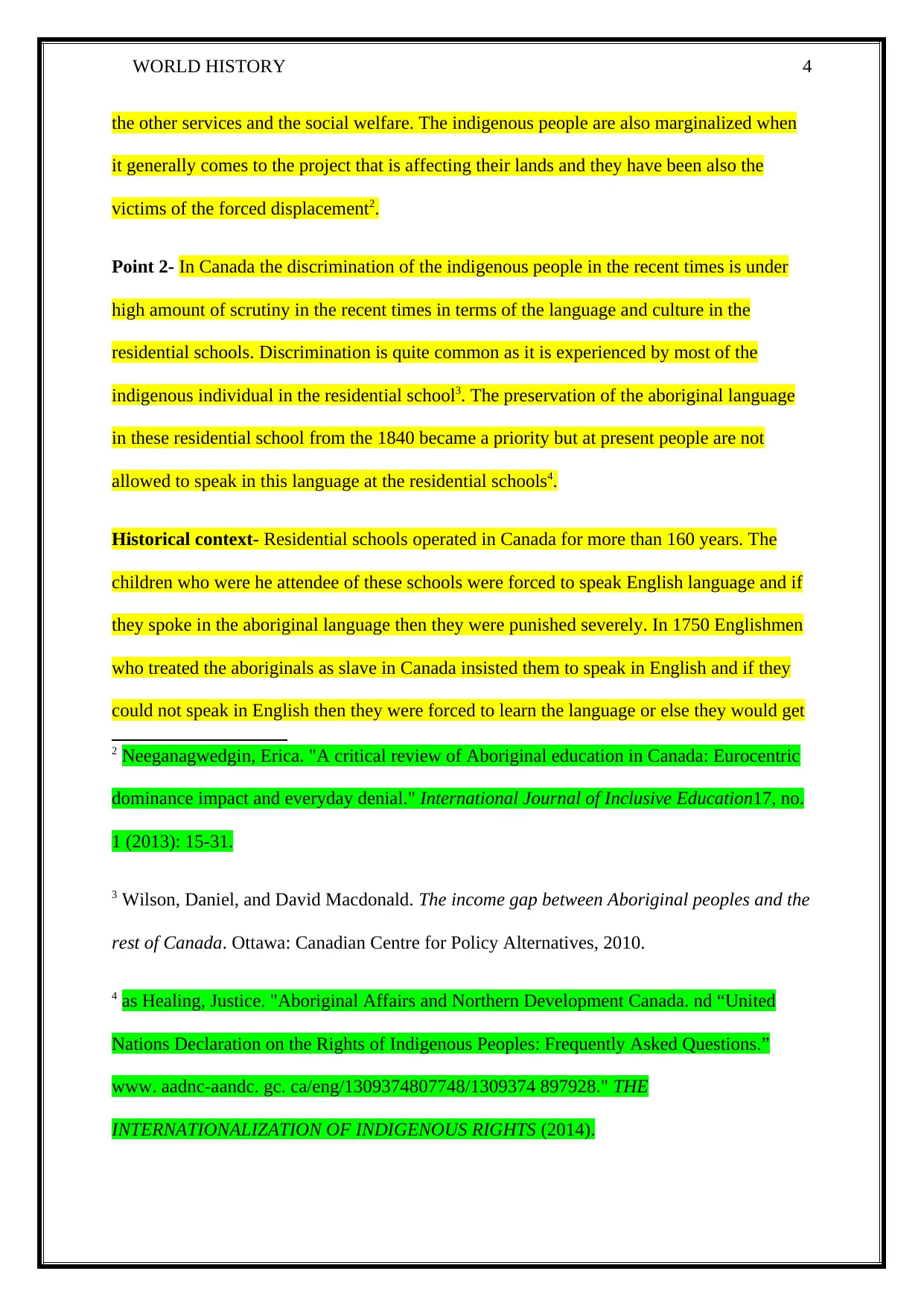
Point 2- In Canada the discrimination of the indigenous people in the recent times is under
high amount of scrutiny in the recent times in terms of the language and culture in the
residential schools. Discrimination is quite common as it is experienced by most of the
indigenous individual in the residential school3. The preservation of the aboriginal language
in these residential school from the 1840 became a priority but at present people are not
allowed to speak in this language at the residential schools4.
Historical context- Residential schools operated in Canada for more than 160 years. The
children who were he attendee of these schools were forced to speak English language and if
they spoke in the aboriginal language then they were punished severely. In 1750 Englishmen
who treated the aboriginals as slave in Canada insisted them to speak in English and if they
could not speak in English then they were forced to learn the language or else they would get
2 Neeganagwedgin, Erica. "A critical review of Aboriginal education in Canada: Eurocentric
dominance impact and everyday denial." International Journal of Inclusive Education17, no.
1 (2013): 15-31.
3 Wilson, Daniel, and David Macdonald. The income gap between Aboriginal peoples and the
rest of Canada. Ottawa: Canadian Centre for Policy Alternatives, 2010.
4 as Healing, Justice. "Aboriginal Affairs and Northern Development Canada. nd “United
Nations Declaration on the Rights of Indigenous Peoples: Frequently Asked Questions.”
www. aadnc-aandc. gc. ca/eng/1309374807748/1309374 897928." THE
INTERNATIONALIZATION OF INDIGENOUS RIGHTS (2014).
the other services and the social welfare. The indigenous people are also marginalized when
it generally comes to the project that is affecting their lands and they have been also the
victims of the forced displacement2.
Point 2- In Canada the discrimination of the indigenous people in the recent times is under
high amount of scrutiny in the recent times in terms of the language and culture in the
residential schools. Discrimination is quite common as it is experienced by most of the
indigenous individual in the residential school3. The preservation of the aboriginal language
in these residential school from the 1840 became a priority but at present people are not
allowed to speak in this language at the residential schools4.
Historical context- Residential schools operated in Canada for more than 160 years. The
children who were he attendee of these schools were forced to speak English language and if
they spoke in the aboriginal language then they were punished severely. In 1750 Englishmen
who treated the aboriginals as slave in Canada insisted them to speak in English and if they
could not speak in English then they were forced to learn the language or else they would get
2 Neeganagwedgin, Erica. "A critical review of Aboriginal education in Canada: Eurocentric
dominance impact and everyday denial." International Journal of Inclusive Education17, no.
1 (2013): 15-31.
3 Wilson, Daniel, and David Macdonald. The income gap between Aboriginal peoples and the
rest of Canada. Ottawa: Canadian Centre for Policy Alternatives, 2010.
4 as Healing, Justice. "Aboriginal Affairs and Northern Development Canada. nd “United
Nations Declaration on the Rights of Indigenous Peoples: Frequently Asked Questions.”
www. aadnc-aandc. gc. ca/eng/1309374807748/1309374 897928." THE
INTERNATIONALIZATION OF INDIGENOUS RIGHTS (2014).
Paraphrase This Document
Need a fresh take? Get an instant paraphrase of this document with our AI Paraphraser
WORLD HISTORY 5
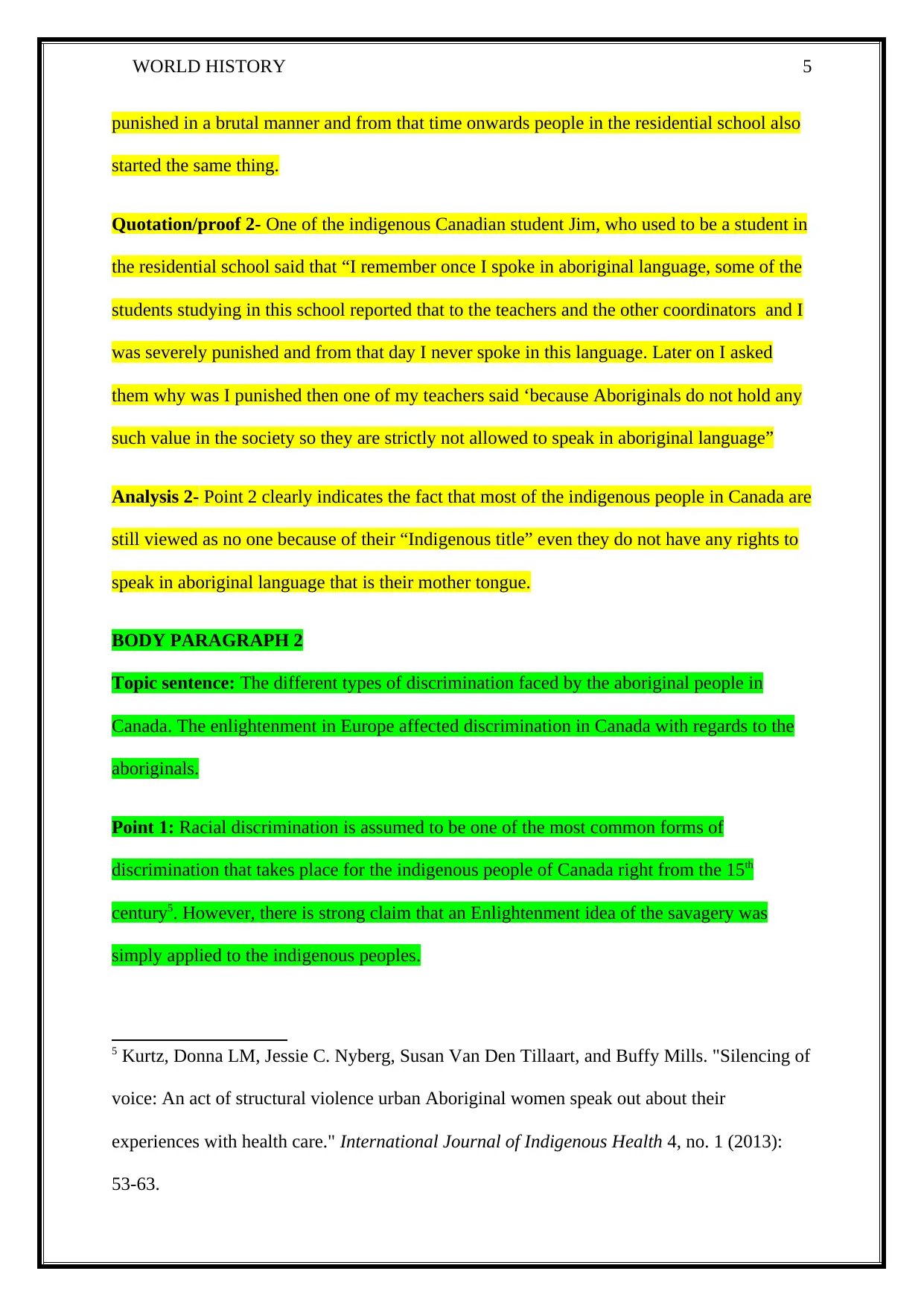
punished in a brutal manner and from that time onwards people in the residential school also
started the same thing.
Quotation/proof 2- One of the indigenous Canadian student Jim, who used to be a student in
the residential school said that “I remember once I spoke in aboriginal language, some of the
students studying in this school reported that to the teachers and the other coordinators and I
was severely punished and from that day I never spoke in this language. Later on I asked
them why was I punished then one of my teachers said ‘because Aboriginals do not hold any
such value in the society so they are strictly not allowed to speak in aboriginal language”
Analysis 2- Point 2 clearly indicates the fact that most of the indigenous people in Canada are
still viewed as no one because of their “Indigenous title” even they do not have any rights to
speak in aboriginal language that is their mother tongue.
BODY PARAGRAPH 2
Topic sentence: The different types of discrimination faced by the aboriginal people in
Canada. The enlightenment in Europe affected discrimination in Canada with regards to the
aboriginals.
Point 1: Racial discrimination is assumed to be one of the most common forms of
discrimination that takes place for the indigenous people of Canada right from the 15th
century5. However, there is strong claim that an Enlightenment idea of the savagery was
simply applied to the indigenous peoples.
5 Kurtz, Donna LM, Jessie C. Nyberg, Susan Van Den Tillaart, and Buffy Mills. "Silencing of
voice: An act of structural violence urban Aboriginal women speak out about their
experiences with health care." International Journal of Indigenous Health 4, no. 1 (2013):
53-63.
punished in a brutal manner and from that time onwards people in the residential school also
started the same thing.
Quotation/proof 2- One of the indigenous Canadian student Jim, who used to be a student in
the residential school said that “I remember once I spoke in aboriginal language, some of the
students studying in this school reported that to the teachers and the other coordinators and I
was severely punished and from that day I never spoke in this language. Later on I asked
them why was I punished then one of my teachers said ‘because Aboriginals do not hold any
such value in the society so they are strictly not allowed to speak in aboriginal language”
Analysis 2- Point 2 clearly indicates the fact that most of the indigenous people in Canada are
still viewed as no one because of their “Indigenous title” even they do not have any rights to
speak in aboriginal language that is their mother tongue.
BODY PARAGRAPH 2
Topic sentence: The different types of discrimination faced by the aboriginal people in
Canada. The enlightenment in Europe affected discrimination in Canada with regards to the
aboriginals.
Point 1: Racial discrimination is assumed to be one of the most common forms of
discrimination that takes place for the indigenous people of Canada right from the 15th
century5. However, there is strong claim that an Enlightenment idea of the savagery was
simply applied to the indigenous peoples.
5 Kurtz, Donna LM, Jessie C. Nyberg, Susan Van Den Tillaart, and Buffy Mills. "Silencing of
voice: An act of structural violence urban Aboriginal women speak out about their
experiences with health care." International Journal of Indigenous Health 4, no. 1 (2013):
53-63.
WORLD HISTORY 6
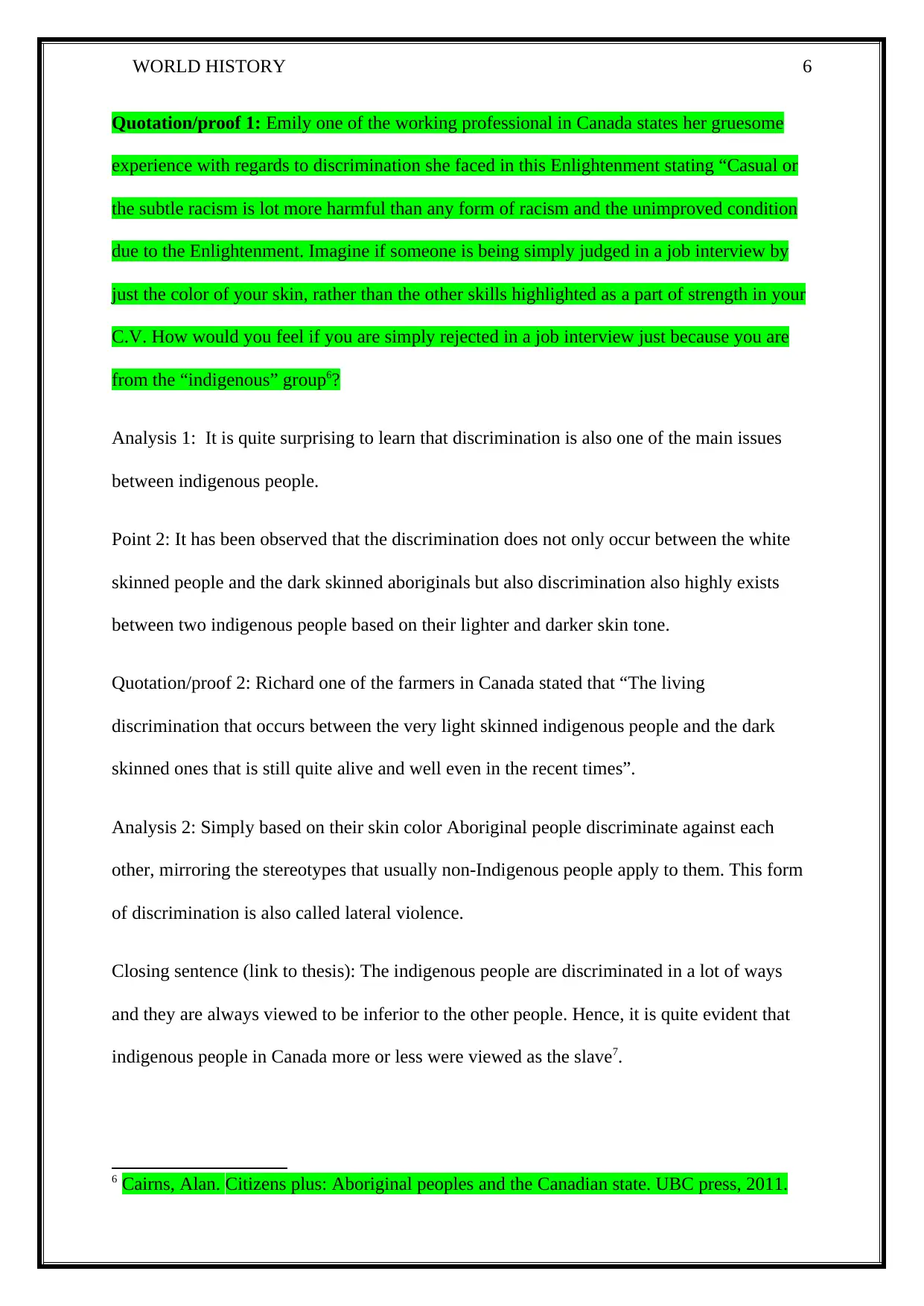
Quotation/proof 1: Emily one of the working professional in Canada states her gruesome
experience with regards to discrimination she faced in this Enlightenment stating “Casual or
the subtle racism is lot more harmful than any form of racism and the unimproved condition
due to the Enlightenment. Imagine if someone is being simply judged in a job interview by
just the color of your skin, rather than the other skills highlighted as a part of strength in your
C.V. How would you feel if you are simply rejected in a job interview just because you are
from the “indigenous” group6?
Analysis 1: It is quite surprising to learn that discrimination is also one of the main issues
between indigenous people.
Point 2: It has been observed that the discrimination does not only occur between the white
skinned people and the dark skinned aboriginals but also discrimination also highly exists
between two indigenous people based on their lighter and darker skin tone.
Quotation/proof 2: Richard one of the farmers in Canada stated that “The living
discrimination that occurs between the very light skinned indigenous people and the dark
skinned ones that is still quite alive and well even in the recent times”.
Analysis 2: Simply based on their skin color Aboriginal people discriminate against each
other, mirroring the stereotypes that usually non-Indigenous people apply to them. This form
of discrimination is also called lateral violence.
Closing sentence (link to thesis): The indigenous people are discriminated in a lot of ways
and they are always viewed to be inferior to the other people. Hence, it is quite evident that
indigenous people in Canada more or less were viewed as the slave7.
6 Cairns, Alan. Citizens plus: Aboriginal peoples and the Canadian state. UBC press, 2011.
Quotation/proof 1: Emily one of the working professional in Canada states her gruesome
experience with regards to discrimination she faced in this Enlightenment stating “Casual or
the subtle racism is lot more harmful than any form of racism and the unimproved condition
due to the Enlightenment. Imagine if someone is being simply judged in a job interview by
just the color of your skin, rather than the other skills highlighted as a part of strength in your
C.V. How would you feel if you are simply rejected in a job interview just because you are
from the “indigenous” group6?
Analysis 1: It is quite surprising to learn that discrimination is also one of the main issues
between indigenous people.
Point 2: It has been observed that the discrimination does not only occur between the white
skinned people and the dark skinned aboriginals but also discrimination also highly exists
between two indigenous people based on their lighter and darker skin tone.
Quotation/proof 2: Richard one of the farmers in Canada stated that “The living
discrimination that occurs between the very light skinned indigenous people and the dark
skinned ones that is still quite alive and well even in the recent times”.
Analysis 2: Simply based on their skin color Aboriginal people discriminate against each
other, mirroring the stereotypes that usually non-Indigenous people apply to them. This form
of discrimination is also called lateral violence.
Closing sentence (link to thesis): The indigenous people are discriminated in a lot of ways
and they are always viewed to be inferior to the other people. Hence, it is quite evident that
indigenous people in Canada more or less were viewed as the slave7.
6 Cairns, Alan. Citizens plus: Aboriginal peoples and the Canadian state. UBC press, 2011.
⊘ This is a preview!⊘
Do you want full access?
Subscribe today to unlock all pages.
Trusted by 1+ million students worldwide
WORLD HISTORY 7
BODY PARAGRAPH 3
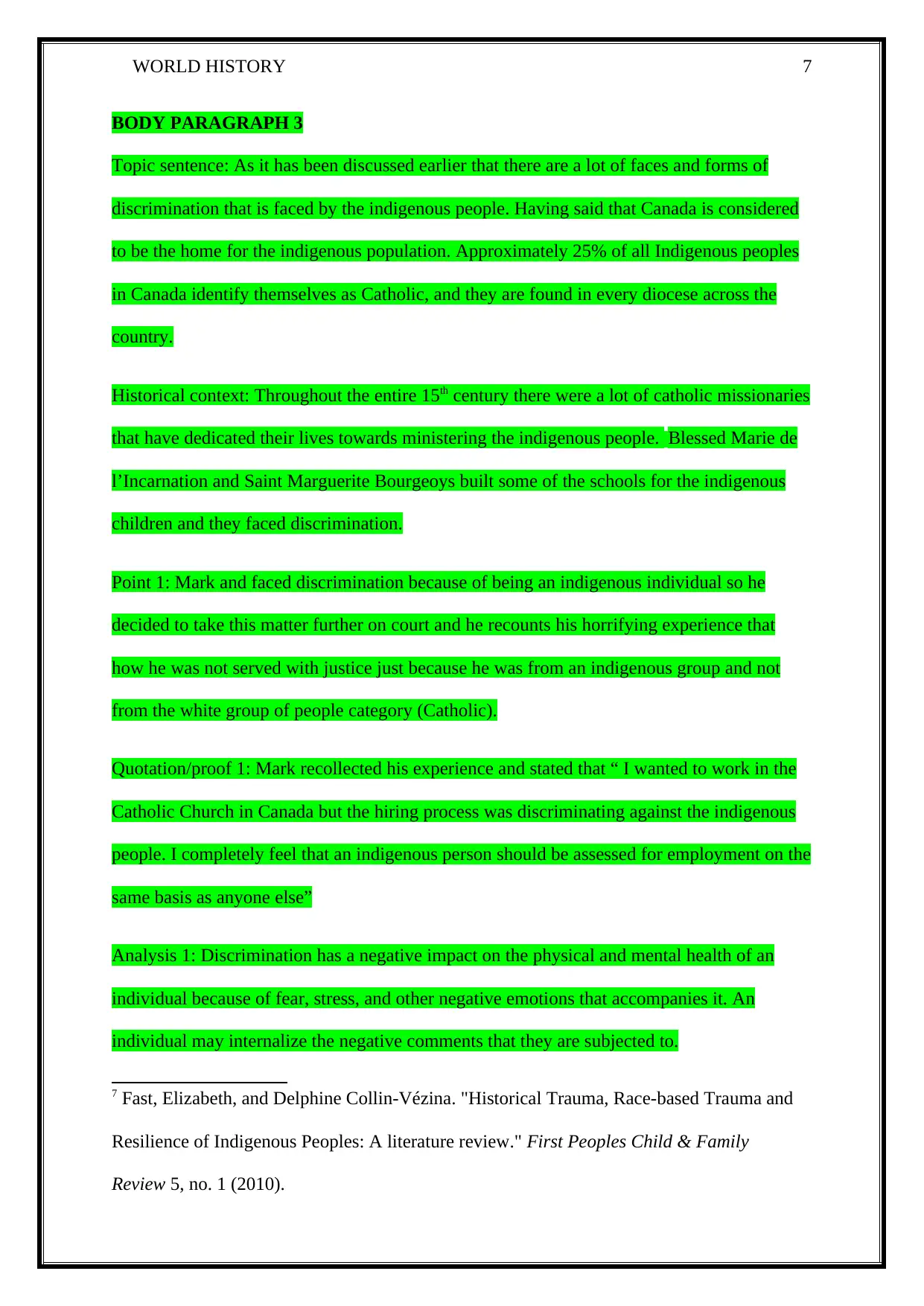
Topic sentence: As it has been discussed earlier that there are a lot of faces and forms of
discrimination that is faced by the indigenous people. Having said that Canada is considered
to be the home for the indigenous population. Approximately 25% of all Indigenous peoples
in Canada identify themselves as Catholic, and they are found in every diocese across the
country.
Historical context: Throughout the entire 15th century there were a lot of catholic missionaries
that have dedicated their lives towards ministering the indigenous people. Blessed Marie de
l’Incarnation and Saint Marguerite Bourgeoys built some of the schools for the indigenous
children and they faced discrimination.
Point 1: Mark and faced discrimination because of being an indigenous individual so he
decided to take this matter further on court and he recounts his horrifying experience that
how he was not served with justice just because he was from an indigenous group and not
from the white group of people category (Catholic).
Quotation/proof 1: Mark recollected his experience and stated that “ I wanted to work in the
Catholic Church in Canada but the hiring process was discriminating against the indigenous
people. I completely feel that an indigenous person should be assessed for employment on the
same basis as anyone else”
Analysis 1: Discrimination has a negative impact on the physical and mental health of an
individual because of fear, stress, and other negative emotions that accompanies it. An
individual may internalize the negative comments that they are subjected to.
7 Fast, Elizabeth, and Delphine Collin-Vézina. "Historical Trauma, Race-based Trauma and
Resilience of Indigenous Peoples: A literature review." First Peoples Child & Family
Review 5, no. 1 (2010).
BODY PARAGRAPH 3
Topic sentence: As it has been discussed earlier that there are a lot of faces and forms of
discrimination that is faced by the indigenous people. Having said that Canada is considered
to be the home for the indigenous population. Approximately 25% of all Indigenous peoples
in Canada identify themselves as Catholic, and they are found in every diocese across the
country.
Historical context: Throughout the entire 15th century there were a lot of catholic missionaries
that have dedicated their lives towards ministering the indigenous people. Blessed Marie de
l’Incarnation and Saint Marguerite Bourgeoys built some of the schools for the indigenous
children and they faced discrimination.
Point 1: Mark and faced discrimination because of being an indigenous individual so he
decided to take this matter further on court and he recounts his horrifying experience that
how he was not served with justice just because he was from an indigenous group and not
from the white group of people category (Catholic).
Quotation/proof 1: Mark recollected his experience and stated that “ I wanted to work in the
Catholic Church in Canada but the hiring process was discriminating against the indigenous
people. I completely feel that an indigenous person should be assessed for employment on the
same basis as anyone else”
Analysis 1: Discrimination has a negative impact on the physical and mental health of an
individual because of fear, stress, and other negative emotions that accompanies it. An
individual may internalize the negative comments that they are subjected to.
7 Fast, Elizabeth, and Delphine Collin-Vézina. "Historical Trauma, Race-based Trauma and
Resilience of Indigenous Peoples: A literature review." First Peoples Child & Family
Review 5, no. 1 (2010).
Paraphrase This Document
Need a fresh take? Get an instant paraphrase of this document with our AI Paraphraser
WORLD HISTORY 8
Point 2: as per some of the surveys it has been also revealed that there are different types of
stress with regards to the discrimination8.
Quotation/proof 2: Kylie 15 year old teenager said that “When I first went to a new school in
Canada I faced a lot of difficulties in terms of discrimination. People subjected me to a lot of
mental tortures and I had to undergo it on a daily basis. I kept quite because I am from the
indigenous group and our voice is generally not heard by the other people at any cost. This
resulted in detoriating my mental as well as physical health to a great extent”
Analysis 2: Throwing light on the above-mentioned experience of Kylie it can be clearly said
that discrimination is like cancer and it tends to destroy the mental and physical well-being of
an individual. The 3 most prominent effects of discrimination are Inferiority, fear, and anger.
Inferiority is a major issue when discussing the effects of discrimination. Furthermore, the
discrimination is such an issue that it leads to the suicide also.
Closing sentence (link to thesis): Discrimination of the indigenous people is not only limited
towards being slave but it has also opened the branches and affecting these people in terms of
their mental and physical well-being.
Conclusion
Rephrasing thesis- Discrimination of the indigenous people in Canada is one of the common
issues like it is faced by most of the indigenous people all across the globe. The
discrimination has also resulted into the slave trade right from the 15th century. Hence, on the
basis of it transatlantic slave trade can be linked as it was also related to slavery system by
particular group of people.
8 Pendakur, Krishna, and Ravi Pendakur. "Aboriginal income disparity in Canada." Canadian
Public Policy 37, no. 1 (2011): 61-83.
Point 2: as per some of the surveys it has been also revealed that there are different types of
stress with regards to the discrimination8.
Quotation/proof 2: Kylie 15 year old teenager said that “When I first went to a new school in
Canada I faced a lot of difficulties in terms of discrimination. People subjected me to a lot of
mental tortures and I had to undergo it on a daily basis. I kept quite because I am from the
indigenous group and our voice is generally not heard by the other people at any cost. This
resulted in detoriating my mental as well as physical health to a great extent”
Analysis 2: Throwing light on the above-mentioned experience of Kylie it can be clearly said
that discrimination is like cancer and it tends to destroy the mental and physical well-being of
an individual. The 3 most prominent effects of discrimination are Inferiority, fear, and anger.
Inferiority is a major issue when discussing the effects of discrimination. Furthermore, the
discrimination is such an issue that it leads to the suicide also.
Closing sentence (link to thesis): Discrimination of the indigenous people is not only limited
towards being slave but it has also opened the branches and affecting these people in terms of
their mental and physical well-being.
Conclusion
Rephrasing thesis- Discrimination of the indigenous people in Canada is one of the common
issues like it is faced by most of the indigenous people all across the globe. The
discrimination has also resulted into the slave trade right from the 15th century. Hence, on the
basis of it transatlantic slave trade can be linked as it was also related to slavery system by
particular group of people.
8 Pendakur, Krishna, and Ravi Pendakur. "Aboriginal income disparity in Canada." Canadian
Public Policy 37, no. 1 (2011): 61-83.
WORLD HISTORY 9
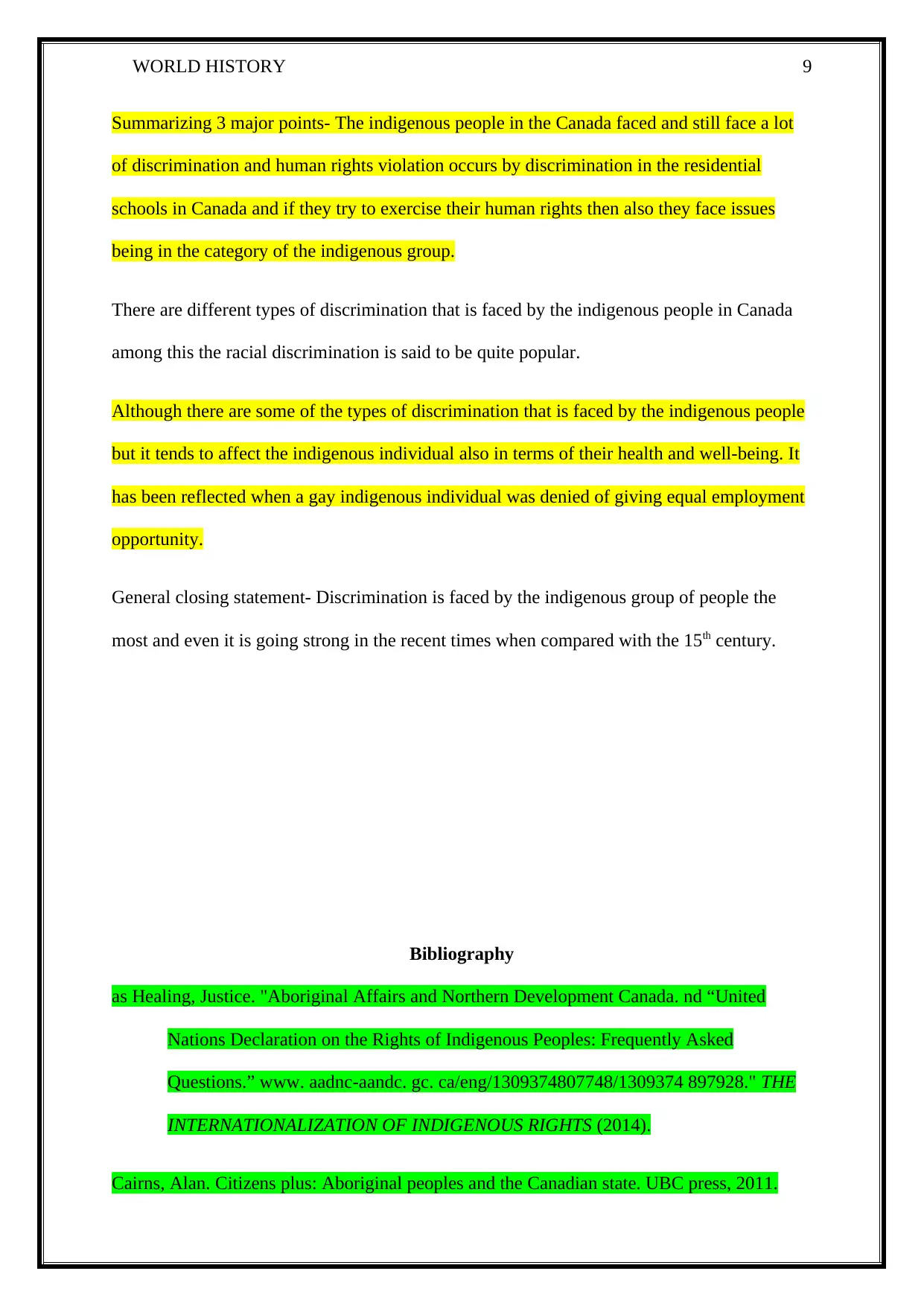
Summarizing 3 major points- The indigenous people in the Canada faced and still face a lot
of discrimination and human rights violation occurs by discrimination in the residential
schools in Canada and if they try to exercise their human rights then also they face issues
being in the category of the indigenous group.
There are different types of discrimination that is faced by the indigenous people in Canada
among this the racial discrimination is said to be quite popular.
Although there are some of the types of discrimination that is faced by the indigenous people
but it tends to affect the indigenous individual also in terms of their health and well-being. It
has been reflected when a gay indigenous individual was denied of giving equal employment
opportunity.
General closing statement- Discrimination is faced by the indigenous group of people the
most and even it is going strong in the recent times when compared with the 15th century.
Bibliography
as Healing, Justice. "Aboriginal Affairs and Northern Development Canada. nd “United
Nations Declaration on the Rights of Indigenous Peoples: Frequently Asked
Questions.” www. aadnc-aandc. gc. ca/eng/1309374807748/1309374 897928." THE
INTERNATIONALIZATION OF INDIGENOUS RIGHTS (2014).
Cairns, Alan. Citizens plus: Aboriginal peoples and the Canadian state. UBC press, 2011.
Summarizing 3 major points- The indigenous people in the Canada faced and still face a lot
of discrimination and human rights violation occurs by discrimination in the residential
schools in Canada and if they try to exercise their human rights then also they face issues
being in the category of the indigenous group.
There are different types of discrimination that is faced by the indigenous people in Canada
among this the racial discrimination is said to be quite popular.
Although there are some of the types of discrimination that is faced by the indigenous people
but it tends to affect the indigenous individual also in terms of their health and well-being. It
has been reflected when a gay indigenous individual was denied of giving equal employment
opportunity.
General closing statement- Discrimination is faced by the indigenous group of people the
most and even it is going strong in the recent times when compared with the 15th century.
Bibliography
as Healing, Justice. "Aboriginal Affairs and Northern Development Canada. nd “United
Nations Declaration on the Rights of Indigenous Peoples: Frequently Asked
Questions.” www. aadnc-aandc. gc. ca/eng/1309374807748/1309374 897928." THE
INTERNATIONALIZATION OF INDIGENOUS RIGHTS (2014).
Cairns, Alan. Citizens plus: Aboriginal peoples and the Canadian state. UBC press, 2011.
⊘ This is a preview!⊘
Do you want full access?
Subscribe today to unlock all pages.
Trusted by 1+ million students worldwide
WORLD HISTORY 10
Fast, Elizabeth, and Delphine Collin-Vézina. "Historical Trauma, Race-based Trauma and
Resilience of Indigenous Peoples: A literature review." First Peoples Child & Family
Review 5, no. 1 (2010).
Kirmayer, Laurence J., Stéphane Dandeneau, Elizabeth Marshall, Morgan Kahentonni
Phillips, and Karla Jessen Williamson. "Rethinking resilience from indigenous
perspectives." The Canadian Journal of Psychiatry 56, no. 2 (2011): 84-91.
Kurtz, Donna LM, Jessie C. Nyberg, Susan Van Den Tillaart, and Buffy Mills. "Silencing of
voice: An act of structural violence urban Aboriginal women speak out about their
experiences with health care." International Journal of Indigenous Health 4, no. 1
(2013): 53-63.
Neeganagwedgin, Erica. "A critical review of Aboriginal education in Canada: Eurocentric
dominance impact and everyday denial." International Journal of Inclusive
Education17, no. 1 (2013): 15-31.
Pendakur, Krishna, and Ravi Pendakur. "Aboriginal income disparity in Canada." Canadian
Public Policy 37, no. 1 (2011): 61-83.
Wilson, Daniel, and David Macdonald. The income gap between Aboriginal peoples and the
rest of Canada. Ottawa: Canadian Centre for Policy Alternatives, 2010.
Fast, Elizabeth, and Delphine Collin-Vézina. "Historical Trauma, Race-based Trauma and
Resilience of Indigenous Peoples: A literature review." First Peoples Child & Family
Review 5, no. 1 (2010).
Kirmayer, Laurence J., Stéphane Dandeneau, Elizabeth Marshall, Morgan Kahentonni
Phillips, and Karla Jessen Williamson. "Rethinking resilience from indigenous
perspectives." The Canadian Journal of Psychiatry 56, no. 2 (2011): 84-91.
Kurtz, Donna LM, Jessie C. Nyberg, Susan Van Den Tillaart, and Buffy Mills. "Silencing of
voice: An act of structural violence urban Aboriginal women speak out about their
experiences with health care." International Journal of Indigenous Health 4, no. 1
(2013): 53-63.
Neeganagwedgin, Erica. "A critical review of Aboriginal education in Canada: Eurocentric
dominance impact and everyday denial." International Journal of Inclusive
Education17, no. 1 (2013): 15-31.
Pendakur, Krishna, and Ravi Pendakur. "Aboriginal income disparity in Canada." Canadian
Public Policy 37, no. 1 (2011): 61-83.
Wilson, Daniel, and David Macdonald. The income gap between Aboriginal peoples and the
rest of Canada. Ottawa: Canadian Centre for Policy Alternatives, 2010.

1 out of 10


Related Documents


Your All-in-One AI-Powered Toolkit for Academic Success.
+13062052269
info@desklib.com
Available 24*7 on WhatsApp / Email
![[object Object]](/_next/static/media/star-bottom.7253800d.svg)
Unlock your academic potential
Copyright © 2020–2026 A2Z Services. All Rights Reserved. Developed and managed by ZUCOL.