Individual Learning Goals: Nursing Practice, Assessment, and Care

Verified

Added on  2023/01/11

|3
|825
|33
Homework Assignment
AI Summary
This assignment focuses on two individual learning goals for nursing practice. The first goal emphasizes the importance of effective communication through the ISBAR (Identification, Situation, Background, Assessment, Recommendation) method during patient handovers, highlighting its role in ensuring coordinated and safe patient care. Strategies to achieve this goal include organizing patient data, using concise language, and ensuring accuracy. The second learning goal centers on patient assessment, including wound management, mobility evaluation, vital signs monitoring, and falls risk assessment. This section underscores how these skills contribute to comprehensive care planning and accurate patient evaluation. Strategies include understanding wound aetiology, recording vital signs, and evaluating mobility and fall risk factors. The assignment references several research papers to support the importance of these practices.
Document Page
Individual Learning Goals
Each action plan is 200 words in addition to the template words (35)
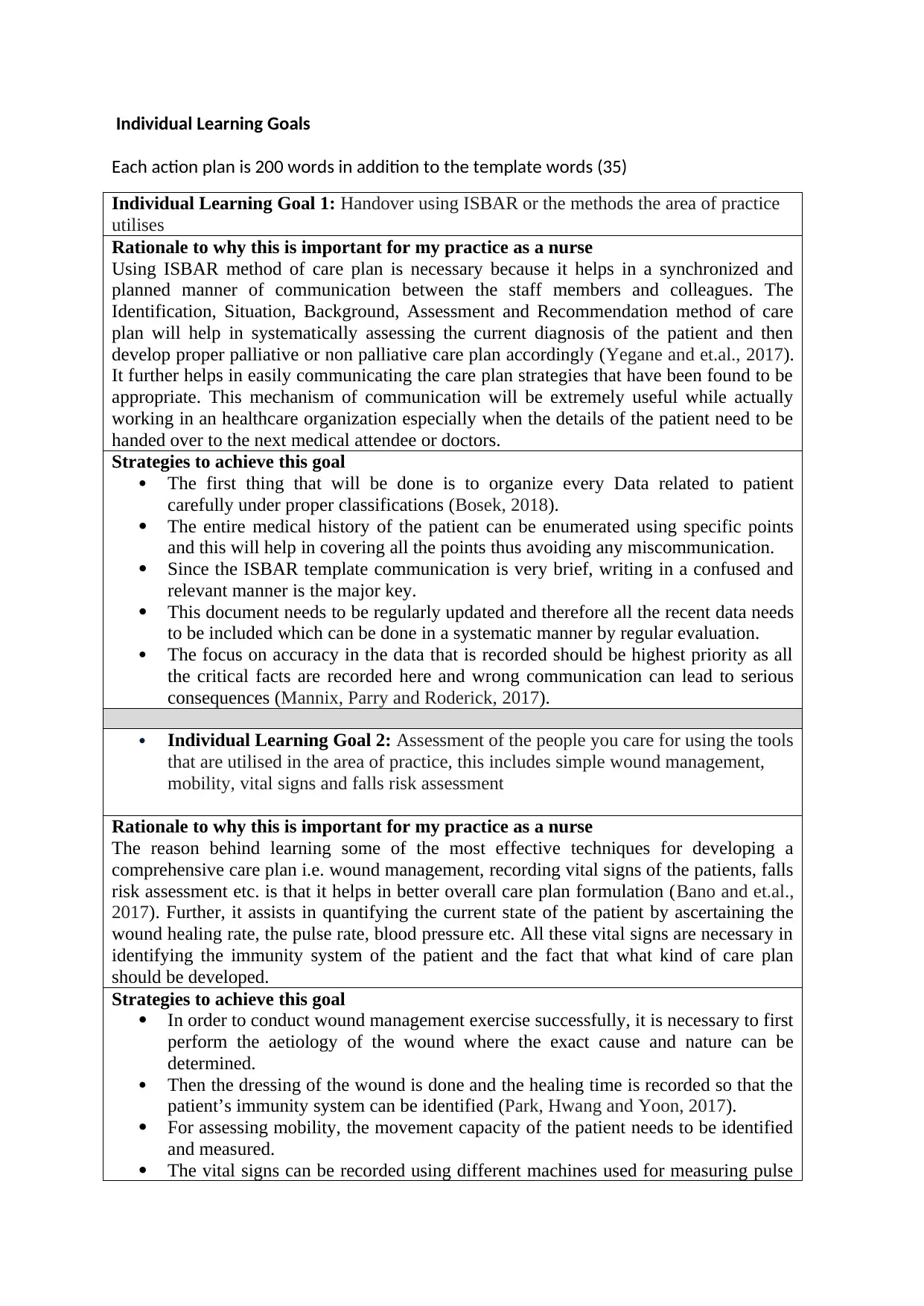
Individual Learning Goal 1: Handover using ISBAR or the methods the area of practice
utilises
Rationale to why this is important for my practice as a nurse
Using ISBAR method of care plan is necessary because it helps in a synchronized and
planned manner of communication between the staff members and colleagues. The
Identification, Situation, Background, Assessment and Recommendation method of care
plan will help in systematically assessing the current diagnosis of the patient and then
develop proper palliative or non palliative care plan accordingly (Yegane and et.al., 2017).
It further helps in easily communicating the care plan strategies that have been found to be
appropriate. This mechanism of communication will be extremely useful while actually
working in an healthcare organization especially when the details of the patient need to be
handed over to the next medical attendee or doctors.
Strategies to achieve this goal
The first thing that will be done is to organize every Data related to patient
carefully under proper classifications (Bosek, 2018).
The entire medical history of the patient can be enumerated using specific points
and this will help in covering all the points thus avoiding any miscommunication.
Since the ISBAR template communication is very brief, writing in a confused and
relevant manner is the major key.
This document needs to be regularly updated and therefore all the recent data needs
to be included which can be done in a systematic manner by regular evaluation.
The focus on accuracy in the data that is recorded should be highest priority as all
the critical facts are recorded here and wrong communication can lead to serious
consequences (Mannix, Parry and Roderick, 2017).
Individual Learning Goal 2: Assessment of the people you care for using the tools
that are utilised in the area of practice, this includes simple wound management,
mobility, vital signs and falls risk assessment
Rationale to why this is important for my practice as a nurse
The reason behind learning some of the most effective techniques for developing a
comprehensive care plan i.e. wound management, recording vital signs of the patients, falls
risk assessment etc. is that it helps in better overall care plan formulation (Bano and et.al.,
2017). Further, it assists in quantifying the current state of the patient by ascertaining the
wound healing rate, the pulse rate, blood pressure etc. All these vital signs are necessary in
identifying the immunity system of the patient and the fact that what kind of care plan
should be developed.
Strategies to achieve this goal
In order to conduct wound management exercise successfully, it is necessary to first
perform the aetiology of the wound where the exact cause and nature can be
determined.
Then the dressing of the wound is done and the healing time is recorded so that the
patient’s immunity system can be identified (Park, Hwang and Yoon, 2017).
For assessing mobility, the movement capacity of the patient needs to be identified
and measured.
The vital signs can be recorded using different machines used for measuring pulse
tabler-icon-diamond-filled.svg

Paraphrase This Document

Need a fresh take? Get an instant paraphrase of this document with our AI Paraphraser
Document Page
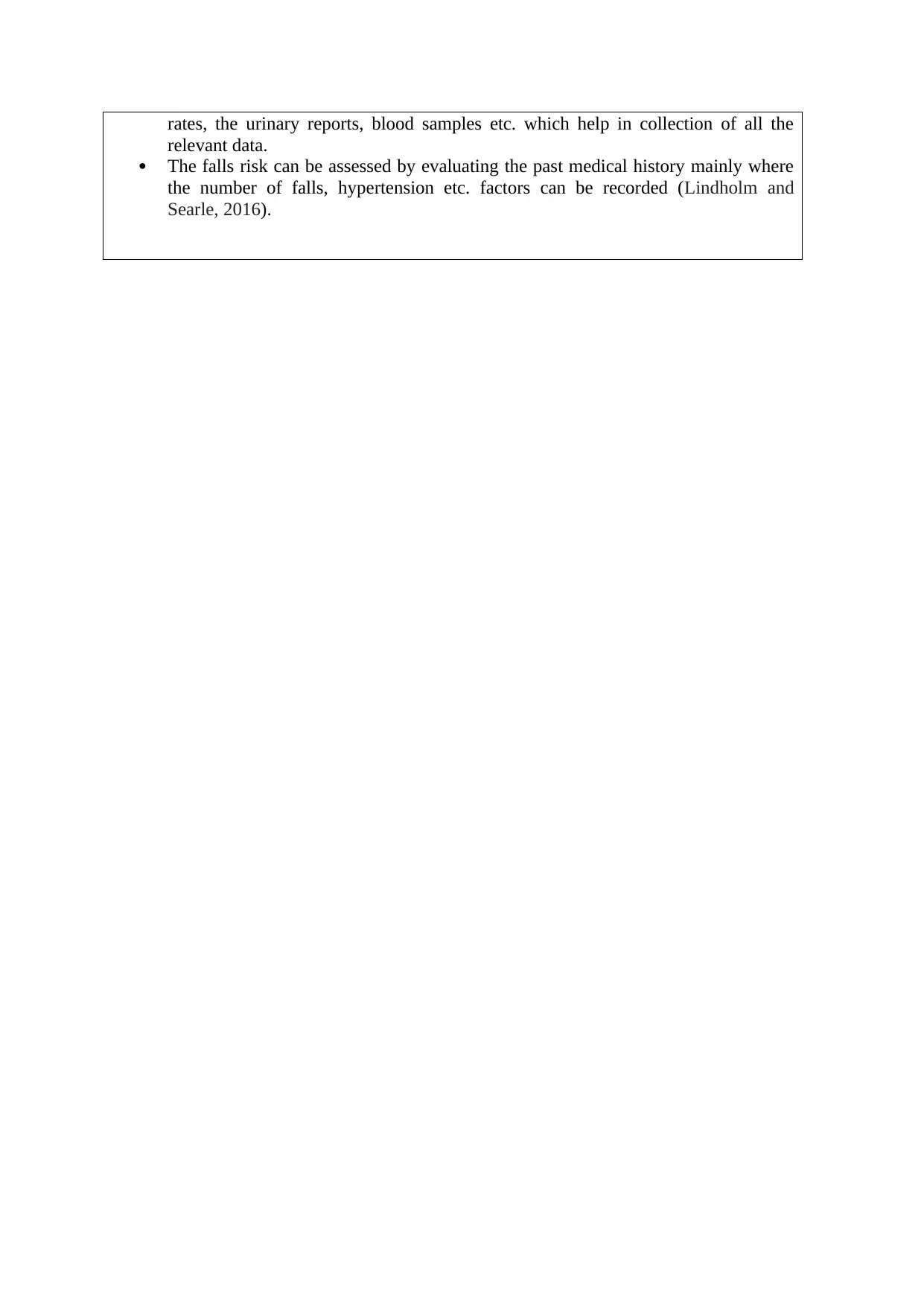
rates, the urinary reports, blood samples etc. which help in collection of all the
relevant data.
The falls risk can be assessed by evaluating the past medical history mainly where
the number of falls, hypertension etc. factors can be recorded (Lindholm and
Searle, 2016).
Document Page
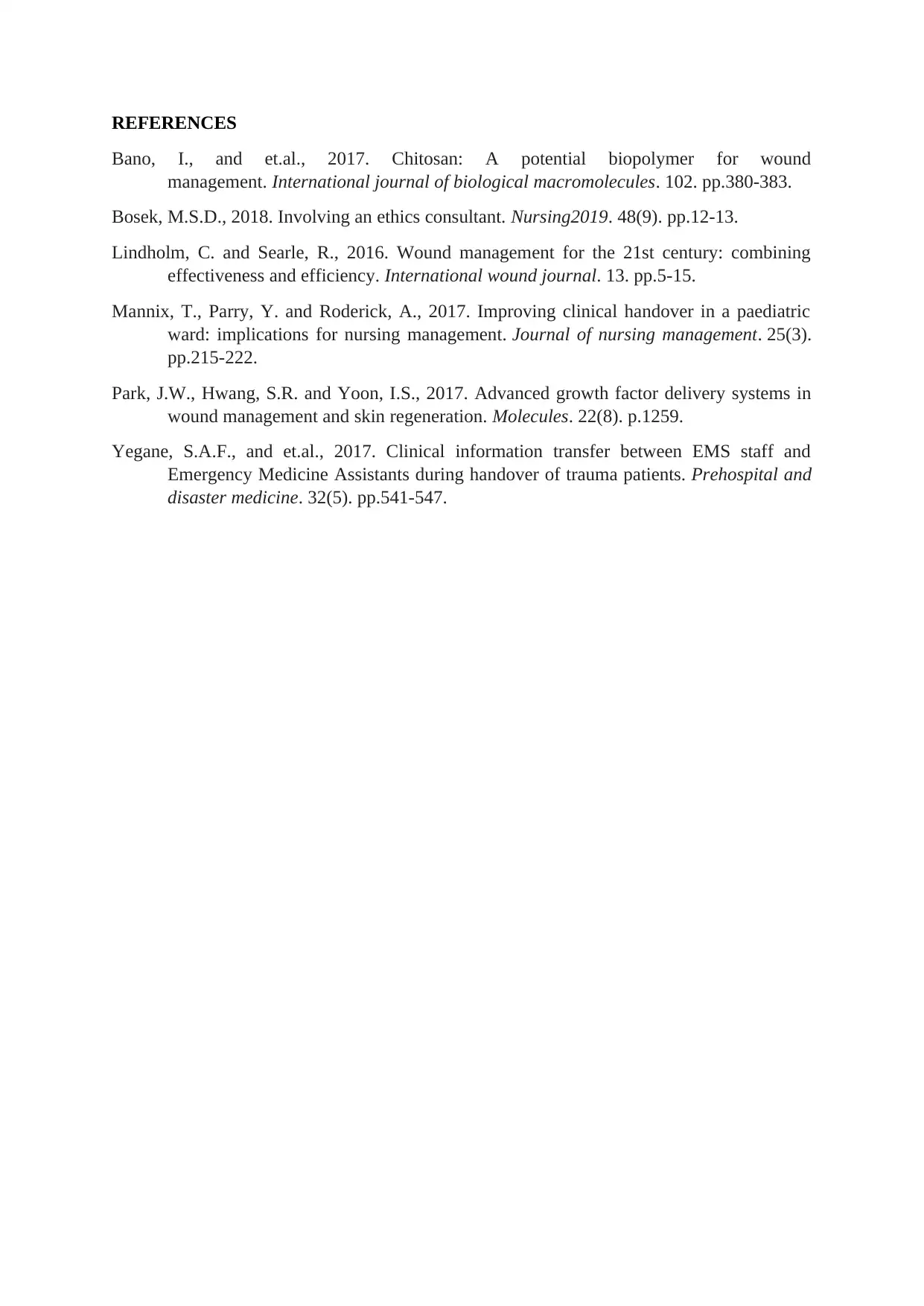
REFERENCES
Bano, I., and et.al., 2017. Chitosan: A potential biopolymer for wound
management. International journal of biological macromolecules. 102. pp.380-383.
Bosek, M.S.D., 2018. Involving an ethics consultant. Nursing2019. 48(9). pp.12-13.
Lindholm, C. and Searle, R., 2016. Wound management for the 21st century: combining
effectiveness and efficiency. International wound journal. 13. pp.5-15.
Mannix, T., Parry, Y. and Roderick, A., 2017. Improving clinical handover in a paediatric
ward: implications for nursing management. Journal of nursing management. 25(3).
pp.215-222.
Park, J.W., Hwang, S.R. and Yoon, I.S., 2017. Advanced growth factor delivery systems in
wound management and skin regeneration. Molecules. 22(8). p.1259.
Yegane, S.A.F., and et.al., 2017. Clinical information transfer between EMS staff and
Emergency Medicine Assistants during handover of trauma patients. Prehospital and
disaster medicine. 32(5). pp.541-547.
chevron_up_icon
1 out of 3
circle_padding
hide_on_mobile
zoom_out_icon
[object Object]