MANM4000 Introduction to Management: Individual Reflection Report
VerifiedAdded on 2022/08/13
|9
|2546
|21
Report
AI Summary
This report is a comprehensive reflection on management theories and their practical application, based on a student's coursework in an Introduction to Management course. It begins with a strategic analysis of the student's future career in Human Resource Management, outlining the necessary steps for professional development, including the importance of internships, skill development, and networking. The report then delves into management styles, analyzing the characteristics of an effective leader and the student's preference for a participative leadership approach. A personal SWOT analysis identifies strengths, weaknesses, opportunities, and threats, alongside an application of Kurt Lewin's change management model to address a change-resistant attribute. The report concludes by outlining skill development plans, setting SMART goals, and summarizing key takeaways, emphasizing the importance of interpersonal skills and active participation in teamwork. The student aims to integrate theoretical knowledge with practical experience, fostering a career in the field of Human Resource Management. This report provides a detailed overview of the student's learning journey, covering areas such as career planning, leadership styles, change management, and skill development.

RUNNING HEAD: INTRODUCTION TO MANAGE M E NT
MANAGEMENT
MANAGEMENT

Paraphrase This Document
Need a fresh take? Get an instant paraphrase of this document with our AI Paraphraser
INTRODUCTION TO MANAGEMENT 1
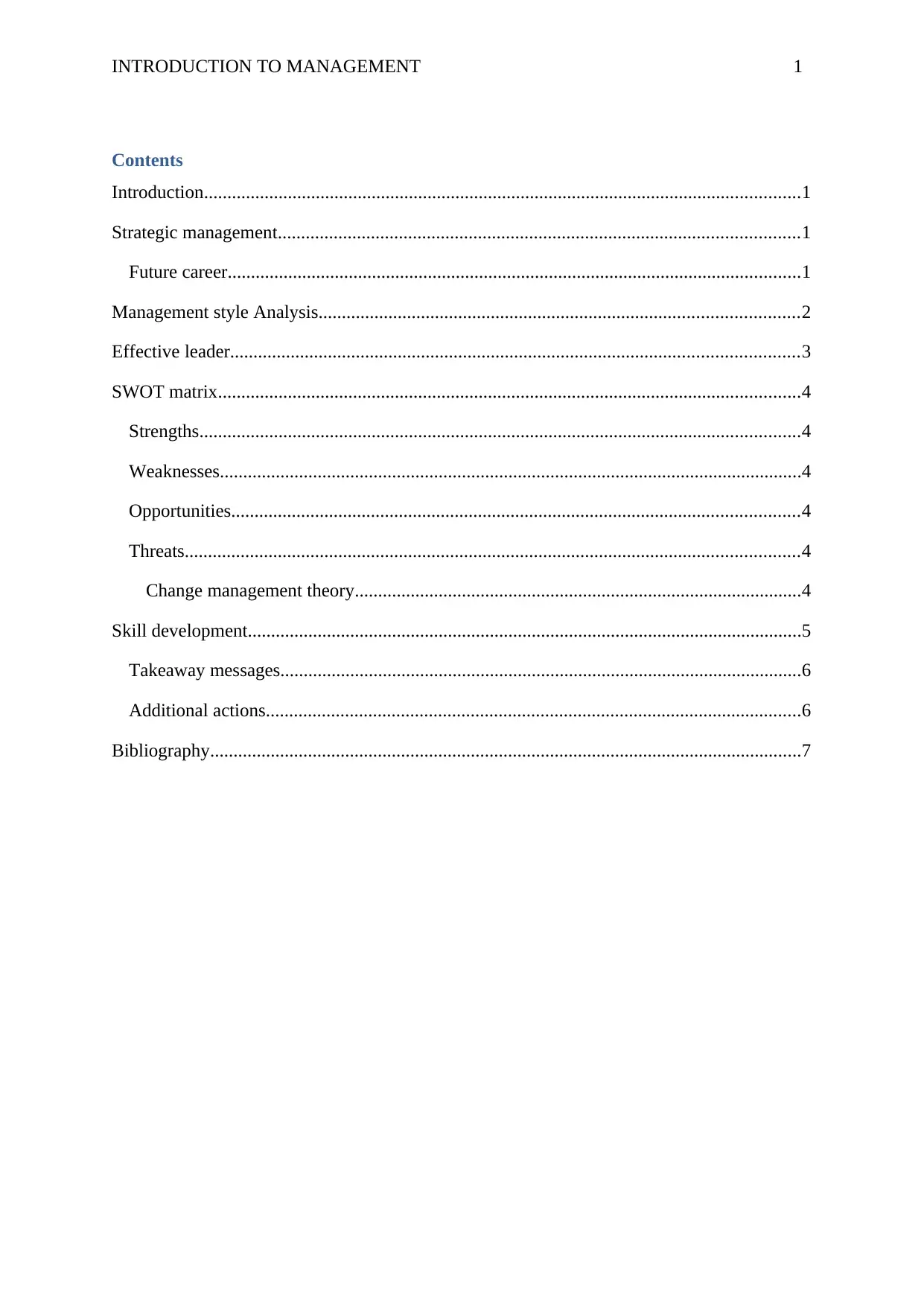
Contents
Introduction................................................................................................................................1
Strategic management................................................................................................................1
Future career...........................................................................................................................1
Management style Analysis.......................................................................................................2
Effective leader..........................................................................................................................3
SWOT matrix.............................................................................................................................4
Strengths.................................................................................................................................4
Weaknesses.............................................................................................................................4
Opportunities..........................................................................................................................4
Threats....................................................................................................................................4
Change management theory................................................................................................4
Skill development.......................................................................................................................5
Takeaway messages................................................................................................................6
Additional actions...................................................................................................................6
Bibliography...............................................................................................................................7
Contents
Introduction................................................................................................................................1
Strategic management................................................................................................................1
Future career...........................................................................................................................1
Management style Analysis.......................................................................................................2
Effective leader..........................................................................................................................3
SWOT matrix.............................................................................................................................4
Strengths.................................................................................................................................4
Weaknesses.............................................................................................................................4
Opportunities..........................................................................................................................4
Threats....................................................................................................................................4
Change management theory................................................................................................4
Skill development.......................................................................................................................5
Takeaway messages................................................................................................................6
Additional actions...................................................................................................................6
Bibliography...............................................................................................................................7
INTRODUCTION TO MANAGEMENT 2
Introduction
The discussion reflects on the application of Management Theories via personal reflection.
The initial section includes information based on future career and required steps to get there.
The next section comprises of appropriate management style and organizational factors to
emerge as an effective leader. The succeeding part involves personal SWOT analysis and it
involves the application of Kurt Lewin’s change Model. It includes the steps undertaken to
develop managerial skills. The key purpose of the reflection report is to apply the
management theories on real life scenario.
Strategic management
With the application of crystal ball analogy I have assessed that I have a career in my chosen
field of study only. I have devoted high efforts to attain management field to develop my
future career. From the initial phase, I attain a huge interest to meet new people and share
conversations. Thus, I perceived that I will have a career in the field of Human Resource
Management. It is a strategic approach for the effective management of human resource to
gain a competitive advantage. It is an attractive field of study as effective management of
human resource enables the organization to gain quality performance from them.
Future career
I have acknowledged that I have to invest high efforts in passing years to establish my
footprints in the chosen carrier field. Additionally, I have acknowledged that I have to
become mentally focused to devote full attention on my present studies. It will aid me to raise
my knowledge based on subject field. However, I have assessed that I need to lay more focus
on raising my practical knowledge as presence of mere theoretical knowledge is not enough
to develop a strong understanding.
1. I must initiate steps to develop a strong career base. Therefore, I will opt for
internship in a nearby organization as it will provide me adequate experience to work
in a multinational company.
2. I must not depend on external sources to raise my knowledge and develop new skills.
I should be self-dependent to improve my learning. It will gradually raise my
knowledge and develop a skill of self-dependent.
Introduction
The discussion reflects on the application of Management Theories via personal reflection.
The initial section includes information based on future career and required steps to get there.
The next section comprises of appropriate management style and organizational factors to
emerge as an effective leader. The succeeding part involves personal SWOT analysis and it
involves the application of Kurt Lewin’s change Model. It includes the steps undertaken to
develop managerial skills. The key purpose of the reflection report is to apply the
management theories on real life scenario.
Strategic management
With the application of crystal ball analogy I have assessed that I have a career in my chosen
field of study only. I have devoted high efforts to attain management field to develop my
future career. From the initial phase, I attain a huge interest to meet new people and share
conversations. Thus, I perceived that I will have a career in the field of Human Resource
Management. It is a strategic approach for the effective management of human resource to
gain a competitive advantage. It is an attractive field of study as effective management of
human resource enables the organization to gain quality performance from them.
Future career
I have acknowledged that I have to invest high efforts in passing years to establish my
footprints in the chosen carrier field. Additionally, I have acknowledged that I have to
become mentally focused to devote full attention on my present studies. It will aid me to raise
my knowledge based on subject field. However, I have assessed that I need to lay more focus
on raising my practical knowledge as presence of mere theoretical knowledge is not enough
to develop a strong understanding.
1. I must initiate steps to develop a strong career base. Therefore, I will opt for
internship in a nearby organization as it will provide me adequate experience to work
in a multinational company.
2. I must not depend on external sources to raise my knowledge and develop new skills.
I should be self-dependent to improve my learning. It will gradually raise my
knowledge and develop a skill of self-dependent.
⊘ This is a preview!⊘
Do you want full access?
Subscribe today to unlock all pages.

Trusted by 1+ million students worldwide
INTRODUCTION TO MANAGEMENT 3
3. I will devote high efforts to gain a fine grading in my undergraduate as decent grades
will attract the recruiters. Additionally, I will upload my resume on ‘LinkedIn’ as it is
a fine platform to seek the attention of recruiters.
4. Additionally, I will frame SMART goals as these will assist me to measure my
success in achieving my future career.
Management style Analysis
Management styles are the principles, techniques, methods, abilities and techniques
undertaken by the manager for the fulfillment of organizational objectives. There are multiple
characteristics that transform an individual into a good manager (Drucker, 2012). Previously,
I had a colleague and he attains characteristics similar to an effective manager. Below are the
qualities of an effective manager.
1. Experience: He had worked in a professional environment and has quality experience
with managing human resource.
2. Leading: He fulfils his responsibility by leading a team of eight members in an
effective manner.
3. Communication skills: He attains fine communication skills and it enables in
communicating to a deeper level with the team members. It assists in early response
to the queries and suggestions (Drucker, 2012).
4. Organized: He as organized with the work and it highly inspires the other individuals
in the work place.
5. Time management: It is a key factor to emerge as an effective manager as it allows in
timely completion of assigned duties and tasks. He had set a schedule for the work
and it benefits in accomplishing the organizational goals.
6. Confidence: The confidence boost the overall personality of an individual and it is
adds up to the personality of an effective manager. My colleague was confident with
his abilities, decision, and experience.
7. Respect: My colleague attain respect for all the employees without considering, age,
gender, sexual orientation, cultural background, and ethnicity (Noe et al., 2015).
Every individual differ in its management style and I prefer ‘Participative leadership style’. It
refers to the involvement of subordinates in goal setting, problem solving, team building but
retains the final decision making authority. It has multiple pros and it assist in developing fine
3. I will devote high efforts to gain a fine grading in my undergraduate as decent grades
will attract the recruiters. Additionally, I will upload my resume on ‘LinkedIn’ as it is
a fine platform to seek the attention of recruiters.
4. Additionally, I will frame SMART goals as these will assist me to measure my
success in achieving my future career.
Management style Analysis
Management styles are the principles, techniques, methods, abilities and techniques
undertaken by the manager for the fulfillment of organizational objectives. There are multiple
characteristics that transform an individual into a good manager (Drucker, 2012). Previously,
I had a colleague and he attains characteristics similar to an effective manager. Below are the
qualities of an effective manager.
1. Experience: He had worked in a professional environment and has quality experience
with managing human resource.
2. Leading: He fulfils his responsibility by leading a team of eight members in an
effective manner.
3. Communication skills: He attains fine communication skills and it enables in
communicating to a deeper level with the team members. It assists in early response
to the queries and suggestions (Drucker, 2012).
4. Organized: He as organized with the work and it highly inspires the other individuals
in the work place.
5. Time management: It is a key factor to emerge as an effective manager as it allows in
timely completion of assigned duties and tasks. He had set a schedule for the work
and it benefits in accomplishing the organizational goals.
6. Confidence: The confidence boost the overall personality of an individual and it is
adds up to the personality of an effective manager. My colleague was confident with
his abilities, decision, and experience.
7. Respect: My colleague attain respect for all the employees without considering, age,
gender, sexual orientation, cultural background, and ethnicity (Noe et al., 2015).
Every individual differ in its management style and I prefer ‘Participative leadership style’. It
refers to the involvement of subordinates in goal setting, problem solving, team building but
retains the final decision making authority. It has multiple pros and it assist in developing fine
Paraphrase This Document
Need a fresh take? Get an instant paraphrase of this document with our AI Paraphraser
INTRODUCTION TO MANAGEMENT 4
interpersonal relation with the subordinates. It assists in improving employee morale and
encouraging creative solutions. It also aid in increasing collaboration and employee retention
in the organization. I must lay attention on multiple aspects to emerge as a participative
leader. The presence of all these factors will allow me to develop my own management style
(Koslowsky et al., 2011).
Involved: One of the key features of participative leadership style is the high involvement of
participative leader. My high involvement will encourage my subordinates to come together
and work on a task. It will provide me an opportunity to contribute to their ideas and offers
timely support.
Open to suggestions: I should consider individual’s opinion to gain idea about their valuable
suggestions. I must be humble enough to accept subordinates alternatives to improve my
personal idea (Gonos & Gallo, 2013).
Team builder: The collaborate efforts defines a participative management style. The efforts of
all the individuals assist in raising total output of the team. Therefore, I will lay attention to
develop team building among the members (Nanjundeswaraswamy & Swamy, 2014).
Empowering: The role of participative leader is to empower the individuals by providing an
opportunity to make decision. It will aid in professional growth of the employees and raising
proficient, optimistic, and motivated employees. Likely, I should empower my subordinates
to boost their motivation and gain their full participation in work (Iqbal et al., 2015).
Effective leader
Below are as factors that assist and prohibits an individual from being an effective leader:
Skilled employees: The presence of skilled employees enables the leader to seek ideas from
them.
Limited resource: The non-availability of required resources restricts the leader to offer
adequate support. Example: The unavailability of required material for training will restricts
the manager to provide essential training to the employees.
Organization culture: The people based organization culture aid the manager to lay a high
attention on the human resource of an organization. Thus, it aid in emerging as effective
leader (Daft, 2014).
interpersonal relation with the subordinates. It assists in improving employee morale and
encouraging creative solutions. It also aid in increasing collaboration and employee retention
in the organization. I must lay attention on multiple aspects to emerge as a participative
leader. The presence of all these factors will allow me to develop my own management style
(Koslowsky et al., 2011).
Involved: One of the key features of participative leadership style is the high involvement of
participative leader. My high involvement will encourage my subordinates to come together
and work on a task. It will provide me an opportunity to contribute to their ideas and offers
timely support.
Open to suggestions: I should consider individual’s opinion to gain idea about their valuable
suggestions. I must be humble enough to accept subordinates alternatives to improve my
personal idea (Gonos & Gallo, 2013).
Team builder: The collaborate efforts defines a participative management style. The efforts of
all the individuals assist in raising total output of the team. Therefore, I will lay attention to
develop team building among the members (Nanjundeswaraswamy & Swamy, 2014).
Empowering: The role of participative leader is to empower the individuals by providing an
opportunity to make decision. It will aid in professional growth of the employees and raising
proficient, optimistic, and motivated employees. Likely, I should empower my subordinates
to boost their motivation and gain their full participation in work (Iqbal et al., 2015).
Effective leader
Below are as factors that assist and prohibits an individual from being an effective leader:
Skilled employees: The presence of skilled employees enables the leader to seek ideas from
them.
Limited resource: The non-availability of required resources restricts the leader to offer
adequate support. Example: The unavailability of required material for training will restricts
the manager to provide essential training to the employees.
Organization culture: The people based organization culture aid the manager to lay a high
attention on the human resource of an organization. Thus, it aid in emerging as effective
leader (Daft, 2014).
INTRODUCTION TO MANAGEMENT 5
Formal communication: The flow of formal communication restricts the manager to
communicate effectively with the subordinates. In the presence of limited communication, a
leader is not able to fully assess subordinates needs and it restricts him/her from being an
effective manager (Yukl, 2013).
SWOT matrix
SWOT is a theory to analyze the strengths, weaknesses, opportunities and threats. It assists to
minimize and eradicate the weakness and threats and gain full utilization of strengths and
opportunities (Gürel & Tat, 2017). Below is the personal SWOT analysis
Strengths
1. I have a strong catching power and it assist me to easily learn new concepts.
2. I have fine communication skills and it acts as strength because it allows developing
fine interpersonal relationship with other individuals.
Weaknesses
1. I am highly resistant to change and it limits me to learn new skills and raise my
knowledge.
2. I attain limited time to pursue new skills or improve existing skills.
Opportunities
1. My communication skills will allow me to emerge as an effective human resource
manager in a reputable organization.
Threats
1. The change resistant attribute prohibits my personal development.
I have analyzed that change resistant is one of my strong weakness that I must eradicate for
personal development.
Change management theory
The Kurt Lewin’s change management model involves three stages to manage change.
According to this model, a change is needed to move forward to a desirable stage of behavior.
It involves unfreezing the current behavior, enabling change and practicing new process
(Hayes, 2018).
Formal communication: The flow of formal communication restricts the manager to
communicate effectively with the subordinates. In the presence of limited communication, a
leader is not able to fully assess subordinates needs and it restricts him/her from being an
effective manager (Yukl, 2013).
SWOT matrix
SWOT is a theory to analyze the strengths, weaknesses, opportunities and threats. It assists to
minimize and eradicate the weakness and threats and gain full utilization of strengths and
opportunities (Gürel & Tat, 2017). Below is the personal SWOT analysis
Strengths
1. I have a strong catching power and it assist me to easily learn new concepts.
2. I have fine communication skills and it acts as strength because it allows developing
fine interpersonal relationship with other individuals.
Weaknesses
1. I am highly resistant to change and it limits me to learn new skills and raise my
knowledge.
2. I attain limited time to pursue new skills or improve existing skills.
Opportunities
1. My communication skills will allow me to emerge as an effective human resource
manager in a reputable organization.
Threats
1. The change resistant attribute prohibits my personal development.
I have analyzed that change resistant is one of my strong weakness that I must eradicate for
personal development.
Change management theory
The Kurt Lewin’s change management model involves three stages to manage change.
According to this model, a change is needed to move forward to a desirable stage of behavior.
It involves unfreezing the current behavior, enabling change and practicing new process
(Hayes, 2018).
⊘ This is a preview!⊘
Do you want full access?
Subscribe today to unlock all pages.
Trusted by 1+ million students worldwide
INTRODUCTION TO MANAGEMENT 6
Unfreezing: It is the first stage and it involves motivating the individuals to move to a new
direction. It involves justifying the need to change previous methods, technology, process and
business technology. I was facing problem due to my weakness of change resistance. My
professor has guided me based on the need of change management.
Changing: It is the stage at which change actually take place. The authority reinforce and
adopts new structure, and habits to enable change in the organization. Adequate degree of
communication, education and support is highly essential to develop change in a positive
manner. My professor has guided and motivated to pursue for new skill for personal
development.
Refreezing: It is ensured that individuals stick to the change and do not fall back to previous
methods. My professor has laid a continuous attention and made sure that I am devoting a
regular attention on new skill development. Thus, my professor has eradicated my fear of
failure and assisted in accepting change (Cummings et al., 2016).
Skill development
I must develop my management skill to develop my career in Human Resource Management.
I need to develop and it includes and human or interpersonal skills to raise my interactive
ability or relate effectively with people. These skills will enable me to make the use of human
potential in the company and motivate the employees for better results. I must attain the
ability to motivate the employees as it is highly desirable as a human resource manager. I will
participate in multiple activities and avail the full benefit of available resource. I will
participate in debate, speech and group presentation.
I will opt for online courses of human resource management as it will provide me adequate
knowledge and aid in gradual development of skills. Additionally, I will seek help from my
professors to support and guide me to raise my skills.
I will develop SMART Goals to enhance my management skills and these are listed below:
1. By February 2020, I will opt for internship in a nearby SME named ‘name of a nearby
organization’.
2. By the end of annual examination, I will attain above 80% marks in HRM subject.
Unfreezing: It is the first stage and it involves motivating the individuals to move to a new
direction. It involves justifying the need to change previous methods, technology, process and
business technology. I was facing problem due to my weakness of change resistance. My
professor has guided me based on the need of change management.
Changing: It is the stage at which change actually take place. The authority reinforce and
adopts new structure, and habits to enable change in the organization. Adequate degree of
communication, education and support is highly essential to develop change in a positive
manner. My professor has guided and motivated to pursue for new skill for personal
development.
Refreezing: It is ensured that individuals stick to the change and do not fall back to previous
methods. My professor has laid a continuous attention and made sure that I am devoting a
regular attention on new skill development. Thus, my professor has eradicated my fear of
failure and assisted in accepting change (Cummings et al., 2016).
Skill development
I must develop my management skill to develop my career in Human Resource Management.
I need to develop and it includes and human or interpersonal skills to raise my interactive
ability or relate effectively with people. These skills will enable me to make the use of human
potential in the company and motivate the employees for better results. I must attain the
ability to motivate the employees as it is highly desirable as a human resource manager. I will
participate in multiple activities and avail the full benefit of available resource. I will
participate in debate, speech and group presentation.
I will opt for online courses of human resource management as it will provide me adequate
knowledge and aid in gradual development of skills. Additionally, I will seek help from my
professors to support and guide me to raise my skills.
I will develop SMART Goals to enhance my management skills and these are listed below:
1. By February 2020, I will opt for internship in a nearby SME named ‘name of a nearby
organization’.
2. By the end of annual examination, I will attain above 80% marks in HRM subject.
Paraphrase This Document
Need a fresh take? Get an instant paraphrase of this document with our AI Paraphraser
INTRODUCTION TO MANAGEMENT 7
Takeaway messages
Below are the three take away messages
1. I will lay a continuous and regular attention on developing interpersonal skills.
2. I will avail the full benefit of available resources like digital resources (internet),
physical resources (books) and human resource (professors and peer groups).
3. Excelling in these skills ill aid in pursuing my future career choice in HRM in a
reputable organization.
Additional actions
1. I will lay active participation in teamwork as it will provide me an opportunity to
collaborate and interact with multiple individuals. Therefore, it will aid in improving
my interpersonal skills.
2. I will grant permission from the authority to lead a group. It will act as a role-play and
aid me to develop leadership skills. This activity will allow me to inspire, motivate,
and guide my peer members.
3. I will seek for motivational books like ‘Awaken the giant within’ and ‘The secret’.
These will prove highly beneficial to raise and maintain my motivational level and
enhance my knowledge.
The discussion summarizes the personal reflection on the course material. From the above
discussion, it is acknowledged that I have a future career in management field as I attain a
huge interest in this study field and I am devoting high efforts to raise my knowledge and
understanding. I will develop SMART goals and LinkedIn profile. Additionally, I will opt
for internship and minimize external dependence. Based on management style analysis, it is
analyzed that manager attain multiple qualities like experience, communication skills,
organized, time management, confidence and respect. I should be open to suggestions, team
builder, and empowering to emerge as an effective participative leader. Resources,
communication style, organization culture and employees are the organizational factors that
prohibit and assist in becoming an effective leader. From the personal analysis, it is assessed
that I attain multiple strengths, weaknesses but minimum opportunities and threats. I should
rely on the application of change management theory to minimize weakness of change
resistant. Moreover, it is analyzed that I will develop SMART objectives for skill
development.
Takeaway messages
Below are the three take away messages
1. I will lay a continuous and regular attention on developing interpersonal skills.
2. I will avail the full benefit of available resources like digital resources (internet),
physical resources (books) and human resource (professors and peer groups).
3. Excelling in these skills ill aid in pursuing my future career choice in HRM in a
reputable organization.
Additional actions
1. I will lay active participation in teamwork as it will provide me an opportunity to
collaborate and interact with multiple individuals. Therefore, it will aid in improving
my interpersonal skills.
2. I will grant permission from the authority to lead a group. It will act as a role-play and
aid me to develop leadership skills. This activity will allow me to inspire, motivate,
and guide my peer members.
3. I will seek for motivational books like ‘Awaken the giant within’ and ‘The secret’.
These will prove highly beneficial to raise and maintain my motivational level and
enhance my knowledge.
The discussion summarizes the personal reflection on the course material. From the above
discussion, it is acknowledged that I have a future career in management field as I attain a
huge interest in this study field and I am devoting high efforts to raise my knowledge and
understanding. I will develop SMART goals and LinkedIn profile. Additionally, I will opt
for internship and minimize external dependence. Based on management style analysis, it is
analyzed that manager attain multiple qualities like experience, communication skills,
organized, time management, confidence and respect. I should be open to suggestions, team
builder, and empowering to emerge as an effective participative leader. Resources,
communication style, organization culture and employees are the organizational factors that
prohibit and assist in becoming an effective leader. From the personal analysis, it is assessed
that I attain multiple strengths, weaknesses but minimum opportunities and threats. I should
rely on the application of change management theory to minimize weakness of change
resistant. Moreover, it is analyzed that I will develop SMART objectives for skill
development.
INTRODUCTION TO MANAGEMENT 8
Bibliography
Cummings, S., Bridgman, T. & Brown, K.G., 2016. Unfreezing change as three steps:
Rethinking Kurt Lewin’s legacy for change management. Human relations, 69(1).
Daft, R.L., 2014. The leadership experience. Cengage Learning.
Drucker, P., 2012. Management. Routledge.
Drucker, P., 2012. The practice of management. Routledge.
Gonos, J. & Gallo, P., 2013. Model for leadership style evaluation. Management: journal of
contemporary management issues, 18(2), pp.157-68.
Gürel, E. & Tat, M., 2017. SWOT analysis: a theoretical review. Journal of International
Social Research.
Hayes, J., 2018. The theory and practice of change management. Palgrave.
Iqbal, N., Anwar, S. & Haider, N., 2015. Effect of leadership style on employee performance.
Arabian Journal of Business and Management Review, 5(5).
Koslowsky, M., Baharav, H. & Schwarzwald, J., 2011. Management style as a mediator of
the power distance‐influence tactics relationship. International Journal of Conflict
Management.
Nanjundeswaraswamy, T.S. & Swamy, D.R., 2014. Leadership styles. Advances in
management, 7(2).
Noe, R.A., Hollenbeck, J.R., Gerhart, B. & Wright, P.M., 2015. Human resource
management. Gaining a Competitive.
Yukl, G., 2013. Leadership in Organizations. Pearson Education India.
Bibliography
Cummings, S., Bridgman, T. & Brown, K.G., 2016. Unfreezing change as three steps:
Rethinking Kurt Lewin’s legacy for change management. Human relations, 69(1).
Daft, R.L., 2014. The leadership experience. Cengage Learning.
Drucker, P., 2012. Management. Routledge.
Drucker, P., 2012. The practice of management. Routledge.
Gonos, J. & Gallo, P., 2013. Model for leadership style evaluation. Management: journal of
contemporary management issues, 18(2), pp.157-68.
Gürel, E. & Tat, M., 2017. SWOT analysis: a theoretical review. Journal of International
Social Research.
Hayes, J., 2018. The theory and practice of change management. Palgrave.
Iqbal, N., Anwar, S. & Haider, N., 2015. Effect of leadership style on employee performance.
Arabian Journal of Business and Management Review, 5(5).
Koslowsky, M., Baharav, H. & Schwarzwald, J., 2011. Management style as a mediator of
the power distance‐influence tactics relationship. International Journal of Conflict
Management.
Nanjundeswaraswamy, T.S. & Swamy, D.R., 2014. Leadership styles. Advances in
management, 7(2).
Noe, R.A., Hollenbeck, J.R., Gerhart, B. & Wright, P.M., 2015. Human resource
management. Gaining a Competitive.
Yukl, G., 2013. Leadership in Organizations. Pearson Education India.
⊘ This is a preview!⊘
Do you want full access?
Subscribe today to unlock all pages.
Trusted by 1+ million students worldwide

1 out of 9


Related Documents


Your All-in-One AI-Powered Toolkit for Academic Success.
+13062052269
info@desklib.com
Available 24*7 on WhatsApp / Email
![[object Object]](/_next/static/media/star-bottom.7253800d.svg)
Unlock your academic potential
Copyright © 2020–2026 A2Z Services. All Rights Reserved. Developed and managed by ZUCOL.