FDY3006 Portfolio: Critical Thinking, Creativity, and Ethical Analysis
VerifiedAdded on 2023/06/10
|7
|1509
|454
Portfolio
AI Summary
This portfolio analysis delves into critical, creative, and ethical thinking through three distinct think pieces. Part A analyzes Elder's article on independent decision-making and the necessity of critical thinking. Part B examines the 'Was Lockdown Necessary' case study, applying logic, relevance, significance, and fairness. Part C discusses client confidentiality in psychology and the ethical considerations of sharing client data with law enforcement. The portfolio uses mind mapping and tabulation to structure arguments and data, showcasing the application of critical thinking standards and creative problem-solving. The reflection sections detail the student's learning process and challenges encountered while constructing the portfolio. The document is available on Desklib, a platform providing study tools and resources for students.
FDY3006 [Thinking Critically,
Creatively and Ethically]
CW1 - Individual Portfolio
Analysis
Name:
ID Number:
Academic Year:
Creatively and Ethically]
CW1 - Individual Portfolio
Analysis
Name:
ID Number:
Academic Year:
Paraphrase This Document
Need a fresh take? Get an instant paraphrase of this document with our AI Paraphraser

Contents
INTRODUCTION....................................................................................................................3
MAIN BODY............................................................................................................................3
Part A – Elder’s Article.......................................................................................................3
Part B – Case study on ‘Was Lockdown Necessary’........................................................4
Part C – Social media networks led to more emotionally detached people....................5
CONCLUSION.........................................................................................................................6
REFERENCES.........................................................................................................................7
INTRODUCTION....................................................................................................................3
MAIN BODY............................................................................................................................3
Part A – Elder’s Article.......................................................................................................3
Part B – Case study on ‘Was Lockdown Necessary’........................................................4
Part C – Social media networks led to more emotionally detached people....................5
CONCLUSION.........................................................................................................................6
REFERENCES.........................................................................................................................7

INTRODUCTION
In order to succeed and develop a niche for oneself in this increasingly competitive
world, the ability to think critically and creatively is very important. This report will consist
of a portfolio creation based around three separately written think pieces which belong to
different field of media using creative methods and critical analysis along with individual
reflection.
MAIN BODY
Part A – Elder’s Article
Description
The major article upon which this portfolio is based upon is written by Linda Elder
and the main premise of this article is that even though independency and the ability to take
one’s decisions is appreciated and looked towards by many, without the existence of critical
thinking, it is futile in the grand scheme of things.
Application
Elder stated that even though the capacity of the human brain is immense when it
comes to matters of intelligent analysis, its nature especially in younger days of a person is to
simply latch onto the first decision made or idea found without analyzing much else. Critical
thinking refers to the comprehensive mental analysis of facts, figures, evidences and
observations in order to arrive at a judgment (Cáceres, Nussbaum and Ortiz, 2020). Students
should stop blindly learning and following whatever decisions others tell them or teach them
and should focus on developing questions, gathering accurate information which must be
relevant to the question and to dwell on alternatives to find the best suitable one.
Reflection
The evaluation of my entire experience in referring and reading that essay paper in
depth was a challenging experience for me as it opened doors which I did not know existed
when it comes to training and disciplining the mind to think critically. I learned on the exact
process which is required to stimulate my brain to think critically about every important
decisions that I plan on taking which is that it all begins with a question getting formed in the
head. After learning to form questions related to decisions, I also learned to dwell on
In order to succeed and develop a niche for oneself in this increasingly competitive
world, the ability to think critically and creatively is very important. This report will consist
of a portfolio creation based around three separately written think pieces which belong to
different field of media using creative methods and critical analysis along with individual
reflection.
MAIN BODY
Part A – Elder’s Article
Description
The major article upon which this portfolio is based upon is written by Linda Elder
and the main premise of this article is that even though independency and the ability to take
one’s decisions is appreciated and looked towards by many, without the existence of critical
thinking, it is futile in the grand scheme of things.
Application
Elder stated that even though the capacity of the human brain is immense when it
comes to matters of intelligent analysis, its nature especially in younger days of a person is to
simply latch onto the first decision made or idea found without analyzing much else. Critical
thinking refers to the comprehensive mental analysis of facts, figures, evidences and
observations in order to arrive at a judgment (Cáceres, Nussbaum and Ortiz, 2020). Students
should stop blindly learning and following whatever decisions others tell them or teach them
and should focus on developing questions, gathering accurate information which must be
relevant to the question and to dwell on alternatives to find the best suitable one.
Reflection
The evaluation of my entire experience in referring and reading that essay paper in
depth was a challenging experience for me as it opened doors which I did not know existed
when it comes to training and disciplining the mind to think critically. I learned on the exact
process which is required to stimulate my brain to think critically about every important
decisions that I plan on taking which is that it all begins with a question getting formed in the
head. After learning to form questions related to decisions, I also learned to dwell on
⊘ This is a preview!⊘
Do you want full access?
Subscribe today to unlock all pages.

Trusted by 1+ million students worldwide

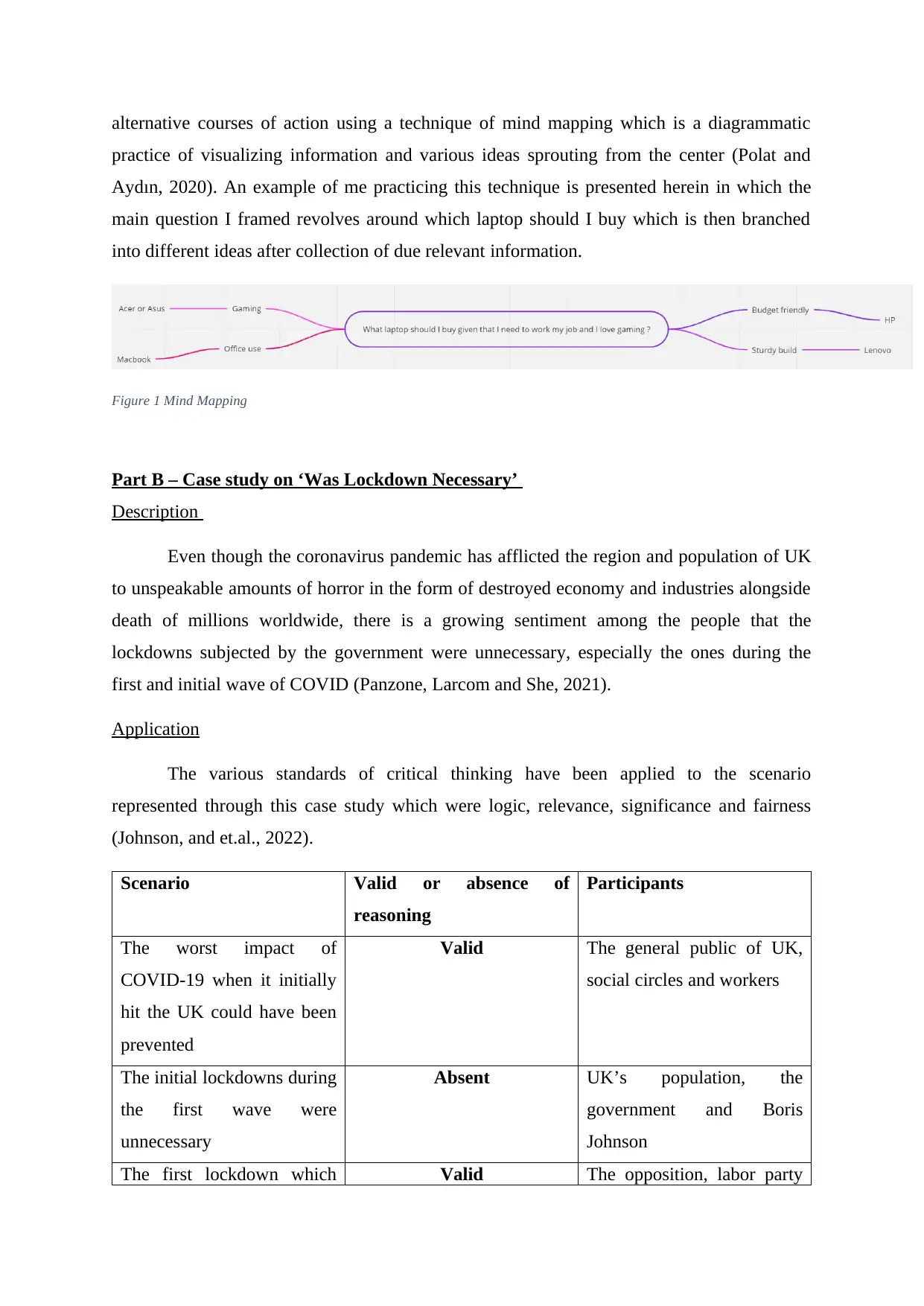
alternative courses of action using a technique of mind mapping which is a diagrammatic
practice of visualizing information and various ideas sprouting from the center (Polat and
Aydın, 2020). An example of me practicing this technique is presented herein in which the
main question I framed revolves around which laptop should I buy which is then branched
into different ideas after collection of due relevant information.
Figure 1 Mind Mapping
Part B – Case study on ‘Was Lockdown Necessary’
Description
Even though the coronavirus pandemic has afflicted the region and population of UK
to unspeakable amounts of horror in the form of destroyed economy and industries alongside
death of millions worldwide, there is a growing sentiment among the people that the
lockdowns subjected by the government were unnecessary, especially the ones during the
first and initial wave of COVID (Panzone, Larcom and She, 2021).
Application
The various standards of critical thinking have been applied to the scenario
represented through this case study which were logic, relevance, significance and fairness
(Johnson, and et.al., 2022).
Scenario Valid or absence of
reasoning
Participants
The worst impact of
COVID-19 when it initially
hit the UK could have been
prevented
Valid The general public of UK,
social circles and workers
The initial lockdowns during
the first wave were
unnecessary
Absent UK’s population, the
government and Boris
Johnson
The first lockdown which Valid The opposition, labor party
practice of visualizing information and various ideas sprouting from the center (Polat and
Aydın, 2020). An example of me practicing this technique is presented herein in which the
main question I framed revolves around which laptop should I buy which is then branched
into different ideas after collection of due relevant information.
Figure 1 Mind Mapping
Part B – Case study on ‘Was Lockdown Necessary’
Description
Even though the coronavirus pandemic has afflicted the region and population of UK
to unspeakable amounts of horror in the form of destroyed economy and industries alongside
death of millions worldwide, there is a growing sentiment among the people that the
lockdowns subjected by the government were unnecessary, especially the ones during the
first and initial wave of COVID (Panzone, Larcom and She, 2021).
Application
The various standards of critical thinking have been applied to the scenario
represented through this case study which were logic, relevance, significance and fairness
(Johnson, and et.al., 2022).
Scenario Valid or absence of
reasoning
Participants
The worst impact of
COVID-19 when it initially
hit the UK could have been
prevented
Valid The general public of UK,
social circles and workers
The initial lockdowns during
the first wave were
unnecessary
Absent UK’s population, the
government and Boris
Johnson
The first lockdown which Valid The opposition, labor party
Paraphrase This Document
Need a fresh take? Get an instant paraphrase of this document with our AI Paraphraser

was initiated was
unavoidable but the
handling of the pandemic
could have been better
of UK, the working class
people and poor belonging
to UK
Reflection
Building this portfolio proved to be quite difficult for me as there are many standards
of critical thinking which are to be applied judiciously to make sense of scenarios presented
in front of us. However after reconstructing my experience in my head, I admit the fact that
learning to apply such complex logics through tabulation allowed me to learn to present my
findings in a much more professional manner. The standards which I learned to apply were
logic and relevance which were present in reasoning’s such as the one where it was stated
that the handling of the initial wave of the COVID-19 could have been much better in UK.
However I noticed that some standards like significance and fairness were missing from
arguments such as it being deemed as lockdowns as a whole were avoidable and unnecessary
when it has been documented that it still helped save countless lives.
Part C – Psychologists should break confidentiality trust with clients on request by
police
Description
Client confidentiality is a principle in psychology that must be adhered to by the
professionals involved in counselling or therapy within which the patient has full right to
have complete control over the use of their sensitive information and the psychologists
cannot reveal their personal information to a third party unless a legal reason or exception to
the clause presents itself (Polychronis, 2020).
Application
Although client confidentiality is the basic and one of the most important rights of
clients during psychological procedures in which their private information is supposed to kept
secret by the people they are involved with at all costs, legal investigation should come under
a valid exception wherein police must be cooperated with.
unavoidable but the
handling of the pandemic
could have been better
of UK, the working class
people and poor belonging
to UK
Reflection
Building this portfolio proved to be quite difficult for me as there are many standards
of critical thinking which are to be applied judiciously to make sense of scenarios presented
in front of us. However after reconstructing my experience in my head, I admit the fact that
learning to apply such complex logics through tabulation allowed me to learn to present my
findings in a much more professional manner. The standards which I learned to apply were
logic and relevance which were present in reasoning’s such as the one where it was stated
that the handling of the initial wave of the COVID-19 could have been much better in UK.
However I noticed that some standards like significance and fairness were missing from
arguments such as it being deemed as lockdowns as a whole were avoidable and unnecessary
when it has been documented that it still helped save countless lives.
Part C – Psychologists should break confidentiality trust with clients on request by
police
Description
Client confidentiality is a principle in psychology that must be adhered to by the
professionals involved in counselling or therapy within which the patient has full right to
have complete control over the use of their sensitive information and the psychologists
cannot reveal their personal information to a third party unless a legal reason or exception to
the clause presents itself (Polychronis, 2020).
Application
Although client confidentiality is the basic and one of the most important rights of
clients during psychological procedures in which their private information is supposed to kept
secret by the people they are involved with at all costs, legal investigation should come under
a valid exception wherein police must be cooperated with.

Many crimes in society are often committed by people who are struggling with their
mental health and have some sort of underlying psychological issues and if by chance the
police need a client’s data to further their investigation and have a genuine issue of law in
which the client seems to be involved in then his data must be shared with the police.
By breaking the trust of their clients in matters of legality and criminal investigations,
the psychologists are technically supporting the law rather than breaking it by helping the
concerned authorities.
Reflection
Premises of an argument are basically argument openers which seek to lay down the
basic information related to the topic and concise the scope according to the topic of the
argument (Sober, 2018). I also learned on listing quality inferences which help support the
inevitable conclusion and further expand upon the argument started in the premise. I also
learned about concluding my argument in a way that leaves a definitive impact on the target
audience while also leaving room to formulate my next line of reasoning in case my logic
gets called out. Learning about proper structuring of an argument was a mildly challenging
experience fort me as I knew about the basics of this topic from my time spent debating as a
part of my extra-curricular schedule. However I did know about the official structure and by
learning premises, inference and conclusions will definitely help me argue better in the
future.
CONCLUSION
The above designed portfolios went into detail regarding the complex processes and
frameworks which guide people to think in a critical manner while displaying their standards
of creativity and ethical considerations by making use of important techniques such as mind
mapping and tabulation of arguments and data.
mental health and have some sort of underlying psychological issues and if by chance the
police need a client’s data to further their investigation and have a genuine issue of law in
which the client seems to be involved in then his data must be shared with the police.
By breaking the trust of their clients in matters of legality and criminal investigations,
the psychologists are technically supporting the law rather than breaking it by helping the
concerned authorities.
Reflection
Premises of an argument are basically argument openers which seek to lay down the
basic information related to the topic and concise the scope according to the topic of the
argument (Sober, 2018). I also learned on listing quality inferences which help support the
inevitable conclusion and further expand upon the argument started in the premise. I also
learned about concluding my argument in a way that leaves a definitive impact on the target
audience while also leaving room to formulate my next line of reasoning in case my logic
gets called out. Learning about proper structuring of an argument was a mildly challenging
experience fort me as I knew about the basics of this topic from my time spent debating as a
part of my extra-curricular schedule. However I did know about the official structure and by
learning premises, inference and conclusions will definitely help me argue better in the
future.
CONCLUSION
The above designed portfolios went into detail regarding the complex processes and
frameworks which guide people to think in a critical manner while displaying their standards
of creativity and ethical considerations by making use of important techniques such as mind
mapping and tabulation of arguments and data.
⊘ This is a preview!⊘
Do you want full access?
Subscribe today to unlock all pages.

Trusted by 1+ million students worldwide

REFERENCES
Books and Journals
Cáceres, M., Nussbaum, M. and Ortiz, J., 2020. Integrating critical thinking into the
classroom: A teacher’s perspective. Thinking Skills and Creativity, 37, p.100674.
Johnson, D., and et.al., 2022. Student Evaluation Using an Intellectual Standards Rubric for
Critical Thinking. Pedagogy in Health Promotion, p.23733799211070544.
Panzone, L.A., Larcom, S. and She, P.W., 2021. Estimating the impact of the first COVID-19
lockdown on UK food retailers and the restaurant sector. Global Food Security, 28, p.100495.
Polat, Ö. and Aydın, E., 2020. The effect of mind mapping on young children’s critical
thinking skills. Thinking Skills and Creativity, 38, p.100743.
Polychronis, P.D., 2020. Integrated care, shared electronic records, and the psychology
profession: a cautionary tale for counseling centers. Journal of College Student
Psychotherapy, 34(1), pp.1-23.
Sober, E., 2018. The design argument. Cambridge University Press.
Books and Journals
Cáceres, M., Nussbaum, M. and Ortiz, J., 2020. Integrating critical thinking into the
classroom: A teacher’s perspective. Thinking Skills and Creativity, 37, p.100674.
Johnson, D., and et.al., 2022. Student Evaluation Using an Intellectual Standards Rubric for
Critical Thinking. Pedagogy in Health Promotion, p.23733799211070544.
Panzone, L.A., Larcom, S. and She, P.W., 2021. Estimating the impact of the first COVID-19
lockdown on UK food retailers and the restaurant sector. Global Food Security, 28, p.100495.
Polat, Ö. and Aydın, E., 2020. The effect of mind mapping on young children’s critical
thinking skills. Thinking Skills and Creativity, 38, p.100743.
Polychronis, P.D., 2020. Integrated care, shared electronic records, and the psychology
profession: a cautionary tale for counseling centers. Journal of College Student
Psychotherapy, 34(1), pp.1-23.
Sober, E., 2018. The design argument. Cambridge University Press.
1 out of 7
Related Documents
Your All-in-One AI-Powered Toolkit for Academic Success.
+13062052269
info@desklib.com
Available 24*7 on WhatsApp / Email
Unlock your academic potential
Copyright © 2020–2025 A2Z Services. All Rights Reserved. Developed and managed by ZUCOL.