Report: Developing Individuals, Teams, and Organisations - Primark
VerifiedAdded on 2023/01/12
|12
|3655
|46
Report
AI Summary
This report examines Primark's approach to developing individuals, teams, and the organization. It begins by analyzing the differences between individual and organizational learning, training, and development, and emphasizes the need for continuous learning and professional development to drive sustainable business performance. The report then explores the contributions of High-Performance Working (HPW) to employee engagement and competitive advantages, and evaluates different performance management approaches. The analysis includes the application of learning cycle theories, benefits of HPW, and critical evaluations of approaches to support high-performance cultures. The report concludes by synthesizing knowledge and information to provide judgments on how HPW and other mechanisms are used to improve engagement, employee commitment, and competitive advantage within Primark.
Developing
Individuals, Teams
and Organisations
Individuals, Teams
and Organisations

Paraphrase This Document
Need a fresh take? Get an instant paraphrase of this document with our AI Paraphraser
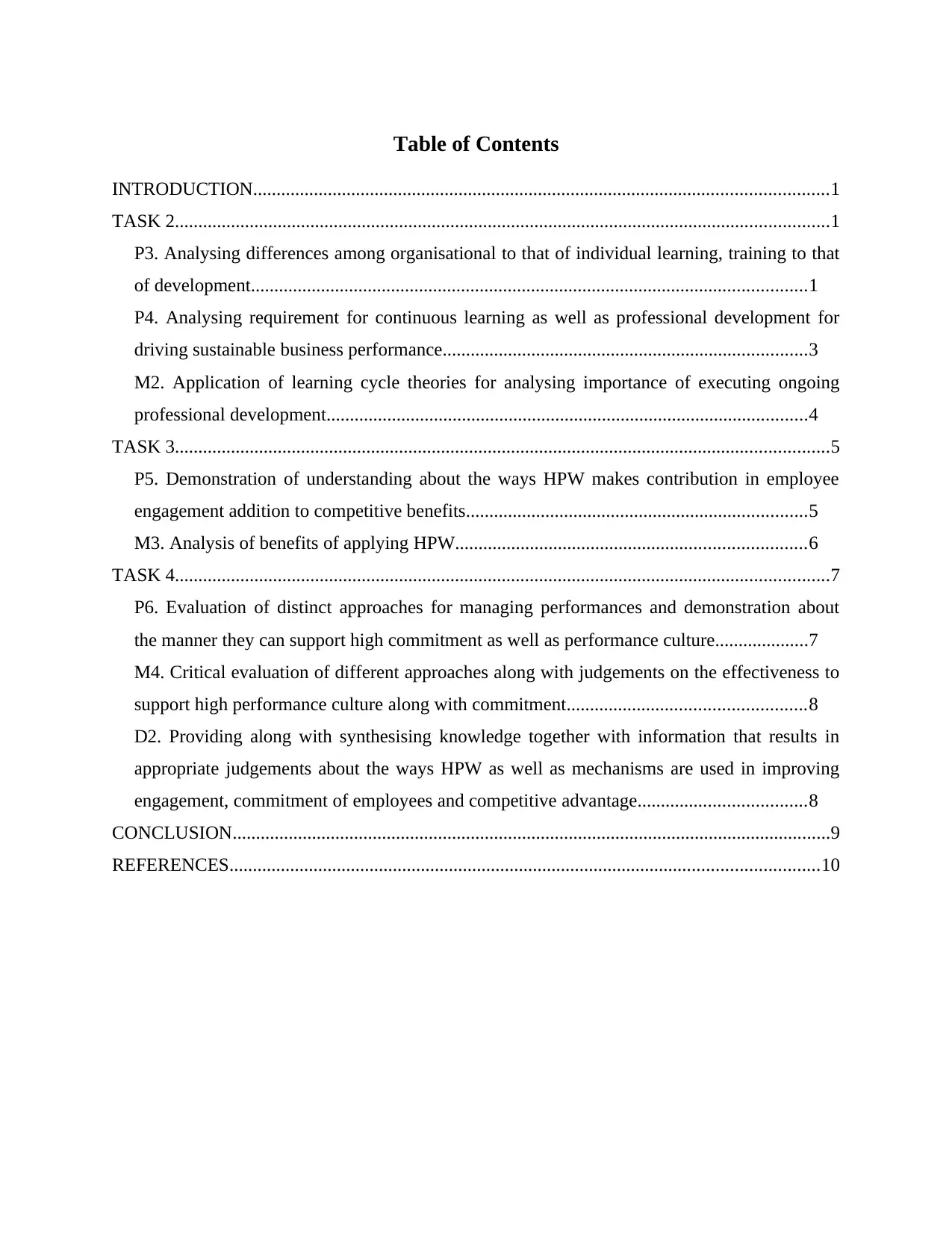
Table of Contents
INTRODUCTION...........................................................................................................................1
TASK 2............................................................................................................................................1
P3. Analysing differences among organisational to that of individual learning, training to that
of development.......................................................................................................................1
P4. Analysing requirement for continuous learning as well as professional development for
driving sustainable business performance..............................................................................3
M2. Application of learning cycle theories for analysing importance of executing ongoing
professional development.......................................................................................................4
TASK 3............................................................................................................................................5
P5. Demonstration of understanding about the ways HPW makes contribution in employee
engagement addition to competitive benefits.........................................................................5
M3. Analysis of benefits of applying HPW...........................................................................6
TASK 4............................................................................................................................................7
P6. Evaluation of distinct approaches for managing performances and demonstration about
the manner they can support high commitment as well as performance culture....................7
M4. Critical evaluation of different approaches along with judgements on the effectiveness to
support high performance culture along with commitment...................................................8
D2. Providing along with synthesising knowledge together with information that results in
appropriate judgements about the ways HPW as well as mechanisms are used in improving
engagement, commitment of employees and competitive advantage....................................8
CONCLUSION................................................................................................................................9
REFERENCES..............................................................................................................................10
INTRODUCTION...........................................................................................................................1
TASK 2............................................................................................................................................1
P3. Analysing differences among organisational to that of individual learning, training to that
of development.......................................................................................................................1
P4. Analysing requirement for continuous learning as well as professional development for
driving sustainable business performance..............................................................................3
M2. Application of learning cycle theories for analysing importance of executing ongoing
professional development.......................................................................................................4
TASK 3............................................................................................................................................5
P5. Demonstration of understanding about the ways HPW makes contribution in employee
engagement addition to competitive benefits.........................................................................5
M3. Analysis of benefits of applying HPW...........................................................................6
TASK 4............................................................................................................................................7
P6. Evaluation of distinct approaches for managing performances and demonstration about
the manner they can support high commitment as well as performance culture....................7
M4. Critical evaluation of different approaches along with judgements on the effectiveness to
support high performance culture along with commitment...................................................8
D2. Providing along with synthesising knowledge together with information that results in
appropriate judgements about the ways HPW as well as mechanisms are used in improving
engagement, commitment of employees and competitive advantage....................................8
CONCLUSION................................................................................................................................9
REFERENCES..............................................................................................................................10
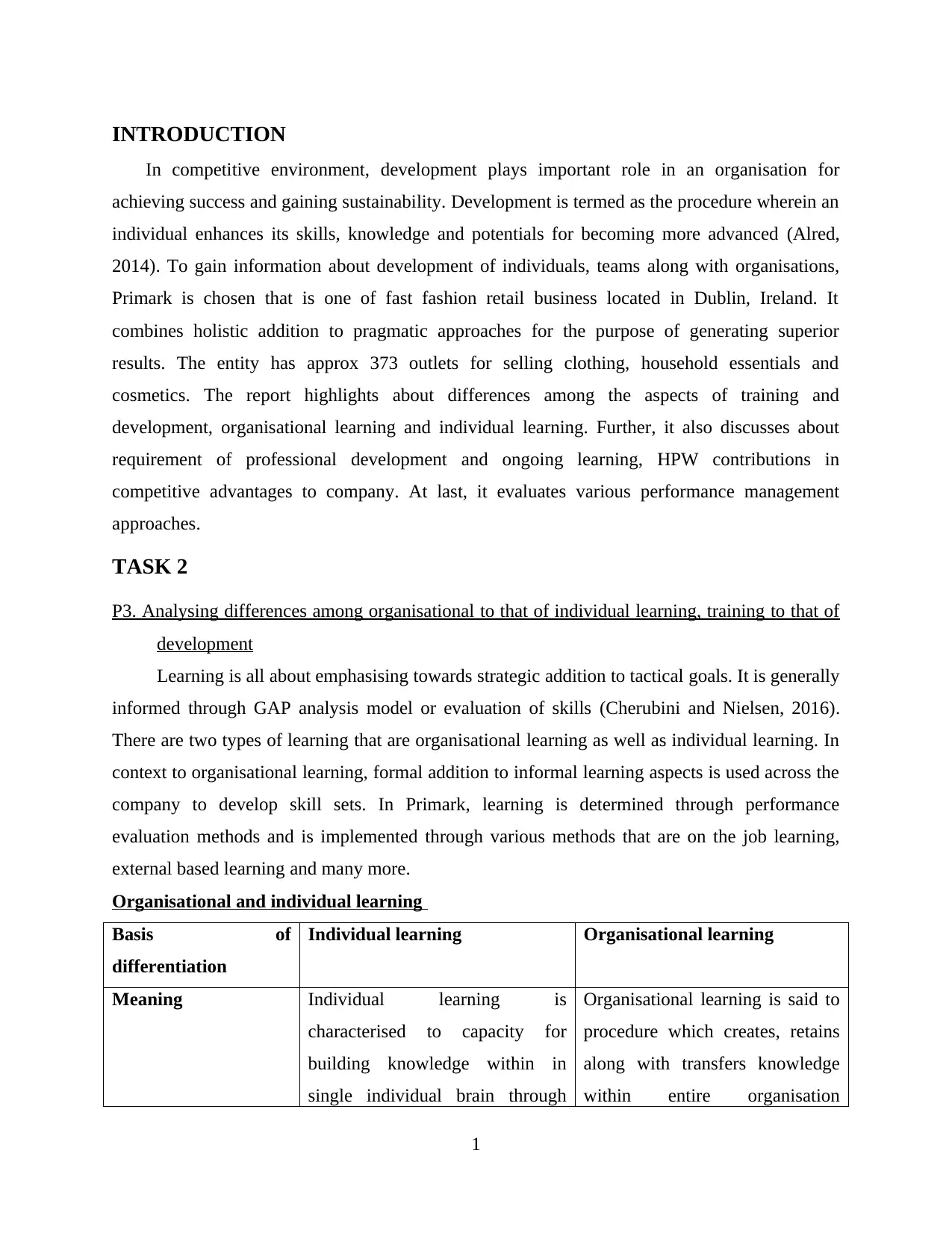
INTRODUCTION
In competitive environment, development plays important role in an organisation for
achieving success and gaining sustainability. Development is termed as the procedure wherein an
individual enhances its skills, knowledge and potentials for becoming more advanced (Alred,
2014). To gain information about development of individuals, teams along with organisations,
Primark is chosen that is one of fast fashion retail business located in Dublin, Ireland. It
combines holistic addition to pragmatic approaches for the purpose of generating superior
results. The entity has approx 373 outlets for selling clothing, household essentials and
cosmetics. The report highlights about differences among the aspects of training and
development, organisational learning and individual learning. Further, it also discusses about
requirement of professional development and ongoing learning, HPW contributions in
competitive advantages to company. At last, it evaluates various performance management
approaches.
TASK 2
P3. Analysing differences among organisational to that of individual learning, training to that of
development
Learning is all about emphasising towards strategic addition to tactical goals. It is generally
informed through GAP analysis model or evaluation of skills (Cherubini and Nielsen, 2016).
There are two types of learning that are organisational learning as well as individual learning. In
context to organisational learning, formal addition to informal learning aspects is used across the
company to develop skill sets. In Primark, learning is determined through performance
evaluation methods and is implemented through various methods that are on the job learning,
external based learning and many more.
Organisational and individual learning
Basis of
differentiation
Individual learning Organisational learning
Meaning Individual learning is
characterised to capacity for
building knowledge within in
single individual brain through
Organisational learning is said to
procedure which creates, retains
along with transfers knowledge
within entire organisation
1
In competitive environment, development plays important role in an organisation for
achieving success and gaining sustainability. Development is termed as the procedure wherein an
individual enhances its skills, knowledge and potentials for becoming more advanced (Alred,
2014). To gain information about development of individuals, teams along with organisations,
Primark is chosen that is one of fast fashion retail business located in Dublin, Ireland. It
combines holistic addition to pragmatic approaches for the purpose of generating superior
results. The entity has approx 373 outlets for selling clothing, household essentials and
cosmetics. The report highlights about differences among the aspects of training and
development, organisational learning and individual learning. Further, it also discusses about
requirement of professional development and ongoing learning, HPW contributions in
competitive advantages to company. At last, it evaluates various performance management
approaches.
TASK 2
P3. Analysing differences among organisational to that of individual learning, training to that of
development
Learning is all about emphasising towards strategic addition to tactical goals. It is generally
informed through GAP analysis model or evaluation of skills (Cherubini and Nielsen, 2016).
There are two types of learning that are organisational learning as well as individual learning. In
context to organisational learning, formal addition to informal learning aspects is used across the
company to develop skill sets. In Primark, learning is determined through performance
evaluation methods and is implemented through various methods that are on the job learning,
external based learning and many more.
Organisational and individual learning
Basis of
differentiation
Individual learning Organisational learning
Meaning Individual learning is
characterised to capacity for
building knowledge within in
single individual brain through
Organisational learning is said to
procedure which creates, retains
along with transfers knowledge
within entire organisation
1
⊘ This is a preview!⊘
Do you want full access?
Subscribe today to unlock all pages.

Trusted by 1+ million students worldwide
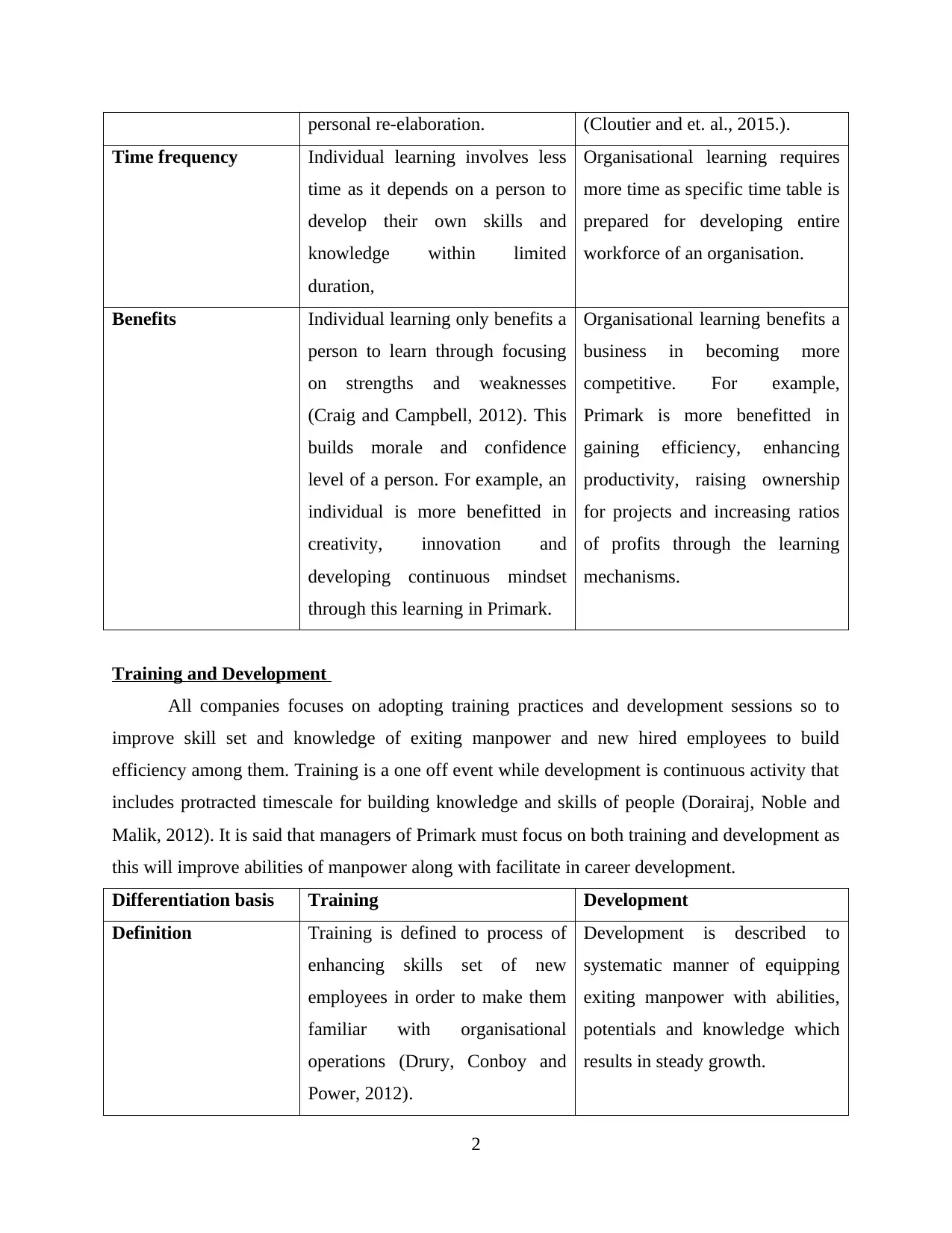
personal re-elaboration. (Cloutier and et. al., 2015.).
Time frequency Individual learning involves less
time as it depends on a person to
develop their own skills and
knowledge within limited
duration,
Organisational learning requires
more time as specific time table is
prepared for developing entire
workforce of an organisation.
Benefits Individual learning only benefits a
person to learn through focusing
on strengths and weaknesses
(Craig and Campbell, 2012). This
builds morale and confidence
level of a person. For example, an
individual is more benefitted in
creativity, innovation and
developing continuous mindset
through this learning in Primark.
Organisational learning benefits a
business in becoming more
competitive. For example,
Primark is more benefitted in
gaining efficiency, enhancing
productivity, raising ownership
for projects and increasing ratios
of profits through the learning
mechanisms.
Training and Development
All companies focuses on adopting training practices and development sessions so to
improve skill set and knowledge of exiting manpower and new hired employees to build
efficiency among them. Training is a one off event while development is continuous activity that
includes protracted timescale for building knowledge and skills of people (Dorairaj, Noble and
Malik, 2012). It is said that managers of Primark must focus on both training and development as
this will improve abilities of manpower along with facilitate in career development.
Differentiation basis Training Development
Definition Training is defined to process of
enhancing skills set of new
employees in order to make them
familiar with organisational
operations (Drury, Conboy and
Power, 2012).
Development is described to
systematic manner of equipping
exiting manpower with abilities,
potentials and knowledge which
results in steady growth.
2
Time frequency Individual learning involves less
time as it depends on a person to
develop their own skills and
knowledge within limited
duration,
Organisational learning requires
more time as specific time table is
prepared for developing entire
workforce of an organisation.
Benefits Individual learning only benefits a
person to learn through focusing
on strengths and weaknesses
(Craig and Campbell, 2012). This
builds morale and confidence
level of a person. For example, an
individual is more benefitted in
creativity, innovation and
developing continuous mindset
through this learning in Primark.
Organisational learning benefits a
business in becoming more
competitive. For example,
Primark is more benefitted in
gaining efficiency, enhancing
productivity, raising ownership
for projects and increasing ratios
of profits through the learning
mechanisms.
Training and Development
All companies focuses on adopting training practices and development sessions so to
improve skill set and knowledge of exiting manpower and new hired employees to build
efficiency among them. Training is a one off event while development is continuous activity that
includes protracted timescale for building knowledge and skills of people (Dorairaj, Noble and
Malik, 2012). It is said that managers of Primark must focus on both training and development as
this will improve abilities of manpower along with facilitate in career development.
Differentiation basis Training Development
Definition Training is defined to process of
enhancing skills set of new
employees in order to make them
familiar with organisational
operations (Drury, Conboy and
Power, 2012).
Development is described to
systematic manner of equipping
exiting manpower with abilities,
potentials and knowledge which
results in steady growth.
2
Paraphrase This Document
Need a fresh take? Get an instant paraphrase of this document with our AI Paraphraser
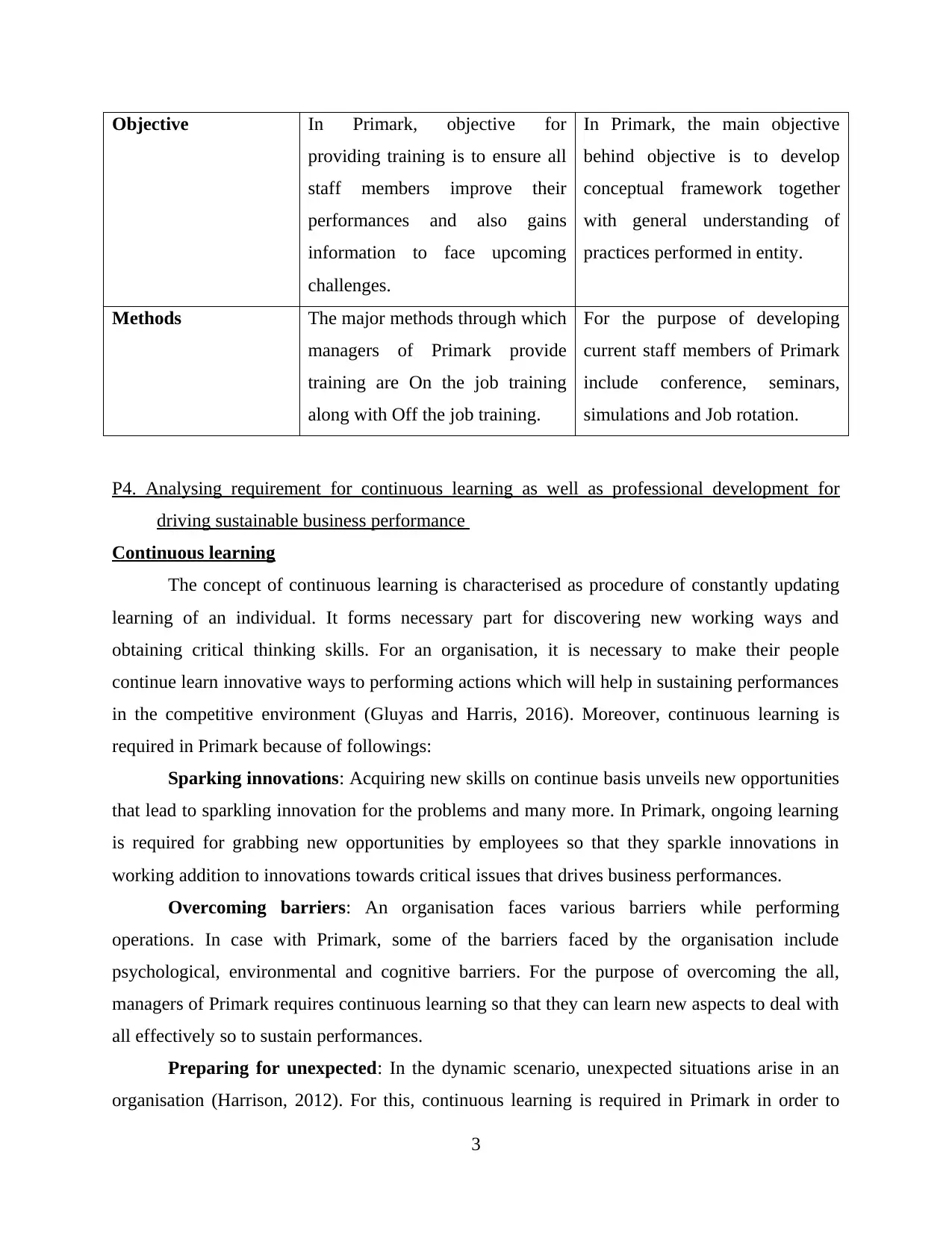
Objective In Primark, objective for
providing training is to ensure all
staff members improve their
performances and also gains
information to face upcoming
challenges.
In Primark, the main objective
behind objective is to develop
conceptual framework together
with general understanding of
practices performed in entity.
Methods The major methods through which
managers of Primark provide
training are On the job training
along with Off the job training.
For the purpose of developing
current staff members of Primark
include conference, seminars,
simulations and Job rotation.
P4. Analysing requirement for continuous learning as well as professional development for
driving sustainable business performance
Continuous learning
The concept of continuous learning is characterised as procedure of constantly updating
learning of an individual. It forms necessary part for discovering new working ways and
obtaining critical thinking skills. For an organisation, it is necessary to make their people
continue learn innovative ways to performing actions which will help in sustaining performances
in the competitive environment (Gluyas and Harris, 2016). Moreover, continuous learning is
required in Primark because of followings:
Sparking innovations: Acquiring new skills on continue basis unveils new opportunities
that lead to sparkling innovation for the problems and many more. In Primark, ongoing learning
is required for grabbing new opportunities by employees so that they sparkle innovations in
working addition to innovations towards critical issues that drives business performances.
Overcoming barriers: An organisation faces various barriers while performing
operations. In case with Primark, some of the barriers faced by the organisation include
psychological, environmental and cognitive barriers. For the purpose of overcoming the all,
managers of Primark requires continuous learning so that they can learn new aspects to deal with
all effectively so to sustain performances.
Preparing for unexpected: In the dynamic scenario, unexpected situations arise in an
organisation (Harrison, 2012). For this, continuous learning is required in Primark in order to
3
providing training is to ensure all
staff members improve their
performances and also gains
information to face upcoming
challenges.
In Primark, the main objective
behind objective is to develop
conceptual framework together
with general understanding of
practices performed in entity.
Methods The major methods through which
managers of Primark provide
training are On the job training
along with Off the job training.
For the purpose of developing
current staff members of Primark
include conference, seminars,
simulations and Job rotation.
P4. Analysing requirement for continuous learning as well as professional development for
driving sustainable business performance
Continuous learning
The concept of continuous learning is characterised as procedure of constantly updating
learning of an individual. It forms necessary part for discovering new working ways and
obtaining critical thinking skills. For an organisation, it is necessary to make their people
continue learn innovative ways to performing actions which will help in sustaining performances
in the competitive environment (Gluyas and Harris, 2016). Moreover, continuous learning is
required in Primark because of followings:
Sparking innovations: Acquiring new skills on continue basis unveils new opportunities
that lead to sparkling innovation for the problems and many more. In Primark, ongoing learning
is required for grabbing new opportunities by employees so that they sparkle innovations in
working addition to innovations towards critical issues that drives business performances.
Overcoming barriers: An organisation faces various barriers while performing
operations. In case with Primark, some of the barriers faced by the organisation include
psychological, environmental and cognitive barriers. For the purpose of overcoming the all,
managers of Primark requires continuous learning so that they can learn new aspects to deal with
all effectively so to sustain performances.
Preparing for unexpected: In the dynamic scenario, unexpected situations arise in an
organisation (Harrison, 2012). For this, continuous learning is required in Primark in order to
3
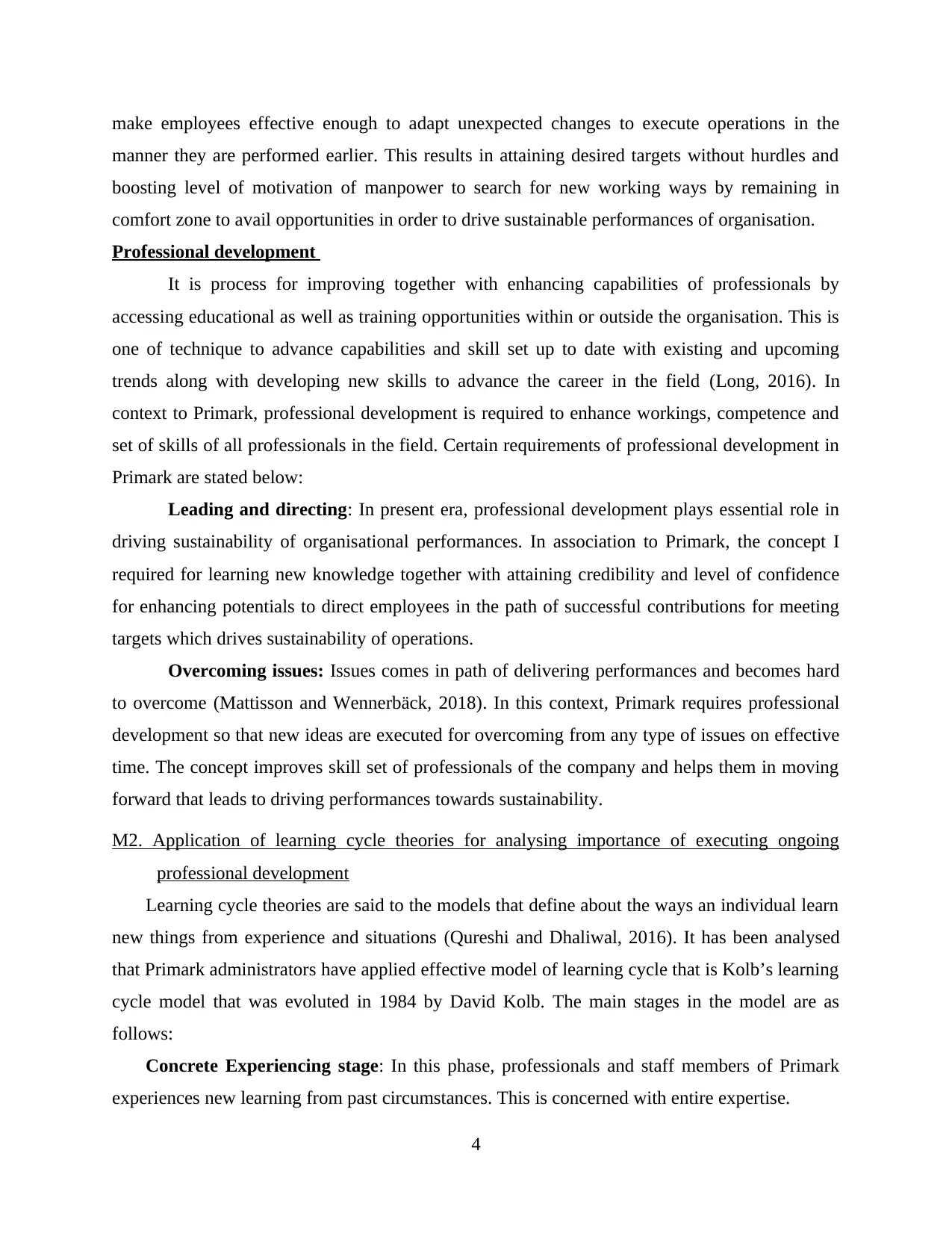
make employees effective enough to adapt unexpected changes to execute operations in the
manner they are performed earlier. This results in attaining desired targets without hurdles and
boosting level of motivation of manpower to search for new working ways by remaining in
comfort zone to avail opportunities in order to drive sustainable performances of organisation.
Professional development
It is process for improving together with enhancing capabilities of professionals by
accessing educational as well as training opportunities within or outside the organisation. This is
one of technique to advance capabilities and skill set up to date with existing and upcoming
trends along with developing new skills to advance the career in the field (Long, 2016). In
context to Primark, professional development is required to enhance workings, competence and
set of skills of all professionals in the field. Certain requirements of professional development in
Primark are stated below:
Leading and directing: In present era, professional development plays essential role in
driving sustainability of organisational performances. In association to Primark, the concept I
required for learning new knowledge together with attaining credibility and level of confidence
for enhancing potentials to direct employees in the path of successful contributions for meeting
targets which drives sustainability of operations.
Overcoming issues: Issues comes in path of delivering performances and becomes hard
to overcome (Mattisson and Wennerbäck, 2018). In this context, Primark requires professional
development so that new ideas are executed for overcoming from any type of issues on effective
time. The concept improves skill set of professionals of the company and helps them in moving
forward that leads to driving performances towards sustainability.
M2. Application of learning cycle theories for analysing importance of executing ongoing
professional development
Learning cycle theories are said to the models that define about the ways an individual learn
new things from experience and situations (Qureshi and Dhaliwal, 2016). It has been analysed
that Primark administrators have applied effective model of learning cycle that is Kolb’s learning
cycle model that was evoluted in 1984 by David Kolb. The main stages in the model are as
follows:
Concrete Experiencing stage: In this phase, professionals and staff members of Primark
experiences new learning from past circumstances. This is concerned with entire expertise.
4
manner they are performed earlier. This results in attaining desired targets without hurdles and
boosting level of motivation of manpower to search for new working ways by remaining in
comfort zone to avail opportunities in order to drive sustainable performances of organisation.
Professional development
It is process for improving together with enhancing capabilities of professionals by
accessing educational as well as training opportunities within or outside the organisation. This is
one of technique to advance capabilities and skill set up to date with existing and upcoming
trends along with developing new skills to advance the career in the field (Long, 2016). In
context to Primark, professional development is required to enhance workings, competence and
set of skills of all professionals in the field. Certain requirements of professional development in
Primark are stated below:
Leading and directing: In present era, professional development plays essential role in
driving sustainability of organisational performances. In association to Primark, the concept I
required for learning new knowledge together with attaining credibility and level of confidence
for enhancing potentials to direct employees in the path of successful contributions for meeting
targets which drives sustainability of operations.
Overcoming issues: Issues comes in path of delivering performances and becomes hard
to overcome (Mattisson and Wennerbäck, 2018). In this context, Primark requires professional
development so that new ideas are executed for overcoming from any type of issues on effective
time. The concept improves skill set of professionals of the company and helps them in moving
forward that leads to driving performances towards sustainability.
M2. Application of learning cycle theories for analysing importance of executing ongoing
professional development
Learning cycle theories are said to the models that define about the ways an individual learn
new things from experience and situations (Qureshi and Dhaliwal, 2016). It has been analysed
that Primark administrators have applied effective model of learning cycle that is Kolb’s learning
cycle model that was evoluted in 1984 by David Kolb. The main stages in the model are as
follows:
Concrete Experiencing stage: In this phase, professionals and staff members of Primark
experiences new learning from past circumstances. This is concerned with entire expertise.
4
⊘ This is a preview!⊘
Do you want full access?
Subscribe today to unlock all pages.
Trusted by 1+ million students worldwide
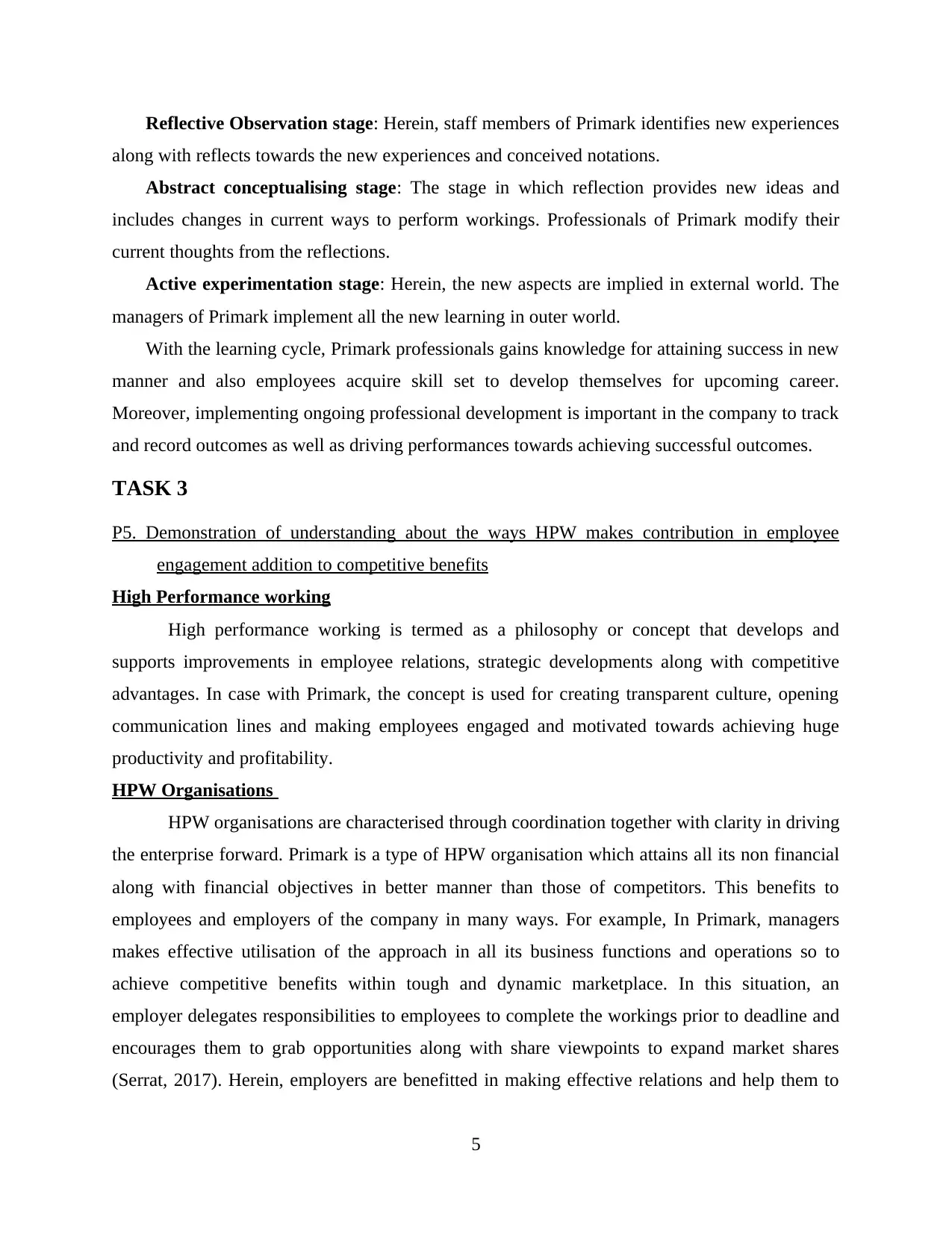
Reflective Observation stage: Herein, staff members of Primark identifies new experiences
along with reflects towards the new experiences and conceived notations.
Abstract conceptualising stage: The stage in which reflection provides new ideas and
includes changes in current ways to perform workings. Professionals of Primark modify their
current thoughts from the reflections.
Active experimentation stage: Herein, the new aspects are implied in external world. The
managers of Primark implement all the new learning in outer world.
With the learning cycle, Primark professionals gains knowledge for attaining success in new
manner and also employees acquire skill set to develop themselves for upcoming career.
Moreover, implementing ongoing professional development is important in the company to track
and record outcomes as well as driving performances towards achieving successful outcomes.
TASK 3
P5. Demonstration of understanding about the ways HPW makes contribution in employee
engagement addition to competitive benefits
High Performance working
High performance working is termed as a philosophy or concept that develops and
supports improvements in employee relations, strategic developments along with competitive
advantages. In case with Primark, the concept is used for creating transparent culture, opening
communication lines and making employees engaged and motivated towards achieving huge
productivity and profitability.
HPW Organisations
HPW organisations are characterised through coordination together with clarity in driving
the enterprise forward. Primark is a type of HPW organisation which attains all its non financial
along with financial objectives in better manner than those of competitors. This benefits to
employees and employers of the company in many ways. For example, In Primark, managers
makes effective utilisation of the approach in all its business functions and operations so to
achieve competitive benefits within tough and dynamic marketplace. In this situation, an
employer delegates responsibilities to employees to complete the workings prior to deadline and
encourages them to grab opportunities along with share viewpoints to expand market shares
(Serrat, 2017). Herein, employers are benefitted in making effective relations and help them to
5
along with reflects towards the new experiences and conceived notations.
Abstract conceptualising stage: The stage in which reflection provides new ideas and
includes changes in current ways to perform workings. Professionals of Primark modify their
current thoughts from the reflections.
Active experimentation stage: Herein, the new aspects are implied in external world. The
managers of Primark implement all the new learning in outer world.
With the learning cycle, Primark professionals gains knowledge for attaining success in new
manner and also employees acquire skill set to develop themselves for upcoming career.
Moreover, implementing ongoing professional development is important in the company to track
and record outcomes as well as driving performances towards achieving successful outcomes.
TASK 3
P5. Demonstration of understanding about the ways HPW makes contribution in employee
engagement addition to competitive benefits
High Performance working
High performance working is termed as a philosophy or concept that develops and
supports improvements in employee relations, strategic developments along with competitive
advantages. In case with Primark, the concept is used for creating transparent culture, opening
communication lines and making employees engaged and motivated towards achieving huge
productivity and profitability.
HPW Organisations
HPW organisations are characterised through coordination together with clarity in driving
the enterprise forward. Primark is a type of HPW organisation which attains all its non financial
along with financial objectives in better manner than those of competitors. This benefits to
employees and employers of the company in many ways. For example, In Primark, managers
makes effective utilisation of the approach in all its business functions and operations so to
achieve competitive benefits within tough and dynamic marketplace. In this situation, an
employer delegates responsibilities to employees to complete the workings prior to deadline and
encourages them to grab opportunities along with share viewpoints to expand market shares
(Serrat, 2017). Herein, employers are benefitted in making effective relations and help them to
5
Paraphrase This Document
Need a fresh take? Get an instant paraphrase of this document with our AI Paraphraser
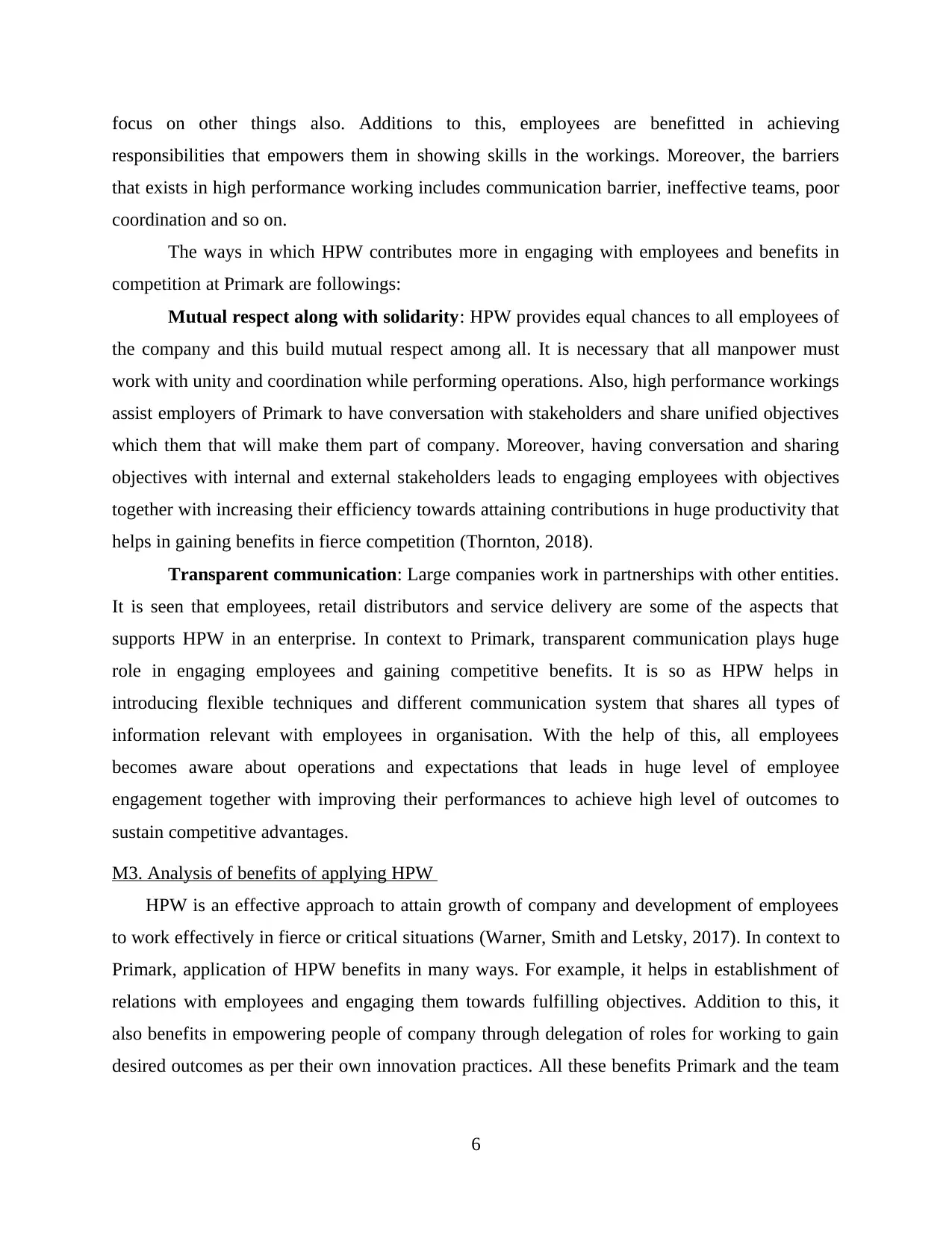
focus on other things also. Additions to this, employees are benefitted in achieving
responsibilities that empowers them in showing skills in the workings. Moreover, the barriers
that exists in high performance working includes communication barrier, ineffective teams, poor
coordination and so on.
The ways in which HPW contributes more in engaging with employees and benefits in
competition at Primark are followings:
Mutual respect along with solidarity: HPW provides equal chances to all employees of
the company and this build mutual respect among all. It is necessary that all manpower must
work with unity and coordination while performing operations. Also, high performance workings
assist employers of Primark to have conversation with stakeholders and share unified objectives
which them that will make them part of company. Moreover, having conversation and sharing
objectives with internal and external stakeholders leads to engaging employees with objectives
together with increasing their efficiency towards attaining contributions in huge productivity that
helps in gaining benefits in fierce competition (Thornton, 2018).
Transparent communication: Large companies work in partnerships with other entities.
It is seen that employees, retail distributors and service delivery are some of the aspects that
supports HPW in an enterprise. In context to Primark, transparent communication plays huge
role in engaging employees and gaining competitive benefits. It is so as HPW helps in
introducing flexible techniques and different communication system that shares all types of
information relevant with employees in organisation. With the help of this, all employees
becomes aware about operations and expectations that leads in huge level of employee
engagement together with improving their performances to achieve high level of outcomes to
sustain competitive advantages.
M3. Analysis of benefits of applying HPW
HPW is an effective approach to attain growth of company and development of employees
to work effectively in fierce or critical situations (Warner, Smith and Letsky, 2017). In context to
Primark, application of HPW benefits in many ways. For example, it helps in establishment of
relations with employees and engaging them towards fulfilling objectives. Addition to this, it
also benefits in empowering people of company through delegation of roles for working to gain
desired outcomes as per their own innovation practices. All these benefits Primark and the team
6
responsibilities that empowers them in showing skills in the workings. Moreover, the barriers
that exists in high performance working includes communication barrier, ineffective teams, poor
coordination and so on.
The ways in which HPW contributes more in engaging with employees and benefits in
competition at Primark are followings:
Mutual respect along with solidarity: HPW provides equal chances to all employees of
the company and this build mutual respect among all. It is necessary that all manpower must
work with unity and coordination while performing operations. Also, high performance workings
assist employers of Primark to have conversation with stakeholders and share unified objectives
which them that will make them part of company. Moreover, having conversation and sharing
objectives with internal and external stakeholders leads to engaging employees with objectives
together with increasing their efficiency towards attaining contributions in huge productivity that
helps in gaining benefits in fierce competition (Thornton, 2018).
Transparent communication: Large companies work in partnerships with other entities.
It is seen that employees, retail distributors and service delivery are some of the aspects that
supports HPW in an enterprise. In context to Primark, transparent communication plays huge
role in engaging employees and gaining competitive benefits. It is so as HPW helps in
introducing flexible techniques and different communication system that shares all types of
information relevant with employees in organisation. With the help of this, all employees
becomes aware about operations and expectations that leads in huge level of employee
engagement together with improving their performances to achieve high level of outcomes to
sustain competitive advantages.
M3. Analysis of benefits of applying HPW
HPW is an effective approach to attain growth of company and development of employees
to work effectively in fierce or critical situations (Warner, Smith and Letsky, 2017). In context to
Primark, application of HPW benefits in many ways. For example, it helps in establishment of
relations with employees and engaging them towards fulfilling objectives. Addition to this, it
also benefits in empowering people of company through delegation of roles for working to gain
desired outcomes as per their own innovation practices. All these benefits Primark and the team
6
in putting best contributions for meeting objectives on time and acquiring competitive benefits in
retail sector.
TASK 4
P6. Evaluation of distinct approaches for managing performances and demonstration about the
manner they can support high commitment as well as performance culture.
Performance management
Performance management is a concept that includes set of activities in order to ensure
attainment of desired goals effectively and efficiently (Wellin, 2016). It majorly focuses towards
performances concerned with employee, divisions and procedures for managing tasks. An
effective performance management constitutes development planning, goal setting, transparent
communication, employee recognition and development. In context to Primark, managers adopt
various performance management systems which are different from each other in many ways.
Strategic system and administrative system are performance management system in which
strategic systems are related to ensure implementation of all strategies promptly and effectively
where as administrative system only oversees plans to improve performances of organisational
manpower.
Organisational culture
Organisational culture is said to values and behaviours which involves people to interact
and communicate with others in enterprise. In context to Primark, managers have set effective
culture in which all employees shares their views and beliefs in performing activities for
attaining objectives that acts as facilitator to effective performance management. However,
various times it also act as barrier in managing performances of the company as it creates issues
to react towards goals.
Approaches of performance management
There are various approaches of managing performances in Primark that supports
commitment along with cultures of set performances. Some of them are evaluated underneath:
Behavioural approach: It is effective performance management technique that involves
series of scales for distinct job dimensions (Woodcock, 2017). With the help of this approach,
managers of Primark are able to measure and manage performances of people at different jobs.
Behaviourally Anchored Rating and Behavioural scales are main methods of the approach that
7
retail sector.
TASK 4
P6. Evaluation of distinct approaches for managing performances and demonstration about the
manner they can support high commitment as well as performance culture.
Performance management
Performance management is a concept that includes set of activities in order to ensure
attainment of desired goals effectively and efficiently (Wellin, 2016). It majorly focuses towards
performances concerned with employee, divisions and procedures for managing tasks. An
effective performance management constitutes development planning, goal setting, transparent
communication, employee recognition and development. In context to Primark, managers adopt
various performance management systems which are different from each other in many ways.
Strategic system and administrative system are performance management system in which
strategic systems are related to ensure implementation of all strategies promptly and effectively
where as administrative system only oversees plans to improve performances of organisational
manpower.
Organisational culture
Organisational culture is said to values and behaviours which involves people to interact
and communicate with others in enterprise. In context to Primark, managers have set effective
culture in which all employees shares their views and beliefs in performing activities for
attaining objectives that acts as facilitator to effective performance management. However,
various times it also act as barrier in managing performances of the company as it creates issues
to react towards goals.
Approaches of performance management
There are various approaches of managing performances in Primark that supports
commitment along with cultures of set performances. Some of them are evaluated underneath:
Behavioural approach: It is effective performance management technique that involves
series of scales for distinct job dimensions (Woodcock, 2017). With the help of this approach,
managers of Primark are able to measure and manage performances of people at different jobs.
Behaviourally Anchored Rating and Behavioural scales are main methods of the approach that
7
⊘ This is a preview!⊘
Do you want full access?
Subscribe today to unlock all pages.
Trusted by 1+ million students worldwide
assist in providing scores and ranks that supports workforce commitment and desires for high
performances. This approach benefits the entity in providing accurate together with reliable
results. However, its limitation is that administrators fail in managing voluminous data and
showing results.
Result approach: It is straightforward approach wherein performances are managed as
per rating of employees by considering results of performances (Alred, 2014). The main
techniques of result approach are Productivity Measurement with Evaluation System as well as
Balanced Scorecard through which managers of Primark analysis performances of all its
employees. This benefits the entity in converting strategic plans into practices of employees for
enhancing commitment and performance culture. In contrary, result approach emphasis on
human resource aspect that in limited manner that creates issues in achieving standards of
performances.
M4. Critical evaluation of different approaches along with judgements on the effectiveness to
support high performance culture along with commitment
The main performance management approaches opted in Primark are result approach and
behavioural approach. These approaches plays significant role in supporting high culture of
performance as well as commitment. As per the thought of Craig and Campbell (2012), result
approach benefits in translation of strategies of Primark into operations with holistic view.
However, it does not focus on aspects on human resource that limits efficiency and effectiveness
of people to work with more strength. As per Long (2016), behavioural approach provides
parameters and mark performances on the basis of distinct parameters that motivates employees
to perform with the set parameters. In contrary, it creates issues related to biasness that may
impact on performance and culture of company.
D2. Providing along with synthesising knowledge together with information that results in
appropriate judgements about the ways HPW as well as mechanisms are used in improving
engagement, commitment of employees and competitive advantage
Through implementation of HPW concept, managers of Primark grab huge opportunities to
expand in competitive business environment. Along with this, the concept also empowers
employees to make effective decision for overcoming from critical situations that improves their
engagement level and commitment to work with fuller efficiency. Addition to this, it also create
positive mindset of all workforce that helps managers to build relations with all subordinates and
8
performances. This approach benefits the entity in providing accurate together with reliable
results. However, its limitation is that administrators fail in managing voluminous data and
showing results.
Result approach: It is straightforward approach wherein performances are managed as
per rating of employees by considering results of performances (Alred, 2014). The main
techniques of result approach are Productivity Measurement with Evaluation System as well as
Balanced Scorecard through which managers of Primark analysis performances of all its
employees. This benefits the entity in converting strategic plans into practices of employees for
enhancing commitment and performance culture. In contrary, result approach emphasis on
human resource aspect that in limited manner that creates issues in achieving standards of
performances.
M4. Critical evaluation of different approaches along with judgements on the effectiveness to
support high performance culture along with commitment
The main performance management approaches opted in Primark are result approach and
behavioural approach. These approaches plays significant role in supporting high culture of
performance as well as commitment. As per the thought of Craig and Campbell (2012), result
approach benefits in translation of strategies of Primark into operations with holistic view.
However, it does not focus on aspects on human resource that limits efficiency and effectiveness
of people to work with more strength. As per Long (2016), behavioural approach provides
parameters and mark performances on the basis of distinct parameters that motivates employees
to perform with the set parameters. In contrary, it creates issues related to biasness that may
impact on performance and culture of company.
D2. Providing along with synthesising knowledge together with information that results in
appropriate judgements about the ways HPW as well as mechanisms are used in improving
engagement, commitment of employees and competitive advantage
Through implementation of HPW concept, managers of Primark grab huge opportunities to
expand in competitive business environment. Along with this, the concept also empowers
employees to make effective decision for overcoming from critical situations that improves their
engagement level and commitment to work with fuller efficiency. Addition to this, it also create
positive mindset of all workforce that helps managers to build relations with all subordinates and
8
Paraphrase This Document
Need a fresh take? Get an instant paraphrase of this document with our AI Paraphraser
share various decisions with them and making changes in strategies in order to gain competitive
benefits (Cherubini and Nielsen, 2016).
CONCLUSION
The mentioned report concludes that the concept of development is an ongoing mechanism
which brings significant changes in an individual, team addition to company as whole. It not
only ensures continuous improvement but also focuses on attainment of higher performance
standards, profit margins and more productivity. The main requirements of continuous learning
in an organisation are to sparkle innovations, overcoming barriers and preparing for unexpected.
Professional development is required for dealing with issues and directing others. Transparent
communication and mutual respect are some of the ways in which HPW contributes towards
employee engagement and achieving competitive benefits. Behavioural approach and Result
approach are essential performance management approaches.
9
benefits (Cherubini and Nielsen, 2016).
CONCLUSION
The mentioned report concludes that the concept of development is an ongoing mechanism
which brings significant changes in an individual, team addition to company as whole. It not
only ensures continuous improvement but also focuses on attainment of higher performance
standards, profit margins and more productivity. The main requirements of continuous learning
in an organisation are to sparkle innovations, overcoming barriers and preparing for unexpected.
Professional development is required for dealing with issues and directing others. Transparent
communication and mutual respect are some of the ways in which HPW contributes towards
employee engagement and achieving competitive benefits. Behavioural approach and Result
approach are essential performance management approaches.
9
REFERENCES
Books and journals:
Alred, G., 2014. Mentoring pocketbook. Management Pocketbooks.
Alliger, G. M. and et. al., 2015. Team resilience. Organizational Dynamics. 44(3). pp.176-184.
Cherubini, F. and Nielsen, R.K., 2016. Editorial analytics: How news media are developing and
using audience data and metrics. Available at SSRN 2739328.
Cloutier, O. and et. al., 2015. The Importance of Developing Strategies for Employee
Retention. Journal of Leadership, Accountability & Ethics. 12(2).
Craig, T. and Campbell, D., 2012. Organisations and the business environment. Routledge.
Dorairaj, S., Noble, J. and Malik, P., 2012, May. Understanding team dynamics in distributed
Agile software development. In International Conference on Agile Software
Development (pp. 47-61). Springer, Berlin, Heidelberg.
Drury, M., Conboy, K. and Power, K., 2012. Obstacles to decision making in Agile software
development teams. Journal of Systems and Software. 85(6) pp.1239-1254.
Gluyas, H. and Harris, S. J., 2016. CONTINUING PROFESSIONAL DEVELOPMENT.
Understanding situation awareness and its importance in patient safety. Nursing
Standard. 30(34).
Harrison, R., 2012. Employee development. Universities Press.
Long, D.G., 2016. Delivering High Performance: The Third Generation Organisation.
Routledge.
Mattisson, T. and Wennerbäck, J. L., 2018. High Performance Teams-the characteristics and
practices of highly efficient teams within organizations (Master's thesis).
Qureshi, Y. and Dhaliwal, K., 2016. High performance team-necessary in a healthcare setting.
Bangladesh Journal of Medical Science. 15(1). pp.10-14.
Serrat, O., 2017. Building a learning organization. In Knowledge solutions (pp. 57-67). Springer,
Singapore.
Thornton, C., 2018. Towards a group analytic praxis for working with teams in organizations
II. Group Analysis, 51(1), pp.72-90.
Warner, N. W., Smith, C. A. P. and Letsky, M. P., 2017. Macrocognition in teams: Theories and
methodologies. CRC Press.
Wellin, M., 2016. Managing the psychological contract: Using the personal deal to increase
business performance. Routledge.
Woodcock, M., 2017. Team development manual. Routledge.
10
Books and journals:
Alred, G., 2014. Mentoring pocketbook. Management Pocketbooks.
Alliger, G. M. and et. al., 2015. Team resilience. Organizational Dynamics. 44(3). pp.176-184.
Cherubini, F. and Nielsen, R.K., 2016. Editorial analytics: How news media are developing and
using audience data and metrics. Available at SSRN 2739328.
Cloutier, O. and et. al., 2015. The Importance of Developing Strategies for Employee
Retention. Journal of Leadership, Accountability & Ethics. 12(2).
Craig, T. and Campbell, D., 2012. Organisations and the business environment. Routledge.
Dorairaj, S., Noble, J. and Malik, P., 2012, May. Understanding team dynamics in distributed
Agile software development. In International Conference on Agile Software
Development (pp. 47-61). Springer, Berlin, Heidelberg.
Drury, M., Conboy, K. and Power, K., 2012. Obstacles to decision making in Agile software
development teams. Journal of Systems and Software. 85(6) pp.1239-1254.
Gluyas, H. and Harris, S. J., 2016. CONTINUING PROFESSIONAL DEVELOPMENT.
Understanding situation awareness and its importance in patient safety. Nursing
Standard. 30(34).
Harrison, R., 2012. Employee development. Universities Press.
Long, D.G., 2016. Delivering High Performance: The Third Generation Organisation.
Routledge.
Mattisson, T. and Wennerbäck, J. L., 2018. High Performance Teams-the characteristics and
practices of highly efficient teams within organizations (Master's thesis).
Qureshi, Y. and Dhaliwal, K., 2016. High performance team-necessary in a healthcare setting.
Bangladesh Journal of Medical Science. 15(1). pp.10-14.
Serrat, O., 2017. Building a learning organization. In Knowledge solutions (pp. 57-67). Springer,
Singapore.
Thornton, C., 2018. Towards a group analytic praxis for working with teams in organizations
II. Group Analysis, 51(1), pp.72-90.
Warner, N. W., Smith, C. A. P. and Letsky, M. P., 2017. Macrocognition in teams: Theories and
methodologies. CRC Press.
Wellin, M., 2016. Managing the psychological contract: Using the personal deal to increase
business performance. Routledge.
Woodcock, M., 2017. Team development manual. Routledge.
10
⊘ This is a preview!⊘
Do you want full access?
Subscribe today to unlock all pages.
Trusted by 1+ million students worldwide

1 out of 12


Related Documents


Your All-in-One AI-Powered Toolkit for Academic Success.
+13062052269
info@desklib.com
Available 24*7 on WhatsApp / Email
![[object Object]](/_next/static/media/star-bottom.7253800d.svg)
Unlock your academic potential
Copyright © 2020–2026 A2Z Services. All Rights Reserved. Developed and managed by ZUCOL.